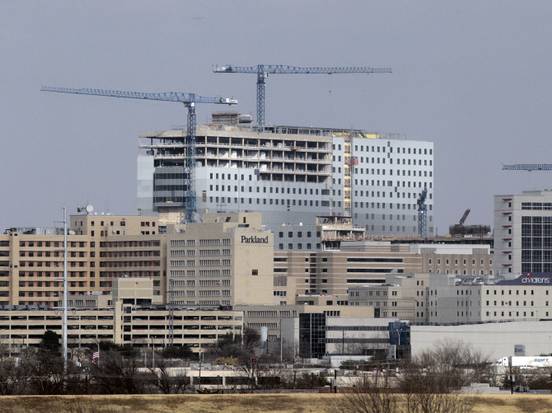
Cash reserves of more than $1 billion were built up, in part, by skimping on staff and building upkeep.
By REESE DUNKLIN
Staff Writer
Dallas Morning News
rdunklin@dallasnews.com
Parkland Memorial Hospital quietly amassed more than $1 billion in cash reserves even as deteriorating patient-care conditions brought it to the brink of closure, an analysis of financial records shows.
The Dallas County taxpayer-supported hospital built the reserve over the last several years, in part by reducing staff and available beds, neglecting its aging building and moving hundreds of millions from the operating budget to help finance construction of a new hospital.
Federal regulators have since forced Parkland to plow at least $75 million back into operations to remedy lapses that they said threatened patients’ lives. That has prompted questions about whether focus on the new $1.2 billion hospital complex exacerbated Parkland’s patient-safety breakdowns.
Dr. Allan Shulkin, a member of Parkland’s governing board from 2004 to 2009, said a reason he left was because he was “a little troubled by what I thought to be an over-emphasis” on construction. He recalled hospital management assuring the board that patient care was under control and sufficiently funded.
It is clear now neither was the case, he said.
“Did we — the board, my board, the current board — get so focused on the new building that we forgot about operations?” said Shulkin, a pulmonary specialist who trained at Parkland in the mid-1970s. “I worry that that began to happen.”
Parkland officials declined Dallas Morning News interview requests. They referred to annual year-end statements of the Parkland Health & Hospital System for information about hospital finances. The News analyzed 10 years of such statements, obtained under the Texas Public Information Act. The statements don’t clearly explain how much money Parkland has at its disposal, but the hospital eventually said its “reserves” encompass cash, investments and assets limited to use, which is akin to savings.
By the Sept. 30 close of fiscal year 2012, those sources totaled just over $1 billion. Of that, about $315 million was restricted to new construction or bond debt repayment.
“We have plenty of cash on hand,” Ted Shaw, Parkland’s interim chief financial officer, told the Board of Managers during a December public meeting.
Parkland benefits from one of the nation’s biggest local-government hospital subsidies — a property tax that generates more than $400 million annually, about a quarter of Parkland’s total revenue. The tax rate is the second-highest for a Texas public hospital, at 27.1 cents per $100 in assessed property value.
Dr. Dana Forgione, an expert on health-care finance and accounting at UT-San Antonio, said public hospitals often don’t make clear how much they have in reserves so as to avoid questions from taxpayers.
“How can they have $1 billion and they couldn’t improve quality a little bit? Those are the questions they don’t want,” Forgione said after reviewing Parkland’s two most recent annual statements. “I understand there’s got to be a trade-off between current expenditures and long-term investment in new and improved facilities. But $1 billion is a lot of money, right?”
Starting in fiscal 2005, Parkland took surplus revenue from daily operations and saved the funds for construction of a new state-of-the-art hospital. Officials have touted what became a 17-story facility on Harry Hines Boulevard as “the largest hospital construction project in the United States,” likening it in size to Cowboys Stadium.
By 2011, Parkland had set aside more than $400 million, records show. The surpluses came from cutting spending on staff and charging higher prices for treating its mostly poor, uninsured patients, among other things.
The amount saved was higher than the $350 million in “cash reserves” that hospital officials had promised to contribute as part of a bond deal approved by voters in 2008. That election gave Parkland permission to sell more than $700 million in construction bonds — the biggest chunk of the new hospital’s financing.
Parkland’s total cash supply peaked at nearly $1.5 billion in early 2011 and began to decline as construction got under way.
Kevin Holloran, a health-care analyst from the Standard & Poor’s credit-rating agency, said Parkland’s balance sheet looked a “little rich.” But the cash levels were a “blip right now on the radar screen” because of construction.
“Cash becomes a very contentious topic at a public hospital. ‘Shouldn’t you spend it all down?’” Holloran said. “But if you’re about to build a new hospital, our opinion would be they financially, soundly did a good thing to put away some money.”
As Parkland’s cash supply grew, the hospital’s medical care in 2008 was coming under “near constant surveillance and investigation” because of “scores of patient complaints, injuries and death,” a federal report later showed.
The scrutiny intensified in 2011, when the U.S. Centers for Medicare & Medicaid Services found that Parkland’s patients were in “immediate jeopardy” of injury and death because of poor staffing and hospital conditions. Federal regulators took the unusual step of placing Parkland under independent safety monitoring in lieu of closure, making it the nation’s largest hospital to face such oversight.
In their February 2012 overview report on Parkland, the monitors said some hospital units lacked enough staff to accommodate emergency patients, worsening overcrowding and treatment delays in the ER. Cuts in the women and infants’ specialty hospital led to bed shortages and “unsafe” nurse-to-patient ratios. The building had soiled floors and holes in walls — duct tape covered one in an operating room — that jeopardized infection control.
The monitors quoted Parkland employees as saying that some safety problems were “the result of a budget reduction in a previous fiscal year” and “budgeted staffing constraints imposed last year.” Some concerns, such as the ER backlogs, were flagged by hospital consultants as far back as 2004, The News found.
The state also faulted Parkland for a “failure to adequately staff nurses in certain areas of the facility” — including the psychiatric ER, where a 2011 patient death triggered the CMS crackdown. In August 2012, the Texas Department of State Health Services fined Parkland a record-setting $1 million.
James A. Smith, former chair of the Texas Society of CPAs and managing director of a Dallas accounting firm, said Parkland’s leaders couldn’t blame patient-care problems on a lack of money, based on his analysis of the two most recent annual financial statements.
“Knowing what we know now,” Smith said, “it seems to me like the construction project, which was a grandiose plan, sucked an awful lot of air out of the room financially.”
For at least a decade, Parkland administrators and board members have argued that a new hospital was the cure to old Parkland’s problems.
“Indeed, Parkland’s future is largely being pinned to the public hopes arising from a new billion-dollar hospital that is making its way up from the ground across the street,” federal safety monitors noted last year. “But hospitals are not simply buildings, bricks and mortar.”
The existing hospital, which opened in 1954, had long been overcrowded. Even $140 million in improvements wouldn’t bring the structure into code compliance, consultants said at one point. And if Parkland hoped to compete for new patients, it needed modern facilities like those of other Dallas hospitals, officials said.
But expansion planning stalled in 2003. Parkland suffered a $76 million budget shortfall that year and started cutting about 500 jobs. County commissioners, who approve Parkland’s budget and appoint its board, were angered they weren’t consulted about new construction and hired outside consultants to study Parkland’s operations.
In February 2004, the board chairwoman sought a succession plan for Dr. Ron Anderson, putting his two-decades-long tenure as hospital CEO in doubt. She didn’t succeed and quit two months later, along with three other members who clashed with Anderson. A newly constituted board led by Dr. Lauren McDonald and other Anderson supporters extended his contract, and Anderson announced that his priority was to “get into a new hospital.” He did not respond to requests for an interview.
With political tensions easing, commissioners in 2005 appointed a blue-ribbon panel to explore construction options. In 2007, it proposed replacing Parkland with an 862-bed hospital. The replacement was about one-fourth larger, along with clinics and offices. Construction would be completed in phases, each likely needing voter approval. The first — featuring a medical, surgical and trauma facility — would tentatively open in 2013 at a cost $840 million.
As final plans were drawn up, Parkland administrators recommended a different approach: Building all at once.
The final bill could drop by $100 million to about $1.2 billion by avoiding the price inflation and redundancies of a gradual move-in, according to a 2008 planning briefing The News obtained. Accelerating construction, though, would require another $400 million sooner in the process.
To make that work, $747 million in bonds and a property tax-rate hike as high as 2.5 cents would be necessary. Parkland promised “to reduce the burden on taxpayers” by raising $150 million in private donations and using $350 million in “cash reserves.”
Parkland’s cash supply was nearly $600 million by mid-2008, after doubling in the previous three-year span. One-time windfalls and record-setting budget surpluses had stabilized Parkland’s finances. Commissioners also let Parkland keep its tax rate at 25.4 cents per $100 in valuation to generate extra money from higher property values.
That meant Parkland could immediately put $250 million of the $350 million into the project, according to the 2008 planning briefing. Enough cash would remain that Parkland could operate for at least four months without collecting another dime — above the median “days cash on hand” for hospitals with strong credit ratings, the briefing said.
The cash commitment helped reduce the amount of bonds needing voter approval but was about $130 million more than originally planned. Parkland forecast that its cash and investments would grow once construction began, according to the briefing.
Aiding that growth, hospital officials said, would be “revenue enhancements” and “productivity and expense improvements.” Parkland’s briefing described those as price increases above inflation and “strategic pricing” of patient services, as well as improvements in billing coding, “employee productivity” and “salary and benefit costs.”
Parkland did not define specific terms for achieving those savings but said doing so could gain $150 million between 2009 and 2014 — perhaps even eliminating need for an additional 1-cent tax hike once the new campus opened.
When Parkland’s board voted for the build-at-once plan in summer 2008, it prompted applause. “When the project got derailed almost five years ago,” Anderson said, “I wasn’t sure that this day would ever come.”
Two months later, safety inspectors showed up unannounced.
The inspectors, working on behalf of CMS, found that Parkland patients were undergoing surgery without informed consent, as federal rules require. The American Medical Association’s code of ethics says patients have the right to approve or reject their surgeon in advance.
Yet Parkland’s consent forms and other records reviewed by inspectors in September 2008 were unclear over who was performing the surgery — faculty physicians from UT Southwestern Medical Center, which staffs Parkland, or resident trainees. Consultants as far back as 2004 had found that many UTSW physicians weren’t supervising residents and urged Parkland to make changes, including hiring its own doctors.
In late October, two weeks before the November bond election on the new hospital, Parkland officials presented CMS a new consent form and insisted they saw no evidence of residents operating unsupervised. Six days later, CMS told Parkland it had revised the original inspection report to remove references to “deficiencies.” The incident remained out of public view until The News reported on it in March 2010.
Another complaint in September 2008 did get noticed. A 58-year-old man named Mike Herrera died after languishing 17 hours untreated in the main emergency room — the type of problem consultants foreshadowed in 2004. A national hospital accrediting agency, the Joint Commission, cited Parkland for about a dozen safety failures.
Parkland enacted new ER procedures and made 10 nursing hires early in the next year, as it promised CMS. Anderson, however, later said Herrera, who had a history of heart disease, was probably going to die even “had our system been working.”
Shortly after Dallas County voters overwhelmingly approved construction of the new hospital, Parkland’s board agreed to reserve the $250 million, as planned, plus another $16 million in cash for the project.
The new building, by that point, was taking more and more of the board’s time, said Shulkin, the former member. Meetings were lasting longer, and new ones were added to the schedule.
“There was a sort of new charge and direction for the board,” he said. “I got the sense that there was a lot of enthusiasm, ‘Oh, man, let’s do the new building.’”
Shulkin said he understood the project’s enormity. But that should not “distract from what we do today” — patient care, he said.
“I thought, hire the people and build it. We’ve still got a hospital to run. We still have patients to take care of,” said Shulkin, who practices at Medical City Dallas Hospital and serves on the Texas Medical Board. “We don’t need to be picking out the drapes.”
Herrera’s ER death had been appalling, he said, and frustrated some board members who had “demanded that the ER’s long waits had to stop.”
In March 2009, Shulkin decided to depart the board months earlier than planned.
“I knew, for me, I didn’t fit in there anymore,” he said. “If so much of the demands on the board are the development and construction of the new building, then let the people who are going to be there at the end be at the beginning as well.”
A month later, Parkland awarded $100 million in contracts to construction managers and designers. At a news conference to announce the firms, administrators talked excitedly about having a first-class, environmentally friendly building that was “patient-centered.” Anderson added that Parkland would no longer be a place of last resort, but rather “a hospital of choice.”
Construction bonds for the new Parkland were sold in August 2009, doubling its cash supply from about $600 million to more than $1.3 billion.
Then in January 2010, Parkland met its election pledge to put $350 million toward the new hospital. The board unanimously approved hospital administrators’ recommendations to transfer a lump sum of $53 million and monthly $2.5 million allotments during the next year from operations.
Before the vote, then-board member Louis Beecherl III cautioned that taking the money from operations at that time left Parkland “with a pretty fine line here of comfort.”
“If we don’t earn a positive bottom line, we’re going to be in real trouble,” Beecherl said, noting Parkland might not be able to build new community clinics if money became tight. “We need to be careful about what we’re doing here.”
Another board member, Alan Walne, said the money could be used for operations if necessary later. But there needed “to be pressure to bear that … we can put these other dollars away and can, in fact, perform in a manner that we told the voters we would,” according to a tape-recording of the meeting.
Parkland’s chief financial officer at the time, John Dragovits, told the board that the hospital would enforce fiscal “discipline so that we’re not in that situation.” Anderson added, “This is first things first.”
In a recent interview, Beecherl said his comment had “nothing to do with patient care.” He simply wanted Parkland to ensure a strong bottom line to maintain investor confidence, he said. Two credit-rating agencies, Fitch and Standard & Poor’s, had given Parkland’s bonds their highest scores, which reduced borrowing costs.
Asked whether Parkland’s large construction project had created financial pressures, Beecherl said the only pressure was finishing it.
“We were functioning in a 60-year-old building, and patient care was not up to current-day standards because of the age of the facility,” said Beecherl, an energy businessman. “The quicker we could build a new facility, the quicker we could get in and improve patient care to modern-day standards.”
Walne added, in an interview, that there was no talk that “we can skimp on patient care so that we can spend on a new hospital.”
“At the end of the day,” he recalled, “when we’d gotten everything taken care of, any dollars that we had … [in surplus,] we would try to set those dollars aside for the new hospital.”
As the hospital broke ground across Harry Hines Boulevard in October 2010, Parkland was also delivering on the “operational improvements” promised before the bond election.
Parkland earned nearly $150 million more in revenue between fiscal years 2009 and 2011 despite the sluggish economy. The hospital did that through price hikes in commercial insurance contracts, rate increases in Parkland’s managed-care plan for Medicaid recipients and “record-breaking reimbursements” through improved medical billing.
Parkland also cut salaries, wages and benefits. From fiscal 2007 to 2009, those expenses had increased by nearly $130 million. But in 2010, they were up only $33 million and, in 2011, they declined $3 million. That was the first reduction since 2003, when state budget cuts prompted layoffs.
A similar trend was apparent in the number of full-time employees, according to a News analysis of data Parkland produced in a public information request.
From fiscal 2007 to 2009, nurses and other classifications of caregivers increased by 9 percent, and Parkland’s total workforce was up by 8 percent. Both exceeded a nearly 7 percent growth in patient volumes.
In 2009 through 2011, however, nurses and caregivers increased by 1 percent, and the total workforce decreased by about 1 percent. Both lagged behind an 8 percent growth in patient volumes.
The cutbacks included about 200 jobs that Parkland eliminated to save $14 million in the fiscal 2010 budget. Officials had cited fears that property values would decline. Parkland said at the time most of the jobs were clerical, and an unspecified number would have been phased out because of a shift to electronic medical records. About half were already vacant, officials said.
For their 2009 and 2010 efforts, top hospital executives and administrators were awarded year-end “incentive” payments. Those bonuses totaled about $6 million for achieving goals such as reducing ER wait times and improving Parkland’s net income.
In recent interviews, former board members Walne and Shulkin said they may have asked administrators to justify staffing expenses, in general. But they recalled no edict to slow hiring or salary spending starting in fiscal year 2009.
“The question of staff was always,” Walne said, “do you have the resources you need to meet the goals you’re trying to achieve in the increase in quality?”
Walne said periodic safety inspections and News coverage of Parkland’s patient care failures had not suggested a “chronic problem” by the time his term ended in early 2011. The Joint Commission, he noted, had also extended Parkland’s accreditation after doing its own inspection in 2010 and was “very complimentary, quite frankly, of the care that was going on.”
“We would have reacted to whatever the recommendations would have been to accommodate patient care,” said Walne, who runs his family’s auto paint and body business. “We would not have known as a board where we needed to be spending money, because no one was giving us an indication that we had deficiencies where stuff needed to be addressed.”
Parkland finished its 2011 fiscal year with a surplus of $105 million — the seventh straight year with a margin of 5 percent or more. It even committed nearly $50 million more to construction. All of that despite having lowered the property-tax rate from 27.4 cents to 27.1 cents per $100 in assessed value.
Some county commissioners had questioned that cut, because of looming state and federal health-care overhauls that might change funding and patient volumes. But Dragovits had assured them during public discussions over the 2011 budget: “We’re not in a position of needing any kind of relief.”
Ongoing patient-safety breakdowns, meanwhile, prompted CMS to launch a massive, top-to-bottom inspection of Parkland.
Regulators found patients were in “immediate jeopardy” of harm or death and faulted the board’s oversight of the hospital. In September 2011, just weeks before the fiscal year ended, the government threatened to cancel more than $400 million in annual Medicare-Medicaid funding.
Continued federal funding was made contingent on Parkland hiring outside safety monitors to overhaul hospital operations, under CMS supervision. The board hired the Alvarez & Marsal Healthcare Industry Group, at a cost now exceeding $9 million, and accepted an April 2013 deadline to reform.
Alvarez & Marsal monitors found that Parkland was failing to meet about half of the government’s 100 or so safety standards and continuing to have an “extremely troubling” number of adverse patient events. Senior hospital managers also hadn’t kept board members “as informed as they should have been” and did not initially share “critical information and documents” during the government crackdown, the monitors wrote.
“Parkland faces regulatory, safety and patient care deficiencies in nearly every aspect of its organization and delivery system,” the monitors said in their February 2012 overview analysis. “If the deficiencies catalogued in this report are not addressed and fixed, Parkland could not pass a CMS hospital survey [inspection] and would not continue as a Medicare and Medicaid participating hospital.”
Some problems were attributed to past budget constraints that led to staff reductions and beds taken out of service. Others were the result of a lack of investment in operations and the existing building.
Parkland, for instance, hadn’t implemented rigorous methods to track the quality of care and performance of UTSW physicians and residents. Hospitals were required in 2008 by the Joint Commission and other accrediting groups to collect such data, monitors noted.
Other problems were in plain sight. In medical and surgical units, there wasn’t an “appropriate level of care-staffed inpatient beds” at key times. That translated into about 30 available but unstaffed beds a day.
“We were told that this was due to budgeted staffing constraints imposed last year,” monitors wrote.
In the ER, patients were forced to wait “longer than acceptable” to transfer. The backlog increased workloads for an already understaffed nursing team. It also “creates safety risks and creates delays for other persons presenting to the hospital for evaluation and stabilizing treatment,” monitors said.
Patients chose to leave without treatment at rates twice the national average in 2011, monitors found. The ER was so full Parkland diverted ambulances to other trauma centers during one-third of its hours each month.
In Parkland’s women’s and infants’ specialty hospital, known as WISH, two units were closed in 2011 and staff decreased by about 20 in anticipation of a decline in deliveries. But the number of patients increased in a few months’ time, monitors wrote.
That made beds scarce at peak times and forced women to recover in hallways or classrooms. Nursing-to-patient ratios in some areas became “unsafe.”
“While Parkland’s new hospital facility should be designed to resolve the inadequate size, proximity and model of care,” the monitors wrote, “Parkland must still make investments in the current hospital facility, specifically in WISH, to ensure a safe environment.”
The hospital itself was in such disrepair that some areas required immediate attention. Floors were soiled, paint chipped and furniture torn in WISH. An operating room had a hole covered by duct tape and a door that wouldn’t close completely. In another unit’s break room, large wet stains on ceiling tiles contributed to infection control risks.
“While Parkland’s current facility may show wear and tear due to its age, it does not have to be unclean,” monitors wrote. “Even the oldest facility can maintain an appearance and standard of cleanliness appropriate for patient care.”
Monitors warned that fixing the deficiencies by the April 2013 deadline was a “heroic challenge” that would require the focus of front-line staff, executives, the board and the community.
“The hospital is in the midst of a major construction project with the ongoing construction of a new hospital facility,” they wrote. “However, construction updates and discussions should not overwhelm or overtake the critical time necessary to oversee quality and safety functions and successful performance.”
The challenge also required money. Parkland estimated that it spent about $32 million in CMS-related expenses by fiscal 2012’s end in September. Just over half of that was on staff salaries, retention payments and benefits. Parkland projected adding roughly 250 full-time employees, including nurses, patient-care assistants and social workers.
The additions contributed to an 11 percent increase in nursing and other caregivers from 2011 to 2012, while patient volumes fell by about 1 percent. The growth rate was also the biggest since at least 2005, the earliest year-to-year comparison possible using the employment data Parkland provided The News. Despite the hires, another 400 nursing positions remained unfilled just before fiscal 2012’s end.
Another $45 million in CMS-related spending was estimated for fiscal 2013 year.
Among the specific investments made since the government’s intervention:
•New hires in the hospital’s medical and surgical units to accommodate more patients from the ER. Parkland also will create a 13-bed medical unit by converting space UTSW researchers were using and add 22 beds by remodeling offices that were once patient rooms.
•Renovations totaling up to $4.3 million in the main emergency department and psychiatric ER, and a redesign of the replacement hospital’s ER to meet safety standards. More than 100 caregiver positions were added in those short-staffed areas at nearly $6 million in fiscal 2012 alone. In early February, privately owned Green Oaks Hospital in Dallas was hired for about $1 million annually to manage the psych ER.
•An additional 28 beds in the women’s and infants’ hospital by reopening one of the closed units and filling 26 positions. Monitors also recommended studying how to use the second closed unit.
•At least $3 million on software systems to better manage patient cases, collect data, and measure clinical outcomes and physician performance. The monitors had urged Parkland’s board to “commit to the provision of financial support for the quality program.” They also recommended a patient rights and safety executive post, which is unfilled.
The expenses had Parkland executives worried publicly over their bottom line. Blaming the CMS-related improvements in part, they predicted fiscal 2012 would end in a loss for the first time in a decade.
“This is something we haven’t had to worry about since I got here,” Dragovits, the CFO who arrived in 2006, said during a March 2012 board meeting.
Dragovits retired last summer. He did not respond to requests from The News for an interview.
By the fiscal year’s end in September, Parkland reported making about $30 million more than it spent, according to its financial statement.
“We’re very financially healthy,” Shaw, Parkland’s interim CFO, said during December’s board meeting. “We continue to be well positioned.”
Nonetheless, there was some financial uncertainty.
Parkland forecast that it would close the fiscal year in September 2013 with a $6 million deficit because of the CMS-related spending, increased drug costs, more uninsured patients and Medicaid funding changes. Officials said balancing its budget would require using some of the $1 billion in “reserves.”
Parkland staff also told the board the replacement hospital would either need more funding to finish it as originally designed under the build-at-once plan or would need to be scaled back. And the 1-cent tax-rate increase it thought “operational improvements” could eliminate would be assessed starting in fiscal 2014, at a slightly higher rate of 1.4 cents.
If Parkland requires more money for construction and patient safety, the hospital could have its finances tested unlike in previous years, financial experts said. Dipping excessively into reserves would potentially make investors nervous, and asking for additional tax support is politically risky.
Already Standard & Poor’s has placed a “negative” outlook on Parkland’s bond rating. It did so after monitors released their critical analysis of Parkland’s problems. That meant a 1-in-3 chance Parkland’s rating could be downgraded, increasing future borrowing costs.
“We felt the risk is significant enough,” said Holloran, the S&P analyst, “that we owed it to the public to say they have a potential problem here.”
For former board member Shulkin, Parkland’s failures have left him “stunned and heartbroken.” He said he’s read the inspection reports and analyses and agreed with CMS’ mandates that the hospital spend millions on improvements.
Given the financial resources Parkland had at its disposal, Shulkin said, “It never should have come to this.”
“The problem with Parkland is, they forgot to take care of what they have to deal with every day,” he said. “They were so seemingly focused on what’s going on across the street that they’re forgetting about what’s going on inside these hallways.”
Staff writers Miles Moffeit and Sherry Jacobson contributed to this report.
http://res.dallasnews.com/graphics/2013_02/parkland/#day5main























 It's Interesting