A fascinating map of the world’s most and least racially tolerant countries

racism-map3

By Max Fisher, Published: May 15, 2013 at 3:28 pm
The Washington Post

When two Swedish economists set out to examine whether economic freedom made people any more or less racist, they knew how they would gauge economic freedom, but they needed to find a way to measure a country’s level of racial tolerance. So they turned to something called the World Values Survey, which has been measuring global attitudes and opinions for decades.

Among the dozens of questions that World Values asks, the Swedish economists found one that, they believe, could be a pretty good indicator of tolerance for other races. The survey asked respondents in more than 80 different countries to identify kinds of people they would not want as neighbors. Some respondents, picking from a list, chose “people of a different race.” The more frequently that people in a given country say they don’t want neighbors from other races, the economists reasoned, the less racially tolerant you could call that society. (The study concluded that economic freedom had no correlation with racial tolerance, but it does appear to correlate with tolerance toward homosexuals.)

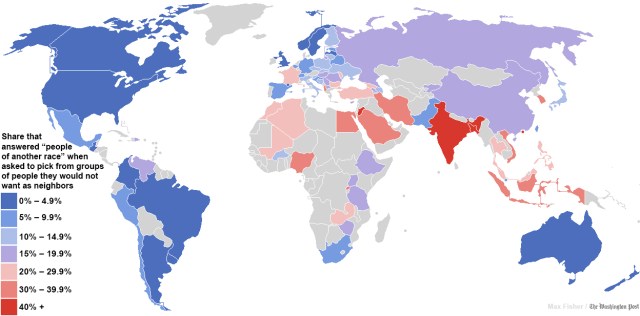
Unfortunately, the Swedish economists did not include all of the World Values Survey data in their final research paper. So I went back to the source, compiled the original data and mapped it out on the infographic above. In the bluer countries, fewer people said they would not want neighbors of a different race; in red countries, more people did.

If we treat this data as indicative of racial tolerance, then we might conclude that people in the bluer countries are the least likely to express racist attitudes, while the people in red countries are the most likely.

Compare the results to this map of the world’s most and least diverse countries.

Before we dive into the data, a couple of caveats. First, it’s entirely likely that some people lied when answering this question; it would be surprising if they hadn’t. But the operative question, unanswerable, is whether people in certain countries were more or less likely to answer the question honestly. For example, while the data suggest that Swedes are more racially tolerant than Finns, it’s possible that the two groups are equally tolerant but that Finns are just more honest. The willingness to state such a preference out loud, though, might be an indicator of racial attitudes in itself. Second, the survey is not conducted every year; some of the results are very recent and some are several years old, so we’re assuming the results are static, which might not be the case.

Here’s what the data show:

• Anglo and Latin countries most tolerant. People in the survey were most likely to embrace a racially diverse neighbor in the United Kingdom and its Anglo former colonies (the United States, Canada, Australia and New Zealand) and in Latin America. The only real exceptions were oil-rich Venezuela, where income inequality sometimes breaks along racial lines, and the Dominican Republic, perhaps because of its adjacency to troubled Haiti. Scandinavian countries also scored high.

• India and Jordan by far the least tolerant. In only two of 81 surveyed countries, more than 40 percent of respondents said they would not want a neighbor of a different race. This included 43.5 percent of Indians and 51.4 percent of Jordanian. (Note: World Values’ data for Bangladesh and Hong Kong appear to have been inverted, with in fact only 28.3 and 26.8 percent, respectively, having indicated they would not want a neighbor of a different race. Please see correction at the bottom of this post.)

• Wide, interesting variation across Europe. Immigration and national identity are big, touchy issues in much of Europe, where racial make-ups are changing. Though you might expect the richer, better-educated Western European nations to be more tolerant than those in Eastern Europe, that’s not exactly the case. France appeared to be one of the least racially tolerant countries on the continent, with 22.7 percent saying they didn’t want a neighbor of another race. Former Soviet states such as Belarus and Latvia scored as more tolerant than much of Europe. Many in the Balkans, perhaps after years of ethnicity-tinged wars, expressed lower racial tolerance.

• The Middle East not so tolerant. Immigration is also a big issue in this region, particularly in Egypt and Saudi Arabia, which often absorb economic migrants from poorer neighbors.

• Racial tolerance low in diverse Asian countries. Nations such as Indonesia and the Philippines, where many racial groups often jockey for influence and have complicated histories with one another, showed more skepticism of diversity. This was also true, to a lesser extent, in China and Kyrgyzstan. There were similar trends in parts of sub-Saharan Africa.

• South Korea, not very tolerant, is an outlier. Although the country is rich, well-educated, peaceful and ethnically homogenous – all trends that appear to coincide with racial tolerance – more than one in three South Koreans said they do not want a neighbor of a different race. This may have to do with Korea’s particular view of its own racial-national identity as unique – studied by scholars such as B.R. Myers – and with the influx of Southeast Asian neighbors and the nation’s long-held tensions with Japan.

• Pakistan, remarkably tolerant, also an outlier. Although the country has a number of factors that coincide with racial intolerance – sectarian violence, its location in the least-tolerant region of the world, low economic and human development indices – only 6.5 percent of Pakistanis objected to a neighbor of a different race. This would appear to suggest Pakistanis are more racially tolerant than even the Germans or the Dutch.

http://www.washingtonpost.com/blogs/worldviews/wp/2013/05/15/a-fascinating-map-of-the-worlds-most-and-least-racially-tolerant-countries/

Thanks to Dr. Mike Moore for bringing this to the attention of the It’s Interesting community.

Stone Age skull-smashing culture discovered

skull

An unusual cluster of Stone Age skulls with smashed-in faces has been found carefully separated from the rest of their skeletons. They appear to have been dug up several years after being buried with their bodies, separated, then reburied. Although collections of detached skulls have been dug up at many Stone Age sites in Europe and the Near East – but the face-smashing is a new twist that adds further mystery to how these societies related to their dead.

Juan José Ibañez at the Spanish National Research Council in Barcelona says the find may suggest that Stone Age cultures believed dead young men were a threat to the world of the living.

No one knows why Neolithic societies buried clusters of skulls – often near or underneath settlements. Some think it was a sign of ancestral veneration. “When people started living together [during the Neolithic period], they needed a social cement,” says Ibañez. Venerating ancestors might have been a way of doing this. But the violence demonstrated towards the skulls in the latest cluster suggests a different story.

The 10,000-year-old skulls were found in Syria. Like those found in other caches, they have been cleanly separated from their spines, suggesting they were collected from dead bodies that had already begun to decompose. Patterns on the bone indicate that some had been decomposing for longer than others, making it likely that they were all gathered together for a specific purpose.

Most of the skulls belonged to adult males between 18 and 30 years old. One – belonging to a child – was left intact; one was smashed to pieces; the remaining nine lacked facial bones. “There was a pattern,” says Ibañez. “The top of the skull and the jaw were there, but they were missing all of the bones in between.” His team believes the facial bones were smashed out with a stone and brute force. “There were no traces of cutting,” he says (American Journal of Physical Anthropology, DOI: 10.1002/ajpa.22111).

Ibañez reckons Stone Age people believed they would receive some benefit – perhaps the strength of the young men the skulls once belonged to – by burying them near or beneath their settlements. Why the faces were smashed in invites speculation.

It may have been an act of spite or revenge, says Ibañez. Or the skulls may have been brought together to create a “community of the dead”, perhaps in order to spiritually interact with the living.

“The post-mortem violence suggests young men were seen as carrying a particular threat,” says Stuart Campbell at the University of Manchester, UK. Destroying their facial structures may have been a way of destroying the individuals’ identities, he says.

Liv Nilsson Stutz at Emory University in Atlanta, Georgia, says the act could have helped deal with grief. “Taking away facial identity could be a way of separating the dead from the living,” she says.

http://www.newscientist.com/article/mg21528784.400-stone-age-skullsmashers-spark-a-cultural-mystery.html

Mysterious exploding manure foam on hog farms

foam_copy
A sample of the manure foam that caused an explosion that lifted a hog barn two feet off the ground and blew a man 20 feet away from where he had been standing.

When you hear about foam in the context of food, you might think of the culinary innovations of the Spanish chef Ferran Adrià, who’s famous for dishes like apple caviar with banana foam.

But this post is about a much less appetizing kind of foam. You see, starting in about 2009, in the pits that capture manure under factory-scale hog farms, a gray, bubbly substance began appearing at the surface of the fecal soup. The problem is menacing: As manure breaks down, it emits toxic gases like hydrogen sulfide and flammable ones like methane, and trapping these noxious fumes under a layer of foam can lead to sudden, disastrous releases and even explosions. According to a 2012 report from the University of Minnesota, by September 2011, the foam had “caused about a half-dozen explosions in the upper Midwest…one explosion destroyed a barn on a farm in northern Iowa, killing 1,500 pigs and severely burning the worker involved.”

The foam grows to a thickness of up to four feet, and scientists can’t explain the phenomenon.

Angela Kent, an associate professor in the department of natural resources and environmental sciences at the University of Illinois, reports that “manure foaming” is “still a very serious problem among pork producers in the Midwest.” Scientists have still not been able to finger the cause of it, but “we are in the midst of a large multi-institution investigation focused on finding the cause of this very serious problem.”

Larry Jacobson, a professor and extension engineer at the University of Minnesota, reports that around 25 percent of operations in the hog-intensive regions of Minnesota, Illinois, and Iowa are experiencing foam—and “the number may be higher, because some operators might not know that they have it.”

He added that the practice of feeding hogs distillers grains, the mush leftover from the corn ethanol process, might be one of the triggers. Distillers grains entered hog rations in a major way around the same time that the foam started emerging, and manure from hogs fed distillers grains contains heightened levels of undigested fiber and volatile fatty acids—both of which are emerging as preconditions of foam formation, he said. But he added that distillers grains aren’t likely the sole cause, because on some operations, the foam will emerge in some buildings but not others, even when all the hogs are getting the same feed mix.

A solution seems to be emerging, Jacobson reports: Dump a bit of monensin, an antibiotic widely used to make cows grow faster, directly into the foam-ridden pit. At rather low levels, about 25 pounds of the stuff will treat a typical 500,000 gallon pit—the stuff effectively breaks up the foam, likely by altering the mix of microbes present. No other treatment has been shown to work consistently, Jacobson said.

Mysterious Poop Foam Causes Explosions on Hog Farms

Christian metal singer Tim Lambesis charged with attempting to hire hit man to kill his wife

tim

The lead singer of the metal band As I Lay Dying has been arrested and charged with seeking to have his wife killed, the San Diego County Sheriff’s Department said.

Authorities said Tuesday that Tim Lambesis tried to contract an undercover detective posing as a killer for hire to murder his estranged wife, who lives in Encinitas, California.

Arraignment was set for Thursday afternoon at North Division Court in Vista.

The department said it learned on May 2 that Lambesis, 32, had asked someone to carry out the killing and an investigation was initiated.

The investigation culminated Tuesday afternoon, “when Lambesis solicited an undercover detective to kill his wife,” it said. He was arrested without incident at a business in Oceanside and taken to the Encinitas Station and booked into the Vista Detention Facility.

Last September, Meggan Lambesis filed with San Diego Superior Court to have the marriage dissolved.

Christian metal singer charged with attempting to hire hit man

Ferris Wheel World Record Broken At Chicago’s Navy Pier

Ferris Wheel Record Attempt

A manager of Chicago’s Navy Pier rode the tourist spot’s Ferris wheel for more than two days – 384 times, up and around – bringing the world record for the longest ride to the birthplace of the amusement park favorite.

“I thought Chicago should have that title,” Clinton Shepherd said after finishing his record-breaking ride on Sunday. Shepherd, the park operations manager, spent 48 hours, 8 minutes and 25 seconds riding Navy Pier’s Ferris wheel over the weekend.

The first Ferris wheel was built in 1893 in Chicago for the World’s Columbian Exposition.

Guinness World Records allowed him to have one five-minute break each hour. He played hours of videogames to stay awake during the ride, and watched James Bond and Batman movies. His gondola on the wheel was specially outfitted with a big-screen TV, cushions and curtains.

Supporters followed him on Twitter. A video camera recorded the feat while volunteer timekeepers documented Shepherd’s activities.

Fans could join Shepherd for a spin by making a donation to the USO. Shepherd’s girlfriend rode with him Saturday for a candlelight anniversary dinner with food from a Chicago restaurant owned by Michael Jordan.

The 32-year-old Shepherd called his adventure “a very overwhelming experience” that was made easier by the support of friends, family and the city of Chicago.

“I was thrilled and honored to be able to have all the love and support I did,” Shepherd said.

The previous record was 30 hours and 35 seconds. Shepherd said he didn’t want to simply beat the record, “I wanted to shatter it.”

“It was little rough at about three in the morning, but the more I kept busy, the better,” Shepherd said.

He said his legs felt wobbly after the ride.

http://www.huffingtonpost.com/2013/05/20/ferris-wheel-world-record_n_3306361.html

Man believed to be dead woke up during his own funeral in Zimbabwe.

funeral

Mourners at a recent funeral in Zimbabwe were caught by surprise when the guest of honor sat up in his coffin.

According to local reports, 34-year-old Brighton Dama Zanthe, the seemingly dead man, woke up last week while friends and family prepared to pay their respects at his home in Gweru.

“I was the first to notice Mr. Zanthe’s moving legs as I was in the queue to view his body. At first I could not believe my eyes but later realized that there was indeed some movements on the body as other mourners retreated in disbelief,” reported Lot Gaka, one of the mourners and Zanthe’s employer.

Fortunately, Zanthe woke up just in time; his body was set to be transported to a funeral parlor later that day. After Zanthe “resurrected” he was taken to a local hospital, where he remained on life support for two days before eventually being released.

Bodies springing back to life is, perhaps surprisingly, not an uncommon occurrence in Zimbabwe. Earlier this year, a woman, who was believed to have collapsed and died during sex, woke up screaming after she was placed into a coffin.

http://www.huffingtonpost.com/2013/03/27/dead-prostitute-comes-back-to-life_n_2965110.html

In another “resurrection” in 2012, a Zimbabwe woman, suspected of being possessed, was rushed to a hospital after she stabbed herself and was allegedly declared dead, the Chronicle reports. However, she did not stay “dead” for long, as she “rose” shortly after.

http://www.chronicle.co.zw/index.php?option=com_content&view=article&id=36339:possessed-woman-stabs-self-to-death-resurrects-&catid=37:top-stories&Itemid=130#.UZKq7is6VEc

http://www.huffingtonpost.com/2013/05/14/dead-man-woke-up-zimbabwe-funeral_n_3275151.html?hpweird=y

18 year old Eesha Khare awarded 2nd place in Intel International Science and Engineering Fair for inventing an improved supercapacitor that could provide super-fast charging of portable electronic devices in the future

intelscience_610x427
Top winner Ionut Budisteanu, 19, of Romania (center) with second-place winners Eesha Khare, 18, of Saratoga, Calif., (left) and Henry Lin, 17, of Shreveport, La., celebrate their awards at the Intel International Science and Engineering Fair.

Khare, an 18-year-old from California, won the Intel Foundation Young Scientist Award and $50,000 for her participation in the Intel International Science and Engineering Fair run by the Society for Science & the Public. Think of it as the world’s largest science fair. Khare took home one of the top prizes for “a tiny device that fits inside cell phone batteries, allowing them to fully charge within 20-30 seconds.”

The official title of Khare’s project is “Design and Synthesis of Hydrogenated TiO2-Polyaniline Nanorods for Flexible High-Performance Supercapacitors.” Her objective reads:

With the rapid growth of portable electronics, it has become necessary to develop efficient energy-storage technology to match this development. While batteries are currently used for energy-storage, they suffer from long charging times and short cycle life. Electrochemical supercapacitors have attracted attention as energy-storage devices because they bridge the gap between current alternatives of conventional capacitors and batteries, offering higher energy density than conventional capacitors and higher power density than batteries. Despite these advantages, supercapacitor energy density is much lower than batteries and increasing energy density remains a key challenge in supercapacitor research. The goal of this work was to design and synthesize a supercapacitor with increased energy density while maintaining power density and long cycle life.

Khare’s supercapacitor can last for 10,000 charge and recharge cycles. She has used it to power an LED as a proof of concept, but envisions its future use in phones, portable electronic devices, and even car batteries.

Curious about how she did it? Put your science hat on. “To improve supercapacitor energy density, I designed, synthesized, and characterized a novel core-shell nanorod electrode with hydrogenated TiO2 (H-TiO2) core and polyaniline shell,” she writes. Essentially, that translates to a much improved supercapacitor.

The 1,600 participants were whittled down to 3 top winners. Besides Khare, Romanian student Ionut Budisteanu came in first by using artificial intelligence to create a model for a low-cost, self-driving car. Henry Lin, a 17-year-old from Louisiana, received the same award as Khare for his project that simulated thousands of clusters of galaxies.

http://news.cnet.com/8301-17938_105-57585337-1/teens-science-project-could-charge-phones-in-20-seconds/

Dennis Hope is selling property on the Moon and other planets.

dennissaguaroMoon_seip

Calling it the biggest loophole in the world doesn’t quite capture its reach: Dennis Hope claims that he owns the moon—and our solar system’s planets—due to what the Outer Space Treaty doesn’t say. The treaty has been the guiding document on space law since 1967, and while it bars any country on Earth from laying claim to a heavenly body, it makes no mention of private companies or individuals doing just that. So Hope formed Lunar Embassy Corp, snatched up the property rights to the moon and more, and has been selling off one-acre lots since.

Purchases can be made here: http://www.lunarembassy.com/

Though Yahoo shines a light on Hope’s offerings (your own piece of the moon will cost just $19.99 an acre; Mars will run you slightly more at $22.49), it’s far from the first time he’s been in the news. He was featured in the documentary Lunarcy!, out last month on Epix, notes the Hollywood Reporter, and he’s talked to media before. As National Geographic previously reported, Hope thinks he has solid ground to stand on: He registered his moon claim with the UN in 1980, and got no answer, which he thinks means it’s a go. And while there’s still plenty of real estate to be had, Hope has sold more than a nominal amount of each: 600 million moon acres (about 7.5% of it) and 325 million Mars acres. He says two former US presidents are landowners as well as 250 “very well known celebrities,” as are two US hotel chains. But Hope does draw the line somewhere: The Apollo landing sites are off-limits.

http://www.newser.com/story/167265/this-man-claims-he-owns-the-moon.html

Catholic television channel TV2000 reports that Pope Francis performed exorcism Sunday – denied by The Vatican

pope
Pope Francis appears to have performed an exorcism on a wheelchair-bound young man who believers in the practice claim was possessed by evil.

According to TV2000, a Catholic television channel, the act was carried out in St Peter’s Square after Mass on Sunday.

Smiling broadly, the Pope initially shook the man’s hand, but the South American pontiff’s expression changed dramatically after a priest from the Legionaries of Christ, a conservative order, leaned in close and spoke a few words to him.

With a more serious expression on his face, Francis placed both hands on the man’s head for 15 seconds. The pilgrim, said to be a 43-year old married man from Mexico called Angelo, then convulsed briefly and emitted a long sigh. His body went limp and his mouth dropped open.

“Exorcists who have seen the footage have no doubt – this was a prayer for liberation from Evil, an actual exorcism,” said TV2000, which is owned by the Italian Bishops Conference.

The station gathered a panel of clergy specialising in exorcisms who scrutinised the footage and concluded that the pope had performed an exorcism.

The Vatican downplayed the incident, although it used ambiguous language that did not deny altogether that Francis had tried to rid the man of evil. “The Holy Father did not intend to carry out any exorcism,” said Father Federico Lombardi, the Vatican spokesman.

“Instead, as he often does for sick and suffering people, he simply intended to pray for a person who was presented to him.”

Leading exorcists insisted that the Pope had indeed taken on the forces of evil.

“The Pope is also the Bishop of Rome, and like any bishop he is also an exorcist,” Father Gabriele Amorth, the Catholic Church’s best known exorcist and the head of the International Association of Exorcists, told La Repubblica newspaper.

“It was a real exorcism,” he said. “If the Vatican has denied this, it shows that they understand nothing”, said Father Amorth who claimed that the Mexican was “possessed by four demons”.

The Rev. Giulio Maspero, a Rome-based systematic theologian who has witnessed or participated in more than a dozen exorcisms, said he was certain that Francis’ prayer on Sunday was either a full-fledged exorcism or a prayer to “liberate” the young man from a demonic possession. He noted that the placement of the pope’s hands on the man’s head was the “typical position” for an exorcist to use.

“When you witness something like that – for me it was shocking – I could feel the power of prayer,” he said in a phone interview, speaking of his own experiences.

Fr Maspero said it was particularly symbolic that Francis’ purported exorcism occurred on Pentecost, an important feast day for the church when the faithful believe Jesus’ apostles received the fullness of the Holy Spirit.

“The Holy Spirit is connected to the exorcism because … it is the manifestation of how God is present among us and in our world,” he said.

There was now, more than ever, a need for exorcists to combat people possessed by “sorcerers” and “Satanists”, Father Amorth said.

“We live in an age in which God has been forgotten. And wherever God is not present, the Devil reigns.”

He acknowledged that many people, even Catholics, regarded exorcism as mumbo-jumbo but insisted they were mistaken. “Those who don’t believe should read the Gospels. Jesus continually performed exorcisms.

“Today, unfortunately, bishops appoint too few exorcists. We need many more. I hope that Rome will send out directives to bishops around the world calling on them to appoint more exorcists.”

He said John Paul II had carried out many exorcisms during his pontificate, but that Benedict XVI had not performed any, instead leaving it to bishops and priests.

“John Paul II fought many times against Satan,” Father Amorth said. “Those battles continue, even though he is dead. In fact he is present today in many exorcisms. If you cite his name during an exorcism, the person who is possessed literally froths at the mouth in fury.”

Francis has made repeated references to the Devil since he was chosen as Benedict’s successor during a secret conclave in March.

At his first Mass, which was held in the Sistine Chapel, where he had been elected by his brother cardinals, he warned: “If we do not confess, if we do not pray to the Lord, we are praying to the Devil. When you do not confess to Jesus Christ, you are confessing to the worldliness of the Devil.”

People possessed by evil are said to display certain symptoms, from extraordinary physical strength to speaking “in tongues” and vomiting nails and bits of glass.

Catholic priests who have trained as exorcists have to follow a ritual known as “De exorcismis et supplicationibus quibusdam”, or “Of exorcisms and certain supplications”, according to guidelines laid down by the Church.

The 84-page document was drawn up in 1998 and is an update on an exorcism rite which was compiled in 1614.

Thanks to Kebmodee for bringing this to the attention of the It’s Interesting community.

http://www.telegraph.co.uk/news/religion/the-pope/10070991/Pope-Francis-performs-first-exorcism.html

Blackbird hitches a ride atop a red-tailed hawk

Landing On A Raptor

Brave Little Balckbird

These images show a red-winged blackbird standing on the back of a red-tailed hawk, looking as if it’s catching a ride to another destination. The series of images were captured recently by photographer Eric Dugan at Napa-Sonoma Marshes Wildlife Area in Northern California. They first appeared in a San Francisco Chronicle story written by outdoors columnist Tom Stienstra.

Dugan described the event:

“I was exploring the wildlife refuge and heard the screech of a red-tailed hawk, loud and repeated. I scanned the sky but didn’t see anything at first. Then, in the distance, I saw a young red-tailed hawk sitting on a telephone pole and the red-winged blackbirds were jumping on and off its back and head, apparently to drive it away from a nesting area.

“I immediately stopped, changed to my long lens, and set up my camera in anticipation for the show. As I walked closer, I anticipated that the hawk would take flight and the blackbirds would pursue it, to drive it out of their territory. I raised the camera and the blackbird actually landed on the hawk multiple times.

“The small bird was so far more maneuverable in flight that all the hawk could do was tolerate it and fly away.”

Dugan stated via email that the photos “are 100 percent legit” and that his only edits were exposure- and shadow-related since lighting was harsh at certain points because of the bright sunshine.

“I went back to the same spot a few days later hoping lightning would strike twice,” Dugan said. “But the red-tailed hawks were hunting way off in the distance.”

His final remark: “Red-winged blackbirds are fearless.”

http://www.grindtv.com/outdoor/nature/post/blackbird-hitches-a-ride-atop-a-red-tailed-hawk/

Thanks to Ray Gaudette for bringing this to the attention of the It’s Interesting community.