
Are we on the cusp of a solar energy boom?

Solar_graphsolar

Solar power is getting much easier to store — and at a much cheaper price

The total solar energy hitting the Earth each year is equivalent to 12.2 trillion watt-hours. That’s over 20,000 times more than the total energy all of humanity consumes each year.

And yet photovoltaic solar panels, the instruments that convert solar radiation into electricity, produce only 0.7 percent of the energy the world uses.

So what gives?

For one, cost: The U.S. Department of Energy estimates an average cost of $156.90 per megawatt-hour for solar, while conventional coal costs an average of $99.60 per MW/h, nuclear costs an average of $112.70 per MW/h, and various forms of natural gas cost between $65.50 and $132 per MW/h. So from an economic standpoint, solar is still uncompetitive.

And from a technical standpoint, solar is still tough to store. “A major conundrum with solar panels has always been how to keep the lights on when the sun isn’t shining,” says Christoph Steitz and Stephen Jewkes at Reuters.

But thanks to huge advancements, solar’s cost and technology problems are increasingly closer to being solved.

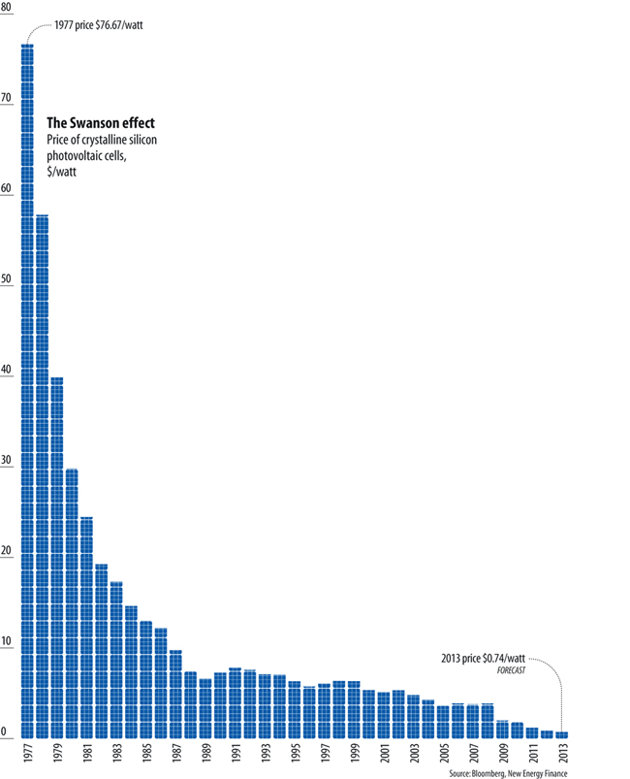
The percentage of light turned into electricity by a photovoltaic cell has increased from 8 percent in the first Cadmium-Telluride cells in the mid-1970s to up to 44 percent in the most efficient cells today, with some new designs theoretically having up to 51 percent efficiency. That means you get a lot more bang for your buck. And manufacturing costs have plunged as more companies have entered the market, particularly in China. Prices have fallen from around $4 per watt in 2008 to just $0.75 per watt last year to just $0.58 per watt today.

If the trend stays on track for another 8-10 years, solar generated electricity in the U.S. would descend to a level of $120 per MW/h — competitive with coal and nuclear — by 2020, or even 2015 for the sunniest parts of America. If prices continue to fall over the next 20 years, solar costs would be half that of coal (and have the added benefits of zero carbon emissions, zero mining costs, and zero scarcity).

Scientists have made huge advances in thermal storage as well, finding vastly more efficient ways to store solar energy. (In one example, solar energy is captured and then stored in beds of packed rocks.)

Lower costs and better storage capacity would mean cheap, decentralized, plentiful, sustainable energy production — and massive relief to global markets that have been squeezed in recent years by the rising cost of fossil fuel extraction, a burden passed on to the consumer. All else being equal, falling energy prices mean more disposable income to save and invest, or to spend.

The prospect of widespread falling energy costs could be a basis for a period of strong economic growth. It could help us replace our dependence on foreign oil with a robust, decentralized electric grid, where energy is generated closer to the point of use. This would mean a sustainable energy supercycle — and new growth in other industries that benefit from falling energy costs.

Indeed, a solar boom could prove wrong those who claim that humanity has over-extended itself and that the era of growth is over.

Thanks to Ray Gaudette for bringing this to the attention of the It’s Interesting community.

http://news.yahoo.com/cusp-solar-energy-boom-075000286.html

School baseball team lifts car to free girl pinned beneath vehicle after mom accidentally backs over her

valley-high-school-baseball-309x184

Sixteen members of a Northern California high school baseball team ran from a practice to save a 16-year-old girl who was pinned under a car, working together to lift it off her while their coach pulled her to safety.

The girl, a student visiting Valley High School in Elk Grove on Wednesday afternoon, was pinned under the car when her mother accidentally backed over her after dropping her off in the school parking lot, Sacramento police said told KCRA-TV.

The team, in the middle of their last practice of the season, heard her cries for help and ran to her.

“We all just ran out there as a team,” varsity coach James Millholland told the TV station. “There was no one really saying much. The guys just got around the car and then everyone just lifted it up.”

Players said it wasn’t difficult to lift the four-door sedan off the girl while their coach pulled her out.

“With all the teamwork we had going on it didn’t feel heavy,” said player Sukhminder Gill. “It felt like we could pick anything up right now. The adrenalin was pumping up.”

The girl, whose name has not been released, was home from the hospital Thursday. Her exact injuries were not clear, but she’s expected to recover.

Players said it was a satisfying way to help finish their season.

“I felt like we were heroes,” Ysidro Castro said. “We did something that actually saved the day.”

http://www.thestar.com/news/world/2013/05/10/school_baseball_team_lifts_car_to_free_16yearold_girl.html

Woman kicked off plane for repeatedly singing ‘I Will Always Love You’

An American Airlines flight en route from Los Angeles to New York had to make an emergency landing last Thursday because a woman wouldn’t stop singing I Will Always Love You, CNN reports.

The flight landed in Kansas City to remove the woman from the plane.

“The passenger was detained, not arrested, and then released pending further investigation by the TSA (Transportation Safety Administration) and federal air marshals,” airport spokesman Tom McKenna said, according to a report from CNN affiliate KMBC.

“I can confirm that she was singing I Will Always Love You as she was escorted off the plane.” McKenna said.

A passenger on the flight recorded video of the woman singing the chorus to the song while police escorted her off the plane.

Dolly Parton released the original version of the song in 1974 and Whitney Houston covered it for the 1992 movie The Bodyguard

http://cnews.canoe.ca/CNEWS/WeirdNews/2013/05/14/20820636.html

Venezuela running out of toilet paper

toilet-paper

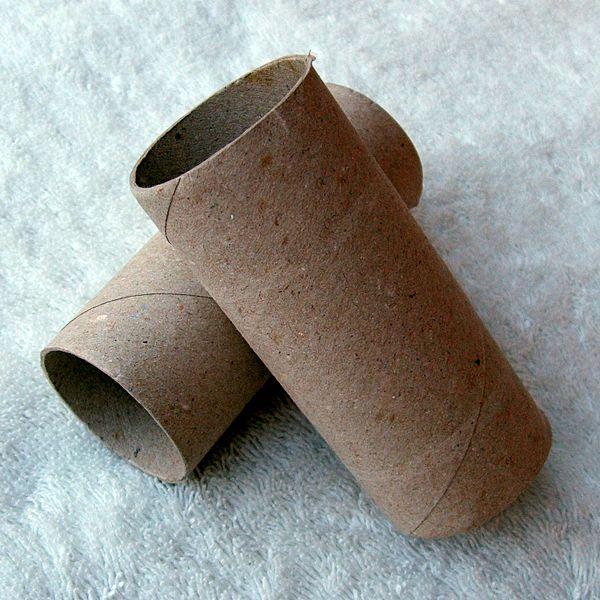
Venezuela officials say they will have to import 50 million rolls to meet the demand of what Trade Minister Alejandro Fleming called a “nervous population.”

The government blames the media for provoking fears about scarcity, which prompted consumers to hoard TP.

But businesses and political opposition blame the government’s policies, like price controls on basic goods — many of which are reportedly in short supply.

After meeting with Venezuelan paper company PAVECA, which agreed to increase its output, Fleming told AVN he will move to “saturate” the market to alleviate the problem.

The typical monthly consumption of toilet paper in the country is 125 million rolls.

http://cnews.canoe.ca/CNEWS/WeirdNews/2013/05/16/20826491.html

Topless protest disrupts opening of Barbie house in Berlin

barbie 1

barbie 2

Women’s rights protesters disrupted the opening of a giant pink doll’s house in Berlin on Thursday, saying the Barbie “Dreamhouse Experience” objectified women.

Promoting the doll made by Mattel Inc, the house allows paying visitors to try on Barbie’s clothes, play in her kitchen and have a go on her pink piano. The exhibition will be open until Aug. 25.

A handful of protesters gathered outside the shocking pink house that has been erected in one of central Berlin’s greyest areas.

A topless woman, a member of the Femen protest group, who had the slogan “Life in plastic is not fantastic” scrawled across her chest, set fire to a Barbie doll tied to a mini crucifix.

“There’s too much emphasis on becoming more beautiful and on being pretty and that puts an awful lot of pressure on girls as well as wasting capacities which they could use to simply be happy or for school,” said Stevie Meriel Schmiedel, a founding member of the “Pink Stinks” protest group.

“We’re protesting because Barbie would not be able to survive with her figure and yet she is an idol for many girls and that’s not healthy,” she said.

One placard read: “Dear Barbie – don’t just bake cupcakes, eat them too!”

A male protester in a wig, pink shirt and shimmering skirt held a poster reading: “Do you like me now?”

Christoph Rahofer, chief executive of Event Marketing Services, which organised the exhibition, similar to one that recently opened in Sunrise, Florida, said the Dreamhouse Experience was a positive thing.

“It’s basically about playing, being amazed and discovering – there’s lots of hidden things to be found and it’s an interactive exhibition.”

The Barbie doll made its debut in 1959, and is named after the daughter, Barbara, of its inventor Ruth Handler, according to Mattel’s website.

http://cnews.canoe.ca/CNEWS/WeirdNews/2013/05/16/20828031.html

40,000 bees found inside Utah home’s wall

bees

A Provo, Utah couple will sleep a little more soundly after a beekeeper removes a hive of tens of thousands of bees from inside their bedroom wall Saturday.

Tyler Judd and his wife moved into their home in Provo five months ago. They first noticed bees outside his home, then, late one night, he and his wife could hear them buzzing inside the walls.

“We were just sitting on our couch, turned off the TV and could hear some buzzing in the walls,” Judd said.

They called in a beekeeper, who located a colony of about 40,000 bees in the wall of the Judd’s master bedroom Friday.

The colony, said beekeeper Al Chubak, was causing bigger trouble to the home than just building their hive, as it was sending swarms to further colonize the area and removing insulation from the home’s interior.

http://www.wcsh6.com/news/article/243538/108/40000-bees-found-inside-Utah-homes-wall

NASA funds development of 3D printer to make food in space, starting with a pizza

meal_worms_3d
Delicious Uncle Sam’s Meal Cubes are laser-sintered from granulated mealworms; part of this healthy breakfast.
mendel_small_si

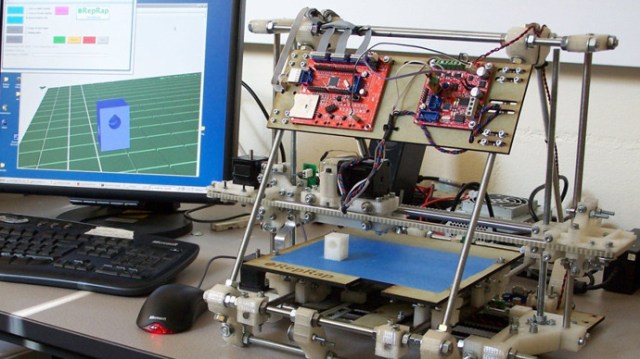
NASA is funding research into 3D printed food which would provide astronauts with meals during long space flights. The futuristic food printers would use cartridges of powder and oils which would have a shelf life of 30 years.

While the idea may seem like something out of a Sci-Fi movie, the process of printing food has already been proven possible. The brains behind the innovation, Anjan Contractor, previously printed chocolate in a bid to prove his concept.

Contractor and his company, Systems & Materials Research Corporation, will now use NASA’s $125,000 grant to attempt to print a pizza. The grant was applied for on March 28, 2013. The pizza printer is still in the conceptual stage, and will begin to be built in two weeks.

The printer will first print a layer of dough, which will be cooked while being printed. Tomato powder will then be mixed with water and oil to print a tomato sauce. The topping for the pizza will be a “protein layer” which could come from any source – animals, milk, or plants.

The concept is to use basic “building blocks” of food in replaceable powder cartridges. Each block will be combined to create a range of foods which can be created by the printer. The cartridges will have a shelf life of 30 years – more than long enough to enable long-distance space travel.

Contractor and his team hope the 3D printer will be used not only by NASA, but also by regular Earthlings. His vision would mean the end of food waste, due to the powder’s long shelf life.

“I think, and many economists think, that current food systems can’t supply 12 billion people sufficiently, ” he said, as quoted by Quartz.

“So we eventually have to change our perception of what we see as food.” There are some conveniences which would come along with the printer. For example, recipes could be traded with others through software. Each recipe would have a set of instructions which tells the printer which cartridge of powder to mix with which liquids, and at what rate and how it should be sprayed.

Another perk includes personalized nutrition.

“If you’re male, female, someone is sick—they all have different dietary needs. If you can program your needs into a 3D printer, it can print exactly the nutrients that person requires,” Contractor said.

Contractor plans on keeping the software portion of his 3D printer entirely open-source, so that anyone can look at its code. He believes this will allow people to find creative uses for the hardware.

http://rt.com/usa/nasa-3d-pizza-printer-590/

Kelp gulls may be responsible for the worst-ever Right Whale die-off

southern-right-whale

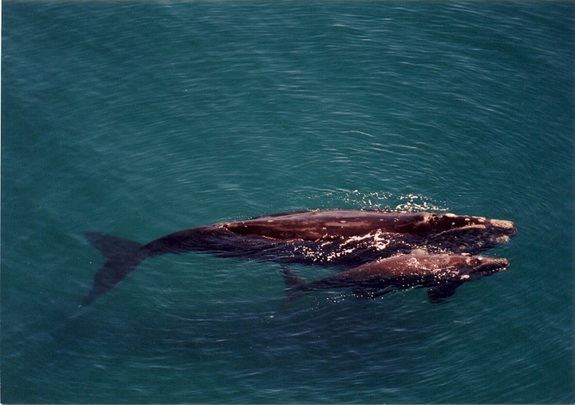
Scientists still don’t know why hundreds of baby southern right whales are turning up dead around Patagonia, a decade after observers first saw signs of the worst die-off on record for the species, according to the Wildlife Conservation Society (WCS).

With no evidence of infectious diseases or deadly toxins in whale tissue samples, scientists are scrambling to determine a cause of death. Some are even pointing a finger at blubber-eating birds.

The whales come to the peaceful Atlantic bays around Peninsula Valdes along Argentina’s Patagonian Coast to give birth and raise their young. At least 605 dead right whales have been counted in the region since 2003, WCS officials say. Of those, 538 were newborn calves. Last year, the mortality event was especially severe, with a record-breaking 116 whale deaths, 113 of them calves.

“In 2012 we lost nearly one-third of all calves born at the Peninsula,” said Mariano Sironi, scientific director of the Instituto de Conservacion de Ballenas in Argentina. “Southern right whales have their first calf when they are nine years old on average. This means that it won’t be until a decade from now that we will see a significant reduction in the number of calves born, as all of the female calves that died will not be contributing any new offspring to the population,” Sironi, who is also an advisor to the Southern Right Whale Health Monitoring Program, added in a statement.

Sironi and colleague Vicky Rowntree, who is co-director of the monitoring program, have studied a strange phenomena that could be stressing southern right whales. They say kelp gulls at Peninsula Valdes land on the backs of the cetaceans to eat their skin and blubber.

“The attacks are very painful and cause large, deep lesions, particularly on the backs of young 2-6 week-old calves,” the researchers said in a statement from WCS. “This harassment can last for hours at a time. As a result, right whale mothers and their calves are expending much precious energy during a time of year when mothers are fasting and at a site where little to no food is available to replenish fat reserves.”

The situation is discouraging for a species that had made a significant comeback since its population was depleted by the whaling industry.

“The southern right whale population is still only a small fraction of its original size, and now we have reason to worry about its recovery,” Rowntree said.

Though the southern right whale is not listed as endangered, conservationists warn that the species’ sister populations could go extinct if hit with a mysterious die-off on this scale. For instance, there are thought to be just about 500 North Atlantic right whales remaining.

Thanks to Dr. Lutter for bringing this to the attention of the It’s Interesting community.
http://news.yahoo.com/worst-ever-whale-die-off-continues-puzzle-110222538.html

United Nations encourages more world-wide consumption of insects as important food source

eat-bugs
Insects are high in protein and minerals, need far less feed per kilo of mass than cattle do and produce far less greenhouse gas per kilo than pigs.

A United Nations food agency is pushing a new kind of diet for a hungry world.

It ranks high in nutritional value and gets good grades for protecting the environment: edible insects.

The Rome-based Food and Agriculture Organization hailed the likes of grasshoppers, ants and other members of the insect world as an underutilised food for people, livestock and pets. A new report says two billion people worldwide already supplement their diets with insects. Insects are high in protein and minerals, need far less feed per kilo of mass than cattle do and produce far less greenhouse gas per kilo than pigs. While most edible insects are gathered in forests, the UN says mechanisation can boost insect-farming production. Currently most insect farming serves niche markets.

http://www.mirror.co.uk/news/world-news/united-nations-wants-eat-more-1887995

Cholesterol-lowering statin drugs may partially block the health benefits of exercise

statin

An important new study suggests that statins, the cholesterol-lowering medications that are the most prescribed drugs in the world, may block some of the fitness benefits of exercise, one of the surest ways to improve health. No one is saying that people with high cholesterol or a family history of heart disease should avoid statins, which studies show can be lifesaving. But the discovery could create something of dilemma for doctors and patients, since the people who should benefit the most from exercise — those who are sedentary, overweight, at risk of heart disease or middle-aged — are also the people most likely to be put on statins, possibly undoing some of the good of their workouts.

For the new study, which was published online in The Journal of the American College of Cardiology, researchers from the University of Missouri and other institutions gathered a group of overweight, sedentary men and women, all of whom had multiple symptoms of metabolic problems, including wide waistlines, high blood pressure or excess abdominal fat.

Most had slightly but not dangerously elevated cholesterol levels. None had exercised regularly in the past year. All underwent muscle biopsies and treadmill testing to determine their aerobic fitness — which was generally quite low — and agreed to continue with their normal diet. Then they all began a supervised 12-week exercise program, during which they visited the university lab five times a week and walked or jogged on a treadmill for 45 minutes at a moderately vigorous pace (about 65 to 70 percent of their individual aerobic maximum).

Half of the group also began taking a daily 40-milligram dose of simvastatin, a particular type of statin sold under the brand name Zocor. At the end of 12 weeks, the participants fitness and muscles were retested.

Statins, as most of us know, are medications designed to reduce the body’s cholesterol levels, particularly levels of low-density lipoprotein, or “bad” cholesterol. The drugs routinely are prescribed for those with high cholesterol and other risk factors for heart disease, and some physicians believe that they should be used prophylactically by virtually everyone over 50.

Exercise also typically is recommended as a means of fighting heart disease and prolonging life span.

And both statins and sweating indisputably are effective. In past studies, researchers have shown that statins reduce the risk of a heart attack in people at high risk by 10 to 20 percent for every 1-millimole-per-liter reduction in blood cholesterol levels (millimoles measure the actual number of cholesterol molecules in the bloodstream), equivalent to about a 40-point drop in LDL levels. Meanwhile, improving aerobic fitness by even a small percentage through exercise likewise has been found to lessen someone’s likelihood of dying prematurely by as much as 50 percent.

So, theoretically, it would seem that combining statins and exercise should provide the greatest possible health benefit. But until the current study, no experiment scrupulously had explored the interactions of statin drugs and workouts in people. And the results, as it turns out, are worrisome.

The unmedicated volunteers improved their aerobic fitness significantly after three months of exercise, by more than 10 percent on average. But the volunteers taking the statins gained barely 1 percent on average in their fitness, and some possessed less aerobic capacity at the end of the study than at its start.

Why there should be such a discrepancy between the two groups’ fitness levels wasn’t clear on the surface. But when the researchers looked microscopically at biopsied muscle tissue, they found notable differences in the levels of an enzyme related to the health of mitochondria, the tiny energy-producing parts of a cell. Mitochondria generally increase in number and potency when someone exercises.

But in the volunteers taking statins, enzyme levels related to mitochondrial health fell by about 4.5 percent over the course of the experiment. The same levels increased by 13 percent in the group not taking the drug. In effect, the volunteers taking statins “were not getting the same bang from their exercise buck” as the other exercisers, says John P. Thyfault, a professor of nutrition and exercise physiology at the University of Missouri and senior author of the study.

This finding joins a small but accumulating body of other studies indicating that statins can negatively affect exercise response. Lab rodents given statins, for instance, can’t run as far as unmedicated animals, while in humans, marathon runners on statins develop more markers of muscle damage after a race than runners not using the drugs.

None of which suggests, Dr. Thyfault says, that statins are not worthwhile. For people who have a family history of high cholesterol or heart disease or who themselves have high cholesterol, he says, “there’s no doubt that statins save lives.”

But for other people, the risk-benefit calculation involving statins may be trickier in light of this and other new science.

“Low aerobic fitness is one of the best predictors” of premature death, Dr. Thyfault says. And if statins prevent people from raising their fitness through exercise, then “that is a concern.”

A possible remedy, he continues, could be for people to get in shape and raise their aerobic fitness before starting the drug, but that’s an issue to discuss with your doctor. “There’s still a great deal we don’t understand” about how statins and exercise mix, he says.

Thanks to Dr. Aarati Didwania for bringing this to the attention of the It’s Interesting community.