North Pole now a lake

n pole

Instead of snow and ice whirling on the wind, a foot-deep aquamarine lake now sloshes around a webcam stationed at the North Pole. The meltwater lake started forming July 13, following two weeks of warm weather in the high Arctic. In early July, temperatures were 2 to 5 degrees Fahrenheit (1 to 3 degrees Celsius) higher than average over much of the Arctic Ocean, according to the National Snow & Ice Data Center.

Meltwater ponds sprout more easily on young, thin ice, which now accounts for more than half of the Arctic’s sea ice. The ponds link up across the smooth surface of the ice, creating a network that traps heat from the sun. Thick and wrinkly multi-year ice, which has survived more than one freeze-thaw season, is less likely sport a polka-dot network of ponds because of its rough, uneven surface.

July is the melting month in the Arctic, when sea ice shrinks fastest. An Arctic cyclone, which can rival a hurricane in strength, is forecast for this week, which will further fracture the ice and churn up warm ocean water, hastening the summer melt. The Arctic hit a record low summer ice melt last year on Sept. 16, 2012, the smallest recorded since satellites began tracking the Arctic ice in the 1970s.

http://www.livescience.com/38347-north-pole-ice-melt-lake.html

Dancing zebras direct traffic in Bolivia

traffic zebra
In La Paz, Boliva, at-risk youth get $57 a month – plus health insurance – for part-time gigs wearing zebra costumes and directing the city’s chaotic traffic.

The streets of the world’s highest capital are a cacophony of sound with the groans and squeals of horns and brakes. There appear to be no rules of the road, as cutting off other drivers, stopping suddenly, and running red lights are a regular part of the traffic flow. The fast-moving chaos creates a dicey experience for pedestrians wanting to cross busy intersections. Enter the dancing zebras.

La Paz’s traffic zebras are a corps of about 100 youths who, dressed in individual, full-body zebra outfits, help schoolchildren and elderly or disabled pedestrians cross the street. They’re also trained in crowd dynamics and street performance.

The program started in 2001, with 20 zebras, sporting “very ugly” two-person costumes, says Patricia Grossman, director of city culture. But La Paz residents took to the zebras, and their friendly guidance stuck, easing bottlenecks and aggression more effectively than “sanctions, tickets, or coercion,” says Ms. Grossman.

The zebras are part of a broader program for 3,000 high-risk youths, which gives 15-to-22-year-olds city improvement jobs. The zebras work four hours daily, Monday through Friday. They make 400 bolivianos monthly (about US$57) and get health insurance, a good gig for youth considering the country’s monthly minimum wage for full-time work is near 650 bolivianos (about $93).

“It’s fun. You can run and jump, there’s movement,” said Claudia Bustamente, a traffic zebra. She hopes to stick with the job at least a year.

Since 2007, the zebras have also participated in fairs, festivals, and events, and lecture at schools against drunken driving. Sometimes they irk local police, as officers feel that the zebras aren’t true law enforcers, says coordinator Kathia Salazar. But surveys indicate that the zebras’ method of enforcing laws and spreading public-service messages is well received and well respected.

http://www.csmonitor.com/World/Global-News/2009/1027/bolivia-in-andean-capital-dancing-zebras-direct-traffic

Florida’s radioactive fountain of youth – is magnesium the secret?

ftn of youth

Jackie Snow
for National Geographic
Published July 23, 2013

Five hundred years ago in June, the Spanish conquistador Juan Ponce de Leon started his journey back to Puerto Rico from Florida after becoming the first European to land on mainland America. After exploring the east coast of Florida, he circled the peninsula and explored the west coast, including modern-day Charlotte Harbor, most likely the location he chose for his second voyage.

According to legend, the explorer set out in search of the fountain of youth, a fabled stream that would extend the life of anyone lucky enough to drink from it.

Thanks to the myth of Ponce de Leon’s trip, Florida—known for its large population of retirees—is now awash in “fountains of youth.” Dozens of bodies of water claim the title of the one legendary fountain, from mineral springs to deep-water wells, not to mention water from a variety of sources that is piped into various built structures.

Only one, however, is known to be radioactive. And, oddly, it might be actually extending life.

In Punta Gorda, a town on Charlotte Harbor, a blocky, green-tiled fountain abuts an empty lot near the harbor. A spigot juts out near the top to release water from the artesian well below. Each of the four sides features a picture of a ship, a tribute to Ponce de Leon.

On the side facing away from the street, a public health notice warns that the water “exceeds the maximum contaminant level for radioactivity.”

The water from the well is also heavy in sulfates, which give it a distinctive smell of rotten eggs. This hasn’t stopped the locals from drinking from it regularly.

“I drank out of that well every day,” said Gussie Baker, a resident of Punta Gorda for all of her 78 years.

Baker used to live down the road from the Hotel Punta Gorda, whose guests would frolic in a pool filled with water from the same aquifer. Baker learned to swim in the pool and passed the fountain on her way to school.

“I love artesian water,” she said. Baker doesn’t live as close to the fountain anymore, but says she would drink it if she were nearby.

Punta Gordians proudly declared the existence of a rejuvenative fountain as far back as 1894. In 1926, they mounted a collection drive to pay for the stout little structure that stands to this day. At the height of its popularity, in the mid-20th century, the handle on the tap had to be replaced every six months.

The environmental movement threatened to put a stop to the locals’ enthusiasm for the fountain. In 1974, Congress passed the Clean Water Act, requiring the Environmental Protection Agency to determine safe levels of a variety of contaminants, including radium. All public water sources were to be tested.

Punta Gorda’s water clocked in at 9.2 picoCuries of radium-226 isotope per liter when it was tested in 1983. This exceeded the recommended radium limit, set at 5 picoCuries per liter.

As a result, in 1986, the city council mulled plugging the well, moving the fountain, and hooking it up to city water. But locals fought back.

“They’ve tried several times over the years to close it down, to seal it up, to move it or hook it to the city water, and the public has always defeated that,” said Wilson Harper, a 71-year-old former water utilities supervisor better known as “Water Bill.”

“The last 15 years it’s been as quiet as a church mouse,” he said.

Lindsay Harrington has worked across the street from the fountain in a real estate office and watched the comings and goings since 1997.

Visitors “usually come with lots of plastic bottles, or big plastic jugs that hold maybe five or ten gallons,” he said.

“We did have an occasion where a gentleman would wash his car there, and I always thought maybe he was hoping it would lengthen the use he would get out of it,” he said. “It was his own automobile fountain of youth.”

Radium shows up in 3 to 4 percent of water around the country, according to a recent study by the United States Geological Survey. Many areas have no radium in their local water. Radium mostly turned up in places that had certain rock formations with particular water chemistry that created the perfect radium sink. Florida made up the third most likely area in which to find radium-laced water.

Zoltan Szabo, a co-author of the study who has worked at the United States Geological Survey for 28 years, explained that Florida’s water is frequently encased in limestone, which doesn’t absorb or store radium. “It’s like a bad paper towel,” Szabo said of the common Floridian rocks.

Artesian water supplies are especially low in oxygen, which also helps draw radium out of the water. Szabo hasn’t looked at the Punta Gorda water supply in particular but says the levels of radium at which the fountain tested are not especially dangerous.

The EPA’s recommended levels are very conservative, Szabo said, and are based on drinking a liter a day for 70 years. Even if that was the amount and length of time someone drank the water, the chance of getting cancer is still low, Szabo said, in the range of 1 in 20,000.

“You’re taking a quantifiable risk,” he said. “If you’re smoking a cigarette, you’re taking a quantifiable risk. Probably more than drinking that water.”

But radium isn’t the only thing that turns up in the water. In fact, a much more humdrum ingredient might hold the secret of its appeal. The water from the aquifer is high in magnesium, the second most common mineral in the body after calcium.

More than 80 percent of Americans are deficient in magnesium, which helps the body regulate heart muscles and control high blood pressure. The World Health Organization recommends that drinking water contain at least 25 milligrams of magnesium per liter, and a U.S. Academy of Science study from 1977 found that 150,000 deaths a year in the United States could be prevented with additional magnesium in water.

According to Carolyn Dean, author of The Magnesium Miracle, the fountain’s 46 ppm of magnesium puts it on par with other mineral waters like San Pellegrino.

The compound magnesium sulfate also makes an appearance in the water. It’s better known as Epsom salt, which has been used in baths to ease aches and pains for years.

Magnesium is regularly removed from many bottled waters by a process known as reverse osmosis. And the fluoride added to many public water supplies counteracts magnesium, too.

Magnesium is especially good for older people: Magnesium deficiency increases with age as the body stops being as efficient in absorption, and many drugs senior citizens take interfere with the body’s ability to digest magnesium.

“Water Bill” Harper has noticed that the fountain is especially popular among Punta Gorda’s older folk.

“One of the problems with city water is we have to maintain a chloride disinfection. It makes everything taste funny,” he said. “The people have learned they can go down and take that water, which is not chlorinated, and let it sit in the refrigerator.

“It’s tasty; it has no reaction with any of their medication. Also, [magnesium sulfate] keeps you regular.”

To Harper’s knowledge, the fountain’s water has not been tested for at least 25 years—although the EPA recommends biannual testing.

When this reporter sent the water off recently to be tested, it got a reading of 14.4 picoCuries per liter, plus or minus 6.4. This is, according to Szabo, within the range of what showed up in the previous test. According to the EPA website, zero is the goal for radium levels.

Between this warning and the ubiquity of bottled water, the fountain is much less popular today. Harrington says days will go by without him seeing anyone at the fountain. But there are still some dedicated drinkers.

Margaret Baumherdt has been drinking from the fountain since 1967, years before any warning went up. Baumherdt, who is now 88, moved to the area when she was in her early 40s and remembers having to wait in line to drink the water.

She gets her daughter to drive her to the fountain from her home in nearby Port Charlotte, the town across the harbor, and fills up as many as 40 gallon jugs at a time. She drinks the water exclusively and even uses it to cook meals like spaghetti. Tap water’s chlorine content doesn’t sit well with her. The fountain water, however, is just right.

“I love the taste,” she said.

http://news.nationalgeographic.com/news/2013/07/130719-florida-fountain-of-youth-radioactive-magnesium-health/

Nebraska judge orders $1 million returned to exotic dancer

gty_cash_pile_mi_130722_16x9_608

A federal judge has ruled that Nebraska cops must return over $1 million confiscated at a traffic stop from a woman who saved the money $1 at a time during her 15 year career as an exotic dancer.

The money belongs to Tara Mishra, 33, of Rancho Cucamonga, Calif., who began putting aside her earnings when she started dancing at age 18, according to an opinion U.S. District Judge Joseph Bataillon wrote last week. The money was meant to start her business and get out of the stripping business, the judge wrote.

State troopers confiscated the money in March 2012 when they pulled over Rajesh and Marina Dheri, of Montville, N.J., for speeding in Nebraska, according to court documents. The Dheris are friends of Mishra and had been given the cash so they could buy a nightclub in New Jersey. Mishra would own half of the business and the Dheris would own the other half.

Mishra had packaged the money in $10,000 bundles tied with hair bands and placed in plastic bags, and it was stashed in the trunk of the Dheri’s rented car, which the Dheris were driving to Chicago. When they were pulled over for speeding, a state trooper asked the Dheris if he could search their vehicle, which they allowed, Bataillon explained.

The state trooper found the money and after suspecting it was drug money took the Dheris into custody, according to the judge’s opinion. But police did not find any evidence of drug activity in the car and a K-9 analysis found only trace elements of illegal drugs on the cash, according to Bataillon.

Neither Mishra nor the Dheris could not be reached for comment.

“The government failed to show a substantial connection between drugs and the money,” Bataillon wrote in his opinion. “The dog sniff is inconsequential…The court finds the Mishras’ story is credible…Ms. Mishra did have control over the money and directed the Dheris to deliver the money to New Jersey for the purchase of the business.”

Bataillon ordered that Mishra receive cash or a check in the value of $1,074,000 with interest.

http://abcnews.go.com/blogs/headlines/2013/07/judge-orders-1-million-returned-to-exotic-dancer/

Formic acid in flying ants is making seagulls intoxicated

secpic_seagull1_b123370404311

Seagulls in southwest England are getting intoxicated from consuming flying ants, brazenly stealing food out of residents’ hands, flying directly into buildings and failing to get out of the way of cars. Apparently, the birds are becoming inebriated from the formic acid in the ants’ bodies, which lowers their inhibitions and disrupts their coordination, similar to the effect of alcohol.

Hot weather has helped spawn large populations of ants, upon which the seagulls feed. “That isn’t so good for the birds – it leaves them a bit drunk,” Rebecca Nesbit, and entomologist with the Society of Biology, said.

Formic acid is likely the reason for a strange bird behavior known as ‘anting,’ in which the birds thrash around, covering themselves in ants. The formic acid may help the birds repel parasites.

http://www.livescience.com/38336-seagulls-drunk-on-ants.html

Canada deliberately starved malnourished aboriginal people, mostly children, for experimentation during WWII

canda

Aboriginal children were deliberately starved in the 1940s and ’50s by Canadian government researchers in the name of science.

Milk rations were halved for years at residential schools across the country. Essential vitamins were kept from people who needed them. Dental services were withheld because gum health was a measuring tool for scientists and dental care would distort research.

For over a decade, aboriginal children and adults were unknowingly subjected to nutritional experiments by Canadian government bureaucrats.

This disturbing look into government policy toward aboriginals after World War II comes to light in recently published historical research.

When Canadian researchers went to a number of northern Manitoba reserves in 1942 they found rampant malnourishment. But instead of recommending increased federal support to improve the health of hundreds of aboriginals suffering from a collapsing fur trade and already limited government aid, they decided against it. Nutritionally deprived aboriginals would be the perfect test subjects, researchers thought.

The details come from Ian Mosby, a post-doctorate at the University of Guelph, whose research focused on one of the most horrific aspects of government policy toward aboriginals during a time when rules for research on humans were just being adopted by the scientific community.

Researching the development of health policy for a different research project, Mosby uncovered “vague references to studies conducted on ‘Indians’ ” and began to investigate.

Government documents eventually revealed a long-standing, government-run experiment that came to span the entire country and involved at least 1,300 aboriginals, most of them children.

These experiments aren’t surprising to Justice Murray Sinclair, chair of the Truth and Reconciliation Commission. The commission became aware of the experiments during their collection of documents relating to the treatment and abuse of native children at residential schools across Canada from the 1870s to the 1990s.

It’s a disturbing piece of research, he said, and the experiments are entrenched with the racism of the time.

“This discovery, it’s indicative of the attitude toward aboriginals,” Sinclair said. “They thought aboriginals shouldn’t be consulted and their consent shouldn’t be asked for. They looked at it as a right to do what they wanted then.”

In the research paper, published in May, Mosby wrote, “the experiment seems to have been driven, at least in part, by the nutrition experts’ desire to test their theories on a ready-made ‘laboratory’ populated with already malnourished human experimental subjects.”

Researchers visited The Pas and Norway House in northern Manitoba in 1942 and found a demoralized population marked by, in their words, “shiftlessness, indolence, improvidence and inertia.”

They decided that isolated, dependent, hungry people would be ideal subjects for tests on the effects of different diets.

“In the 1940s, there were a lot of questions about what are human requirements for vitamins,” Mosby said. “Malnourished aboriginal people became viewed as possible means of testing these theories.”

These experiments are “abhorrent and completely unacceptable,” said Andrea Richer, spokesperson for Aboriginal Affairs and Northern Development Minister Bernard Valcourt.

The first experiment began in 1942 on 300 Norway House Cree. Of that group, 125 were selected to receive vitamin supplements, which were withheld from the rest.

At the time, researchers calculated the local people were living on less than 1,500 calories a day. Normal, healthy adults generally require at least 2,000.

In 1947, plans were developed for research on about 1,000 hungry aboriginal children in six residential schools in Port Alberni, B.C., Kenora, Ont., Schubenacadie, N.S., and Lethbridge, Alta.

One school for two years deliberately held milk rations to less than half the recommended amount to get a ‘baseline’ reading for when the allowance was increased. At another school, children were divided into one group that received vitamin, iron and iodine supplements and one that didn’t.

One school depressed levels of vitamin B1 to create another baseline before levels were boosted.

And, so that all the results could be properly measured, one school was allowed none of those supplements.

The experiments, repugnant today, would probably have been considered ethically dubious even at the time, said Mosby.

“I think they really did think they were helping people. Whether they thought they were helping the people that were actually involved in the studies — that’s a different question.”

http://www.thestar.com/news/canada/2013/07/16/hungry_aboriginal_kids_used_unwittingly_in_nutrition_experiments_researcher_says.html

Electricity-Generating, Transparent Solar Cell Windows

ucla-transparent-solar-windows-537x373

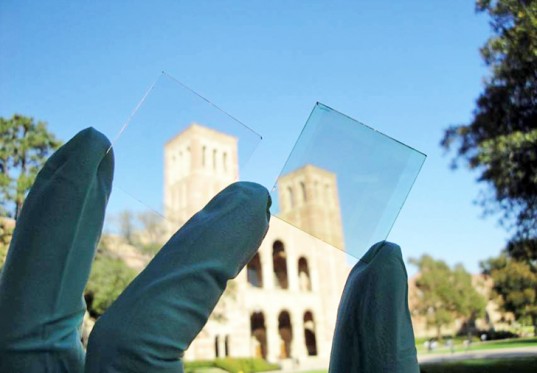
A team from UCLA has developed a new transparent solar cell that has the ability to generate electricity while still allowing people to see outside. In short, they’ve created a solar power-generating window! Described as “a new kind of polymer solar cell (PSC)” that produces energy by absorbing mainly infrared light instead of traditional visible light, the photoactive plastic cell is nearly 70% transparent to the human eye—so you can look through it like a traditional window.

“These results open the potential for visibly transparent polymer solar cells as add-on components of portable electronics, smart windows and building-integrated photovoltaics and in other applications,” said study leader Yang Yang, a UCLA professor of materials science and engineering and also director of the Nano Renewable Energy Center at California NanoSystems Institute (CNSI). “Our new PSCs are made from plastic-like materials and are lightweight and flexible. More importantly, they can be produced in high volume at low cost.”

There are also other advantages to polymer solar cells over more traditional solar cell technologies, such as building-integrated photovoltaics and integrated PV chargers for portable electronics. In the past, visibly transparent or semitransparent PSCs have suffered low visible light transparency and/or low device efficiency because suitable polymeric PV materials and efficient transparent conductors were not well deployed in device design and fabrication. However that was something the UCLA team wished to address.

By using high-performance, solution-processed, visibly transparent polymer solar cells and incorporating near-infrared light-sensitive polymer and silver nanowire composite films as the top transparent electrode, the UCLA team found that the near-infrared photoactive polymer absorbed more near-infrared light but was less sensitive to visible light. This, in essence, created a perfect balance between solar cell performance and transparency in the visible wavelength region.

UCLA Develops Electricity-Generating, Transparent Solar Cell Windows

Thanks to Jody Troupe for bringing this to the attention of the It’s Interesting community.

To create a robot with common sense, mimic a toddler

robot

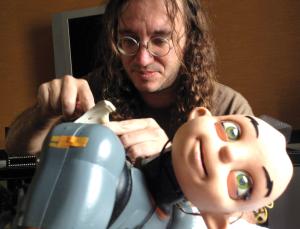
Artificial intelligence researcher Ben Goertzel wants to create robots far more intelligent than humans


Why will your robot, Adam Z1, be a toddler?

We are not trying to make a robot exactly like a 3-year-old. There is no toilet training involved! Our main goal is for him to engage in creative play like a young child. For example, if you ask him to “build me something I haven’t seen before” using foam blocks, he would remember what he’d seen you see and then build something different. A smart 3-year-old can do this but no robot today can.

Where will that lead?
What I want to do is make thinking machines that are far smarter than humans. Step one is to make an AI program that understands the world, and itself, in a basic common-sense manner. I think the best way to get there is to build a robot toddler.

How will you get from toddler-level smarts to super-intelligence?
We have specialised algorithms that can predict the stock market and genetic causes of disease. Once we get an AI with basic common sense, you can hybridise with existing narrow software. By putting the two together, you are going to get a whole new kind of artificial general intelligence expert – good at solving specialised problems, but in a way that uses contextual understanding.

Many have tried to create human-like AI and failed. What will be different about yours?
Our open source AI project OpenCog has an architecture for general intelligence that incorporates all the different aspects of what the mind does. No one else seems to have that. Most computer scientists focus on one algorithm – for search or for pattern-recognition, perhaps. The human mind is more heterogeneous; it integrates a bunch of different algorithms. We have tried to encompass that complexity in a family of learning and memory algorithms that all work together.

Will you teach the robot or program it?
It will be a mix. The robot will watch people in the lab and experiment and fiddle with things, and we will also have a programming team improving the algorithms all the time. But there won’t be “build stairs” or “build a wall” programs that we write. It will have to learn these things from higher-level goals – like pleasing people, or getting gold stars.

Adam Z1’s body will be a highly lifelike Hanson robot – why is that important?
The main thing with the Hanson robot is that the face is highly expressive. In terms of social interactions, it is valuable to have a robot that can convey emotions and desires. He needs to learn from people: the more engaged they are, the better data they will give to power his learning.

You are crowdfunding Adam Z1. So far you have only $5000 of the $300,000 target…
Raising research money via crowdfunding is a very speculative thing. We viewed it as a kind of experiment, not only to gain money but also to learn how people react; what they say, what pushback they give. If we succeed, that would be awesome and will accelerate our progress. Fortunately we already have some funding, so the project is going forward one way or another.

http://www.newscientist.com/article/mg21929260.300-to-create-a-robot-with-common-sense-mimic-a-toddler.html#.Uez9QNK-pH8

China’s white dolphins on verge of extinction due to Hong Kong construction

Chinese-White-Dolphin

China’s unique white dolphins — famous for the actual pink hue of their skin — face going from endangered to extinct — with conservationists doubtful they can be saved.

“We’ve seen alarming decline in the last decade — 158 dolphins in 2003, just 61 dolphins in 2012,” says Samuel Hung, Chairman of the Hong Kong Dolphin Conservation Society.

“We are at a critical juncture on whether we can help the dolphins,” adds Hung. “I have no idea whether they will keep going down and down — but what I do know is we need to work urgently to come up with solutions to clean up the dolphin’s habitat.”

Land reclamation for massive engineering projects, resulting water pollution and boat strikes have exacted a heavy toll on the white dolphin population, which is mainly found in the waters of Hong Kong’s Pearl River Delta in southern China.

In 2016, the first automobiles are expected to roll across the 42-kilometer Hong Kong-Zhuhai-Macau bridge, respectively connecting the Asian financial hub with the Chinese mainland’s “special economic zone” and the world’s gambling capital. Now under construction, the world’s longest cross-sea bridge and tunnel link will go “right through the heart of the dolphin population,” says Hung. “There will be lots of piling activities to construct the bridge.”

By 2023, Hong Kong aims to complete a third runway for Chep Lap Kok international airport, already one of the world’s busiest. In the absence of soil on which to build, 650 hectares of land — an area more than 5,000 Olympic-sized swimming pools — will be reclaimed from the sea. The area is also prime habitat for the Chinese white dolphin.

The Hong Kong government has also proposed four additional land reclamation projects in dolphin-populated areas that aim to increase the amount of land on which to build in order to bring down the high cost of housing, adds Hung.

Yet, despite Hong Kong’s plans for numerous engineering projects that will impact the white dolphins’ habitats, the founder of the 10-year old Hong Kong Dolphin Conservation Society says he “actually applauds” the government’s conservation efforts.

“I don’t doubt their desire to conserve,” explains Hung, who adds that the Hong Kong government has provided more than $1 million Hong Kong dollars (US$125,000) each year for environmental research funds, set up a marine protection park for the white dolphins and helped monitor dolphin population numbers.

“But it’s the other bureaus who want to push economic projects” including Hong Kong’s Airport Authority and the Civil Engineering and Development Department, says Hung.

“The economic departments are more influential so our voice for conservation work is drowned out by the voice for construction.”

http://edition.cnn.com/2013/07/19/world/china-hong-kong-white-dolphin-extinction/?hpt=hp_c2

Tea Party leader Ken Crow speaks about breeding, bloodlines and DNA at Tea Party rally in Washington D.C.

Last week, Tea Party activist and lawmakers within the GOP gathered near the Capitol to express their feelings against the immigration reform bill passed by the Senate.

Members of the Republican Party, including Rep. Steve King (Iowa), and Senatores Jeff Sessions (Ala.) and Ted Cruz (Texas) showed up to the rally, which spoke against a pathway to citizenship for undocumented immigrants.

But it was the remarks from Ken Crow, one of the Tea Party community’s co-founders, that alarmed George Zornick of The Nation.

Zornick uploaded the clip of Crow’s remarks onto YouTube that same day, with the caption: “At a rally against immigration reform on Capitol Hill on July 15, 2013, Tea Party leader Ken Crow has some really ugly things to day about “well-bred” Americans and supposedly inferior cultures. Why won’t the media be honest about what some people opposed to immigration reform think?”

Some of Crow’s remarks during the rally are as follows:

“From those incredible blood lines of Thomas Jefferson and George Washington and John Smith. And all these great Americans, Martin Luther King. These great Americans who built this country. You came from them.”

“And the unique thing about being from that part of the world, when you learn about breeding, you learn that you cannot breed Secretariat to a donkey and expect to win the Kentucky Derby,” he said. “You guys have incredible DNA and don’t forget it.”