New research shows that workplace clutter may increase creativity

Severe-Workplace-Clutter

Here’s a toast to the slob in the office, the gal with so much junk on her desk she can’t find her telephone. All that clutter may be part of the reason she is so creative.

For years, we’ve been told that piles of personal rubbish have got to be a liability. Now there’s a flip side to that theorem.

Researchers at the University of Minnesota decided to take a look at a long-established principle of human honesty and productivity — keep your work area clean and you will be more likely to work your tail off, stay honest, be generous with your coworkers, and on and on.

Cleanliness, after all, is next to godliness.

“We were thinking about doing a paper showing how being tidy makes people kind of do the right thing,” psychologist Kathleen Vohs, lead author of a study in the journal Psychological Science, said in a telephone interview. “And then we started challenging ourselves. Is there anything that goes along with a messy environment that could be good?”

So Vohs and her co-workers conducted a series of experiments in Holland and the United States to see if there’s an up-side to untidiness. The finding, she said, surprised even the researchers.

A messy work environment, the research suggested, can bring out a person’s creativity and lead to the birth of bold, new ideas. In other words, a less- than-perfect work environment can make a person more likely to think out of the box, or at least above the horizon of those neat people in the office.

That doesn’t mean you can set a nitwit in front of a cluttered desk and end up with another Einstein, who is said to have muttered these immortal words: “If a cluttered desk is a sign of a cluttered mind, of what, then, is an empty desk a sign?”

Numerous historic photos of Einstein’s office show he was no neat freak.

No amount of clutter is going to make an empty brain creative, but this research indicates that a little clutter may bring out the freshest and most creative side of you.

“The environment doesn’t create something that isn’t already there,” Vohs said. “To the extent that you are creative, it pulls it out of you.”

Not a lot of researchers have taken up the banner of messy desks, so there’s not much to compare this work with, but the research involved a large number of participants, both young and old, and it led to these conclusions:

Sociology’s “broken windows theory” is not entirely accurate. According to Vohs’ study, that theory “posits that minor signs of disorder can cause much bigger consequences, such as delinquency and criminality.” But her research suggested a less-pristine environment can leave persons free to turn to creativity instead of crime.

“Orderly environments would encourage adherence to social convention and overall conservatism, whereas disorderly environments would encourage people to seek novelty and unconventional routes.”

“Our findings imply that varying the environment can be an effective way to shape behavior.”

Those findings resulted from three experiments in which participants were assigned tasks while seated in a neat, orderly office, or in an office that was identical in every way except it was filled with clutter, such as papers on the floor and stacks of files on the desk.

Thirty-four Dutch students were tested to see if the orderliness of the room had any effect on their generosity and sense of needing to do the right thing. At the end of the experiment, for example, the students were asked to contribute to a worthy cause.

Some 82 percent of the students in the orderly room contributed money, compared to only 47 percent in the disorderly room.

As they left the room, they were offered a treat, either an apple or a piece of candy. Participants from the orderly room were more than three times as likely to take the apple. Moral: orderliness brought out a need do the right thing.

In a second experiment, participants were told to come up with new uses for ping-pong balls to help a manufacturer.

“Participants in the disorderly room generated more highly creative ideas than did participants in the orderly room,” the study said.

In the final experiment, 188 American adults were asked to pick from a list of new options to be added to a restaurant’s menu. Participants from the orderly room were far more likely to pick a healthy option than were participants from a disorderly room.

The researchers described the findings as “robust,” meaning there was little question that the environment directly influenced the behavior of the participants.

“Disorderly environments seem to inspire breaking free of tradition, which can produce fresh insights,” the researchers concluded. “Orderly environments, in contrast, encourage convention and playing it safe.”

Something good can come from either setting, Vohs said. A tidy workplace may help people walk a straight line. A messy desk may help them figure out a new way to keep from walking at all.

http://abcnews.go.com/Technology/tidy-messy-environment-impact-decisions-behavior-study/story?id=19909678

Gregory Kloehn makes New York City dumpster into home

Dumpster 8

Dumpster 7

Dumpster 6

Dumpster 5

Dumpster 4

Dumpster 3

Dumpster 2

dumpster 1

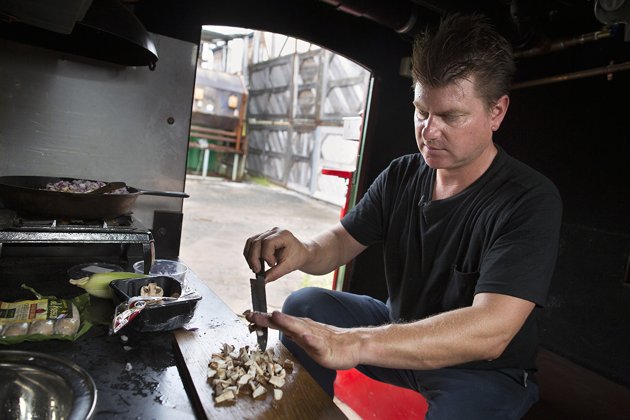
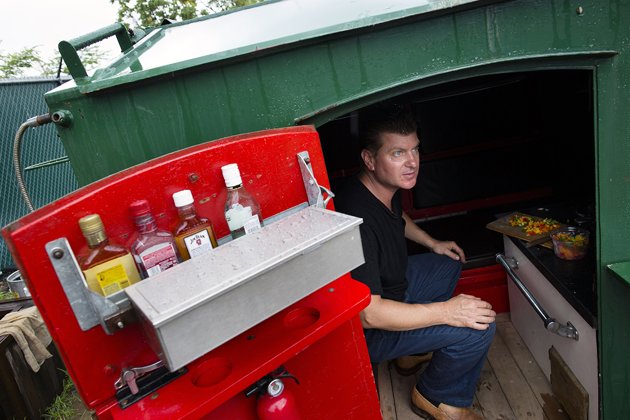
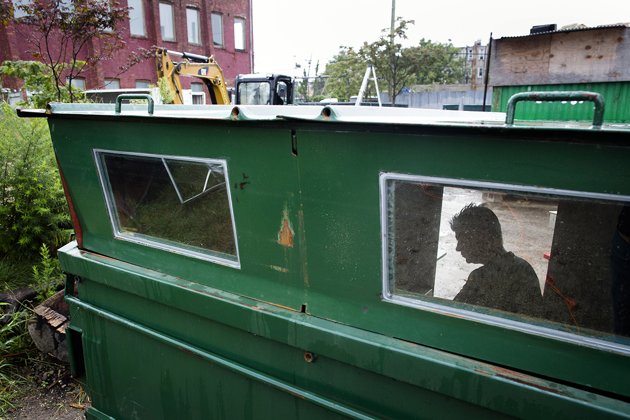
A California designer has turned a $2,000 dumpster into a fully functional home, complete with a bathroom, bed, kitchen and sun deck.

Gregory Kloehn converted the dumpster in Brooklyn off of a hunch, and now he uses it whenever he stays in New York.

‘It just hit me,’ he said on HGTV’s show, ‘You Live in What?’ ‘I thought hey, this is the perfect shape for a home.’

Kloehn added wheels to the bottom of the dumpster so it could be more easily transported and carved a custom door on the side for easy entry and exit.

For drinking water, he installed a six-gallon water tank on the roof.

The same water is funneled into the tiny toilet when he needs to use the bathroom. The water is also hooked up to an outdoor shower.

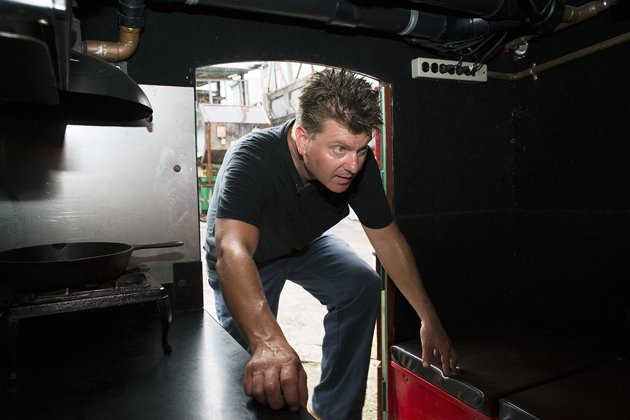
The red-and-black-colored interior is insulated with padding and features a small seating area. But sleeping appears uncomfortable. He appears to only barely fit inside when he lies down.

The small kitchen takes up one corner of the dumpster and features a microwave and mini stove. Both run on electricity.

A small grill is also attached to the outside of the dumpster. On the roof, an umbrella provides some shade for outdoor lounging.

If he wants to get some extra sunlight inside, as well, he can lift the retractable roof to expose two windows and let in the light.

‘I think [passersby] are just surprised that someone would take something like this and spend enough time to make it a home,’ he told HGTV.

Thanks to Mr. Cuomo for bringing this to the attention of the It’s Interesting community.

Read more: http://www.dailymail.co.uk/news/article-2387619/Gregory-Kloehn-California-designer-turns-DUMPSTER-into-Brooklyn-getaway-complete-toilet-stove-sun-deck.html#ixzz2bcXoXQFm

Barnaby Jack dies one week before scheduled talk about how to hack implantable medical devices

Branaby Jack

The mysterious death of a San Francisco “ethical hacker,” who was set to give a speech on infiltrating wireless implantable medical devices, has caused speculation that he was the victim of a targeted attack, and raised alarm about the safety of devices such as pacemakers.

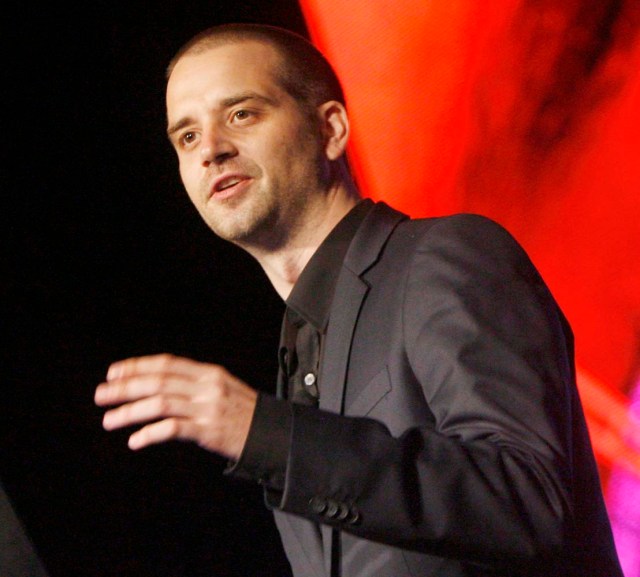
Professional hacker Barnaby Jack, who famously demonstrated how to make ATMs spit out cash, was set to reveal the secrets of how implantable medical devices, specifically pacemakers, can be hacked, in a talk scheduled for last Thursday at the Black Hat security conference in Las Vegas.

“He was able to remotely exploit them, and this talk was really dedicated to how the manufacturers could improve the security of the device,” IOactive CEO Jennifer Steffens said.

But his girlfriend found the 35-year-old dead in his San Francisco home July 25. The cause of death is still under investigation, according to the San Francisco coroner’s office.

Police say they have ruled out foul play, but the cause of death might not be determined by the medical examiner for another month.

Jack dedicated his career to exposing the vulnerabilities hackers can exploit. The title of his scheduled talk at the Black Hat security conference was “Implantable Medical Devices: Hacking Humans,” and he planned to discuss how these devices “operate and communicate, and the security shortcomings of the current protocols,” according to the Black Hat website.

“He wanted to know, how could that stuff down there fail, and especially how it could fail if there were some not nice people out there trying to make it crash,” security researcher Dan Kaminsky said.

Jack’s research into the possibility of hacking medical devices is reminiscent of the plot twist in the end of the second season of the Emmy-award winning series “Homeland,” in which the fictional vice president was killed when his pacemaker was hacked by terrorists.

That scene got people wondering whether it is possible to hack implantable medical devices. In an interview with Bloomberg News before his death, Jack said that the answer is yes.

“Once I took a look, I was actually shocked to see how many vulnerabilities existed,” Jack said.

The FDA said in a statement that there is no cause for alarm for the nearly 3 million Americans who have pacemakers.

“[The FDA] is not aware of any patient injuries or deaths associated with these incidents, nor do we have any indication that any specific devices or systems in clinical use have been purposely targeted at this time,” the regulatory agency said.

Meanwhile, questions — and even conspiracy theories — are swirling around the Web regarding Jacks’ untimely death, with some even blaming the U.S. government.

“This is an industry where a lot of money and danger is at stake,” ABC News consultant and former FBI Agent Brad Garrett said. “The work he was doing certainly put him at some risk,” ABC News consultant and former FBI Agent Brad Garrett said.

http://abcnews.go.com/US/hackers-mysterious-death-prompts-conspiracy-theories-concerns-pacemakers/story?id=19868557

Hacking researchers take control of cars

hack car

Forget car jacking. As cars become increasingly complex, car hacking — taking over a vehicle’s computer-controlled systems — is becoming a very real threat.

At the DEF CON hacking conference this weekend in Las Vegas, two computer software researchers with a grant from the Defense Advanced Research Projects Agency released the code they wrote to carry out attacks on a Toyota Prius and a Ford Escape and provide links to their findings in a 100-page white paper,
Their goal? To help other researchers find and address auto industry security flaws before malicious hackers find ways to prey on unsuspecting drivers.

“The more people we can get on the problem, the better,” Charlie Miller, a Twitter security engineer, told the Herald last night. “Let’s fix it now before anyone’s hurt.”

Sitting inside a Toyota Prius and a Ford Escape with laptops connected to the vehicles’ computer networks, Miller and Chris Valasek, director of security intelligence at IOActive, were able to disable the Ford’s brakes so the car kept moving no matter how hard the driver pressed the pedal. They were also able to force the Toyota to accelerate its engine, brake suddenly at 80 mph and jerk the steering wheel.

“We believe our electronic control systems are robust and secure and we will continue to rigorously test and improve them,” said a spokeswoman for Toyota, adding the company, and the auto industry, is focused on preventing remote hacking into a vehicle’s control systems.

They did not attempt to attack the vehicles remotely, Miller said, because that already had been done in a 2010 study by researchers at the University of Washington and the University of California at San Diego.

In May, the U.S. Department of Homeland Security issued an advisory warning of flaws in the wireless Bluetooth systems in some cars that could be exploited by an outsider to take control of some of the car’s functions.

“As you computerize more aspects of a car, those are more things hackers can control,” Miller said. “The bottom line is you’re safer in a car with no bells and whistles.”

Tiffany Rad, a senior researcher at Woburn-based Kaspersky Lab, which provides protection against cyber threats, said auto manufacturers should be concerned now that Miller and Valasek are making their code public.

“If these two guys can do this, it means to me the bad guys can do it, too, now that it’s public,” Rad said. “It lowers the bar to replicate what they did.”

http://bostonherald.com/business/automotive/2013/08/hacking_researchers_take_control_of_cars

Thanks to Ray Gaudette for bringing this to the It’s Interesting community.

Man tries to smuggle turtle onto plane by hiding it in a hamburger

turtle-burger-l

A man tried to smuggle his pet turtle through security in Guangzhou Baiyun International Airport by hiding it in a KFC hamburger.

The incident occurred on the morning of July 29, when a man, surnamed Li, was about to board China Southern Airlines flight 345 to Beijing, Guangzhou Daily reported. As Li passed through airport security, X-ray screening machines detected a few “odd protrusions” sticking out of a KFC burger that the man had packed in his bag.

Airport staff determined that the protrusions looked suspiciously like turtle limbs, and asked to inspect Li’s luggage.

“There’s no turtle in there, just a hamburger,” Li reportedly insisted. “There’s nothing special to see inside.”

Li finally acquiesced to an inspection after repeated requests from airport staff, who uncovered the pet turtle hidden inside the burger. When asked why he had devised this strange idea, Li said that he had only wanted to travel together with his “beloved” turtle.

After staff patiently explained that turtles could not be smuggled on board the plane, Li reluctantly agreed to allow a friend to care for his pet while he was away.

http://www.scmp.com/news/china-insider/article/1293310/man-tries-smuggle-turtle-plane-hiding-it-hamburger

Scientists in China grow soft teeth from urine

teeth2

Scientists have grown rudimentary teeth out of the most unlikely of sources, human urine.

The results, published in Cell Regeneration Journal, showed that urine could be used as a source of stem cells that in turn could be grown into tiny tooth-like structures.

The team from China hopes the technique could be developed into a way of replacing lost teeth.

Other stem cell researchers caution that that goal faces many challenges.

Teams of researchers around the world are looking for ways of growing new teeth to replace those lost with age and poor dental hygiene.

Stem cells – the master cells which can grow into any type of tissue – are a popular area of research.

The group at the Guangzhou Institutes of Biomedicine and Health used urine as the starting point.

Cells which are normally passed from the body, such as those from the lining of the body’s waterworks, are harvested in the laboratory. These collected cells are then coaxed into becoming stem cells.

A mix of these cells and other material from a mouse was implanted into the animals.

The researchers said that after three weeks the bundle of cells started to resemble a tooth: “The tooth-like structure contained dental pulp, dentin, enamel space and enamel organ.”

However, the “teeth” were not as hard as natural teeth.

This piece of research is not immediately going to lead to new options for the dentist, but the researchers say it could lead to further studies towards “the final dream of total regeneration of human teeth for clinical therapy”.

Prof Chris Mason, a stem cell scientist at University College London, said urine was a poor starting point.

“It is probably one of the worst sources, there are very few cells in the first place and the efficiency of turning them into stem cells is very low.

“You just wouldn’t do it in this way.”

He also warned that the risk of contamination, such as through bacteria, was much higher than with other sources of cells.

Prof Mason added: “The big challenge here is the teeth have got a pulp with nerve and blood vessels which have to make sure they integrate to get permanent teeth.”

http://www.bbc.co.uk/news/health-23492425

Thanks to Kebmodee for bringing this to the attention of the It’s Interesting community.

Monogamy may have evolved to keep baby-killers away

monogamy

Social monogamy – when a male and female of the species stick together for the long term, although may mate with others – is rare in mammals generally. However, it occurs in over a quarter of primate species, including humans, gibbons and many New World monkeys, such as titis.

To investigate what originally drove us to establish such pair bonds, a team led by Kit Opie of University College London and Susanne Shultz from the University of Manchester, UK, gathered data on the mating behaviour of 230 primate species. They selected behavioural traits associated with several possible evolutionary drivers of monogamy, including the risk of infanticide, the need for paternal care and the potential for guarding female mates.

Using data on the genetic relationships between the species, the team ran millions of computer simulations of the evolution of these traits to work out which came first.

All three were linked to the evolution of monogamy but only behaviours associated with infanticide actually preceded it, suggesting that this was the driver. Suckling infants are most likely to be killed by unrelated males, in order to bring the mother back into ovulation.

With pair-bonding in place, not only would a mother have a male to help protect the infant from marauding males, but there would then be the opportunity for the male to help care for it by providing extra resources. This means the infant can be weaned earlier, again reducing the chance of it being killed.

“Until recently, reconstructing how behaviour evolves has been very tricky as there are few behavioural traces in the fossil record. The statistical approach we have used allows us to bring the fossils to life and to understand the factors that have led to the evolution of monogamy in humans and other primates,” says Shultz.

Carel van Schaik, a primatologist at the University of Zurich in Switzerland says the results are solid but questions whether they can be extrapolated to humans. He says evidence suggests that humans were never really monogamous and that the monogamy we see today in many cultures is socially imposed.

Shultz counters that there is fossil evidence pointing to monogamy in australopithecines, the hominin genus from which modern humans descended.

“Although we suggest that infanticide may help explain the evolution of monogamy in humans, we do not argue that it is the only factor nor that monogamy is universal,” Shultz says. “I would suggest that where infanticide risk is high, as it would be with our ancestors, having a father provide protection and care would facilitate the evolution of the modern human extended childhood.”

Journal reference: PNAS, DOI: 10.1073/pnas.1307903110

Court orders reckless driver to wear ‘idiot’ sign

Instead of a dunce cap in the corner, an Ohio woman will have to wear an “idiot” sign at an intersection as punishment for driving on the sidewalk.

Shena Hardin, 32, was caught on a cellphone camera as her car swerved onto the sidewalk to get around a bus picking up and dropping off children on East 38th Street in Cleveland. The bus driver was recording and police were ready because Hardin allegedly passed the bus on the sidewalk on a regular basis.

She originally pleaded not guilty to charges of not stopping for a school bus, which was picking up a disabled child, and reckless operation of a vehicle but was convicted.

She received a $250 fine and a 30-day licence suspension, according to the report.

The judge also ordered Hardin to stand on a street near where the offence took place for an hour a day for 2 days wearing a sign that reads: Only an idiot drives on the sidewalk to avoid a school bus.”

http://cnews.canoe.ca/CNEWS/WeirdNews/2012/11/06/20335271.html

idiot

On the first day she smoked, listened to music and sent text messages while standing with the sign.

Cleveland Municipal Judge Pinkey Carr, not happy with Hardin’s nonchalant behavior, told Hardin’s attorney Tuesday that she expected better behavior.

The next morning, Hardin was not smoking or texting while holding the 22-inch sign that reads, “Only an idiot would drive on the sidewalk to avoid a school bus.”

And a radio station personality stood beside her with a sign that read, “If she’s an idiot, so am I.” Archie Berwick, who said he is with WLFM FM/87.7, said everyone has made mistakes, and it’s insulting to call someone an idiot.

Dozens of reporters and onlookers milled around the corner, including the mother of a child who rides the bus Hardin drove around.

“She did it every morning, putting my daughter in danger,” Lisa Kelley said. “She’s a fool.”

Hardin refused to talk to reporters and refused to apologize for her behavior.

“I don’t owe these people anything,” she said. “If the kids (who were on the school bus she illegally passed) were here, I would apologize to them.”

The rest of the hour the woman stood holding the sign, as dozens of people stopped their cars and took pictures and videos. Many called her “fool” and cursed at her.

Carr said Tuesday, “I saw television footage of her smoking and texting, and the only time she held that sign up was to use it as a shield to block the wind so she could light up her cigarettes. She was making a mockery of my court order.”

Hardin works as an administrative assistant at the Cleveland State University Police Department.

http://www.cleveland.com/metro/index.ssf/2012/11/hardin.html

Pea plant grows inside man’s lung

ccccc

Ron Sveden had been battling emphysema for months when his condition deteriorated.

He was steeling himself for a cancer diagnosis when X-rays revealed the growth in his lung.

Doctors believe that Mr Sveden ate the pea at some point, but it “went down the wrong way” and sprouted.

“One of the first meals I had in the hospital after the surgery had peas for the vegetable. I laughed to myself and ate them,” Mr Sveden told a local Boston TV reporter.

Mr Sveden said the plant was about half an inch (1.25cm) in size.

“Whether this would have gone full-term and I’d be working for the Jolly Green Giant, I don’t know. I think the thing that finally dawned on me is that it wasn’t the cancer,” Mr Sveden said.

http://www.bbc.co.uk/news/world-us-canada-10945050