Seattle plans to grow first free food forest

forest

The city’s new park will be filled with edible plants, and everything from pears to herbs will be free for the taking.

Seattle’s new food forest aims to be an edible wilderness. Seattle’s vision of an urban food oasis is going forward. A seven-acre plot of land in the city’s Beacon Hill neighborhood will be planted with hundreds of different kinds of edibles: walnut and chestnut trees; blueberry and raspberry bushes; fruit trees, including apples and pears; exotics like pineapple, yuzu citrus, guava, persimmons, honeyberries, and lingonberries; herbs; and more. All will be available for public plucking to anyone who wanders into the city’s first food forest.

“This is totally innovative, and has never been done before in a public park,” Margarett Harrison, lead landscape architect for the Beacon Food Forest project. Harrison is working on construction and permit drawings now and expects to break ground this summer.

The concept of a food forest certainly pushes the envelope on urban agriculture and is grounded in the concept of permaculture, which means it will be perennial and self-sustaining, like a forest is in the wild. Not only is this forest Seattle’s first large-scale permaculture project, but it’s also believed to be the first of its kind in the nation.

“The concept means we consider the soils, companion plants, insects, bugs—everything will be mutually beneficial to each other,” says Harrison.

That the plan came together at all is remarkable on its own. What started as a group project for a permaculture design course ended up as a textbook example of community outreach gone right.

“Friends of the Food Forest undertook heroic outreach efforts to secure neighborhood support. The team mailed over 6,000 postcards in five different languages, tabled at events and fairs, and posted fliers,” writes Robert Mellinger for Crosscut.

Neighborhood input was so valued by the organizers, they even used translators to help Chinese residents have a voice in the planning.

So just who gets to harvest all that low-hanging fruit when the time comes?

“Anyone and everyone,” says Harrison. “There was major discussion about it. People worried, ‘What if someone comes and takes all the blueberries? That could very well happen, but maybe someone needed those blueberries. We look at it this way—if we have none at the end of blueberry season, then it means we’re successful.”

http://delightmakers.com/news-bleat/seattles-first-food-forest/

Thanks to Jody Troupe for bringing this to the attention of the It’s Interesting community.

Chinese farmer grows Buddha-shaped pears

pear3
pear2
pear1

Gao Xianzhang has managed to create what some would call the holiest fruits ever, pears shaped like Buddha.

Gao has been working on his pear-growing technique for six years and this season he managed to grow 10,000 Buddha-shaped baby pears.

Each fruit is grown in an intricate Buddha mould and ends up looking like a juicy figurine.

The ingenious farmer says the locals in his home village of Hexia, northern China, have been buying his Buddha pears as soon as he picks them from the trees.

Most of them think they are cute and that they bring good luck.

http://delightmakers.com/news-bleat/chinese-farmer-grows-buddha-shaped-pears/

Thanks to Jody Troupe for bringing this to the attention of the It’s Interesting community.

Physicists discover ‘clearest evidence yet’ that the Universe is a hologram

god_particle
1_14328

At a black hole, Albert Einstein’s theory of gravity apparently clashes with quantum physics, but that conflict could be solved if the Universe were a holographic projection.

A team of physicists have provided what has been described by the journal Nature as the “clearest evidence yet” that our universe is a hologram.

The new research could help reconcile one of modern physics’ most enduring problems : the apparent inconsistencies between the different models of the universe as explained by quantum physics and Einstein’s theory of gravity.

The two new scientific papers are the culmination of years’ work led by Yoshifumi Hyakutake of Ibaraki University in Japan, and deal with hypothetical calculations of the energies of black holes in different universes.

The idea of the universe existing as a ‘hologram’ doesn’t refer to a Matrix-like illusion, but the theory that the three dimensions we perceive are actually just “painted” onto the cosmological horizon – the boundary of the known universe.

If this sounds paradoxical, try to imagine a holographic picture that changes as you move it. Although the picture is two dimensional, observing it from different locations creates the illusion that it is 3D.

This model of the universe helps explain some inconsistencies between general relativity (Einstein’s theory) and quantum physics. Although Einstein’s work underpins much of modern physics, at certain extremes (such as in the middle of a black hole) the principles he outlined break down and the laws of quantum physics take over.

The traditional method of reconciling these two models has come from the 1997 work of theoretical physicist Juan Maldacena, whose ideas built upon string theory. This is one of the most well respected ‘theories of everything’ (Stephen Hawking is a fan) and it posits that one-dimensional vibrating objects known as ‘strings’ are the elementary particles of the universe.

Maldacena has welcomed the new research by Hyakutake and his team, telling the journal Nature that the findings are “an interesting way to test many ideas in quantum gravity and string theory.”

Leonard Susskind, a theoretical physicist regarded as one of the fathers of string theory, added that the work by the Japanese team “numerically confirmed, perhaps for the first time, something we were fairly sure had to be true, but was still a conjecture.”

Here is the original press release from Nature:

A team of physicists has provided some of the clearest evidence yet that our Universe could be just one big projection.

In 1997, theoretical physicist Juan Maldacena proposed1 that an audacious model of the Universe in which gravity arises from infinitesimally thin, vibrating strings could be reinterpreted in terms of well-established physics. The mathematically intricate world of strings, which exist in nine dimensions of space plus one of time, would be merely a hologram: the real action would play out in a simpler, flatter cosmos where there is no gravity.

Maldacena’s idea thrilled physicists because it offered a way to put the popular but still unproven theory of strings on solid footing — and because it solved apparent inconsistencies between quantum physics and Einstein’s theory of gravity. It provided physicists with a mathematical Rosetta stone, a ‘duality’, that allowed them to translate back and forth between the two languages, and solve problems in one model that seemed intractable in the other and vice versa. But although the validity of Maldacena’s ideas has pretty much been taken for granted ever since, a rigorous proof has been elusive.

In two papers posted on the arXiv repository, Yoshifumi Hyakutake of Ibaraki University in Japan and his colleagues now provide, if not an actual proof, at least compelling evidence that Maldacena’s conjecture is true.

In one paper2, Hyakutake computes the internal energy of a black hole, the position of its event horizon (the boundary between the black hole and the rest of the Universe), its entropy and other properties based on the predictions of string theory as well as the effects of so-called virtual particles that continuously pop into and out of existence. In the other3, he and his collaborators calculate the internal energy of the corresponding lower-dimensional cosmos with no gravity. The two computer calculations match.

“It seems to be a correct computation,” says Maldacena, who is now at the Institute for Advanced Study in Princeton, New Jersey and who did not contribute to the team’s work.

The findings “are an interesting way to test many ideas in quantum gravity and string theory”, Maldacena adds. The two papers, he notes, are the culmination of a series of articles contributed by the Japanese team over the past few years. “The whole sequence of papers is very nice because it tests the dual [nature of the universes] in regimes where there are no analytic tests.”

“They have numerically confirmed, perhaps for the first time, something we were fairly sure had to be true, but was still a conjecture — namely that the thermodynamics of certain black holes can be reproduced from a lower-dimensional universe,” says Leonard Susskind, a theoretical physicist at Stanford University in California who was among the first theoreticians to explore the idea of holographic universes.

Neither of the model universes explored by the Japanese team resembles our own, Maldacena notes. The cosmos with a black hole has ten dimensions, with eight of them forming an eight-dimensional sphere. The lower-dimensional, gravity-free one has but a single dimension, and its menagerie of quantum particles resembles a group of idealized springs, or harmonic oscillators, attached to one another.

Nevertheless, says Maldacena, the numerical proof that these two seemingly disparate worlds are actually identical gives hope that the gravitational properties of our Universe can one day be explained by a simpler cosmos purely in terms of quantum theory.

http://www.nature.com/news/simulations-back-up-theory-that-universe-is-a-hologram-1.14328#/b1

Robo Faber – a robot that can generate infinite number of unique abstract ‘hand-drawings’

robot art8

robot art7

robot art6

robot art5

robot art4

robot art 3

robot art2

robot art 1

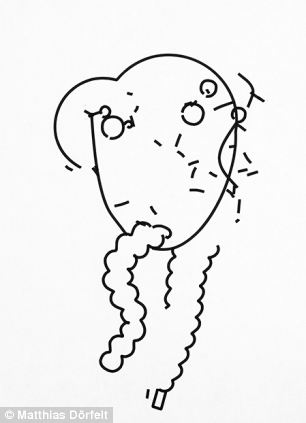
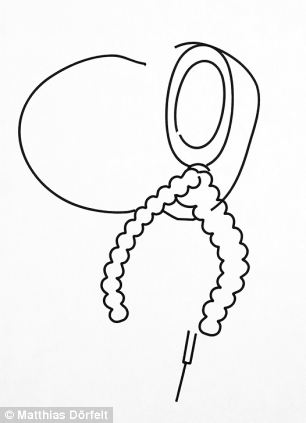
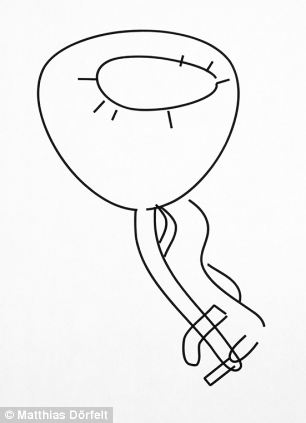
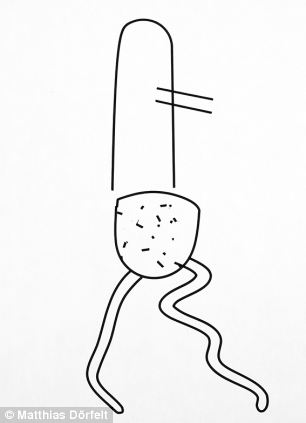
It might not be Van Gogh, but this robot’s work certainly provokes a reaction.
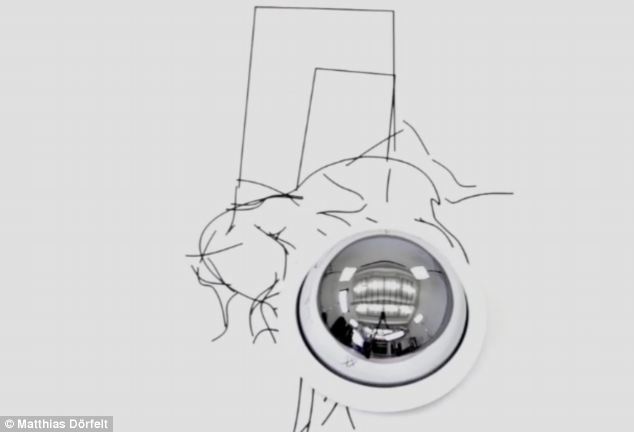
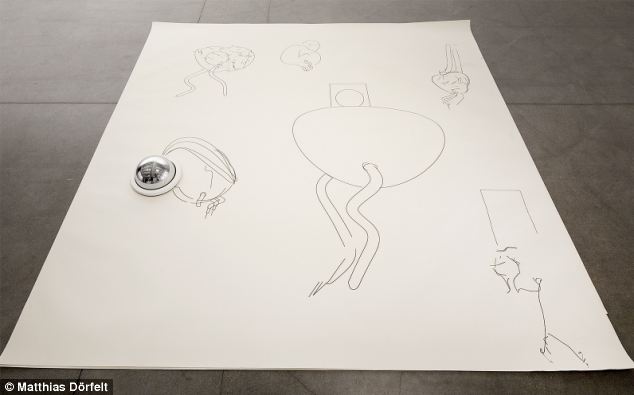
When let loose on paper, the robot runs riot drawing bold, bizarre and seemingly random shapes.

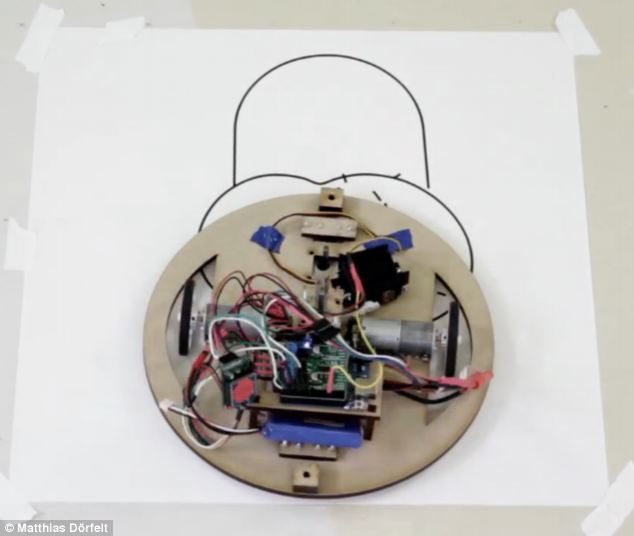
The machine, named Robo Faber, is programmed with an algorithm created by Los Angeles-based artist Matthias Dörfelt.

‘I did a lot of work recently where I wrote custom computer software to generate drawings that look very similar to my own hand drawn ones,’ creator Mr Dörfelt told MailOnline.

‘Creating a robot that would actually use a pen to bring these drawings into a physical form was a logical next step.’

Robo Faber is a custom built differential drive robot consisting of two dc motors with encoders at each of the motor shafts.
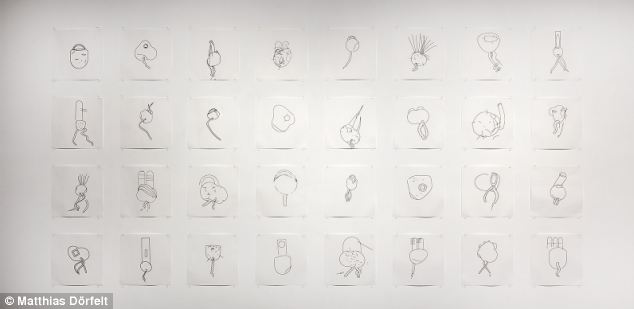
Each piece of art is entirely unique and there is no clear logic to how the pieces fit together.

According to Mr Dörfelt, the intention was to leave it open to the audience to find the connections that make sense to them.
‘The reactions have been extremely positive,’ said Mr Dörfelt.

‘I think the drawings have a quality to them that make them interesting on their own, even if you don’t know the whole robot story or that they were created by a robot.’

Mr Dörfelt has previously used computer algorithms to create a wall of randomly generated, unique faces, and hopes to continue to explore how robots can create works of art.

Read more: http://www.dailymail.co.uk/sciencetech/article-2493412/The-robot-DOODLE-Machine-creates-abstract-drawings–image-same.html#ixzz2nSzL2CX2

Austria media reports on speculated robot suicide

o-ROBOT-SUICIDE-570

Firemen were called to a house fire that broke out after a mechanical cleaning gadget somehow switched itself on and destroyed itself by moving onto a kitchen hotplate.
Local media in Austria have referred to the incident as ‘robot suicide’ and even suggested it was fed up with the constant cleaning it had to do.

Fireman Helmut Kniewasser was one of those called to tackle the blaze at Hinterstoder in Kirchdorf, Austria.

He said: ‘The home-owner had put the small robot on the work surface to clean up some spilled cereal. Once the robot had done its job it was switched off but left on the kitchen sideboard.

‘The 44-year-old house owner, together with his wife and son, then left the house and were not home when the robot set off.

‘Somehow it seems to have reactivated itself and made its way along the work surface where it pushed a cooking pot out of the way and basically that was the end of it.
‘It pretty quickly started to melt underneath and then stuck to the kitchen hotplate. It then caught fire. By the time we arrived, it was just a pile of ash.

‘The entire building had to be evacuated and there was severe smoke damage particularly in the flat where the robot had been in use.

‘I don’t know about the allegations of a robot suicide but the homeowner is insistent that the device was switched off – it’s a mystery how it came to be activated and ended up making its way to the hotplate.’

It took an hour to clean and make the building safe. But the family at least for the moment is homeless as their apartment is no longer habitable thanks to the smoke damage.

The homeowner said: ‘The company that makes the robots is selling dangerous devices, I intend to sue to get compensation. It has ruined my home as everything is smoke damaged.’

Read more: http://www.dailymail.co.uk/news/article-2503733/Paranoid-android-Cleaning-gadget-switches-moves-kitchen-hotplate-suicide-bid.html#ixzz2nSvEZAqf
F

Samantha West – robot telemarketer that denies it’s a robot

ways-messing-with-telemarketers-6

The phone call came from a charming woman with a bright, engaging voice to the cell phone of a TIME Washington Bureau Chief Michael Scherer. She wanted to offer a deal on health insurance, but something was fishy.

When Scherer asked point blank if she was a real person, or a computer-operated robot voice, she replied enthusiastically that she was real, with a charming laugh. But then she failed several other tests. When asked “What vegetable is found in tomato soup?” she said she did not understand the question. When asked multiple times what day of the week it was yesterday, she complained repeatedly of a bad connection.

Over the course of the next hour, several TIME reporters called her back, working to uncover the mystery of her bona fides. Her name, she said, was Samantha West, and she was definitely a robot, given the pitch perfect repetition of her answers. Her goal was to ask a series of questions about health coverage—”Are you on Medicare?” etc.—and then transfer the potential customer to a real person, who could close the sale. You can listen for yourself to some of the reporting here: http://newsfeed.time.com/2013/12/10/meet-the-robot-telemarketer-who-denies-shes-a-robot/

If you want, you can call her too. Her number is (484) 589-5611. This number, if you Google it, is the subject of much discussion online as other recipients of Samantha West calls complain on chat boards about the mysteriously persistent lady who keeps calling them. “A friendly sounded woman on the other end claimed I requested health insurance information,” writes one mark. “She doggedly refused to deviate from her script.”

After answering her questions, one TIME reporter was transferred to an actual human who did not promptly end the call, as others had when asked about Samantha. Asked for the company’s website, the real human on the other end of the line said it was premierhealthagency.com, the website of a Ft. Lauderdale company. “We’re here to help. . . because we care,” is the company motto on its homepage. A TIME reporter called the company directly, identified himself and said TIME was doing a story about the robot who calls people on the company’s behalf. “We don’t use robot calls, sir,” said the person who answered the phone, before promptly hanging up the phone.

When the number was called a second time, a real live employee of Premier Health Plans Inc., who gave his name as Bruce Martin, answered the phone. He said he was not sure if Samantha West’s phone number, mentioned above, was one of the company’s numbers. “First of all, we use TV, we use radio, we use Internet,” said Martin. He described the company as selling life insurance, health insurance and dental insurance. He asked that TIME publish the name of his company, the website and phone number in the article. “If you are going to publish this in the magazine, I’d like to get something out of it,” he said. The TIME reporter agreed to do just that.

Martin also said he would inquire internally about whether Samantha West worked for the company, but would not be able to respond to the request Monday night. TIME will update the story with any additional information he provides.

UPDATE: As of Dec. 11, one day after this story published, the phone number listed above was no longer answered by Samantha West. Rather, it diverted callers to a busy signal. Also the website, premierhealthagency.com, had been taken offline.

Read more: Samantha West The Telemarketer Robot Who Swears She’s Not a Robot | TIME.com http://newsfeed.time.com/2013/12/10/meet-the-robot-telemarketer-who-denies-shes-a-robot/#ixzz2nSpfusYd

Zhang Fuxing’s 400 kg iron shoes

Zhang Fuxing says all the heavy lifting can cure back pain and hemorrhoids.

A Chinese factory worker says walking in huge iron shoes weighing more than 200kg each can cure back pain, but faces hefty competition in his bid to build the country’s heaviest footwear.

“I’ve been walking with iron shoes for seven years,” said Zhang Fuxing, before strapping two crudely welded iron blocks to his feet.

“After they reached 400kg, I felt very proud. Next spring I plan to add 50kg.”

Zhang took a deep breath before each wrenching step in the towering footwear, with every impact leaving him struggling for balance.

It took him more than a minute to take 10 paces, but he claims to walk up to 15 metres each day in the shoes, which he has gradually increased in weight, and touts them as a cure for back pain and hemorrhoids.

Zhang, 52, credits his ability to move the shoes – which he leaves outdoors, safe in the knowledge that they are close to impossible for most people to lift – to the Chinese spiritual martial art of qigong, said to involve controlling the flow of supposed bodily energies.

“It’s not strong muscles that make you able to walk like this, the power comes from internal organs,” he said, adding: “When you walk with your heart it will work.”

Zhang believes his shoes to be the heaviest in China, but admits that competition from a number of other eccentrics renders his claim uncertain.

One of two Chinese iron shoe wearers to share a Guinness World Record for walking 10 metres backwards in heavyweight iron boots is Zhang Zhenghui from Changsha. According to a 2010 report by Xinhua news agency, he has gold-painted shoes weighing more than 200kg.

Lai Yingying, an entertainer from Fujian in the east, was shown by state broadcaster CCTV wearing shoes tipping the scales at a total of 300kg.

A runner, Liu Mei, took to exercising in metal footwear after growing bored of tying sandbags onto his trainers, the state-run China News Service reported, and challenged other exponents to compete for the title of “Iron Shoe King”.

His call “hit the world of eccentric stunt people like a tidal wave”, the report said, but there is no record of the contest having taken place.

Zhang Fuxing – who runs a workshop making machine parts – says he was inspired by one of these pioneers. “I saw someone wearing iron shoes on TV. They said it was good for the heart and bones,” he said.

At the time Zhang was suffering from back pain “so bad that I couldn’t bend over to wash my face”, but claims his symptoms disappeared just months after donning the footwear, an experience which left him wanting to share them with a wider audience.

He now manufactures a range of weighted metal footwear, which users strap over their existing shoes, in a small factory near his hometown in the northern city of Tangshan, and sells them online.

A snazzy red pair weighing 10kg each costs 550 yuan (HK$700), while the heaviest 60kg boots sell for 1,450 yuan.

He claims to have sold several hundred pairs, including at least 10 to his neighbours, several of whom gathered around on a chilly morning to watch Zhang take his wobbling steps.

“We’ve all worn his iron shoes, it makes your legs feel better,” said Chen Guanghua, a woman in her sixties. “We can’t all play badminton, but anyone can wear shoes.”

http://www.scmp.com/news/china/article/1376837/chinese-worker-gets-leg-200kg-iron-shoes

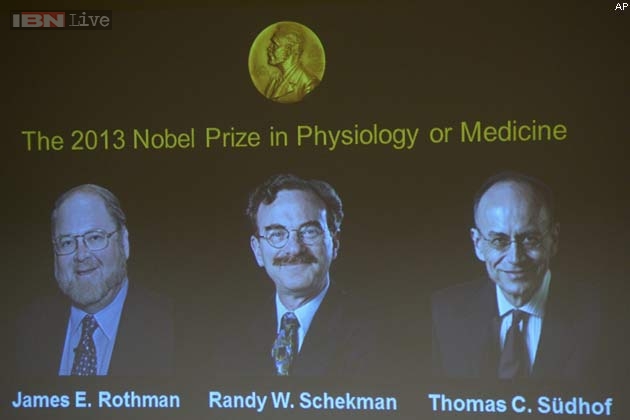
Nobel winner Randy Sheckman declares boycott of top science journals

2013nobelmedicinewinners

Randy Schekman says his lab will no longer send papers to Nature, Cell and Science as they distort scientific process.

Leading academic journals are distorting the scientific process and represent a “tyranny” that must be broken, according to a Nobel prize winner who has declared a boycott on the publications.

Randy Schekman, a US biologist who won the Nobel prize in physiology or medicine this year and receives his prize in Stockholm on Tuesday, said his lab would no longer send research papers to the top-tier journals, Nature, Cell and Science.

Schekman said pressure to publish in “luxury” journals encouraged researchers to cut corners and pursue trendy fields of science instead of doing more important work. The problem was exacerbated, he said, by editors who were not active scientists but professionals who favoured studies that were likely to make a splash.

The prestige of appearing in the major journals has led the Chinese Academy of Sciences to pay successful authors the equivalent of $30,000 (£18,000). Some researchers made half of their income through such “bribes”, Schekman said in an interview.

Writing in the Guardian, Schekman raises serious concerns over the journals’ practices and calls on others in the scientific community to take action.

“I have published in the big brands, including papers that won me a Nobel prize. But no longer,” he writes. “Just as Wall Street needs to break the hold of bonus culture, so science must break the tyranny of the luxury journals.”

Schekman is the editor of eLife, an online journal set up by the Wellcome Trust. Articles submitted to the journal – a competitor to Nature, Cell and Science – are discussed by reviewers who are working scientists and accepted if all agree. The papers are free for anyone to read.

Schekman criticises Nature, Cell and Science for artificially restricting the number of papers they accept, a policy he says stokes demand “like fashion designers who create limited-edition handbags.” He also attacks a widespread metric called an “impact factor”, used by many top-tier journals in their marketing.

A journal’s impact factor is a measure of how often its papers are cited, and is used as a proxy for quality. But Schekman said it was “toxic influence” on science that “introduced a distortion”. He writes: “A paper can become highly cited because it is good science – or because it is eye-catching, provocative, or wrong.”

Daniel Sirkis, a postdoc in Schekman’s lab, said many scientists wasted a lot of time trying to get their work into Cell, Science and Nature. “It’s true I could have a harder time getting my foot in the door of certain elite institutions without papers in these journals during my postdoc, but I don’t think I’d want to do science at a place that had this as one of their most important criteria for hiring anyway,” he told the Guardian.

Sebastian Springer, a biochemist at Jacobs University in Bremen, who worked with Schekman at the University of California, Berkeley, said he agreed there were major problems in scientific publishing, but no better model yet existed. “The system is not meritocratic. You don’t necessarily see the best papers published in those journals. The editors are not professional scientists, they are journalists which isn’t necessarily the greatest problem, but they emphasise novelty over solid work,” he said.

Springer said it was not enough for individual scientists to take a stand. Scientists are hired and awarded grants and fellowships on the basis of which journals they publish in. “The hiring committees all around the world need to acknowledge this issue,” he said.

Philip Campbell, editor-in-chief at Nature, said the journal had worked with the scientific community for more than 140 years and the support it had from authors and reviewers was validation that it served their needs.

“We select research for publication in Nature on the basis of scientific significance. That in turn may lead to citation impact and media coverage, but Nature editors aren’t driven by those considerations, and couldn’t predict them even if they wished to do so,” he said.

“The research community tends towards an over-reliance in assessing research by the journal in which it appears, or the impact factor of that journal. In a survey Nature Publishing Group conducted this year of over 20,000 scientists, the three most important factors in choosing a journal to submit to were: the reputation of the journal; the relevance of the journal content to their discipline; and the journal’s impact factor. My colleagues and I have expressed concerns about over-reliance on impact factors many times over the years, both in the pages of Nature and elsewhere.”

Monica Bradford, executive editor at Science, said: “We have a large circulation and printing additional papers has a real economic cost … Our editorial staff is dedicated to ensuring a thorough and professional peer review upon which they determine which papers to select for inclusion in our journal. There is nothing artificial about the acceptance rate. It reflects the scope and mission of our journal.”

Emilie Marcus, editor of Cell, said: “Since its launch nearly 40 years ago, Cell has focused on providing strong editorial vision, best-in-class author service with informed and responsive professional editors, rapid and rigorous peer-review from leading academic researchers, and sophisticated production quality. Cell’s raison d’etre is to serve science and scientists and if we fail to offer value for both our authors and readers, the journal will not flourish; for us doing so is a founding principle, not a luxury.”

http://www.theguardian.com/science/2013/dec/09/nobel-winner-boycott-science-journals?CMP=twt_fd

Thanks to Kebmodee for bringing this to the attention of the It’s Interesting community.