Western Scientists Look To Chinese Medicine For Fresh Leads

chinese medicine

by Alan Yu

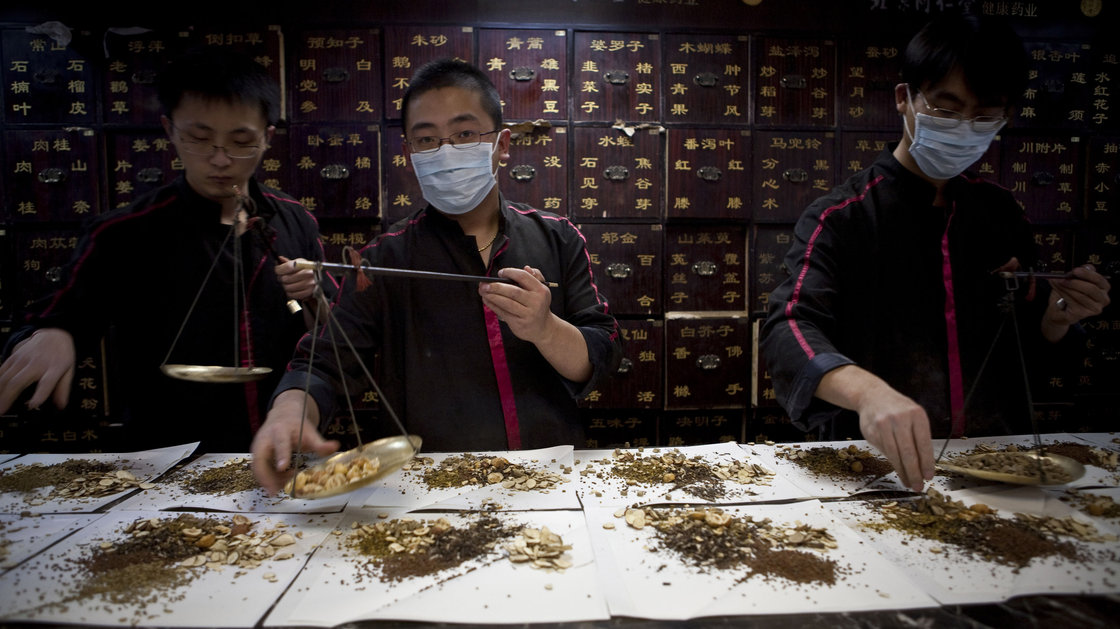
In the quest for new treatments, U.S. researchers are looking to traditional Chinese medicines, some of the oldest remedies in the world.

A recent discovery resulted in a better treatment for a type of leukemia that strikes about 1 in 250,000 people in the U.S. Another study found a potential new painkiller in China’s medicine chest. Other researchers are studying a traditional medicinal plant called “thunder god vine” for its anti-cancer properties.

The approach has already had some success. The Chinese herbal medicine artemisinin, for instance, has gone on to become the most potent anti-malarial drug available.

Not all the leads have panned out, of course. But the old field has shown enough potential to keep interest high.
A better leukemia treatment drawn from an ancient medicine should give us hope for developing anti-cancer drugs, says Dr. Samuel Waxman, a co-author of the report and professor of medicine and cancer specialist at Mount Sinai Hospital. “It gives a lot of optimism of seeking other types of cancer medicines in the Chinese pharmacopedia, which many people are looking into,” Waxman says.

The treatment uses arsenic trioxide, which has traditionally been used in Chinese medicine. The U.S. Food and Drug Administration approved arsenic trioxide (sold as Trisenox here) as a treatment in 2000, and later research showed that patients who received standard chemotherapy followed by arsenic trioxide did better than patients who just received standard chemotherapy.

But a big clinical test recently found that the drug, in combination with all-trans retinoic acid — another drug commonly used to treat acute promyelocytic leukemia (APL) — turned out to be more effective than the usual chemotherapy.
That results means arsenic trioxide should become the new standard for patients that can use it, says Dr. Richard Stone, director of the adult acute leukemia program at the Dana-Farber Cancer Institute.

“So this was a cure for leukemia without chemotherapy, really for the first time in a large randomized trial,” says Stone. “We’ve got a patient in the hospital right now who’s receiving that very therapy.”

He says there are still side effects from the new regimen affecting the skin and heart, but for most people they’re less of a problem than the hair loss, vomiting and diarrhea that can come with chemotherapy.

The arsenic trioxide treatment was developed by a Chinese doctor working in northern China during the Cultural Revolution, according to Mount Sinai’s Waxman. This doctor couldn’t use much Western medicine, so to treat his APL patients, he started giving them arsenic trioxide intravenously. He kept a journal for 10 years and noticed that it worked remarkably well. He eventually published his findings in 2001 with other collaborators.

“That was one of the first examples of a targeted treatment in all of cancer,” Waxman says.

Other researchers are also studying triptolide, a natural product of a traditional Chinese medicinal plant called lei gong teng or “thunder god vine” as a possible anti-cancer drug. The product was effective against cancer in animal models and scientists in the West are now studying exactly how it works, says Jun Liu, one of the researchers and a professor of pharmacology and molecular sciences at Johns Hopkins University.

“Traditional medicine will always remain a useful source of new drugs. The question is, to what extent?” Liu says. “Drug discovery and development is a very lengthy and costly process and there are always failures.”

Research into Chinese medicine is no different. Cancer reseachers at the University of Minnesota recently started an early clinical trial to study a drug that was developed from triptolide for treating pancreatic cancer, says Edward Greeno, associate professor of medicine at the University of Minnesota. He points out it took millions of dollars just to get to this point.

“It’s easy to think, and normal to think, that if people are using it already then it shouldn’t require a lot to develop it into a useful product. The problem is that our standard for what is safe and effective is very high, appropriately,” Greeno says. “It looks like a pretty straight path but what you don’t see are all the false starts and wrong turns that we make along the way.”

Studying Chinese medicine for new treatments has had its share of wrong turns. Western scientists previously looked into treatments for the prevention of dementia, eczema, and bacteria that cause most types of stomach ulcers, but concluded they weren’t particularly effective.

But the failures don’t mean we should give up, says Brian Berman, a professor of medicine at the University of Maryland who served as the principal investigator of two Chinese medicine research initiatives funded by the National Institutes of Health.

Chinese medicine is one lead to consider, especially for chronic diseases that have yet to be cured. “The advantage you have when you look at some of the Chinese medicine therapies is that by and large, they are safe, as long as what you’re getting doesn’t have added ingredients,” Berman says. “We need to look at what other cultures have to offer and then we need to put them through a scientifically rigorous test.”

Read more: http://www.npr.org/blogs/health/2014/01/18/261055778/western-scientists-look-to-chinese-medicine-for-fresh-leads

China is cloning on an industrial scale

pig3

pig2

pig1

By David Shukman

You hear the squeals of the pigs long before reaching a set of long buildings set in rolling hills in southern China.

Feeding time produces a frenzy as the animals strain against the railings around their pens. But this is no ordinary farm.

Run by a fast-growing company called BGI, this facility has become the world’s largest centre for the cloning of pigs.

The technology involved is not particularly novel – but what is new is the application of mass production.

The first shed contains 90 animals in two long rows. They look perfectly normal, as one would expect, but each of them is carrying cloned embryos. Many are clones themselves.

This place produces an astonishing 500 cloned pigs a year: China is exploiting science on an industrial scale.

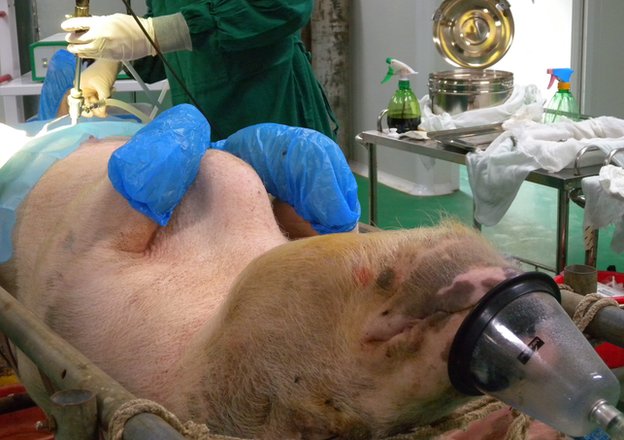
To my surprise, we’re taken to see how the work is done. A room next to the pens serves as a surgery and a sow is under anaesthetic, lying on her back on an operating table. An oxygen mask is fitted over her snout and she’s breathing steadily. Blue plastic bags cover her trotters.

Two technicians have inserted a fibre-optic probe to locate the sow’s uterus. A third retrieves a small test-tube from a fridge: these are the blastocysts, early stage embryos prepared in a lab. In a moment, they will be implanted.

The room is not air-conditioned; nor is it particularly clean. Flies buzz around the pig’s head.

My first thought is that the operation is being conducted with an air of total routine. Even the presence of a foreign television crew seems to make little difference. The animal is comfortable but there’s no sensitivity about how we might react, let alone what animal rights campaigners might make of it all.

I check the figures: the team can do two implantations a day. The success rate is about 70-80%.

Dusk is falling as we’re shown into another shed where new-born piglets are lying close to their mothers to suckle. Heat lamps keep the room warm. Some of the animals are clones of clones. Most have been genetically modified.

The point of the work is to use pigs to test out new medicines. Because they are so similar genetically to humans, pigs can serve as useful “models”. So modifying their genes to give them traits can aid that process.

One batch of particularly small pigs has had a growth gene removed – they stopped growing at the age of one. Others have had their DNA tinkered with to try to make them more susceptible to Alzheimer’s.

Back at the company headquarters, a line of technicians is hunched over microscopes. This is a BGI innovation: replacing expensive machines with people. It’s called “handmade cloning” and is designed to make everything quicker and easier.

The scientist in charge, Dr Yutao Du, explains the technique in a way that leaves me reeling.

“We can do cloning on a very large scale,” she tells me, “30-50 people together doing cloning so that we can make a cloning factory here.”

A cloning factory – an incredible notion borrowed straight from science fiction. But here in Shenzhen, in what was an old shoe factory, this rising power is creating a new industry.

The scale of ambition is staggering. BGI is not only the world’s largest centre for cloning pigs – it’s also the world’s largest centre for gene sequencing.

In neighbouring buildings, there are rows of gene sequencers – machines the size of fridges operating 24 hours a day crunching through the codes for life.

To illustrate the scale of this operation, Europe’s largest gene sequencing centre is the Wellcome Trust Sanger Institute near Cambridge. It has 30 machines. BGI has 156 and has even bought an American company that makes them.

BGI’s chief executive, Wang Jun, tells me how they need the technology to develop ever faster and cheaper ways of reading genes.

Again, a comparison for scale: a recently-launched UK project seeks to sequence 10,000 human genomes. BGI has ambitions to sequence the genomes of a million people, a million animals and a million plants.

Wang Jun is keen to stress that all this work must be relevant to ordinary people through better healthcare or tastier food. The BGI canteen is used as a testbed for some of the products from the labs: everything from grouper twice the normal size, to pigs, to yoghurt.

I ask Wang Jun how he chooses what to sequence. After the shock of hearing the phrase “cloning factory”, out comes another bombshell:

“If it tastes good you should sequence it,” he tells me. “You should know what’s in the genes of that species.”

Species that taste good is one criterion. Another he cites is that of industrial use – raising yields, for example, or benefits for healthcare.

“A third category is if it looks cute – anything that looks cute: panda, polar bear, penguin, you should really sequence it – it’s like digitalising all the wonderful species,” he explains.

I wonder how he feels about acquiring such power to take control of nature but he immediately contradicts me.

“No, we’re following Nature – there are lots of people dying from hunger and protein supply so we have to think about ways of dealing with that, for example exploring the potential of rice as a species,” the BGI chief counters.

China is on a trajectory that will see it emerging as a giant of science: it has a robotic rover on the Moon, it holds the honour of having the world’s fastest supercomputer and BGI offers a glimpse of what industrial scale could bring to the future of biology.

Read more: http://www.bbc.co.uk/news/science-environment-25576718

Thanks to Kebmodee for bringing this to the attenion of the It’s Interesting community.

Televised sunrise in Beijing due to persistently heavy smog

sunrise
This LED screen displays the rising sun in Beijing’s Tiananmen Square, which is shrouded in heavy smog on Jan. 16, 2014.

Air pollution in the Chinese capital reached new, choking heights on Thursday. Those who still felt the urge to catch a glimpse of sunlight were able to gather around the city’s gigantic LED screens, where this glorious sunrise was broadcast as part of a patriotic video loop.

Read more: Beijing’s Televised Sunrise | TIME.com http://world.time.com/2014/01/17/beijing-smog-combatted-with-televised-sunrises/#ixzz2qmuRRoma

Thanks to Kebmodee for bringing this to the attention of the It’s Interesting community.

Google to make smart contact lenses that will monitor blood sugar

google-contact-lens-620xa

If successful, Google’s newest venture could help to eliminate one of the most painful and intrusive daily routines of diabetics.

People with diabetes have difficulty controlling the level of sugar in their blood stream, so they need to monitor their glucose levels — typically by stabbing themselves with small pin pricks, swabbing their blood onto test strips and feeding them into an electronic reader.

Google’s smart contacts could potentially make blood sugar monitoring far less invasive.

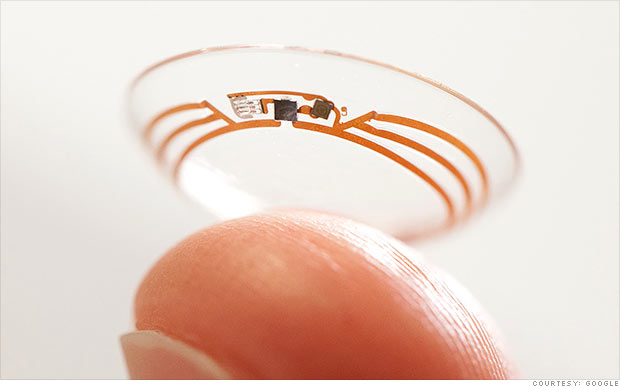
The prototype contacts are outfitted with tiny wireless chips and glucose sensors, sandwiched between two lenses. They are able to measure blood sugar levels once per second, and Google is working on putting LED lights inside the lenses that would flash when those levels are too low or high.

The electronics in the lens are so small that they appear to be specks of glitter, Google said. The wireless antenna is thinner than a human hair.

They’re still in the testing phase and not yet ready for prime time. Google (GOOG, Fortune 500) has run clinical research studies, and the company is in discussions with the U.S. Food and Drug Administration.

Diabetes is a chronic problem, affecting about one in 19 people across the globe and one in 12 in the United States.

The smart contacts are being developed in Google’s famous Google X labs, a breeding ground for projects that could solve some of the world’s biggest problems. Google X labs is also working on driverless cars and balloons that transmit Wi-Fi signals to remote areas.

Google’s contact lens project isn’t the first attempt at building the technology. For many years, scientists have been investigating whether other body fluids, including tears, could be used to help people measure their glucose levels. In 2011, Microsoft (MSFT, Fortune 500) partnered with the University of Washington to build contact lenses with small radios and glucose sensors.

http://money.cnn.com/2014/01/17/technology/innovation/google-contacts/

Thanks to Jody Troupe for bringing this to the attention of the It’s Interesting community.

How this family of four lives ‘off the grid’ in the middle of the desert

<img src=https://its-interesting.com/wp-content/uploads/2014/01/living-off-the-grid.jpg&#8221; alt=”living off the grid” width=”614″ height=”429″ class=”aligncenter size-full wp-image-7407″ />

At a time when we carry computers in our pockets and our cars practically do the driving for us, a certain subset of people have willingly chosen to cut the cord on modern American life — for good.

Off-the-grid living — that is, using natural resources like sun and wind power to provide amenities like heat and electricity — has become commonplace in places like Terlingua, an isolated community in Southwest Texas. What was once a bustling mining town is now a veritable ghost town, tucked into the foothills of Big Bend National Park in the north Chihuahuan desert.

To Abe Connally, 34, it was the perfect place to go off the map. In 2002, Connally moved to Terlingua, leaving behind a lucrative job as a web designer in Austin, Texas in order to try his hand at rural life.

“I’ve always enjoyed rural life, and the thought of sustainability and home-scale energy production intrigued me,” says Abe, who grew up in New Mexico and Texas. “On top of that, I wanted to see how integrating systems to reduce waste and improve efficiency would affect the architecture and other components of this lifestyle.”

Within a year, he met and married his wife, Josie, a British expat who was raised in Africa, Portugal and England before she finally settled out West. They never questioned whether to build their own home or not. It was only a matter of finding the right land and the right resources.

“When we started building our first home, we figured that if we could build a sustainable homestead from scratch in the desert, then we could do it anywhere,” Josie says. “We realized that if we could reduce our needs and resources, our lifestyle would be cheaper to maintain, giving us money to save or invest.”
More than a decade, two hand-built homes and a pair of energetic sons later, they’ve dedicated their lives to maintaining their sustainable home, using their blog VelaCreations to teach others how to follow in their footsteps.

Here’s what it’s like to live really off-the-grid:

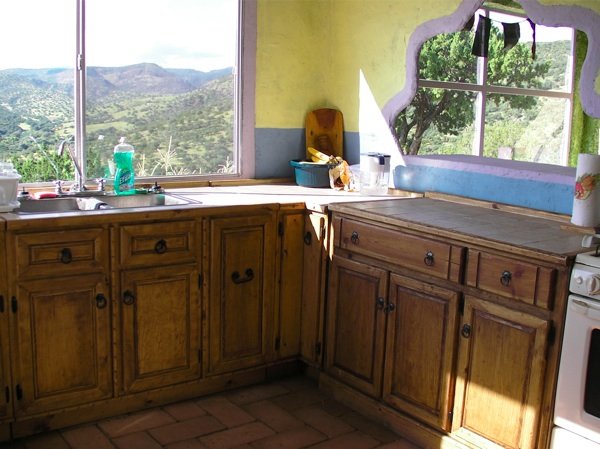
“When we built our first home, we had almost no money,” Josie says. “We bought 20 acres of pristine desert land for $1,000 and moved an old bus onto it. The bus — retrofitted with a bed, small stove, solar panel and batteries, etc. — was our home until we could build a better quality one.”

pic1

Neither Abe nor Josie were particularly experienced home builders — far from it. They relied on books, blogs and online tutorials to learn everything from bricklaying to building solar panels for energy.

Abe: “[Renowned architect] Michael Reynolds introduced us to the concepts of architecture as a group of integrated systems. From passive solar designs to using waste as construction materials, his books showed us that it was possible to live like we wanted to.”

pic2

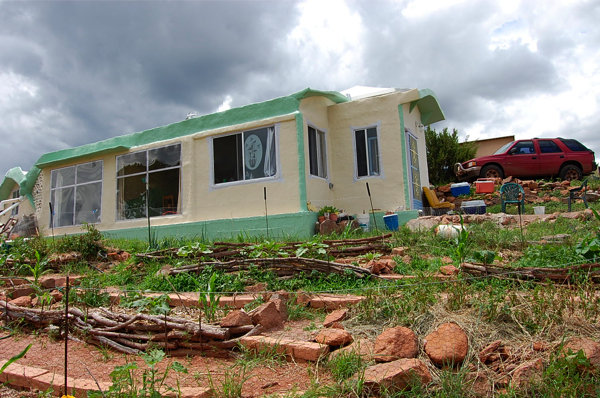
They built their first sustainable home in 2002 near Terlingua, but they were 30 miles from the closest schools and hospitals — not exactly ideal for raising small children. In 2007, they moved closer to town and started constructing home No. 2.

pic3

Like their own personal Rome, their new home took years to complete and is a constant work in progress.

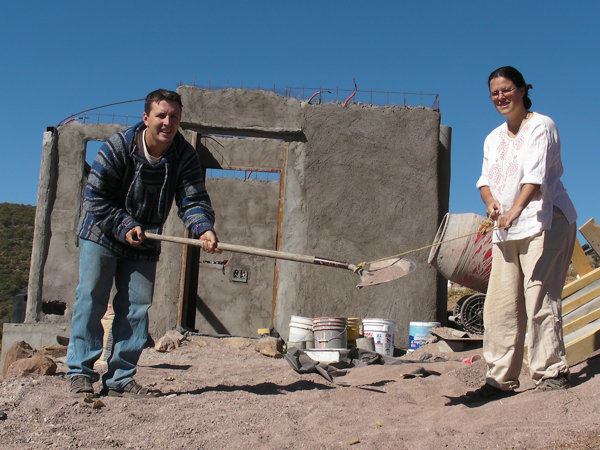
Abe: “We added to each system as we could afford it, in other words, little by little. For the house itself, we used adobe, mixing the mud with our feet and putting it into forms (made from scrap materials) straight on the walls. It took a long time, but cost almost nothing.”

pic4

For off-the-gridders, the sun is crucial. The Connallys rely on solar power for all of their heat and electricity (with help from a homemade wind generator).

“The house is partially buried in a south-facing hill [and] the thermal mass of the hill helps to keep a constant temperature inside the house year-round, like a cave,” Abe explains. “The house stays about 70 degrees for most of the year.”

pic5

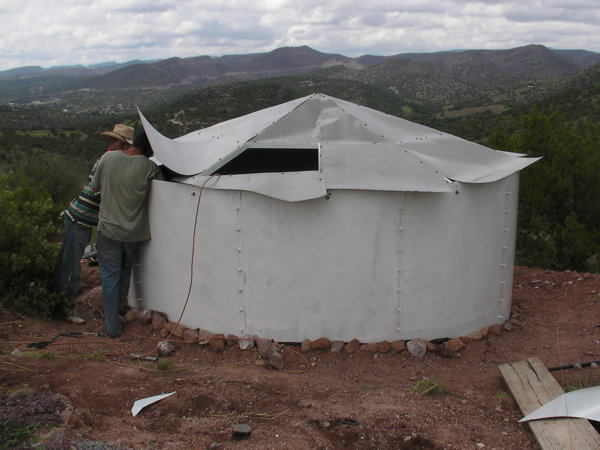
Abe: “Our water is collected from the roof. We live in a desert, so rainfall is limited, and the majority of our rain comes from July through September. We store this water in large tanks we make ourselves and then filter for domestic use.”

pic6

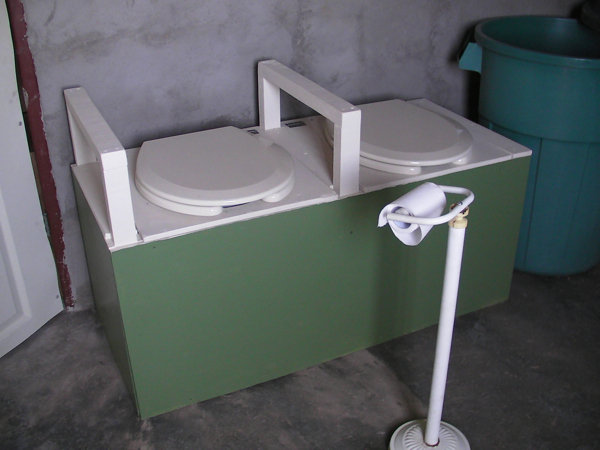
“The first part of off-grid living is to conserve, and reduce your needs, so that it’s easier to produce your necessities for yourself,” Abe says. By using a composting toilet, which requires no water, they cut down on waste and fertilize their land at the same time.

pic7

The interior has a modern feel, with hand-laid brick floors and painstakingly carved entryways.

pic8

Their $9,600 annual budget is planned down to the dollar. They earn a small income through Abe’s web consulting business and some freelance writing, but their farm is their real paycheck.

When they decided to rebuild, they sought out more fertile land with enough rainfall to sustain a garden and livestock.

pic9

As a family, they bring new meaning to the term “farm to table”:

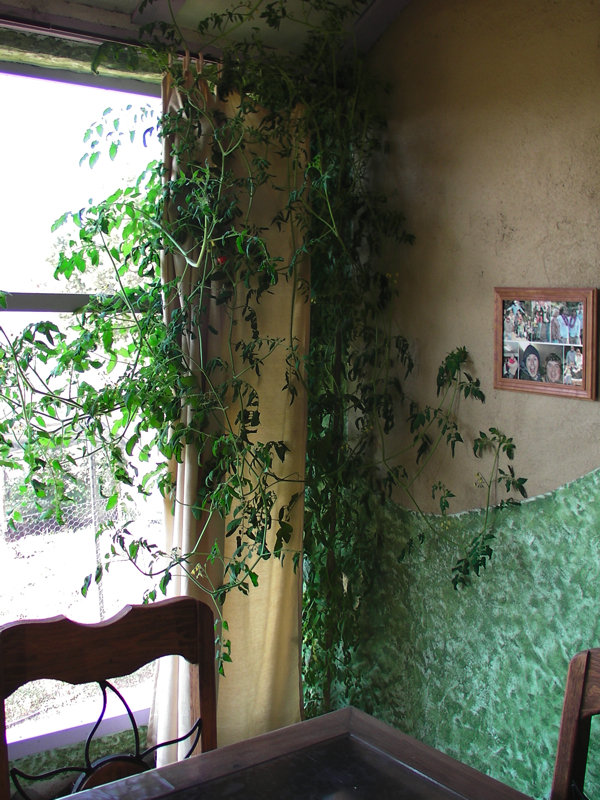
“We’ve had tomato plants that produce for several years, and they become these jungles of fresh food right in the dining room,” Abe says. “In fact, our youngest son, Nico, will sit there and eat every red tomato he can reach, but if you put one on his plate, he refuses to touch it.”

pic10

Josie: “We grow a wide variety of things, depending on our tastes at the time. We regularly grow tomatoes, strawberries, peppers, okra, cucumbers, squash, corn, sunflowers, melons, greens, roots and several herbs. We also have a few fruit trees (plums, apricots, peaches).”

pic11

“There is no food fresher than that, and it’s something you get kind of used to,” she says.

pic12

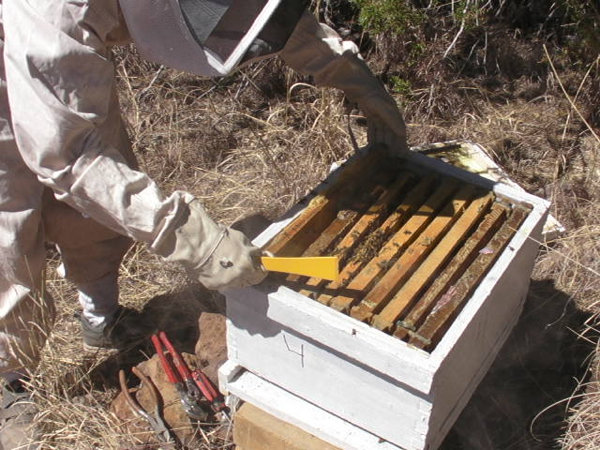
They’ve even got a tiny village of beehives for fresh honey.

pic13

Meat is also on the menu. The Connallys have gradually raised a menagerie of livestock, including pigs, rabbits, guinea pigs, and chickens. It’s vastly cheaper than purchasing their meat from stores.

pic14

One of their pigs just had a litter.

pic15

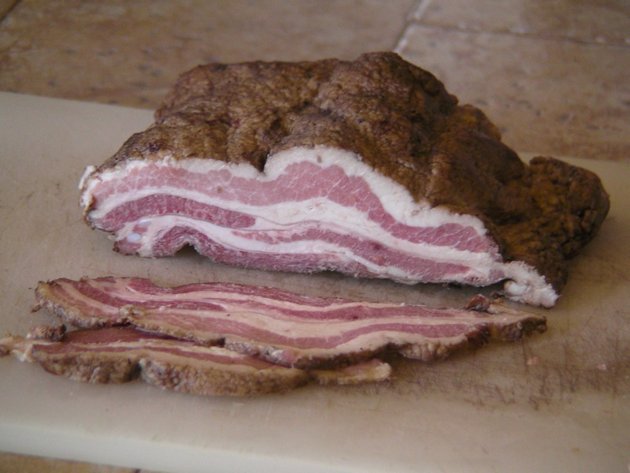
They’re cute now, but eventually they’ll be sold in the village or, more often than not, wind up on the dinner menu. The Connallys have become quite the bacon connoisseurs.

pic16

Everyone lends a hand in the family harvest.

Josie: “The kids collect eggs and feed all the poultry. We feed the rabbits, pigs and all the other little critters. We then all go look at any baby rabbits and the kids often get out their guinea pigs to play with.”

pic17

Nothing goes to waste.

Josie: “We sell any surplus. We often have extra meat (especially rabbit), which we sell locally. We also sell eggs, as well as trading them for raw milk. Any vegetables and such we tend to preserve (drying, canning, kimchi) as we don’t yet grow enough to fill our yearly needs.”

pic18

Even rabbit fur gets turned into cozy hats and slippers.

pic19

Josie: “Right now, we’re spending about $800 a month: $100 on fuel, $500 on [feed for the animals], groceries and other household items, and $100 on Internet and phone. We also continue to improve our homestead, which costs a little extra, depending on the task at hand.”

pic20

Their bedrooms are cozy and get a lot of natural light, which helps them conserve electricity.

pic21

Abe: “I think there’s a certain pride that comes from being able to say ‘I made that’. We are surrounded by things we’ve made ourselves, including our home and energy infrastructure.”

pic22

With two kids under the age of 5, the Connallys admit they’ve made some allowances in their off-grid lifestyle. They have games for game nights and keep a healthy stock of books and DVDs for entertainment.

pic24

But, naturally, they spend most of their free time outdoors.

pic25

They keep a car handy for trips to town and to cart the kids to and from school each day. Their goal this year is to get their car running on natural fuel supplies.

Josie: “We live about a 20-minute drive from a small village, where there’s a kindergarten, primary school, clinic and a couple of basic stores. That’s actually one of the main reasons we moved here before starting a family: still very rural, but with everything needed for small kids.”

pic26

The kids seem to dig it.

pic27

Laundry gets done the old-fashioned way.

pic28

Sunlight and fresh air are all the dryer they’ll ever need.

pic29

It’s always nice to have relatives visit, like the kids’ grandparents.

pic30

Josie: “We’re in constant contact with family and friends over the Internet (huge fans of Skype and the like). However, visits are unfortunately much less frequent. If we ever get around to building the blimp we’ve always wanted, we’ll be sure to stop by a lot more often.”

Abe: “We’ve been able to save a few years worth of income, but also, because of our lifestyle, we don’t have to earn as much. So instead of working 40-hour weeks for money, we work 5-10 hours a week. This gives us enough for savings and expenses. The real value is the 30 hours a week we gain.”

pic31

Abe: “It took a long time, but cost almost nothing. That was 12 years ago and we are still amazed by how far we’ve come since then.”

pic31

To see more from the Connallys’ off-the-grid home, check out their blog, VelaCreations: http://velacreations.com/

Read more: http://finance.yahoo.com/news/family-life-off-the-grid-abe-connally-vela-creations-144054081.html

Thanks to Ray Gaudette for bringing this to the attention of the It’s Interesting community.

Cooling Underwear Puts Sperm On Ice

dnews-files-2014-01-snowballs_sperm_cooling_670x440-jpg

The briefs, called Snowballs, began last year as a Kickstarter campaign by Joshua Shoemake.

The idea began with several couples struggling to conceive. One couple had a miscarriage. They were told to give up and try adopting. Then a gynecologist told them that elevated scrotal temperature can be a major cause of infertility in men, according to the company.

Sick of holding melting freezer bags on their crotches, the guys worked on a design for organic cotton boxer-briefs with space for a “SnowWedge” gel pack made from carboxymethyl cellulose sodium that could stay cool for at least 30 minutes. Using the briefs helped one of the couples have a baby girl, the company said.

http://news.discovery.com/tech/gear-and-gadgets/cooling-underwear-puts-sperm-on-ice-140110.htm

Thansk to Dr. Lutter for bringing this to the It’s Interesting community.

How To Make Your Face (Digitally) Unforgettable

face

Thanks to new research out of MIT, you might one day be able to subtly manipulate your picture to make it more memorable — meaning that people should be more likely to remember your face.

According to the research article: “One ubiquitous fact about people is that we cannot avoid evaluating the faces we see in daily life … In this flash judgment of a face, an underlying decision is happening in the brain — should I remember this face or not? Even after seeing a picture for only half a second we can often remember it.”

There are subjective factors affecting how a face sticks in your memory — for example, if you know someone else who looks similar, you might find a new face more familiar. But researchers found that there is also a strong universal component to memorability. Some faces are just consistently more easily remembered.

Researchers found that certain associations help make a face memorable: familiarity, kindness, trustworthiness, uniqueness.
“The basic idea is that if there is someone you have never seen [before] and … this person looks familiar — then, if this person looks kind, trustworthy and distinct, then it will be easier to remember them,” says Aude Oliva, a principal research scientist at MIT’s Computer Science and Artificial Intelligence Lab.

But, she says, there’s no “recipe” for how exactly to make facial features look like that; it differs from face to face. But the researchers are working toward creating an app or demo that would analyze thousands of versions of any face, each with tiny modifications, and figure out which is the most memorable — without changing other key aspects like attractiveness, age or expression.

“Manipulating faces is a very tricky process,” Oliva says. “The changes must be subtle and keep the original features of the portrait.”

What’s the point of capitalizing on that? The researchers suggest that social network users could upload more memorable profile pictures, or that job applicants could include a digitally remastered portrait to “more readily stick in the minds of potential employers,” according to the MIT press release (although, take note, job applicants: Business Insider says including your photo with a resume is a no-no anyway).

It could also be used in movies to make the lead characters stick out and fade the extras into the background.

At first glance, the project could seem deceptive or disparaging, as if it’s exploiting our memory or telling us our natural faces aren’t good enough for LinkedIn. But Oliva stresses that the changes are very subtle. And, we wonder, is it any different than using Photoshop to touch up a profile picture or using makeup to make an anchor’s face look more striking on TV?

http://www.npr.org/blogs/alltechconsidered/2014/01/09/261064231/how-to-make-your-face-digitally-unforgettable

Iranian man has gone 60 years without bathing

man-spends-60-years-sans-bathing-1389116651-4027

Amou-Haji-550x364

Amou Haji, aged 80, who lives in Dejgah village in the southern Iranian province of Fars has not bathed for 60 years.

The last record of longest time going without showers belonged to a 66-year-old Indian man, Kailash Singh, who had not taken a bath over 38 years.

He believes cleanliness brings him sickness. His favorite food is rotten meat of dead animals, especiall porcupines, and when asked to eat clean food and drink clean water he gets mad.

His smoking pipe is filled with animal’s feces instead of tobacco and when he feels like smoking cigarettes he lights up a few of them at a time.

Amou Haji has a couple of places to live in: one is a hole in the ground resembling a grave to keep him grounded and in touch with the reality of life and the other is an open brick shack built by those who felt sorry for him.

He drinks his five liters of water every day out of a large rusty oil tin.

http://tehrantimes.com/society/113249-man-has-gone-60-years-without-bathing-

New research shows that psychedelic drugs may help decrease crime

lsd

Psychedelic drugs could help to keep ex-offenders out of prison, new research suggests.

U.S. scientists have found that drugs such as LSD and magic mushrooms could be used to help reform criminals under community correction supervision.

It has previously been thought that LSD could be used to treat alcohol addiction, but the new research is the first in 40 years to suggest it could be used to stop criminals from re-offending.

Researchers from the University of Alabama at Birmingham and Johns Hopkins University School of Medicine, Baltimore, collected data about 25,622 people under community supervision between 2002 and 2007.

All study participants were in the Treatment Accountability for Safer Communities (TASC) program, for people with a history of drug abuse, including alcohol addiction.

The researchers found that criminals diagnosed with a hallucinogen use disorder were less likely to fail the TASC programme, appear in court and be arrested and imprisoned, compared to those who did not have a history of taking the drugs.

Just one per cent of people on the programme were diagnosed with a hallucinogen disorder, while heavy users of cocaine, cannabis and alcohol were the most common.

‘Our results provide a notable exception to the robust positive link between substance use and criminal behaviour,’ the researchers wrote in their study, which was published in the Journal of Psychopharmacology.

‘They add to both the older and emerging body of data indicating beneficial effects of hallucinogen interventions and run counter to the legal classification as well as popular perception of hallucinogens as categorically harmful substances with no therapeutic potential,’ they added.

The scientists believe that offenders may be especially likely to benefit from LSD treatment as many people become criminals as a result of drug-seeking behaviour and impulsive conduct, often caused by compulsive drug use.

The study took factors such as race, employment, age, history of drug abuse and crimes, as well as gender and education into account.

However, the researchers warned that the findings of the study should not be seen to advocate recreational use of psychedelic drugs.

‘Nevertheless, they demonstrate that, in a real-world, substance-related intervention setting, hallucinogen use is associated with a lower probability of poor outcome,’ they wrote.

They believe the research should be the start of a continued investigation into the use of psychedelic drugs to treat criminals.

Read more: http://www.dailymail.co.uk/sciencetech/article-2537137/Could-LSD-cut-crime-Psychedelic-drug-help-prevent-criminals-offending.html#ixzz2qK1CX9Vz
Follow us: @MailOnline on Twitter | DailyMail on Facebook