Hidden painting found under Picasso’s The Blue Room


The Blue Room features a nude woman bathing in Picasso’s studio.


Infrared technology revealed it had another image below the surface.


When the image was turned on its side, it revealed a portrait of a man.

A hidden painting has been found by scientists beneath the brush strokes of The Blue Room, a 1901 Picasso artwork.

Art experts and conservators at The Phillips Collection in Washington used infrared technology on the masterpiece, revealing a bow-tied man with his face resting on his hand.

Picasso created both works in Paris during his famous blue period.

“It’s really one of those moments that really makes what you do special,” said conservator Patricia Favero.

Acknowledged as one of the 20th Century’s greatest artists, Pablo Picasso focused on monochromatic paintings in shades of blue and blue-green during his blue period from 1900 to 1904.

The Blue Room has been the subject of exploration since 2008 by experts from the Phillips Collection, National Gallery of Art, Cornell University and Delaware’s Winterthur Museum.

Improved infrared imagery allowed them to see a man wearing a jacket and bow tie, resting his bearded face on his hand with three rings on his fingers.

Technical analysis confirmed the hidden portrait was likely to have been painted just before The Blue Room.

Favero added that, having found the second image back in 2008, they then wanted to know who the man was.

“We’re still working on answering that question,” she said.

Curator Susan Behrends Frank told press agency AP: “When he [Picasso] had an idea, you know, he just had to get it down and realise it,” explaining that the artist had quickly painted over another completed picture when the inspiration took him.

“He could not afford to acquire new canvasses every time he had an idea that he wanted to pursue. He worked sometimes on cardboard because canvas was so much more expensive.”

The Blue Room has been part of the Phillips Collection since 1927.

Conservators suspected back in 1954 it may have had another painting below its surface, as brushstrokes did not match the composition of a woman bathing in Picasso’s studio.

But it was not until the 1990s that an X-ray revealed a “fuzzy image” of something under the main image.

Research on The Blue Room will continue and curators have planned a 2017 exhibition focusing on the painting and the portrait beneath it. It is also part of a tour to South Korea in 2015.

This is not the first time a hidden image has been found beneath a Picasso artwork.

A technical analysis of La Vie at the Cleveland Museum of Art revealed he had reworked the painting’s composition, while a moustached man was found beneath the painting Woman Ironing at Manhattan’s Guggenheim Museum.

http://www.bbc.com/news/entertainment-arts-27884323

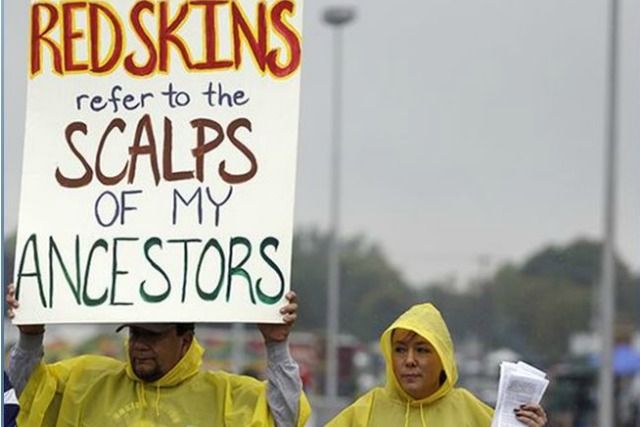
U.S. Patent Office has canceled trademarks belonging to the Redskins football team, saying they are offensive to Native Americans

In a decision released Wednesday, the office’s Trademark Trial and Appeal Board ruled that “these registrations must be canceled because they were disparaging to Native Americans.”

The Patent Office said it will continue to treat the patents as though they are valid while the team appeals the decision. The team has two months to do that, and the whole process could take years.

In the meantime, the Redskins can continue using the logos.

But the decision, if upheld, would make it harder for the team to claim ownership of its brand. If it wants to go to court against a counterfeiter making T-shirts with the team’s logo, for instance, it will be harder to show that the organization owns the brand. The team will have to illustrate that they have always used the logos, rather than relying official trademark registrations.

The decision came in response to a suit brought by five Native Americans.

“We are extraordinarily gratified to have prevailed in this case,” said Alfred W. Putnam, Jr., Chairman of Drinker Biddle & Reath LLP, which represented the five men and women.

The board also canceled the registrations in 1999, but a federal judge overturned that decision in 2003, saying there was no proof that the name was disparaging at the time of registration. Some of the patents date back to the 1960s.

Thanks to Pete Cuomo and Dr. Lutter for bringing this to the attention of the It’s Interesting community.

http://money.cnn.com/2014/06/18/news/companies/patent-office-redskins/index.html

U.S. health care system ranks lowest in international survey

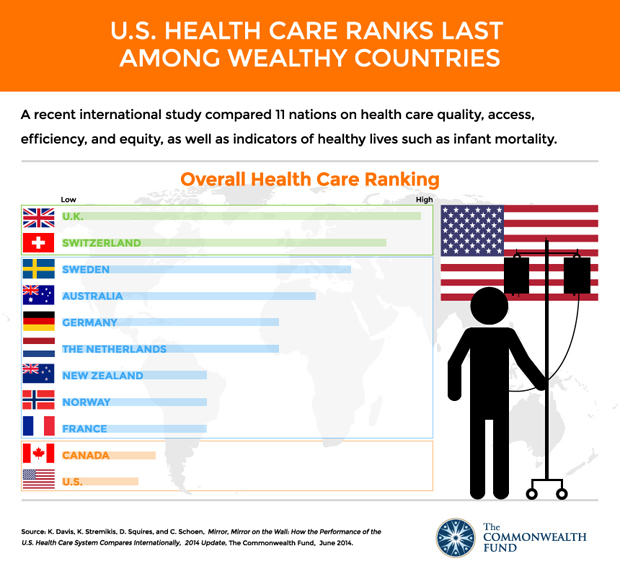
The U.S. spends more money on health care compared with other industrialized countries, but Americans still get the least bang for their buck — and many still don’t have access to care — according to a report just published by the Commonwealth Fund. The report from the private health care research foundation examined data on expenditures, delivery and access to health care services among 11 industrialized countries: Australia, Canada, France, Germany, the Netherlands, New Zealand, Norway, Sweden, Switzerland, the U.K. and the U.S.

Overall, the U.K. and Switzerland were rated highest for factors that included quality, access, efficiency and equity of health care. The U.S., Canada and France overall ranked lowest. The U.S. was found to perform worst in areas concerning cost of care, efficiency, equity and overall health of its citizens, even though health care expenditures were highest per capita compared with the other 10 countries in the report.

In 2011, the U.S. spent $8,508 per capita in health care expenditures, compared with $3,405 per capita in the U.K., which was the country with the highest ranked health care system overall.

“Although the U.S. spends more on health care than any other country and has the highest proportion of specialist physicians, survey findings indicate that from the patients’ perspective, and based on outcome indicators, the performance of American health care is severely lacking,” write the authors in the report. “The nation’s substantial investment in health care is not yielding returns in terms of public satisfaction or health outcomes.”

For quality of care assessment, the authors ranked countries in categories such as effectiveness, safety and coordination of care. Norway and Sweden performed lowest overall for these factors, while the U.K., Australia and Switzerland were rated highest.

Though the U.K. scored best in most categories, the country ranked second worst after the U.S. in terms of the health of its residents. This was based on factors such as adult and infant mortality rates, receptiveness to medical services and life expectancy at age 60. Citizens of France, Sweden and Switzerland were found to be healthiest overall.

The authors of the report note that the U.S. stands apart from other industrialized countries because it does not offer universal health insurance, meaning lower income individuals often don’t have sufficient access to health care — especially preventive medicine — compared with other countries.

However, universal health care has its drawbacks. In Canada, for example, health care may pose little financial burden but this often means patients must wait longer for needed services.

Though the Affordable Care Act in the U.S. has improved access to medical services for many in this country, researchers say is still too early to tell if these new health care policies will improve the overall health of Americans.

“These results indicate a consistent relationship between how a country performs in terms of equity and how patients rate other dimensions of performance: the lower the performance score for equity, the lower the performance on other measures,” the authors write in their report. “This suggests that, when a country fails to meet the needs of the most vulnerable, it also fails to meet needs for the average citizen.”

The report, now in its fourth year, used data from the Commonwealth Fund 2011 International Health Policy Survey of Sicker Adults; the Commonwealth Fund 2012 International Health Policy Survey of Primary Care Physicians; and the Commonwealth Fund 2013 International Health Policy Survey. The report from 2013 is based on surveys of more than 20,000 adults about health care experiences in their respective countries. Additionally, the researchers incorporated data from the World Health Organization and the Organization for Economic Cooperation and Development.

Thanks to Pete Cuomo for bringing this to the attention of the It’s Interesting community.

http://www.cbsnews.com/news/u-s-health-care-system-ranks-lowest-in-international-survey/

Earth’s Most Abundant, But Hidden Mineral Finally Seen, Named: bridgmanite

Earth’s most abundant mineral lies deep in the planet’s interior, sealed off from human eyes. Now, scientists for the first time have gotten a glimpse of the material in nature, enclosed inside a 4.5-billion-year-old meteorite. The result: They have characterized and named the elusive mineral.

The new official name, bridgmanite, was approved for the mineral formerly known by its chemical components and crystal structure — silicate-perovskite. The magnesium-silicate mineral was named after Percy Bridgman, a 1946 Nobel Prize-winning physicist, according to the American Geophysical Union blog.

http://www.livescience.com/46337-elusive-mineral-named-bridgmanite.html

Bachelor party stumbles upon 3 million year old stegomastodon skull

Some guys have trouble remembering just what happened during their bachelor party, but a group of men on a recent stag send-off in New Mexico aren’t likely to forget their celebration very soon — since they stumbled upon a perfectly preserved three-million-year-old mastodon skull.

The party was on a hike in Elephant Butte Lake State Park near Albuquerque when they saw a bone jutting one to two inches from the sand. They started digging and uncovered the enormous skull. Their first thought was it could be the remains of a woolly mammoth so they snapped photos and sent them to the New Mexico Museum of Natural History and Science.

Scientists there made the identification — it wasn’t a woolly mammoth, but, in fact, a much more exciting find. The skull belonged to a stegomastodon — a prehistoric ancestor of the woolly mammoth — as well as today’s elephants. The massive animal stood about 9 feet tall, weighed six tons and walked the Earth during the Ice Age, according to Gary Morgan, a paleontologist at the museum who analyzed the fossil. He estimates the animal was about 50 years old when it died on a sandbar of the ancient Rio Grande River.

The family of mastodons migrated to North America around 15 million years ago and died out around 10,000 years ago.

“This is far and away the best one we’ve ever found,” said Morgan about the bachelor party’s discovery.

Scientists, following up on the party’s tip, went to the site and sealed the skull, which weighed more than 1,000 pounds, in a cast. It was transported to the museum, where it will eventually will be placed on display.

Antonia Gradillas, 33, was among the men who made the original discovery. He said, “This is the coolest thing ever. Some people with PhDs in this field might not even have this kind of opportunity. We were so lucky.”

Thanks to Dr. Rajadhyaksha for bringing this to the attention of the It’s Interesting community.

http://news.discovery.com/animals/paleontology/bachelor-party-finds-mastedon-skull-140616.htm

New solar power team creates supercritical steam that can drive the world’s most advanced power plant turbines

A team of solar thermal engineers and scientists at the Energy Centre in Newcastle have used the ample sunlight flooding their solar fields to create what’s called ‘supercritical’ steam – an ultra-hot, ultra-pressurised steam that’s used to drive the world’s most advanced power plant turbines – at the highest levels of temperature and pressure EVER recorded with solar power.

They used heat from the sun, reflected off a field of heliostats (or mirrors) and concentrated onto a central receiver point to create the steam at these supercritical levels. The achievement is being described in the same terms as breaking the sound barrier, so impressive are its possible implications for solar thermal technology.

Put simply, the temperature of the steam they created (570° C) is about twice the maximum heat of your kitchen oven – or around the point where aluminium alloy would start melting. And the accompanying pressure (23.5 megapascals) is about 100 times as high as the pressure in your car tyres, or roughly what you’d experience if you were about 2 kilometres under the surface of the ocean.

That’s all impressive in itself. But when you take into consideration that this is the first time solar power has ever been used to create these ‘supercritical’ levels on this scale – traditionally only ever reached using the burning of fossil fuels – the real worth of this achievement begins to sink in.

Solar thermal, or concentrating solar power (CSP) power plants have traditionally only ever operated at ‘subcritical’ levels, meaning they could not match the efficiency or output of the world’s most state of the art fossil fuel power plants.

Enter the Advanced Solar Steam Receiver Project. To prove that solar thermal technology can match it with the best fossil fuel systems, they developed a fully automated control system which predicts the heat delivered from every mirror (or heliostat), allowing them to achieve maximum heat transfer, without overheating and fatiguing the receiver. With this amount of control, they were able to accurately recreate the temperature and pressures needed for supercritical success.

So instead of relying on burning coal to produce supercritical steam, this method demonstrates that the power plants of the future could be using the zero emission energy of the sun to reach peak efficiency levels – and at a cheaper price.

Thank to Kebmodee for bringing this to the attention of the It’s Interesting community.

http://csironewsblog.com/2014/06/03/our-solar-team-sets-a-hot-and-steamy-world-record/

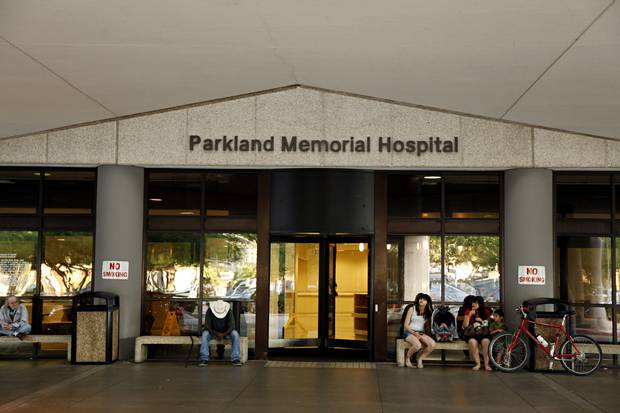
Parkland psych ER is again scene of patient abuse

Parkland Memorial Hospital said the patient-gagging incident in the psychiatric emergency room was discovered on April 8 during a routine review of security video from March 16. Parkland notified the Texas health department within a day, it said, in compliance with regulations.

By MILES MOFFEIT AND BROOKS EGERTON

The psychiatric patient spat at Parkland Memorial Hospital staff as they strapped her into a chair. Then a nurse shoved a toilet paper roll into her mouth, while a co-worker put a sheet over her head.

“Blood stains can be seen on the toilet tissue” after its removal, says a police report that describes security camera footage. A follow-up report says a third employee warned the caregivers that their actions were “illegal.”

Texas health authorities are investigating the March incident — the first abuse in Parkland’s psychiatric emergency room to become public since the hospital hired a new chief executive. One nurse involved in the gagging was also involved in the 2011 restraint of a psych ER patient whose death triggered a federal investigation and virtual takeover of Parkland.

State health regulations prohibit restraint that obstructs a psychiatric patient’s airway or ability to communicate. A prior state enforcement action against Parkland requires hospital managers to report patient abuse within two days of becoming aware of it.

Parkland reported the gagging incident more than three weeks after it occurred. The hospital said managers didn’t know about it initially but acted promptly once they did.

“Employees on site did not elevate this incident appropriately,” Parkland spokeswoman April Foran said. The hospital fired two of five employees who were present during the restraint, she said. Two others resigned, and a fifth “received corrective action.”

Parkland, which collects hundreds of millions of dollars a year from Dallas County taxpayers, would not name the employees. But The Dallas Morning News confirmed the identities of two: Charles Enyinna-Okeigbo, the nurse who forced the toilet paper roll into the patient’s mouth, and Sherwin De Guzman, a supervising nurse.

Authorities have previously investigated both nurses: Enyinna-Okeigbo for domestic violence, and De Guzman in connection with the 2011 death of psych ER patient George Cornell. State and federal regulators found that Cornell was illegally restrained shortly before dying. They cited De Guzman for failing to supervise the technicians who subdued Cornell.

Parkland’s in-house police department investigated the March incident and asked the Dallas County district attorney’s office whether assault charges should be filed. A prosecutor said that the use of force was “unfortunate” but not criminal.

Both nurses declined to comment to The News. Enyinna-Okeigbo told police that he was merely trying to stop the spitting and was not angry with the patient, according to Parkland records.

UT Southwestern Medical Center, whose physicians supervise care at the public hospital, identified the psychiatrist in charge as Dr. Uros Zrnic. He “was not informed or aware of the incident until the videotape was reviewed” in April, UTSW said.

Terrified patient

Experts criticized Parkland after reading police reports on the latest incident at The News’ request.

“When a patient spits, it’s the last resort of a terrified human being, and being restrained like this is terrifying,” said Dr. Peter Breggin, a New York psychiatrist and former consultant for the National Institute of Mental Health.

“Trained mental health workers in this day and age know that spitting is a cause for staff to back off,” he said, adding that forcing objects into patients’ mouths can escalate violence. “There’s no excuse for this abuse.”

Dennis Borel, executive director of the Coalition of Texans with Disabilities, said some Parkland psych workers “still don’t get it.”

“This is pretty outrageous when it was just a few years ago that these kinds of actions were supposed to trigger training and other safe approaches at Parkland,” Borel said. “Everything in the patient’s behavior indicates she was desperately trying to protect herself, and they were making it worse. They failed the patient miserably.”

The state health department hit Parkland in 2012 with a $1 million fine because of Cornell’s death and several other “egregious deficiencies.” It was by far the largest hospital fine in Texas history.

Under a settlement, the hospital paid $750,000. It can avoid paying the rest if, by later this summer, it demonstrates compliance with safety requirements.

Because of the gagging incident, regulators are investigating whether there have been more “significant, egregious deficiencies and a failure to correct them or an attempt to hide them,” said health department spokeswoman Carrie Williams. “It’s an open investigation, and there have been no findings in this case so far.”

Parkland also remains under a 2013 corporate integrity agreement with the U.S. Department of Health & Human Services. It requires periodic reports on patient safety, among other steps.

Compliance with that agreement is a top stated priority of Dr. Fred Cerise, Parkland’s new chief executive. He started work about a week after the March gagging incident.

Cerise and other hospital officials declined to be interviewed for this report. In written responses to questions, Parkland said “the event was discovered” on April 8 during a routine review of security video from March 16. Parkland notified the Texas health department within a day, they said, in compliance with state regulations.

Parkland also said that in addition to taking personnel actions, it now requires video reviews of restraints within 24 hours. But it would not say whether it previously had a schedule for reviewing the security videos, or why it took more than three weeks to detect the gagging incident.

Quick investigation

The criminal investigation lasted less than 48 hours before the case was closed as “unfounded,” police reports show. A News investigation last year found that Parkland police have a history of quickly closing cases in which hospital employees are accused of abuse.

The hospital released nine pages of reports on the investigation, blacking out the names of employees and the patient. It released no information about why the patient was in the psych ER or whether she was injured in the restraint incident. There is no indication in the records that police tried to interview the woman.

When asked, the hospital spokeswoman told The News that “Parkland made multiple attempts to locate the patient” but failed.

The reports contain conflicting versions of what led to strapping the patient to the chair.

Enyinna-Okeigbo told police the woman became “extremely agitated” while in a common area of the psych ER. He said he gave her medication to calm down, but it didn’t work. When staff then directed her toward seclusion rooms, she began to “spit, swing, and kick at the staff,” police wrote, summarizing Enyinna-Okeigbo’s account.

A fellow caregiver who was interviewed “does not recall seeing the patient strike or attempt to strike any staff members,” a police report says. This caregiver also said he didn’t recall seeing the toilet paper roll put into the patient’s mouth or any bleeding. He denied covering the patient’s face with the sheet. The police report noted that “video of the incident contradicts this.”

The reports quote another staffer as saying he saw the bleeding and thought the patient had been “struck by a nurse.” He described the scene as “very chaotic” and said employees lacked training for such situations.

The police description of video footage begins as the patient resists efforts to strap her into a restraint chair: “She appeared to be acting aggressively toward to the medical staff, including spitting on multiple occasions in the direction of the staff.”

Five staffers approached the woman, including one who “immediately placed the roll of toilet tissue over the patient’s mouth,” a report says. “The patient began to resist,” leading Enyinna-Okeigbo to “shove the end of the roll into the patient’s mouth, at one point even appearing to force the patient’s jaw open to completely insert the roll.”

Then another employee secured the sheet around the patient’s head, and the bloody toilet paper was removed from her mouth. Next, a surgical mask was put on the patient. It, too, later showed blood stains.

A Parkland officer met with Assistant District Attorney Craig McNeil on April 10 to discuss potential criminal charges against Enyinna-Okeigbo. “McNeil stated that he felt the culpable mental state exhibited was negligence, and the mental state that has to be met for assault is reckless,” a police report says. “Therefore, McNeil stated that he did not feel that [Enyinna-Okeigbo] met the culpable state to be charged with a crime.”

McNeil told The News he did not know why the hospital didn’t consider charges against the staff member who put the sheet around the patient’s head. Foran, the Parkland spokeswoman, said hospital police gave the DA’s office “complete details” of the incident and noted that prosecutors have “full discretion” about how to proceed.

No assault

The News became aware of the incident on May 28 and asked Parkland for all related police reports. That same day, a Parkland detective asked McNeil for a written explanation of his reasoning, which the hospital gave The News.

“The use of force against a patient in an altered mental state is always unfortunate and should be avoided,” McNeil wrote. But it “does not appear to have been done with the intent to harm the patient.”

In an interview with The News, McNeil identified Enyinna-Okeigbo as the nurse who stuffed the toilet paper roll into the patient’s mouth.

The prosecutor said that spitting could be considered assault because of the potential for disease transmission. In using that term, he said, he did not mean to suggest that the patient should be charged with assault but added: “You have the right to defend yourself.”

McNeil said he could not tell from the video why the patient had blood in her mouth. He said he saw no footage of the patient being struck.

McNeil handled a 2011 case in which security video showed Parkland psychiatric technician Johnny Roberts choking a patient into unconsciousness. The hospital fired Roberts, but grand jurors declined to indict him.

“I was not happy about that,” McNeil said. “I still don’t know why they did that.”

Troubled pasts

The News’ reporting of George Cornell’s death ultimately led to a regulatory crackdown and two years of round-the-clock federal monitoring of Parkland.

The hospital installed security cameras — the same ones that captured the recent gagging incident. It also promised to fire problem employees and retrain others, especially on patient restraints.

Parkland would not say whether Enyinna-Okeigbo or De Guzman received this training.

De Guzman left his job at Parkland at some point after Cornell’s death in February 2011. He returned to work later the same year, according to hospital employment data. Parkland would not explain his departure or return.

Cornell’s death also led to a federal civil rights lawsuit that’s still pending against the hospital, UTSW, De Guzman and other caregivers. In court records, Cornell’s family has noted ways that regulators found fault with De Guzman.

Enyinna-Okeigbo, who was hired at Parkland in 2005, was charged with misdemeanor assault of his wife in 2008.

Dallas County prosecutors initially proposed a deal under which he could plead guilty and serve probation, court records show. Instead, for reasons the records don’t explain, they dismissed the charge in exchange for his completion of an anger management class. He never entered a plea and has no conviction record.

Parkland would not say whether it was aware of the allegations against Enyinna-Okeigbo. The hospital said that before 2011 it conducted criminal background checks only on prospective employees. It said it now checks existing employees, too.

In 2013, Parkland hired privately owned Green Oaks Hospital to manage its psychiatric services. Green Oaks, which receives $1.1 million a year under the deal, declined to comment for this report. Parkland would not discuss the company’s performance.

http://www.dallasnews.com/investigations/20140614-parkland-psych-er-is-again-scene-of-patient-abuse.ece


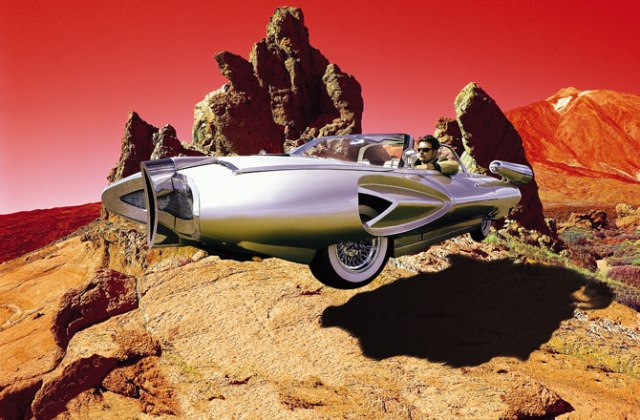
Toyota thinks hover cars may be in our future

If you asked a guy in the 1960s what he thought we’d be driving today, he’d probably think about what he’d seen in a popular TV science-fiction show of the time and say “a hover car.”

But 1960s guy would probably be a little disappointed that what people are actually driving are cars that look a bit like his mid-60s Mustang but a thousand pounds heavier.

Somewhere inside Toyota there’s a team of engineers who still have that 1960s innocence, as Toyota managing officer Hiroyoshi Yoshiki has just revealed the company is working on a real-life hover car, or at least investigating the potential.

According to The Verge (via Jalopnik), the project is underway at one of Toyota’s “most advanced” research and development areas.

Unfortunately, we’re not going to have something approximating the Jetsons’ car, nor even Luke Skywalker’s speeder any time soon. The car won’t so much be hovering in free space as “a little bit away” from the road. This is more likely to mean microns than inches, but the aim is to reduce road friction.

Without turning the car into a giant aircraft wing this probably isn’t a simple process, as friction is rather important to a car’s ability to go, stop and corner. And losing contact with the road entirely needs lots of energy and usually lots of speed, too — think jet aircraft, rather than a Toyota Yaris.

Yoshiki, speaking at Bloomberg’s Next Big Thing Summit in San Francisco, wouldn’t elaborate further on the company’s ideas, so it’s unknown how close such an idea is to reality. Nor did he reveal how long Toyota has worked on the idea — so we’re not expecting flying Priuses any time soon.

Thanks to Da Brayn for bringing this to the attention of the It’s Interesting community.

http://news.discovery.com/autos/future-of-transportation/toyota-thinks-hover-cars-might-be-a-thing-140613.htm

Serial tickler on the loose in Boston

Police in Boston are investigating a number of overnight break-ins in the Brighton neighborhood of Boston early Tuesday morning.

Two homes on Foster Road and one on Kirkwood Road were targeted during the early morning hours.

People living in the neighborhood close to Boston College fear a serial tickler is breaking into homes and targeting men.

In one of the break-ins, David Master said he heard screaming from one of his roommates. “He felt something on his foot and thought it was the cat,” Master said. “He woke up to see a man crouched by his bed.”

Master told the Boston Globe he and his roommates did not pursue the man. The man apparently walked in through their unlocked door.

The first break-in was reported around 3:50 a.m., the Globe reported. Residents in a home on Foster Street said they found a masked man in their home. When they spotted him, he ran in an unknown direction, the Globe reported.

Gino Caligore says his apartment was another target for the tickler. “Apparently the tickler had come in, tickled my roommate, and before my friend could catch him or anything, the guy ran out of the house,” Caligore said.

Boston police asked anyone with information about the crime to contact them.

Read more: http://www.wcvb.com/news/string-of-home-invasions-could-be-tied-to-serial-tickler/26424224#ixzz34cvVuDVp

NASA unveils model of warp-drive starship, which is currently impossible.

NASA’s Harold White has been working since 2010 to develop a warp drive that will allow spacecraft to travel at speeds faster than light — 186,000 miles per second.

White, who heads NASA’s Advanced Propulsion Team, spoke about his conceptual starship at a conference last fall. But interest in his project reached a new level this week when he unveiled images of what the craft might look like.

Created by artist Mark Rademaker, who based them on White’s designs, the images show a technologically detailed spacecraft that wouldn’t look out of place in a “Star Trek” movie. Rademaker says creating them took more than 1,600 hours.

For now, warp speed is only possible in TV and movies, with both “Star Trek” and “Star Wars” referencing an idea that was completely speculative at the time. White has fittingly named the concept spacecraft IXS Enterprise, for the starship famously piloted by Captain James T. Kirk in the “Star Trek” TV series and movies.

At the SpaceVision 2013 Space Conference last November in Phoenix, White talked about his design, the concepts behind it and the progress that’s been made in warp-drive development over the decades. He discussed the idea of a “space warp,” a loophole in the theory of general relativity that would allow for massive distances to be traveled very quickly, reducing travel times from thousands of years to days.

In his speech, White described space warps as faraway galaxies that can bend light around them. They work on the principle of bending space both in front of and behind a spacecraft. This would essentially allow for the empty space behind the craft to expand, both pushing and pulling it forward at the same time. The concept is similar to that of an escalator or moving walkway.

“There’s no speed limit on the expansion and contraction of space,” White said at the conference. “You can actually find a way to get around what I like to call the 11th commandment: Thou shall not exceed the speed of light.”

It’s the idea of space warps that inspired physicist Miguel Alcubierre in 1994 to first theorize a mathematical model of a warp drive that would be able to bend space and time. While studying Alcubierre’s equations, White decided to design his own retooled version of the Alcubierre Drive. His recently unveiled design has much less empty space than the first concept model, increasing its efficiency.

The warp drive that White’s team has been working on would literally transcend space, shortening the distance between two points and allowing the craft to break the speed of light. This would be a spaceship with no speed limit.

Because travel into space has been extremely limited due to existing means of propulsion, such a technology could blow open the possibilities of space exploration. It could allow for study of the farthest reaches of space, parts that scientists once considered unimaginable.

Although the technology to create the spacecraft or the warp drive doesn’t yet exist, the artistic renderings Rademaker created could potentially be a model of what’s to come — the first spacecraft to break the speed-of-light barrier and journey beyond our solar system.

In his design, White says he drew from Matthew Jeffries’ 1965 sketches of the Enterprise from “Star Trek,” saying parts of that ship were mathematically correct. He worked with Rademaker and graphic designer Mike Okuda to update the math and produce what he believes to be a viable spacecraft.

According to NASA, there hasn’t been any proof that a warp drive can exist, but the agency is experimenting nonetheless. Although the concept doesn’t violate the laws of physics, that doesn’t guarantee that it will work.

“We’re starting to talk about what the next chapter for human space exploration going to be,” White said at SpaceVision.

http://www.cnn.com/2014/06/12/tech/innovation/warp-speed-spaceship/index.html