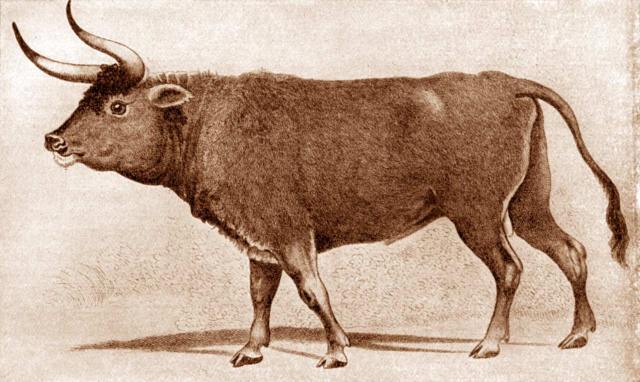
Scientists Sequence Genome of Eurasian Wild Aurochs, an Extinct Species of Ox that Gave Rise to Modern Bison

A multinational team of researchers has sequenced the nuclear genome of the aurochs (Bos primigenius), an extinct species of ox that inhabited Europe, Asia and North Africa.

“This is the first complete nuclear genome sequence from the extinct Eurasian aurochs,” said Dr David MacHugh of University College Dublin, Ireland, corresponding author of a paper published online in the journal Genome Biology.

Domestication of the now-extinct wild aurochs gave rise to the two major domestic extant cattle species – Bos taurus and B. indicus.

While previous genetic studies have shed some light on the evolutionary relationships between European aurochs and modern cattle, important questions remain unanswered, including the phylogenetic status of aurochs, whether gene flow from aurochs into early domestic populations occurred, and which genomic regions were subject to selection processes during and after domestication.

To build a clearer picture of the ancestry of European cattle breeds, Dr MacHugh and his colleagues from the United States, the UK, China and Ireland, extracted genetic material from a bone of a 6,750 year old wild aurochs discovered in a cave in Derbyshire, England.

The scientists then sequenced its complete genome and compared it with the genomes of 81 domesticated Bos taurus and B. indicus animals, and DNA marker information from more than 1,200 modern cows.

They discovered clear evidence of breeding between wild British aurochs and early domesticated cattle.

“Our results show the ancestors of modern British and Irish breeds share more genetic similarities with this ancient specimen than other European cattle,” Dr MacHugh said.

“This suggests that early British farmers may have restocked their domesticated herds with wild aurochs.”

“Genes linked to neurobiology and muscle development were also found to be associated with domestication of the ancestors of European cattle, indicating that a key part of the domestication process was the selection of cattle based on behavioral and meat traits.”

The study contradicts earlier simple models of cattle domestication and evolution that researchers proposed based on mitochondrial DNA or Y chromosomes.

“What now emerges from high-resolution studies of the nuclear genome is a more nuanced picture of crossbreeding and gene flow between domestic cattle and wild aurochs as early European farmers moved into new habitats such as Britain during the Neolithic,” Dr MacHugh concluded.

_____

Stephen D.E. Park et al. 2015. Genome sequencing of the extinct Eurasian wild aurochs, Bos primigenius, illuminates the phylogeography and evolution of cattle. Genome Biology 16: 234; doi: 10.1186/s13059-015-0790-2

http://www.sci-news.com/genetics/science-genome-eurasian-wild-aurochs-bos-primigenius-03377.html?utm_source=feedburner&utm_medium=feed&utm_campaign=Feed%3A+BreakingScienceNews+%28Breaking+Science+News%29

Bison Herders Wanted


In an annual roundup on Antelope Island in the Great Salt Lake, about 775 bison are corralled and vaccinated.

The morning sky had turned to pink and it was to time to saddle up, so Benedikt Preisler, 59, strode across this grassy island to make use of the riding boots and cowboy hat he had bought the day before. “The outfit,” said Mr. Preisler, a German tourist standing in a sea of 10-gallon hats, “is necessary.”

It was the annual Antelope Island bison roundup, a Utah tradition that brings together seasoned cowboys and wide-eyed neophytes for a weekend of Western romance. Participants camp out on this island in the Great Salt Lake and spend a day on horseback chasing hundreds of bison toward corrals, where the animals are given vaccinations and about 200 are readied for sale. (The auctioned animals later become burgers, steaks and jerky.)

The event attracts local ranchers toting well-worn bullwhips as well as urban desk workers craving respite from the tyranny of the computer. For some, it is the only opportunity to interact with bison — those iconic, furry, fast-moving ungulates that are often called American buffalo and once numbered in the tens of millions before they were decimated by early settlers.

The annual roundup on Antelope Island has become a draw for seasoned cowboys as well as tourists.

“I’m a surgeon — it’s very boring compared to this,” said Paul Olive, 57, who drove 1,300 miles from Springfield, Mo., for the event. “It is an adrenaline rush to be on a horse, chasing a wild buffalo. Because it can be very dangerous.”

Antelope Island is a rugged, salt-ringed expanse just an hour’s drive from Salt Lake City, and its eastern shore faces the city’s twinkling skyline. The island’s bison are the descendants of 12 animals transported by boat to the island in 1893 by frontiersmen who sought to protect a few of the endangered animals — and turn a profit — by creating a hunting reserve for the wealthy. By 1926, it cost $300 to shoot one of the animals — the equivalent of about $4,000 today.

Today, about 775 bison are on the island, making them one of the oldest and largest publicly owned bison herds in the nation. And the island is now a state park teeming with native creatures, including pronghorn antelope.

Park rangers began the roundup and auction in 1986 to ensure that the animals did not overrun the island. Pulling a move from Tom Sawyer, officials billed the task as entertainment, and began inviting the public to help.

The roundup was added to tourist booklets, and the 1991 movie “City Slickers” — starring Billy Crystal as a New Yorker out West — helped popularize the idea of a cowboy vacation.

This year’s roundup took place on Friday. Standing in a dew-kissed field, Mr. Preisler explained that he had flown from Germany just for the ride after learning about the event during a business trip to Utah last year. His horse, Joe, was a rental.

Nearby, an experienced horseman named Dean Holliday, 83, said he had worked the event since its inception and lived just a few miles away.

“Touch of the old West,” said Mr. Holliday, who had brought two grandsons along. One, a professional photographer, circled the scene with an elaborate camera rig, treating his grandfather — in a neckerchief and a cowboy hat — as if he were the star of a Western epic.

Participants of the roundup spend a day on horseback chasing hundreds of bison toward corrals.

“One of these days I’m going to hang up my spurs,” Mr. Holliday added. “And these guys are going to continue on.”

During a brief orientation, roundup leaders explained that the group would flank nearby clusters of bison and chase them north for several miles. Shouts and skyward whip cracks were appropriate means of coercion. Off limits were guns, iPods and attempts to touch the animals.

Weighing up to 2,000 pounds, bison look like bears but run more like gazelles, reaching speeds of 30 or even 40 miles an hour, and they will occasionally charge at agitators. Horses are occasionally gored.

“These animals are wild, and they don’t do exactly what you want them to,” said Chad Bywater, 40, a longtime participant, explaining that cattle roundups tend to be far tamer.

Twelve bison, also known as American buffalo, were first brought to Antelope Island in 1893 as part of a plan to create a hunting refuge for the wealthy.

A local news team readied a drone to capture video, and the 250 or so riders set off, traveling up steep hills and across plains of yellow grass, galloping behind the bison.

At one point, the animals turned on the riders, forcing a brief retreat. At another, a bison broke from the herd and went careering toward tourists watching from the roadside. Onlookers raced to their minivans, pulling binoculars behind them.

By 1 p.m., the riders had the bison in the corrals, clicking fence doors shut. It was the fastest roundup anyone could remember.

Tyra Canary, 46, a fraud detection analyst from a nearby suburb, called the ride “therapy.” “I watch your credit card for fraud eight hours a day, five days a week,” she said. “It’s really good to just get out in the sun.”

Horses lapped from a trough. Men with chaps and handlebar mustaches recounted the morning’s exploits and planned for the evening campout.

Mr. Preisler, the German visitor, dismounted and declared the ride a success. “You should do it once in a lifetime,” he said.

A night in a tent, however, was not on the itinerary. “No — oh, God, no,” he said, explaining that he had opted for the comfort of a nearby hotel.


Uzbek farmers told to glue cotton back on bushes ahead of state trip

When word came that the Uzbek prime minister would be driving past their village, local officials wanted to impress him with roads lined by snowy white fields of cotton.

The only problem was that the cotton had already been picked.

So, locals say, farmers were told to glue cotton balls back on the bushes to give an impression of a bountiful harvest of the country’s most important crop.

Ahead of the expected visit by the prime minister, Shavkat Mirziyaev, at the end of September, some 400 men and women in the village of Shaharteppa in Ferghana province were reportedly pressed into service along the main road where the official convoy was expected to pass.

“Some of them were applying glue inside the bolls and others were putting cotton on the bolls, while another group was attaching cotton capsules onto stalks in the front rows of the cotton field,” a resident, who spoke on condition of anonymity, told RFE/RL’s Uzbek Service.

“When I asked them why they were gluing cotton, they told me, ‘Apparently the prime minister is coming and we’re told everything should look good here,’” the resident said.

Meanwhile, hundreds of others swept the area along the main road to keep it clean for the prime minister.

A farmer appeared to confirm the claim. “People were put through so much trouble,” he said. “More than 500 people had to leave their work and come and glue cotton here. They said it was being done at the provincial governor’s order.”

Fearing reprisals from the authorities, the farmer did not want to give his name.

Yet it seems the farmers labored in vain as the prime minister changed his route at the last minute and did not pass by the village after all.

It wasn’t the first time the province had gone to such lengths to create a good impression. Ferghana officials reportedly had cotton glued back on bushes to please the president, Islam Karimov, during a trip in October 2009, and fake flowers were apparently attached to trees when Karimov visited the region in March 2015.

In neighbouring Tajikistan, the facades of private and official buildings are given a hasty facelift alongside main roads before the convoy of President Emomali Rahmon passes during regional trips.

The practice is also commonplace in other former Soviet republics including Russia, where the phrase “Potemkin village” refers to fake facades that are said to have been put up as a show for dignitaries in tsarist times.

Last week, workers reportedly had to remove cracked asphalt from a new road hurriedly launched ahead of a visit by Vladimir Putin to the town in Zabaykalsky Krai in September.

In Suzdal, a historic city outside Moscow, the facades of shabby buildings were covered by custom-made posters to please the visiting president, media reported.

http://www.theguardian.com/world/2015/oct/16/uzbek-farmers-glue-cotton-on-bushes

Astronomers may have found giant alien ‘megastructures’ orbiting star near the Milky Way

A large cluster of objects in space look like something you would “expect an alien civilization to build”, astronomers have said.

Jason Wright, an astronomer from Penn State University, is set to publish a report on the “bizarre” star system – suggesting the objects could be a “swarm of megastructures”.

He told The Independent: “I can’t figure this thing out and that’s why it’s so interesting, so cool – it just doesn’t seem to make sense.”

Speaking to The Atlantic, Mr Wright said: “Aliens should always be the very last hypothesis you consider, but this looked like something you would expect an alien civilisation to build. I was fascinated by how crazy it looked.”

The snappily named KIC 8462852 star lies just above the Milky Way, between the constellations Cygnus and Lyra. It first attracted the attention of astronomers in 2009, when the Kepler Space Telescope identified it as a candidate for having orbiting Earth-like planets.

But KIC 8462852 was emitting a stranger light pattern than any of the other stars in Kepler’s search for habitable planets.

Kepler works by analysing light from distant places in the universe — looking for changes that take place when planets move in front of their stars. But the dip in starlight from KIC 8462852 does not seem to be the normal pattern for a planet.

Tabetha Boyajian, a postdoc at Yale, told The Atlantic: “We’d never seen anything like this star. It was really weird. We thought it might be bad data or movement on the spacecraft, but everything checked out.”

In 2011 the star was flagged up again by several members of Kepler’s “Planet Hunters” team – a group of ‘citizen scientists’ tasked with analysing the data from the 150,000 stars Kepler was watching.

The analysts tagged the star as “interesting “ and “bizarre” because it was surrounded by a mass of matter in tight formation.

This was consistent with the mass of debris that surrounds a young star just as it did with our sun before the planets formed. However this star was not young and the debris must have been deposited around it fairly recently or it would have been clumped together by gravity – or swallowed by the star itself.

Boyajian, who oversees the Planet Hunters project, recently published a paper looking at all the possible natural explanations for the objects and found all of them wanting except one – that another star had pulled a string of comets close to KIC 8462852. But he said even this would involve an incredibly improbable coincidence.

A this stage Mr Wright, the astronomer from Penn State University, and his colleague Andrew Siemion, the Director of SETI (Search for Extra-Terrestrial Intelligence), got involved. Now the possibility the objects were created by intelligent creatures is being taken very seriously by the team.

As civilisations become more technologically advanced, they create new and better ways of collecting energy — with the end result being the harnessing of energy directly from their star. If the speculation about a megastructure being placed around the star system is correct, scientists say it could be a huge set of solar panels placed around the star.

The three astronomers want to point a radio dish at the star to look for wavelengths associated with technological civilisations. And the first observations could be ready to take place as early as January, with follow-up observations potentially coming even quicker.

“If things go really well, the follow-up could happen sooner,” Wright told The Atlantic. “If we saw something exciting… we’d be asking to go on right away.”

http://www.independent.co.uk/news/world/forget-water-on-mars-astronomers-may-have-just-found-giant-alien-megastructures-orbiting-a-star-near-a6693886.html

Thanks to Kebmodee and David Frey for bringing this to the It’s Interesting community.

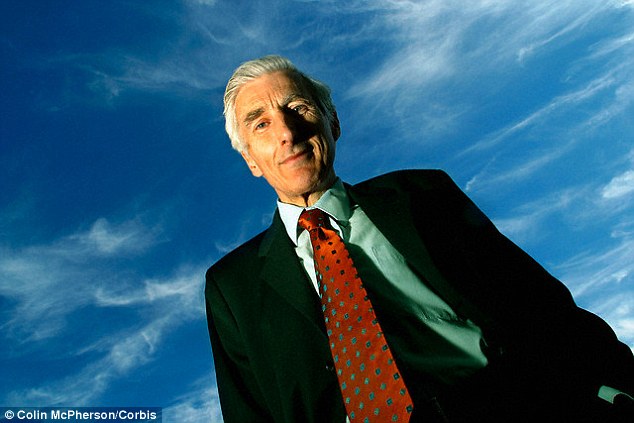
Astronomer Sir Martin Rees believes aliens have transitioned from organic forms to machines – and that humans will do the same.

British astrophysicist and cosmologist, Sir Martin Rees, believes if we manage to detect aliens, it will not be by stumbling across organic life, but from picking up a signal made by machines.

It’s likely these machines will have evolved from organic alien beings, and that humans will also make the transition from biological to mechanical in the future.

Sir Martin said that while the way we think has led to all culture and science on Earth, it will be a brief precursor to more powerful machine ‘brains’.

He thinks that life away from Earth has probably already gone through this transition from organic to machine.

On a planet orbiting a star far older than the sun, life ‘may have evolved much of the way toward a dominant machine intelligence,’ he writes.

Sir Martin believes it could be one or two more centuries before humans are overtaken by machine intelligence, which will then evolve over billions of years, either with us, or replacing us.

‘This suggests that if we were to detect ET, it would be far more likely to be inorganic: We would be most unlikely to “catch” alien intelligence in the brief sliver of time when it was still in organic form,’ he writes.

Despite this, the astronomer said Seti searches are worthwhile, because the stakes are so high.

Seti seeks our electromagnetic transmissions thought to be made artificially, but even if it did hit the jackpot and detect a possible message sent by aliens, Sir Martin says it is unlikely we would be able to decode it.

He thinks such a signal would probably be a byproduct or malfunction of a complex machine far beyond our understanding that could trace its lineage back to organic alien beings, which may still exist on a planet, or have died out.

He also points out that even if intelligence is widespread across the cosmos, we may only ever recognise a fraction of it because ‘brains’ may take a form unrecognisable to humans.

For example, instead of being an alien civilisation, ET may be a single integrated intelligence.

He mused that the galaxy may already teem with advanced life and that our descendants could ‘plug in’ to a galactic community.

Read more: http://www.dailymail.co.uk/sciencetech/article-3285966/Is-ET-ROBOT-Astronomer-Royal-believes-aliens-transitioned-organic-forms-machines-humans-same.html#ixzz3pOiCcJY8

Scientists develop system to detect Supervolcano eruptions

Researchers claim to have worked out how to accurately predict the eruption of ‘supervolcanoes’ that blanket the earth in giant ash clouds triggering a ‘nuclear winter’.

They say the discovery could reveal exactly when giant pools of magma greater than 100 cubic miles in volume and formed a few miles below the surface will erupt.

Repeatedly throughout Earth’s history,when they become a super-eruption, the resulting gigantic volcanic outbursts that throw 100 times more superheated gas, ash and rock into the atmosphere than run-of-the-mill eruptions – enough to blanket continents and plunge the globe into decades-long volcanic winters.

The most recent super-eruption took place about 27,000 years ago in New Zealand, well before humans kept records of volcanic eruptions and their aftermath.

Geologists today are studying deposits from past super-eruptions to try and understand where and how rapidly these magma bodies develop and what causes them to eventually erupt.

Despite considerable study, geologists are still debating how quickly these magma pools can be activated and erupted, with estimates ranging from millions to hundreds of years.

Now a team of geologists have developed a new ‘geospeedometer’ that they argue can help resolve this controversy by providing direct measurements of how long the most explosive types of magma existed as melt-rich bodies of crystal-poor magma before they erupted.

They have applied their new technique to two super-eruption sites and a pair of very large eruptions and found that it took them no more than 500 years to move from formation to eruption.

These results are described in the article ‘Melt inclusion shapes: Timekeepers of short-lived giant magma bodies’ appearing in the November issue of the journal Geology.

Geologists have developed a number of different ‘timekeepers’ for volcanic deposits.

The fact that these techniques measure different processes and have different resolutions, has contributed to this lack of consensus.

‘Geologists have developed a number of different ‘timekeepers’ for volcanic deposits,’ said Guilherme Gualda, associate professor of earth and environmental sciences at Vanderbilt University, who directed the project.

‘The fact that these techniques measure different processes and have different resolutions, has contributed to this lack of consensus.

‘Our new method indicates that the process can take place within historically relevant spans of time,’
The method was developed as part of the doctoral thesis of Ayla Pamukcu, who is now a post-doctoral researcher at Brown and Princeton Universities.

‘The hot spot under Yellowstone National Park has produced several super-eruptions in the past.

‘The measurements that have been made indicate that this magma body doesn’t currently have a high-enough percentage of melt to produce a super-eruption.

But now we know that, when or if it does reach such a state, we will only have a few hundred years to prepare ourselves for the consequences,’ Gualda said.

The researchers’ geospeedometer is based on millimeter-sized quartz crystals that grew within the magma bodies that produced these giant eruptions.

Quartz crystals are typically found in magmas that have a high percentage of silica.

This type of magma is very viscous and commonly produces extremely violent eruptions. Mount St. Helens was a recent example.

When the crystals form, they often capture small blobs of molten magma – known as blebs or melt inclusions. Blebs are initially round.

While the crystal is floating in hot magma, diffusion causes them to gradually acquire the polygonal shape of the crystal void that they occupy. But this faceting process can be halted if eruption occurs before complete faceting is achieved.

Using advanced 3-D X-ray tomography, the researchers were able to measure the size and shape of the melt inclusions with exquisite precision.

In cases where the inclusions had not become completely faceted, the researchers could determine how much time had elapsed since they were enclosed.

‘Previous studies provided us with the data we needed to calculate the rate of the faceting process. We then used this rate, in combination with our shape measurements, to calculate how long the crystal existed in the magma before the eruption,’ said Pamukcu.

In addition, the researchers compared the results obtained with faceting with results obtained using other techniques.

Crystallization may cause variations in concentration of certain elements. In quartz, the element titanium can vary sharply between different zones or layers within the crystal.

Over time, however, the process of diffusion gradually smooths out these variations.

This process also stops at the eruption, so the shallower the slope of titanium concentrations across these boundaries today, the longer the crystal spent in magmatic conditions.

The physics of this process is also well known, so the researchers could use these measurements to provide an independent estimate of how long a crystal spent floating around in the melt.

They found that the duration times they derived from the titanium diffusion measurements agreed closely with those produced by the faceting method.

‘Our current method will also work on smaller volcanic systems, as long as they erupt magmas that contain quartz crystals,’ said Pamukcu.

‘We are also confident that we can adapt these techniques to work with other minerals, which will allow us to make similar timescale calculations for other types of magmas and volcanoes, like the low-silica basalts commonly erupted from Hawaiian volcanoes.’

Read more: http://www.dailymail.co.uk/sciencetech/article-3281859/Phew-Scientists-claim-developed-predict-cataclysmic-SUPERVOLCANO-eruptions-end-life-Earth.html#ixzz3pD81J9cT

Israeli hummus cafe owner offers free refill for every serving of hummus to Jews and Palestinian guests dining together, to show that “we’re all human beings”.

A hummus cafe in Israel is giving a 50 percent discount to tables mixing Jewish and Arab diners, in a campaign the owner hopes will bring people together as dozens of people have been killed in Israeli-Palestinian violence this month.

Kobi Tzafrir, the owner of Humus Bar in the town of Kfar Vitkin, initially posted the offer on Facebook.

“With us we don’t have Arabs! But we also don’t have Jews… With us we’ve got human beings! Real excellent Arab hummus! Excellent Jewish falafel!”, the post, which by Monday evening had been shared more than 1,000 times, read.

Tzafrir told Al Jazeera he wanted to show that there are a lot of Arabs and Jews who are not taking part in the violent events reported in the media.

“We want to show that we’re all human beings, just like each other, not so different,” he said over the phone.

http://www.aljazeera.com/news/2015/10/israeli-hummus-cafe-jews-arabs-discount-151019201935558.html

Drought causes 450-year-old Mexican church to emerge from reservoir


The Temple of Quechula was built in 1564 but later abandoned and ultimately submerged by a dam. Now drought conditions in Chiapas have seen it rise again.

The ruins of a 16th century church have emerged from the waters of a reservoir in Mexico.

The water level in the Nezahualcóyotl reservoir in Chiapas state has dropped by 25m (82ft) because of a drought in the area. The church, known as the Temple of Santiago or the Temple of Quechula, has been under nearly 100ft of water since 1966.

The church, which is believed to have been built by Spanish colonists, is 183ft long and 42ft wide, with a bell tower that rises 48ft above the ground.

It was built in 1564, the Associated Press reported, because of an expected surge in population, but abandoned after plague hit the area between 1773 and 1776.

“It was a church built thinking that this could be a great population center, but it never achieved that,” architect Carlos Navarretes said. “It probably never even had a dedicated priest, only receiving visits from those from Tecpatán.”

http://www.theguardian.com/world/2015/oct/19/drought-mexican-church-reservoir

Cancer drug nilotinib may reverse Parkinson’s disease

by Jon Hamilton

A drug that’s already approved for treating leukemia appears to dramatically reduce symptoms in people who have Parkinson’s disease with dementia, or a related condition called Lewy body dementia.

A pilot study of 12 patients given small doses of nilotinib found that movement and mental function improved in all of the 11 people who completed the six-month trial, researchers reported Saturday at the Society for Neuroscience meeting in Chicago.

And for several patients the improvements were dramatic, says Fernando Pagan, an author of the study and director of the Movement Disorders Program at Georgetown University Medical Center. One woman regained the ability to feed herself, one man was able to stop using a walker, and three previously nonverbal patients began speaking again, Pagan says.

“After 25 years in Parkinson’s disease research, this is the most excited I’ve ever been,” Pagan says.

If the drug’s effectiveness is confirmed in larger, placebo-controlled studies, nilotinib could become the first treatment to interrupt a process that kills brain cells in Parkinson’s and other neurodegenerative diseases, including Alzheimer’s.

One of the patients in the pilot study was Alan Hoffman, 74, who lives with his wife, Nancy, in Northern Virginia.

Hoffman was diagnosed with Parkinson’s in 1997. At first, he had trouble moving his arms. Over time, walking became more difficult and his speech became slurred. And by 2007, the disease had begun to affect his thinking.

“I knew I’d dropped off in my ability to read,” Hoffman says. “People would keep giving me books and I’d have read the first chapter of about 10 of them. I had no ability to focus on it.”

“He had more and more difficulty making sense,” Nancy Hoffman says. He also became less active, less able to have conversations, and eventually stopped doing even household chores, she says.

But after a few weeks on nilotinib, Hoffman “improved in every way,” his wife says. “He began loading the dishwasher, loading the clothes in the dryer, things he had not done in a long time.”

Even more surprising, Hoffman’s scores on cognitive tests began to improve. At home, Nancy Hoffman says her husband was making sense again and regained his ability to focus. “He actually read the David McCullough book on the Wright Brothers and started reading the paper from beginning to end,” she says.

The idea of using nilotinib to treat people like Alan Hoffman came from Charbel Moussa, an assistant professor of neurology at Georgetown University and an author of the study.

Moussa knew that in people who have Parkinson’s disease with dementia or a related condition called Lewy body dementia, toxic proteins build up in certain brain cells, eventually killing them. Moussa thought nilotinib might be able to reverse this process.

His reasoning was that nilotinib activates a system in cells that works like a garbage disposal — it clears out unwanted proteins. Also, Moussa had shown that while cancer cells tend to die when exposed to nilotinib, brain cells actually become healthier.

So Moussa had his lab try the drug on brain cells in a Petri dish. “And we found that, surprisingly, with a very little amount of the drug we can clear all these proteins that are supposed to be neurotoxic,” he says.

Next, Moussa had his team give the drug to transgenic mice that were almost completely paralyzed from Parkinson’s disease. The treatment “rescued” the animals, he says, allowing them to move almost as well as healthy mice.

Moussa’s mice got the attention of Pagan from Georgetown’s Movement Disorders Program. “When Dr. Moussa showed them to me,” Pagan says, “it looked like, hey, this is type of drug that we’ve been looking for because it goes to the root of the problem.”

The pilot study was designed to determine whether nilotinib was safe for Parkinson’s patients and to determine how much drug from the capsules they were taking was reaching their brains. “But we also saw efficacy, which is really unheard of in a safety study,” Pagan says.

The study found that levels of toxic proteins in blood and spinal fluid decreased once patients began taking nilotinib. Also, tests showed that the symptoms of Parkinson’s including tremor and “freezing” decreased. And during the study patients were able to use lower doses of Parkinson’s drugs, suggesting that the brain cells that produce dopamine were working better.

But there are some caveats, Pagan says. For one thing, the study was small, not designed to measure effectiveness, and included no patients taking a placebo.

Also, nilotinib is very expensive. The cost of providing it to leukemia patients is thousands of dollars a month.

And finally, Parkinson’s and dementia patients would have to keep taking nilotinib indefinitely or their symptoms would continue to get worse.

Alan Hoffman was okay for about three weeks after the study ended and he stopped taking the drug. Since then, “There’s (been) a pretty big change,” his wife says. “He does have more problems with his speech, and he has more problems with cognition and more problems with mobility.”

The Hoffmans hope to get more nilotinib from the drug’s maker, Novartis, through a special program for people who improve during experiments like this one.

Meanwhile, the Georgetown team plans to try nilotinib in patients with another brain disease that involves toxic proteins: Alzheimer’s.

http://www.npr.org/sections/health-shots/2015/10/17/448323916/can-a-cancer-drug-reverse-parkinsons-disease-and-dementia

New research suggests that male brains may be wired to prioritize sex over food.

According to a new study, the male brain contains two extra cells that can cause men to seek out sex as a priority, even over food. Female brains do not contain these cells.

The research, conducted by scientists at University College London, may have been carried out on tiny transparent worms, but co-author Professor Scott Emmons has insisted the findings offer an insight into human sex habits.

“Though the work is carried out in a small worm, it nevertheless gives us a perspective that helps us appreciate and possibly understand the variety of human sexuality, sexual orientation, and gender identification,” he said, according to The Telegraph.

“Although we have not looked in humans, it is plausible that the male human brain has types of neurons that the female brain doesn’t, and vice versa. This may change how the two sexes perceive the world and their behavioural priorities.”

The researchers studied the brains and behaviours of Caenorhabditis elegans – small soil-dwelling worms that grow to 1mm long – to draw their conclusions.

The worm species is made up of two sexes: males and hermaphrodites. Scientists consider the latter “modified females” that do not need to have sex in order to reproduce.

Caenorhabditis elegans are often used in studies relevant to human biology and disease as they contain many of the same genes that humans do.

After recently discovering that the male worms contained two extra brain cells, the researchers wanted to find out what impact this could have on their behaviour.

They conditioned the worms in a controlled environment so that they would associate the appearance of salt with starvation.

Over the course of the experiment, the worms began to move away from the salt.

However, when salt was present at the same time as a potential mate, the male worms risked getting close to the salt in order to advance sexually.

In contrast the hermaphrodite worms continued to move away from the salt.

The study, published in the online journal Nature, concludes that male brains may be genetically wired to prioritise sex over food.

This isn’t the first study to suggest men and women’s brains may be wired differently.

In 2013, a study from the University of Pennsylvania found that men generally have more connections within each hemisphere of the brain, while in women the two halves of the brain are much more interlinked.

The scientists concluded that male brains are mainly configured to co-ordinate perception and action, while women’s are more geared up to integrate “heart and mind” thought processes, linking analytical and intuitive reasoning.

http://www.huffingtonpost.co.uk/2015/10/15/male-brain-prioritise-sex-over-food_n_8300240.html