Boy cuts off his index finger during argument with father over phone use

The 11-year-old boy, from Suzhou, China, is said to have sliced off the digit after having an argument with his father about his smartphone addiction.

As his father chastised him for being constantly glued to his phone, the boy is said to have grabbed a knife and plunged it into his left index finger in a fit of rage.

The argument is said to have started when his father told him to put down the phone and help his brother with his homework.

The boy was taken to hospital where surgeon Ren Zhourong attempted to reattach the severed finger during a three-hour operation.

It will be a week until doctors know if the surgery was a success.

Boy ‘cuts off finger during argument with father over phone use’

Researchers reveal white dwarf rampaging through the universe that may have destroyed 15 alien worlds


By MARK PRIGG FOR DAILYMAIL.COM

A real-life ‘Death Star’ caught is the act of destroying a planet is continuing its destructive journey, researchers have found.

Last year astronomers used the Very Large Telescope in Chile to see an asteroid being ripped apart by a white dwarf – a small star that has ‘run out of fuel’ – and forming a glowing debris ring.
Now, it is believed it may have ‘eaten’ at least 15.

The discovery has provided a glimpse of what is expected to happen to our own solar system when the sun stops burning.

‘Our sun will one day balloon out to become a red giant star, wiping out Mercury and Venus and maybe Earth, before it becomes a white dwarf,’ lead author Boris Gänsicke, an astronomer at the University of Warwick, told Space.com

‘By looking at this white dwarf, we get a look at what the future of the solar system might be like.’
The dead star is a white dwarf known as WD 1145+017, which lies about 570 light-years from Earth in the constellation Virgo, according the the paper, which set to detailed their findings Feb. 3 in the journal Astrophysical Journal Letters.

Gänsicke found the killer white dwarf system has rapidly evolved in the few months since the discovery.
‘It’s exciting and unexpected that we can see this kind of dramatic change on human timescales,’ Gänsicke said.

The team ‘identified six, but there are clearly more — it could be 10, maybe 15.’

The bodies are orbiting the dead star at about the same distance as the planetesimal that previous research spotted, and are each two to four times the size of the white dwarf.

It is believed they are huge clouds of gas and dust.

WHAT IS A WHITE DWARF?
A white dwarf is the remains of a smaller star that has run out of nuclear fuel.

While large stars – those exceeding ten ten times the mass of our sun – suffer a spectacularly violent climax as a supernova explosion at the ends of their lives, smaller stars are spared such dramatic fates.

When stars like the sun come to the ends of their lives they exhaust their fuel, expand as red giants and later expel their outer layers into space.

The hot and very dense core of the former star – a white dwarf – is all that remains.

White dwarfs contain approximately the mass of the sun but have roughly the radius of Earth, meaning they are incredibly dense.

The gravity on the surface of a white dwarf is 350,000 times that of gravity on Earth.

They become so dense because their electrons are smashed together, creating what’s caused ‘degenerative matter’.

This means that a more massive white dwarf has a smaller radius than its less massive counterpart.

Read more: http://www.dailymail.co.uk/sciencetech/article-3488287/The-real-life-DEATH-STAR-Researchers-reveal-white-dwarf-rampaging-universe-destroyed-15-alien-worlds.html#ixzz42lFVHZMu

Plastic-eating bacteria discovered in recycling plant

By Eva Botkin-Kowacki

Plastic is everywhere around us. We drink out of plastic cups, buy disposable water bottles, unwrap new electronics from plastic packaging, take home plastic shopping bags, and even wear plastic in polyester fabrics.

Some 311 million tons of plastic is produced across the globe annually, and just 10 percent makes it back to a recycling plant. The rest ends up in landfills, or as litter on land or in the ocean, where it remains for decades and longer.

As for the plastic that has been recycled, it has given rise to an unintended side effect: A team of scientists searching through sediments at a plastic bottle recycling plant in Osaka, Japan have found a strain of bacteria that has evolved to consume the most common type of plastic.

Ideonella sakaiensis 201-F6 can degrade poly (ethylene terephthalate), commonly called PET or PETE, in as little as six weeks, they report in a new paper published Thursday in the journal Science.

Common uses of PET include polyester fibers, disposable bottles, and food containers. The last two are typically labelled with a No. 1 inside a recycling symbol.

But this new paper doesn’t mean you should ditch your reusable water bottles in favor of a tray of disposable ones, or that we’re going to inject this bacteria into landfills tomorrow. This study simply evaluated if the bacteria in question could degrade PET and was conducted under laboratory conditions.

“We hope this bacterium could be applied to solve the severe problems by the wasted PET materials in nature,” Kohei Oda, one of the study authors, tells The Christian Science Monitor in an email. But “this is just the initiation for application.” More research has to be done in order to make this a practical solution to plastic pollution.

But could this sort of fix work in theory?

“[Plastics] have been engineered for cost and for durability, or longevity,” says Giora Proskurowski, an oceanographer at the University of Washington who studies plastic debris in the ocean but was not part of this study, in a phone interview with the Monitor. But he’s hopeful that this research could yield further studies and technologies to mitigate the problem.

The durability of plastic isn’t the only challenge this potential fix faces. Microbes are like teenagers, Christopher Reddy, a senior scientist at Woods Hole Oceanographic Institution who studies environmental pollution and was not part of this study, explains in an interview with the Monitor.

“You can tell them to clean the garage over the weekend but they’re going to do it on their own timescale, they’re going to do it when they want, they’re going to pick the easiest thing to do and they’re likely going to leave you more frustrated than you think,” he explains the metaphor. Similarly, you can’t rely on microbes to break down compounds. “Don’t rely on microbes to clean the environment.”

Dr. Reddy says that has a lot to do with the environment outside the lab. In the experiment, he says, the researchers controlled the situation so the bacteria ate the plastic, but in nature, they would have many options for food.

Also, if I. sakaiensis 201-F6 were to be applied, it would likely only help plastic pollution on land. PET particles are denser than water, so they tend to sink down into the sediment. The trillions of tons of plastic particles amassing in the oceans are other types of plastics, types for which this bacteria probably lacks an appetite. Also, Dr. Proskurowski says, marine organisms have evolved to withstand the saltwater and sunlight that sediment-dwelling organisms might not.

Still, perhaps this bacteria could be harnessed to accelerate degradation of plastics that make it to a landfill, he says.

But this study does show that “the environment is evolving and you get the microbes evolving along with that as well,” Proskurowski says. “These are evolving systems.”

Neither Proskurowski nor Reddy were surprised that the researchers found an organism that can consume PET.

“I’m surprised it’s taken this long. I’ve been waiting for results like this,” Proskurowski says.

“Nature is incredibly wily, microbes are incredibly wily,” Reddy says. “Microbes are very good eaters.”

This is not the first time researchers have found an organism that will eat trashed plastic. Last year engineers at Stanford University found a mealworm that can eat styrofoam. And in that case, it was not the animal’s digestion that broke down the styrofoam, but bacteria it its gut.

http://www.csmonitor.com/Science/2016/0310/Researchers-discover-plastic-eating-bacteria-in-recycling-plant

Using mathematical modeling to predict terrorist attacks

A terrorist attack might seem like one of the least predictable of events. Terrorists work in small, isolated cells, often using simple weapons and striking at random. Indeed, the element of unpredictability is part of what makes terrorists so scary – you never know when or where they will strike.

However, new research shows that terror attacks may not be as unpredictable as people think. A paper by Stephen Tench and Hannah Fry, mathematicians at the University College London, and Paul Gill, a security and crime expert, shows that terrorist attacks often follow a general pattern that can be modeled and predicted using math.

Predicting human behavior is obviously a difficult thing to do, and one can’t always extrapolate from past events to predict the future. As one academic discussion of the topic points out, if you made a forecast in 1864 about how many presidents would be assassinated in office based on historical data, the expected number would be zero. But over the next 40 years, four U.S. presidents were killed in office.

Yet when you put individual human acts together and look at the aggregate, they often do follow a pattern that can be represented with math. As Sir Arthur Conan Doyle writes in “The Sign of Four,” the second Sherlock Holmes novel, “. . . while the individual man is an insoluble puzzle, in the aggregate he becomes a mathematical certainty.”

The Hawkes process

The mathematical model that Tench and Fry use to look at terrorist attacks is called a “Hawkes process.” The basic idea behind Hawkes processes is that some events don’t occur independently; when a certain event happens, you’re more likely to see other events of the same kind shortly thereafter. As time elapses, however, the probability of a subsequent event occurring gradually fades away and returns to normal.

A mathematician named Alan Hawkes first developed the idea while searching for a mathematical model that would describe the patterns of earthquakes. Earthquake tremors aren’t independent events, either – after an earthquake hits, the area often experiences aftershocks. So Hawkes designed his equations to reflect the greater probability of experiencing a subsequent tremor shortly after the first one.

Since Hawkes developed the model in the 1970s, similar equations have been used to describe all kinds of sequences of related events, including how epidemics travel, how electrical impulses move through the brain, and how emails move through an organization. Recently, Hawkes processes have also been used to predict the locations and timings of burglaries and gang-related violence.

Why gang-related violence follows a Hawkes process is fairly easy to understand. A murder or shooting by one gang often provokes retaliation by another gang. So following the first incident, the probability of a second incident typically goes up.

It’s a little harder to understand why burglaries follow a Hawkes process – i.e., why one burglary would increase the chances of another burglary happening soon after. But, having your house burglarized does increase the chances that thieves will visit again. The burglars now know the location of your valuables and the layout of your house and your neighborhood, meaning your neighbors are more likely to be burglarized in the future, too.

Hawkes processes so accurately describe how trends in crime vary that some security companies and law enforcement bureaus have started to use them in their work. As Fry says, companies like PredPol monitor data on past crimes to model geographic “hotspots” that can be more heavily policed or can become the focus of specific crime-prevention policies.

Predicting terrorist attacks

In their paper, Tench, Fry and Gill apply this same model to terrorism in Northern Ireland. The paper looks at more than 5,000 explosions of improved explosive devices (IEDs) around Northern Ireland during a particularly violent time known as “the Troubles” between 1970 and 1998, when paramilitary groups in the mostly Catholic Northern Ireland fought to secede from Britain and join Ireland. The researchers used the process to analyze when and where one group, the Provisional Irish Republican Army (IRA), launched its terror attacks, how the British Security Forces responded, and how effective those responses were.

IED explosions follow a pattern. After one incident, others follow more quickly. So you have the ordinary chance of the event, but afterward you have a “little kick,” as Fry says, that increases the probability that you’ll have another attack – but then fades away over time. Mathematicians can capture and model these patterns using a Hawkes process equation. The math can reveal patterns in past terrorist activity that weren’t seen before, or be used to test different theories about those patterns, the researchers say. It can also create predictive models, which estimate the probability of future attacks at different times and in different areas.

The researchers say that their analysis shows distinct phases in the conflict between the Irish terrorists and authorities. For example, bombings slowed down as the IRA was infiltrated by British security forces and when more of its members were imprisoned, and bombings increased when the group launched a renewed campaign of violence or tried to use incidents of terrorism as a bargaining tool in negotiations.

One of the most fascinating lessons of the research is on the effects of counterterrorist operations. The paper shows evidence that the death of Catholic civilians, whom the IRA claimed to be representing, would cause the group to increase their IED attacks in retaliation.

That finding echoes previous research that looked at counterterrorism operations by the United States and its coalition partners in Iraq. That paper showed that counterinsurgency operations that were carried out indiscriminately – in other words, attacks that hurt or kill innocent people who were not necessarily insurgents — led to a backlash of terrorist violence. In contrast, counterinsurgency operations that were carried out in a discriminating, targeted way led to a lower level of violence than before.

The paper looks at events in the past, but Tench says the same technique can be used to project future trends. After one terrorist attack, and especially after civilians are killed, the likelihood of subsequent “aftershocks” increases for a specific time period, and authorities need to intervene quickly to avoid a long period of violence. They must also ensure their counterterrorism operations are targeted at the actual insurgents, to avoid provoking the destructive wave of violence that indiscriminate counterterrorism has been shown to do.

Tench says he hopes counterterrorism officials will start using the technique as part of their portfolio. “This application of the Hawkes process is a relatively new idea, so I imagine it might take some time to filter through,” he says.

https://www.washingtonpost.com/news/wonk/wp/2016/03/01/the-eerie-math-that-could-predict-terrorist-attacks/

New research shows that horses can recognize human emotion

Psychologists studied how 28 horses reacted to seeing photographs of positive versus negative human facial expressions. When viewing angry faces, horses looked more with their left eye, a behaviour associated with perceiving negative stimuli. Their heart rate also increased more quickly and they showed more stress-related behaviours. The study, published February 10 in Biology Letters, concludes that this response indicates that the horses had a functionally relevant understanding of the angry faces they were seeing. The effect of facial expressions on heart rate has not been seen before in interactions between animals and humans.

Amy Smith, a doctoral student in the Mammal Vocal Communication and Cognition Research Group at the University of Sussex who co-led the research, said: “What’s really interesting about this research is that it shows that horses have the ability to read emotions across the species barrier. We have known for a long time that horses are a socially sophisticated species but this is the first time we have seen that they can distinguish between positive and negative human facial expressions.”

“The reaction to the angry facial expressions was particularly clear — there was a quicker increase in their heart rate, and the horses moved their heads to look at the angry faces with their left eye.”

Research shows that many species view negative events with their left eye due to the right brain hemisphere’s specialisation for processing threatening stimuli (information from the left eye is processed in the right hemisphere).

Amy continued: “It’s interesting to note that the horses had a strong reaction to the negative expressions but less so to the positive. This may be because it is particularly important for animals to recognise threats in their environment. In this context, recognising angry faces may act as a warning system, allowing horses to anticipate negative human behaviour such as rough handling.”

A tendency for viewing negative human facial expressions with the left eye specifically has also been documented in dogs.

Professor Karen McComb, a co-lead author of the research, said: “There are several possible explanations for our findings. Horses may have adapted an ancestral ability for reading emotional cues in other horses to respond appropriately to human facial expressions during their co-evolution. Alternatively, individual horses may have learned to interpret human expressions during their own lifetime. What’s interesting is that accurate assessment of a negative emotion is possible across the species barrier despite the dramatic difference in facial morphology between horses and humans.”

“Emotional awareness is likely to be very important in highly social species like horses — and our ongoing research is examining the relationship between a range of emotional skills and social behaviour.”

The horses were recruited from five riding or livery stables in Sussex and Surrey, UK, between April 2014 and February 2015. They were shown happy and angry photographs of two unfamiliar male faces. The experimental tests examined the horses’ spontaneous reactions to the photos, with no prior training, and the experimenters were not able to see which photographs they were displaying so they could not inadvertently influence the horses.

Journal Reference: Amy Victoria Smith, Leanne Proops, Kate Grounds, Jennifer Wathan and Karen McComb. Functionally relevant responses to human facial expressions of emotion in the domestic horse (Equus caballus). Biology Letters, 2016 DOI: 10.1098/rsbl.2015.0907

https://www.sciencedaily.com/releases/2016/02/160209221158.htm

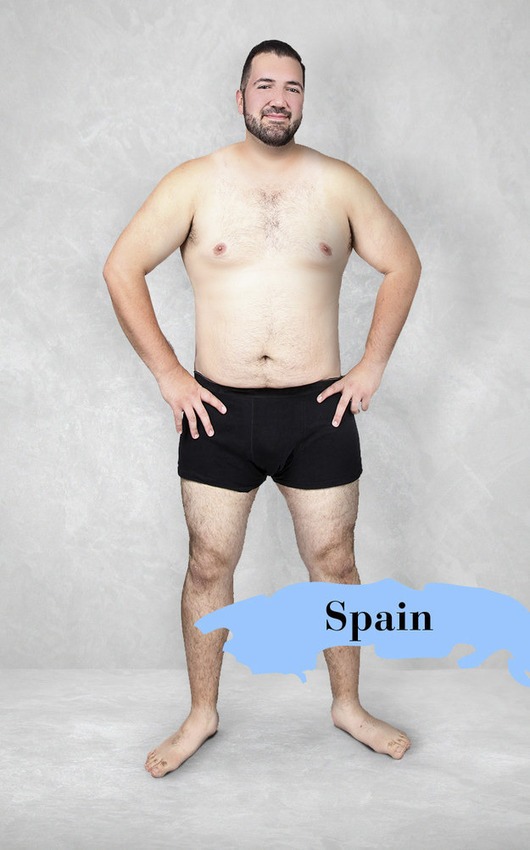
A man’s body was Photoshopped to show different beauty standards around the world

UK-based Internet medical service Superdrug Online Doctor commissioned graphic designers from 19 countries around the world to Photoshop a man to “make him more attractive” to people in their country.

According to research from Superdrug Online Doctor, 40% of men they sampled felt pressure and anxiety to have trim bodies, though different sample sizes, locations and time frames can alter survey results greatly (the sample size of their research is unclear). The company concluded that both men and women suffer from society’s impossible standards of beauty.

“Men suffer equally with women around low body confidence as many strive to attain a standard of ‘attractiveness’ that is both often unobtainable and, as this report shows, driven by cultural perceptions and advertising ideals,” a statement explaining the project reads on the company’s website.

The project was also partially inspired by a 2012 survey conducted by the University of the West of England, which theorized that men feel more pressure than women to be thin (80.7% of British men compared to 75% of British women).

There is no doubt that the pressures affect both genders. One survey of 1,000 women, conducted in 2014 by Glamour and Ohio State University, concluded that 80% of participants felt badly when they looked in the mirror.

While some of the Photoshopped images in this series show men with six-pack abs and long, flowing hair, not every graphic designer chose to change the man’s body in such drastic ways. Some images keep his muscle tone the same and simply make him skinnier, while others make him look even bigger and barrel-chested. A few only change the man’s body in very minor ways.

man 2

“Joke Addiction” As A Neurological Symptom

In a new paper, neurologists Elias D. Granadillo and Mario F. Mendez describe two patients in whom brain disorders led to an unusual symptom: “intractable joking.”

Patient #1 was

A 69-year-old right-handed man presented for a neuropsychiatric evaluation because of a 5-year history of compulsive joking… On interview, the patient reported feeling generally joyful, but his compulsive need to make jokes and create humor had become an issue of contention with his wife. He would wake her up in the middle of the night bursting out in laughter, just to tell her about the jokes he had come up with. At the request of his wife, he started writing down these jokes as a way to avoid waking her. As a result, he brought to our office approximately 50 pages filled with his jokes.

Granadillo and Mendez quote some of the patient’s gags:

Q: What is a pill-popping sexual molester guilty of? A: Rape and pillage.
Q: What did the proctologist say to his therapist? A: All day long I am dealing with assholes.

Went to the Department of Motor Vehicles to get my driver’s license. They gave me an eye exam and here is what they said:
ABCDEFG, HIJKMNLOP, QRS, TUV, WXY and Z; now I know my ABC’s, can I have my license please?

The man’s comedic compulsion was attributed to a stroke, which had damaged part of his left caudate nucleus, although an earlier lesion to the right frontal cortex, caused by a subarachnoid hemorrhage, may have contributed to the pathological punning. Granadillo and Mendez say that a series of medications, including antidepressants, had little impact on his “compulsive need to constantly make and tell jokes.”

Patient #2 was a 57-year old man, who had become “a jokester”, a transformation that had occurred gradually, over a three period. At the same time, the man became excessively forward and disinhibited, making inappropriate actions and remarks. He eventually lost his job after asking “Who the hell chose this God-awful place?”

The patient constantly told jokes and couldn’t stop laughing at them. However, he did not seem to find other people’s jokes funny at all.

The man’s case, however, came to a sad end. His behavior continued to deteriorate and he developed symptoms of Parkinson’s. He died several years later. The diagnosis was Pick’s disease, a rare form of dementia. A post mortem revealed widespread neurodegeneration: “frontotemporal atrophy, severe in the frontal lobes and moderate in the temporal lobes, affecting the right side more than the left” was noted.

Neuroskeptic
« The Myth of “Mind-Altering Parasite” Toxoplasma Gondii?
“Joke Addiction” As A Neurological Symptom
By Neuroskeptic | February 28, 2016 5:51 am
26
In a new paper, neurologists Elias D. Granadillo and Mario F. Mendez describe two patients in whom brain disorders led to an unusual symptom: “intractable joking.”

Patient #1 was

A 69-year-old right-handed man presented for a neuropsychiatric evaluation because of a 5-year history of compulsive joking… On interview, the patient reported feeling generally joyful, but his compulsive need to make jokes and create humor had become an issue of contention with his wife. He would wake her up in the middle of the night bursting out in laughter, just to tell her about the jokes he had come up with. At the request of his wife, he started writing down these jokes as a way to avoid waking her. As a result, he brought to our office approximately 50 pages filled with his jokes.

Granadillo and Mendez quote some of the patient’s gags:

Q: What is a pill-popping sexual molester guilty of? A: Rape and pillage.
Q: What did the proctologist say to his therapist? A: All day long I am dealing with assholes.

Went to the Department of Motor Vehicles to get my driver’s license. They gave me an eye exam and here is what they said:
ABCDEFG, HIJKMNLOP, QRS, TUV, WXY and Z; now I know my ABC’s, can I have my license please?

The man’s comedic compulsion was attributed to a stroke, which had damaged part of his left caudate nucleus, although an earlier lesion to the right frontal cortex, caused by a subarachnoid hemorrhage, may have contributed to the pathological punning. Granadillo and Mendez say that a series of medications, including antidepressants, had little impact on his “compulsive need to constantly make and tell jokes.”

granadillo_mendez

Patient #2 was a 57-year old man, who had become “a jokester”, a transformation that had occurred gradually, over a three period. At the same time, the man became excessively forward and disinhibited, making inappropriate actions and remarks. He eventually lost his job after asking “Who the hell chose this God-awful place?”

The patient constantly told jokes and couldn’t stop laughing at them. However, he did not seem to find other people’s jokes funny at all.

The man’s case, however, came to a sad end. His behavior continued to deteriorate and he developed symptoms of Parkinson’s. He died several years later. The diagnosis was Pick’s disease, a rare form of dementia. A post mortem revealed widespread neurodegeneration: “frontotemporal atrophy, severe in the frontal lobes and moderate in the temporal lobes, affecting the right side more than the left” was noted.

The authors say that both of these patients displayed Witzelsucht, a German term literally meaning ‘joke addiction’. Several cases have been reported in the neurological literature, often associated with damage to the right hemisphere of the brain. Witzelsucht should be distinguished from ‘pathological laughter‘, in which patients start laughing ‘out of the blue’ and the laughter is incongruent with their “mood and emotional experience.” In Witzelsucht, the laughter is genuine: patients really do find their own jokes funny, although they often fail to appreciate those of others.

Granadillo ED, & Mendez MF (2016). Pathological Joking or Witzelsucht Revisited. The Journal of Neuropsychiatry and Clinical Neurosciences PMID: 26900737

Google Unveils Neural Network with “Superhuman” Ability to Determine the Location of Almost Any Image

Here’s a tricky task. Pick a photograph from the Web at random. Now try to work out where it was taken using only the image itself. If the image shows a famous building or landmark, such as the Eiffel Tower or Niagara Falls, the task is straightforward. But the job becomes significantly harder when the image lacks specific location cues or is taken indoors or shows a pet or food or some other detail.

Nevertheless, humans are surprisingly good at this task. To help, they bring to bear all kinds of knowledge about the world such as the type and language of signs on display, the types of vegetation, architectural styles, the direction of traffic, and so on. Humans spend a lifetime picking up these kinds of geolocation cues.

So it’s easy to think that machines would struggle with this task. And indeed, they have.
Today, that changes thanks to the work of Tobias Weyand, a computer vision specialist at Google, and a couple of pals. These guys have trained a deep-learning machine to work out the location of almost any photo using only the pixels it contains.

Their new machine significantly outperforms humans and can even use a clever trick to determine the location of indoor images and pictures of specific things such as pets, food, and so on that have no location cues.

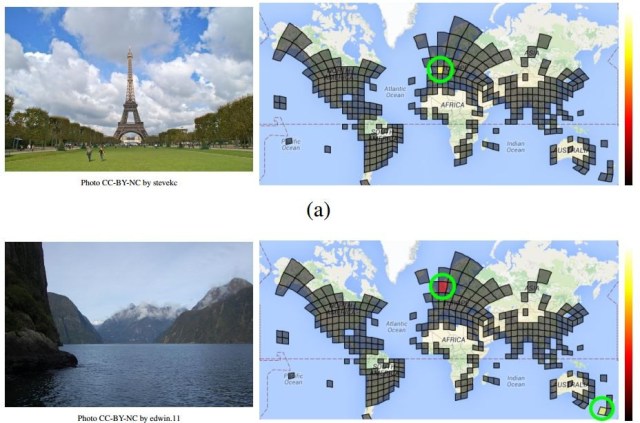
Their approach is straightforward, at least in the world of machine learning. Weyand and co begin by dividing the world into a grid consisting of over 26,000 squares of varying size that depend on the number of images taken in that location.

So big cities, which are the subjects of many images, have a more fine-grained grid structure than more remote regions where photographs are less common. Indeed, the Google team ignored areas like oceans and the polar regions, where few photographs have been taken.

Next, the team created a database of geolocated images from the Web and used the location data to determine the grid square in which each image was taken. This data set is huge, consisting of 126 million images along with their accompanying Exif location data.

Weyand and co used 91 million of these images to teach a powerful neural network to work out the grid location using only the image itself. Their idea is to input an image into this neural net and get as the output a particular grid location or a set of likely candidates.

They then validated the neural network using the remaining 34 million images in the data set. Finally they tested the network—which they call PlaNet—in a number of different ways to see how well it works.

The results make for interesting reading. To measure the accuracy of their machine, they fed it 2.3 million geotagged images from Flickr to see whether it could correctly determine their location.

“PlaNet is able to localize 3.6 percent of the images at street-level accuracy and 10.1 percent at city-level accuracy,” say Weyand and co. What’s more, the machine determines the country of origin in a further 28.4 percent of the photos and the continent in 48.0 percent of them.

That’s pretty good. But to show just how good, Weyand and co put PlaNet through its paces in a test against 10 well-traveled humans. For the test, they used an online game that presents a player with a random view taken from Google Street View and asks him or her to pinpoint its location on a map of the world.

Anyone can play at http://www.geoguessr.com. Give it a try—it’s a lot of fun and more tricky than it sounds.

Needless to say, PlaNet trounced the humans. “In total, PlaNet won 28 of the 50 rounds with a median localization error of 1131.7 km, while the median human localization error was 2320.75 km,” say Weyand and co. “[This] small-scale experiment shows that PlaNet reaches superhuman performance at the task of geolocating Street View scenes.”

An interesting question is how PlaNet performs so well without being able to use the cues that humans rely on, such as vegetation, architectural style, and so on. But Weyand and co say they know why: “We think PlaNet has an advantage over humans because it has seen many more places than any human can ever visit and has learned subtle cues of different scenes that are even hard for a well-traveled human to distinguish.”

They go further and use the machine to locate images that do not have location cues, such as those taken indoors or of specific items. This is possible when images are part of albums that have all been taken at the same place. The machine simply looks through other images in the album to work out where they were taken and assumes the more specific image was taken in the same place.

That’s impressive work that shows deep neural nets flexing their muscles once again. Perhaps more impressive still is that the model uses a relatively small amount of memory unlike other approaches that use gigabytes of the stuff. “Our model uses only 377 MB, which even fits into the memory of a smartphone,” say Weyand and co.

Ref: arxiv.org/abs/1602.05314 : PlaNet—Photo Geolocation with Convolutional Neural Networks

Thanks to Kebmodee for bringing this to the attention of the It’s Interesting community.

Phantom Eye Patients See and Feel with Missing Eyeballs

by Elizabeth Preston

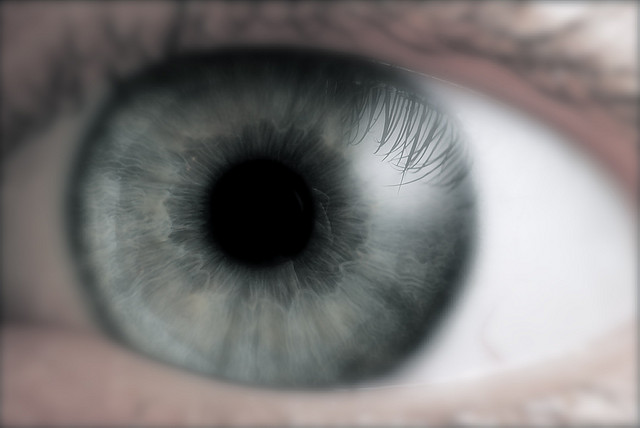
Amputees often feel eerie sensations from their missing limbs. These “phantom limb” feelings can include pain, itching, tingling, or even a sense of trying to pick something up. Patients who lose an eye may have similar symptoms—with the addition of actual phantoms.

Phantom eye syndrome (PES) had been studied in the past, but University of Liverpool psychologist Laura Hope-Stone and her colleagues recently conducted the largest study of PES specifically in patients who’d lost an eye to cancer.

The researchers sent surveys to 239 patients who’d been treated for uveal melanoma at the Liverpool Ocular Oncology Centre. All of these patients had had one eye surgically removed. Some of their surgeries were only 4 months in the past; others had taken place almost 4 and a half years earlier. Three-quarters of the patients returned the surveys, sharing details about how they were doing in their new monocular lives.

Sixty percent of respondents said they had symptoms of phantom eye syndrome. These symptoms included pain, visual sensations, or the impression of actually seeing with the missing eye.

Patients with visual symptoms most often saw simple shapes and colors. But some people reported more distinct images, “for example, resembling wallpaper, a kaleidoscope, or fireworks, or even specific scenes and people,” the authors write.

Then there were the ghosts.

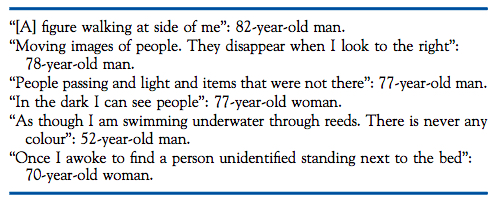
Some people said they had seen strangers haunting their fields of vision, as in these survey responses:

A survey isn’t a perfect way to measure how common PES is overall. But Hope-Stone says there were enough survey responses to produce helpful data for doctors who treat patients with eye cancer.

“We can now tell whether certain kinds of patients are more likely to have phantom symptoms,” she says. For example, “PES is more common in younger patients, and having pain in the non-existent eye is more likely in patients who are anxious and depressed, although we don’t know why.”

About a fifth of PES patients, understandably, said they were disturbed by their symptoms. A similar number found them “pleasurable,” Hope-Stone says.

Doctors aren’t sure exactly why phantom eye syndrome occurs. Since different patients have different symptoms, Hope-Stone says, “I suspect that…there may be a range of causes.”

For that matter, phantom limbs are still mysterious to doctors too. “Human perception is a complex process,” Hope-Stone explains. Even when our sensory organs are gone—the vision receptors in our eyes, the pain and touch receptors in our hands—the nerves and brain areas that used to talk to those organs keep working just fine. “Interactions between [these systems] may contribute to phantom sensations,” she says, although “the exact mechanisms are unclear.”

Even if they don’t know why it happens, doctors can warn their patients about the kinds of symptoms they’re likely to experience—and the ghosts they might see.

http://blogs.discovermagazine.com/inkfish/2015/06/05/phantom-eye-patients-see-and-feel-with-missing-eyeballs/#.VtM-OfkrIgv

Goats being used to clear poison ivy and other plants in Boston Hyde Park

The city is renting eight goats to graze on a city-owned golf course and another four at a wild landscape area. They will eat poison ivy, buckthorn, Japanese knotweed and other invasive plant species clogging the land, said Ryan Woods, a spokesman for the Boston Parks and Recreation Department.

“Goats eat everything. It’s one of the natural things that they do, and they’re able to digest these things that are harmful to humans,” Woods said. Plus they’re cheaper and quieter than lawnmowers, he added __ and they drop natural fertilizer along the way.

The goats will be split into herds of four, each of which can clear up to a third of an acre per week. One herd will graze on a wild landscape in the Hyde Park neighborhood for four weeks starting on July 6. Afterward, they’ll join two other herds working at the George Wright Golf Course for six weeks starting on July 20.
The goal is to make overgrown areas more inviting to visitors, Woods said.

The goats will live at those sites until they finish their work, surrounded by solar-powered electric fences that keep them in and predators out. They’ll also be fed hay and water to supplement their diet.

http://boston.cbslocal.com/2015/06/10/boston-hires-goat-crew-to-landscape-weed-choked-city-land/

Thanks to Pete Cuomo for bringing this to the It’s Interesting community.