ndividuals with acne have a significantly increased risk for depression within the first 5 years after receiving an acne diagnosis, according to a recent study.
For their study, Dr Isabelle Vallerand, of the University of Calgary in Canada, and colleagues obtained and evaluated patient data from the 1986-2012 Health Improvement Network (THIN) in the United Kingdom.
Results of the analysis revealed that individuals with acne had a 63% higher risk for depression within 1 year after diagnosis compared with individuals without acne, thus indicating the importance of evaluating patients with acne for symptoms of depression.
“This study highlights an important link between skin disease and mental illness,” Dr Vallerand said in a press release.
“Given the risk of depression was highest in the period right after the first time a patient presented to a physician for acne concerns, it shows just how impactful our skin can be towards our overall mental health.”
—Christina Vogt
Reference:
Vallerand IA, Lewinson RT, Parsons LM, et al. Risk of depression among patients with acne in the U.K.: a population-based cohort study [published online February 7, 2018]. Brit J Dermatol. doi:10.1111/bjd.16099.
Cheetahs are synonymous with speed. But past the big cat’s slender build and lean muscles, there’s something inside that aids this animal’s need for speed.
A new report, published February 2 in Scientific Reports, shows that certain parts of the cheetah’s inner ear help to make it a better hunter. The study marks the first time researchers have analyzed the big cats’ inner ear.
ALL EARS
If you watch a cheetah sprinting in slow motion, you can see that they tend to keep their heads stable and their eyes fixed on prey even while in motion. To learn how the animal’s bone structure helps with this, lead author Camille Grohé turned to the animals’ inner ear.
The inner ear is crucial for maintaining balance and a steady head posture. It consists of three semicircular canals containing fluid and sensory hair cells that pick up motion in the head. Since each canal is angled differently, they’re each sensitive to different movements: one targets up-and-down motion, one side-to-side, and one tilts from one side to the other.
Using high-resolution imaging, Grohé and the team scanned 21 felid skulls. While some skulls were of other big cats, seven belonged to modern cheetahs. The researchers also imaged the skull of an extinct giant cheetah to see how the inner ear might have evolved.
The inner ears of cheetahs are like that of no other modern felids, the study found. Large vestibular systems—which help with balance—took up more of the inner ear of the cheetah than of any other big cat. Cheetahs also had longer semicircular ear canals, which help with head movement and eye direction.
“This distinctive inner ear anatomy reflects enhanced sensitivity and more rapid response to head motions,” co-author John Flynn says in a press release.
These highly-tuned traits were not seen in the extinct cheetah species, which shows these developments in the cheetah’s inner ear happened relatively recently.
“The living cheetah’s ancestors have evolved slender bones that would allow them to run very fast and then an inner ear ultra-sensitive to head movements to hold their head still, enabling them to run even faster,” Grohé adds.
BUILT FOR SPEED
As the fastest land animal, lightweight cheetahs are built for sprinting. Their spines are long and flexible, which allows them to launch from 0 to 60 miles per hour in just three seconds. While their strong, lean muscles help propel them forward, their large nasal cavities help them gulp in air to recover after a chase.
A lost Viking army which was a “key part” of the creation of England may have been identified by archaeologists.
More than 250 skeletons found at St Wystan’s church, Repton, Derbyshire, have been dated to the 9th Century.
Chronicles state a “large heathen army” began to hack its way across England in AD866, toppling Anglo-Saxon kings until being halted by Alfred the Great.
Cat Jarman from the University of Bristol said: “This army had left almost no trace, but maybe here it is.”
In AD866 the Vikings went from ferocious raiders to an invading force – the Viking Great Army had arrived.
Ms Jarman, from the department of Anthropology and Archaeology, said: “This was a key part in the story of how England was made.
“The defeat of Anglo-Saxon kingdoms, the creation of a Viking state and Alfred’s reaction to it were all major parts of this. Its echoes are still felt today.
“But because of the lack of physical evidence it has not been given the attention it deserves.”
The Viking army was believed to have wintered at Repton in AD873 but the evidence did not add up.
A mysterious mound in St Wystan’s church yard excavated in the 1970s and 80s contained the remains of at least 264 people.
But nearly 20% were women and there were few signs of battle injuries.
Carbon dating showed bones dating from the 200 years previous to the Viking invasion.
Ms Jarman said: “We found the carbon dating had been thrown out by those individuals having a diet high in seafood.
“Once adjusted, the dates matched the records.
“And a new analysis of the bones… showed traumatic injury, while the role of women in Viking armies is better understood.”
Other graves with probable Viking links were investigated, and one may contain sacrificial victims.
Four children, aged eight to 18, were buried near the mass grave and at least two have signs of traumatic injury.
Ms Jarman said it “parallels accounts of sacrificial killings to accompany Viking dead”.
The pages of the Voynich Manuscript, estimated to have been written between 1404-1438, have puzzled researchers for over a century.
by Michael d’Estries
The 600-year-old book no one can read has been fascinating us for decades, but we’re only recently starting to learn more about it.
Named after the Polish-American bookseller Wilfrid M. Voynich, who acquired it in 1912, the Voynich Manuscript is a detailed 240-page book written in a language or script that is completely unknown.
Some folks have labelled the Voynich Manuscript as nothing more than an ancient hoax, including Gordon Rugg of Keele University in the U.K., who has spent more than a decade studying the manuscript. Rugg writes in a 2016 paper that the text would be easy to fake if the author was familiar with simple coding techniques. “We have known for years that the syllables are not random. There are ways of producing gibberish which are not random in a statistical sense,” he told New Scientist. “It’s a bit like rolling loaded dice. If you roll dice that are subtly loaded, they would come up with a six more often than you would expect, but not every time.”
But other researchers don’t necessarily agree. In a 2013 study published in the journal PLoS One, Dr. Diego Amancio, a professor at University of São Paulo’s Institute of Mathematical and Computer Sciences, explained how the book’s beautiful gibberish is likely an actual language.
“We show that it is mostly compatible with natural languages and incompatible with random texts,” he writes. “We also obtain candidates for keywords of the Voynich Manuscript, which could be helpful in the effort of deciphering it.”
Deciphering it with artificial intelligence
More recently, Greg Kondrak, an expert in natural language processing at the University of Alberta, used artificial intelligence to try to crack the code. With the help of his grad student, Bradley Hauer, Kondrak used samples from “Universal Declaration of Human Rights,” which was written in nearly 400 languages, running algorithms to identify the language of the text. Although they hypothesized it was written in Arabic, it turned out the most likely language was Hebrew.
The researchers hypothesized the manuscript was created using alphagrams, where the letters of a word are replaced in alphabetical order. With that assumption, they tried to create an algorithm to read the text.
“It turned out that over 80 percent of the words were in a Hebrew dictionary, but we didn’t know if they made sense together,” said Kondrak, in a statement.
After being unable to find Hebrew scholars to confirm their findings, the researchers turned to Google Translate. “It came up with a sentence that is grammatical, and you can interpret it,” said Kondrak, “she made recommendations to the priest, man of the house and me and people. It’s a kind of strange sentence to start a manuscript but it definitely makes sense.”
Without historians of ancient Hebrew, Kondrak said that the full meaning of the Voynich manuscript will remain a mystery.
The beautifully illustrated plants that fill up the pages of the Voynich Manuscript have never been accurately identified.
Bringing the puzzle to the people
It may seem far-fetched, but this famous manuscript could become a bestseller.
Siloe, a small publishing house in Spain specializing in handcrafted replicas of ancient manuscripts, in 2016 was granted the exclusive rights to create 898 facsimiles of the Voynich.
“It’s a book that has such an aura of mystery that when you see it for the first time, it fills you with an emotion that is very hard to describe,” Juan Jose Garcia, the editor of Siloe, told AFP.
No ordinary scan-and-print project, the Voynich replicas will be meticulously crafted to match every “stain, hole, and sewn-up tear in the parchment,” according to the news agency. The publishing house has even created a secret paste and aging process to make the more than 200 pages of the book appear and feel indistinguishable from the real thing. The process is expected to take a full 18 months to complete.
Siloe had reportedly been petitioning the Beinecke Rare Book & Manuscript Library at Yale, which took possession of the Voynich in 1969, to publish a replica for the last 10 years. The library finally acquiesced after both an increase in scholarly interest in the Voynich and quality assurances from experts associated with previous rare manuscript copies completed by Siloe.
“We thought that the facsimile would provide the look and feel of the original for those who were interested,” Raymond Clemens, curator at the Beinecke library, told the AFP. “It also enables libraries and museums to have a copy for instructional purposes and we will use the facsimile ourselves to show the manuscript outside of the library to students or others who might be interested.”
A work of curious art
Besides its indecipherable characters, the manuscript is also crammed with illustrations of astronomical charts, human figures, and plants, the latter of which have never been positively identified as anything found on Earth. These puzzles have led to the manuscript being classified as everything from the work of aliens to the musings of an inter-dimensional Medieval sorcerer.
Whatever the true answer, you don’t have to shell out the expected $8,000 to $9,000 cost for an exact replica. In addition to offering high-res digital scans of the Voynich pages online, Yale is selling hardcover copies for $50 that include accompanying research on the manuscript.
You can also view a digital overview of the 250 pages of the Voynich Manuscript in the video below.
This Swedish ritual reportedly helps people see the future. Start by spending your daylight hours shut in a dark room. No eating, speaking, sleeping or engaging with technology or the outside world for a whole day. By cutting yourself off in this manner, you’re preparing your mind and spirit for the Swedish pseudo-pagan ritual of Årsgång, or the “year walk.”
Next, leave your home when the clock strikes 12. Alone in the dark, walk to the local church or house of worship. This ritual can only be done at midnight, preferably on the winter solstice or Christmas, but another winter’s eve of your choosing will work. When you arrive, walk around the building three times counterclockwise, then blow in the keyhole of the front door. (This is to temporarily renounce any attachments you may have to religion.)
Once you’ve completed these steps, you will have opened yourself up to enter the spirit world — and you may even be able to see the future.
When pagan beliefs and rituals were at their height in Scandinavia, some people were known to disappear during these walks, while others were rewarded with seeing what was ahead personally or for those in their community.
“The walker might gain information about marriage, the harvest, the possibility of war, or if there will be fires, but the most common information was about who was going to die in the upcoming year,” explains Atlas Obscura.
A year-walker might also see visions, like the brook horse, which gathers children on its back and then plunges into the water with them, drowning them all. Or the huldra, “a deceptively beautiful female entity, who often had bark and treelike features growing on her back instead of skin. Said to be the forest guardians, they would lure people to their homes to either marry them or kill them. Either way, the victim would be lost forever,” according to this page on folklore from the University of Southern California.
When the walker was ready for the experience to be over, he would return to the church and reclaim his faith.
A team at Swedish video game maker Simogo developed a game for smartphones based on the year walk. You can see a trailer for the immersive game set in a snowy landscape in the video below:
“We based [the game] off folklore in a very unscientific way,” the writer of the game, Jonas Tarestad, told Atlas Obscura. “In a way we recreated the word-of-mouth process of the past and added our own details. In the end we had sort of lost the grasp of what parts we made up to fit the game and what parts were original folklore.”
A study recently published in open-access journal Frontiers in Psychology finds that 9-10 year-old children are significantly more attentive and engaged with their schoolwork following an outdoor lesson in nature. This “nature effect” allowed teachers to teach uninterrupted for almost twice as long during a subsequent indoor lesson. The results suggest that outdoor lessons may be an inexpensive and convenient way to improve student engagement in education — a major factor in academic achievement.
Scientists have known for a while that natural outdoor environments can have a variety of beneficial effects on people. People exposed to parks, trees or wildlife can experience benefits such as physical activity, stress reduction, rejuvenated attention and increased motivation. In children, studies have shown that even a view of greenery through a classroom window could have positive effects on students’ attention.
However, many teachers may be reluctant to hold a lesson outdoors, as they might worry that it could overexcite the children, making it difficult for them to concentrate on their schoolwork back in the classroom. Ming Kuo, a scientist at the University of Illinois at Urbana-Champaign, and her colleagues set out to investigate this, and hypothesized that an outdoor lesson in nature would result in increased classroom engagement in indoor lessons held immediately afterwards.
“We wanted to see if we could put the nature effect to work in a school setting,” says Kuo. “If you took a bunch of squirmy third-graders outdoors for lessons, would they show a benefit of having a lesson in nature, or would they just be bouncing off the walls afterward?”
The researchers tested their hypothesis in third graders (9-10 years old) in a school in the Midwestern United States. Over a 10-week period, an experienced teacher held one lesson a week outdoors and a similar lesson in her regular classroom, and another, more skeptical teacher did the same. Their outdoor “classroom” was a grassy spot just outside the school, in view of a wooded area.
After each outdoor or indoor lesson, the researchers measured how engaged the students were. They counted the number of times the teacher needed to redirect the attention of distracted students back to their schoolwork during the observation, using phrases such as “sit down” and “you need to be working”. The research team also asked an outside observer to look at photos taken of the class during the observation period and score the level of class engagement, without knowing whether the photos were taken after an indoor or outdoor lesson. The teachers also scored class engagement.
The team’s results show that children were more engaged after the outdoor lessons in nature. Far from being overexcited and inattentive immediately after an outdoor lesson, students were significantly more attentive and engaged with their schoolwork. The number of times the teacher had to redirect a student’s attention to their work was roughly halved immediately after an outdoor lesson.
“Our teachers were able to teach uninterrupted for almost twice as long at a time after the outdoor lesson,” says Kuo, “and we saw the nature effect with our skeptical teacher as well.”
The researchers plan to do further work to see if the technique can work in other schools and for less experienced teachers. If so, regular outdoor lessons could be an inexpensive and convenient way for schools to enhance student engagement and performance. “We’re excited to discover a way to teach students and refresh their minds for the next lesson at the same time,” says Kuo. “Teachers can have their cake and eat it too.”
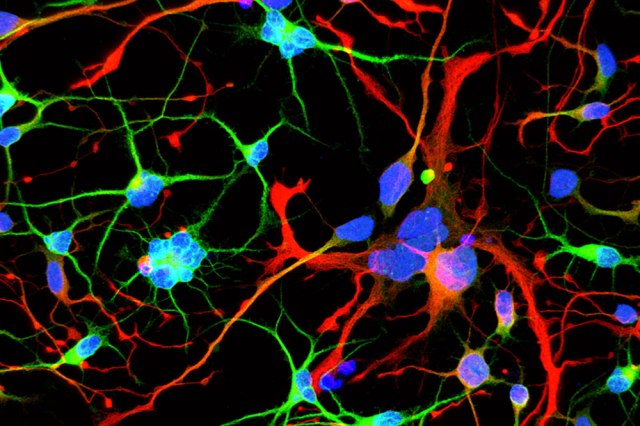
Huntington’s neurons show multiple nuclei (blue) within the same cell, and other signs of trouble, long before symptoms emerge.
With new findings, scientists may be poised to break a long impasse in research on Huntington’s disease, a fatal hereditary disorder for which there is currently no treatment.
One in 10,000 Americans suffer from the disease, and most begin to show symptoms in middle age as they develop jerky movements—and as these patients increasingly lose brain neurons, they slide into dementia. But the new research suggests that these symptoms may be a late manifestation of a disease that originates much earlier, in the first steps of embryonic development.
A team at Rockefeller led by Ali Brivanlou, the Robert and Harriet Heilbrunn Professor, developed a system to model Huntington’s in human embryonic stem cells for the first time. In a report published in Development, they describe early abnormalities in the way Huntington’s neurons look, and how these cells form larger structures that had not previously been associated with the disease.
“Our research supports the idea that the first domino is pushed soon after fertilization,” Brivanlou says, “and that has consequences down the line. The final domino falls decades after birth, when the symptoms are observable.”
The findings have implications for how to best approach treating the disorder, and could ultimately lead to effective therapies.
A new tool
Huntington’s is one of the few diseases with a straightforward genetic culprit: One hundred percent of people with a mutated form of the Huntingtin (HTT) gene develop the disease. The mutation takes the form of extra DNA, and causes the gene to produce a longer-than-normal protein. The DNA itself appears in the form of a repeating sequence, and the more repeats there are, the earlier the disease sets in.
Research on Huntington’s has thus far relied heavily on animal models of the disease, and has left many key questions unanswered. For example, scientists have not been able to resolve what function the HTT gene serves normally, or how its mutation creates problems in the brain.
Suspecting that the disease works differently in humans, whose brains are much bigger and more complex than those of lab animals, Brivanlou, along with research associates Albert Ruzo and Gist Croft, developed a cell-based human system for their research. They used the gene editing technology CRISPR to engineer a series of human embryonic stem cell lines, which were identical apart from the number of DNA repeats that occurred at the ends of their HTT genes.
“We started seeing things that were completely unexpected,” says Brivanlou. “In cell lines with mutated HTT, we saw giant cells. It looked like a jungle of disorganization.”
When cells divide, they typically each retain one nuclei. However, some of these enlarged, mutated cells flaunted up to 12 nuclei—suggesting that neurogenesis, or the generation of new neurons, was affected. The disruption was directly proportional to how many repeats were present in the mutation: The more repeats there were, the more multinucleated neurons appeared.
“Our work adds to the evidence that there is an unrecognized developmental aspect to the pathology,” Brivanlou says. “Huntington’s may not be just a neurodegenerative disease, but also a neurodevelopmental disease.”
Toxic or essential?
Treatments for Huntington’s have typically focused on blocking the activity of the mutant HTT protein, the assumption being that the altered form of the protein was more active than normal, and therefore toxic to neurons. However, Brivanlou’s work shows that the brain disruption may actually be due to a lack of HTT protein activity.
To test its function, the researchers created cell lines that completely lacked the HTT protein. These cells turned out to be very similar to those with Huntington’s pathology, corroborating the idea that a lack of the protein—not an excess of it—is driving the disease.
The findings are significant, Brivanlou notes, since they indicate that existing treatments that were designed to block HTT activity may actually do more harm than good.
“We should rethink our approach to treating Huntington’s,” he says. “Both the role of the HTT protein and the timing of treatment need to be reconsidered; by the time a patient is displaying symptoms, it may be too late to medicate. We need to go back to the earliest events that trigger the chain reaction that ultimately results in disease so we can focus new therapies on the cause, not the consequences.”
The researchers hope their new cell lines will be a useful resource for studying the cellular and molecular intricacies of Huntington’s further, and suggest they may provide a model for examining other diseases of the brain that are specific to humans.
You may perceive the world the way your friends do, according to a Dartmouth study finding that friends have similar neural responses to real-world stimuli and these similarities can be used to predict who your friends are.
The researchers found that you can predict who people are friends with just by looking at how their brains respond to video clips. Friends had the most similar neural activity patterns, followed by friends-of-friends who, in turn, had more similar neural activity than people three degrees removed (friends-of-friends-of-friends).
Published in Nature Communications, the study is the first of its kind to examine the connections between the neural activity of people within a real-world social network, as they responded to real-world stimuli, which in this case was watching the same set of videos.
“Neural responses to dynamic, naturalistic stimuli, like videos, can give us a window into people’s unconstrained, spontaneous thought processes as they unfold. Our results suggest that friends process the world around them in exceptionally similar ways,” says lead author Carolyn Parkinson, who was a postdoctoral fellow in psychological and brain sciences at Dartmouth at the time of the study and is currently an assistant professor of psychology and director of the Computational Social Neuroscience Lab at the University of California, Los Angeles.
The study analyzed the friendships or social ties within a cohort of nearly 280 graduate students. The researchers estimated the social distance between pairs of individuals based on mutually reported social ties. Forty-two of the students were asked to watch a range of videos while their neural activity was recorded in a functional magnetic resonance imaging (fMRI) scanner. The videos spanned a range of topics and genres, including politics, science, comedy and music videos, for which a range of responses was expected. Each participant watched the same videos in the same order, with the same instructions. The researchers then compared the neural responses pairwise across the set of students to determine if pairs of students who were friends had more similar brain activity than pairs further removed from each other in their social network.
Figure 1 from paper: Social network. The social network of an entire cohort of first-year graduate students was reconstructed based on a survey completed by all students in the cohort (N = 279; 100% response rate). Nodes indicate students; lines indicate mutually reported social ties between them. A subset of students (orange circles; N = 42) participated in the fMRI study. Image by Carolyn Parkinson.
The findings revealed that neural response similarity was strongest among friends, and this pattern appeared to manifest across brain regions involved in emotional responding, directing one’s attention and high-level reasoning. Even when the researchers controlled for variables, including left-handed- or righthandedness, age, gender, ethnicity, and nationality, the similarity in neural activity among friends was still evident. The team also found that fMRI response similarities could be used to predict not only if a pair were friends but also the social distance between the two.
“We are a social species and live our lives connected to everybody else. If we want to understand how the human brain works, then we need to understand how brains work in combination— how minds shape each other,” explains senior author Thalia Wheatley, an associate professor of psychological and brain sciences at Dartmouth, and principal investigator of the Dartmouth Social Systems Laboratory.
For the study, the researchers were building on their earlier work, which found that as soon as you see someone you know, your brain immediately tells you how important or influential they are and the position they hold in your social network.
The research team plans to explore if we naturally gravitate toward people who see the world the same way we do, if we become more similar once we share experiences or if both dynamics reinforce each other.
For centuries, musicians have used drugs to enhance creativity and listeners have used drugs to heighten the pleasure created by music. And the two riff off each other, endlessly. The relationship between drugs and music is also reflected in lyrics and in the way these lyrics were composed by musicians, some of whom were undoubtedly influenced by the copious amounts of heroin, cocaine and “reefer” they consumed, as their songs sometimes reveal.
Acid rock would never have happened without LSD, and house music, with its repetitive 4/4 beats, would have remained a niche musical taste if it wasn’t for the wide availability of MDMA (ecstasy, molly) in the 1980s and 1990s.
And don’t be fooled by country music’s wholesome name. Country songs make more references to drugs than any other genre of popular music, including hip hop.
Under the influence
As every toker knows, listening to music while high can make it sound better. Recent research, however, suggests that not all types of cannabis produce the desired effect. The balance between two key compounds in cannabis, tetrahydrocannabinol and cannabidiols, influence the desire for music and its pleasure. Cannabis users reported that they experienced greater pleasure from music when they used cannabis containing cannabidiols than when these compounds were absent.
Listening to music – without the influence of drugs – is rewarding, can reduce stress (depending upon the type of music listened to) and improve feelings of belonging to a social group. But research suggests that some drugs change the experience of listening to music.
Clinical studies that have administered LSD to human volunteers have found that the drug enhances music-evoked emotion, with volunteers more likely to report feelings of wonder, transcendence, power and tenderness. Brain imaging studies also suggest that taking LSD while listening to music, affects a part of the brain leading to an increase in musically inspired complex visual imagery.
Certain styles of music match the effects of certain drugs. Amphetamine, for example, is often matched with fast, repetitive music, as it provides stimulation, enabling people to dance quickly. MDMA’s (ecstasy) tendency to produce repetitive movement and feelings of pleasure through movement and dance is also well known.
An ecstasy user describes the experience of being at a rave:
“I understood why the stage lights were bright and flashing, and why trance music is repetitive; the music and the drug perfectly complemented one another. It was as if a veil had been lifted from my eyes and I could finally see what everyone else was seeing. It was wonderful.”
There is a rich representation of drugs in popular music, and although studies have shown higher levels of drug use in listeners of some genres of music, the relationship is complex. Drug representations may serve to normalise use for some listeners, but drugs and music are powerful ways of strengthening social bonds. They both provide an identity and a sense of connection between people. Music and drugs can bring together people in a political way, too, as the response to attempts to close down illegal raves showed.
People tend to form peer groups with those who share their own cultural preferences, which may be symbolised through interlinked musical and substance choices. Although there are some obvious synergies between some music and specific drugs, such as electronic dance music and ecstasy, other links have developed in less obvious ways. Drugs are one, often minor, component of a broader identity and an important means of distinguishing the group from others.
Although it is important not to assume causality and overstate the links between some musical genres and different types of drug use, information about preferences is useful in targeting and tailoring interventions, such as harm reduction initiatives, at music festivals.
The tiniest particles of airborne pollution may affect the weather, new research suggests—even in some of the most pristine parts of the world.
A study published in the journal Science found that ultra-fine aerosol particles, produced by industrial activity, are helping storms grow bigger and more intense in the Amazon basin. Many scientists had long assumed that these microscopic particles—which can be more than 1,000 times smaller than the width of a human hair—were far too small to have any effect on the weather.
But a combination of observations and model simulations, focusing on the tropical rainforest outside the Brazilian city of Manaus, indicate that these tiny particles are actually causing bigger storm clouds and heavier rainfall. The findings suggest that the increase in pollution since the onset of the Industrial Revolution may have “appreciably changed” the formation of storm clouds, the researchers write. And they suggest that changes in the Amazon’s climate could potentially reverberate in other parts of the world.
The research comes at a time of growing interest in aerosols—small pollution particles, often produced by industrial activities—and their influence on global weather and climate. Aerosols are known to produce a temporary cooling effect on the climate, and research increasingly suggests that air pollution may have helped to cover up some of the effects of human-caused climate change (Climatewire, Jan. 22). This means ongoing efforts to reduce pollution may be accompanied by enhanced warming, scientists note, along with a variety of other weather-related side effects.
The new study reinforces the idea that pollution has a significant influence on atmospheric processes, down to daily weather patterns. Previous research has already demonstrated that larger aerosol particles can lead to stronger storms.
Particles in the air can interact with water vapor and form droplets, influencing the formation of clouds. One widely covered modeling study, published in the Proceedings of the National Academy of Sciences in 2014, suggested that pollution from Asia can intensify storms in the northwestern Pacific and may even affect weather patterns over North America.
But until now, the influence of the tiniest pollution particles has been largely overlooked.
“Previously, scientists had this concept that these ultra-fine particles, they are too small to be ‘activated,’ to be transformed into cloud droplets,” Jiwen Fan, the lead study author and a scientist at the Pacific Northwest National Laboratory, told E&E News.
The Amazon provided a “perfect setting” to investigate, she added. Rainforest outside Manaus remains relatively untouched by human activity, and the background aerosol levels are low. But winds often sweep in pollution from the city, providing a kind of natural laboratory to test the effects of higher and lower levels of particles in the air.
The researchers found that the tiny particles had an even greater effect on storm intensity than their larger counterparts. The tiny particles are lifted higher into the air before they begin to interact with water vapor and transform into cloud droplets, forming taller clouds. The resulting high concentration of water droplets forming the clouds release large amounts of heat as they condense, which helps to invigorate the air rising up through the cloud and intensify the brewing storm.
So far, the study only documents the process in a specific part of the Brazilian Amazon, meaning more research would be needed to determine whether the same effects apply elsewhere. But the researchers suggest that other humid and remote parts of the world, where human influence is starting to grow, may be similarly affected. For instance, the influence of shipping traffic in the open ocean might be a point worth investigating, Fan suggested.
The researchers also suggest that climatic changes in the Amazon could affect precipitation patterns in other places. This remains to be investigated—but the authors point out that the water cycle in the warm, humid Amazon plays a significant role in regulating climate patterns elsewhere around the world.
If human pollution continues to encroach on the region’s remaining untouched areas, they write, the resulting weather changes “could have profound effects on other places around the globe.”