Artificial muscle is 200 times stronger than real muscle


They’re small but mighty. The tiny artificial muscles created by an international team of researchers are 200 times stronger than human muscle fibers of comparable size.

In the future, improved versions of the muscles could go into the next generation of motors for robots arms, flaps on airplane wings, medical devices — any inanimate thing that moves.

“There’s a lot of excitement,” said Richard Vaia, who studies high-tech materials at the Air Force Research Laboratory at Wright-Patterson Air Force Base in Ohio. Vaia was not involved in the making of the new muscle.

Researchers around the world have been trying to create artificial muscles that work more the way natural muscles do, to allow for more-delicate movements than current mechanisms can achieve.

Ray Baughman, a nanotechnology researcher at the University of Texas at Dallas, led the team that made the new muscle, which he sometimes calls a yarn because of the way it’s woven.  The muscles would work well in small medical devices, he said. His lab in Texas has thought of another creative use for them, too: “We’ve been playing with yarns to open and close blinds depending on the temperature of the room,” he told TechNewsDaily.

In the farther future, artificial muscles could give robots more natural-looking facial expressions, Baughman said.

The lab wants to try to manufacture longer ropes of the muscle, so it can weave a protective fabric for firefighters’ uniforms. The fabric would automatically seal its pores when faced with a sudden flash, Baughman said.

Baughman’s new muscles are made of ropes of carbon nanotubes, a super-tiny, high-tech material that researchers are adding to everything from water filters to experimental airplane parts. Baughman said he and his team twisted the nanotubes — “quite similarly to the way people insert twists into common wool or cotton fibers” — into thicker yarns. They then filled the hollow space in the nanotubes with different materials, including paraffin, the wax that goes in candles.

To get the muscles to contract, researchers heated them briefly. When heated, the paraffin wax expanded, pushing against the nanotube walls and making them fatter and shorter. As the wax cooled again, it shrank, and the nanotubes became narrower and longer. The muscles were able to shorten and then lengthen again every 25 milliseconds, or 25 thousandths of a second, Baughman said. Such fast contractions mean the muscles are able to perform a lot of work, he said.

The combination of carbon nanotubes and wax impresses Vaia. “The novel thing was how they utilized the properties of the two, came up with the correct processing to put them together,” he said.

Right now, Baughman’s lab knows how to make a muscle fiber that’s one kilometer (0.62 miles) long, but Baughman hopes one day to weave fabrics that require miles of fiber.

He also is looking to make the muscles react to chemicals instead of heat. Heat-driven motors are energy-inefficient, so chemical-driven muscles might be more practical.

Baughman and his colleagues wrote about their work Nov. 15 in the journal Science.

http://www.livescience.com/24811-strong-artificial-muscle.html
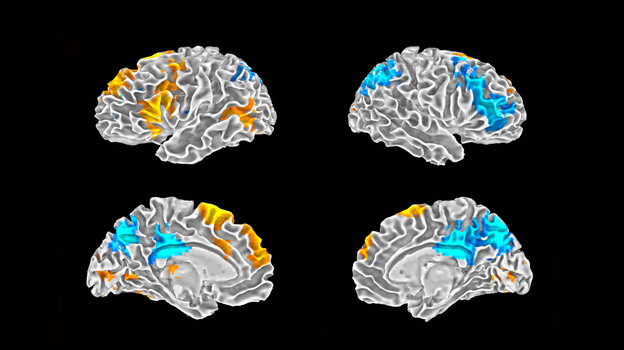
A Peek Inside Rappers’ Brains Shows Roots Of Improvisation

 The warmer orange colors show parts of the brain most active during improvisational rap. The blue regions are most active when rappers performed a memorized piece.

Some rappers have an impressive ability to make up lyrics on the fly, in a style known as freestyle rap.

These performers have a lot in common with jazz musicians, it turns out.

Scientists have found artists in both genres are using their brains in similar ways when they improvise.

A group of jazz pianists had their heads examined in a 2008 PLOS One study, which subjected the musicians to functional magnetic resonance imaging scans. These scans highlight areas of brain activity.

When riffing on a tune instead of playing a memorized composition, the musicians had lower activity in a part of the frontal brain that is thought to be responsible for planning and greater activity in another part of the frontal brain believed to motivate thought and action.

After hearing about the jazz study, Los Angeles rappers Michael Eagle and Daniel Rizik-Baer contacted one of the researchers, Allen Braun, chief of the voice, speech and language branch of the National Institute on Deafness and Other Communication Disorders. Eagle and Rizik-Baer proposed a similar study on freestyle rap.

Soon Braun’s colleague Siyuan Liu at NIDCD put together a team, which included the two rappers, to determine what was happening inside these performers’ brains.

In their study, published today in Scientific Reports, five professional rappers were given a set of lyrics to memorize. A week later each was put inside an MRI machine to put on his performance.

“It’s not a very natural environment, that’s for sure,” notes Braun, a co-author on the latest study. “It’s noisy and you have to lie on your back. And you need to stay still.”

The clinical setting may not have been the normal setting for the rappers, but they had little difficulty performing on cue. Each would perform the preset rap, and then they would switch to improvising to the same music track.

“By comparing the two, we could see the neural activity associated with freestyle rap,” Braun says.

When Liu and the other researchers examined the fMRI data, they found that, like the jazz musicians, the rappers’ brains were paying less conscious attention to what was going on but had strong action in the area that motivates action and thought.

“Unlike the jazz study, these changes were very strongly associated with the left hemisphere of the brain,” Braun says. That’s the half of the brain where, for most right-handed people, language is processed.

The team also found a network of connections in the performers’ brains during the freestyle raps, linking parts of the brain responsible for motivation, language, action and emotion.

And raps that were rated as more innovative correlated with more activity in the region of the brain that stores words. It’s not surprising, says Braun, “that the more creative the rap, the more they’re tapping the lexicon.”

The study is part of a larger body of research that is hoping to determine what is happening inside the brain during the creative process. Braun says that he’d like to know more about what happens in the next phase of creativity, revision. He has recruited a group of poets for that study.

http://www.npr.org/blogs/health/2012/11/14/165145967/a-peek-inside-rappers-brains-shows-roots-of-improvisation?sc=emaf

Thanks to Dr. Nakamura for bringing this to the attention of the It’s Interesting community.

Brazil aims to clone endangered animals


Conservationists in Brazil are poised to try cloning eight animals that are under pressure, including jaguars and maned wolves.

Other conservation groups have welcomed the plan, but say the priority should always be to preserve species in the wild by minimising hunting and maintaining habitats.

“While cloning is a tool of last resort, it may prove valuable for some species,” says Ian Harrison of the Biodiversity Assessment Unit at Conservation International in Arlington, Virginia. “Experimenting with it now, using species that are not at immediate risk of extinction, is important.”

None of the targeted animals are critically endangered, but Brazil’s agricultural research agency, Embrapa, wants a headstart. Working with the Brasilia Zoological Garden, it has collected around 420 tissue samples, mostly from carcasses.

The eight species live in the Cerrado, a tropical savannah. They will be cloned and kept in captivity as a reserve in case wild populations collapse.

Within a month, Embrapa hopes to begin cloning the maned wolf (Chrysocyon brachyurus), which is classed as “Near Threatened” on the IUCN Red List of endangered species. About 13,000 remain across South America.

As well as jaguars and maned wolves, the researchers hope to clone black lion tamarins (Leontopithecus chrysopygus), bush dogs (Speothos venaticus), coatis, collared anteaters (Tamandua tetradactyla), gray brocket deer (Mazama gouazoupira) and bison.

There are no plans to release cloned animals into the wild, says Embrapa’s Carlos Frederico Martins. Being clones, they would lack the genetic variability of wild populations.

Embrapa created Brazil’s first cloned animal in 2001, a cow called Vitória that died last year. It has since cloned over 100 animals, mainly cows and horses.

Rare animals have been cloned before, including the ox-like gaur, a wild sheep called a mouflon, a wild cow called the banteng, and even an extinct mountain goat – the Pyrenean ibex – that died at birth. Since then, more versatile cloning techniques have been developed, increasing the chances of success.

“The key is foresight, to just save a little piece of skin, blood or other living cells before the genes from these individuals are lost from the planet forever. A freezer the size of a standard refrigerator could store the genetics for all the pandas in China, or all the mountain gorillas in Africa,” says Robert Lanza of Advanced Cell Technology in Marlborough, Massachusetts, who headed the group that produced the gaur. “If you have the genetic material you can produce sperm, for instance, and reintroduce genetic diversity whenever you want.”

Rhiannon Lloyd of the University of Portsmouth, UK, runs a facility that stores DNA of threatened and extinct species. She backs Embrapa’s plan: “Collecting from dead specimens prevents the valuable information within their cells being lost forever.”

http://www.newscientist.com/article/dn22493-brazil-aims-to-clone-endangered-animals.html?cmpid=RSS|NSNS|2012-GLOBAL|online-news

Pioneering self-contained ‘smart village’ offers world model for rural poverty relief


An innovative, high-tech “smart village” built in Malaysia provides a potential global template for addressing rural poverty in a sustainable environment, say international experts meeting in California’s Silicon Valley.

Rimbunan Kaseh, a model community built north-east of Kuala Lumpur, consists of 100 affordable homes, high-tech educational, training and recreational facilities, and a creative, closed-loop agricultural system designed to provide both food and supplementary income for villagers.

Malaysian Dato’ Tan Say Jim detailed the project Monday at a special meeting in San Jose of the Global Science and Innovation Advisory Council (GSIAC) — a unique assembly of all-star international and Malaysian experts and leaders created to guide sustainable Malaysian development.

The “smart village,” located on 12 hectares in the Malaysian state of Pahang, includes a four-level aquaculture system whereby water cascades through a series of tanks to raise, first, fish sensitive to water quality, then tilapia (“the world’s answer to affordable protein,” says Mr. Tan), then guppies and finally algae. The latter two products are used to feed the larger fish.

Filtered fish tank wastewater is then used to irrigate trees, grain fields and crops such as flowers and fresh produce, the plants grown individually in novel hydroponic devices. The “auto-pot” is a three-piece plastic container that automatically detects soil moisture levels and waters plants precisely as required, reducing needs for costly fertilizers and pesticides as well as water.

Organic waste is composted to encourage worms and other organisms on which free-range chickens feed together with the home-grown grains.

In addition to access to reliable food supplies, villagers augment their monthly income by an estimated $400 to $650.

“It is a complete loop; a modern farm — one that could even exist on the rooftop of a building,” says Mr. Tan of IRIS Corporation Berhad, which spearheads the public-private partnership.

The energy-efficient homes (roughly 100 square meters – 1,000 square feet) require 10 days to construct, in part from post-consumer materials, and cost between 50,000 to 60,000 Malaysian Ringgit ($16,000 to $20,000).

The village’s solar-generated power is complemented by biomass energy and mini-hydro electricity.

Rounding out the design: a community hall, resource centre, places of worship, playgrounds and educational facilities equipped with 4G Internet service supporting both e-learning and e-health services.

Photos of the “smart village” are available for download online at https://dl.dropbox.com/u/3960397/smart%20village%20photos.zipA video depicting home construction is online here: http://www.youtube.com/watch?v=OvXaWmlB6Wg

“With this project we stimulate rural growth with modern agriculture activities, we balance development and economic activities between the urban and rural areas, we provide income and we improve living standards,” says Mr. Tan.

Malaysia is looking to scale up the smart village initiative, replicating the Rimbunan Kaseh model at as many as 12 sites in the short to medium term.

“This model offers a great opportunity to create holistic change for people in the worse circumstances in Malaysia and other nations as well,” says Ellis Rubinstein, President and Chief Executive Officer of the New York Academy of Sciences (NYAS), which co-chairs the GSIAC Secretariat with the Malaysian Industry-Government Group on High Technology (MIGHT).

Says Mr. Rubinstein: “Integrated smart communities could transform services available to Malaysia’s citizenry while creating thousands of jobs, complementing GSIAC’s unprecedented alliance to improve education in that country at every level from ‘Cradle to Career’.

Says Dato’ Zakri Abdul Hamid (Dr. A.H. Zakri), Science Advisor to Prime Minister of Malaysia and co-chair of of MIGHT: “GSIAC has provided us with an unprecedented opportunity to advance our local capacities in both scale and effectiveness. Thanks to the New York Academy of Sciences, we have a chance to work with a partnership of many of the world’s leading multinational companies – usually competitors but, for us, coming together – and experts from universities around the world.

“This alliance gives us confidence we can take up in Malaysia the best practices so far demonstrated anywhere in the world. It opens the door to major foreign investment. And it gives us a chance that no other government – either regional or national – has anywhere else in the world: to develop a staged, integrated solution to our citizen’s needs that will dramatically increase efficiencies of scale as well as metrics of performance and impact just by virtue of being an integrated, fully thought out plan from the outset.”

Assembled last year, GSIAC is composed of leading education, economics, business, science and technology experts from Malaysia, China, India, Russia, Japan, Korea, The Netherlands, the UK and the USA, including two Nobel laureates, each volunteering to help the Asian country achieve an environmentally-sustainable, high-income economy driven by knowledge and innovation.

http://www.eurekalert.org/pub_releases/2012-07/migf-ps071212.php

Thanks to Kebmodee for bringing this to the attention of the It’s Interesting community.

Irish Sea ‘human hamster wheel’ sinks


A Wiltshire man has abandoned his bid to walk across the Irish Sea, after his giant floating hamster wheel sank.

Chris Todd, from Bromham, gave up 10 hours after starting out from north Wales for the Irish Republic when the rudders on his “Tredalo” failed.

He planned to try again, but the Tredalo broke up and sank in heavy seas as it was being towed back for repairs.

“So I’m afraid I don’t have the Tredalo any more – but I’ve solved the problem of where to store it,” Mr Todd said.

It took the 35-year-old engineer just under a year to build the raft in his back garden.

Mr Todd had hoped to make the crossing between Trearddur Bay near Holyhead to Greystones Harbour by walking the wheel for up to 48 hours.

“When I set off on Sunday the conditions were ideal and the forecast was really good,” said Mr Todd.

“Then the wind started to pick up and the waves – which were pretty nasty out there – started to give the raft a bit of a battering.

“But the wheel was coping really well with the waves and the progress was far better then I could have ever hoped.

“Unfortunately the rudders weren’t and they failed – I’m just gutted they weren’t stronger – if they had been I would probably be in Ireland.”

Rudderless, Mr Todd said he was left with “no option than to take a tow” back to Wales with the safety boat.

“I think I was about 26 miles out at the time the rudders gave way – which was almost half way,” said Mr Todd.

“But sadly in the heavy seas after two hours of towing the craft – it disintegrated and sank so I’m afraid I don’t have the Tredalo any more.”

Mr Todd was hoping to raise £20,000 for the Wiltshire Blind Association and the Royal National Lifeboat Institution (RNLI).

“Such an enormous effort and to get nearly half way across the Irish Sea – I was hoping to raise a bit more for the RNLI and the Wiltshire Blind Association,” he said.

“So I’m hoping people will recognise the effort and the spirit in which it was undertaken and perhaps donate a little to help the charities.”

http://www.bbc.co.uk/news/uk-england-wiltshire-19885984

New incredibly bright comet to appear in 2013


A new comet has been discovered that is predicted to blaze incredibly brilliantly in the skies during late 2013. With a perihelion passage of less than two million kilometres from the Sun on 28 November 2013, current predictions are of an object that will dazzle the eye at up to magnitude —16. That’s far brighter than the full Moon. If predictions hold true then C/2012 S1 will certainly be one of the greatest comets in human history, far outshining the memorable Comet Hale-Bopp of 1997 and very likely to outdo the long-awaited Comet Pan-STARRS (C/2011 L4) which is set to stun in March 2013.

The new comet, named C/2012 S1 (ISON) was found by the International Scientific Optical Network (ISON) in Russia on 21 September when astronomers Vitali Nevski and Artyom Novichonok captured it on CCD images taken through a 0.4-metre reflector. Its near-parabolic orbit suggests that it has arrived fresh from the Oort Cloud, a vast zone of icy objects orbiting the Sun, pristine remnants of the formation of the Solar System.

C/2012 S1 currently resides in the northwestern corner of Cancer. At magnitude +18 it is too dim to be seen visually but it will be within the reach of experienced amateur astronomers with CCD equipment in the coming months as it brightens. It is expected to reach binocular visibility by late summer 2013 and a naked eye object in early November of that year. Northern hemisphere observers are highly favoured. Following its peak brightness in late November it will remain visible without optical aid until mid-January 2014.

Comet brightness predictions sometimes exceed their performance. Amateur astronomers of a certain age may remember the Comet Kohoutek hype of 1973 – not quite the ‘damp squib’ it has been portrayed, since it reached naked eye visibility! Even if C/2012 S1 takes on the same light curve as Kohoutek it is certain to be spectacular, quite possibly a once-in-a-civilisation’s-lifetime event.

http://www.astronomynow.com/news/n1209/25comet/

Scientists discover gene that controls striping pattern on cats

Scientists say they’ve found the gene that sets the common tabby pattern – stripes or blotches.

It’s one of several genes that collaborate to create the distinctive design of a cat’s coat, and it’s the first of the pattern genes to be identified.

Cats with narrow stripes, the so-called “mackerel” pattern, have a working copy of the gene. But if a mutation turns the gene off, the cat ends up with the blotchy “classic” pattern, researchers reported online last week in the journal Science.

It’s called “classic” because “cat lovers really like the blotched pattern,” said one of the authors, Greg Barsh. He works at both Stanford University and the HudsonAlpha Institute of Biotechnology in Huntsville, Ala.

The research team, which included scientists from the National Cancer Institute, examined DNA from wild cats in California to identify the gene.

They also found that a mutation in the same gene produces the blotches and stripes of the rare “king” cheetah, rather than the spots most cheetahs have.

Leslie Lyons, a cat geneticist who studies coat color traits at the University of California, Davis, but didn’t participate in the new work, agreed that the research has identified the tabby’s stripes-versus-blotches gene. She noted that mysteries remain, such as just what genetic machinery gives a tabby spots.

How childhood neglect affects the brain


Science is painting a dramatic picture of how childhood neglect damages developing brains, so stunting them that neglect might be likened to physically violent abuse.

The latest addition to this research narrative comes from a study of mice placed in isolation early in their lives, an experiment that, on its surface, might seem redundant: After all, we already know that neglect is bad for humans, much less mice.

But they key to the study is in the details. The researchers found striking abnormalities in tissues that transmit electrical messages across the brain, suggesting a specific mechanism for some of the dysfunctions seen in neglected human children.

“This is very strong evidence that changes in myelin cause some of the behavioral problems caused by isolation,” said neurologist Gabriel Corfas of Harvard Medical School, a co-author of the new study, released Sept. 13 in Science.


Corfas and his team, led by fellow Harvard Med neuroscientist Manabu Makinodan, put 21-day-old mice in isolation for two weeks, then returned them to their colonies. When the mice reached adolescence, the researchers compared their brains and behavior to mice who hadn’t been isolated.

The isolated mice were antisocial, with striking deficits in memory. Their myelin, a cell layer that forms around neuronal networks like insulation around wires, was unusually thin, especially in the prefrontal cortex, a brain region central to cognition and personality.

Similar patterns of behavior have been seen, again and again, in children raised in orphanages or neglected by parents, as have changes to a variety of brain regions, including the prefrontal cortex. The myelin deficiencies identified by Corfas and Makinodan may underlie these defects.


“This is incredibly important data, because it gives us the neural mechanisms associated with the deleterious changes in the brain” that arise from neglect, said Nathan Fox, a cognitive neuroscientist at the University of Maryland.

Fox was not involved in the new study, but is part of a research group working on a long-term study of childhood neglect that is scientifically striking and poignantly tragic. Led by Harvard Medical School pediatricians Charles Nelson and Margaret Sheridan, the project has tracked for the last 12 years children who started their lives in an orphanage in Bucharest, Romania, a country infamous for the spartan, impersonal conditions of its orphanages.

Among children who spent their first two years in the orphanage, the researchers observed high levels developmental problems, cognitive deficits, mental illness, and significant reductions in brain size. When the researchers measured the sheer amount of electrical activity generated by the brains of children who’d been isolated as toddlers, “it was like you’d had a rheostat, a dimmer, and dimmed down the amount of energy in these institutionalized children,” said Fox.

These problems persisted even when toddlers were later adopted, suggesting a crucial importance for those early years in setting a life’s neurological trajectory. “There’s a sensitive period for which, if a child is taken out of an institution, the effects appear to be remediated, and after which remediation is very, very difficult,” Fox said. The same pattern was observed in Corfas and Makinodan’s mice.

One phenomenon not studied in the mice, but regularly found in people neglected as children, are problems with stress: mood disorders, anxiety, and general dysfunction in a body’s stress responses.

Those mechanisms have been studied in another animal, the rhesus monkey. While deprivation studies on non-human primates — and in particular chimpanzees — are controversial, the results from the monkey studies have been instructive.

Early-life isolation sets off a flood of hormones that permanently warp their responses to stress, leaving them anxious and prone to violent swings in mood.

Isolation is so damaging because humans, especially as infants, literally depend on social stimulation to shape their minds, said psychologist John Cacioppo of the University of Chicago.

“Human social processes were once thought to have been incidental to learning and cognition,” Cacioppo wrote in an e-mail. “However, we now think that the complexities and demands of social species have contributed to the evolution of the brain and nervous system and to various aspects of cognition.”

Corfas and Makinodan’s team linked specific genetic changes to the abnormalities in their mice, and hope they might someday inform the development of drugs that can help reverse isolation’s effects.

A more immediate implication of the research is social. As evidence of neglect’s severe, long-term consequences accumulates, it could shape the way people think not just of orphanages, but policy matters like maternity and paternity leave, or the work requirements of single parents on welfare.

“What this work certainly says is that the first years of life are crucially important for brain architecture,” Fox said. “Infants and young children have to grow up in an environment of social relationships, and experiencing those is critical for healthy cognitive, social and psychological development. As a society, we should be figuring out how to encourage all that to happen.”

Thanks to Kebmobee for bringing this to the attention of the It’s Interesting community.

http://www.wired.com/wiredscience/2012/09/neuroscience-of-neglect/

New monkey species discovered: Cercopithecus Lomamiensis

Scientists are claiming they have discovered a new species of monkey living  in the remote forests of the Democratic Republic of Congo — an animal  well-known to local hunters but until now, unknown to the outside world.

In a paper published Wednesday in the open-access journal Plos One, the  scientists describe the new species that they call Cercopithecus Lomamiensis,  known locally as the Lesula, whose home is deep in central DR Congo’s Lomami  forest basin. The scientists say it is only the second discovery of a monkey  species in 28 years.

In an age where so much of the earth’s surface has been photographed,  digitized, and placed on a searchable map on the web discoveries like this one  by a group of American scientists this seem a throwback to another time.

“We never expected to find a new species there,” says John Hart, the lead  scientist of the project, “but the Lomami basin is a very large block that has  had very little exploration by biologists.”

Hart says that the rigorous scientific process to determine the new species  started with a piece of luck, strong field teams, and an unlikely field sighting  in a small forest town.

“Our Congolese field teams were on a routine stop in Opala. It is the closest  settlement of any kind to the area of forest we were working in,” says Hart.

The team came across a strange looking monkey tethered to a post. It was the  pet of Georgette, the daughter of the local school director.

She adopted the young monkey when its mother was killed by a hunter in the  forest. Her father said it was a Lesula, well-known to hunters in that part of  the forest. The field team took pictures and showed them to Hart.

“Right away I saw that this was something different. It looked a bit like a  monkey from much further east, but the coloring was so different and the range  was so different,” said Hart.

The monkey to the east is the semi-terrestrial owl-faced monkey. Based on the  photos, Hart believed that their shape and size could be similar, but their  morphology or outward appearance was very distinct.

The Lesula had strikingly large, almost human like, eyes, a pink face and  golden mane. Far to the east, across several large river systems, the Owl Face  is aptly named. Its sunken eyes are set deep in a dark face, a white stripe  running down from its brow to its mouth, like a line of chalk on a  blackboard.

To a layman it looks like an open and shut case. But animals are often widely  divergent within a species — humans are an obvious example — so Hart and his  team needed science to prove their gut feeling.

“I got in touch with geneticists and anthropologists to get their advice. I  knew it was important to have a collaborative team of experts,” says Hart.

The exhaustive study took three years.

Hart’s teams set up digital sound recorders in the forests to record the  morning calls of the Owl Face and Lesula monkeys. They analyzed the ecology of  the forest and behavior of the shy and difficult to observe monkey.

Field teams collected Lesula specimens from hunters and monkeys freshly  killed by leopards and once, a crowned eagle (the field worker had to wait for  the eagle to leave its perch, says Hart). The specimens were shipped to two  research centers in the U.S and the data shared with labs across the  country.

Christopher Gilbert, an anthropologist based at Hunter College in Manhattan,  says the difference in appearance between the Lesula and Owl Face was  striking.

“After comparing the skins, we immediately concluded that this was probably  something different that we had seen before,” says Gilbert, an expert in primate  and monkey evolution.

Skulls of the Lesula and Owl Face monkey were measured with calipers and  digitally drawn in 3D. “We looked at the difference in shape and a number of  landmarks in the skulls,” says Gilbert.

While the Owl Face and Lesula had similar sized skulls, he says, the Lesula  had significantly larger orbits and several other small, but statistically  significant, differences in the hard anatomy of the skull.

The anatomical studies are backed up by genetics. Scientists at New York  University and Florida Atlantic University were able trace an ancient common  ancestor. Scientists believe the monkeys evolved separately after a series of  rivers separated their habitats.

“The clincher was that lab and field teams were able to document significant  difference in conjunction with the genetics. The monkeys were different and have  been different for a couple of million years. It demonstrates that there are  places in the world that we do not know much about,” says Gilbert.

The Lesula’s range covers an area of about 6,500 square miles (17,000 square  kilometers) between the Lomani and Tshuapa Rivers. Until recently, it was one of  the Congo’s least biologically explored forest blocks.

Hart hopes that the announcement will bring a renewed effort to save central  Africa’s pristine forests. Under threat by loggers, bush meat hunters, and weak  national governments, the forests are a potential well of important scientific discoveries, and a key linchpin of the earth’s  biodiversity.

Teresa and John Hart’s Lukuru Foundation is working with the Congolese  authorities to establish a national park in the Lomani basin before it loses its  unique biodiversity.

“The challenge now is to make the Lesula an iconic species that carries the  message for conservation of all of DR Congo’s endangered fauna,” says Hart.

And what of the first Lesula they found — Georgette’s pet. After he saw the  pictures, Hart regularly sent a team to keep track of the young Lesula’s  progress. At some point Georgette let the monkey roam free.

“It seems someone captured it,” says Hart, “it probably ended up in the  cooking pot.”

He hopes that with proper protection, the Lesula, and the rest of Lomani’s  incredible animal biodiversity, won’t suffer a similar fate.

Read more: http://www.abc15.com/dpp/news/national/scientists-discover-new-monkey#ixzz26JLXnMcp