Japanese Scientist Invents Safe Edible Burger From Human Feces

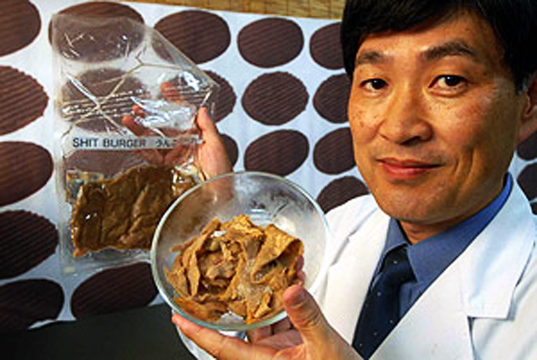
Mitsuyuki Ikeda, a researcher from the Environmental Assessment Center in Okayama has developed a new artificial meat burger made of human feces.

Ikeda has gathered sewage mud (which contains human feces) and has developed the artificial meat by adding fecal extracts, soy protein and steak sauce essence. Artificial food coloring to added to it to give it the same look as red meat. It is composed of 63 percent protein, 25 percent carbohydrates, 3 percent lipids and 9 percent minerals.

Protein is extracted from the sewage mud first. After the protein is extracted, “reaction enhancer” is added to it and it is then put in a machine called the “exploder” which produces the artificial meat. During the entire process, the bacteria in the sewage mud is rendered harmless as it is killed by heating.

The scientist is hoping that the new type of meat will one day replace real meat, which is more expensive to produce. He claims that the new feces burger is actually healthier than real meat (fecal meat has less fat and hence less calories) and is more environment-friendly (cows supposedly contribute around 18 percent of our greenhouse gas emissions).

Currently, fecal meat costs 10-20 times more than normal meat because of the cost of research, but ultimately Ikeda plans to bring the price down so that people can switch to feacl meat one day.

Ikeda did not say whether his “poop meat” is as tasty as real meat and he has acknowledged that few people would be keen to eat it.
http://www.ibtimes.com/articles/164958/20110617/japanese-scientist-makes-poop-burger-mitsuyuki-ikeda.htm


Genetically Engineered Stomach Microbe Converts Seaweed into Ethanol

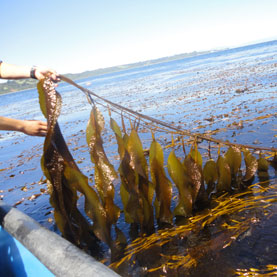
Seaweed may well be an ideal plant to turn into biofuel. It grows in much of the two thirds of the planet that is underwater, so it wouldn’t crowd out food crops the way corn for ethanol does. Because it draws its own nutrients and water from the sea, it requires no fertilizer or irrigation. Most importantly for would-be biofuel-makers, it contains no lignin—a strong strand of complex sugars that stiffens plant stalks and poses a big obstacle to turning land-based plants such as switchgrass into biofuel.

Researchers at Bio Architecture Lab, Inc., (BAL) and the University of Washington in Seattle have now taken the first step to exploit the natural advantages of seaweed. They have built a microbe capable of digesting it and converting it into ethanol or other fuels or chemicals. Synthetic biologist Yasuo Yoshikuni, a co-founder of BAL, and his colleagues took Escherichia coli, a gut bacterium most famous as a food contaminant, and made some genetic modifications that give it the ability to turn the sugars in an edible kelp called kombu into fuel. They report their findings in the January 20 issue of the journal Science.

To get his E. coli to digest kombu, Yoshikuni turned to nature—specifically, he looked into the genetics of natural microbes that can break down alginate, the predominant sugar molecule in the brown seaweed. “The form of the sugar inside the seaweed is very exotic,” Yoshikuni told Scientific American. “There is no industrial microbe to break down alginate and convert it into fuels and chemical compounds.”

Once he and his colleagues had isolated the genes that would confer the required traits, they used a fosmid—a carrier for a small chunk of genetic code—to place the DNA into the E. coli cells, where it took its place in the microbe’s own genetic instruction set. To test the new genetically engineered bacterium, the researchers ground up some kombu, mixed it with water and added the altered E. coli. Before two days had gone by the solution contained about 5 percent ethanol and water. It also did this at (relatively) low temperatures between 25 and 30 degrees Celsius, both of which mean that the engineered microbe can turn seaweed to fuel without requiring the use of additional energy for the process.

An analysis from the Pacific Northwest National Laboratory (pdf) suggests that the U.S. could supply 1 percent of its annual gasoline needs by growing such seaweed for harvest in slightly less than 1 percent of the nation’s territorial waters. Humans already grow and harvest some 15 million metric tons of kombu and other seaweeds to eat. And there’s no reason to fear the newly engineered E. coli escaping into the wild and consuming the seaweed already out there, Yoshikuni argues. “E. coli loves the human gut, it doesn’t like the ocean environment,” he says. “I can hardly imagine it would do something. It would just be dead.”

The microbe could turn out to be useful for making molecules other than ethanol, such as isobutanol or even the precursors of plastics, Yoshikuni says. “Consider the microbe as the chassis with engineered functional modules,” or pathways to produce a specific molecule, Yoshikuni says. “If we integrate other pathways instead of the ethanol pathway, this microbe can be a platform for converting sugar into a variety of molecules.”

The fact that such a one-stop industrial microbe can turn seaweed into a variety of molecules has attracted the attention of outfits such as the U.S. Department of Energy’s Advanced Research Projects Agency–Energy, or ARPA–e, which has funded BAL work with DuPont to produce other molecules from such engineered microbes. “Because seaweed grows naturally in the ocean, it uses the two thirds of the planet that we don’t use for agriculture,” ARPA–e program director Jonathan Burbaum wrote in an e-mail. “ARPA–e is directing a small portion of the remaining funding toward an aquafarm experiment to measure area productivity and harvest efficiency.”
http://www.scientificamerican.com/article.cfm?id=genetically-engineered-stomach-microbe-turns-seaweed-into-ethanol&WT.mc_id=MND_20120216

Scientists Crack the Genetic Code of the 14th Century Bubonic Plague that Killed 50 Million Europeans

Scientists have mapped out the entire genetic map of the Black Death, a 14th century bubonic plague that killed 50 million Europeans in one of the most devastating epidemics in history.

The work, which involved extracting and purifying DNA from the remains of Black death victims buried in London’s “plague pits,” is the first time scientists have been able to draft a reconstructed genome of any ancient pathogen.

Their result — a full draft of the entire Black Death genome — should allow researchers to track changes in the disease’s evolution and virulence, and lead to better understanding of modern-day infectious diseases.

Building on previous research which showed that a specific variant of the Yersinia pestis (Y. pestis) bacterium was responsible for the plague that ravaged Europe between 1347 and 1351, a team of German, Canadian and American scientists went on to “capture” and sequence the entire genome of the disease.

“The genomic data show that this bacterial strain, or variant, is the ancestor of all modern plagues we have today worldwide. Every outbreak across the globe today stems from a descendant of the medieval plague,” said Hendrik Poinar, of Canada’s McMaster University, who worked with the team.

“Experts say the direct descendants of the same bubonic plague still exist today, killing around 2,000 people a year.

A virulent strain of E. coli bacteria which caused a deadly outbreak of infections in Germany and France earlier this year was also found to contain DNA sequences from plague bacteria.

For this study Poinar’s team analysed skeletal remains from Black Death victims buried in London’s East Smithfield “plague pits,” which are located under what is now the Royal Mint.

By focusing on promising specimens from the dental pulp of five bodies, which had already been pre-screened for the presence of Y. pestis, they were able to extract, purify and enrich the disease’s DNA and at the same time reduce the amount of background non-plague DNA which might interfere.

Linking the 1349 to 1350 dates of the skeletal remains to the genetic data allowed the researchers to calculate the age of the ancestor of Y. pestis that caused the mediaeval plague.

Poinar, whose work was published in the journal Nature, said the team found that in 660 years of evolution, the genetic map of the ancient organism had only barely changed. “The next step is to determine why this was so deadly,” he said.

Johannes Krause Of Germany’s University of Tubingen, who also worked on the study, said the same approach could now be used to study the genomes of all sorts of historic pathogens.

“This will provide us with direct insights into the evolution of human pathogens and historical pandemics,” he said in a statement.

http://www.reuters.com/article/2011/10/12/us-plague-genome-idUSTRE79B5D220111012?feedType=RSS

Common Bacteria Discovered to be Mind-Altering, Improving Mood and Reducing Anxiety

Hundreds of species of bacteria call the human gut their home. This gut “microbiome” influences our physiology and health in ways that scientists are only beginning to understand. Now, a new study suggests that gut bacteria can even mess with the mind, altering brain chemistry and changing mood and behavior.

John Cryan and colleagues at McMaster University in Canada fed mice a broth containing a benign bacterium, Lactobacillus rhamnosus. The scientists chose this particular bug partly because they had a handy supply and also because related Lactobacillus bacteria are a major ingredient of probiotic supplements and very little is known about their potential side effects, Cryan says.

In this case, the side effects appeared to be beneficial. Mice whose diets were supplemented with L. rhamnosus for 6 weeks exhibited fewer signs of stress and anxiety in standard lab tests, Cryan and colleagues reported yesterday in the Proceedings of the National Academy of Sciences.

http://news.sciencemag.org/sciencenow/2011/08/mind-altering-bugs.html