Shape-Shifting Jesus Described in Ancient Egyptian Text

last-supper-mosaic

A newly deciphered Egyptian text, dating back almost 1,200 years, tells part of the crucifixion story of Jesus with apocryphal plot twists, some of which have never been seen before.

Written in the Coptic language, the ancient text tells of Pontius Pilate, the judge who authorized Jesus’ crucifixion, having dinner with Jesus before his crucifixion and offering to sacrifice his own son in the place of Jesus. It also explains why Judas used a kiss, specifically, to betray Jesus — because Jesus had the ability to change shape, according to the text — and it puts the day of the arrest of Jesus on Tuesday evening rather than Thursday evening, something that contravenes the Easter timeline.

The discovery of the text doesn’t mean these events happened, but rather that some people living at the time appear to have believed in them, said Roelof van den Broek, of Utrecht University in the Netherlands, who published the translation in the book “Pseudo-Cyril of Jerusalem on the Life and the Passion of Christ”(Brill, 2013).

Copies of the text are found in two manuscripts, one in the Morgan Library and Museum in New York City and the other at the Museum of the University of Pennsylvania. Most of the translation comes from the New York text, because the relevant text in the Pennsylvania manuscript is mostly illegible.

Pontius Pilate has dinner with Jesus

While apocryphal stories about Pilate are known from ancient times, van den Broek wrote in an email to LiveScience that he has never seen this one before, with Pilate offering to sacrifice his own son in the place of Jesus.

“Without further ado, Pilate prepared a table and he ate with Jesus on the fifth day of the week. And Jesus blessed Pilate and his whole house,” reads part of the text in translation. Pilate later tells Jesus, “well then, behold, the night has come, rise and withdraw, and when the morning comes and they accuse me because of you, I shall give them the only son I have so that they can kill him in your place.”

In the text, Jesus comforts him, saying, “Oh Pilate, you have been deemed worthy of a great grace because you have shown a good disposition to me.” Jesus also showed Pilate that he can escape if he chose to. “Pilate, then, looked at Jesus and, behold, he became incorporeal: He did not see him for a long time …” the text read.

Pilate and his wife both have visions that night that show an eagle (representing Jesus) being killed.

In the Coptic and Ethiopian churches, Pilate is regarded as a saint, which explains the sympathetic portrayal in the text, van den Broek writes.

The reason for Judas using a kiss

In the canonical bible the apostle Judas betrays Jesus in exchange for money by using a kiss to identify him leading to Jesus’ arrest. This apocryphal tale explains that the reason Judas used a kiss, specifically, is because Jesus had the ability to change shape.

“Then the Jews said to Judas: How shall we arrest him [Jesus], for he does not have a single shape but his appearance changes. Sometimes he is ruddy, sometimes he is white, sometimes he is red, sometimes he is wheat coloured, sometimes he is pallid like ascetics, sometimes he is a youth, sometimes an old man …” This leads Judas to suggest using a kiss as a means to identify him. If Judas had given the arresters a description of Jesus he could have changed shape. By kissing Jesus Judas tells the people exactly who he is.

This understanding of Judas’ kiss goes way back. “This explanation of Judas’ kiss is first found in Origen [a theologian who lived A.D. 185-254],” van den Broek writes. In his work, Contra Celsum the ancient writerOrigen, stated that “to those who saw him [Jesus] he did not appear alike to all.”

St. Cyril impersonation

The text is written in the name of St. Cyril of Jerusalem who lived during the fourth century. In the story Cyril tells the Easter story as part of a homily (a type of sermon). A number of texts in ancient times claim to be homilies by St. Cyril and they were probably not given by the saint in real life, van den Broek explained in his book.

Near the beginning of the text, Cyril, or the person writing in his name, claims that a book has been found in Jerusalem showing the writings of the apostles on the life and crucifixion of Jesus. “Listen to me, oh my honored children, and let me tell you something of what we found written in the house of Mary …” reads part of the text.

Again, it’s unlikely that such a book was found in real life. Van den Broek said that a claim like this would have been used by the writer “to enhance the credibility of the peculiar views and uncanonical facts he is about to present by ascribing them to an apostolic source,” adding that examples of this plot device can be found “frequently” in Coptic literature.

Arrest on Tuesday

Van den Broek says that he is surprised that the writer of the text moved the date of Jesus’ Last Supper, with the apostles, and arrest to Tuesday. In fact, in this text, Jesus’ actual Last Supper appears to be with Pontius Pilate. In between his arrest and supper with Pilate, he is brought before Caiaphas and Herod.

In the canonical texts, the last supper and arrest of Jesus happens on Thursday evening and present-day Christians mark this event with Maundy Thursday services. It “remains remarkable that Pseudo-Cyril relates the story of Jesus’ arrest on Tuesday evening as if the canonical story about his arrest on Thursday evening (which was commemorated each year in the services of Holy Week) did not exist!” writes van den Broek in the email.

A gift to a monastery … and then to New York
About 1,200 years ago the New York text was in the library of the Monastery of St. Michael in the Egyptian desert near present-day al-Hamuli in the western part of the Faiyum. The text says, in translation, that it was a gift from “archpriest Father Paul,” who, “has provided for this book by his own labors.”

The monastery appears to have ceased operations around the early 10th century, and the text was rediscovered in the spring of 1910. In December 1911, it was purchased, along with other texts, by American financier J.P. Morgan. His collections would later be given to the public and are part of the present-day Morgan Library and Museum in New York City. The manuscript is currently displayed as part of the museum’s exhibition “Treasures from the Vault” running through May 5.

Who believed it?

Van den Broek writes in the email that “in Egypt, the Bible had already become canonized in the fourth/fifth century, but apocryphal stories and books remained popular among the Egyptian Christians, especially among monks.”

Whereas the people of the monastery would have believed the newly translated text, “in particular the more simple monks,” he’s not convinced that the writer of the text believed everything he was writing down, van den Broek said.

“I find it difficult to believe that he really did, but some details, for instance the meal with Jesus, he may have believed to have really happened,” van den Broek writes. “The people of that time, even if they were well-educated, did not have a critical historical attitude. Miracles were quite possible, and why should an old story not be true?”

http://www.livescience.com/27840-shape-shifting-jesus-ancient-text.html

Vatican spends $30 million to purchase apartments above Europe’s largest gay sauna: Europa Multiclub

emc

The latest Vatican deal to leave Catholics around the world clutching their rosaries involves the purchase of a block of Rome real-estate that happens to include Europe’s largest gay bathhouse, Europa Multiclub.

The $30 million dollar investment was paid out to find an extravagant home for Cardinal Ivan Dias, a 76-year old Vatican official, and house a dozen more high-level Catholic priests.

Those who are defending Cardinal Dias in light of the new information claim he chose the location to “provide spiritual guidance” to the gay men who enjoyed the sauna.

Vatican purchases apartments above Europe’s largest gay sauna

Landscape of Dead Bodies May Have Inspired First Mummies

sn-mimmification

Trekking through Chile’s Atacama Desert 7000 years ago, hunter-gatherers known as the Chinchorro walked in the land of the dead. Thousands of shallowly buried human bodies littered the earth, their leathery corpses pockmarking the desolate surroundings. According to new research, the scene inspired the Chinchorro to begin mummifying their dead, a practice they adopted roughly 3000 years before the Egyptians embraced it.

Archaeologists have long studied how the Chinchorro made their mummies, the first in history, says ecologist Pablo Marquet of the Pontifical Catholic University of Chile in Santiago. After removing the skin to be dried, the hunter-gatherers scooped out the organs and stuffed the body with clay, dried plants, and sticks. Once they reattached the skin, embalmers painted the mummy shiny black or red and put a black wig on its head. Covering the corpses’ faces were clay masks, some molded into an open-mouthed expression that later inspired Edvard Munch’s famous painting The Scream.

Few scientists have tackled the mystery of why the Chinchorro started to mummify their dead in the first place. Complicated cultural practices such as mummification, Marquet says, tend to arise only in large, sedentary populations. The more people you have in one place, the more opportunity for innovation, development, and the spread of new ideas. The Chinchorro don’t fit that mold. As nomadic hunter-gatherers, they formed groups of about only 100 people.

To solve the mystery, Marquet and his colleagues needed to go back in time. Using data from ice cores in the Andes, the researchers reconstructed the climate of the region where the Chinchorro lived: the northern coast of Chile and the southern coast of Peru, along the western edge of the Atacama Desert. Before 7000 years ago, the area was extremely arid, the team found, but then it went through a wetter period that lasted until about 4000 years ago. Analyses of carbon-dated Chinchorro artifacts, such as shell piles (known as middens) and mummies, suggest that the rainier conditions supported a larger population, peaking about 6000 years ago.

The team calculated, based on the demographics of hunter-gatherers, that a single Chinchorro group of roughly 100 people would produce about 400 corpses every century. These corpses, shallowly buried and exposed to the arid Atacama climate, would not have decomposed, but lingered. Given that the Chinchorro settled the Atacama coast roughly 10,000 years ago, the researchers argue that by the time the practice of mummification started about 7000 years ago, a staggering number of bodies would have piled up. A single person was likely to see several thousand naturally mummified bodies during his or her lifetime, the team reports online today in the Proceedings of the National Academy of Sciences. The number increased over the years, until mummies “became part of the landscape,” Marquet says.

This constant exposure to natural mummies may have led to a cult of the dead involving artificial mummification. “The dead have a huge impact on the living,” Marquet says, citing work by psychologists and sociologists that shows that exposure to dead bodies produces tangible psychological and social effects, often leading to religious practices. “There’s a conflict between how you think of someone alive and dead,” he says. Religious practices and ideas—such as funerals, wakes, and the belief in ghosts—help resolve that conflict. “Imagine living in the barren desert with barely anything, just sand and stone,” he says. Barely anything, that is, except for hundreds, if not thousands, of dead bodies that never decay. One would feel “compelled somehow to relate” to the corpses, he says, speculating that the Chinchorro made mummies in order to come to terms with the continued presence of their dead. When the climate turned dry again and food supplies dwindled, Marquet says, the population dropped. The complex Chinchorro embalming practices also petered out around that time.

http://news.sciencemag.org/sciencenow/2012/08/landscape-of-dead-bodies-may-hav.html

Thanks to Dr. Rajadhyaksha for bringing this to the attention of the It’s Interesting community.

Star Wars fans rise up in Britain: Jedi Knights top census in alternative faith

star-wars-episode-7_jpeg1-1280x960

Jedi Knights are the most popular alternative faith in Britain, new census  figures reveal.
In 2001 there was a campaign to urge people to answer “Jedi Knights” when  asked what religion they were on the census. And that year a whopping 330,000  did so.
That number was down to 176,632 in 2011 census figures released Tuesday,  but characters made famous in the six “Star Wars” movies are still on top when it comes to the  “other” religions category.
In comparison, only 29,000 put down that they were “Atheist.”
And just 2,418 people chose Scientology. At least Tom Cruise’s favorite  belief system beat “Witchcraft,” which 1,276 people selected.
Other notable numbers from the census release, published by The Guardian:
– More than 23,000 said they were “Mixed Religion”
– 6,242 said they believed in “Heavy Metal.”
– Almost 3,000 “Believe in God.”
In contrast 33.2 million people, or 59 percent of the people of England  and Wales, marked down Christianity as their religion.

Read more: http://www.nydailynews.com/news/world/jedi-knights-top-british-census-alternative-faith-article-1.1218422#ixzz2Eu3XS09T

Arkansas Republican representative Jon Hubbard proclaims slavery was ‘a blessing.’

Jon Hubbard, a Republican member of the Arkansas House of Representatives, has written a new book in which he says slavery was “a blessing” for African-Americans, among other questionable statements.

Hubbard, a first term Republican from Jonesboro, Ark., makes a series of racially charged statements in the self-published book, including saying that integration of schools is hurting white students, that African slaves had better lives under slavery than in Africa, that blacks are not contributing to society, and that a situation is developing the United States which is similar to that of Nazi Germany.

The questionable statements in Hubbard’s book, “Letters to the Editor: Confessions of a Frustrated Conservative,” were first reported by Arkansas Times and TalkBusiness.net.

Regarding slavery, Hubbard wrote:

“… the institution of slavery that the black race has long believed to be an abomination upon its people may actually have been a blessing in disguise. The blacks who could endure those conditions and circumstances would someday be rewarded with citizenship in the greatest nation ever established upon the face of the Earth.” (Pages 183-89)

On the subject of school integration, Hubbard described black students as having a “a lack of discipline and ambition,” which he said has hurt the entire educational system.

Hubbard also tackled immigration and said that Christians in America are in a similar position to that of Germans during Hitler’s rise to power.

… the immigration issue, both legal and illegal … will lead to planned wars or extermination. Although now this seems to be barbaric and uncivilized, it will at some point become as necessary as eating and breathing.” (Page 9)

Hubbard declined to comment on the book when contacted by The Huffington Post, saying that he did not have time.

An Air Force veteran, Hubbard sells insurance in Arkansas and Missouri. He serves on several legislative committees, including ones dealing with issues related to aging, insurance, telecommunications, and waterways and aeronautics policy.

On his campaign website, Hubbard says he will defend Christianity as a state lawmaker.

“And perhaps the most important pledge I can make to the people of District 58, the citizens of Arkansas, and to myself, is to do whatever I can to defend, protect, and preserve our Christian heritage,” Hubbard says on his website. “Regardless of one’s religious beliefs, if we as a nation continue to turn away from those Christian principles and values upon which this great nation was founded, we will have truly lost everything worth saving!”

Hubbard has a history of taking conservative stances in the legislature. In June, he called for the University of Arkansas to be audited to see if tax money had been spent on a panel discussion about undocumented immigrants. In February, he asked the state Department of Health to implement a policy that would require birth certificates be produced by anyone seeking non-emergency medical care in a hospital in order to prove their citizenship.

http://www.huffingtonpost.com/2012/10/05/jon-hubbard-arkansas-slavery-book_n_1943661.html

Kuwait Death Penalty for Cursing God

Kuwait’s parliament on Thursday provisionally passed amendments to the Gulf state’s penal code stipulating the death penalty for those who curse God, Islam’s Prophet Mohammed or his wives.

Forty-six MPs, including cabinet ministers, voted for the key amendments that will come into effect only after another round of voting and government approval. The second and final vote will take place in two weeks.

Four Shiite MPs voted against the law, a pro-Shiite Sunni lawmaker abstained, while two MPs refused to vote.

Shiite MPs have demanded that the new amendments also enforce the death penalty for anyone who curses their sect’s 12 revered Imams, but the Sunni- dominated parliament rejected their requests.

The move to stiffen penalties for religious crimes came after authorities last month arrested a Shiite tweeter for allegedly cursing the Prophet Mohammed, his wife and some companions.

The suspect, Hamad al-Naqi, is being detained pending further interrogation and trial.

Sectarian tensions have flared in Kuwait between the Sunni majority and Shiites, who form about a third of the native population of 1.17 million, reflecting rising regional tensions between the two Islamic sects.

http://www.france24.com/en/20120412-kuwait-mps-okay-death-penalty-cursing-god

Cheeus

In Dallas, Texas Dan and Sarah Bell discovered a Jesus shaped Cheeto in 2009. Nicknaming the Cheeto “Cheesus,” Sarah noticed that one of the chips looked oddly familiar “I was putting them in my hand and I had eaten most of the ones in my hand, and one was left lying there. And I said, ‘Oh my gosh, look at this. It really looks like a person in a robe praying.”

CBS News reported the Cheeto in question is about 2 inches tall and missing a right arm. Other than that, one might see a distinct robe, long hair and a man praying.

The couple looks at the Cheeto as memento as a momento from god of how blessed they are. For now they are keeping the “Cheesus” in a plastic box and contemplating a possible eBay auction. In the past, a piece of toast with the likeness of Mother Mary ingrained in the bread sold for $28,000. The Bell’s said they just be happy with $25.

http://www.manolith.com/2009/05/18/cheesus-jesus-likeness-found-in-cheetos-bag/

Face Of Jesus Appears On Stingray

New religious/internet icon Sad Stingray Jesus spotted in South Carolina. Via Charleston’s Post and Courier:

It’s not as famous as Grilled Cheesus or Nun Bun, but the image a James Island woman found Friday on the back of a dead cownose ray may be one day.

“I just kind of thought it looked like a bearded homeless man,” said Erica Scheldt, 24. “But when I posted pictures on Instagram, one of my friends was like, ‘That’s Jesus.’ And I was like, ‘Oh my God! You’re right!’”

Scheldt also pointed out that she is from Nashville, home of the famous  Nun Bun, a cinnamon roll that bears a strong resemblance to Mother  Teresa.


http://www.disinfo.com/2012/04/face-of-jesus-appears-on-stingray/


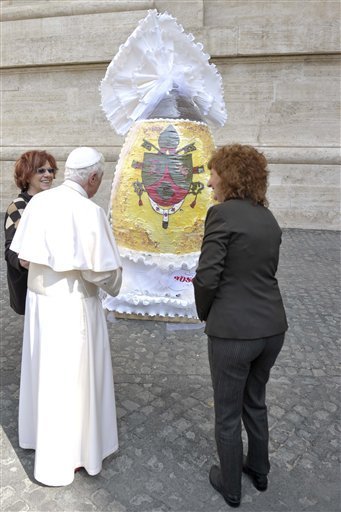
Pope Receives Gigantic Chocolate Easter Egg

A pleased-looking Pope Benedict XVI has been presented with a colourful, two-metre high Easter egg weighing 250 kilograms as Catholics and other Christians prepare to celebrate Easter.

The egg, made by Italian chocolate maker Tosca, was unveiled in a Vatican courtyard. The brilliant yellow and blue wrapper was decorated with the Pope’s coat of arms, wreathes of flowers and doves – the symbol of peace.

The head of the Roman Catholic Church, who will be 85 later this month, will not be cracking open the egg himself, but will give it to young offenders in Rome’s Casal del Marmo institute, which he visited in 2007, according to the Vatican’s official newspaper, L’Osservatore Romano.

Tosca, based in the northern town of Cremona, is known for its oversized delicacies.

http://bigpondnews.com/articles/OddSpot/2012/04/05/Pope_given_whopper_Easter_egg_736440.html


Lego Jesus

WA church in Sweden has been displaying a life-size Lego statue of Jesus Christ since 2009.

Churchgoers donated nearly 30,000 Lego bricks to build the 1.78 metre (5.8 foot) high statue, said Per Wilder, the pastor of the Oensta Gryta Church in Vaesteras, about 110 kilometres (70 miles) west of Stockholm.

“It is a fantastic installation and it will be there as long as we think it is in a good spot,” he said.

The model was based on Danish sculptor Bertel Thorvaldsens’s 19th century work Christus, which depicts the resurrection of Jesus Christ.

Wilder said the statue would remain permanently at the church and there were no plans to sell it to raise funds.

http://www.google.com/hostednews/afp/article/ALeqM5jfvsy2G44S1zgbkMgubhgKUEEPuQ