Divers nearly swallowed by humpback whales


Two ocean scuba divers have narrowly missed being swallowed whole by two humpback whales that shot up from the deep to chase fish right next to where the divers were floating.

Charter boat owner and captain Shawn Stambuck was filming the divers off the coast of California from his boat and posted video of the near miss online on July 20.
In the footage, a whale’s tail can be seen breaking the surface in the distance as seagulls swoop down from above. A shot below the surface shows the ocean under the divers teaming with a large school of small fish, which one website later identified as sardines.

Then, out of nowhere, the water around two divers begins bubbling and frothing as the fish swim up and break the surface en masse. Seconds later, two massive whales barrel up out of the water with their mouths gaping open to swallow the fish, just metres away from the divers.

One of the divers can be heard yelling out “holy s—” as he swims for the boat.

“You’re going to have to do more to clean that wet suit,” another person laughs off camera.

The divers were likely never going to end up food for the whales, as humpbacks feed predominately on krill and small fish and do not have a gullet large enough to fit a human.

http://news.ninemsn.com.au/world/2013/07/23/06/08/divers-nearly-swallowed-by-humpback-whales

Kelp gulls may be responsible for the worst-ever Right Whale die-off

southern-right-whale

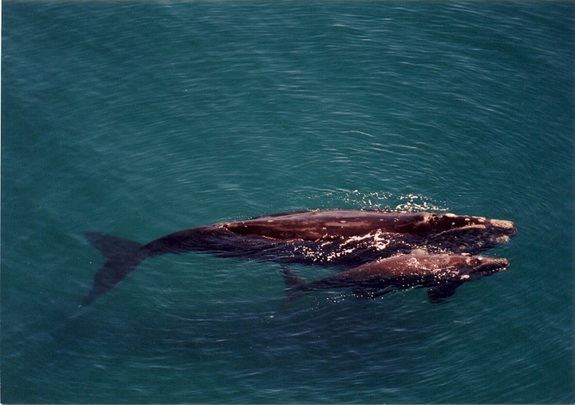
Scientists still don’t know why hundreds of baby southern right whales are turning up dead around Patagonia, a decade after observers first saw signs of the worst die-off on record for the species, according to the Wildlife Conservation Society (WCS).

With no evidence of infectious diseases or deadly toxins in whale tissue samples, scientists are scrambling to determine a cause of death. Some are even pointing a finger at blubber-eating birds.

The whales come to the peaceful Atlantic bays around Peninsula Valdes along Argentina’s Patagonian Coast to give birth and raise their young. At least 605 dead right whales have been counted in the region since 2003, WCS officials say. Of those, 538 were newborn calves. Last year, the mortality event was especially severe, with a record-breaking 116 whale deaths, 113 of them calves.

“In 2012 we lost nearly one-third of all calves born at the Peninsula,” said Mariano Sironi, scientific director of the Instituto de Conservacion de Ballenas in Argentina. “Southern right whales have their first calf when they are nine years old on average. This means that it won’t be until a decade from now that we will see a significant reduction in the number of calves born, as all of the female calves that died will not be contributing any new offspring to the population,” Sironi, who is also an advisor to the Southern Right Whale Health Monitoring Program, added in a statement.

Sironi and colleague Vicky Rowntree, who is co-director of the monitoring program, have studied a strange phenomena that could be stressing southern right whales. They say kelp gulls at Peninsula Valdes land on the backs of the cetaceans to eat their skin and blubber.

“The attacks are very painful and cause large, deep lesions, particularly on the backs of young 2-6 week-old calves,” the researchers said in a statement from WCS. “This harassment can last for hours at a time. As a result, right whale mothers and their calves are expending much precious energy during a time of year when mothers are fasting and at a site where little to no food is available to replenish fat reserves.”

The situation is discouraging for a species that had made a significant comeback since its population was depleted by the whaling industry.

“The southern right whale population is still only a small fraction of its original size, and now we have reason to worry about its recovery,” Rowntree said.

Though the southern right whale is not listed as endangered, conservationists warn that the species’ sister populations could go extinct if hit with a mysterious die-off on this scale. For instance, there are thought to be just about 500 North Atlantic right whales remaining.

Thanks to Dr. Lutter for bringing this to the attention of the It’s Interesting community.

http://news.yahoo.com/worst-ever-whale-die-off-continues-puzzle-110222538.html

Adoption at sea: sperm whales take in outcast bottlenose dolphin

dolphin-with-spinal-trouble-sperm-whales_63541_600x450

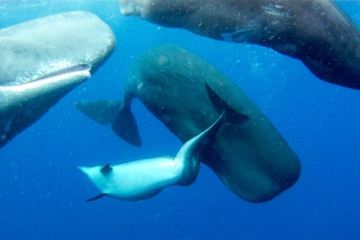
A group of sperm whales appear to have taken in a deformed bottlenose dolphin, marine researchers have discovered.

Behavioral ecologists Alexander Wilson and Jens Krause of Berlin’s Leibniz-Institute of Freshwater Ecology and Inland Fisheries came across the heartwarming scene some 15 to 20 kilometers off the Azores in the North Atlantic, as they observed the dolphin six times while it nuzzled and rubbed members of the group, reports the journal Science.

“It really looked like they had accepted the dolphin for whatever reason. They were being very sociable,” Wilson told the journal.

The dolphin’s unfortunate deformity — a spinal disfigurement, likely a birth defect, which gives its back half an “S” shape — could help explain how it’s come to be taken in by the sperm whale group, explains Science.

“Sometimes some individuals can be picked on. It might be that this individual didn’t fit in, so to speak, with its original group,” Wilson says, speculating that the deformity could have put the animal at a disadvantage among its own kind — perhaps it had a low social status, or just couldn’t keep up with the other dolphins.

Sperm whales swim more slowly than dolphins, notes the journal, and the pod designates one member to “babysit” the calves near the surface while the other adults dive deep.

But what was in it for the sperm whales? There’s no obvious advantage, Wilson tells Science.

In fact, as cetacean ecologist Mónica Almeida e Silva of the University of the Azores in Portugal tells the journal, sperm whales have good reasons not to like bottlenose dolphins. “Why would sperm whales accept this animal in their group?” she said. “It’s really puzzling to me.”

But maybe we shouldn’t draw too much from this apparent display of affection: as behavioral biologist Luke Rendell of the University of St. Andrews in the U.K. explained to Science, the briefness of the observation, and its rarity, as well as how little is known about these particular whales, makes it hard to interpret. They might simply enjoy the dolphin’s attentions, says Rendell, or “they could just be thinking, ‘Wow, this is a kind of weird calf’.”

Read more: http://newsfeed.time.com/2013/01/26/adoption-at-sea-sperm-whales-take-in-outcast-bottlenose-dolphin/#ixzz2J7iTuEgQ

Multi-Tasking Humpback Whales Sing While Feeding, Not Just Breeding

whale

Humpback whales are famed for their songs, most often heard in breeding season when males are competing to mate with females. In recent years, however, reports of whale songs occurring outside traditional breeding grounds have become more common. A new study may help explain why.

Humpbacks sing for their supper — or at least, they sing while they hunt for it.

The research, published December 19 in PLoS ONE, uncovers the whales’ little-understood acoustic behavior while foraging.

It also reveals a previously unknown behavioral flexibility on their part that allows the endangered marine mammals to balance their need to feed continuously with the competing need to exhibit mating behaviors such as song displays.

“They need to feed. They need to breed. So essentially, they multi-task,” said study co-author Ari S. Friedlaender, research scientist at Duke University’s Nicholas School of the Environment. “This suggests the widely held behavioral dichotomy of breeding-versus-feeding for this species is too simplistic.”

Researchers from the U.S. Naval Postgraduate School, the University of California-Santa Barbara and Duke tracked 10 humpback whales in coastal waters along the Western Antarctic Peninsula in May and June 2010. The peninsula’s bays and fjords are important late-season feeding grounds where humpbacks feast on krill each austral autumn before migrating to warm-water calving grounds thousands of miles away.

Using non-invasive multi-sensor tags that attach to the whales with suction cups, the researchers recorded the whales’ underwater movements and vocalizations as they foraged.

All 10 of the tags picked up the sounds of background songs, and in two cases, they recorded intense and continuous whale singing with a level of organization and structure approaching that of a typical breeding-ground mating display. The song bouts sometimes lasted close to an hour and in one case occurred even while sensors indicated the whale, or a close companion, was diving and lunging for food.

Humpbacks sing most frequently during breeding season, but are known to sing on other occasions too, such as while escorting mother-calf pairs along migratory routes. Though the reasons they sing are still not thoroughly understood, one distinction is clear: Songs sung in breeding grounds are quite different in duration, phrase type and theme structure from those heard at other locations and times.

“The fact that we heard mating displays being sung in late-season foraging grounds off the coast of Antarctica suggests humpback whale behavior may be more closely tied to the time of year than to physical locations. This may signify an ability to engage in breeding activities outside their traditional warm-water breeding grounds,” said Douglas P. Nowacek, Repass-Rogers University Associate Professor of Conservation Technology at Duke’s Nicholas School.

As the region’s climate warms, sea ice cover around the Western Antarctic Peninsula has thinned in recent years and the water stays open later in the foraging season, he explained. Whales are remaining there longer into austral autumn to feast on krill instead of heading off to warm-water breeding grounds, as many scientists previously believed.

“Mating may now be taking place at higher latitudes,” Nowacek said. “This merits further study.”

Alison K. Stimpert, research associate in oceanography at the Naval Postgraduate School, was lead author of the new study. Lindsey E. Peavey, a PhD Student at the University of California at Santa Barbara’s Bren School of Environmental Science and Management, co-authored it with Stimpert, Friedlaender and Nowacek.

Journal Reference:

1.Stimpert AK, Peavey LE, Friedlaender AS, Nowacek DP. Humpback Whale Song and Foraging Behavior on an Antarctic Feeding Ground. PLoS One, 2012 DOI: 10.1371/journal.pone.0051214

http://www.sciencedaily.com/releases/2012/12/121219174156.htm

‘Extinct’ whale found: Odd-looking pygmy whale traced back 2 million years

12-19-12-pgymy-right-whale_full_380

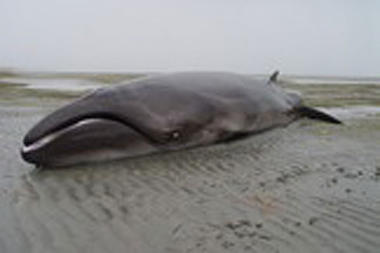
The pygmy right whale, a mysterious and elusive creature that rarely comes to shore, is the last living relative of an ancient group of whales long believed to be extinct, a new study suggests.

The findings, published Tuesday, Dec. 18, in the Proceedings of the Royal Society B, may help to explain why the enigmatic marine mammals look so different from any other living whale.

“The living pygmy right whale is, if you like, a remnant, almost like a living fossil,” said Felix Marx, a paleontologist at the University of Otago in New Zealand. “It’s the last survivor of quite an ancient lineage that until now no one thought was around.”

The relatively diminutive pygmy right whale, which grows to just 21 feet (6.5 meters) long, lives out in the open ocean. The elusive marine mammals inhabit the Southern Hemisphere and have only been spotted at sea a few dozen times. As a result, scientists know almost nothing about the species’ habits or social structure.

The strange creature’s arched, frownlike snout makes it look oddly different from other living whales. DNA analysis suggested pygmy right whales diverged from modern baleen whales such as the blue whale and the humpback whale between 17 million and 25 million years ago. However, the pygmy whales’ snouts suggested they were more closely related to the family of whales that includes the bowhead whale. Yet there were no studies of fossils showing how the pygmy whale had evolved, Marx said.

To understand how the pygmy whale fit into the lineage of whales, Marx and his colleagues carefully analyzed the skull bones and other fossil fragments from pygmy right whales and several other ancient cetaceans.

The pygmy whale’s skull most closely resembled that of an ancient family of whales called cetotheres that were thought to have gone extinct around 2 million years ago, the researchers found. Cetotheres emerged about 15 million years ago and once occupied oceans across the globe.

The findings help explain how pygmy whales evolved and may also help shed light on how these ancient “lost” whales lived. The new information is also a first step in reconstructing the ancient lineage all the way back to the point when all members of this group first diverged, he said.

http://www.csmonitor.com/Science/2012/1219/Extinct-whale-found-Odd-looking-pygmy-whale-traced-back-2-million-years

Thanks to Dr. Lutter for bringing this to the attention of the It’s Interesting community.

Post-Sandy beach erosion reveals skeleton of rare beaked whale

Whalebones-jpg

When Hurricane Sandy blew by Florida last month it blew sand away that led to erosion.

That erosion exposed the remains of a beaked whale on Sunday.

An Orlando-area couple was looking for sand dollars when they noticed something far more interesting in the sand at the oceanfront dog park in New Smyrna Beach.

When they started digging, they found the remains of an 8- to 9-foot whale that may have been there for decades.

“It speaks to the amazing amount of post-Sandy erosion that’s happened on this beach,” said Ed Dettman, who walks the beach every day.

There is only one record of a beaked whale washed up on the beach, and this isn’t it.

The skull, vertebrae and ribs were recovered and laid out as if the whale were in a museum.

The couple turned their find over to the county.

The remains were a foot below the surface but were likely much deeper before the storm blew through.

Read more: http://www.wesh.com/news/central-florida/volusia-county/Beach-erosion-reveals-remains-of-whale/-/12983450/17799578/-/7lkvaqz/-/index.html#ixzz2FSYDmWfx

Stranded humpback whale on Dutch coast currently struggling to free itself

humpback


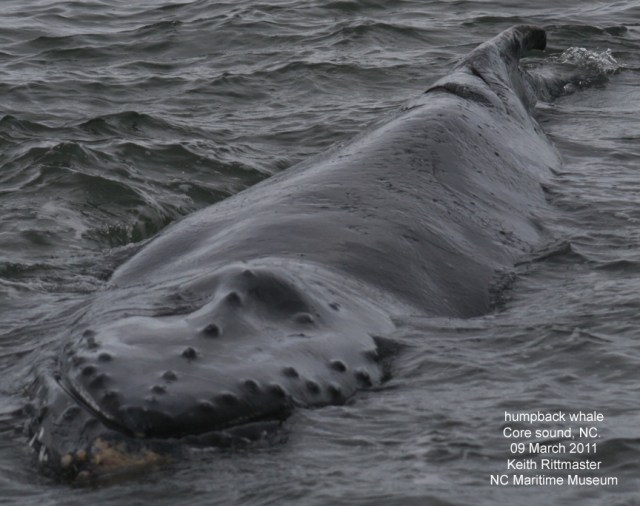
Rescuers say a humpback whale has stranded on a sandbank near the northern Dutch coast and is trying to free itself as the tide rises.

Henriette de Waal, a spokeswoman for the Ecomare wildlife and nature center, says the whale was spotted early Wednesday stuck in a gully on a sandbank off the coast of Den Helder, 90 kilometers (55 miles) north of Amsterdam.

She says boats from the Dutch coast guard and navy are at the scene but keeping their distance as the 12-meter (40-foot) animal, which is partially submerged, struggles to get into deeper water.

It is unusual for humpback whales to strand off the Dutch coast, though De Waal says an increasing number of the marine mammals have been spotted in the North Sea in recent years.

http://www.nbc12.com/story/20324655/stranded-humpback-whale-struggles-to-free-itself

London bar raided after selling whale skin cocktail

101212-whale

Cops swooped on the Nightjar bar in Hoxton, East London, where barmen were  serving the Moby Dick drink.

It contained Laphroaig whisky, Drambuie, ale, bitters and a “whale skin  infusion”.

The raid last week comes amid a Europe-wide ban on whale meat and products,  except under strict restrictions in Greenland and Denmark.

The Metropolitan Police were tipped-off in October that the bar was serving  whale skin illegally. The Met’s Wildlife Crime Unit and a UK Border Force  officer raided the premises on December 3.

A police spokesman said: “One item from the premises was seized. This has  been  sent for analysis.”

No arrests have been made at the Nightjar, which describes itself on its  website as “a hidden slice of old-school glamour”. Its drinks range from £9  to £17 a glass.

Bar bosses said it had been unaware the drink contained an illegal ingredient  until the raid and has removed the drink from sale.

Nightjar director Edmund Weil said: “We did have a drink on this year’s menu  which included a small amount of scotch whisky infused with a single 2 x 5cm  strip of dried whale skin.

“The strip was purchased in a shop by an employee while on a trip to Japan in  autumn 2011.

“Until the police visit, neither ourselves nor our employees were aware of  the  legislation under which the bottle was seized.

“In hindsight we realise that regardless of the legal framework around such  products, it was an error of judgement on our part to include this on our  menu, and we would like to offer our apologies to anyone who may have been  offended by it.

“We have removed the drink entirely from our menu, which will be reprinted  before Monday to reflect this.”

Native Greenlanders who use whales as subsistence food are the only Europeans  allowed to kill or to eat them in strictly limited amounts.

Read more: http://www.thesun.co.uk/sol/homepage/news/4689220/Bar-raided-for-whale-meat-cocktail.html#ixzz2EhWDnief

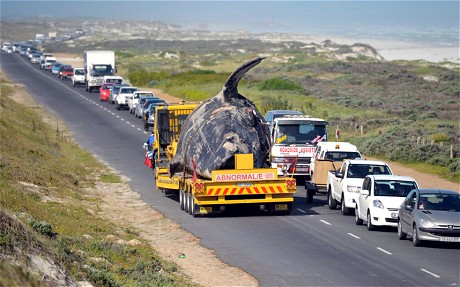
South African whale driven through streets

beachedwhale1 beachedwhale2 beachedwhale3


South African council cleaners have used a lorry to move a stranded whale from a beach near Cape Town.  Officials pulled the huge mammal through heavy traffic down a busy road along the city’s False Bay coastline.  Salvage staff needed an industrial digger to move the 30 metre southern Right Whale, which became stranded on Sunday at Cape Town’s Capricorn beach.

City emergency services spokesman Wilfred Solomons-Johannes confirmed the beach had been closed amid fears deadly Great White sharks had entered shallow waters to feed on the carcase.  He said: “The whale was spotted on the beach on Sunday afternoon. “It had become beached and was dead by the time officials could get to it.  The animal had several bits of flesh taken out of it, and it appears it had been bitten by sharks.”  He added: “We called in the city’s specialist marine rescue team, who used diggers and a lorry to remove the whale.

“It was heaved onto the back of a truck and taken to a landfill site for disposal.”

Mr Solomons-Johannes said experts would examine the dead animal to try to establish how it died.  He added: “Samples were taken from the whale and these will be analysed to try to work out what happened to it.  We hope to get the results within the next couple of days, which may help to explain why it died.”

City officials closed several beaches around Cape Town on Sunday after sharks were spotted in waters close to the beached whale.

Mr Solomons-Johannes on Tuesday confirmed some had reopened following the removal of the carcase but said Capricorn beach itself would remain closed until further notice.  He said: “Capricorn beach remains closed for the next few days until the whale blood and oil has dispersed sufficiently.

“The city is appealing to all water users to be vigilant at this time, obey the shark siren, and to take note of the Shark Spotters’ flags and signage for regular updates on shark sightings.  Beach users are advised that the general caution will remain in place until further notice.”

Specialist teams of Shark Spotters were working on several of Cape Town’s beaches to watch for any signs of the deadly animals.  The killer beasts are frequent visitors to the waters around the city and have been responsible for a string of attacks on humans.

British man Michael Cohen, 47, narrowly escaped with his life in September 2011 after he was bitten by a shark on a beach near Cape Town.  The keen swimmer lost his right leg and part of his left foot after being savaged in the False Bay water.

Zimbabwean tourist Lloyd Skinner was eaten alive by sharks in January 2010 as he swam near the town of Fish Hoek.  Shocked holiday-makers watched from the shore as he was pulled underwater, and rescuers later recovered only his goggles.

Southern Right whales are also regularly seen in the sea around Cape Town.

The massive mammals spend most of their time in the deep ocean but move towards the Cape peninsula during winter and spring to mate.

http://www.telegraph.co.uk/earth/wildlife/9596404/South-African-whale-driven-through-streets.html