Black Mamba venom discovered to be a better painkiller than morphine


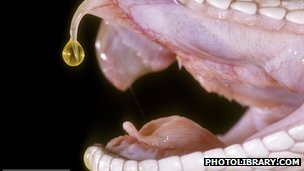
A painkiller as powerful as morphine, but without most of the side-effects, has been found in the deadly venom of the black mamba, say French scientists.

The predator, which uses neurotoxins to paralyse and kill small animals, is one of the fastest and most dangerous snakes in Africa.

However, tests on mice, reported in the journal Nature, showed its venom also contained a potent painkiller.

They admit to being completely baffled about why the mamba would produce it.

The researchers looked at venom from 50 species before they found the black mamba’s pain-killing proteins – called mambalgins.

Dr Eric Lingueglia, from the Institute of Molecular and Cellular Pharmacology near Nice, told the BBC: “When it was tested in mice, the analgesia was as strong as morphine, but you don’t have most of the side-effects.”

Morphine acts on the opioid pathway in the brain. It can cut pain, but it is also addictive and causes headaches, difficulty thinking, vomiting and muscle twitching. The researchers say mambalgins tackle pain through a completely different route, which should produce few side-effects.

He said the way pain worked was very similar in mice and people, so he hoped to develop painkillers that could be used in the clinic. Tests on human cells in the laboratory have also showed the mambalgins have similar chemical effects in people.

But he added: “It is the very first stage, of course, and it is difficult to tell if it will be a painkiller in humans or not. A lot more work still needs to be done in animals.”

Dr Nicholas Casewell, an expert in snake venom at the Liverpool School of Tropical Medicine, has recently highlighted the potential of venom as a drug source.

Commenting on this study he said: “It’s very exciting, it’s a really great example of drugs from venom, we’re talking about an entirely new class of analgesics.”

Dr Lingueglia said it was “really surprising” that black mamba venom would contain such a powerful painkiller.

Dr Casewell agreed that it was “really, really odd”. He suggested the analgesic effect may work in combination “with other toxins that prevent the prey from getting away” or may just affect different animals, such as birds, differently to mice.

The Royal Pharmaceutical Society’s Dr Roger Knaggs said: “We are witnessing the discovery of a novel mechanism of action which is not a feature of any existing painkillers.”

He cautioned that the mambalgins worked by injections into the spine so would need “significant development” before they could be used in people.

http://www.bbc.co.uk/news/health-19812064

Thanks to Kebmodee for bringing this to the It’s Interesting community.
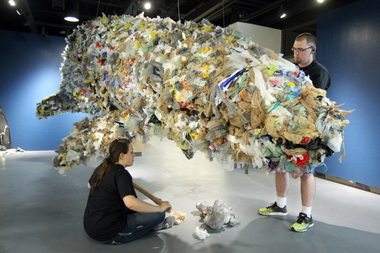
Whale sculpture made from recycled bags

Inspired by the stomach contents of a dead gray whale that washed up in Seattle a couple years ago, an art professor has created a baby whale from recycled plastic bags.

Art professor Marie Weichman told the Kitsap Sun (is.gd/a7rz9H) she got the idea for the exhibit after hearing about the debris found in the stomach a dead gray whale that washed ashore in Seattle in 2010.

That debris included sweatpants, a golf ball, surgical gloves, small towels, bits of plastic and more than 20 plastic bags, according to reports at the time.

The sculpture became a project for art, marine-science and design students. It goes on display Thursday in the college’s Art Building.

http://seattletimes.com/html/localnews/2019324170_recycledwhale03.html

Pennsylvania couple charged with trying to sell neighbor’s lost puppy on Craig’s list

A couple in Pennsylvania is facing criminal charges for selling their neighbor’s lost puppy on Craigslist instead of returning it, according to police.

Police in Leechburg, Pa., said two dogs, a Rottweiler and a golden retriever mix, wandered onto the property of Scott Duff, 41, and Roxanne Duff, 38, on September 3.

After discovering the animals, police say, Roxanne Duff left a phone message for police saying she was unsure what to do with them.

Leechburg Police Officer Christopher Laird returned Roxanne Duff’s message, recommending that she contact either an animal shelter or a local dog kennel, according to a police report. He told her he would contact her if they find dogs’ owner. During that call, Roxanne Duff allegedly told Laird that the Rottweiler puppy had run away since her initial report.

Later in the evening, Laird received a call from the dogs’ owner, Shawn Lerch, who said Duff had returned his golden retriever but not the Rottweiler. Lerch said he believed his dog was still in the area and suspected the Duffs were keeping him, despite what he had been told.

When Laird knocked on his neighbor’s door, Scott Duff answered and allegedly denied having the puppy. The next day, Lerch called police again, saying he believed the dog was still at the Duffs’ house, according to the report.

This time, police chief Michael Diebold went to the Duffs’ home, where he found the couple’s five-year-old son and his babysitter. According to the police report, the child said, “his mommy had given the dog to a woman from the Internet.”

Diebold contacted Scott Duff again and told him what his child had said. Duff told him he had no knowledge of this and said he only knew that the puppy had escaped from his yard. A short time later, Duff called police back and allegedly admitted that his wife had placed an ad and sold the dog on Craigslist for $50.

After police located the woman who bought the Rottweiler, who said she was unaware of the theft. Roxanne Duff went to Pittsburgh, where the woman lived, to retrieve the dog, and it was returned to Lerch.

Police charged the Duffs last week with not making a reasonable effort to return lost property, two counts of conspiracy and false reporting.

The couple is due in court for a preliminary hearing on October 31.

http://usnews.nbcnews.com/_news/2012/09/21/13991541-pennsylvania-couple-charged-with-selling-neighbors-dog-on-craigslist

Scientists discover gene that controls striping pattern on cats

Scientists say they’ve found the gene that sets the common tabby pattern – stripes or blotches.

It’s one of several genes that collaborate to create the distinctive design of a cat’s coat, and it’s the first of the pattern genes to be identified.

Cats with narrow stripes, the so-called “mackerel” pattern, have a working copy of the gene. But if a mutation turns the gene off, the cat ends up with the blotchy “classic” pattern, researchers reported online last week in the journal Science.

It’s called “classic” because “cat lovers really like the blotched pattern,” said one of the authors, Greg Barsh. He works at both Stanford University and the HudsonAlpha Institute of Biotechnology in Huntsville, Ala.

The research team, which included scientists from the National Cancer Institute, examined DNA from wild cats in California to identify the gene.

They also found that a mutation in the same gene produces the blotches and stripes of the rare “king” cheetah, rather than the spots most cheetahs have.

Leslie Lyons, a cat geneticist who studies coat color traits at the University of California, Davis, but didn’t participate in the new work, agreed that the research has identified the tabby’s stripes-versus-blotches gene. She noted that mysteries remain, such as just what genetic machinery gives a tabby spots.

Giant hive with a half million killer bees discovered in Richardson, Texas

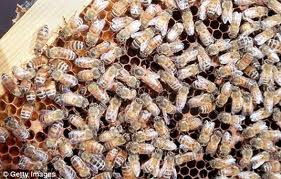
A Richardson Texas neighborhood was all a-buzz Friday morning, after workers discovered a huge four foot tall bee hive filled with killer bees.

“I can still get stung, hopefully not today,” says Kyle Lieb, Beekeeper with Little Giant Beekeepers.  He and his partner, Jefferson Souza, are suiting up for a dangerous job: removing the hive filled with killer bees.

“I’m stung 15-20 times per day,” says Souza.

Because they’re killer bees, they’ve made their last batch of honey. The hybrid bee is more likely to attack than your average honey bee.

“Unfortunately, we have to exterminate them, because no beekeeper will take it, because they’re aggressive.  We don’t want them to spread,” says Lieb.

Beekeepers say they believe the massive hive was filled with as many as 500,000 angry bees.

Neighbors say they believe the hive had to be removed in the interest of public safety. Residents along Clear Lake Circle worried that kids, who play at the end of the cul de sac, could get stung. The city wasn’t going to take that chance.

“If they do attack, they attack in large numbers, like hundreds or thousands.  It can be deadly,” says Lieb.

Workers believe these busy bees have been making the hive the past seven months. There may be as much as 30 pounds of honey inside, which cannot be harvested now that the hive has been sprayed with pesticide.

It took only a few hours to make sure all of the bees died. Workers then removed the hive, so another colony could not move into the vacant “house” in the neighborhood.

http://www.nbcdfw.com/news/local/Massive-Killer-Beehive-Removed-in-Richardson-170715986.html

Thanks to Mr. Cuomo for bringing this to the attention of the It’s Interesting community.

Seagull steals camera and captures sunset over San Francisco Bay


French tourist Nathalie Rollandin was filming the sunset from the beach when the bird snatched her GoPro video camera and flew out over the water.

Luckily for Ms Rollandin, the gull chose to land twenty seconds later on a walkway before dropping the camera. After a few pecks at it, the bird appears to lose interest in its plunder and flies off into the sunset.

After managing to track down her camera – intact and still recording outside a yacht club – Ms Rollardin posted the bird’s footage on YouTube, describing it as “a San Francisco sunset I will hardly forget”.

http://www.telegraph.co.uk/earth/wildlife/9550107/Seagull-steals-camera-and-captures-sunset-over-San-Francisco-Bay.html

Phallostethus cuulong – fish that has penis on its head discovered in Vietnam

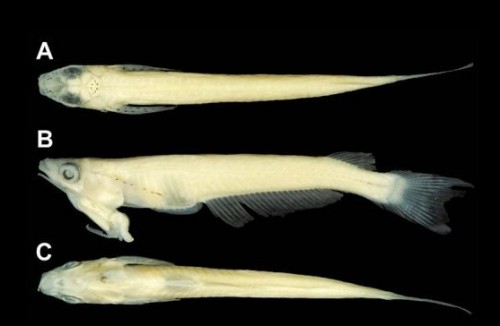
A new fish species belonging to the Phallostethidae family was recently discovered in Vietnam’s Mekong Delta.

Found in the waters of Southeast Asia, these fish are characterized as unusual due to their penises being positioned on their heads.

Phallostethus cuulong, as researchers call it, was reportedly long known about by the people residing in the Mekong Delta area, but the fish was just recently discovered by scientists.

“We have scientifically identified a new penis-head fish in Vietnam,” researcher Tran Dac Dinh from Can Tho University said.

http://www.weirdasianews.com/2012/09/15/researchers-discover-penishead-fish-vietnam/


Scottish wildcat soon to be extinct

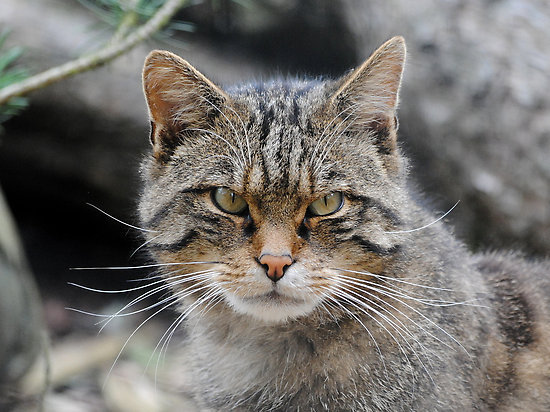
Scottish wildcats may be the next species to be wiped out from the earth, as conservationists say the numbers of pure-bred cats may have fallen to about 35 individuals.

According to the Daily Mail, a team from the Scottish Wildcat Association (SWA) reviewed 2,000 records of camera trap sightings, eyewitness reports and road kills.

The analysis suggested there could be just 35 wildcats – also known as the Highland Tiger.

Other research also estimated there could be less than 400 pure-bred cats.

A report funded by the Scottish Natural Heritage (SNH) estimated there were 150 breeding pairs left.

Disease and inter-breeding with domestic and feral cats are said to be among the main threats to pure-bred wildcats.


The SWA said licensed trapping of the mammals should be allowed so blood samples could be taken in an effort to better understand the state of the population. It has also suggested relocating pure wildcats to areas where there are fewer risks.

http://www.phenomenica.com/2012/09/scottish-wildcats-may-become-extinct-only-35-left.html

Traffic ticket paid with 137 origami pigs

A miffed motorist who received a $137 traffic ticket stuck it to the police when he paid the fine with 137 origami pigs made of  $1 bills in a couple of Dunkin’ Donuts boxes.

With a phone propped in his shirt pocket to record the transaction, a man that uses that moniker “Bacon Moose” on YouTube arrived to make a municipal court payment for a ticket that he thought was unfair. The video does not indicate the man’s name, the court jurisdiction or when the fine was paid.

“I got this ticket in a town where the cops (and absurd red light cameras) are pretty much a money trap and that’s it. I decided to pay in an appropriate manner — 137 origami pig $1 bills, put in a pair of dozen Dunkin’ Donuts boxes,” he wrote on YouTube.

In the video, which has now been viewed over 180,000 times on YouTube, “Bacon Moose” approaches the counter, where an office worker tries to accept the payment for the ticket, only to find that it presented in a very unique fashion. He refuses to accept it as “Bacon Moose” insists that its legal tender.

“I understand that, but the way that you have it folded, I’m not going to sit here and unfold all of that,” the employee says.

“Bacon Moose” continued to protest, insisting that his payment be accepted.

“How different is this then if I had crumpled bills in my pocket? I am offering you to pay in cash right now. I would have paid by card, but you offer a 5 percent fee for that,” he said.

The officer worker is baffled.

“Why would you do that? Times are tough. Why would you take the time to fold all of these up?” the employee asks.

Eventually, the clerk brings over a uniformed police officer to assess the situation. That officer quite politely asks “Bacon Moose” to step over to the counter and unfold the bills.

“Bacon Moose” finally agrees. Moments later in the clip, it suddenly dawns on that officer what he is looking at.

“Little piggies in a donut box! I got it, I got it!” he laughs.

Eventually while counting the bills, the officer worker begins to see the humor, particularly as “Bacon Moose” identifies one of the origami pigs as Admiral Ackbacon, the sole survivor of a great pig massacre of 2012.

“I will give you props,” the clerk says. “You have made me laugh for the day. I will give you mad props on you taking your time to do each and every one of these.”

“Bacon Moose” added a title to the clip noting that it took eight minutes to count the money, but it only took three minutes to unfold it.  He notes that he lost track after four hours of how long it took him to fold all the dollar bills.  He documented the process here.