Pea plant grows inside man’s lung

ccccc

Ron Sveden had been battling emphysema for months when his condition deteriorated.

He was steeling himself for a cancer diagnosis when X-rays revealed the growth in his lung.

Doctors believe that Mr Sveden ate the pea at some point, but it “went down the wrong way” and sprouted.

“One of the first meals I had in the hospital after the surgery had peas for the vegetable. I laughed to myself and ate them,” Mr Sveden told a local Boston TV reporter.

Mr Sveden said the plant was about half an inch (1.25cm) in size.

“Whether this would have gone full-term and I’d be working for the Jolly Green Giant, I don’t know. I think the thing that finally dawned on me is that it wasn’t the cancer,” Mr Sveden said.

http://www.bbc.co.uk/news/world-us-canada-10945050

Thousands Of Bees Attack Texas Couple, Kill Horses

bees-swarming-1

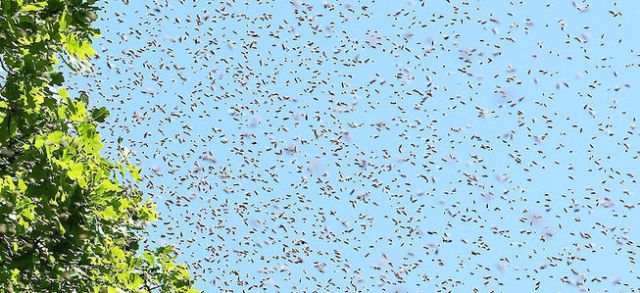
A swarm of about 30,000 bees attacked a North Texas couple as they exercised their miniature horses, stinging the animals so many times they died.

Kristen Beauregard, 44, was stung about 200 times, and her boyfriend about 50 times, the Fort Worth Star-Telegram reported Saturday ( ). http://bit.ly/12RiVMA

But the horses, Chip and Trump, were so covered in bees they shimmered. Neither could be saved.

“They were chasing us down, they were following us,” Beauregard said of the incident Wednesday evening. “We swept up piles and piles of them … it was like a bad movie.”

The bees are being tested to see whether they are Africanized or “killer” bees. It is unclear what prompted them to leave the hive.

Beauregard was exercising Trump, a Shetland pony, when he started to jump and kick, she said. That is when a cloud of bees started stinging them all over. Trying to escape, she jumped in the pool and the horse followed.

“It got all dark, like it was nighttime there were so many bees,” she told the newspaper. “We were trying stand up in the water but every time we stuck our heads out for air, they would cover us and start stinging us. We were trying to breathe and they were stinging us in the face and in the nose.”

She escaped to the house, and her boyfriend called 911. Bees chased her, crashing into the windows of the house. Trump ran through the yard, rubbing against bushes in an attempt to wipe off the bees.

Beauregard’s boyfriend called 911 and firefighters arrived with special gear and a foam substance used to clear the bees. They were able to drag the horses to a pasture where police and paramedics tried to treat them.

Chip, a 6-year-old show horse, died before a veterinarian arrived. Trump was sedated and taken to equine veterinarian Patricia Tersteeg’s clinic.

“He was so overwhelmed by bites that his body could not handle it,” Tersteeg said. “That’s way too much for any 250-pound mammal to survive.”

The bees also killed five hens, and stung the couple’s dog.

http://www.huffingtonpost.com/2013/07/27/bee-attack-texas_n_3663964.html

Divers nearly swallowed by humpback whales


Two ocean scuba divers have narrowly missed being swallowed whole by two humpback whales that shot up from the deep to chase fish right next to where the divers were floating.

Charter boat owner and captain Shawn Stambuck was filming the divers off the coast of California from his boat and posted video of the near miss online on July 20.
In the footage, a whale’s tail can be seen breaking the surface in the distance as seagulls swoop down from above. A shot below the surface shows the ocean under the divers teaming with a large school of small fish, which one website later identified as sardines.

Then, out of nowhere, the water around two divers begins bubbling and frothing as the fish swim up and break the surface en masse. Seconds later, two massive whales barrel up out of the water with their mouths gaping open to swallow the fish, just metres away from the divers.

One of the divers can be heard yelling out “holy s—” as he swims for the boat.

“You’re going to have to do more to clean that wet suit,” another person laughs off camera.

The divers were likely never going to end up food for the whales, as humpbacks feed predominately on krill and small fish and do not have a gullet large enough to fit a human.

http://news.ninemsn.com.au/world/2013/07/23/06/08/divers-nearly-swallowed-by-humpback-whales

Diamond Light Source particle accelerator enables discovery of CRF1 receptor structure that may help design new drugs for anxiety and depression

crf

Scientists have used one of the world’s most powerful X-ray machines to identify the molecule responsible for feelings of stress, anxiety and even depression.

The pituitary gland is known to the medical world as a key player in stress and anxiety, as it releases stress chemicals in the blood.

However, scientists have now discovered that the protein receptor CRF1 is responsible for releasing hormones which can cause anxiety and depression over extended periods of time. The protein receptor is found in the brain and controls our response to stress. When it detects stress molecules released by the hypothalamus, it releases these hormones.

The study, conducted by drug company Heptares Therapeutics, was published in the Nature journal on 17 July.

Researchers used a particle accelerator called the Diamond Light Source to understand the structure of CRF1. The X-ray machine’s powerful beams illuminated the protein’s structure, according to the Sunday Times, including a crevice that could become a new target for drug therapy.

The information gained from this study will be used to design small molecule drugs that fit into this new pocket to treat depression.

Speaking to the Sunday Times, Dr Fiona Marshall, Chief Scientific Officer at Heptares Therapeutics, said: “Now we know its shape, we can design a molecule that will lock into this crevice and block it so that CRF1 becomes inactive — ending the biochemical cascade that ends in stress.”

Writing on Diamond’s website, Dr. Andrew Dore, a senior scientist with Heptares added that the structure of the protein receptor “can be used as a template to solve closely related receptors that open up the potential for new drugs to treat a number of major diseases including Type 2 diabetes and osteoporosis”.

Thanks to Tracy Lindley for bringing this to the attention of the It’s Interesting community.

http://www.independent.co.uk/news/science/scientists-discover-the-molecule-responsible-for-causing-feelings-of-depression-8724471.html

Stinky corpse flower blooms in Washington D.C.

CORPSE-FLOWER23-

For weeks, gawkers lined up at the U.S. Botanic Garden, hoping to be among the lucky ones to catch the show when a giant-sized corpse flower bloomed for the first time in seven years.

Its legendary stench was part of the attraction. On Sunday afternoon, when the 8-foot-tall (2.4-metre) Titan Arum plant finally began opening its petals, a smell almost strong enough to stop traffic lured tourists inside from the sweltering National Mall.

Since it went on display July 11 as a 4-foot-tall sprig, the corpse flower has attracted over 120,000 visitors, about one-tenth of the garden’s annual number in less than two weeks.

It proved to be an unexpected hit during Washington’s summer tourist season. For about 48 hours, long lines of visitors tried to inch close enough to get a whiff of a terrible smell that in the natural world attracts carrion eaters like dung beetles and flies.

The Botanic Garden’s Laura Condeluci said most of the smell had abated by Tuesday, but the flower had attracted so much attention, it was continuing to draw throngs.

On social media, the flower – nicknamed Mortimer – chronicled its moments of glory and celebrity visitors on a Twitter feed at @DCTitanArum.

“As of this afternoon, both @DarrellIssa and @jaredpolis will have visited me,” Mortimer tweeted on Tuesday, referring to a California Republican and a Colorado Democrat in the House of Representatives. “I have brought bipartisanship to DC. Almost time to retire.”

Mortimer bloomed on Instagram, with #corpseflower a popular hashtag. There was live streaming video at http://www.usbg.gov/return-titan (“Due to high traffic, you may experience some difficulty with the web stream,” the Botanic Garden warned).

A time-lapse video of the blossom opening was here#at=15 .

Condeluci said the Titan Arum looks for pollinators in the evening, emitting heat and a smell of rotting flesh as the sun starts to fade. The smell, which dissipates in the daytime, generally lasts 24 to 48 hours.

“The heat helps generate the scent upward … (so) that something up to maybe a mile away will smell it and come running,” she said by telephone.

“For us, that’s fabulous, that people are excited about a plant,” she said. “We think it’s spectacular to look at, and a slightly terrible smell. Even if folks can’t smell it, it’s really dramatic.”

http://www.reuters.com/article/2013/07/23/us-usa-corpse-flower-idUSBRE96M11K20130723

North Pole now a lake

n pole

Instead of snow and ice whirling on the wind, a foot-deep aquamarine lake now sloshes around a webcam stationed at the North Pole. The meltwater lake started forming July 13, following two weeks of warm weather in the high Arctic. In early July, temperatures were 2 to 5 degrees Fahrenheit (1 to 3 degrees Celsius) higher than average over much of the Arctic Ocean, according to the National Snow & Ice Data Center.

Meltwater ponds sprout more easily on young, thin ice, which now accounts for more than half of the Arctic’s sea ice. The ponds link up across the smooth surface of the ice, creating a network that traps heat from the sun. Thick and wrinkly multi-year ice, which has survived more than one freeze-thaw season, is less likely sport a polka-dot network of ponds because of its rough, uneven surface.

July is the melting month in the Arctic, when sea ice shrinks fastest. An Arctic cyclone, which can rival a hurricane in strength, is forecast for this week, which will further fracture the ice and churn up warm ocean water, hastening the summer melt. The Arctic hit a record low summer ice melt last year on Sept. 16, 2012, the smallest recorded since satellites began tracking the Arctic ice in the 1970s.

http://www.livescience.com/38347-north-pole-ice-melt-lake.html

Formic acid in flying ants is making seagulls intoxicated

secpic_seagull1_b123370404311

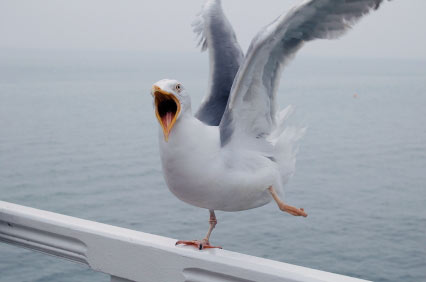
Seagulls in southwest England are getting intoxicated from consuming flying ants, brazenly stealing food out of residents’ hands, flying directly into buildings and failing to get out of the way of cars. Apparently, the birds are becoming inebriated from the formic acid in the ants’ bodies, which lowers their inhibitions and disrupts their coordination, similar to the effect of alcohol.

Hot weather has helped spawn large populations of ants, upon which the seagulls feed. “That isn’t so good for the birds – it leaves them a bit drunk,” Rebecca Nesbit, and entomologist with the Society of Biology, said.

Formic acid is likely the reason for a strange bird behavior known as ‘anting,’ in which the birds thrash around, covering themselves in ants. The formic acid may help the birds repel parasites.

http://www.livescience.com/38336-seagulls-drunk-on-ants.html

China’s white dolphins on verge of extinction due to Hong Kong construction

Chinese-White-Dolphin

China’s unique white dolphins — famous for the actual pink hue of their skin — face going from endangered to extinct — with conservationists doubtful they can be saved.

“We’ve seen alarming decline in the last decade — 158 dolphins in 2003, just 61 dolphins in 2012,” says Samuel Hung, Chairman of the Hong Kong Dolphin Conservation Society.

“We are at a critical juncture on whether we can help the dolphins,” adds Hung. “I have no idea whether they will keep going down and down — but what I do know is we need to work urgently to come up with solutions to clean up the dolphin’s habitat.”

Land reclamation for massive engineering projects, resulting water pollution and boat strikes have exacted a heavy toll on the white dolphin population, which is mainly found in the waters of Hong Kong’s Pearl River Delta in southern China.

In 2016, the first automobiles are expected to roll across the 42-kilometer Hong Kong-Zhuhai-Macau bridge, respectively connecting the Asian financial hub with the Chinese mainland’s “special economic zone” and the world’s gambling capital. Now under construction, the world’s longest cross-sea bridge and tunnel link will go “right through the heart of the dolphin population,” says Hung. “There will be lots of piling activities to construct the bridge.”

By 2023, Hong Kong aims to complete a third runway for Chep Lap Kok international airport, already one of the world’s busiest. In the absence of soil on which to build, 650 hectares of land — an area more than 5,000 Olympic-sized swimming pools — will be reclaimed from the sea. The area is also prime habitat for the Chinese white dolphin.

The Hong Kong government has also proposed four additional land reclamation projects in dolphin-populated areas that aim to increase the amount of land on which to build in order to bring down the high cost of housing, adds Hung.

Yet, despite Hong Kong’s plans for numerous engineering projects that will impact the white dolphins’ habitats, the founder of the 10-year old Hong Kong Dolphin Conservation Society says he “actually applauds” the government’s conservation efforts.

“I don’t doubt their desire to conserve,” explains Hung, who adds that the Hong Kong government has provided more than $1 million Hong Kong dollars (US$125,000) each year for environmental research funds, set up a marine protection park for the white dolphins and helped monitor dolphin population numbers.

“But it’s the other bureaus who want to push economic projects” including Hong Kong’s Airport Authority and the Civil Engineering and Development Department, says Hung.

“The economic departments are more influential so our voice for conservation work is drowned out by the voice for construction.”

http://edition.cnn.com/2013/07/19/world/china-hong-kong-white-dolphin-extinction/?hpt=hp_c2

New research on adult neurogenesis shows that about 1,400 new brain cells are born every day, and about 80% of human brain cells in the dentate gyrus of the hippocampus undergo renewal in adulthood

ooold-neurons

bomb

by Leonie Welberg

The question of whether adult neurogenesis occurs in the human hippocampus has been a hotly debated topic in neuroscience. In a study published in Cell, Frisén and colleagues now settle the debate by providing evidence that around 1,400 dentate gyrus cells are born in the human brain every day.

The authors made use of a birth-dating method that is based on the principle that 14C in the atmosphere is taken up by plants and — because humans eat plants and animals that eat plants — eventually also by humans. As 14C is incorporated into DNA during cell division, the 14C content of a cell is thought to reflect 14C levels in the atmosphere at the time of the birth of the cell. Importantly, atomic bomb testing in the 1950s and 1960s resulted in a spike in atmospheric 14C levels, and levels declined after 1963; this means that the level of 14C in cellular DNA can be used as a relatively precise marker of a cell’s birth date.

The authors applied the 14C birth-dating method to whole hippocampi dissected from post-mortem brains donated by individuals who were born in different years in the twentieth century. They separated neurons from non-neuronal hippocampal cells, purified the neuronal DNA and determined 14C levels. Neuronal 14C levels did not match atmospheric 14C levels in the individual’s birth year but were either higher (for people born before 1950) or lower (for people born after 1963), suggesting that at least some of the hippocampal cells were born after the year in which an individual was born.

Computer modelling of the data revealed that the best-fit model was one in which 35% of hippocampal cells showed such turnover, whereas the majority did not (that is, they were born during development). Assuming that, in humans, adult neurogenesis would take place in the dentate gyrus rather than in other hippocampal areas (as it does in rodents), and as the dentate gyrus contains about 44% of all hippocampal neurons, this model suggests that about 80% of human dentate gyrus cells undergo renewal in adulthood. This is in striking contrast to the scenario in mice, in which only ~10% of adult dentate gyrus neurons undergo renewal. The study further showed that there is very little decline in the level of hippocampal neurogenesis with ageing in humans, which is again in contrast to rodents.

It is now well established that adult-born neurons have a functional role in the mouse and rat dentate gyrus and olfactory bulb. A previous study using the same neuronal birth-dating method established that no adult neurogenesis takes place in the olfactory bulb and cortex in humans, but the new study has elegantly shown that the situation is different in the dentate gyrus. Whether the adult-born neurons have functional implications in humans remains a topic for future investigation.

http://www.nature.com/nrn/journal/v14/n8/full/nrn3548.html?WT.ec_id=NRN-201308

Thanks to Kebmodee for bringing this to the attention of the It’s Interesting community.

Brazilian man killed in his bed by falling cow

fALLING-COW-KILLS-MAN-facebook

The one-tonne cow was grazing on a hill behind the small house, in the town of Caratinga, when it stepped onto the asbestos roof, which collapsed under its weight.

Joao Maria de Souza, 45, was lying in bed when the animal fell on him.

He was taken to hospital and died the day after, reportedly of internal bleeding.

Mr Souza was conscious and appeared to be in a good condition, but he had to wait too long to be seen by a doctor, relatives said.

Local media says this is the third such incident in the region in the past three years.

There were no casualties in the two previous incidents.

In the first occasion, there was no one inside the house when the cow fell through the roof.

In the second incident, a baby and a small child were sleeping next to the spot where the animal fell, in what was described at time as a miraculous escape.

Caratinga is in a hilly area of Minas Gerais, a Brazilian state traditionally known as a cattle raising and dairy producing region.

http://www.bbc.co.uk/news/world-latin-america-23303998