Dried Meat ‘Resurrects’ Lost Species of Beaked Whale

sn-whales

A gift of dried whale meat—and some clever genetic sleuthing across almost 16,000 kilometers of equatorial waters—has helped scientists identify a long-forgotten animal as a new species of beaked whale. The “resurrection” raises new questions about beaked whales, the most elusive and mysterious of cetaceans.

“Literally nothing is known about most species of beaked whales; they are probably the least known family of large mammals,” says Robin Baird, a cetacean biologist at Cascadia Research Collective in Olympia. “So it’s exciting to have this study.”

The species, Mesoplodon hotaula, is a dark blue, Volkswagen-van-sized cetacean with the prominent snout that gives beaked whales their common name. It first came to scientists’ attention in 1963 when a single adult female stranded on the coast of Sri Lanka in the Indian Ocean. The director of the National Museums of Ceylon, P. E. P. Deraniyagala, decided that it was different from the other Mesoplodon species known at that time, and assigned it the name hotaula, meaning “pointed beak” in the local Sinhala language. But only 2 years later, M. hotaula was eliminated as a species when other researchers decided that it was identical to M. ginkgodens (another beaked whale which scientists know only from stranded carcasses and have never seen alive in the sea).

Forty years later, locals on an atoll in the Gilbert Islands, part of the Republic of Kiribati in the west Pacific, gave a visiting marine biologist dried strips of whale meat left over from a recent festival. The sample was turned over to cetacean geneticists at the University of Auckland in New Zealand who had assembled a database of the DNA of all known beaked whales. “It was a surprise, because the genetic sequences from the meat didn’t match any of the known species,” says Scott Baker, a cetacean geneticist now at Oregon State University’s Marine Mammal Institute in Newport, and one of the authors of the study. “We thought we had a new species.”

Then, in 2005, other co-authors collected some whale bone and teeth on Palmyra Atoll, which lies southeast of the Hawaiian Islands and 2600 kilometers northeast of the Gilbert Islands. The genetic sequences extracted from these specimens matched those of the dried meat. “We knew then we were on to something,” Baker says. Finally, in 2009, the body of a beaked whale was found in the Seychelles, in the western part of the Indian Ocean; its DNA also matched that of the dried meat sample, even though this whale lived tens of thousands of kilometers away from the Gilbert Islands.

That was the clue the researchers needed. “We immediately wondered, ‘Could it be Deraniyagala’s beaked whale?’ ” Baker says. It was. The team recently reported its resurrection of the forgotten M. hotaula in Marine Mammal Science. Counting M. hotaula, there are now 15 known species in this genus, making it by far the most species-rich genus of cetaceans.

Overall, the saga of M. hotaula shows “that there are probably even more species of beaked whales that we don’t know about,” says Phil Clapham, a marine mammalogist at the National Marine Mammal Laboratory in Seattle, Washington. “We don’t see them because they’re very deep-diving and live far from land.” They also live in a poorly surveyed part of the ocean, Baker says, where very few people dwell on remote atolls.

Intriguingly, it is the islanders who seem to know the most about M. hotaula and some other beaked whales. The Gilbert Islands residents who provided the original gift of dried meat reported that it came from one of seven whales they had driven onto the beach and killed. “That was something we didn’t know: that these beaked whales live in groups,” Baker says. “We thought they were solitary” because of the single, stranded individuals that are occasionally found. The scientists also believe that males of M. hotaula fight each other, because this behavior is known in other species of beaked whales, and because the teeth of two adult male specimens were broken. “Other than that, and knowing that Deraniyagala was right, M. hotaula is still pretty mysterious,” says Baker, who hopes to launch an expedition to learn more about them.

http://news.sciencemag.org/biology/2014/02/dried-meat-resurrects-lost-species-whale

Thanks to Dr. Rajadhyaksha for bringing this to the attention of the It’s Interesting community.

Stephen Hawking: ‘There are no black holes’

Stephen Hawking's black hole theory
Notion of an ‘event horizon’, from which nothing can escape, is incompatible with quantum theory, physicist claims.

by Zeeya Merali

Most physicists foolhardy enough to write a paper claiming that “there are no black holes” — at least not in the sense we usually imagine — would probably be dismissed as cranks. But when the call to redefine these cosmic crunchers comes from Stephen Hawking, it’s worth taking notice. In a paper posted online, the physicist, based at the University of Cambridge, UK, and one of the creators of modern black-hole theory, does away with the notion of an event horizon, the invisible boundary thought to shroud every black hole, beyond which nothing, not even light, can escape.

In its stead, Hawking’s radical proposal is a much more benign “apparent horizon”, which only temporarily holds matter and energy prisoner before eventually releasing them, albeit in a more garbled form.

“There is no escape from a black hole in classical theory,” Hawking told Nature. Quantum theory, however, “enables energy and information to escape from a black hole”. A full explanation of the process, the physicist admits, would require a theory that successfully merges gravity with the other fundamental forces of nature. But that is a goal that has eluded physicists for nearly a century. “The correct treatment,” Hawking says, “remains a mystery.”

Hawking posted his paper on the arXiv preprint server on 22 January1. He titled it, whimsically, ‘Information preservation and weather forecasting for black holes’, and it has yet to pass peer review. The paper was based on a talk he gave via Skype at a meeting at the Kavli Institute for Theoretical Physics in Santa Barbara, California, in August 2013.

Hawking’s new work is an attempt to solve what is known as the black-hole firewall paradox, which has been vexing physicists for almost two years, after it was discovered by theoretical physicist Joseph Polchinski of the Kavli Institute and his colleagues.

In a thought experiment, the researchers asked what would happen to an astronaut unlucky enough to fall into a black hole. Event horizons are mathematically simple consequences of Einstein’s general theory of relativity that were first pointed out by the German astronomer Karl Schwarzschild in a letter he wrote to Einstein in late 1915, less than a month after the publication of the theory. In that picture, physicists had long assumed, the astronaut would happily pass through the event horizon, unaware of his or her impending doom, before gradually being pulled inwards — stretched out along the way, like spaghetti — and eventually crushed at the ‘singularity’, the black hole’s hypothetical infinitely dense core.

But on analysing the situation in detail, Polchinski’s team came to the startling realization that the laws of quantum mechanics, which govern particles on small scales, change the situation completely. Quantum theory, they said, dictates that the event horizon must actually be transformed into a highly energetic region, or ‘firewall’, that would burn the astronaut to a crisp.

This was alarming because, although the firewall obeyed quantum rules, it flouted Einstein’s general theory of relativity. According to that theory, someone in free fall should perceive the laws of physics as being identical everywhere in the Universe — whether they are falling into a black hole or floating in empty intergalactic space. As far as Einstein is concerned, the event horizon should be an unremarkable place.

Now Hawking proposes a third, tantalizingly simple, option. Quantum mechanics and general relativity remain intact, but black holes simply do not have an event horizon to catch fire. The key to his claim is that quantum effects around the black hole cause space-time to fluctuate too wildly for a sharp boundary surface to exist.

In place of the event horizon, Hawking invokes an “apparent horizon”, a surface along which light rays attempting to rush away from the black hole’s core will be suspended. In general relativity, for an unchanging black hole, these two horizons are identical, because light trying to escape from inside a black hole can reach only as far as the event horizon and will be held there, as though stuck on a treadmill. However, the two horizons can, in principle, be distinguished. If more matter gets swallowed by the black hole, its event horizon will swell and grow larger than the apparent horizon.

Conversely, in the 1970s, Hawking also showed that black holes can slowly shrink, spewing out ‘Hawking radiation’. In that case, the event horizon would, in theory, become smaller than the apparent horizon. Hawking’s new suggestion is that the apparent horizon is the real boundary. “The absence of event horizons means that there are no black holes — in the sense of regimes from which light can’t escape to infinity,” Hawking writes.

“The picture Hawking gives sounds reasonable,” says Don Page, a physicist and expert on black holes at the University of Alberta in Edmonton, Canada, who collaborated with Hawking in the 1970s. “You could say that it is radical to propose there’s no event horizon. But these are highly quantum conditions, and there’s ambiguity about what space-time even is, let alone whether there is a definite region that can be marked as an event horizon.”

Although Page accepts Hawking’s proposal that a black hole could exist without an event horizon, he questions whether that alone is enough to get past the firewall paradox. The presence of even an ephemeral apparent horizon, he cautions, could well cause the same problems as does an event horizon.

Unlike the event horizon, the apparent horizon can eventually dissolve. Page notes that Hawking is opening the door to a scenario so extreme “that anything in principle can get out of a black hole”. Although Hawking does not specify in his paper exactly how an apparent horizon would disappear, Page speculates that when it has shrunk to a certain size, at which the effects of both quantum mechanics and gravity combine, it is plausible that it could vanish. At that point, whatever was once trapped within the black hole would be released (although not in good shape).

If Hawking is correct, there could even be no singularity at the core of the black hole. Instead, matter would be only temporarily held behind the apparent horizon, which would gradually move inward owing to the pull of the black hole, but would never quite crunch down to the centre. Information about this matter would not destroyed, but would be highly scrambled so that, as it is released through Hawking radiation, it would be in a vastly different form, making it almost impossible to work out what the swallowed objects once were.

“It would be worse than trying to reconstruct a book that you burned from its ashes,” says Page. In his paper, Hawking compares it to trying to forecast the weather ahead of time: in theory it is possible, but in practice it is too difficult to do with much accuracy.

Polchinski, however, is sceptical that black holes without an event horizon could exist in nature. The kind of violent fluctuations needed to erase it are too rare in the Universe, he says. “In Einstein’s gravity, the black-hole horizon is not so different from any other part of space,” says Polchinski. “We never see space-time fluctuate in our own neighbourhood: it is just too rare on large scales.”

Raphael Bousso, a theoretical physicist at the University of California, Berkeley, and a former student of Hawking’s, says that this latest contribution highlights how “abhorrent” physicists find the potential existence of firewalls. However, he is also cautious about Hawking’s solution. “The idea that there are no points from which you cannot escape a black hole is in some ways an even more radical and problematic suggestion than the existence of firewalls,” he says. “But the fact that we’re still discussing such questions 40 years after Hawking’s first papers on black holes and information is testament to their enormous significance.”

http://www.nature.com/news/stephen-hawking-there-are-no-black-holes-1.14583?WT.mc-id=GPL_NatureNews

Video shows humpback whale almost capsizing kayaker in Norway

Incredible footage has emerged capturing the moment a humpback whale swam underneath a kayak and almost capsized the kayaker.
Berthold Hinrichs was kayaking in waters near Senja Island in northern Norway when he saw a pod of humpback whales breaching in the water nearby.

His camera shows as the whales swim closer and closer to his kayak. Finally a humpback whale surfaces right next to him.

“[It] did not capsize [the kayak] but me and my camera got wet,” Hinrichs told news.com.au. “Some minutes later it happened again and then I was on the back of the humpback,” he said.

The video shows the moment the whale swims beside him and then directly under his kayak, crashing into it and making Hinrichs’ kayak shake.

“I got a lot of water in my kayak which froze to ice, so I had to return to the harbour,” Hinrichs said.

According to Hinrichs, there were about 30 humpback whales and 50 orcas in Senja bay that day.

Hinrichs is an avid adventurer and nature enthusiast, whose Facebook page ( https://www.facebook.com/berthold.hinrichs#!/berthold.hinrichs ) contains magnificent photos and videos of many up-close encounters with sea creatures.

Humpbacks are a highly migratory species, found in oceans all around the world. There are estimated to be 6000-8000 humpback whales in the North Pacific and about 10,000 in the North Atlantic. Humpback whales are classified as endangered.

http://www.news.com.au/travel/world-travel/amazing-footage-shows-humpback-whale-almost-capsize-kayaker-in-norway/story-e6frfqbr-1226812210586

Rarely Seen Whale Courting Ritual Spotted Off SoCal Coast

whale+mating
A pair of gray whales is seen courting off the coast of Dana Point, Calif., on Sunday, Jan. 26, 2014, hundreds of miles north of their typical, protected breeding spots in the warm lagoons of Baja California

Not only are whales spyhopping more than usual off the SoCal coast this year, they’re putting on shows rarely seen in this part of the Pacific.

An amorous pair of gray whales was spotted rolling in the surf about 2 miles off the Dana Point coast Sunday — a ritual suggestive of courtship and possibly mating, and usually seen farther out in the ocean.

“It’s not often that we catch this behavior on film,” said Alisa Schulman-Janiger, director and coordinator for ACS/LA Gray Whale Census and Behavior Project.

Schulman-Janiger was hesitant to describe the behavior as mating since it wasn’t clear exactly what was happening underwater, but she said the whales rolling, breaching and touching certainly looks like courtship.

A camera on board Captain Dave’s Dolphin & Whale Watching Safari captured the moment, embedded below. Among the voyeurs witnessing the couple were a pod of curious bottlenose dolphins, kayakers and a stand-up paddle boarder.

“Apparently everyone was curious, especially the dolphin. We often see pacific white-sided dolphin interacting with these whales but to have bottlenose dolphin was extraordinary,” Captain Dave Anderson said.

Every year, gray whales migrate some 12,000 miles from their feeding grounds near Alaska and British Columbia to the warm, protected lagoons of Baja California — hundreds of miles south of Dana Point — to give birth and nurse their calves.

“We don’t know why these two whales chose to make a stop along the way,” Anderson said.

It’s also a mystery why this season has been particularly plentiful for whale watchers off the Southern California coast. Schulman-Janiger said gray whale sightings are the second-highest they’ve been in 31 years, and several factors could be contributing to the trend.

California’s extremely dry winter has made visibility along the coast consistently better, so watchers may be seeing more whales simply because conditions are clearer, Schulman-Janiger said.

“If you can see them, you can count them,” she said.
Another possibility lies in the whales’ arctic feeding grounds, which froze earlier than usual this year, forcing them to head south sooner than expected.

But that still doesn’t explain why so many whales are appearing to hug the shore, a route typically taken by young whales who aren’t in such a rush to get to the Baja lagoons and mate. Schulman-Janiger said scientists will need to see the whole picture of this year’s season before a conclusion can be reached.

So far, Captain Dave’s safaris have had 168 gray whale encounters this season, which runs from January to May. By comparison, the safaris recorded 78 sightings of gray whales last year, the group said.

About 50 miles north along the Palos Verdes Peninsula, where Schulman-Janiger’s whale census project is stationed, there have been about 738 gray whale sightings since Dec. 1, 2013. That’s up about 200 since last year and more than twice the average, according to data from the ACS/LA Gray Whale Census and Behavior Project, pictured above.

For those hoping to spot whales, the creatures will continue migrating south until about mid-February. At the end of April and beginning of May, mothers and their calves will start moving northward again.

To protect the still-vulnerable juveniles, these pairs tend to hug the shore so there’s a better chance of spotting them on their way back to arctic feeding grounds, Schulman-Janiger said.

Foot-Long, Sex-Crazed Snails That Pierce Tires and Devour Houses

hand
giant snail

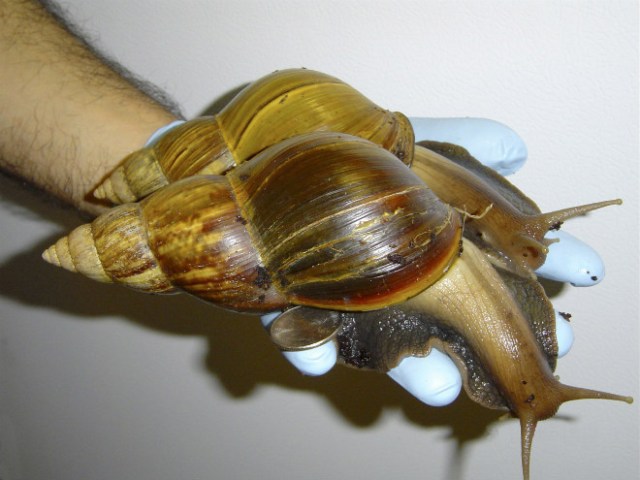
In the 1960s, a boy vacationing with his family in Hawaii pocketed a few giant African land snails (Lissachatina fulica), a mollusk that grows to a foot long and a full pound. Hawaii had been battling the pest, and so too would Florida, where the boy returned with his new friends. Once home, he quickly grew bored of the snails and handed them over to his grandmother, who set them free in her backyard.

What ensued was an invasion by rapidly reproducing critters that have over the last century spread out of their native East Africa into tropical climes all over the world, from Asia to South America, as stowaways on ships or as pets brought home by people with a thing for snails. In Florida, eradication took seven years. Other places, like Brazil, have not been so lucky in their efforts.

You see, the giant African land snail is a hermaphroditic love machine. “Snails have female bits and male bits,” explained biologist Robert Cowie of the University of Hawaii, “a single pore, through which if you’re acting as a male, a penis extrudes, or if you’re acting as a female, through which the other snail puts its penis in. And in some cases they can do it reciprocally.”

Thus the giant snail never meets another snail it can’t get busy with. Once fertilized, the snail will bury several hundred eggs a few inches below ground, and because of the incredible size of the species, the young will emerge far larger than native varieties, making them that much more resistant to predation.

Alas, four decades after evicting this enormous, fecund snail, Florida finds itself overrun once again. The creature was reintroduced here in 2011, and this time, according to Cowie, it may well be “bizarre, voodoo-like religious proceedings” to blame. The snail’s slime, he says, is coveted in certain South American rituals, and practitioners may have released the giant snails into their Miami-area backyards, hoping they’d breed freely.

The USDA and U.S. District Attorney’s Office are investigating this. It probably doesn’t help the ritualists’ case, though, that the year before the current outbreak, authorities questioned a Florida man said to have convinced his followers to drink the fluid from live giant African land snails, which he sliced open before squeezing the slime into their mouths. If you can believe it, the victims fell violently ill — ironic, what with this being a healing ritual.

Anyway, if it was indeed the practitioners who released the snails so they (the snails, not the practitioners) could multiply rapidly, it worked. Big time. Florida agriculture officials have collected 137,000 giant snails in just over two years. Compare that to the relatively few 17,000 collected in the first eradication in the 1960s, and you soon see the magnitude of this problem.

Today, Miami is simply overrun with the things. Not only do the giant snails chow on some 500 economically important plants in the area, they’re devouring houses. It seems they have a taste for stucco, which contains precious calcium. Without a ready supply of the stuff to fuel their amazing growth, they’ll simply turn on each other — at least in captivity.

A long time ago I had some African snails in the lab, in an aquarium-type tank,” said Cowie, “and apparently I wasn’t providing a sufficient source of calcium, and they would just eat each other’s shells. These snails produce big shells, they need a lot of calcium, and a lot of people these days when they keep snails they’ll put a bit of cattle bone in the terrarium for the snails to chew on, just to get the calcium.”

And because I know you were wondering: Yes, you can eat giant African land snails. But cook them well. I mean really well. Just boil them for a month. Grill them with napalm if you have it. Because like many snails and semi-slugs, this species carries the deadly rat lungworm.

As its name suggests, the parasite attacks rats, which pass the larvae in their feces. Snails that eat this waste are infected, as are folks who eat the snails. In humans, the larvae attack the brain, leading to meningitis and often a pretty horrible death. This has been documented as a particular problem in China, where people may not be cooking giant snails sufficiently.

But for all the folks who cook their giant snails properly, still others ingest them accidentally. All manner of critters could very easily end up in your Caesar salad, for instance, since cooks don’t always peel apart the lettuce before chopping it. “And it could just as well be a little baby African snail,” said Cowie. “OK, it’s a bit crunchy, but so is the lettuce a bit crunchy, and you’d never know. So that’s the way people generally get infected in places where they don’t habitually eat raw snails.”

With such health risks combined with the damage to agriculture and the snails just being a public menace — with shells so big and sharp that they can puncture tires that run them over, for instance — Florida is sinking millions of dollars into its eradication measures. The state has 50 full-time staffers assigned to the project, said Denise Feiber of the Florida Department of Agriculture and Consumer Services, which is leading the effort.

By deploying common over-the-counter snail poison and advertising a hotline residents can call to report sightings, authorities have so far been able to contain the critter to Miami. And no, pouring salt on them is in no way an acceptable option for homeowners. It’s a horrible death. Osmosis pulls the water out of the snail, killing it of dehydration. Just don’t do it. Ever.

But it’s possible, according to Cowie, that the giant snail could well spread to other Gulf states, though luckily they probably can’t tolerate the cooler weather in Georgia and other states farther north (contrary to popular belief, Hotlanta is not in fact always hot — most of the time it’s just Atlanta).

Cowie knows all too well the explosive population growth these things are capable of when left unchecked. In Hawaii, where he lives, the giant African land snail was introduced in the 1930s by Japanese immigrants who wanted to keep them as pets. They have since essentially assumed ecological control, tearing through agriculture and muscling out native species.

In 1950s Hawaii, “there were stories of on a rainy day, when the snails all came out and crawled all over the road,” Cowie said, “the cars would squish them and cars would end up skidding on the squished snail. Dead, crushed snail and slime, sort of all mish-mashed together by the cars. So that was when Hawaii got serious about trying to control them. And we’ve not been successful at controlling them.”

http://www.wired.com/wiredscience/2014/01/absurd-creature-of-the-week-foot-giant-african-land-snail/

Rare conjoined gray whale twins found in Mexico

whales 2

conjoined-whalex_75190_600x450

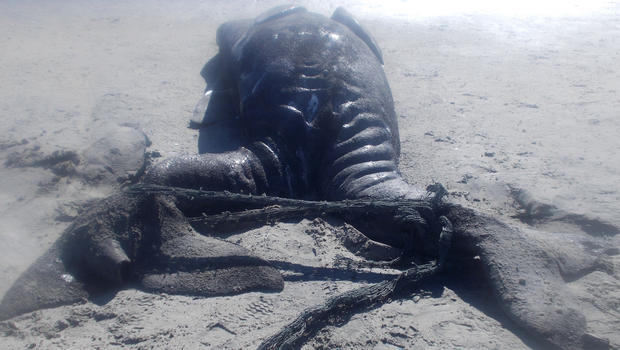
The Mexican government says fishermen found two rare conjoined gray whale calves that died shortly after being born.

Biologist Benito Bermudez says the whales were found alive in the Ojo de Liebre lagoon in the Baja California Peninsula but lived only a few hours.

Bermudez said Wednesday they were linked at the waist, with two full heads and tail fins.

Bermudez is a marine biologist with the National Natural Protected Areas Commission, or CONANP. He said scientists are collecting skin, muscle and baleen samples to study the creatures.

Every year more than 20,000 gray whales swim to Mexico from Alaska to mate and give birth.

http://www.cbsnews.com/news/rare-conjoined-gray-whale-twins-found-in-mexico/

Japanese turnip may stop the flu

Suguki-640x426

Scientists have discovered that bacteria found in a traditional Japanese pickle can prevent flu. Could this be the next superfood?

The research, which assesses the immune-boosting powers of Lactobacillus brevis from Suguki – a pickled turnip, popular in Japan – in mice that have been exposed to a flu virus, is published today (06 November) in the SfAM journal, Letters in Applied Microbiology.

Lead researcher, Ms Naoko Waki of KAGOME CO., LTD. in Japan said: “Our results show that when a particular strain of Lactobacillus brevis is eaten by mice, it has protective effects against influenza virus infection.”

Suguki enthusiasts have often cited its protective powers but it is not known yet whether the same effects will be seen in humans. Human clinical trials using a probiotic drink containing Lactobacillus brevis KB290 bacteria are underway and scientists are hopeful that, given a suitable quantity of bacteria, foods containing them may turn out to be the next superfood.

What it is about the bacteria that gives them this amazing property is not known, but it is remarkably tolerant to stomach juices, which are too acidic for many bacteria. This is largely due to a protective layer of sugars called exopolysaccharides.

“We know that exopolysaccharides have immune boosting effects in other similar bacteria, so we wonder if the exopolysaccharides of KB290 are responsible for the effects we see,” said Ms Waki. Further studies will be undertaken to investigate this.

The effect of the bacteria is to increase the production of immune system molecules in the body – IFN-α and flu-specific antibodies – and to enhance activity to eradicate virus infected cells. In this study these effects were sufficient to prevent infection by the H1N1 flu and the scientists think that there could also be protection against other viral infections, including the deadly H7N9 flu, which has recently emerged in China.

http://www.eurekalert.org/pub_releases/2013-11/w-jsp110413.php

More Than 300 Sharks In Australia Are Now On Twitter

sharks_custom-dc7b6fa386286385524b95e25225e6065aa192b7-s40-c85

By Alan Yu

Sharks in Western Australia are now tweeting out where they are.

Government researchers have tagged 338 sharks with acoustic transmitters that monitor where the animals are. When a tagged shark is about half a mile away from a beach, it triggers a computer alert, which tweets out a message on the Surf Life Saving Western Australia Twitter feed. The tweet notes the shark’s size, breed and approximate location.

Since 2011, Australia has had more fatal shark attacks than any other country; there have been six over the past two years — the most recent in November.

The tagging system alerts beachgoers far quicker than traditional warnings, says Chris Peck, operations manager of Surf Life Saving Western Australia. “Now it’s instant information,” he tells Sky News, “and really people don’t have an excuse to say we’re not getting the information. It’s about whether you are searching for it and finding it.”

The tags will also be monitored by scientists studying the sharks. Researchers have tagged great whites, whaler sharks and tiger sharks.

“This kind of innovative thinking is exactly what we need more of when it comes to finding solutions to human-wildlife conflict,” says Alison Kock, research manager of the Shark Spotters program in South Africa. Kock tells NPR that the project is a good idea — but that people should know that not all sharks are tagged.

Her program does the same work, but humans do the spotting and tweeting.

Kock and Kim Holland, a marine biologist who leads shark research at the University of Hawaii, agree that the tweets won’t be enough to protect swimmers.

“It can, in fact, provide a false sense of security — that is, if there is no tweet, then there is no danger — and that simply is not a reasonable interpretation,” Holland says, pointing out that the reverse is also true. “Just because there’s a shark nearby doesn’t mean to say that there’s any danger. In Hawaii, tiger sharks are all around our coastlines all the time, and yet we have very, very few attacks.”

In Western Australia, the local government recently proposed a plan to bait and kill sharks that swim near beaches.

Holland says most shark biologists would agree that’s not a good plan, partly because of what researchers have learned using acoustic transmitters. Scientists tracking white sharks, for example, found that the species can travel great distances, going from Western Australia to South Africa in some cases.

“Because we know that they are so mobile, we’re not sure that killing any of them will have any effect on safety,” Holland says, pointing out that great white sharks don’t set up shop along the same coastlines for long. He says the number of these sharks is on the rise — but there aren’t that many to begin with.

“The other side of the coin is that it’s a horrible thing to see when people get killed, so there’s often public outcry for government agencies to do something.”

http://www.npr.org/blogs/alltechconsidered/2013/12/31/258670211/more-than-300-sharks-in-australia-are-now-on-twitter?ft=1&f=1001

When Whale Watching Turns Deadly

sn-whalecollisions

Humpback whales are facing new dangers in Hawaiian waters, where more than 10,000 of the cetaceans congregate from December to April to calve and breed. That’s the conclusion of an analysis of historical records of ship strikes on humpback whales (Megaptera novaeangliae) in the seas around the Hawaiian Islands between 1975 and 2011. In that 36-year period, 68 such strikes were reported, including the one that injured the humpback calf in the photo above. The scientists have not yet been able to quantify the number of whales lethally wounded or killed outright by such hits. Because more than 63% of the collisions involved calves and subadults, the scientists conclude that these younger animals are particularly susceptible to being struck, most likely because they spend more time at the surface to breathe than do adults. Worryingly, the number of strikes has steadily increased over the years, the team reports in the Journal of Cetacean Research and Management—and not because there are more whales. Instead, the increase is apparently due to tourism. The majority of vessels that have collided with whales in Hawaii are small- to medium-sized boats, less than 21.2 meters in length, the scientists say, which happens to be the size of commercial whale-watching vessels. Federal regulations require these boats to remain at least 100 yards distance from the humpbacks. They may be keeping their distance while observing the whales, but not when under way: The majority of collisions occurred when the vessels were travelling at 10 to 19 knots, the team reports—apparently, too fast to avoid colliding with the very animals the skippers and tourists have come out to watch.

http://news.sciencemag.org/plants-animals/2013/12/scienceshot-when-whale-watching-turns-deadly

‘No More Woof’ claims to translate dog thoughts into English language

Just because you can pre-order something doesn’t mean it’ll be awesome when it’s finally ready. The folks behind the No More Woof dog translator seem to be looking to tamper everyone’s expectations as such, with phrases like “to be completely honest, the first version will be quite rudimentary” and “the more money we raise, the better the chances of creating something truly amazing!”

The No More Woof Indiegogo campaign is looking to raise $10,000; at the time of this writing, the project’s at just over $7,000 with almost two months left to go, so it looks like this is happening.

The technology itself involves a dog-worn headset that senses EEG activity in the dog’s brain, runs the data through a tiny computer, and renders the thought out as words through a speaker. We’re talking simple stuff here like “I’m hungry, I’m tired, I want to go out, SQUIRREL!”

From the looks of it, it’s probably not too much more advanced than what you’re able to glean from your dog already – the dog barks at the door when he wants to go out, barks at his bowl when he wants food, and goes to sleep when he’s tired.

You’ll need to pony up at least $65 to get the lowest-level hardware – “one sensor equipped NMW able to distinguish 2-3 thought patterns, most likely Tiredness, Hunger and Curiosity,” according to the Indiegogo listing. Pay more and you can get versions with better and better features. Fork over a cool $5,000 and you can get the first No More Woof to ship.

Read more: BEHOLD THE FUTURE: Dog Translator Available for Pre-order | TIME.com http://techland.time.com/2013/12/19/behold-the-future-dog-translator-available-for-pre-order/#ixzz2pGGJwmc6