Mayan apocalypse: panic spreads as December 21 nears

CUBA-MAYAN_CEREMON_2421941b

Cubans participate in a Mayan ritual at Bacuranao beach in eastern Havana.

Fears that the end of the world is nigh have spread across the world with only days until the end of the Mayan calendar, with doomsday-mongers predicting a cataclysmic end to the history of Earth.

Ahead of December 21, which marks the conclusion of the 5,125-year “Long Count” Mayan calendar, panic buying of candles and essentials has been reported in China and Russia, along with an explosion in sales of survival shelters in America. In France believers were preparing to converge on a mountain where they believe aliens will rescue them.

The precise manner of Armageddon remains vague, ranging from a catastrophic celestial collision between Earth and the mythical planet Nibiru, also known as Planet X, a disastrous crash with a comet, or the annihilation of civilisation by a giant solar storm.

In America Ron Hubbard, a manufacturer of hi-tech underground survival shelters, has seen his business explode.

“We’ve gone from one a month to one a day,” he said. “I don’t have an opinion on the Mayan calendar but, when astrophysicists come to me, buy my shelters and tell me to be prepared for solar flares, radiation, EMPs (electromagnetic pulses) … I’m going underground on the 19th and coming out on the 23rd. It’s just in case anybody’s right.”

In the French Pyrenees the mayor of Bugarach, population 179, has attempted to prevent pandemonium by banning UFO watchers and light aircraft from the flat topped mount Pic de Bugarach.

According to New Age lore it as an “alien garage” where extraterrestrials are waiting to abandon Earth, taking a lucky few humans with them.

Russia saw people in Omutninsk, in Kirov region, rushing to buy kerosene and supplies after a newspaper article, supposedly written by a Tibetan monk, confirmed the end of the world.

The city of Novokuznetsk faced a run on salt. In Barnaul, close to the Altai Mountains, panic-buyers snapped up all the torches and Thermos flasks.

Dmitry Medvedev, the Russian prime minister, even addressed the situation.

“I don’t believe in the end of the world,” before adding somewhat disconcertingly: “At least, not this year.”

In China, which has no history of preoccupation with the end of the world, a wave of paranoia about the apocalypse can be traced to the 2009 Hollywood blockbuster “2012”.

The film, starring John Cusack, was a smash hit in China, as viewers were seduced by a plot that saw the Chinese military building arks to save humanity.

Some in China are taking the prospect of Armageddon seriously with panic buying of candles reported in Sichuan province.

The source of the panic was traced to a post on Sina Weibo, China’s version of Twitter, predicting that there will be three days of darkness when the apocalypse arrives.

One grocery store owner said: “At first, we had no idea why. But then we heard someone muttering about the continuous darkness.”

Shanghai police said scam artists had been convincing pensioners to hand over savings in a last act of charity.

Meanwhile in Mexico, where the ancient Mayan civilisation flourished, the end time has been seen as an opportunity. The country has organised hundreds of Maya-themed events, and tourism is expected to have doubled this year.

Nasa has been aggressively seeking to dispel doomsday fears. It says there is no evidence Nibiru exists, and rumours it could be hiding behind the sun are unfounded.

“It can’t hide behind the sun forever, and we would’ve seen it years ago,” a Nasa scientist said.

The space agency also rejected apocalyptic theories about unusual alignments of the planets, or that the Earth’s magnetic poles could suddenly “flip.”

Conspiracy theorists contend that the space agency is involved in an elaborate cover up to prevent panic.

But David Morrison, an astronomer at Nasa, said: “At least once a week I get a message from a young person, as young as 11, who says they are ill and/or contemplating suicide because of the coming doomsday. I think it’s evil for people to propagate rumours on the internet to frighten children.”

Mayans themselves reject any notion that the world will end. Pedro Celestino Yac Noj, a Mayan sage, burned seeds and fruits to mark the end of the old calender at a ceremony in Cuba. He said: “The 21st is for giving thanks and gratitude and the 22nd welcomes the new cycle, a new dawn.”

http://www.telegraph.co.uk/news/worldnews/northamerica/usa/9730618/Mayan-apocalypse-panic-spreads-as-December-21-nears.html

Water Ice and Possible Organic Materials Discovered at Mercury’s North Pole


It’s time to add Mercury to the list of worlds where you can go ice-skating. Confirming decades of suspicion, a NASA spacecraft has spotted vast deposits of water ice on the planet closest to the sun.

Temperatures on Mercury can reach 800 degrees Fahrenheit (427 degrees Celsius), but around the north pole, in areas permanently shielded from the sun’s heat, NASA’s Messenger spacecraft found a mix of frozen water and possible organic materials.

Evidence of big pockets of ice is visible from a latitude of 85 degrees north up to the pole, with smaller deposits scattered as far away as 65 degrees north.

The find is so enticing that NASA will direct Messenger’s observation toward that area in the coming months — when the angle of the sun allows — to get a better look, said Gregory Neumann, a Messenger instrument scientist at NASA’s Goddard Space Flight Center in Maryland. [Latest Mercury Photos from Messenger]

“There is an ongoing campaign, when the spacecraft permits, to look further northward,” said Neumann, the lead author of one of three Mercury studies published online in the Nov. 29 edition of the journal Science.

Researchers also believe the south pole has ice, but Messenger’s orbit has not allowed them to obtain extensive measurements of that region yet.

Messenger will spiral closer to the planet in 2014 and 2015 as it runs out of fuel and is perturbed by the sun’s and Mercury’s gravity. This will let researchers peer closer at the water ice as they figure out how much is there.

Speculation about water ice on Mercury dates back more than 20 years.

In 1991, Earth-bound astronomers fired radar signals to Mercury and received results showing there could be ice at both poles. This was reinforced by 1999 measurements using the more powerful Arecibo Observatory microwave beam in Puerto Rico. Radar pictures beamed back to New Mexico’s Very Large Array showed white areas that researchers suspected was water ice.

A closer view, however, required a spacecraft. Messenger settled into Mercury’s orbit in March 2011, after a few flybys.  Almost immediately, NASA used a laser altimeter to probe the poles. The laser is weak — about the strength of a flashlight — but just powerful enough to distinguish bright icy areas from the darker, surrounding Mercury regolith.

Neumann said the result was “curious”: There were few bright spots inside craters.

Team member John Cavanaugh was pretty sure of what they were finding, Neumann recalled. Cavanaugh had been a part of NASA’s Lunar Reconnaissance Orbiter team, and he had seen a similar strange pattern on Earth’s moon when LRO found ice at the lunar poles in 2009.

Flash heating on Mercury would mix nearly all of its ice with the surrounding regolith – as well as with possible organic material borne to the planet by comets and ice-rich asteroids.

“So what you’re seeing is the fact that water ice can’t survive indefinitely in these locations because the temperatures apparently spike up,” Neumann said.

The team expected to find water ice on Mercury. Indeed, Messenger already drew a link this year between permanently shadowed areas on the planet and the “radar bright” spots seen from Earth.

All researchers needed to do was point their instruments in the right spot, seek out bright areas and then measure the temperature and composition.

Messenger’s neutron spectrometer spotted hydrogen, which is a large component of water ice. But the temperature profile unexpectedly showed that dark, volatile materials – consistent with climes in which organics survive – are mixing in with the ice.

“This was very exciting. You are looking for bright stuff, and you see dark stuff – gee, it’s something new,” Neumann said.

Organic materials are life’s ingredients, though they do not necessarily lead to life itself. While some scientists think organics-bearing comets sparkedlife on Earth, the presence of organics is also suspected on airless, distant worlds such as Pluto. Scientists say comets carrying organic bits smashed into other planets frequently during the solar system’s history.

Researchers are now working to determine if they indeed saw organics on Mercury. So far, they suspect Mercury’s water ice is coated with a 4-inch (10 centimeters) blanket of “thermally insulating material,” according to Neumann’s paper.

It will take further study to figure out exactly what this material is, but Neumann said the early temperature curves could show organic materials such as amino acids.

http://www.livescience.com/25132-water-ice-mercury-messager-discovery.html

Ancient Microbial Life Found Thriving in Permanent Darkness 60 Feet Beneath Antarctica Ice


Ancient microbes have been discovered in bitter-cold brine beneath 60 feet of Antarctic ice, in permanent darkness and subzero temperatures of Antarctica’s Lake Vida, located in the northernmost of the McMurdo Dry Valleys of East Antarctica.

In the current issue of the Proceedings of the National Academy of Sciences, Nathaniel Ostrom, Michigan State University zoologist, has co-authored “Microbial Life at -13ºC in the Brine of an Ice-Sealed Antarctic Lake.” Ostrom was part of a team that discovered an ancient thriving colony, which is estimated to have been isolated for more than 2,800 years living in a brine of more than 20 percent salinity that has high concentrations of ammonia, nitrogen, sulfur and supersaturated nitrous oxide—the highest ever measured in a natural aquatic environment.”It’s an extreme environment – the thickest lake ice on the planet, and the coldest, most stable cryo-environment on Earth,” Ostrom said. “The discovery of this ecosystem gives us insight into other isolated, frozen environments on Earth, but it also gives us a potential model for life on other icy planets that harbor saline deposits and subsurface oceans, such as Jupiter’s moon Europa.”Members of the 2010 Lake Vida expedition team, Dr. Peter Doran (professor, University of Illinois, Chicago), Dr. Chris Fritsen (research professor, Desert Research Institute, Reno, Nev.) and Jay Kyne (an ice driller) use a sidewinder drill inside a secure, sterile tent on the lake’s surface to collect an ice core and brine existing in a voluminous network of channels 16 meters and more below the lake surface. 

On the Earth’s surface, water fuels life. Plants use photosynthesis to derive energy. In contrast, at thermal vents at the ocean bottom, out of reach of the sun’s rays, chemical energy released by hydrothermal processes supports life. Life in Lake Vida lacks sunlight and oxygen. Its high concentrations of hydrogen gas, nitrate, nitrite and nitrous oxide likely provide the chemical energy used to support this novel and isolated microbial ecosystem. The high concentrations of hydrogen and nitrous oxide gases are likely derived from chemical reactions with the surrounding iron-rich rocks.

Consequently, it is likely that the chemical reactions between the anoxic brine and rock provide a source of energy to fuel microbial metabolism. These processes provide new insights into how life may have developed on Earth and function on other planetary bodies, Ostrom said. The research team comprised scientists from the Desert Research Institute (Reno, Nev.), the University of Illinois-Chicago, NASA, the University of Colorado, the Jet Propulsion Laboratory, Montana State University, the University of Georgia, the University of Tasmania and Indiana University.

For more information: “Microbial life at −13 °C in the brine of an ice-sealed Antarctic lake,” by Alison E. Murray et al. PNAS, 2012. http://www.pnas.org/content/early/2012/11/21/1208607109.abstract Journal reference: Proceedings of the National Academy of Sciences.

http://www.dailygalaxy.com/my_weblog/2012/11/ancient-microbial-life-found-thriving-in-permanent-darkness-60-feet-beneath-antarctica-ice.html

Record High Ice-Thaw In Arctic and Greenland this year


The Northern Hemisphere’s largest expanses of ice have thawed faster and more extensively this year than scientists have previously recorded. And the summer isn’t over.

Studies suggest that more of the massive Greenland ice cap has melted than at any time since satellite monitoring began 33 years ago, while the Arctic sea’s ice is shrinking to its smallest size in modern times.

“This year’s melting season is a Goliath,” said geophysicist Marco Tedesco, director of the Cryospheric Processes Laboratory at City University of New York. “The ice is being lost at a very strong pace.”

Scientists monitor the annual thaw closely because changes in the ice of the far North can raise sea levels and affect weather throughout the hemisphere by altering wind currents, heat distribution and precipitation.

Shrinkage of the Arctic sea ice since 2006, for instance, helped lead to seasons of severe snow across Europe, China and North America, researchers at Columbia University, the Georgia Institute of Technology and the Chinese Academy of Sciences reported earlier this year.

As the seasonal ice abates more each year, new polar shipping lanes also open up, as do opportunities for mineral exploration. By some estimates, as much as 25% of the world’s oil and natural-gas reserves are under the Arctic seafloor. Russia, Denmark, Norway and Canada are vying to control these assets.

The giant ice cap at the top of the world partly melts every summer and refreezes every winter. In recent years, the thaw has become progressively more extensive, NASA and European satellite observations suggest. At the same, the refreeze has been smaller—adding up to long-term shrinkage in the ice cover.

This year’s unusual summer thaw was spurred partly by natural variations in weather, but also reflected rising levels of heat-trapping carbon dioxide and methane in the air, amplified by carbon soot from widespread wildfires and the burning of fuels, said scientists at Stanford University and the National Snow and Ice Data Center.

Carried north across the Arctic by winds, soot not only darkens snow and ice, making it absorb more heat from sunlight, but also interferes with the formation of clouds that might otherwise providing cooling shade.

“They all cause enhanced warming in the Arctic,” said Stanford University atmospheric scientist Mark Jacobson, who advocates for renewable energy. “Soot can double the warming.”

In many ways, the Arctic ice pack and Greenland ice cap are mirror opposites. The ice pack is a vast layer of frozen salt water, a few yards thick at most, floating atop an open sea, like ice cubes in a highball. Changes in the size of the Arctic ice can alter weather patterns globally, though the melting doesn’t raise sea levels since the ice displaces the same amount of ocean water when frozen as when liquid.

The Greenland ice sheet is a land-based formation of frozen fresh water up to two miles thick. The water runoff from Greenland ice dilutes the salinity of ocean water, changing its density and altering currents. The runoff that doesn’t refreeze adds to rising ocean levels.

Despite their differences, their fates are linked. “There is little doubt that in terms of warming, things are coming together in the Arctic,” said glaciologist Paul Mayewski, director of the Climate Change Institute at the University of Maine. “Without a doubt, warming in the Arctic is very, very strong,”

In fact, more melting occurred across the Greenland ice cap—the world’s second-largest ice sheet after Antarctica—in June and July than in any year since at least 1979, when satellite monitoring of the island’s ice began, Dr. Tedesco and his colleagues reported earlier this month. The Greenland thaw began in May, a month earlier than usual.

On average, about half of the surface of Greenland’s ice sheet naturally melts during the summer, and then mostly refreezes with the approach of winter. This year, nearly the entire ice cover, from its thin, low-lying coastal edges to its two-mile-thick center, experienced some melting at its surface, according to measurements from three independent satellites analyzed by NASA and university scientists.

“This summer, we have seen melting at the very highest elevations of the Greenland ice sheet, which we have not seen before in the satellite record,” said climatologist Thomas Mote of the University of Georgia, who studies snow cover. Researchers expect much of it to refreeze.

By Wednesday, the Arctic sea ice had shrunk to 1.54 million square miles, about 70,000 square miles smaller than the previous modern low set in September 2007, according to the satellite readings compiled by NASA and the National Snow and Ice Data Center in Boulder, Colo. By that measure, the six lowest Arctic sea ice levels on record all occurred in the past six years.

Even when the Arctic ice refreezes, the new ice is often thinner, making it more vulnerable to storms and seasonal temperature variations, said climate scientist Julienne Stroeve at the Snow and Ice Data Center.

About a week remains in the melt season. Researchers won’t know the full extent of this year’s melting until the end of September.

http://online.wsj.com/article/SB10000872396390444772804577621470127844642.html?mod=googlenews_wsj#articleTabs%3Darticle

NASA scientist links recent extreme hot weather to climate change

What do the 2010 heat wave in Russia, last year’s Texas drought, and the 2003 heat wave in Europe have in common?

All are examples of extreme weather caused by climate change, according to a new study from NASA scientist James Hansen.

“This is not a climate model or a prediction but actual observations of weather events and temperatures that have happened,” he wrote in a Washington Post opinion piece meant to accompany the study.

“Our analysis shows that it is no longer enough to say that global warming will increase the likelihood of extreme weather and to repeat the caveat that no individual weather event can be directly linked to climate change. To the contrary, our analysis shows that, for the extreme hot weather of the recent past, there is virtually no explanation other than climate change.”

The study, which was published by the Proceedings of the National Academy of Sciences, looks at the past six decades of global temperatures and finds what Hansen described as a “stunning” rise in the frequency of extremely hot summers.

It compared what is happening now to what was happening between 1951-1980. In those years, extremely hot temperatures covered less than 0.2% of the planet. Now, those temperatures cover about 10% of the land area, the study said.

It dismissed the idea that specific weather patterns are by themselves sufficient to explain today’s extreme anomalies. Phenomena like La Nina have always been around, but large areas of extreme warming have only come about with climate change, the study said.

“The odds that natural variability created these extremes are minuscule, vanishingly small. To count on those odds would be like quitting your job and playing the lottery every morning to pay the bills,” wrote Hansen.

Hansen directs research at the NASA Goddard Institute for Space Studies in New York and is a longtime environmental activist.

http://www.cnn.com/2012/08/05/us/climate-change/index.html?hpt=hp_t2

NASA says that Enceladus, Saturn’s largest moon, is a good bet for alien life in our solar system


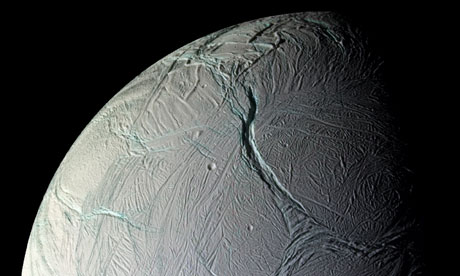
Enceladus is little bigger than a lump of rock and has appeared, until recently, as a mere pinprick of light in astronomers’ telescopes. Yet Saturn‘s tiny moon has suddenly become a major attraction for scientists. Many now believe it offers the best hope we have of discovering life on another world inside our solar system.

The idea that a moon a mere 310 miles in diameter, orbiting in deep, cold space,   1bn miles from the sun, could provide a home for alien lifeforms may seem extraordinary. Nevertheless, a growing number of researchers consider this is a real prospect and argue that Enceladus should be rated a top priority for future space missions.

This point is endorsed by astrobiologist Professor Charles Cockell of Edinburgh University. “If someone gave me several billion dollars to build whatever space probe I wanted, I would have no hesitation,” he says. “I would construct one that could fly to Saturn and collect samples from Enceladus. I would go there rather than Mars or the icy moons of Jupiter, such as Europa, despite encouraging signs that they could support life. Primitive, bacteria-like lifeforms may indeed exist on these worlds but they are probably buried deep below their surfaces and will be difficult to access. On Enceladus, if there are lifeforms, they will be easy to pick up. They will be pouring into space.”

The cause of this unexpected interest in Enceladus – first observed by William Herschel in 1789 and named after one of the children of the Earth goddess Gaia – stems from a discovery made by the robot spacecraft Cassini, which has been in orbit of Saturn for the past eight years. The $3bn probe has shown that the little moon not only has an atmosphere, but that geysers of water are erupting from its surface into space. Even more astonishing has been its most recent discovery, which has shown that these geysers contain complex organic compounds, including propane, ethane, and acetylene.

“It just about ticks every box you have when it comes to looking for life on another world,” says Nasa astrobiologist Chris McKay. “It has got liquid water, organic material and a source of heat. It is hard to think of anything more enticing short of receiving a radio signal from aliens on Enceladus telling us to come and get them.”

Cassini’s observations suggest Enceladus possesses a subterranean ocean that is kept liquid by the moon’s internal heat. “We are not sure where that energy is coming from,” McKay admits. “The source is producing around 16 gigawatts of power and looks very like the geothermal energy sources we have on Earth – like the deep vents we  see in our ocean beds and which bubble up hot gases.”

At the moon’s south pole, Enceladus’s underground ocean appears to rise close to the surface. At a few sites, cracks have developed and water is bubbling to the surface before being vented into space, along with complex organic chemicals that also appear to have built up in its sea.

Equally remarkable is the impact of this water on Saturn. The planet is famed for its complex system of rings, made of bands of small particles in orbit round the planet. There are seven main rings: A, B, C, D, E, F and G, and the giant E-ring is linked directly with Enceladus. The water the moon vents into space turns into ice crystals and these feed the planet’s E-ring. “If you turned off the geysers of Enceladus, the great E-ring of Saturn would disappear within a few years,” says McKay. “For a little moon, Enceladus has quite an impact.”

Yet the discovery of Enceladus’s strange geology was a fairly tentative affair, says Professor Michele Dougherty of Imperial College London. She was the principal investigator for Cassini’s magnetometer instrument. “Cassini had been in orbit round Saturn for more than six months when it passed relatively close to Enceladus. Our results indicated that Saturn’s magnetic field was being dragged round Enceladus in a way that suggested it had an atmosphere.”

So Dougherty and her colleagues asked the Cassini management to direct the probe to take a much closer look. This was agreed and in July 2005 Cassini moved in for a close-up study. “I didn’t sleep for two nights before that,” says Dougherty. “If Cassini found nothing we would have looked stupid and the management team might not have listened to us again.”

Her fears were groundless. Cassini swept over Enceladus at a height of 173km and showed that it did indeed possess an atmosphere, albeit a thin one consisting of water vapour, carbon dioxide, methane and nitrogen. “It was wonderful,” says Dougherty. “I just thought: wow!”

Subsequent sweeps over the moon then revealed those plumes of water. The only other body in the solar system, apart from Earth, possessing liquid water on its surface had  been revealed. Finally came the discovery of organics, and the little moon went from being merely an interesting world to one that was utterly fascinating.

“Those plumes do not represent a torrent,” cautions McKay. “This is not the Mississippi pouring into space. The output is roughly equivalent to that of the Old Faithful geyser in Yellowstone national park. On the other hand, it would be enough to create a river that you could kayak down.

“The fact that this water is being vented into space and is mixed with organic material is truly remarkable, however. It is an open invitation to go there. The place may as well have a big sign hanging over it saying: ‘Free sample: take one now’.”

Collecting that sample will not be easy, however. At a distance of 1bn miles, Saturn and its moons are a difficult target. Cassini took almost seven years to get there after its launch from Cape Canaveral in  1997.

“A mission to Enceladus would take a similar time,” says McKay. Once there, several years would be needed to make several sweeps over Enceladus to collect samples of water and organics. “Then we would need a further seven years to get those samples back to Earth.”

Such a mission would therefore involve almost 20 years of space flight – on top of the decade needed to plan it and to construct and launch the probe. “That’s 30 years in all, a large chunk of any scientist’s professional life,” says McKay.

McKay and a group of other Nasa scientists based at the Jet Propulsion Laboratory in Pasadena are undaunted, however. They are now finalising plans for an Enceladus Sample Return mission, which would involve putting a probe in orbit round Saturn. It would then use the gravity of the planet’s biggest moon, Titan, to make sweeps over Enceladus. Plume samples would then be stored in a canister that would eventually be fired back to Earth on a seven-year return journey.

Crucially, McKay and his colleagues believe such a mission could be carried out at a relatively modest cost – as part of Nasa’s Discovery programme, which funds low-budget missions to explore the solar system. Previous probes have included Lunar Prospector, which studied the moon’s geology; Stardust, which returned a sample of material scooped from a comet’s tail; and Mars Pathfinder, which deployed a tiny motorised robot vehicle on the Red Planet in 1997.

“The criteria for inclusion in the Discovery programme demand that any mission must cost less than $500m, though that does not include the price of launch,” says McKay. “We think we can adapt the technology that was developed on the Stardust mission to build an Enceladus Sample Return. If so, we can keep the cost below $500m. We are finalising plans and will announce our proposals in autumn.”

Such a mission is backed by Dougherty. “I think Enceladus is one of the best bets we now have for finding life on another world in our solar system. It is certainly worth visiting but it is not the only hope we have. The icy moons of Jupiter – such as Ganymede, Callisto and Europa – still look a very good prospect as well.”

And there is one problematic issue concerning Enceladus: time. “Conditions for life there are good at present but we do not know how long they have been in existence,” says McKay. “They might be recent or ancient. For life to have evolved, we need the latter to have been the case. At present, we have no idea about their duration, though geologists I have spoken to suggest that water and organics may have been there for a good while. The only way we will find out is to go there.”

The late entry of Enceladus in the race to find extraterrestrial life adds an intriguing new destination for astrobiologists in their hunt for aliens. Before its geysers were discovered, two main targets dominated their research: Mars and the icy moons of Jupiter. The former is the easiest to get to and has already received visits from dozens of probes. On 6 August, the $2.5bn robot rover Curiosity is set to land there and continue the hunt for life on the Red Planet. “For life to evolve you need liquid water, and although it is clear it once flowed on Mars, its continued existence there is debatable,” says Cockell. “By contrast, you can see water pouring off Enceladus along with those organics.”

Many scientists argue that water could exist deep below the Martian surface, supporting bacteria-like lifeforms. However, these reservoirs could be many metres, if not kilometres, below Mars’s surface and it could take decades to find them. Similarly, the oceans under the thick ice that covers Europa – and two other moons of Jupiter, Ganymede and Callisto – could also support life. But again, it will be extremely difficult for a robot probe to drill through the kilometres of ice that cover the oceans of these worlds.

Enceladus, by these standards, is an easy destination – but a distant one that will take a long time to reach. “No matter where we look, it appears it will take two or three decades to get answers to our questions about the existence of life on other worlds in the solar system,” says Cockell. “By that time, telescopes may have spotted signs of life on planets elsewhere in the galaxy. Our studies of extra-solar planets are getting more sophisticated, after all, and one day we may spot the presence of oxygen and water in our spectrographic studies of these distant worlds – an unambiguous indication that living entities exist there.

However, telescopic studies of extra-solar planets won’t reveal the nature of those lifeforms. Only by taking samples from planets in our solar system and returning them to laboratories on Earth, where we can study them, will we be able to reveal their exact nature and mode of replication – if they exist, of course. The little world of Enceladus could then have a lot to teach us.

http://www.guardian.co.uk/science/2012/jul/29/alien-life-enceladus-saturn-moon

Unmanned U.S. X-37B Space Plane Returns to Earth


Unmanned Air Force space plane lands after secret mission

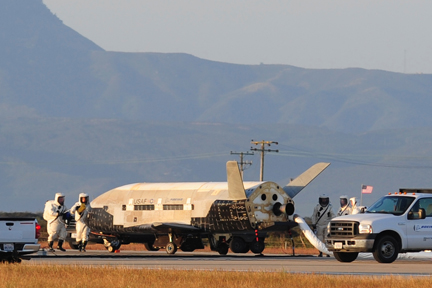
Wrapping up a classified 469-day mission, an unmanned Air Force space plane dropped out of orbit and returned to Earth on Saturday, executing an automated landing to close out the program’s second test flight.

An unmanned Air Force space plane dropped out of orbit and glided to a computer-controlled California landing early Saturday to close out a classified 469-day military mission.

The reusable Boeing-built X-37B Orbital Test Vehicle touched down on a runway at Vandenberg Air Force Base, Calif., at 5:48 a.m. PDT (GMT-7). The Air Force did not provide any advance warning of the re-entry and landing time and no technical details about the vehicle’s performance were released.

But in a statement, the Air Force said the autonomous landing by the nation’s “newest and most advanced re-entry spacecraft” was executed “safely and successfully.”

“With the retirement of the space shuttle fleet, the X-37B OTV program brings a singular capability to space technology development,” Air Force Lt. Col. Tom McIntyre, X-37B program manager, said in the statement. “The return capability allows the Air Force to test new technologies without the same risk commitment faced by other programs. We’re proud of the entire team’s successful efforts to bring this mission to an outstanding conclusion.”

The X-37B was launched atop a United Launch Alliance Atlas 5 rocket that took off March 5, 2011, from Florida’s Cape Canaveral Air Force Station. It was the second flight for the Air Force Orbital Test Vehicle program following a successful 224-day maiden voyage in 2010. The spacecraft used for that mission is expected to be relaunched in October.

As with the initial test flight, details about the program’s just-concluded second mission are classified.

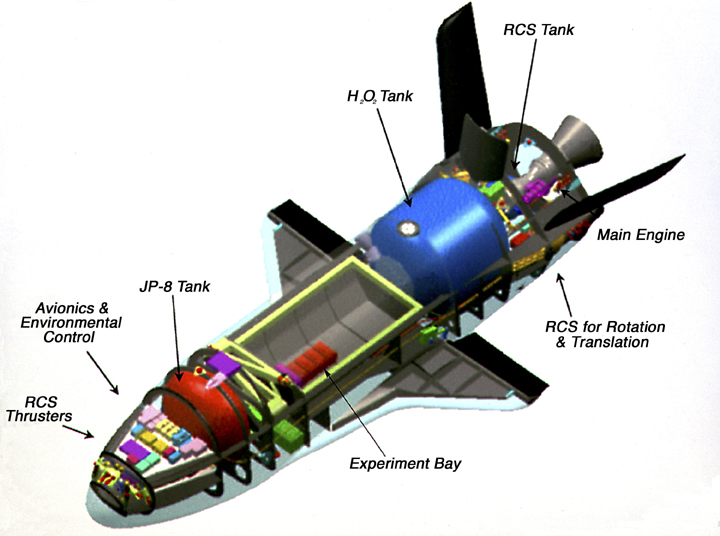
Built by Boeing’s Experimental Systems Group, the X-37B is equipped with twin tail fins, stubby wings and an advanced heat shield. It is about one quarter the size of NASA’s now-retired space shuttle, measuring 29 feet long. It has a wingspan of just 14 feet and weighs about 11,000 pounds when loaded with propellants.

“With OTV-1, we proved that unmanned space vehicles can be sent into orbit and safely recovered,” Paul Rusnock, Boeing vice president of Government Space Systems, said in a company statement. “With OTV-2, we tested the vehicle design even further by extending the…mission duration of the first vehicle and testing additional capabilities.

“We look forward to the second launch of OTV-1 later this year and the opportunity to demonstrate that the X-37B is an affordable space vehicle that can be repeatedly reused.”

The spacecraft was originally developed by Boeing for NASA and the Defense Advanced Research Projects Agency, or DARPA, but it eventually was turned over to the Orbital Test Vehicle program operated by the Rapid Capabilities Office of the Air Force.

The unmanned orbiter is based on the same lifting body design used for the space shuttle and flies a similar re-entry trajectory. But the X-37B features more lightweight composite materials, improved wing leading edge insulation and tougher heat-shield tiles that “are significantly more durable than the first generation tiles used by the space shuttle,” according to a Boeing Web site description. “All avionics on the X-37B are designed to automate all de-orbit and landing functions.”

The X-37B features a scaled-down 4-foot by 7-foot payload bay. But unlike NASA’s manned orbiter, which relied on fuel cells for electrical power, the Air Force space plane is equipped with a deployable solar array that permits it to remain in orbit for long-duration missions.

What else might have been carried aloft during the OTV program’s second mission is not known. The possibilities include reconnaissance cameras or other spy sensors; test gear to precisely measure the craft’s performance over the course of a long-duration mission; and space exposure experiments to help researchers learn more about the long-term effects of the space environment on sensitive materials or instruments.

http://news.cnet.com/8301-11386_3-57454645-76/unmanned-air-force-space-plane-lands-after-secret-mission/?google_editors_picks=true

Huge algal bloom discovered by NASA under melting arctic ice


Scientists in the Arctic have discovered the largest ever under-ice bloom of phytoplankton, likening the discovery to “finding the Amazon rainforest in the middle of the Mojave Desert.”

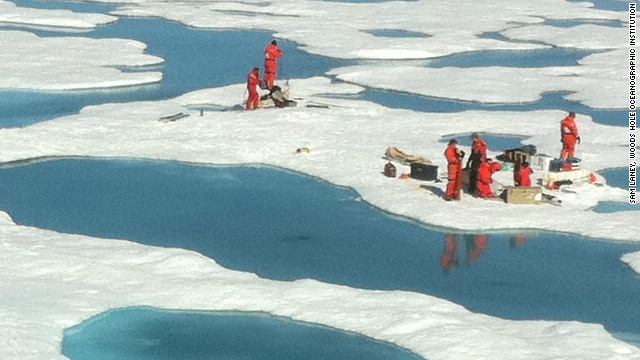
Researchers were amazed to discover a colossal 100 kilometer (62 miles) stretch of phytoplankton blooming under Arctic ice, north of Alaska, in July last year.

It had previously been assumed that sea ice blocked the sunlight necessary for the growth of marine plants. But four times more phytoplankton was found under the ice than in ice-free waters nearby.

Scientists now believe that pools of melting ice actually function like skylights and magnifying glasses, focusing sunlight into sea water, providing the perfect conditions for the intense phytoplankton bloom, which makes the water look like pea soup.

Undiscovered until the 1970s, the ocean’s phytoplankton is now understood to be responsible for about as much of the oxygen in our atmosphere as plants on land.

The ecological consequences of the polar bloom are not yet fully understood but given phytoplankton’s position at the base of the food chain, it is expected to have implications for ocean animals that feed in the area.

It was a serendipitous discovery for scientists who, as part of NASA’s ICESCAPE program, were studying the impact of climate change in the Chukchi sea, where melt season changes are pronounced.

Making their way through meter-thick ice aboard the U.S. Coast Guard’s largest icebreaker Healy in July last year, scientists observed surprising amounts of fluorescing chlorophyll, indicating the presence of photosynthesizing plant life.

Tide turns towards undersea energy

“If someone had asked me before the expedition whether we would see under-ice blooms, I would have told them it was impossible,” said ICESCAPE mission leader Kevin Arrigo of Stanford University, at a press conference announcing the publication of findings in “Science” this month. “This discovery was a complete surprise.”

Donald Perovich, a U.S. Army geophysicist who studied the ice’s optical properties, described the under-ice area as looking “like a photographic negative”.

“Beneath the bare-ice areas that reflect a lot of sunlight, it was dark. Under the melt ponds, it was very bright,” he said.

The melt pools were found to let in four times as much light as snow-covered ice. Protected from ultraviolet rays, phytoplankton grows twice as fast under-ice as in the open ocean.

Using an automated microscope system called an Imaging FlowCytobot, Woods Hole Oceanographic Institution biologist Sam Laney took millions of photographs of the phytoplankton organisms, some of which he also found in brine channels inside the ice.

Antarctic ice shelves ‘tearing apart’, says study

The type of phytoplankton found near coasts can bloom rapidly when there are changes to the amounts of light and nutrients available. Some blooms are toxic for humans and marine life.

If the Arctic sea ice continues to thin, blooms might become more widespread and appear earlier, which could pose problems for migrating birds and whales, said Arrigo.

“It could make it harder and harder for migratory species to time their life cycles to be in the Arctic when the bloom is at its peak,” he said. “If their food supply is coming earlier, they might be missing the boat.”

“At this point we don’t know whether these rich phytoplankton blooms have been happening in the Arctic for a long time, and we just haven’t observed them before,” he said.

http://www.cnn.com/2012/06/10/world/phytoplankton-mega-bloom-eco-solutions/index.html?hpt=hp_c1

Famously Reclusive Neil Armstrong Gives Exclusive Interview to Australian Accountant

It was one small interview for astronaut Neil Armstrong … and one giant scoop for an Australian accountant, of all people.

In the year’s most out-of-this-world get, the first man to step foot on the moon sat down with CPA (Certified Practicing Account) Australia’s Alex Malley to narrate his historic lunar landing in an extremely rare interview.

Armstrong was the commander of NASA’s three-man Apollo 11 mission that landed on the moon on July 20, 1969. Armstrong and fellow astronaut Buzz Aldrin spent about two hours on the surface before returning to the Eagle lunar module.

The 81-year old American is famously reluctant to discuss the moon landing and has granted very few interviews in the last 40 years — so why choose to open up to CPA Australia? Malley thinks he knows the answer.

“I knew something a lot of people didn’t know about Neil Armstrong — his dad was an auditor,” said Malley in the first of the four part interview with Armstrong posted on the CPA website.

In the 45-minute interview Commander Armstrong discussed his childhood in Ohio, walking on the moon, and what it’s like to sleep on a spaceship.

Armstrong also recounts the moment he got the call to ask him if his crew were ready to land on the moon.

“The bosses asked, ‘Do you think you and your guys are ready?” Armstrong recalled. “I said it’d be nice to have another month, but we’re in a race here and we had to take the opportunity when we had it. I had to say we are ready, we are ready to go.”

“I thought we had a 90% chance of getting back safely to Earth on that flight, but only a 50-50 chance of making a successful landing on the first attempt.”

Armstrong also details the crew’s harrowing 12-minute descent to the moon, when he realized that the Eagle lunar module’s auto-pilot was preparing to land the crew on the slope of a huge moon crater.

“The computer showed us where it intended to land, and it was a very bad location, on the side of a large crater about 100-150m in diameter with very steep slopes covered with very large boulders — not a good place to land at all,” he said.

Armstrong took over the craft manually and managed to land it like a helicopter in a smoother area to the west with just 20 seconds of fuel left. “Houston, Tranquility Base here. The Eagle has landed,” were Armstrong’s words to mission control on earth.

As for “That’s one small step for a man, one giant leap for mankind,” Armstrong says he didn’t think of those immortal words until after they’d landed safely.

The first few moments when Armstrong and Buzz Aldrin stepped out of the Eagle and onto the surface of the moon were tender, he remembers.

“We recognized that we wouldn’t have been there if it hadn’t been for our competitors in the Soviet Union — it was a competition that made both of our programs able to do what we achieved. We put medallions for our fallen colleagues on both sides, and that was a tender moment.”

Armstrong laughed off the conspiracy theorists who believe the 1969 moon landing was faked, telling CPA Australia’s Malley that “800,000 staff at NASA couldn’t possibly keep a secret.”

“People love conspiracy theories, but it was never a concern to me — because I know one day someone’s going to go fly back up there and pick up that camera I left,” he said.

As for the future direction of space travel, Armstrong worries about cuts to NASA’s budget, and says the space program remains an important source of motivation for young Americans.

NASA’s 2013 budget for the exploration of Mars was cut by 38%, and the budget for planetary exploration overall was reduced by $300 million — a major concern, according to Armstrong.

“NASA’s been one of the most successful public investments in motivating students to do well and achieve all they can achive, and it’s sad that we are turning the program in a direction where it will reduce the amount of motivation it provides to young people.”

http://www.cnn.com/2012/05/25/world/asia/neil-armstrong-rare-interview/index.html?iid=article_sidebar

The Viking Missions May Have Discovered Life on Mars in 1976

Since the Viking Mars probes traveled to the red planet back in 1976, NASA has sent several more probes, landers, and rovers to the Martian surface to study the planet’s geology and search for signs of microbial life. But the evidence for life may have been hidden in Viking’s data all along. A new analysis of the data collected by probes Viking 1 and Viking 2 suggest the missions found evidence of microbial life more than three decades ago.

The new analysis centres on one of the three experiments carried by the probe: the Labeled Release (LR) experiment. This instrument searched for signs of life by mixing samples of Martian soil with droplets of water containing nutrients and radioactive carbon. If the soil contained microbes, the reasoning went, they would metabolise these carbon atoms and nutrients and release either methane gas or radioactive carbon dioxide, either of which would tip off the probes that life existed in the soil.

That’s exactly what happened. But other experiments aboard Viking didn’t back up the LR, and NASA scientists had to dismiss the LR’s findings as anomalous.

But now an analysis by a University of Southern California neurobiologist (and former NASA space shuttle project director) and a mathematician from Italy’s University of Siena could reverse that thinking. They used a technique called cluster analysis, which clusters together similar-looking data sets, to see what would happen. They found the analysis created two clusters: one for the two active experiments on Viking and the other for five control experiments.

Further, when they compared Viking’s data to confirmed biological sources on Earth, like temperature readings from a lab rat, the analysis correctly clustered the biological readings with the active Viking experiment data, separate from the non-biological data in the control experiments. All that essentially means that the cluster analysis, when fed a good deal of data from both biological and non-biological sources, correctly separates the two types of data. And when it does so, it lumps the Viking data into the “biological” category.

That’s not concrete evidence for microbial life on Mars. It’s merely concrete evidence that there is a stark difference between Viking’s LR experiment data and the control experiment data. And it’s evidence that the Viking data tracks with biological rather than non-biological data. More study is necessary (isn’t it always?), but if the cluster analysis is to be believed then our first shot at detecting microbial life in the soils of Mars may have hit pay dirt – and we didn’t even realise it.

[NatGeo]

http://www.popsci.com.au/technology/space/the-viking-mars-missions-may-have-discovered-life-in-1976