Premature Baby in Argentina Found Alive in Morgue Refrigerator 10 Hours After Being Pronounced Dead


One-week-old Luz Milagros Veron is Argentina’s miracle baby. Pronounced dead after her premature birth, the baby withstood more than 10 hours in a morgue refrigerator before being found alive.

“Today is the eighth day of my daughter’s resurrection,” the girl’s father, Fabian Veron, told CNN Wednesday.

Doctors at the Perrando Hospital in northeast Argentina can’t explain it, and every, doctor, nurse and morgue worker who dealt with the baby has been suspended as an investigation gets underway, officials said.

Luz Milagros remains in stable condition but she’s in intensive care, a health official said.

Analia Boutet, the baby’s mother, had given birth four times previously, and had recently suffered a miscarriage. This baby was born on April 3, three months early, and had no vital signs, hospital director Dr. Jose Luis Meirino told CNN.

The gynecologist on hand didn’t find any signs of life, so he passed the baby to a neonatal doctor who also didn’t find vital signs, Meirino said.

The doctors observed the baby for a while, and only then, pronounced her dead.

The hospital followed protocol, Meirino said.

Two morgue workers then put her body inside a little wooden coffin and placed it in the freezer.

“Up to that point, there were still no vital signs,” the hospital director said.

That night, Boutet began insisting on seeing her dead daughter’s body, Veron said.

She wanted to take a picture with her cell phone of the baby just as she lay, as a memory, the husband said.

It took some cajoling, but finally, hospital officials allowed the couple to visit the baby in the hospital morgue around 10 p.m., Veron said. As many as 12 hours had passed since the baby had been declared dead.

“They put the coffin on top of a stretcher and we looked for a little crowbar to open it because it was nailed shut,” Veron told a local television station. “It was nailed shut. I put the crowbar in there and started prying. I took a breath and took the lid off.”

Boutet approached the baby’s body, touched her hand, and heard a cry, Veron told CNN.

She jumped back. “It’s my imagination, it’s my imagination,” she repeated.

But the baby was alive, and crying.

Veron’s brother-in-law rushed the baby back to the neonatal ward. He clutched her close to his chest for warmth. She felt like an ice-cold bottle against his body, the relative told Veron.

“I can’t explain what happened. Only that God has performed a miracle,” Veron said.

His daughter was given a fresh, if precarious chance, and along with it, a new name.

She was going to be named Lucia, but after finding her alive, her parents said she would be Luz Milagros — the Spanish words for light and miracles.

In the meantime, an investigation has been launched at the hospital.

“I don’t have an explanation for what happened, but if there is culpability we’ll see what we’ll do,” Rafael Sabatinelli, deputy secretary of health in the Chaco region, told CNN.

“The personnel who were involved have responsibilities, and therefore, will have to be held accountable for their actions,” he said in a statement.

Both Sabatinelli and Meirino said it was the first time they had witnessed an incident like this, but that a nearly identical thing happened in Israel in 2008.

In that case, a baby was found alive in a morgue refrigerator after having been declared dead.

Some doctors at the time said that it was possible that the low temperatures inside the refrigerator had slowed down the baby’s metabolism and helped her survive. However, that baby later died.

http://www.cnn.com/2012/04/11/world/americas/argentina-baby-survivor/index.html?hpt=hp_c2
 

Autism may be linked to obesity during pregnancy


Obesity during pregnancy may increase chances for having a child with autism, provocative new research suggests.

It’s among the first studies linking the two, and though it doesn’t prove obesity causes autism, the authors say their results raise public health concerns because of the high level of obesity in this country.

Study women who were obese during pregnancy were about 67 percent more likely than normal-weight women to have autistic children. They also faced double the risk of having children with other developmental delays.

On average, women face a 1 in 88 chance of having a child with autism; the results suggest that obesity during pregnancy would increase that to a 1 in 53 chance, the authors said.

The study was released online Monday in Pediatrics.

Since more than one-third of U.S. women of child-bearing age are obese, the results are potentially worrisome and add yet another incentive for maintaining a normal weight, said researcher Paula Krakowiak, a study co-author and scientist at the University of California, Davis.

Previous research has linked obesity during pregnancy with stillbirths, preterm births and some birth defects.

Dr. Daniel Coury, chief of developmental and behavioral pediatrics at Nationwide Children’s Hospital in Columbus, Ohio, said the results “raise quite a concern.”

He noted that U.S. autism rates have increased along with obesity rates and said the research suggests that may be more than a coincidence.

More research is needed to confirm the results. But if mothers’ obesity is truly related to autism, it would be only one of many contributing factors, said Coury, who was not involved in the study.

Genetics has been linked to autism, and scientists are examining whether mothers’ illnesses and use of certain medicines during pregnancy might also play a role.

The study involved about 1,000 California children, ages 2 to 5. Nearly 700 had autism or other developmental delays, and 315 did not have those problems.

Mothers were asked about their health. Medical records were available for more than half the women and confirmed their conditions. It’s not clear how mothers’ obesity might affect fetal development, but the authors offer some theories.

Obesity, generally about 35 pounds overweight, is linked with inflammation and sometimes elevated levels of blood sugar. Excess blood sugar and inflammation-related substances in a mother’s blood may reach the fetus and damage the developing brain, Krakowiak said.

The study lacks information on blood tests during pregnancy. There’s also no information on women’s diets and other habits during pregnancy that might have influenced fetal development.

There were no racial, ethnic, education or health insurance differences among mothers of autistic kids and those with unaffected children that might have influenced the results, the researchers said.

http://www.usatoday.com/news/health/story/2012-04-09/Autism-obesity-pregnancy/54126558/1

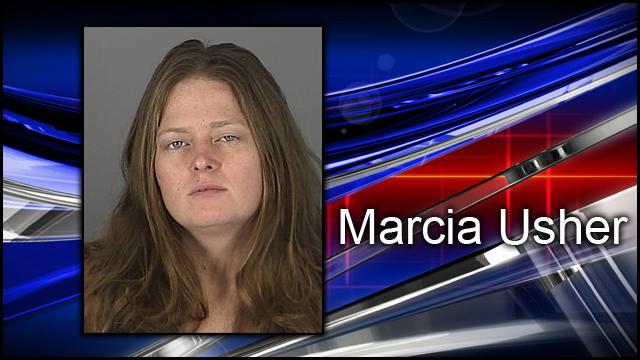
Marcia Usher: Drunk Florida Woman Facing Multiple Charges After She Called 911 for Help Finding a Place to Urinate

A woman needing help finding the bathroom is now facing numerous charges.

Her first mistake: calling 911 for her restroom emergency.

The Pasco Sheriff’s Office says 32-year-old Marcia Usher placed the 911 call Wednesday night, saying she was lost in the woods and didn’t know where she should urinate.

Responding deputies found Usher not in the woods, but instead in front of her home, reportedly intoxicated and drinking a beer.

A deputy noticed a nearby open beer cooler and asked Usher if he could check inside for any weapons or drugs. According to the arrest report, Usher complied and told the deputy there was beer and a knife inside.

Instead of a knife, the deputy immediately saw a loaded handgun on top of the beer.

The deputy tried putting Usher in handcuffs, and a brief struggle ensued.  She was reportedly tackled to the ground and taken into custody without further incident.

At the jail, a vial of meth residue was allegedly discovered on Usher during a strip search.

She now faces charges of carrying a concealed weapon without a permit, possession of methamphetamine, introduction/possession of contraband in a detention facility, and resisting arrest without violence.

http://www.wtsp.com/news/article/243316/8/Deputies-Drunk-woman-calls-911-to-say-she-was-lost-in-woods-did-not-know-where-to-urinate


‘Kony 2012’ Director Suffers Psychotic Break


The director of a wildly popular video about brutal African warlord Joseph Kony has been diagnosed with brief psychosis and is expected to stay in the hospital for weeks, his wife said Wednesday.

Jason Russell, 33, was hospitalized last week in San Diego after witnesses saw him pacing naked on a sidewalk, screaming incoherently and banging his fists on the pavement. He was in his underwear when police arrived.

His outburst came after the video’s sudden success on the Internet brought heightened scrutiny to Invisible Children, the group he co-founded in 2005 to fight African war atrocities.

Russell’s family said that the filmmaker’s behavior was not due to drugs or alcohol. He was given a preliminary diagnosis of brief reactive psychosis, in which a person displays sudden psychotic behavior.

“Doctors say this is a common experience given the great mental, emotional and physical shock his body has gone through in these last two weeks. Even for us, it’s hard to understand the sudden transition from relative anonymity to worldwide attention — both raves and ridicules, in a matter of days,” Danica Russell said in a statement.

Researchers don’t know how many people suffer from the condition, mainly because symptoms are fleeting, but those with personality disorders are at greater risk for having an episode. Brief reactive psychosis is triggered by trauma or major stress such as an accident or death of a loved one. Other stressors can include sleep deprivation or dehydration.

Symptoms include hallucinations, delusions and strange speech and behavior. People typically recover within a few weeks without medication. Others have to take antipsychotic drugs to alleviate symptoms or undergo talk therapy to cope.

The condition causes “temporary debilitation, but in general people have good recoveries,” said Dr. Stephen Marder, professor of psychiatry at the University of California, Los Angeles.

In some cases, doctors say brief reactive psychosis can signal the beginning of a more serious mental illness such as schizophrenia.

Danica Russell said it may be months before her husband returns to San Diego-based Invisible Children.

“Jason will get better. He has a long way to go, but we are confident that he will make a full recovery,” she said.

Russell narrates the 30-minute video “Kony 2012,” which has been viewed more than 84 million times on YouTube since it was released this month. In the video, Russell talks to his young son, Gavin, about Kony and the Lord’s Resistance Army.

The Invisible Children group has been criticized for not spending enough directly on the people it intends to help and for oversimplifying the 26-year-old conflict involving the LRA and its leader, Kony, a bush fighter wanted by the International Criminal Court for crimes against humanity.

Invisible Children has acknowledged the video overlooked many nuances but said it was a “first entry point” that puts the conflict “in an easily understandable format.” It said money that directly benefits the cause accounted for more than 80 percent of its spending from 2007 to 2011.

Read more: http://www.sfgate.com/cgi-bin/article.cgi?f=/n/a/2012/03/21/national/a083749D70.DTL#ixzz1prY2sYn4


Astronauts Suffer Brain and Eye Damage After One Month in Space

Astronauts who have spent more than a month in space have shown evidence of damage to their eyeballs and brain tissue.

MRI scans on 27 Nasa astronauts revealed a pattern of deformities in their eyeballs, optic nerves and pituitary glands, it was revealed in the journal Radiology.

Seven of the astronauts had a flattening of one or both of the eyeballs, causing them to become long-sighted. Four had swelling around the optic nerve and three had deformed pituitary glands.

The study was led by Larry Kramer at the University of Texas Health Science Centre in Houston, who says the findings could be explained by a build-up of cerebrospinal fluid in the brains of the astronauts, caused by exposure to the micro-gravity of space.

He added: “Microgravity-induced intracranial hypertension represents a hypothetical risk factor and a potential limitation to long-duration space travel.

“Consider the possible impact on proposed manned missions to Mars or even the concept of space tourism. Can risks be eventually mitigated? Can abnormalities detected be completely reversed?

“The next step is confirming the findings, defining causation and working towards a solution based on solid evidence.”

The findings have not rendered any astronauts ineligible for future space travel.

Shuttle missions typically last a couple of weeks, AFP reports, while International Space Station journeys can last more than six months.

A Mars mission could potentially last a year-and-a-half.

Last month Nasa published a feature about vision changes experienced by astronauts on board the ISS. It referenced research from the October 2011 issue of Ophthalmology and referred to tests on seven astronaut test subjects who all reported blurred vision.

Astronaut Bob Thirsk, who spent six months as a member of the Expedition 20 and 21 crews in 2007, told a post-flight survey: “After a few weeks aboard I noticed that my visual acuity had changed.

“My distant vision was not too bad, but I found that it was more difficult to read procedures. I also had trouble manually focusing cameras, so I would ask a crewmate to verify my focus setting on critical experiments.”

Nasa provides space anticipation glasses (spectacles with a stronger prescription) for crew members over the age of 40

Crews also have access to SuperFocus glasses – adjustable focus glasses eliminating the need for bi- and tri-focal lens associated with multiple vision adjustments. These specialised glasses are in addition to an astronaut’s regular prescription glasses.

http://www.huffingtonpost.co.uk/2012/03/13/astronauts-in-space-for-more-than-one-month-suffer-brain-and-eye-damage_n_1341190.html?1331642133&ncid=edlinkusaolp00000008

Free Pizza With a Vasectomy in Cape Cod


If you’re considering a vasectomy, and happen to like pizza and basketball, a Massachusetts urology clinic has an offer for you.

Urology Associates of Cape Cod says it’s offering a free pizza to vasectomy patients during March Madness. An administrator with the group says it’s a lighthearted way to raise awareness about the procedure and drum up business.

Evan Cohen of the clinic told the Cape Cod Times that getting a vasectomy during the NCAA basketball tournament is the perfect time because typically a day or two of recovery is needed following the operation, so it gives patients an excuse to lie on the couch and watch hoops.

A commercial promoting the deal asks the question, “Hey guys! Want to watch the college basketball tournament guilt-free? You know you’ve been thinking about a vasectomy, anyway. Now’s the time to get it done.”

http://www.cbsnews.com/8301-504763_162-57398849-10391704/mass-clinic-offers-free-pizza-for-vasectomy-during-march-madness/

Maryland Couple has 5,000 Cabbage Patch Dolls and has built a $200,000 amusement park for them

Kevin, a cheery, curled-top boy, extends an invitation to his friend by cell phone, “I’d love to have you come over and play.”

For most children that play date at Magic Crystal Valley in Maryland would be a dream come true: riding a miniature train, a motorized swing and even a hot-air balloon that sweeps them 30 feet in the air.

But Kevin, and his hundreds of friends from around the country, are Cabbage Patch Kids, and their “parents” are humans who are obsessed with the ugly, but cuddly dolls that hit the market by storm in 1983.

Pat and Joe Prosey own 5,000 and they consider them their own children, even though the 64-year-olds have a real-life grown daughter.

“They are kids. We don’t use the word D-O-L-L — they might hear,” said Joe, a former shipyard worker who built this special playground for other enthusiasts.

They are collectors, but say it really isn’t about the money, but an obsession with their “babies.”

The obsession all began with Pat Prosey, a former paint store technician, who had loved baby dolls as a girl. “Mother said one day I would probably collect some type of doll when I was older,” she said.

The soft dolls with the wrinkled faces were created by Xavier Roberts, a 21-year-old art student from Georgia, who adopted a German technique for sculpture with his mother’s quilting skills, according to his the Cabbage Patch Kids website.

His concept — adoptable “Little People” — was developed in 1976. Each doll was different and came with a double-barreled name and a birth certificate.

By the end of 1981, the Cabbage Patch doll had made the cover of Newsweek magazine, and he had sold nearly 3 million kids. By 1990, 65 million had been “adopted,” according to his web site.

Pat Prosey got her first Cabbage Patch Meg in 1985 for $50. “She was kind of cute and when I got her got her home, Joe thought I had lost my mind,” she said.

But soon, she found a boy, named Kevin, and today he is the spokesman for what has become their personal Cabbage Patch empire.

After Meg and Kevin, came the “preemies” and the ones with freckles. “They went from freckles to teeth to glasses and toothbrushes, and before you know it, our whole house in Baltimore was filled with Cabbage Patch Kids,” said Pat Prosey.

But when her father offered the couple a farm two hours south in Leonardstown, Md., they jumped at the chance to find room for their growing collection.

She said she thought, “Now, I could actually build a place for my kids,” and the amusement park was born.

As for Joe Prosey, he got hooked in the 1980s one day when he was at a waterskiing event and saw a miniature sample of a wet suit hanging on a shop wall. “I thought, that’ll fit a Cabbage Patch Kid.”

The following weekend, he dressed Kevin the wetsuit and took him waterskiing — even though has he got strange looks from others.

Soon, Joe Prosey was writing a column in a collectors’ newsletter using Kevin’s voice. “He was a real kid doing real stuff,” he said. “There was such response, a woman phoned us and asked, could I do it again?”

Then, as they met more Cabbage Patch parents, the Proseys sent gifts back and forth — eventually arranging play dates at their dream playground.

Now the couple displays and sells Cabbage Patch originals. Those from the 70s and 80s can sell for as much as $25,000 to $35,000 a piece.

“Xavier Robert told us, “If you want to prosper at this thing, you have to live the fantasy day in and day out,” said Joe Prosey. “The collectors will love you.”

Experts say there is a fine line between collecting and hoarding, which a serious psychological disorder.

“With hoarding, we look at three main behaviors: one, acquiring too many possessions; second, having great difficulty discarding something; and three difficulty organizing,” said Julie Pike, a clinical psychologist from the Anxiety Disorder Treatment Center in Durham, N.C. “But there is a lot of overlap.”

Pike has been featured on TLC’s reality show, “Hoarding: Buried Alive,” and spoke with ABCNews.com last year.

Collectors are usually well-organized and know exactly where each item is and what they have. They are also proud, not ashamed, of their possessions, she said.

“But if collectors get in a place where they are spending so much money that they can’t pay their mortgage, that’s a problem,” Pike said. “Or if they are spending so much time at it that they can’t go to their job or leave their house.”

Pat Prosey insists she loves her “fantasy world” and the couple has always had “a roof over our heads, food in our mouths and clothes on our back.”

“You can walk out of every day life and there is no harm done, no foul play and have a good time,” she said. “People pay $2 million for a painting — is that crazy? I love my Cabbage Patches like another person loves a Rembrandt or a shiny new car.”

http://abcnews.go.com/Health/crazy-obsession-couple-owns-5000-cabbage-patch-kids/story?id=15828541#.T1cbryM2GRC

Nomophobia


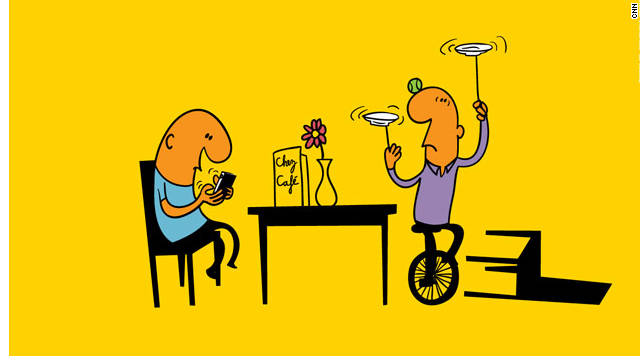
According to recent research sponsored by SecurEnvoy, an internet security firm, more people feel anxious and tense when they are out of reach of their phone — and the younger they are, the more likely the stress.

Known as “nomophobia,” or “no mobile-phone phobia,” a recent online survey of 1,000 people in the UK found that almost two thirds (66%) of respondents were afflicted, a rise of 11% when compared to a similar study four years ago.

“Some people get panic attacks when they are not with their phones,” said Michael Carr-Gregg, an adolescent psychologist working in Melbourne.

“Others become very anxious and make all endeavors to locate the mobile phone. I have clients who abstain from school or their part-time jobs to look for their phones when they cannot find them in the morning.”

CNN Photos: De-Vice: Our mobile addiction

According to the survey, the younger you are, the more prone you are to nomophobia. The youngest age group (18 -24) tops the nomophobic list at 77%, which is 11% more than that of the next group — those aged 25-34.

“This is the most tribal generation of young people,” said Carr-Gregg. “Adolescents want to be with their friends on a 24-hour basis.”

Women are also more likely to be unnerved by cell phone separation, with 70% of respondents reporting the malady compared to 61% of men. Andy Kemshall, the CTO and co founder of secure Envoy, believes that may be because men are more likely to have two phones and are less likely to misplace both — 47% of men carry two phones, compared to only 33% of women.

Major drivers of nomophobia include boredom, loneliness, and insecurity, said Carr-Gregg, while some young nomophobes cannot bear solitude. “Many of my clients go to bed with their mobile phones while sleeping just like how one will have the teddy bear in the old days,” he said.

“While teddy doesn’t communicate, the phone does,” said Carr-Gregg, adding insomnia to the list of potential problems.

“This reduced the amount of time to reflect,” he said. “Some kids cannot entertain themselves. The phone has become our digital security blanket.”

As smartphone penetration spreads across the globe, so does nomophobia. On a visit to Singapore in February this year, Carr-Gregg spoke to students from a peer support group at the United World College and identified similar problems.

“There is no doubt that nomophobia is international,” he said. “[But] without phones, there will not be nomophobia.”

Meanwhile, Indian researchers have also evaluated mobile phone dependence among students at M.G.M. Medical College and the associated hospital of central India. India, after China, is the second largest mobile phone market in the world. The Telecom Regulatory Authority of India (TRAI) reported that there were 884.37 million mobile connections in India as of November, while China had 963.68 million.

The cross-sectional study, published by the Indian Journal of Community Medicine three years ago, recruited 200 medical students and scholars. About one in five students were nomophobic, results showed. The study claimed that the mobile phone has become “a necessity because of the countless perks that a mobile phone provides like personal diary, email dispatcher, calculator, video game player, camera and music player.”

“There is an increase in the nomophobic population in India because the number of mobile phone users has increased,” said Dr. Sanjay Dixit, one the researchers and the head of the Indian Journal of Community Medicine. “We are currently doing another research on mobile phone dependency, it’s not published yet, but analysis shows that about 45% of the Indian population, not just medical students, is nomophobic.”

With the augmented ownership and usage of smartphones among adolescents, Dixit says the young population is more at risk, partly because they can access the Internet through phones more easily, increasing the time spent on phones.

“We found out that people who use mobile phones for more than three hours a day have a higher chance of getting nomophobia,” he said, warning this can pose potential dangers.

Accidents lurk while nomophobes fix their attention on phones. According to Dixit, up to 25% nomophobes reported accidents while messaging or talking on the phone, which includes minor road accidents, falling while going upstairs or downstairs and stumbling while walking. More than 20% also reported pain in the thumbs due to excessive texting.

“One could look at this as a form of addiction to the phone,” said Eric Yu Hai Chen, a psychiatrist and professor at The University of Hong Kong. “The fear is part of the addiction. The use of hand phone has some features that predispose this activity to addiction, similar to video games, naming, easy access.”

To tackle anxiety and accidents induced by phones, Dixit suggests switching off the phone, especially while driving. “People can also carry a charger all the time,” he said. “Our study shows that the no-battery-situation upsets nomophobes the most.

“People can also prepay phone cards for emergency calls and credit balance in phones to ensure a constant and functioning network,” he said. Other solutions include supplying friends with an alternate contact number and storing important phone numbers somewhere else as backups.

“Enforcing a period when handset is turned off can help loosen its hold over everyday life,” said Dixit. Sometimes, the problem can even be the cure.

“One of my clients actually makes use mobile phone apps to deal with anxiety,” said Carr-Gregg. “It’s called iCounselor Anxiety.”

The launch of the app presents users with a scale to rate their anxiety levels from 1 to 10, where 10 is “panicked.” After choosing the level, ten recommendations of calming activities will be suggested, followed by instructions to change the user’s thoughts, so to change subsequent feelings.

“It is almost like having a psychologist in your phone,” said Carr-Gregg.

Prevalent it may be, nomophobia, however, is not yet a qualified phobia.

“Nomophobia is not included in the DSM [Diagnostic and Statistical Manual of Mental Disorders] yet,” said Dixit. “But it is an up coming problem. For the first time on this continent [India], we are trying to make it more scientific,” he added, referring to his undergoing research on nomophobic India.

http://www.cnn.com/2012/03/06/tech/mobile/nomophobia-mobile-addiction/index.html?hpt=hp_c4

PICA: Woman Eats 4,000 Sponges


A DENTAL nurse told yesterday how she has EATEN 4,000 washing-up sponges due to a rare disorder.

Kerry Trebilcock, 21, has also munched more than 100 bars of SOAP.

She suffers from pica, which causes victims to crave objects that are not food.

Kerry, of Mylor, Cornwall, said: “One day I will beat this and be able to have a shower or do the washing-up without feeling hungry.”

Sponge eater Kerry said she likes to spice up her bizarre snacks with hot sauce or mustard.

Sometimes, she dips them in tea or hot chocolate like biscuits.

She also chomps on chunks of soap — but only organic fruit-flavoured varieties, with lemon and lime her favourite.

Kerry said: “I have been very particular about the type of sponges and soaps I’d eat and how I’d prepare them.

“If I went out for the day I’d carry a small plastic bag of cut-up pieces of sponge with some tomato and BBQ sauce in Tupperware. I was never without a ‘snack’.”

Other pica sufferers eat metal, coal, sand, chalk — or even lightbulbs and furniture.

Petite Kerry, who weighs just 8st, has endured shocking stomach cramps, constipation and diarrhoea.

And although she has cut down on her sponge munching, she has been unable to totally shake the condition.

At one point Kerry was eating five a day topped with hot relish, BBQ sauce, ketchup, mustard, jam or honey.

She said: “The sauces and dipping the sponges in drinks softened them — and I’d chew them until the flavour was gone. Then I would swallow the sponge.”

Sponges are commonly made from cellulose wood fibres or foamed plastic polymers.

Organic soap contains olive or palm oil, glycerin and plant scents, plus oatmeal to lift off dead skin.

Kerry’s eating habits changed after a holiday to Morocco in 2008, during which she picked up an infection of hookworm, a parasite that lives in the small intestine.

At first, she began craving junk food. But then something strange happened.

She said: “After one dinner where I ate a double helping of lasagne and a tub of ice cream, I still felt hungry.

“To distract myself, I decided to wash the dishes. I took out a new sponge from a packet and had an overwhelming desire to eat it.

“I sat down with a glass of water and chewed the sponge until it was gone.

“It tasted of nothing but I found eating it enjoyable.

“Finally my hunger was gone and my stomach felt satisfied.”

Afterwards, though, she felt embarrassed and scared — and cried herself to sleep.

But the next morning, as she washed herself with lemon and lime soap, she had an urge to eat some and swallowed a chunk.

She said: “I knew something was very wrong with me but I didn’t want to tell anyone as I felt like a freak. But after a week I’d eaten nine sponges and over a pound of organic soap.”

Her hookworm infection was diagnosed by her GP but she kept quiet about her cravings in case he thought she was mad.

She said: “I would go to the supermarket and buy over 40 sponges and different types of organic soap.

“It made me hungry just smelling all the different soap products in the cleaning aisle. The cashiers joked that I must love cleaning!”

Kerry, who also eats normal food, finally confided to a friend in 2009.

And after seeing the doctor again, she was told she had pica and could seriously damage her digestive system.

A programme of counselling and vitamins has set her on the road to recovery. And she is determined to succeed. But it is a slow and arduous process.

Kerry said: “I still have a one-inch square of sponge and three teaspoons of organic soap with each meal.

“But I am making progress and speak to other sufferers of pica on internet forums, which helps.

“There are some out there far worse than me who eat car tyres, spoons and even sofas.”

Kerry is trying to curb her pangs with Floral Gum sweets.

She said: “They taste like soap so they help me get the flavour I desire without doing any damage. I know one day I will beat this.”

Kerry’s student sister Jody, 20, told how the family initially found her sponge munching hard to understand.

She said: “Watching her eat a sponge or soap was extremely weird. But Kerry has educated us all about pica.

“I’m so proud she has worked hard to fight this condition and is recovering through counselling.

“She is really brave to talk about it so openly.”

http://www.thesun.co.uk/sol/homepage/news/4161108/Girl-eats-4000-brwashing-up-sponges.html

Man Survives Being Impaled with Garden Shears Through Eye Socket

An 86-year-old Arizona man is lucky to have his eyesight — and luckier to be alive — after doctors extracted a pair of pruning shears from his head.

Even the doctors who treated him are amazed at the lack of permanent damage.

Leroy Luetscher was treated at University Medical Center in Tucson, the same center credited with saving Giffords’ life in January. The Arizona congresswoman had been shot in the head by a gunman as she met with constituents outside a supermarket.

Here’s what happened in the latest incident, according to details revealed at a Tuesday news conference and by the hospital:

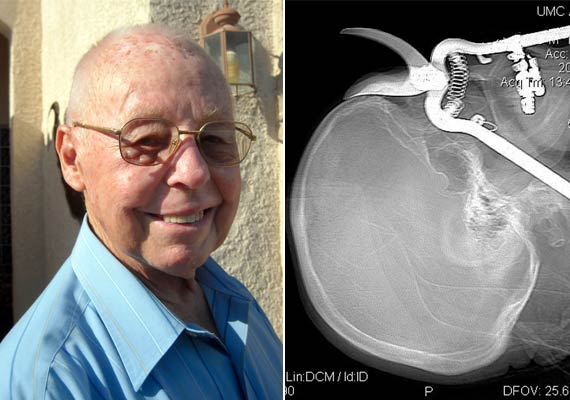
Luetscher was gardening in the backyard, trimming some plants, when he dropped his pruning shears, point side down. As Luetscher leaned over to grab the shears that had lodged in the dirt, he fell on them, face first. One of the handles shot through his right eye socket and lodged itself in his head.

“I couldn’t believe it. I just could not believe it. I sort of pulled on them -– it seemed real solid — so I just left it alone,” he said during the news conference to discuss the injury.

Luetscher said the searing pain actually helped him keep his wits about him. He said he put a T-shirt over the wound to help stop the bleeding and told his long-time live-in girlfriend to call an ambulance.

Today, the Green Valley resident has swelling to his eyelids, and some double vision, but is otherwise fine. He expressed gratitude to University Medical Center and the team of trauma surgeons and specialists who helped him, including Drs. Julie Wynne, Lynn Polonski and Kay Goshima.

Polonski, an ophthalmologist, said the team made incisions underneath Luetscher’s right upper lip and his sinus wall, allowing medical workers to loosen the handle of the pruning shears with their fingers. “Once we were able to loosen it up, it went fairly easily,” he said.

Doctors rebuilt Luetscher’s orbital floor with metal mesh, and managed to save his eye.

“You wouldn’t believe your eyes,” Wynne said. “Half of the pruning shears was sticking out and the other half was in his head.”

“You just wonder how the handle of the pruning shears got there. The handle was actually resting on the external carotid artery in his neck,” Polonski added. “We are so happy that Mr. Luetscher did not lose his eye or any vital structures.”

Doctors said so many things could have gone wrong — a ruptured eyeball, a severed artery, a fatal infection.

“You know, if it went a little bit in a different direction, it basically could have killed him or he could have had a stroke,” Polonski said.

http://latimesblogs.latimes.com/nationnow/2011/08/86-year-old-man-spears-himself-in-the-eye-has-full-recovery.html