Mexican Vigilantes Battling A Drug Cartel For Control Of A City

MexDrug1

by Harrison Jacobs

Mexico has long suffered blistering violence and crime at the hands of its homegrown drug cartels.

Though the Mexican government has waged war on the cartels, the effort has struggled to go anywhere. More than 90,000 people have died in the ongoing conflict.

Fed up with a corrupt police force that is often in bed with the cartels and a military that has to this point been ineffective, some Mexicans have taken it upon themselves to fight the cartels and protect their families — with an incredible conflict happening this week in the city of Paracuaro.

Over the last year, vigilante groups, known as fuerzas autodefensas have sprung up all over Mexico, particularly in the southwestern state of Michoacan, an area plagued by the Knights Templar cartel.

MexDrug2

In neighbouring Guerrero, members of the Public Safety System (the name of the vigilante group) marched to commemorate the first anniversary of their founding.

MexDrug3

On Monday, hundreds of vigilantes stormed Paracuaro, Michoacan, where the Knights Templar had set up their headquarters, in order to seize the town back from the cartel. Below is the entrance, where vigilantes erected a checkpoint.

MexDrug4

The gunmen, “community police” from a number of nearby towns, rode in a convoy of pickup trucks and SUVs, before engaging in a gunfight with the Knights Templar.

MexDrug5

The battle was bloody. One vigilante, two members of the Knights Templar, and two federal police were reportedly killed in the shootout.

MexDrug6

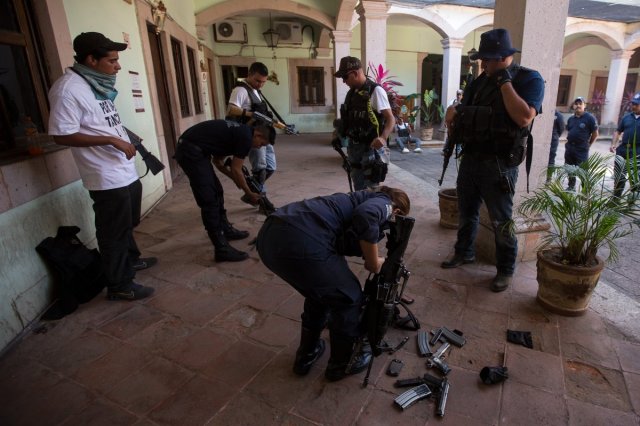
Once they had taken control of the town, the vigilantes began disarming municipal police, whom they accuse of being corrupt and in league with the cartel.

MexDrug7

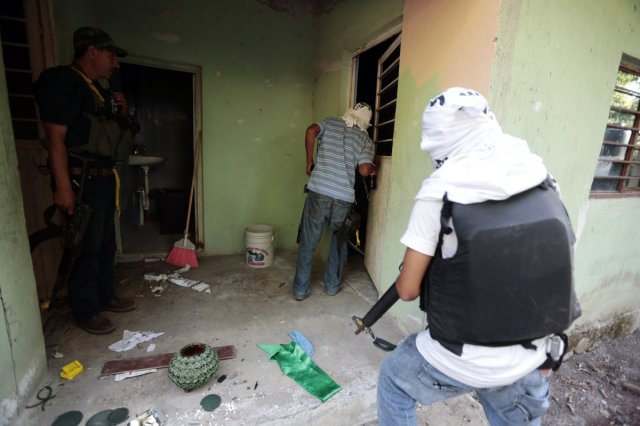
The vigilantes set up patrols and checkpoints on any highways going into and out of Paracuaro.

MexDrug8

Anybody suspected of being associated with the Knights Templar was detained. Currently, 11 police officers are being held on suspicion of colluding with the cartel.

MexDrug9

What happened in Paracuaro is becoming more common. Several months ago, another group in Guerrero detained more than 50 people for over six weeks for alleged crimes.

MexDrug10

While the vigilantes in Paracuaro went after the drug cartel, most other vigilante groups in Mexico are more concerned with punishing criminals who commit robberies, rape, and murder, than stopping the actual drug trade.

MexDrug11

In response to the vigilantes’ takeover of Paracauro, the Michaocan governor told press that the police will begin attempting to “eradicate” the vigilante groups.

MexDrug12

For a government and police force already overwhelmed by the drug cartels, trying to eliminate the vigilante groups likely won’t be easy.

MexDrug13

http://www.businessinsider.com.au/mexican-vigilantes-battle-drug-cartel-photos-2014-1

Thanks to Kebmodee for bringing this to the attention of the It’s Interesting community.

New research shows that psychedelic drugs may help decrease crime

lsd

Psychedelic drugs could help to keep ex-offenders out of prison, new research suggests.

U.S. scientists have found that drugs such as LSD and magic mushrooms could be used to help reform criminals under community correction supervision.

It has previously been thought that LSD could be used to treat alcohol addiction, but the new research is the first in 40 years to suggest it could be used to stop criminals from re-offending.

Researchers from the University of Alabama at Birmingham and Johns Hopkins University School of Medicine, Baltimore, collected data about 25,622 people under community supervision between 2002 and 2007.

All study participants were in the Treatment Accountability for Safer Communities (TASC) program, for people with a history of drug abuse, including alcohol addiction.

The researchers found that criminals diagnosed with a hallucinogen use disorder were less likely to fail the TASC programme, appear in court and be arrested and imprisoned, compared to those who did not have a history of taking the drugs.

Just one per cent of people on the programme were diagnosed with a hallucinogen disorder, while heavy users of cocaine, cannabis and alcohol were the most common.

‘Our results provide a notable exception to the robust positive link between substance use and criminal behaviour,’ the researchers wrote in their study, which was published in the Journal of Psychopharmacology.

‘They add to both the older and emerging body of data indicating beneficial effects of hallucinogen interventions and run counter to the legal classification as well as popular perception of hallucinogens as categorically harmful substances with no therapeutic potential,’ they added.

The scientists believe that offenders may be especially likely to benefit from LSD treatment as many people become criminals as a result of drug-seeking behaviour and impulsive conduct, often caused by compulsive drug use.

The study took factors such as race, employment, age, history of drug abuse and crimes, as well as gender and education into account.

However, the researchers warned that the findings of the study should not be seen to advocate recreational use of psychedelic drugs.

‘Nevertheless, they demonstrate that, in a real-world, substance-related intervention setting, hallucinogen use is associated with a lower probability of poor outcome,’ they wrote.

They believe the research should be the start of a continued investigation into the use of psychedelic drugs to treat criminals.

Read more: http://www.dailymail.co.uk/sciencetech/article-2537137/Could-LSD-cut-crime-Psychedelic-drug-help-prevent-criminals-offending.html#ixzz2qK1CX9Vz
Follow us: @MailOnline on Twitter | DailyMail on Facebook

Could Pot Help Veterans With PTSD? Brain Scientists Say Maybe

pot

by Jon Hamilton

Veterans who smoke marijuana to cope with post-traumatic stress disorder may be onto something. There’s growing evidence that pot can affect brain circuits involved in PTSD.

Experiments in animals show that tetrahydrocannabinol, the chemical that gives marijuana its feel-good qualities, acts on a system in the brain that is “critical for fear and anxiety modulation,” says Andrew Holmes, a researcher at the National Institute on Alcohol Abuse and Alcoholism. But he and other brain scientists caution that marijuana has serious drawbacks as a potential treatment for PTSD.

The use of marijuana for PTSD has gained national attention in the past few years as thousands of traumatized veterans who fought in Iraq and Afghanistan have asked the federal government to give them access to the drug. Also, Maine and a handful of other states have passed laws giving people with PTSD access to medical marijuana.

But there’s never been a rigorous scientific study to find out whether marijuana actually helps people with PTSD. So lawmakers and veterans groups have relied on anecdotes from people with the disorder and new research on how both pot and PTSD works in the brain.

An Overactive Fear System

When a typical person encounters something scary, the brain’s fear system goes into overdrive, says Dr. Kerry Ressler of Emory University. The heart pounds, muscles tighten. Then, once the danger is past, everything goes back to normal, he says.

But Ressler says that’s not what happens in the brain of someone with PTSD. “One way of thinking about PTSD is an overactivation of the fear system that can’t be inhibited, can’t be normally modulated,” he says.

For decades, researchers have suspected that marijuana might help people with PTSD by quieting an overactive fear system. But they didn’t understand how this might work until 2002, when scientists in Germany published a mouse study showing that the brain uses chemicals called cannabinoids to modulate the fear system, Ressler says.

There are two common sources of cannabinoids. One is the brain itself, which uses the chemicals to regulate a variety of brain cells. The other common source is Cannabis sativa, the marijuana plant.

So in recent years, researchers have done lots of experiments that involved treating traumatized mice with the active ingredient in pot, tetrahydrocannabinol (THC), Ressler says. And in general, he says, the mice who get THC look “less anxious, more calm, you know, many of the things that you might imagine.”

Problems with Pot

Unfortunately, THC’s effect on fear doesn’t seem to last, Ressler says, because prolonged exposure seems to make brain cells less sensitive to the chemical.

Another downside to using marijuana for PTSD is side effects, says Andrew Holmes at the National Institute on Alcohol Abuse and Alcoholism. “You may indeed get a reduction in anxiety,” Holmes says. “But you’re also going to get all of these unwanted effects,” including short-term memory loss, increased appetite and impaired motor skills.

So for several years now, Holmes and other scientists have been testing drugs that appear to work like marijuana, but with fewer drawbacks. Some of the most promising drugs amplify the effect of the brain’s own cannabinoids, which are called endocannabinoids, he says. “What’s encouraging about the effects of these endocannabinoid-acting drugs is that they may allow for long-term reductions in anxiety, in other words weeks if not months.”

The drugs work well in mice, Holmes says. But tests in people are just beginning and will take years to complete. In the meantime, researchers are learning more about how marijuana and THC affect the fear system in people.

At least one team has had success giving a single dose of THC to people during something called extinction therapy. The therapy is designed to teach the brain to stop reacting to something that previously triggered a fearful response.

The team’s study found that people who got THC during the therapy had “long-lasting reductions in anxiety, very similar to what we were seeing in our animal models,” Holmes says. So THC may be most useful when used for a short time in combination with other therapy, he says.

As studies continue to suggest that marijuana can help people with PTSD, it may be unrealistic to expect people with the disorder to wait for something better than marijuana and THC, Ressler says. “I’m a pragmatist,” he says. “I think if there are medications including drugs like marijuana that can be used in the right way, there’s an opportunity there, potentially.”

http://www.npr.org/blogs/health/2013/12/23/256610483/could-pot-help-veterans-with-ptsd-brain-scientists-say-maybe

Uruguay becomes first nation to legalize of all aspects of marijuana trade

pot

Uruguay’s Senate, on Tuesday, approved the legalization of marijuana in the country—including the growing, sale and smoking—making it the first nation to sanction all aspects of the pot industry. Previously, the use of marijuana was legal in the South American country, but cultivation and sale of the drug were not.

The newly passed, government-backed bill will now provide for government regulation of all aspects of the marijuana trade with an eye on “wresting the business from criminals,” according to Reuters. “The bill gives authorities 120 days to set up a drug control board that will regulate cultivation standards, fix the price and monitor consumption.” Uruguayan president Jose Mujica is a supporter of a legal national market for marijuana, but the measure has yet to win over a majority of the 3-plus million people in the country. A recent poll, Reuters reports, found that 58 percent of Uruguayans are opposed to legalization.

Here’s more from Reuters on what the law will look like on the ground once it goes into effect:

Cannabis consumers will be able to buy a maximum of 40 grams (1.4 ounces) each month from licensed pharmacies as long as they are Uruguayan residents over the age of 18 and registered on a government database that will monitor their monthly purchases. When the law is implemented in 120 days, Uruguayans will be able to grow six marijuana plants in their homes a year, or as much as 480 grams (about 17 ounces), and form smoking clubs of 15 to 45 members that can grow up to 99 plants per year. Registered drug users should be able to start buying marijuana over the counter from licensed pharmacies in April.

http://www.slate.com/blogs/the_slatest/2013/12/10/uruguay_sets_up_a_national_marketplace_for_marijuana_the_world_s_first.html

Thanks to Kebmodee for bringing this to the attention of the It’s Interesting community.

FBI Captures Alleged Silk Road Boss Using His Own Methods

silk road

From an Internet café in San Francisco, a 29-year-old free-market evangelist who called himself “Dread Pirate Roberts” used untraceable web services, an international network of servers and anonymous digital currency to run a global online exchange of cocaine and heroin beyond the reach of the law.

For two years, cybercrime experts from the FBI pored over the secretive online drug bazaar known as Silk Road — an underground operation that had become, by the time the FBI shut it down this week, the venue for $1 billion worth of illegal transactions, according to prosecutors. Seeking the mastermind behind it, investigators began picking up clues: an anonymous posting to a website devoted to hallucinogenic mushrooms, recurring references to an Austrian school of economics, and early clues left on public sites including Google and LinkedIn.

A big break came in July, when a routine inspection of inbound mail from Canada turned up a parcel containing nine counterfeit IDs — each with a different name, but all featuring the photograph of the same man.

According to a 33-page criminal complaint unsealed yesterday in Manhattan federal court, the man in the ID photos was Ross Ulbricht, Silk Road’s alleged overseer. FBI agents arrested Ulbricht in San Francisco the same day at the Glen Park library in San Francisco, where he had gone to log onto a computer, according to a person briefed on the matter.

The criminal complaint against Ulbricht depicts the dark side of Internet commerce. In it, special agent Christopher Tarbell of the FBI’s New York office described Silk Road as “the most sophisticated and extensive criminal marketplace on the Internet today” — a virtual bazaar where buyers could find everything from heroin and hacking software to contact information for hit men in more than 10 different countries.

Meanwhile, on July 10 of this year, customs officials intercepted the package from Canada as part of what the complaint characterized as a routine inspection. The package, addressed to an apartment on 15th Street in San Francisco, contained nine counterfeit IDs, each in a different name, but all featuring a photo of the same person.

Agents from Homeland Security Investigations arrived on July 26 at the 15th Street address. There, according to the complaint, they encountered Ross Ulbricht, whose photo matched those on all nine fake IDs.

Confronted with a fake California driver’s license bearing his photo and birthdate but a different name, Ulbricht avoided answering questions about the purchase of false IDs, according to the complaint. Instead, he volunteered that “hypothetically” anyone could go onto a website named Silk Road and purchase any drugs or counterfeit IDs they wanted. Ulbricht then produced his real ID, a Texas driver’s license, according to the complaint, and explained that he was subletting a room in the apartment for $1,000 a month. According to the complaint, he also said the roommates knew him as “Josh.”

Ulbricht stands accused of narcotics trafficking, money laundering, computer-hacking conspiracy and, in an indictment unsealed yesterday in Maryland, of attempted murder.

Bitcoin Bets Feed Twitter Dreams as Regulators CircleCyber Drug Bazaar’s Alleged Boss Paired EBay Style, Crime
The genius of Silk Road’s design and the reason it eluded the FBI’s grasp for so long, according to the complaint, was its impenetrability. The site was accessible only on a so-called tor network, which is designed to conceal the true Internet addresses of computers using it. Its exclusive reliance on Bitcoin, an anonymous digital currency, added another layer of protection for its buyers and sellers.

Since November 2011, Tarbell’s team made more than 100 purchases of drugs from Silk Road vendors, accepting shipments of ecstasy, cocaine, heroin, LSD and other drugs posted from 10 different countries, including the U.S., according to the complaint.

In the FBI’s bid to identify the individual behind Silk Road, an agent on Tarbell’s team combed through Internet postings and discovered the earliest mention of the site on shroomery.org, an informational website for consumers of “magic mushrooms,” in January 2011.

The posting, from someone with the username altoid, alerted the site’s visitors to Silk Road and asked if anyone had tried it. Two days later, someone using the same username posted a similar message on “bitcointalk.org,” a discussion forum for the virtual currency.

“The two postings created by ’altoid’ on Shroomery and Bitcoin Talk appear to be attempts to generate interest in the site,” Tarbell wrote. “The fact that ’altoid’ posted similar messages about the site on two very different discussion forums, two days apart, indicates that ’altoid’ was visiting various discussion forums…and seeking to publicize the site among the forum users — which, based on my training and experience, is a common online marketing tactic for new websites.”

In October 2011, altoid surfaced again on the Bitcoin forum, seeking an “IT pro” to help build a Bitcoin startup company and directing potential job candidates to the Gmail account of someone named Ross Ulbricht. From a Google profile associated with the account, the FBI learned that Ulbricht had an interest in the Austrian school of economics and the Auburn, Alabama-based Ludwig von Mises Institute. According to the group’s website, it functions as a center of Libertarian political and social theory.

Similar sentiments are voiced on a page of professional networking site LinkedIn that is also attributed to Ulbricht, according to the complaint. In a LinkedIn profile accessed yesterday, a user identified as Ross Ulbricht describes himself as an “investment adviser and entrepreneur” and lists his interests as “trading, economics, physics, virtual worlds, liberty.”

Agents made a connection between Ulbricht and Silk Road: The site’s webmaster, who identified himself as Dread Pirate Roberts, made regular references to Austrian economic theory and the teachings of Mises to justify Silk Road’s existence.

The New York FBI agents weren’t the only lawmen gunning for Silk Road. In April 2012, a federal agent in Maryland began communicating with Dread Pirate Roberts in an undercover capacity, posing as a drug dealer.

In January, the undercover agent completed the sale of a small quantity of cocaine to a Silk Road employee and was paid the equivalent of $27,000 in Bitcoin currency. According to the Maryland indictment, Dread Pirate Roberts subsequently asked the undercover agent to murder an employee the site overseer believed to have stolen money from Silk Road.

During this time, Tarbell’s team in New York tracked the Silk Road webmaster’s online logins to an Internet café on Laguna Street in San Francisco, near an apartment where Ulbricht had moved.

Following the confrontation, Tarbell and his team learned that in the weeks leading up to the discovery of the counterfeit identity papers, Dread Pirate Roberts had sent a series of private e-mails suggesting that he “needed a fake ID,” according to the complaint.

All the while, word of Silk Road and its bazaar of illicit goods and services spread around the Internet. In August, Forbes.com posted an interview with Dread Pirate Roberts that it said was conducted via messages sent through the site. “The highest levels of government are hunting me,” the cyber entrepreneur said, adding: “I can’t take any chances.”

Yesterday afternoon, Ulbricht surfaced at San Francisco’s Glen Park library, a small branch facility where public computers are located in front of the check-out desk. There, according to the person familiar with the matter, he was arrested by the FBI.

The criminal case is U.S. v. Ulbricht, 13-mg-023287; the civil forfeiture case is U.S. v. Ulbricht, 13-cv-06919, U.S. District Court, Southern District of New York (Manhattan).

To contact the reporters on this story: Greg Farrell in New York at gregfarrell@bloomberg.net

To contact the editor responsible for this story: Michael Hytha at mhytha@bloomberg.net

http://www.businessweek.com/news/2013-10-03/fbi-captures-alleged-silk-road-pirate-boss-using-his-own-methods#p2

Thanks to Kebmodee for bringing this to the attention of the It’s Interesting community.

Ohio man orders gun safe on Internet and discovers almost 300 pounds of marijuana inside

HT_pot_in_gun_safe_ml_130816_16x9_608

Authorities in Ohio say a man who ordered a gun safe online opened it up only to discover 280 pounds of marijuana inside.

Shelby County Sheriff John Lenhart in western Ohio says the safe was made in Nogales, Mexico and that it was sent by truck to Ohio.

He says the marijuana has a street value of $420,000.

Federal authorities who are investigating say the truck driver who brought the shipment into the United States is now missing.

The Ohio sheriff says that truck was carrying a full shipment of safes, but none of the others contained any drugs.

He says the safe with the marijuana was delivered to Ohio in June, but authorities have kept quiet about it while they looked into how the safe got into the U.S.

http://abcnews.go.com/US/wireStory/gun-safe-ohio-man-filled-marijuana-19995543

Marijuana And Cancer: Scientists Find that a Non-Psychoactive Cannabis Compound Stops Metastasis In Aggressive Cancers

pile-of-weed3

A pair of scientists at California Pacific Medical Center in San Francisco has found that a compound derived from marijuana could stop metastasis in many kinds of aggressive cancer, potentially altering the fatality of the disease forever.

“It took us about 20 years of research to figure this out, but we are very excited,” said Pierre Desprez, one of the scientists behind the discovery, to The Huffington Post. “We want to get started with trials as soon as possible.”

The Daily Beast first reported on the finding, which has already undergone both laboratory and animal testing, and is awaiting permission for clinical trials in humans.

Desprez, a molecular biologist, spent decades studying ID-1, the gene that causes cancer to spread. Meanwhile, fellow researcher Sean McAllister was studying the effects of Cannabidiol, or CBD, a non-toxic, non-psychoactive chemical compound found in the cannabis plant. Finally, the pair collaborated, combining CBD and cells containing high levels of ID-1 in a petri dish.

“What we found was that his Cannabidiol could essentially ‘turn off’ the ID-1,” Desprez told HuffPost. The cells stopped spreading and returned to normal.

“We likely would not have found this on our own,” he added. “That’s why collaboration is so essential to scientific discovery.”

Desprez and McAllister first published a paper about the finding in 2007. Since then, their team has found that CBD works both in the lab and in animals. And now, they’ve found even more good news.

“We started by researching breast cancer,” said Desprez. “But now we’ve found that Cannabidiol works with many kinds of aggressive cancers–brain, prostate–any kind in which these high levels of ID-1 are present.”

Desprez hopes that clinical trials will begin immediately.

“We’ve found no toxicity in the animals we’ve tested, and Cannabidiol is already used in humans for a variety of other ailments,” he said. Indeed, the compound is used to relieve anxiety and nausea, and, since it is non-psychoactive, does not cause the “high” associated with THC.

While marijuana advocates will surely praise the discovery, Desprez explained that it’s not so easy as just lighting up.

“We used injections in the animal testing and are also testing pills,” he said. “But you could never get enough Cannabidiol for it to be effective just from smoking.”

Furthermore, the team has started synthesizing the compound in the lab instead of using the plant in an effort to make it more potent.

“It’s a common practice,” explained Desprez. “But hopefully it will also keep us clear of any obstacles while seeking approval.”

http://www.huffingtonpost.com/2012/09/19/marijuana-and-cancer_n_1898208.html?ncid=edlinkusaolp00000003&ir=Weird%20News

Controversial surgical treatment for addiction burns away the brain’s pleasure center


How far should doctors go in attempting to cure addiction? In China, some physicians are taking the most extreme measures. By destroying parts of the brain’s “pleasure centers” in heroin addicts and alcoholics, these neurosurgeons hope to stop drug cravings. But damaging the brain region involved in addictive desires risks permanently ending the entire spectrum of natural longings and emotions, including the ability to feel joy.

In 2004, the Ministry of Health in China banned this procedure due to lack of data on long term outcomes and growing outrage in Western media over ethical issues about whether the patients were fully aware of the risks.

However, some doctors were allowed to continue to perform it for research purposes—and recently, a Western medical journal even published a new study of the results. In 2007, The Wall Street Journal detailed the practice of a physician who claimed he performed 1000 such procedures to treat mental illnesses such as depression, schizophrenia and epilepsy, after the ban in 2004; the surgery for addiction has also since been done on at least that many people.

The November publication has generated a passionate debate in the scientific community over whether such research should be published or kept outside the pages of reputable scientific journals, where it may find undeserved legitimacy and only encourage further questionable science to flourish.

The latest study is the third published since 2003 in Stereotactic and Functional Neurosurgery, which isn’t the only journal chronicling results from the procedure, which is known as ablation of the nucleus accumbens. In October, the journal World Neurosurgery also published results from the same researchers, who are based at Tangdu Hospital in Xi’an.

The authors, led by Guodong Gao, claim that the surgery is “a feasible method for alleviating psychological dependence on opiate drugs.” At the same time, they report that more than half of the 60 patients had lasting side effects, including memory problems and loss of motivation. Within five years, 53% had relapsed and were addicted again to opiates, leaving 47% drug free.

(MORE: Addicted: Why We Get Hooked)

Conventional treatment only results in significant recovery in about 30-40% of cases, so the procedure apparently improves on that, but experts do not believe that such a small increase in benefit is worth the tremendous risk the surgery poses.  Even the most successful brain surgeries carry risk of infection, disability and death since opening the skull and cutting brain tissue for any reason is both dangerous and unpredictable. And the Chinese researchers report that 21% of the patients they studied experienced memory deficits after the surgery and 18% had “weakened motivation,” including at least one report of lack of sexual desire. The authors claim, however, that “all of these patients reported that their [adverse results] were tolerable.” In addition, 53% of patients had a change in personality, but the authors describe the majority of these changes as “mildness oriented,” presumably meaning that they became more compliant. Around 7%, however, became more impulsive.

The surgery is actually performed while patients are awake in order to minimize the chances of destroying regions necessary for sensation, consciousness or movement.  Surgeons use heat to kill cells in small sections of both sides of the brain’s nucleus accumbens.  That region is saturated with neurons containing dopamine and endogenous opioids, which are involved in pleasure and desire related both to drugs and to ordinary experiences like eating, love and sex.

(MORE: A Drug to End Drug Addiction)

In the U.S. and the U.K., reports the Wall Street Journal, around two dozen stereotactic ablations are performed each year, but only in the most intractable cases of depression and obsessive-compulsive disorder and after extensive review by institutional review boards and intensive discussions with the patient, who must acknowledge the risks. Often, a different brain region is targeted, not the nucleus accumbens. Given the unpredictable and potentially harmful consequences of the procedure, experts are united in their condemnation of using the technique to treat addictions. “To lesion this region that is thought to be involved in all types of motivation and pleasure risks crippling a human being,” says Dr. Charles O’Brien, head of the Center for Studies of Addiction at the University of Pennsylvania.

David Linden, professor of neuroscience at Johns Hopkins and author of a recent book about the brain’s pleasure systems calls the surgery “horribly misguided.”  He says “This treatment will almost certainly render the subjects unable to feel pleasure from a wide range of experiences, not just drugs of abuse.”

But some neurosurgeons see it differently. Dr. John Adler, professor emeritus of neurosurgery at Stanford University, collaborated with the Chinese researchers on the publication and is listed as a co-author.  While he does not advocate the surgery and did not perform it, he believes it can provide valuable information about how the nucleus accumbens works, and how best to attempt to manipulate it. “I do think it’s worth learning from,” he says. ” As far as I’m concerned, ablation of the nucleus accumbens makes no sense for anyone.  There’s a very high complication rate. [But] reporting it doesn’t mean endorsing it. While we should have legitimate ethical concerns about anything like this, it is a bigger travesty to put our heads in the sand and not be willing to publish it,” he says.

(MORE: Anesthesia Study Opens Window Into Consciousness)

Dr. Casey Halpern, a neurosurgery resident at the University of Pennsylvania makes a similar case. He notes that German surgeons have performed experimental surgery involving placing electrodes in the same region to treat the extreme lack of pleasure and motivation associated with otherwise intractable depression.  “That had a 60% success rate, much better than [drugs like Prozac],” he says. Along with colleagues from the University of Magdeburg in Germany, Halpern has just published a paper in the Proceedings of the New York Academy of Sciences calling for careful experimental use of DBS in the nucleus accumbens to treat addictions, which have failed repeatedly to respond to other approaches. The paper cites the Chinese surgery data and notes that addiction itself carries a high mortality risk.

DBS, however, is quite different from ablation.  Although it involves the risk of any brain surgery, the stimulation itself can be turned off if there are negative side effects, while surgical destruction of brain tissue is irreversible. That permanence—along with several other major concerns — has ethicists and addiction researchers calling for a stop to the ablation surgeries, and for journals to refuse to publish related studies.

Harriet Washington, author of Medical Apartheid:  The Dark History of Medical Experimentation on Black Americans from Colonial Times to the Present, argues that by publishing the results of unethical studies, scientists are condoning the questionable conditions under which the trials are conducted. “When medical journals publish research that violates the profession’sethical guidelines, this serves not only to sanction such abuses, but to encourage them,” she says. “In doing so, this practice encourages a relaxing of moral standards that threatens all patients and subjects, but especially  the medically vulnerable.”

(MORE: Real-Time Video: First Look at a Brain Losing Consciousness Under Anesthesia)

Shi-Min Fang, a Chinese biochemist who became a freelance journalist and recently won the journal Nature‘s Maddox prize for his exposes of widespread fraud in Chinese research, has revealed some of the subpar scientific practices behind research conducted in China, facing death threats and, as the New York Times reported, a beating with a hammer. He agrees that publishing such research only perpetuates the unethical practices. Asked by TIME to comment on the addiction surgery studies, Fang writes that publishing the research, particularly in western journals, “would encourage further unethical research, particularly in China where rewards for publication in international journals are high.”

While he doesn’t have the expertise to comment specifically on the ablation data, he says “the results of clinical research in China are very often fabricated. I suspect that the approvals by Ethics Committee mentioned in these papers were made up to meet publication requirement. I also doubt if the patients were really informed in detail about the nature of the study.” Fang also notes that two of the co-authors of the paper are advertising on the internet in Chinese, offering the surgery at a cost of 35,000 renminbi, about $5,600.  That’s more than the average annual income in China, which is about $5,000.

Given the available evidence, in fact, it’s hard to find a scientific justification for even studying the technique in people at all. Carl Hart, associate professor of psychology at Columbia University and author of the leading college textbook on psychoactive drugs, says animal studies suggest the approach may ultimately fail as an effective treatment for addiction; a 1984 experiment, for example, showed that destroying the nucleus accumbens in rats does not permanently stop them from taking opioids like heroin and later research found that it similarly doesn’t work for curbing cocaine cravings. Those results alone should discourage further work in humans. “These data are clear,” he says, “If you are going to take this drastic step, you damn well better know all of the animal literature.” [Disclosure:  Hart and I have worked on a book project together].

(MORE: Top 10 Medical Breakthroughs of 2012)

Moreover, in China, where addiction is so demonized that execution has been seen as an appropriate punishment and where the most effective known treatment for heroin addiction— methadone or buprenorphine maintenance— is illegal, it’s highly unlikely that addicted people could give genuinely informed consent for any brain surgery, let alone one that risks losing the ability to feel pleasure. And even if all of the relevant research suggested that ablating the nucleus accumbens prevented animals from seeking drugs, it would be hard to tell from rats or even primates whether the change was due to an overall reduction in motivation and pleasure or to a beneficial reduction in desiring just the drug itself.

There is no question that addiction can be difficult to treat, and in the most severe cases, where patients have suffered decades of relapses and failed all available treatments multiple times, it may make sense to consider treatments that carry significant risks, just as such dangers are accepted in fighting suicidal depression or cancer.  But in the ablation surgery studies, some of the participants were reportedly as young as 19 years old and had only been addicted for three years.  Addiction research strongly suggests that such patients are likely to recover even without treatment, making the risk-benefit ratio clearly unacceptable.

The controversy highlights the tension between the push for innovation and the reality of risk. Rules on informed consent didn’t arise from fears about theoretical abuses:  they were a response to the real scientific horrors of the Holocaust. And ethical considerations become especially important when treating a condition like addiction, which is still seen by many not as an illness but as a moral problem to be solved by punishment.  Scientific innovation is the goal, but at what price?
Read more: http://healthland.time.com/2012/12/13/controversial-surgery-for-addiction-burns-away-brains-pleasure-center/#ixzz2ExzobWQq

Thanks to Dr. Lutter for bringing this to the attention of the It’s Interesting community.

 

Marijuana farm the size of two football fields discovered in Chicago


Police in Chicago became farmers for a day Wednesday as they began to chop down a  marijuana farm as big as two football fields found in the city.

The farm, which contains about 1,500 plants and could have netted $7-10 million, was spotted by a police officer and county sheriff’s deputy in a helicopter as they headed back to their hangar, MyFoxChicago.com reports.

No arrests had been made as of Wednesday, and police were still trying to determine who owns the property that housed the grow site on the city’s far South Side. But police said they were hopeful that because of the size of the operation, informants or others might provide tips about those involved, including a man seen running from the area as the helicopter swooped low.

James O’Grady, the commander of the department’s narcotics division, tells The Associated Press they’ve never seen anything like it before, in part because Chicago’s harsh winters mean growers have a lot less time to plant, grow and harvest marijuana than their counterparts in less inclement places such as California and Mexico. The bumper crop was likely planted in spring, O’Grady said.

Add to that the urban sprawl: there are few spots in Chicago where such an operation could go unnoticed because of all the buildings, roads and residents. The growers took pains to ensure their crop was largely hidden by a canopy of trees and surrounding vegetation.

“Somebody put a lot of thought into it,” O’Grady said. “But they probably didn’t anticipate the helicopter.”

Chicago Police Officer Stan Kuprianczyk, a pilot, said police helicopters flew “over it all the time,” to and from their hangar, without spying the grow site. Yet somehow, a number of factors came together to allow Cook County Sheriff’s Deputy Edward Graney to spot the plants.

“We had the right altitude, the right angle, the right sunlight, and I happened to be glancing down,” said Graney. He said he initially spotted five plants or so through the trees before he asked Kuprianczyk to circle around for a closer look.

“We just happened to be right over a small hole in the trees and we looked down,” Kuprianczyk said.

They also happened to have the right training, Graney said, explaining that just a few weeks earlier a much smaller operation in suburban Chicago prompted them to fly over and videotape the scene so they might be able to recognize marijuana if they ever saw it from the air again.

So, by the time Graney spotted the marijuana plants, which are a much brighter shade of green than the surrounding vegetation, he had a pretty good idea what he was looking at.

Superintendent Garry McCarthy, whose officers are more used to intercepting shipments of marijuana grown elsewhere or discovering hydroponic growing operations inside buildings, said the discovery of the marijuana is significant in a larger fight against street violence.

Those involved with narcotics, whether it is marijuana, heroin or cocaine, purchase firearms with their profits and have shown they’re willing to use them to protect their business, he said.

“That’s where the violence comes in, the competition for the markets,” he said.

Read more: http://www.foxnews.com/us/2012/10/03/police-in-chicago-uncover-nearly-1000-pot-plants-in-city/?test=latestnews#ixzz28RCvlyQP