New research shows molecular mechanism by which neuronal projections can regenerate after injury

The mechanisms that drive axon regeneration after central nervous system (CNS) injury or disease are proposed to recapitulate, at least in part, the developmental axon growth pathways. This hypothesis is bolstered by a new study by O’Donovan et al. showing that activation of a B-RAF kinase signaling pathway is sufficient to promote robust axon growth not only during development but also after injury.

B-RAF was previously shown to be essential for developmental axon growth but it was not known if additional signaling pathways are required. In this study, the authors demonstrate that activation of B-RAF alone is sufficient to promote sensory axon growth during development. Using a conditional B-RAF gain-of-function mouse model, the authors elegantly prove that B-RAF has a cell-autonomous role in the developmental axon growth program. Notably, activated B-RAF promoted overgrowth of embryonic sensory axons projecting centrally in the spinal cord, suggesting that this pathway may normally be quiescent in central axons.

Could activated B-RAF also enhance axon regeneration in the adult central nervous system? The authors found that activated B-RAF not only enabled sensory axon growth into the spinal cord after spinal injury, but also promoted regrowth of axons projecting in the optic nerve. Regeneration in the injured CNS is prevented by both the poor intrinsic regrowth capacity of axons and by inhibitory factors in the tissue environment. Importantly, the B-RAF–activated signaling growth program was insensitive to this repulsive environment.

Interestingly, the authors find that B-RAF synergizes with the PI3-kinase–mTOR pathway, which also functions downstream of growth factors. This opens the possibility that combinatorial approaches that integrate these two pathways may heighten regenerative capacity.

This in vivo study significantly advances the understanding of the role of MAP kinases in axon growth and suggests that reactivation of the B-RAF pathway may be exploited to promote axon regeneration in the injured central nervous system. An exciting future avenue will be to determine the downstream mechanisms controlled by B-RAF.

O’Donovan, K.J., et al. 2014. J. Exp. Med. doi:10.1084/jem.20131780.

http://jem.rupress.org/content/211/5/746.1.long

New research shows that women who never sunbathe are twice as likely to die than those who do so regularly

Researchers at the Karolinska Institute, Sweden, say guidelines that advise people to stay out of the sun unless wearing sunscreen may be harmful, particularly in northern countries which have long, cold winters.

Exposure to ultraviolet radiation from sunlight is often cited as a cause of skin melanoma (malignant tumour of melanocytes) and avoiding overexposure to the sun to prevent all types of skin cancer is recommended by health authorities.

But the new study, which followed nearly 30000 women over 20 years, suggests that women who stay out of the sun are at increased risk of melanomas and are twice as likely to die from any cause, including cancer.

It is thought that a lack of vitamin D may be to blame. Vitamin D is created in the body through exposure to sunshine and a deficiency is known to increase the risk of diabetes, TB, multiple sclerosis and rickets.

Previous studies showed that vitamin D can increase survival rates for women with breast cancer while deficiencies can signal prostate cancer in men.

The study looked at 29518 Swedish women who were recruited from 1990 to 1992 and asked to monitor their sunbathing habits.

After 20 years there had been 2545 deaths and it was found that women who never sunbathed were twice as likely to have died from any cause.

Women who sunbathed in the mild Swedish summer were also 10% less likely to die from skin cancer, although those who sunbathed abroad in sunnier countries were twice as likely to die from melanoma.

Yinka Ebo, senior health information officer at Cancer Research UK, said striking a balance was important.

“The reasons behind higher death rates in women with lower sun exposure are unexplained . overexposure to UV radiation from the sun or sunbeds is the main cause of skin cancer.”

http://www.timeslive.co.za/thetimes/2014/05/09/avoiding-sunshine-could-kill-you-study-finds

Thanks to Kebmodee for bringing this to the attention of the It’s Interesting community.

China Mulls Construction of a High Speed Train to the U.S.

by Daniel Politi

It sure sounds far-fetched but a story in the Beijing Times claims China is considering building a high-speed train that would connect China’s northeast with the United States. The project would cross Siberia and the Bering Strait to Alaska, and then go across Canada into the United States, according to the English-language report published in the state-run China Daily. To cross the Bering Strait into Alaska, the railway would need a 125-mile underwater tunnel, which implies it would be around four times the length of the tunnel that crosses the English Channel, notes a very skeptical Washington Post article on the report.

China Daily claims that the technology to construct such a long underwater tunnel already exists and will be used to build a tunnel to connect China’s Fujian province with Taiwan. “Right now we’re already in discussions. Russia has already been thinking about this for many years,” said a railway expert cited by the Beijing Times, according to the Independent’s report on the story. The train would reportedly travel at around 220mph, meaning the entire trip between the United States and China would take around two days.

What is being called the China-Russia-Canada-America line is one of four large-scale international high-speed rail projects the country wants to build, the Guardian writes, citing the Beijing Times:

The first is a line that would run from London via Paris, Berlin, Warsaw, Kiev and Moscow, where it would split into two routes, one of which would run to China through Kazakhstan and the other through eastern Siberia. The second line would begin in the far-western Chinese city of Urumqi and then run through Kazakhstan, Uzbekistan, Turkmenistan, Iran and Turkey to Germany. The third would begin in the south-western city of Kunming and end in Singapore.

http://www.slate.com/blogs/the_slatest/2014/05/10/china_mulls_construction_of_a_high_speed_train_to_the_u_s.html

Thanks to Kebmodee for bringing this to the attention of the It’s Interesting community.

LA Sheriff Secretly Recorded All of Compton From Above

In 2012, a private company working with the LA County Sheriff’s Department flew a civilian plane rigged with multiple high-powered video cameras over the city of Compton, recording “video of everything that happened inside that 10-square-mile municipality,” all without telling residents, according to The Atlantic. Expanding on a previous piece by the Center for Investigative Reporting, The Atlantic says that the project was a test-run of sorts by the company, Persistent Surveillance Systems, eager to show off its tech to the country’s largest sheriff’s department. (Neither article says how long the plane was in the air or exactly how many times it flew and recorded, but the head of the company himself brags that “We literally watched all of Compton during the time that we were flying, so we could zoom in anywhere within the city of Compton and follow cars and see people.”)

They didn’t tell Compton because Compton might not have liked it.

Ohio-based PSS sells surveillance equipment (known as wide area surveillance) that uses cameras mounted on the underside of planes to record video, allowing police to pause, rewind, and zoom in on footage that’s been recorded in real-time, like a much creepier DVR. The Sheriffs were “persuaded” by Ross McNutt (the Air Force veteran who owns PSS) to let him fly a plane outfitted with cameras over Compton in response to a chain of horrible crimes terrorizing the city’s residents: a string of necklace-jackings. The plan was to have McNutt’s aircraft hover over areas where reported thefts had taken place, and to look for anything that might help investigators.

“Our whole system costs less than the price of a single police helicopter and costs less for an hour to operate than a police helicopter. But at the same time, it watches 10,000 times the area that a police helicopter could watch,” McNutt told CIR. While the tech sounds futuristic (in a dystopian way), it is thankfully still limited: the cameras are not powerful enough yet to recognize faces. (Nowhere near as fancy/invasive as the license-plate recognition software that the LAPD uses.) McNutt himself predicts that technology will advance within the next few years, so don’t even sweat it.

At no point was any of this revealed to the residents of Compton because the cops knew they wouldn’t much care for having their entire city recorded. “A lot of people do have a problem with the eye in the sky, the Big Brother, so in order to mitigate any of those kinds of complaints, we basically kept it pretty hush-hush,” says LA County Sheriff Sgt. Doug Iketani, the project’s supervisor.

http://la.curbed.com/archives/2014/04/la_sheriff_secretly_recorded_all_of_compton_from_above.php

Thanks to Kebmodee for bringing this to the attention of the It’s Interesting community.

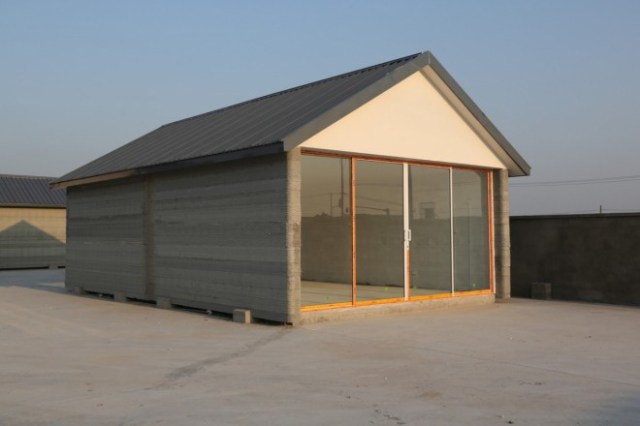
Recycled Concrete Houses 3D-Printed in 24 Hours in China

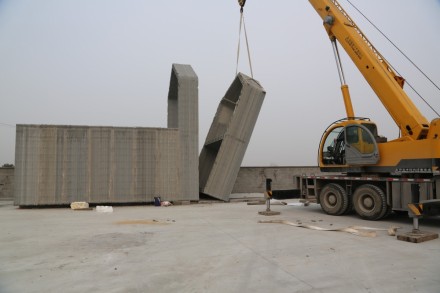
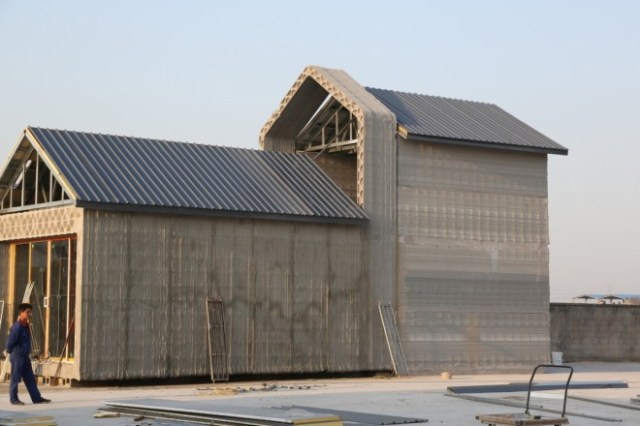
A Chinese construction firm based in Shanghai has succeeded in building 10 houses each measuring 200 square metres in 24 hours by using an enormous 3D printer.

The houses are all eco-friendly and constructed from 3D-printed building blocks made from layers of recycled construction waste and glass fibre and mixed with cement.

Each home costs less than £3,000 to build.

WinSun Decoration Design Engineering spent 20 million Yuan (£1.9m) and 12 years to develop a 3D printer 6.6 metres tall, 10 metres wide and 150 metres long.

Large 3D printers have been in existence for several years and have been used to make plane parts and prototypes.

“We purchased parts for the printer overseas, and assembled the machine in a factory in Suzhou. Such a new type of 3D-printed structure is environment-friendly and cost-effective,” said the 3D-printer’s inventor, Winsun CEO Ma Yihe.

Winsun used architectural design software AutoCAD Architecture to not only plan the building but also to calculate tracing paths that took into account plumbing, electrical lining, insulation materials and windows, that would be added once the main structure was built.

The company holds 77 national patents for its construction materials.

Ma’s office building, which covers an area of 10,000 square metres, was also constructed with 3D-printed walls and took a month to build from an assembly line of four 3D printers.

“Industrial waste from demolished buildings is damaging our environment, but with 3D-printing, we are able to recycle construction waste and turn it into new building materials,” said Ma.

“This would create a much safer environment for construction workers and greatly reduce construction costs.”

http://www.ibtimes.co.uk/china-recycled-concrete-houses-3d-printed-24-hours-1445981

Thanks to Kebmodee for bringing this to the attention of the It’s Interesting community.

Desert dig uncovers huge Atari games dump

Video game archaeologists have found a cache of Atari games that were buried in the New Mexico desert 30 years ago.

Before now reports Atari had dumped millions of game cartridges were widely believed to be an urban myth.

But a three-hour dig at a landfill site turned up many Atari cartridges, including copies of the game ET: The Extra Terrestrial.

Atari made millions of copies of the ET game, but it sold poorly and helped to contribute to the demise of the firm.

“For a lot of people, it’s something that they’ve wondered about and it’s been rumoured and talked about for 30 years, and they just want an answer,” said Zak Penn, director of a documentary being made about the search for the site and its uncovering.

The documentary by Fuel Entertainment is being prepared for Microsoft’s Xbox TV channel.

Cash crunch

Atari was thought to have dumped truckloads of unsold games in the landfill site on the outskirts of Alamogordo in 1983 as the company was winding down.

The game maker’s descent from its position as the dominant force in home gaming in the late 1970s and early 1980s was swift and has been partly blamed on the gamble it took on making a game of Steven Spielberg’s 1982 hit film ET.

The game was made from scratch in five weeks for the Atari 2600 console. Even before the game was finished Atari, committed huge amounts of money and resources to it and produced millions of copies when it was done.

The ET game has been described as one of the worst ever created. Its challenging game play and poor graphics put people off buying it and left Atari with huge amounts of unsold inventory.

The search to see if the rumours about the dump were true was given new life by the efforts of one unnamed game enthusiast who did the detective work to narrow down its location.

Red tape surrounding the uncovering of the landfill site held up the start of the dig but once permission was granted excavations began on 26 April.

Three hours of digging with a backhoe uncovered significant amounts of Atari 2600 game cartridges – many of which were still in their original packaging.

Only a limited amount of material could be retrieved from the dump because the dig was only allowed access for one day. The local authority of Alamogordo ordered the dig site to be refilled on 27 April.

http://www.bbc.com/news/technology-27187609

Thanks to Kebmodee for bringing this to the attention of the It’s Interesting community.

World’s longest-running science experiment finally ends.

The world’s longest-running laboratory experiment has finally delivered a result – eight months after the man who patiently watched over it unrewarded for five decades died.

Set up in the 1920s to demonstrate to students that objects that appear solid can flow like liquids, the pitch drop experiment at the University of Queensland has captivated many who had waited more than 13 years for the latest globule of the tar-like substance to form and fall.

Pitch is a material hard enough to shatter when hit by a hammer. However put a pile of it in a funnel and the pressure generated from being squeezed through the narrow mouth makes it flow like liquid. Albeit slowly.

To put things in perspective: Australia is moving north at six centimetres a year due to continental drift. The pitch in this experiment is moving 10 times slower than that.

On Thursday, the ninth dollop to fall in 83 years touched down. Until last week, no one had ever seen one land.
Similarly, in 1988, he knew a drop was close, but it happened in the five minutes when he left the room to get a cup of tea.

By 2000 there was a webcam pointed at the pitch. Although in England, Professor Mainstone knew he could watch it live or have it recorded. However, a tropical storm caused a 20 minute power outage right when the pitch landed.

Professor Mainstone died after suffering a stroke last August, aged 78, just months before the ninth blob of pitch fell.

Current custodian Andrew White said given the amount of pitch yet to land in the beaker, the experiment could run for at least another 80 years. He said if the pitch continued to drop at the current rate, the next dollop to land could coincide with the centenary of the experiment in 2027.

Physicist John Mainstone missed all three pitch drops that took place during his custodianship. Having retrieved the experiment from the back of a cupboard, he watched over it for 50 years.

Professor Mainstone once devoted an entire weekend to watching the pitch in 1977 – only to go home exhausted and miss the event by a day.

The experiment has been referenced in popular culture, getting a mention in Nick Earls’ book Perfect Skin. It is recognised by Guinness World Records as the longest-running laboratory experiment, and in 2005 it won an Ig Nobel Prize – “for research that makes you people laugh and think”.

Professor White, a quantum physicist who describes himself as just “four pitch drops old”, thinks the experiment’s appeal is in its touchstone qualities.

“It gives you a connection to deep time that you don’t get in your normal lifetime,” he said.

“In that beaker is the pitch drop from before you were born, from before your parents were born and for some younger people, the pitch drop from before their grandparents were born.”

The experiment was set up in 1927 by Thomas Parnell, the founding professor of physics at Queensland University.

Between 1930 and 1988 the pitch drops fell on average every eight years. Professor White said the drops took longer to form and fall after air-conditioning was installed in the university in the 1980s. They now land, slightly larger, in the beaker every 13 years or so.

A common household material a hundred years ago, pitch was used to waterproof containers including boats and coffins.

Pitch is a viscous elastic material, meaning it can behave either as a solid or a liquid depending on the conditions. A more familiar viscous material is toothpaste – it flows when under pressure. But on a toothbrush it can be held upside down and it won’t flow.

The experiment has delivered a published scientific result. After seven drops, scientists calculated the viscosity of pitch in a 1984 paper published in the Euro-pean Journal of Physics. They found it was 230 billion times that of water.

“It’s hardly a high-yield experiment and we could probably have got that data more quickly in other ways,” Professor White admitted. “But the real value of this is that it gets people to think about the world in a different way.”

http://www.smh.com.au/technology/sci-tech/pitch-err-this-worlds-longestrunning-experiment-finally-drops-20140423-zqy9g.html

NASA Space Assets Detect Ocean inside Saturn Moon

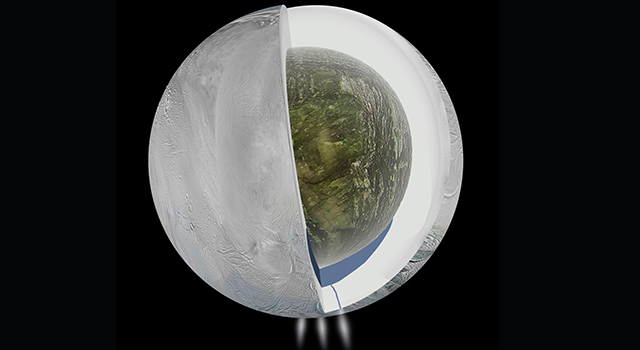
NASA’s Cassini spacecraft and Deep Space Network have uncovered evidence Saturn’s moon Enceladus harbors a large underground ocean of liquid water, furthering scientific interest in the moon as a potential home to extraterrestrial microbes.

Researchers theorized the presence of an interior reservoir of water in 2005 when Cassini discovered water vapor and ice spewing from vents near the moon’s south pole. The new data provide the first geophysical measurements of the internal structure of Enceladus, consistent with the existence of a hidden ocean inside the moon. Findings from the gravity measurements are in the Friday, April 4 edition of the journal Science.

“The way we deduce gravity variations is a concept in physics called the Doppler Effect, the same principle used with a speed-measuring radar gun,” said Sami Asmar of NASA’s Jet Propulsion Laboratory in Pasadena, Calif., a coauthor of the paper. “As the spacecraft flies by Enceladus, its velocity is perturbed by an amount that depends on variations in the gravity field that we’re trying to measure. We see the change in velocity as a change in radio frequency, received at our ground stations here all the way across the solar system.”

The gravity measurements suggest a large, possibly regional, ocean about 6 miles (10 kilometers) deep, beneath an ice shell about 19 to 25 miles (30 to 40 kilometers) thick. The subsurface ocean evidence supports the inclusion of Enceladus among the most likely places in our solar system to host microbial life. Before Cassini reached Saturn in July 2004, no version of that short list included this icy moon, barely 300 miles (500 kilometers) in diameter.

“This then provides one possible story to explain why water is gushing out of these fractures we see at the south pole,” said David Stevenson of the California Institute of Technology, Pasadena, one of the paper’s co-authors.

Cassini has flown near Enceladus 19 times. Three flybys, from 2010 to 2012, yielded precise trajectory measurements. The gravitational tug of a planetary body, such as Enceladus, alters a spacecraft’s flight path. Variations in the gravity field, such as those caused by mountains on the surface or differences in underground composition, can be detected as changes in the spacecraft’s velocity, measured from Earth.

The technique of analyzing a radio signal between Cassini and the Deep Space Network can detect changes in velocity as small as less than one foot per hour (90 microns per second). With this precision, the flyby data yielded evidence of a zone inside the southern end of the moon with higher density than other portions of the interior.

The south pole area has a surface depression that causes a dip in the local tug of gravity. However, the magnitude of the dip is less than expected given the size of the depression, leading researchers to conclude the depression’s effect is partially offset by a high-density feature in the region, beneath the surface.

“The Cassini gravity measurements show a negative gravity anomaly at the south pole that however is not as large as expected from the deep depression detected by the onboard camera,” said the paper’s lead author, Luciano Iess of Sapienza University of Rome. “Hence the conclusion that there must be a denser material at depth that compensates the missing mass: very likely liquid water, which is seven percent denser than ice. The magnitude of the anomaly gave us the size of the water reservoir.”

There is no certainty the subsurface ocean supplies the water plume spraying out of surface fractures near the south pole of Enceladus, however, scientists reason it is a real possibility. The fractures may lead down to a part of the moon that is tidally heated by the moon’s repeated flexing, as it follows an eccentric orbit around Saturn.

Much of the excitement about the Cassini mission’s discovery of the Enceladus water plume stems from the possibility that it originates from a wet environment that could be a favorable environment for microbial life.

“Material from Enceladus’ south polar jets contains salty water and organic molecules, the basic chemical ingredients for life,” said Linda Spilker, Cassini’s project scientist at JPL. “Their discovery expanded our view of the ‘habitable zone’ within our solar system and in planetary systems of other stars. This new validation that an ocean of water underlies the jets furthers understanding about this intriguing environment.”

The Cassini-Huygens mission is a cooperative project of NASA, the European Space Agency and the Italian Space Agency. JPL manages the mission for NASA’s Science Mission Directorate in Washington. For more information about Cassini, visit:

http://www.nasa.gov/cassini

and

http://saturn.jpl.nasa.gov

http://www.jpl.nasa.gov/news/news.php?release=2014-103&utm_source=iContact&utm_medium=email&utm_campaign=NASAJPL&utm_content=cassini20140403

Thanks to Kebmodee for bringing this to the attention of the It’s Interesting community.

Red Moon, Green Light

This is not a scene from a sci-fi special effects movie. The green beam of light and red lunar disk are real enough, captured in the early morning hours of April 15. Of course, the reddened lunar disk is easy to explain as the image was taken during this week’s total lunar eclipse. Immersed in shadow, the eclipsed Moon reflects the dimmed reddened light of all the sunsets and sunrises filtering around the edges of planet Earth, seen in silhouette from a lunar perspective. But the green beam of light really is a laser. Shot from the 3.5-meter telescope at Apache Point Observatory in southern New Mexico, the beam’s path is revealed as Earth’s atmosphere scatters some of the intense laser light. The laser’s target is the Apollo 15 retroreflector, left on the Moon by the astronauts in 1971. By determining the light travel time delay of the returning laser pulse, the experimental team from UC San Diego is able to measure the Earth-Moon distance to millimeter precision and provide a test of General Relativity, Einstein’s theory of gravity. Conducting the lunar laser ranging experiment during a total eclipse uses the Earth like a cosmic light switch. With direct sunlight blocked, the reflector’s performance is improved over performance when illuminated by sunlight during a normal Full Moon, an effect fondly known as The Full Moon Curse.

http://apod.nasa.gov/apod/ap140418.html

Thanks to Kebmodee for bringing this to the attention of the It’s Interesting community.

Columbian Mammoth becomes South Carolina’s state fossil, with official language in the State Bill of it’s creation by God on the Sixth Day

<img src="https://its-interesting.com/wp-content/uploads/2014/04

The Columbian Mammoth is about to become an official state symbol of South Carolina, but its path to the limelight was long and fraught with controversy.

Here's the text of the bill that made it official:

Section 1-1-712A. The Columbian Mammoth, which was created on the Sixth Day with the other beasts of the field, is designated as the official State Fossil of South Carolina and must be officially referred to as the ‘Columbian Mammoth’, which was created on the Sixth Day with the other beasts of the field.

This is actually the watered-down version of the bill; one version, proposed earlier, made even more explicit references to the role of a divine creator in the mammoth’s history.

This all started when an 8-year-old suggested that the Columbian mammoth become South Carolina’s state fossil. Olivia McConnell had some good reasoning behind her suggestion: Mammoth teeth found in a South Carolina swamp in 1725 were the first vertebrate fossils identified in North America.

Her submission became a bill. The original draft was simple enough: “Section 1-1-691. The Wooly Mammoth is designated as the official State Fossil of South Carolina.” But almost immediately the proposal ran into trouble. On a practical level: Senate Majority Leader Harvey Peeler objected strenuously to having any new state symbols enacted in a state that already has a state spider, state beverage and a state hospitality beverage among many others. On a philosophical level: proclaiming a state fossil in a state where there is still intense debate over teaching evolution as fact creates some problems.

From USA Today:

State Sen. Mike Fair, a Greenville Republican who serves on the panel that will decide the science standards, said that natural selection should be taught as theory rather than as scientific fact. He argues that natural selection can make biological changes within species but it can’t explain the whole progression from microbes to humans.

“This whole subject should be taught as a pro and con,” he said.

Last week, Fair had raised his own objection that temporarily killed Olivia’s bill but withdrew it after another senator told him the story of the Lake City girl’s campaign to get an official state fossil.

Fair wasn’t the only one who had objections. Another State Senator, Kevin Bryant started a pushing a change that would add some biblical flair to the otherwise direct language. The New York Times:

But then Senator Kevin Bryant proposed an amendment rooted in the Book of Genesis, imputing God as the creator of the woolly mammoth: “And God made the beast of the earth after his kind, the cattle after their kind, and everything that creepeth upon the earth after his kind: and God saw that it was good.”
Bryant’s version was struck down, but the final version of the bill did include that language about the Mammoth being created on the sixth day.

There was one other addition, too. Frustrated by the amount of time spent discussing state symbols instead of governing, legislators also added an amendment to the bill prohibiting the General Assembly from enacting any new state symbols “until such time as the General Assembly directly by legislative enactment removes this moratorium.”

Read more: http://www.smithsonianmag.com/smart-news/south-carolinas-state-fossil-creation-controversy-180950474/#4mOTlJmLsprzxrmM.99

Thanks to Kebmodee for bringing this to the attention of the It’s Interesting community.