Mars One – proposed human settlement on Mars in 2023

Human Settlement on Mars in 2023
Mars One is a not-for-profit organization that will take humanity to Mars in 2023, to establish the foundation of a permanent settlement from which we will prosper, learn, and grow. Before the first crew lands, Mars One will have established a habitable, sustainable settlement designed to receive astronauts every two years. To accomplish this, Mars One has developed a precise, realistic plan based entirely upon existing technologies. It is both economically and logistically feasible, in motion through the integration of existing suppliers and experts in space exploration.
We invite you to participate in this journey, by sharing our vision with your friends, by supporting our effort and, perhaps, by becoming the next Mars astronaut yourself.

http://mars-one.com/en/

Thanks to Kebmodee for bringing this to the attention of the It’s Interesting community.

World War One Wasteland – rare photographs

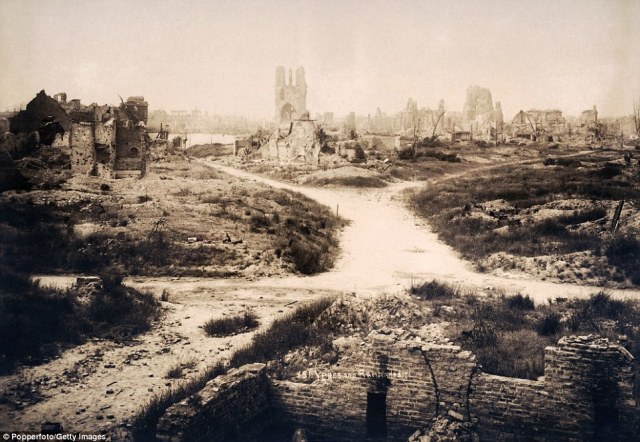
It could be the scene from a nuclear holocaust. A once-thriving city reduced to mere rubble, a 700-year-old cathedral barely left standing, trees that proudly lined an idyllic avenue torn to shreds. There’s barely anyone in sight. But the devastation wrought in these rare, haunting images was caused long before the atomic bomb came into existence.
It is the apocalyptic aftermath of dogged fighting along the Western Front during World War One when Allied and German forces tried to shell each other into submission with little success other than leaving a trail of utter carnage and killing millions.

The strategically important Belgian city of Ypres, which stood in the way of Germany’s planned sweep into France from the North, bore the brunt of the onslaught.
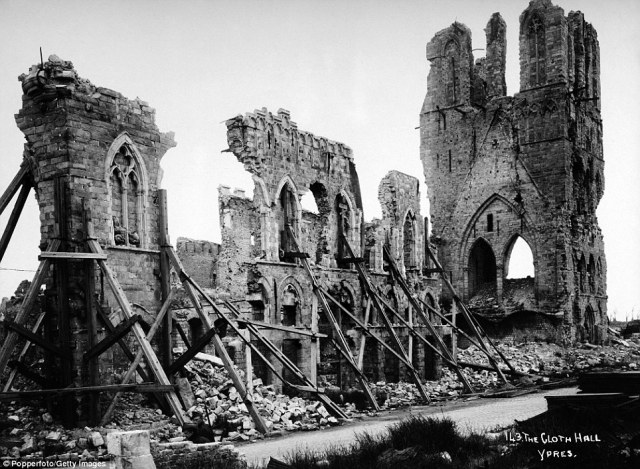
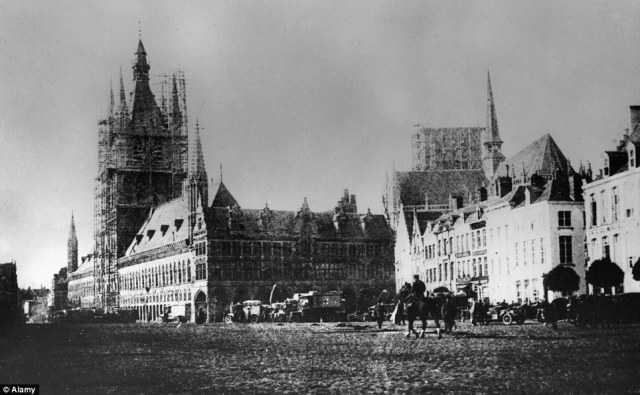
At its height, the city was a prosperous centre of trade in the cloth industry known throughout the world. After the war, it was unrecognizable. The Cloth Hall, which was one of the largest commercial buildings of the Middle Ages when it served as the city’s main market for the industry, was left looking like a medieval ruin.
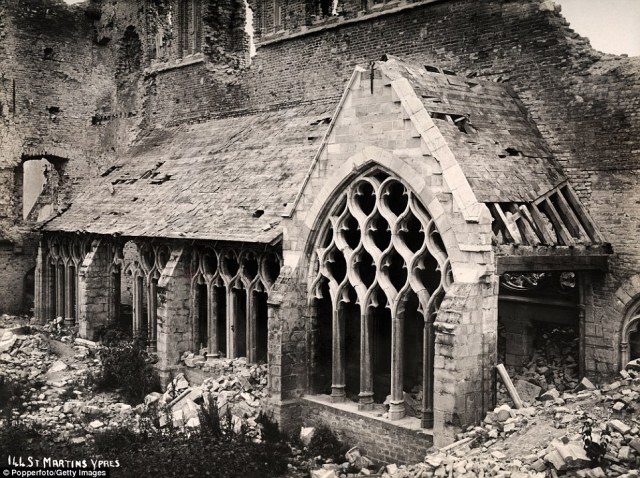
Its stunning cathedral, St Martin’s, fared little better

ww1
Apocalypse: This was all that remained of the Belgian town of Ypres in March 1919 after fierce fighting during World War One reduced it to mere rubble

ww2
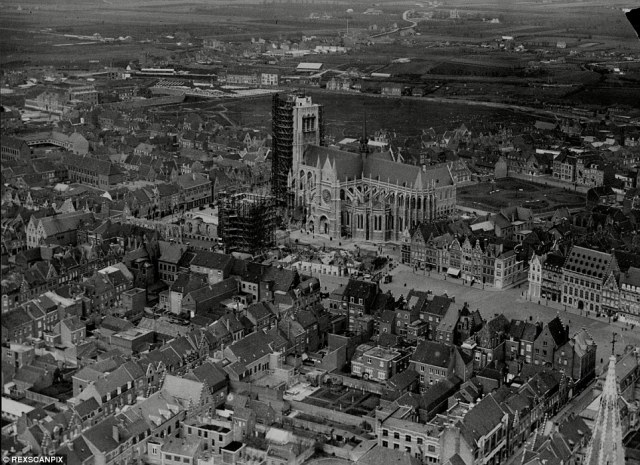
In rehab: An aerial view of Ypres under construction in 1930 which gives an idea of how the city looked before it was bombarded during the Great War

ww3
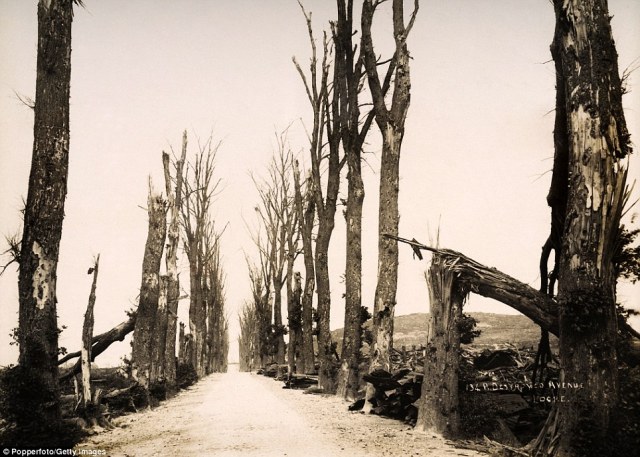
Felled: Trees along an avenue in Locre, Belgium, lie torn to shreds. These images are from a series documenting the devastation caused along the Western Front

ww4
Destroyed: The Hotel de Ville in Arras, Northern France, looks more like a medieval ruins after it was heavily shelled during World War One

ww5
Shaping nature: A huge bomb crater at Messines Ridge in Northern France, photographed circa March 1919, soon after the end of World War One

ww6
Reflected glory: A peaceful pond is what remains today of the craters made by massive mines on the Messines Ridge near Ypres. Their explosion was heard in London

ww7
Sorry sight: The Cloth Hall at Ypres, which was one of the largest commercial buildings of the Middle Ages when it served as the main market for the city’s cloth industry

ww8
Standing proud: How the Cloth Hall looked just before before the 1st bombardment by the Germans during the first battle of Ypres in October 1914

ww1
Doomsday: St Martin’s cathedral at Ypres, which was rebuilt using the original plans after the war. At 102 metres (335 ft), it is among the tallest buildings in Belgium

ww1
Devastation: St Martin’s Cathedral was the seat of the former diocese of Ypres from 1561 to 1801 and is still commonly referred to as such

ww1
How it looked before: The cathedral was rebuilt to the original Gothic design, with a spire added, as seen here in 1937

ww1
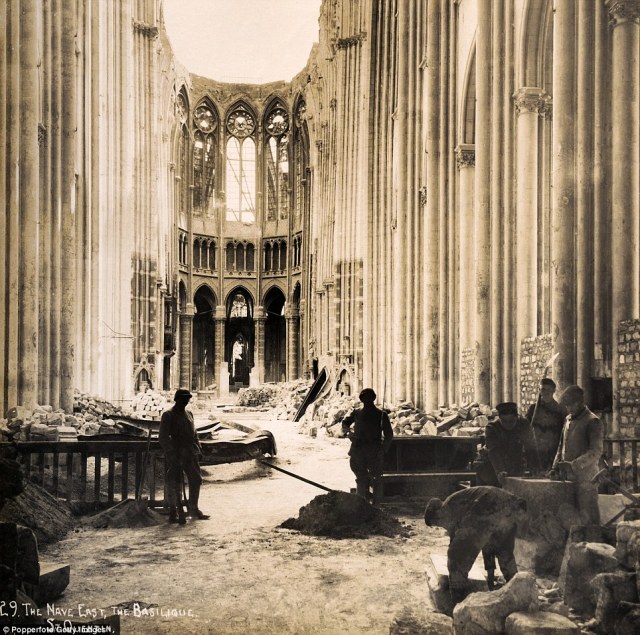
Clear-up effort: The East end of the Nave in the Basilique at Saint-Quentin in Northern France photographed soon after the end of World War One, circa March 1919

ww1
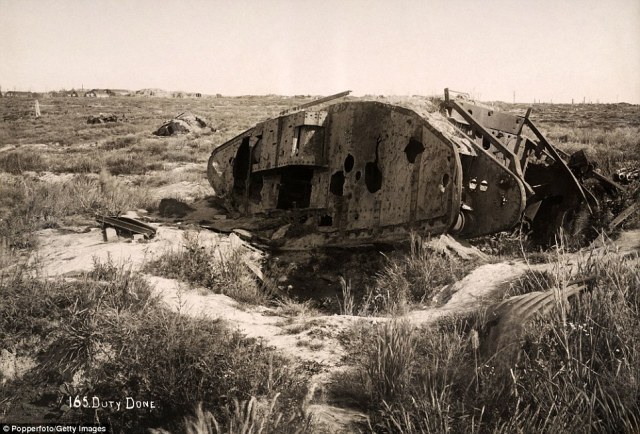
Shot to pieces: The wreckage of a tank. Some 7.5million men lost their lives on the Western Front during World War One

ww1
Forlorn: A little girl cuts a sorry figure surrounded by the ruined buildings in the French village of Neuve Eglise, which was heavily bombed

Read more: http://www.dailymail.co.uk/news/article-2282108/World-War-One-wasteland-Haunting-rare-images-apocalyptic-destruction-Western-Front.html#ixzz2LZUhxVxX

Thanks to Kebmodee for bringing this to the attention of the It’s Interesting community.

New bionic hand allows person to feel what they are touching

2-bionic-handsBionic-handv1

The first bionic hand that allows an amputee to feel what they are touching will be transplanted later this year in a pioneering operation that could introduce a new generation of artificial limbs with sensory perception.

The patient is an unnamed man in his 20s living in Rome who lost the lower part of his arm following an accident, said Silvestro Micera of the Ecole Polytechnique Federale de Lausanne in Switzerland.

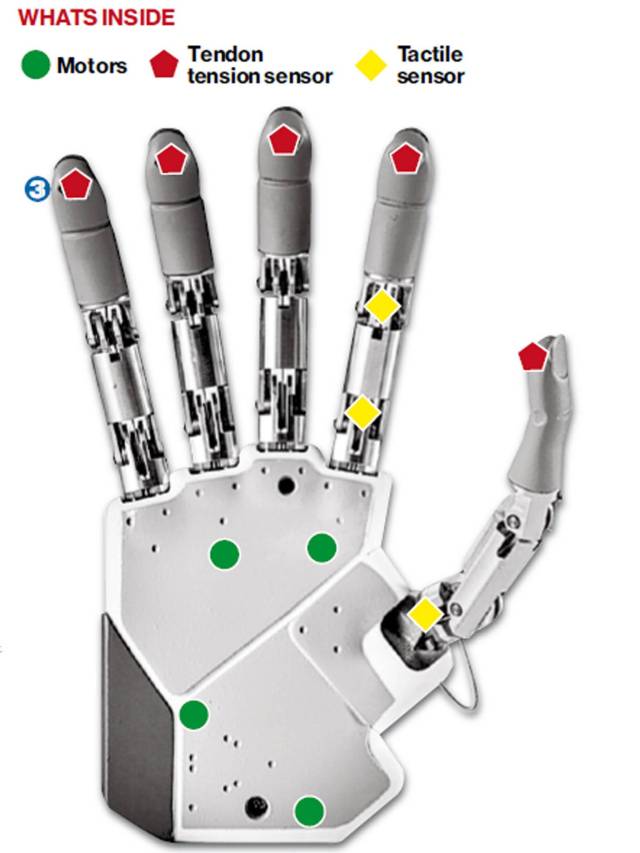
The wiring of his new bionic hand will be connected to the patient’s nervous system with the hope that the man will be able to control the movements of the hand as well as receiving touch signals from the hand’s skin sensors.

Dr Micera said that the hand will be attached directly to the patient’s nervous system via electrodes clipped onto two of the arm’s main nerves, the median and the ulnar nerves.

This should allow the man to control the hand by his thoughts, as well as receiving sensory signals to his brain from the hand’s sensors. It will effectively provide a fast, bidirectional flow of information between the man’s nervous system and the prosthetic hand.

“This is real progress, real hope for amputees. It will be the first prosthetic that will provide real-time sensory feedback for grasping,” Dr Micera said.

“It is clear that the more sensory feeling an amputee has, the more likely you will get full acceptance of that limb,” he told the American Association for the Advancement of Science meeting in Boston.

“We could be on the cusp of providing new and more effective clinical solutions to amputees in the next year,” he said.

An earlier, portable model of the hand was temporarily attached to Pierpaolo Petruzziello in 2009, who lost half his arm in a car accident. He was able to move the bionic hand’s fingers, clench them into a fist and hold objects. He said that he could feel the sensation of needles pricked into the hand’s palm.

However, this earlier version of the hand had only two sensory zones whereas the latest prototype will send sensory signals back from all the fingertips, as well as the palm and the wrists to give a near life-like feeling in the limb, Dr Micera said.

“The idea would be that it could deliver two or more sensations. You could have a pinch and receive information from three fingers, or feel movement in the hand and wrist,” Dr Micera said.

“We have refined the interface [connecting the hand to the patient], so we hope to see much more detailed movement and control of the hand,” he told the meeting.

The plan is for the patient to wear the bionic hand for a month to see how he adapts to the artificial limb. If all goes well, a full working model will be ready for testing within two years, Dr Micera said.

One of the unresolved issues is whether patients will be able to tolerate having such a limb attached to them all the time, or whether they would need to remove it periodically to give them a rest.

Another problem is how to conceal the wiring under the patient’s skin to make them less obtrusive. The electrodes of the prototype hand to be fitted later this year will be inserted through the skin rather than underneath it but there are plans under development to place the wiring subcutaneously, Dr Micera said.

http://www.independent.co.uk/life-style/gadgets-and-tech/news/a-sensational-breakthrough-the-first-bionic-hand-that-can-feel-8498622.html

Thanks to Kebmodee for bringing this to the attention of the It’s Interesting community.

Mississippi finally ratifies 13th Amendment abolishing slavery

jackson_mississippi

The Mississippi government this month formally ratified the 13th Amendment abolishing slavery. The amendment was adopted by the U.S. in 1865. But, like several other states whose delegations opposed the measure at the time — New Jersey and Kentucky included — Mississippi subsequently voted to ratify the amendment. That vote happened in 1995.

But, in Mississippi a key step was never taken and the ratification was not made official.

Dr. Ranjan Batra, an associate professor at the University of Mississippi Medical Center, looked into the issue after watching the Steven Spielberg movie “Lincoln.” He, along with another UMC colleague, discovered that the state did not officially notify the U.S. archivist in 1995 as required.

Batra’s colleague called the Mississippi secretary of state, who at last sent the needed paperwork to the National Archives. The Federal Register wrote back on Feb. 7 to confirm that “with this action, the State of Mississippi has ratified the 13th Amendment to the Constitution of the United States.”

Read more: http://www.foxnews.com/politics/2013/02/18/mississippi-fixes-oversight-formally-ratifies-13th-amendment-on-slavery/#ixzz2LGrGPvo6

Thanks to Kebmodee for bringing this to the attention of the It’s Interesting community.

Lab rats given a 6th sense through a brain-machine interface

_65888650_65886269

Duke University researchers have effectively given laboratory rats a “sixth sense” using an implant in their brains.

An experimental device allowed the rats to “touch” infrared light – which is normally invisible to them.

The team at Duke University fitted the rats with an infrared detector wired up to microscopic electrodes that were implanted in the part of their brains that processes tactile information.

The results of the study were published in Nature Communications journal.

The researchers say that, in theory at least, a human with a damaged visual cortex might be able to regain sight through a device implanted in another part of the brain.

Lead author Miguel Nicolelis said this was the first time a brain-machine interface has augmented a sense in adult animals.

The experiment also shows that a new sensory input can be interpreted by a region of the brain that normally does something else (without having to “hijack” the function of that brain region).

“We could create devices sensitive to any physical energy,” said Prof Nicolelis, from the Duke University Medical Center in Durham, North Carolina.

“It could be magnetic fields, radio waves, or ultrasound. We chose infrared initially because it didn’t interfere with our electrophysiological recordings.”

His colleague Eric Thomson commented: “The philosophy of the field of brain-machine interfaces has until now been to attempt to restore a motor function lost to lesion or damage of the central nervous system.

“This is the first paper in which a neuroprosthetic device was used to augment function – literally enabling a normal animal to acquire a sixth sense.”
In their experiments, the researchers used a test chamber with three light sources that could be switched on randomly.

They taught the rats to choose the active light source by poking their noses into a port to receive a sip of water as a reward. They then implanted the microelectrodes, each about a tenth the diameter of a human hair, into the animals’ brains. These electrodes were attached to the infrared detectors.

The scientists then returned the animals to the test chamber. At first, the rats scratched at their faces, indicating that they were interpreting the lights as touch. But after a month the animals learned to associate the signal in their brains with the infrared source.

They began to search actively for the signal, eventually achieving perfect scores in tracking and identifying the correct location of the invisible light source.

One key finding was that enlisting the touch cortex to detect infrared light did not reduce its ability to process touch signals.

http://www.bbc.co.uk/news/science-environment-21459745

Thanks to Kebmodee for bringing this to the attention of the It’s Interesting community.

Car stuck at 125mph for an hour

shutterstock_124372423

It started with a trip to a supermarket. It ended with a high-speed chase, a frantic call to police, a highway-bound ballet, a border crossing, a ditch, and a guy who is very, very lucky to be alive.

Frank Lecerf, from his home in Pont-de-Metz, near the French city of Amiens, was making his weekly trip to the grocery store in his Renault Laguna. He was going 60 miles an hour when the car’s speed dial jammed. Lecerf tried to brake. Instead of slowing, though, the car sped up — with each tap on the brake leading to more acceleration. Eventually, the car reached a speed of 125 mph — and then remained stuck there. For an hour.

Lecerf’s general route was unexpectedly international, starting in France and ending in Belgium.

Lecerf, frantic, called the police from his car — and they sent an escort that The Guardian describes as “a platoon of police cars” to help him navigate a busy highway. (Lecerf stayed, appropriately, in the fast lane.) What resulted was a small miracle of technological coordination: Responding to emergency services’ advance warnings, three different toll booths raised their barriers as Lecerf approached. A police convoy ensured that roads were kept clear for the speeding car. Fellow drivers, obligingly, got out of the way. Emergency services patched Lecerf through to a Renault engineer who tried — though failed — to help Lecerf get the speeding car to slow down.

“My life flashed before me,” Lecerf later told Le Courrier Picard. “I just wanted it to stop.”

Finally, it did. The goal everyone had been working for, coordinating for — the speeding car running out of gas before its Newtonian nightmare ended in violence — was achieved. Lecerf’s car, finally out of fuel, came to rest in a ditch. He had driven from northern France and along the French coast up through Calais and Dunkirk, eventually crossing the border into Belgium. The little Renault had stopped, finally, in the town of Alveringem.

Before it did, though, Lecerf was stuck in his speeding car for an hour. (It’s unclear what, exactly, went wrong with the machine — though Lecerf’s upcoming lawsuit against Renault should help to figure that out.) The man and his vehicle and his communal, ad hoc escort ended up traveling more than 100 miles together before they got their Hollywood ending — an ending made possible not by individual heroics, but by collective effort.

http://www.theatlantic.com/technology/archive/2013/02/this-guys-car-got-stuck-at-125mph-for-an-hour/273140/?google_editors_picks=true

Thanks to Kebmodee for bringing this to the attention of the It’s Interesting community.

Russian family was isolated from all human contact for 40 years, unaware that WWII existed

russia1

russia2

russia3

russia4

russia5

Siberian summers do not last long. The snows linger into May, and the cold weather returns again during September, freezing the taiga into a still life awesome in its desolation: endless miles of straggly pine and birch forests scattered with sleeping bears and hungry wolves; steep-sided mountains; white-water rivers that pour in torrents through the valleys; a hundred thousand icy bogs. This forest is the last and greatest of Earth’s wildernesses. It stretches from the furthest tip of Russia’s arctic regions as far south as Mongolia, and east from the Urals to the Pacific: five million square miles of nothingness, with a population, outside a handful of towns, that amounts to only a few thousand people.

When the warm days do arrive, though, the taiga blooms, and for a few short months it can seem almost welcoming. It is then that man can see most clearly into this hidden world—not on land, for the taiga can swallow whole armies of explorers, but from the air. Siberia is the source of most of Russia’s oil and mineral resources, and, over the years, even its most distant parts have been overflown by oil prospectors and surveyors on their way to backwoods camps where the work of extracting wealth is carried on.

Thus it was in the remote south of the forest in the summer of 1978. A helicopter sent to find a safe spot to land a party of geologists was skimming the treeline a hundred or so miles from the Mongolian border when it dropped into the thickly wooded valley of an unnamed tributary of the Abakan, a seething ribbon of water rushing through dangerous terrain. The valley walls were narrow, with sides that were close to vertical in places, and the skinny pine and birch trees swaying in the rotors’ downdraft were so thickly clustered that there was no chance of finding a spot to set the aircraft down. But, peering intently through his windscreen in search of a landing place, the pilot saw something that should not have been there. It was a clearing, 6,000 feet up a mountainside, wedged between the pine and larch and scored with what looked like long, dark furrows. The baffled helicopter crew made several passes before reluctantly concluding that this was evidence of human habitation—a garden that, from the size and shape of the clearing, must have been there for a long time.

It was an astounding discovery. The mountain was more than 150 miles from the nearest settlement, in a spot that had never been explored. The Soviet authorities had no records of anyone living in the district.

The four scientists sent into the district to prospect for iron ore were told about the pilots’ sighting, and it perplexed and worried them. “It’s less dangerous,” the writer Vasily Peskov notes of this part of the taiga, “to run across a wild animal than a stranger,” and rather than wait at their own temporary base, 10 miles away, the scientists decided to investigate. Led by a geologist named Galina Pismenskaya, they “chose a fine day and put gifts in our packs for our prospective friends”—though, just to be sure, she recalled, “I did check the pistol that hung at my side.”

As the intruders scrambled up the mountain, heading for the spot pinpointed by their pilots, they began to come across signs of human activity: a rough path, a staff, a log laid across a stream, and finally a small shed filled with birch-bark containers of cut-up dried potatoes. Then, Pismenskaya said,

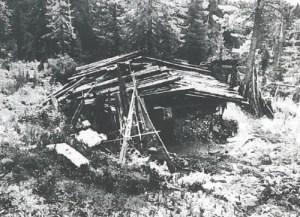
“beside a stream there was a dwelling. Blackened by time and rain, the hut was piled up on all sides with taiga rubbish—bark, poles, planks. If it hadn’t been for a window the size of my backpack pocket, it would have been hard to believe that people lived there. But they did, no doubt about it…. Our arrival had been noticed, as we could see.”

The low door creaked, and the figure of a very old man emerged into the light of day, straight out of a fairy tale. Barefoot. Wearing a patched and repatched shirt made of sacking. He wore trousers of the same material, also in patches, and had an uncombed beard. His hair was disheveled. He looked frightened and was very attentive…. We had to say something, so I began: ‘Greetings, grandfather! We’ve come to visit!’

The old man did not reply immediately…. Finally, we heard a soft, uncertain voice: ‘Well, since you have traveled this far, you might as well come in.’

The sight that greeted the geologists as they entered the cabin was like something from the middle ages. Jerry-built from whatever materials came to hand, the dwelling was not much more than a burrow—”a low, soot-blackened log kennel that was as cold as a cellar,” with a floor consisting of potato peel and pine-nut shells. Looking around in the dim light, the visitors saw that it consisted of a single room. It was cramped, musty and indescribably filthy, propped up by sagging joists—and, astonishingly, home to a family of five:

The silence was suddenly broken by sobs and lamentations. Only then did we see the silhouettes of two women. One was in hysterics, praying: ‘This is for our sins, our sins.’ The other, keeping behind a post… sank slowly to the floor. The light from the little window fell on her wide, terrified eyes, and we realized we had to get out of there as quickly as possible.

Led by Pismenskaya, the scientists backed hurriedly out of the hut and retreated to a spot a few yards away, where they took out some provisions and began to eat. After about half an hour, the door of the cabin creaked open, and the old man and his two daughters emerged—no longer hysterical and, though still obviously frightened, “frankly curious.” Warily, the three strange figures approached and sat down with their visitors, rejecting everything that they were offered—jam, tea, bread—with a muttered, “We are not allowed that!” When Pismenskaya asked, “Have you ever eaten bread?” the old man answered: “I have. But they have not. They have never seen it.” At least he was intelligible. The daughters spoke a language distorted by a lifetime of isolation. “When the sisters talked to each other, it sounded like a slow, blurred cooing.”

Slowly, over several visits, the full story of the family emerged. The old man’s name was Karp Lykov, and he was an Old Believer—a member of a fundamentalist Russian Orthodox sect, worshiping in a style unchanged since the 17th century. Old Believers had been persecuted since the days of Peter the Great, and Lykov talked about it as though it had happened only yesterday; for him, Peter was a personal enemy and “the anti-Christ in human form”—a point he insisted had been amply proved by Tsar’s campaign to modernize Russia by forcibly “chopping off the beards of Christians.” But these centuries-old hatreds were conflated with more recent grievances; Karp was prone to complain in the same breath about a merchant who had refused to make a gift of 26 poods [940 pounds] of potatoes to the Old Believers sometime around 1900.

Things had only got worse for the Lykov family when the atheist Bolsheviks took power. Under the Soviets, isolated Old Believer communities that had fled to Siberia to escape persecution began to retreat ever further from civilization. During the purges of the 1930s, with Christianity itself under assault, a Communist patrol had shot Lykov’s brother on the outskirts of their village while Lykov knelt working beside him. He had responded by scooping up his family and bolting into forest.

That was in 1936, and there were only four Lykovs then—Karp; his wife, Akulina; a son named Savin, 9 years old, and Natalia, a daughter who was only 2. Taking their possessions and some seeds, they had retreated ever deeper into the taiga, building themselves a succession of crude dwelling places, until at last they had fetched up in this desolate spot. Two more children had been born in the wild—Dmitry in 1940 and Agafia in 1943—and neither of the youngest Lykov children had ever seen a human being who was not a member of their family. All that Agafia and Dmitry knew of the outside world they learned entirely from their parents’ stories. The family’s principal entertainment, the Russian journalist Vasily Peskov noted, “was for everyone to recount their dreams.”

The Lykov children knew there were places called cities where humans lived crammed together in tall buildings. They had heard there were countries other than Russia. But such concepts were no more than abstractions to them. Their only reading matter was prayer books and an ancient family Bible. Akulina had used the gospels to teach her children to read and write, using sharpened birch sticks dipped into honeysuckle juice as pen and ink. When Agafia was shown a picture of a horse, she recognized it from her mother’s Bible stories. “Look, papa,” she exclaimed. “A steed!”

But if the family’s isolation was hard to grasp, the unmitigated harshness of their lives was not. Traveling to the Lykov homestead on foot was astonishingly arduous, even with the help of a boat along the Abakan. On his first visit to the Lykovs, Peskov—who would appoint himself the family’s chief chronicler—noted that “we traversed 250 kilometres [155 miles] without seeing a single human dwelling!”

Isolation made survival in the wilderness close to impossible. Dependent solely on their own resources, the Lykovs struggled to replace the few things they had brought into the taiga with them. They fashioned birch-bark galoshes in place of shoes. Clothes were patched and repatched until they fell apart, then replaced with hemp cloth grown from seed.

The Lykovs had carried a crude spinning wheel and, incredibly, the components of a loom into the taiga with them—moving these from place to place as they gradually went further into the wilderness must have required many long and arduous journeys—but they had no technology for replacing metal. A couple of kettles served them well for many years, but when rust finally overcame them, the only replacements they could fashion came from birch bark. Since these could not be placed in a fire, it became far harder to cook. By the time the Lykovs were discovered, their staple diet was potato patties mixed with ground rye and hemp seeds.

In some respects, Peskov makes clear, the taiga did offer some abundance: “Beside the dwelling ran a clear, cold stream. Stands of larch, spruce, pine and birch yielded all that anyone could take…. Bilberries and raspberries were close to hand, firewood as well, and pine nuts fell right on the roof.”

Yet the Lykovs lived permanently on the edge of famine. It was not until the late 1950s, when Dmitry reached manhood, that they first trapped animals for their meat and skins. Lacking guns and even bows, they could hunt only by digging traps or pursuing prey across the mountains until the animals collapsed from exhaustion. Dmitry built up astonishing endurance, and could hunt barefoot in winter, sometimes returning to the hut after several days, having slept in the open in 40 degrees of frost, a young elk across his shoulders. More often than not, though, there was no meat, and their diet gradually became more monotonous. Wild animals destroyed their crop of carrots, and Agafia recalled the late 1950s as “the hungry years.” “We ate the rowanberry leaf,” she said,

“roots, grass, mushrooms, potato tops, and bark, We were hungry all the time. Every year we held a council to decide whether to eat everything up or leave some for seed.”

Famine was an ever-present danger in these circumstances, and in 1961 it snowed in June. The hard frost killed everything growing in their garden, and by spring the family had been reduced to eating shoes and bark. Akulina chose to see her children fed, and that year she died of starvation. The rest of the family were saved by what they regarded as a miracle: a single grain of rye sprouted in their pea patch. The Lykovs put up a fence around the shoot and guarded it zealously night and day to keep off mice and squirrels. At harvest time, the solitary spike yielded 18 grains, and from this they painstakingly rebuilt their rye crop.

As the Soviet geologists got to know the Lykov family, they realized that they had underestimated their abilities and intelligence. Each family member had a distinct personality; Old Karp was usually delighted by the latest innovations that the scientists brought up from their camp, and though he steadfastly refused to believe that man had set foot on the moon, he adapted swiftly to the idea of satellites. The Lykovs had noticed them as early as the 1950s, when “the stars began to go quickly across the sky,” and Karp himself conceived a theory to explain this: “People have thought something up and are sending out fires that are very like stars.”

“What amazed him most of all,” Peskov recorded, “was a transparent cellophane package. ‘Lord, what have they thought up—it is glass, but it crumples!'” And Karp held grimly to his status as head of the family, though he was well into his 80s. His eldest child, Savin, dealt with this by casting himself as the family’s unbending arbiter in matters of religion. “He was strong of faith, but a harsh man,” his own father said of him, and Karp seems to have worried about what would happen to his family after he died if Savin took control. Certainly the eldest son would have encountered little resistance from Natalia, who always struggled to replace her mother as cook, seamstress and nurse.

The two younger children, on the other hand, were more approachable and more open to change and innovation. “Fanaticism was not terribly marked in Agafia,” Peskov said, and in time he came to realize that the youngest of the Lykovs had a sense of irony and could poke fun at herself. Agafia’s unusual speech—she had a singsong voice and stretched simple words into polysyllables—convinced some of her visitors she was slow-witted; in fact she was markedly intelligent, and took charge of the difficult task, in a family that possessed no calendars, of keeping track of time. She thought nothing of hard work, either, excavating a new cellar by hand late in the fall and working on by moonlight when the sun had set. Asked by an astonished Peskov whether she was not frightened to be out alone in the wilderness after dark, she replied: “What would there be out here to hurt me?”

Of all the Lykovs, though, the geologists’ favorite was Dmitry, a consummate outdoorsman who knew all of the taiga’s moods. He was the most curious and perhaps the most forward-looking member of the family. It was he who had built the family stove, and all the birch-bark buckets that they used to store food. It was also Dmitry who spent days hand-cutting and hand-planing each log that the Lykovs felled. Perhaps it was no surprise that he was also the most enraptured by the scientists’ technology. Once relations had improved to the point that the Lykovs could be persuaded to visit the Soviets’ camp, downstream, he spent many happy hours in its little sawmill, marveling at how easily a circular saw and lathes could finish wood. “It’s not hard to figure,” Peskov wrote. “The log that took Dmitry a day or two to plane was transformed into handsome, even boards before his eyes. Dmitry felt the boards with his palm and said: ‘Fine!'”

Karp Lykov fought a long and losing battle with himself to keep all this modernity at bay. When they first got to know the geologists, the family would accept only a single gift—salt. (Living without it for four decades, Karp said, had been “true torture.”) Over time, however, they began to take more. They welcomed the assistance of their special friend among the geologists—a driller named Yerofei Sedov, who spent much of his spare time helping them to plant and harvest crops. They took knives, forks, handles, grain and eventually even pen and paper and an electric torch. Most of these innovations were only grudgingly acknowledged, but the sin of television, which they encountered at the geologists’ camp,

“proved irresistible for them…. On their rare appearances, they would invariably sit down and watch. Karp sat directly in front of the screen. Agafia watched poking her head from behind a door. She tried to pray away her transgression immediately—whispering, crossing herself…. The old man prayed afterward, diligently and in one fell swoop.”

Perhaps the saddest aspect of the Lykovs’ strange story was the rapidity with which the family went into decline after they re-established contact with the outside world. In the fall of 1981, three of the four children followed their mother to the grave within a few days of one another. According to Peskov, their deaths were not, as might have been expected, the result of exposure to diseases to which they had no immunity. Both Savin and Natalia suffered from kidney failure, most likely a result of their harsh diet. But Dmitry died of pneumonia, which might have begun as an infection he acquired from his new friends.

His death shook the geologists, who tried desperately to save him. They offered to call in a helicopter and have him evacuated to a hospital. But Dmitry, in extremis, would abandon neither his family nor the religion he had practiced all his life. “We are not allowed that,” he whispered just before he died. “A man lives for howsoever God grants.”

When all three Lykovs had been buried, the geologists attempted to talk Karp and Agafia into leaving the forest and returning to be with relatives who had survived the persecutions of the purge years, and who still lived on in the same old villages. But neither of the survivors would hear of it. They rebuilt their old cabin, but stayed close to their old home.

Karp Lykov died in his sleep on February 16, 1988, 27 years to the day after his wife, Akulina. Agafia buried him on the mountain slopes with the help of the geologists, then turned and headed back to her home. The Lord would provide, and she would stay, she said—as indeed she has. A quarter of a century later, now in her seventies herself, this child of the taiga lives on alone, high above the Abakan.

“She will not leave. But we must leave her, seen through the eyes of Yerofei on the day of her father’s funeral:

I looked back to wave at Agafia. She was standing by the river break like a statue. She wasn’t crying. She nodded: ‘Go on, go on.’ We went another kilometer and I looked back. She was still standing there.”

Read more: http://www.smithsonianmag.com/history-archaeology/For-40-Years-This-Russian-Family-Was-Cut-Off-From-Human-Contact-Unaware-of-World-War-II-188843001.html#ixzz2JgLr6Xgw
Follow us: @SmithsonianMag on Twitter

Thanks to Kebmodee for bringing this to the attention of the It’s Interesting community.

First Evidence of Life in Antarctic Subglacial Lake

subglacial lake 4
subglacial lake 3
subglacial lake 2
subglacial lake 1

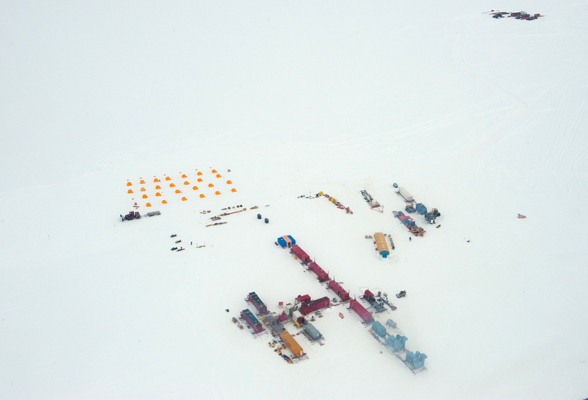
The search continues for life in subglacial Lake Whillans, 2,600 feet below the surface of the West Antarctic Ice Sheet—but a thrilling preliminary result has detected signs of life.

At 6:20am on January 28, four people in sterile white Tyvek suits tended to a wench winding cable onto the drill platform. One person knocked frost off the cable as it emerged from the ice borehole a few feet below. The object of their attention finally rose into sight: a gray plastic vessel, as long as a baseball bat, filled with water from Lake Whillans, half a mile below.

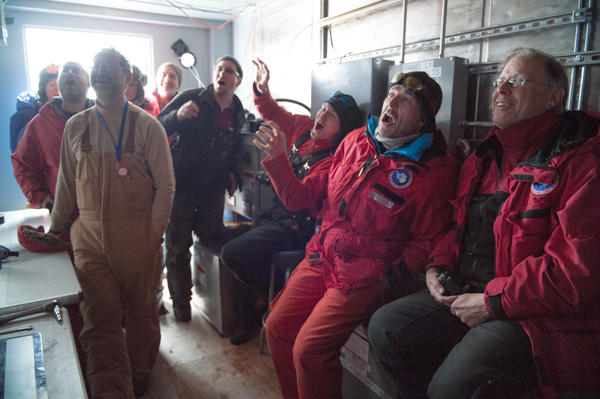
The bottle was hurried into a 40-foot cargo container outfitted as a laboratory on skis. Some of the lake water was squirted into bottles of media in order to grow whatever microbes might inhabit the lake. Those cultures could require weeks to produce results. But one test has already produced an interesting preliminary finding. When lake water was viewed under a microscope, cells were seen: their tiny bodies glowed green in response to DNA-sensitive dye. It was the first evidence of life in an Antarctic subglacial lake.

(A Russian team has reported that two types of bacteria were found in water from subglacial Lake Vostok, but DNA sequences matched those of bacteria that are known to live inside kerosene—causing the scientists to conclude that those bacteria came from kerosene drilling fluid used to bore the hole, and not from Lake Vostok itself.)

In order to conclusively demonstrate that Lake Whillans harbors life, the researchers will need to complete more time-consuming experiments showing that the cells actually grow—since dead cells can sometimes show up under a microscope with DNA-sensitive staining. And weeks or months will pass before it is known whether these cells represent known types of microbes, or something never seen before. But a couple of things seem likely. Most of those microbes probably subsist by chewing on rocks. And despite being sealed beneath 2,600 feet of ice, they probably have a steady supply of oxygen.

The oxygen comes from water melting off the base of the ice sheet—maybe a few penny thicknesses of ice per year. “When you melt ice, you’re liberating the air bubbles [trapped in that ice],” says Mark Skidmore, a geomicrobiologist at Montana State University who is part of the Whillans drilling, or WISSARD, project. “That’s 20 percent oxygen,” he says. “It’s being supplied to the bed of the glacier.”

In one possible scenario, lake bacteria could live on commonly occurring pyrite minerals that contain iron and sulfur. The bacteria would obtain energy by using oxygen to essentially “burn” that iron and sulfur (analogous to the way that animals use oxygen to slowly burn sugars and fats). Small amounts of sulfuric acid would seep out as a byproduct; that acid would attack other minerals in the sands and sediments of the lake—leaching out sodium, potassium, calcium, and other materials that would accumulate in the water.

This process, called weathering, breaks down billions of tons of minerals across the Earth’s surface each year. Researchers working on the National Science Foundation-funded WISSARD project hope to learn whether something like this also happens under the massive ice sheets covering Antarctica and Greenland. They’ve already seen one tantalizing sign.

The half mile of glacial ice sitting atop Lake Whillans is quite pure—derived from snow that fell onto Antarctica thousands of years ago. It contains only one-hundredth the level of dissolved minerals that are seen in a clear mountain creek, or in tap water from a typical city. But a sensor lowered down the borehole this week showed that dissolved minerals were far more abundant in the lake itself. “The fact that we see high concentrations is suggestive that there’s some interesting water-rock-microbe interaction that’s going on,” says Andrew Mitchell, a microbial geochemist from Aberystwyth University in the UK who is working this month at Lake Whillans.

Microbes, in other words, might well be munching on minerals under the ice sheet. The Whillans team will take months or years to unravel this picture. They will perform experiments to see whether microbes taken from the lake metabolize iron, sulfur, or other components of minerals. And they will analyze the DNA of those microbes to see whether they’re related to rock-chewing bacteria that are already known to science.

Antarctica isn’t the only place in the solar system where water sits concealed in the dark beneath thick ice. Europa and Enceladus (moons of Jupiter and Saturn, respectively) are also thought to harbor oceans of liquid water. What is learned at Lake Whillans could shed light on how best to look for life in these other places.

http://blogs.discovermagazine.com/crux/2013/01/29/first-evidence-of-life-in-antarctic-subglacial-lake/

Thanks to Kebmodee for bringing this to the attention of the It’s Interesting community.
DARPA eyes pop-up deep sea sensors with project Upward Falling Payloads

nextgov-medium

In a proposal almost as fanciful as the fictional 20,000 Leagues Under the Sea by Jules Verne, the Defense Advanced Research Projects Agency kicked off a research project last Friday to develop sensor systems that could be placed miles below the surface of the ocean and activated when needed by a remote command.

DARPA said it wants to develop a system that can store unmanned sensors such as waterborne or airborne cameras, decoys, network nodes, beacons and jammers, in watertight capsules that can withstand pressure at depths up to six kilometers (3.7 miles) and then be launched to the surface “after years of dormancy.”

Nearly half of the world’s oceans have depths deeper than 4 kilometers (2.5 miles), DARPA said, “which provides a “vast area for concealment of storage” and this concealment “also provides opportunity to surprise maritime targets from below, while its vastness provides opportunity to simultaneously operate across great distance,” DARPA said.

The agency said it envisions the subsystems of its Upward Falling Payloads projects will consist of a sensor payload, a “riser” providing pressure tolerant encapsulation of the payload and a communication system triggering launch of the payload stored on a container with an inner, 4-7/8 inch diameter and a length of 36 inches.

In the first stage of the three-phase project expected to cost no more than $1.75 million, DARPA wants researchers to concentrate on a communications system that avoids “false triggers” of the deep-sea systems and can operate at long distances from the submerged sensors. Proposals for this phase also should detail the design of a capsule and riser system that will work after sitting for years on the seabed, and potential sensor systems for military or humanitarian use.

The second phase of the project calls for the communication system to “wake up” the system on the seabed and launch it, with tests planned the Western Pacific in 2015 and 2016,though tests also could be conducted in the Atlantic or offshore from Hawaii, DARPA said.

In the third phase, planned for 2017, DARPA plans tests of a completely integrated and distributed Upward Falling Payloads system at full depth in the Western Pacific.

Proposals are due March 12 and DARPA expects to make an award in June.

http://www.nextgov.com/defense/2013/01/darpa-eyes-pop-deep-sea-sensors/60655/

Thanks to Kebmodee for bringing this to the attention of the It’s Interesting community.