A Japanese company could astound the world by 2050, building the first elevator to space.
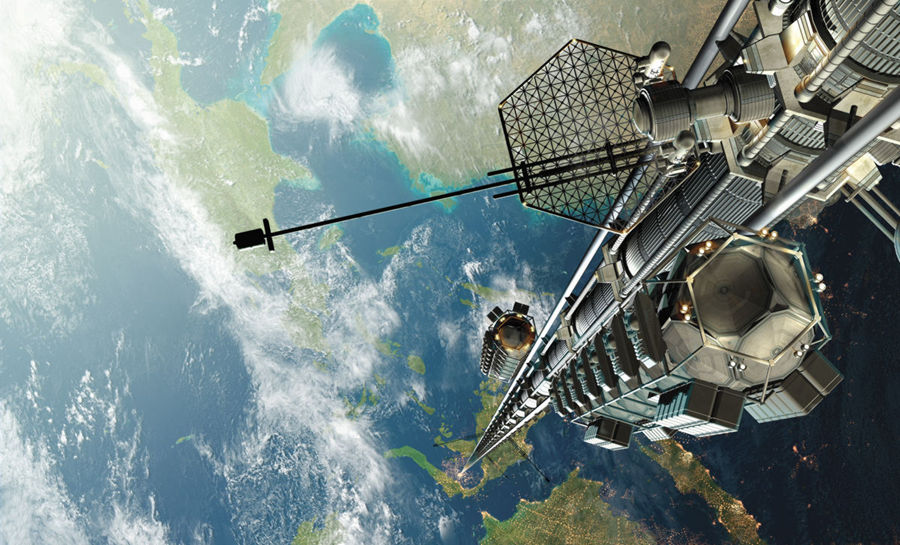
According to The Daily Yomiuri, Tokyo construction company, Obayashi Corporation, hopes to erect a space elevator by 2050. The futuristic space lift would ferry passengers and cargo along a carbon nanotube ribbon from a terrestrial terminal to a spaceport nearly a quarter of the way to the moon.
The company says it plans to create 59,652-mile-long, carbon-nanotube cable that would include an anchor in space. The terminal station would house laboratories and living space, while the life would have the capacity to ferry upwards of 30 people to the station at 124 miles per hour. The trip would translate to a nearly eight-day long trip to reach the station. Magnetic linear motors are one possible means of propulsion for the car, according to Obayashi. Solar power generation facilities would also be set up around the terminal station to transmit power to the ground, the company noted.
The company did not release details regarding the cost of the project, simply saying it remains in the planning phase.
“At this moment, we cannot estimate the cost for the project,” an Obayashi official said in a statement. “However, we’ll try to make steady progress so
that it won’t end just up as simply a dream.”
The announcement comes as a number of individuals have proposed a similar project, noting that a floating station near the Earth’s equator could serve as a launching point. However, a string of issues have largely left the proposal in the theoretical stages.
Among the issues engineers would have to confront includes the long transit times required by riding a space elevator. Engineers note that passage through the Van Allen belt would constitute a radiation hazard. A recently released study suggests that a space elevator would be subject to wobbles caused by gravitational tugs from the moon and sun, as well as solar wind. A space elevator would also constitute a navigational hazard for aircraft and low Earth orbit space craft. The project could also be subject to a terrorist attack.
Because building a space elevator involves achieving a number of technological breakthroughs, not the least of which is the mass production of carbon nanotubes, the matter of how much it would cost is a matter of debate. Bradley Carl Edwards, who conducted a study of space elevators for NASA, suggested that the total cost of construction would be about $10 billion in a 2005 IEEE Spectrum article. But the tradeoff, he suggests, is lowering the costs of space travel by orders of magnitude, to the current cost of shipping people and cargo across the Pacific Ocean.
Of note, David Smitherman of NASA/Marshall’s Advanced Projects Office has compiled plans for such an elevator that could turn science fiction into reality. His publication, Space Elevators: An Advanced Earth-Space Infrastructure for the New Millennium, is based on findings from a space infrastructure conference held at the Marshall Space Flight Center.
“The system requires the center of mass be in geostationary orbit,” said Smitherman. “The cable is basically in orbit around the Earth.”
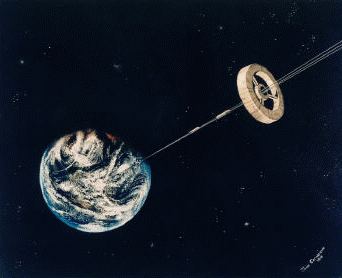
A space elevator is essentially a long cable extending from our planet’s surface into space with its center of mass at geostationary Earth orbit (GEO), 35,786 km in altitude. Electromagnetic vehicles traveling along the cable could serve as a mass transportation system for moving people, payloads, and power between Earth and space.
The NASA plan would call for a base tower approximately 50 km tall — the cable would be tethered to the top. To keep the cable structure from tumbling to Earth, it would be attached to a large counterbalance mass beyond geostationary orbit, perhaps an asteroid moved into place for that purpose. Four to six “elevator tracks” would extend up the sides of the tower and cable structure going to platforms at different levels. These tracks would allow electromagnetic vehicles to travel at speeds reaching thousands of kilometers-per-hour.
Conceptual designs place the tower construction at an equatorial site. The extreme height of the lower tower section makes it vulnerable to high winds. An equatorial location is ideal for a tower of such enormous height because the area is practically devoid of hurricanes and tornadoes and it aligns properly with geostationary orbits
Obayashi, the company, is just days away from completing work on Japan’s tallest structure, the Tokyo Sky Tree, which will stand 2,080 feet. The tower will serve as a digital broadcasting antenna as well as a sightseeing attraction that allows uninterrupted views of the Japanese capital and beyond.







 It's Interesting