Smoking Smothers Your Genes

sn-epigenetic

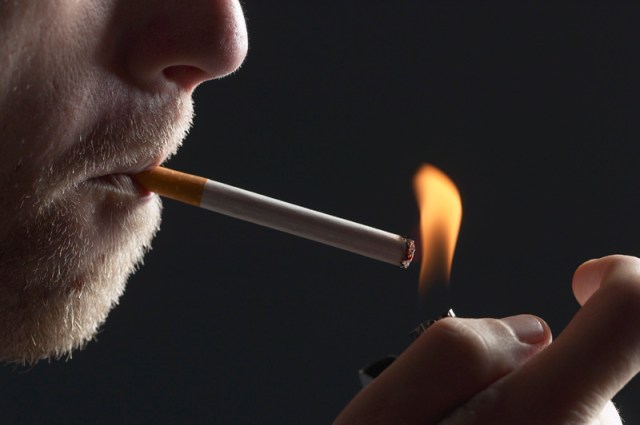
Cigarettes leave you with more than a smoky scent on your clothes and fingernails. A new study has found strong evidence that tobacco use can chemically modify and affect the activity of genes known to increase the risk of developing cancer. The finding may give researchers a new tool to assess cancer risk among people who smoke.

DNA isn’t destiny. Chemical compounds that affect the functioning of genes can bind to our genetic material, turning certain genes on or off. These so-called epigenetic modifications can influence a variety of traits, such as obesity and sexual preference. Scientists have even identified specific epigenetic patterns on the genes of people who smoke. None of the modified genes has a direct link to cancer, however, making it unclear whether these chemical alterations increase the risk of developing the disease.

In the new study, published in Human Molecular Genetics, researchers analyzed epigenetic signatures in blood cells from 374 individuals enrolled in the European Prospective Investigation into Cancer and Nutrition. EPIC, as it’s known, is a massive study aimed at linking diet, lifestyle, and environmental factors to the incidence of cancer and other chronic diseases. Half of the group consisted of people who went on to develop colon or breast cancer 5 to 7 years after first joining the study, whereas the other half remained healthy.

The team, led by James Flanagan, a human geneticist at Imperial College London, discovered a distinct “epigenetic footprint” in study subjects who were smokers. Compared with people who had never smoked, these individuals had fewer chemical tags known as methyl groups—a common type of epigenetic change—on 20 different regions of their DNA. When the researchers extended the analysis to a separate group of patients and mice that had been exposed to tobacco smoke, they narrowed down the epigenetic modifications to several sites located in four genes that have been weakly linked to cancer before. All of these changes should increase the activity of these genes, Flanagan says. It’s unclear why increasing the activity of the genes would cause cancer, he says, but individuals who don’t have cancer tend not to have these modifications.

The study is the first to establish a close link between epigenetic modifications on a cancer gene and the risk of developing the disease, says Robert Philibert, a behavioral geneticist at the University of Iowa in Iowa City. “To the best of my knowledge, no previous genome-wide epigenetics study has taken such efforts from initial discovery to replication to experimental validation,” adds Lutz Breitling, an epidemiologist at the German Cancer Research Center in Heidelberg, Germany.

The work may lead to new ways to asses cancer risks from smoking. “Previous research into smoking has often asked people to fill out questionnaires, … which have their obvious drawbacks and inaccuracies,” Flanagan says. The new study, he says, may make it possible for doctors to quantify a person’s cancer risk simply through an epigenetic analysis of their DNA.

http://news.sciencemag.org/sciencenow/2012/12/smoking-smothers-your-genes.html

Thanks to Dr. Rajadhyaksha for bringing this to the attention of the It’s Interesting community.

How gender stereotypes warp our view of depression

74583142depressioncrop

Stereotypes about male and female roles may influence the way we perceive depressed people.

It’s a well-known fact that men and women who behave the same way in the exact same situation—whether it’s a job interview, a cocktail party, or a traffic stop—are sometimes perceived and treated differently based on their gender.

Something similar, it seems, may happen when men and women start to show signs of depression. A new study, published this week in the journal PLoS ONE, suggests that people of both sexes are less likely to view men as being depressed and in need of professional help—even if a man’s symptoms are identical to a woman’s.

“A lot of attention has been paid to depression in women, and with good reason: Depression is twice as common in women,” says Dr. James B. Potash, the editor of the study and a professor of psychiatry at the University of Iowa, in Iowa City. “There has been relatively little focus on education about depression in men. This [study] emphasizes the importance of figuring out how to get through to men that depression can be disabling and treatment is important.”

Health.com: 12 Signs of Depression in Men

In the study, researchers in the U.K. asked a group of about 600 adults to read a short description of a hypothetical depressed person. This vignette, which was designed to illustrate the diagnostic criteria for clinical depression (also known as major depression), read in part:

For the past two weeks, Kate has been feeling really down. She wakes up in the morning with a flat, heavy feeling that sticks with her all day. She isn’t enjoying things the way she normally would. In fact, nothing gives her pleasure. Even when good things happen, they don’t seem to make Kate happy.

Fifty-seven percent of the study participants recognized Kate’s symptoms—which also included difficulty concentrating, fatigue, and insomnia—as indications of a mental health disorder, and more than three-quarters of those people correctly identified the disorder as depression. Only 10% of the respondents said Kate did not have a problem.

The researchers presented the same vignette to another group of 600 people. This time, however, every mention of “Kate” was replaced by “Jack,” and all the pronouns were switched from female to male. Those minor changes had a noticeable effect: Though nearly as many people recognized Jack as having a mental health problem (52%), more than twice as many as in the Kate scenario said he did not (21%).

In addition, men themselves were less likely than women to label Jack depressed—a pattern that was not seen with Kate.

Health.com: How to Help Someone Who’s Depressed

Why the difference? Male stereotypes that emphasize traits such as toughness and strength may dissuade both women and men, and especially the latter, from identifying or acknowledging the signs of depression in men, says study author Viren Swami.

“Men are expected to be strong, deny pain and vulnerability, and conceal any emotional fragility,” says Swami, a psychologist at the University of Westminster, in London. “Because of these societal expectations, men appear to have poorer understanding of mental health and aren’t as good at detecting symptoms of depression compared with women.”

Potash says the findings also may reflect the fact that women are generally more attuned to emotions and better at articulating them. Some men might have all the outward signs of depression, and yet when asked about their mood they “may not be able to say much more than ‘I don’t know,’” he says. “A substantial minority of men just don’t describe depression.”

Health.com: 10 Careers With High Rates of Depression

On a deeper level, men’s failure to recognize the symptoms of depression in a fellow male may represent a kind of defense mechanism prompted by an “unconscious identification” with that man, says Dr. Radu Saveanu, a professor of psychiatry at the University of Miami Miller School of Medicine.

“They may think, ‘If this guy is having trouble and may need treatment, I may be in the same position someday,’” says Saveanu, who was not involved in the study. “That anxiety distorts the ability to be more objective.”

All of these dynamics may affect the likelihood of seeking or recommending treatment. In the study, men were more likely than women to recommend that Kate seek professional help, but this gap disappeared in the Jack scenario. Men also expressed less sympathy for Jack than women did.

The reluctance to seek treatment isn’t unique to men, but it does reflect an independent-minded streak that is more common among males, Potash says. Men tend to think that pulling themselves out of depression is “something they ought to be able to do,” he says. “It’s the stereotype of men who never ask for directions. They won’t admit that they can’t take care of it themselves.”

Health.com: Depressed? 12 Mental Tricks to Turn It Around

Gender, of course, isn’t the only factor that shapes how we view depression symptoms. Swami also found that respondents of either sex who held negative attitudes towards psychiatry and science felt that both Kate and Jack’s symptoms were less distressing, more difficult to treat, and less worthy of sympathy or professional help.

Swami took these trends into account, but he can’t rule out that other factors might have influenced the gender differences seen in the study. The participants’ own mental health history was unknown, for instance, though Swami says previous diagnoses do not tend to impact “mental health literacy,” or how well people understand mental health issues.

Future research will need to address these limitations, he says.

Read more: http://healthland.time.com/2012/11/15/how-gender-stereotypes-warp-our-view-of-depression/#ixzz2Es26tBvB


University of Iowa Carver College of Medicine Doctors Reattach Hand and Wrist After Tree Accident


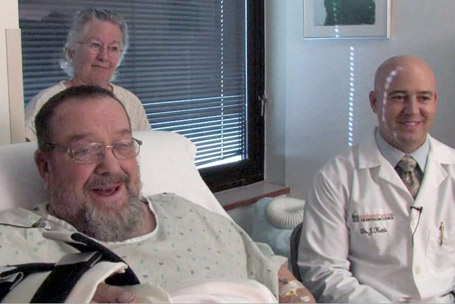
Roger Batchelder knows what it means to be truly thankful.

The 74-year-old LaPorte City, Iowa, retired fire fighter has been a patient at University of Iowa Hospitals and Clinics since Halloween, when a tree-cutting accident resulted in the complete removal of his right hand and wrist.

Thanks to the quick action of paramedics on the scene, the air ambulance crew, UI Hospitals and Clinics plastic surgeons Jerrod Keith, MD and Brad Coots, MD, orthopedic surgeon Todd McKinley, MD, and a full complement of emergency department and surgical personnel, Batchelder’s hand was saved and reattached, and he may regain some use eventually.

“Words don’t even express how grateful I am,” says Batchelder. “The fact that the doctor assembled his surgical team so quickly sped the whole thing up and helped save my hand.”

Keith and Coots led a surgical team that worked for eight hours to reattach Batchelder’s hand, as well as reconnecting tissue, muscle, nerves and tendons.

“We quickly and efficiently talked to Roger in the emergency department to let him know what his options were,” Keith said.

He said they told Batchelder they could reattach the hand but there would be risks: it was a long surgery, there was no guarantee the hand would regain any function and because the surgery would cause a large loss of blood and need for transfusion, it could be potentially life-threatening.

“I didn’t even have to think about it,” Batchelder said. “For me, I thought it would be better than a hook.”

Accident in the field

Batchelder was helping a friend prepare a field to be cleared for farming in the early afternoon of Oct. 31. He said there were about eight trees that had to be cut before the bulldozer could come in to remove the stumps, and they had to be cleared that day.

“When I started there wasn’t much wind at all,” he says. “A bit later I noticed the wind started to pick up so I adjusted my work a little.”

Batchelder is experienced with a chain saw and has been clearing trees and brush from areas for years. When it’s time to remove a tree he cuts a wedge on the side of the tree that will bend and fall, and cuts a pair of slices in the other side to help it along.

He had already gotten five trees down, but the sixth tree was being a bit difficult. Usually when he cuts the wedge, he says, the tree starts to move toward the fall. This time, however, the tree didn’t budge. He went to the other side and cut the slits – but nothing happened.

“The wind was blowing the wrong direction, it was kind of holding the tree up,” Batchelder says.

That lasted just a few seconds before things suddenly turned dangerous. The tree started falling toward the slits rather than the wedge – and right toward where Batchelder was standing.

“I saw the tree starting to come at me so I started to back up,” he says.

He backed up to get away from the tree but stepped in a hole and got stuck. The tree, he said, fell on his arm, right above his wrist. He thought the tree crushed his arm against the stump.

“The tree hit me in the chest and I fell to the ground. I pitched the chain saw off to the side so I wouldn’t land on it,” he says.

Batchelder’s wife, Patty, was just a few yards away with the couple’s truck when she saw the tree begin to fall. She immediately drove over to where he husband was lying.

“There was the tree, the chainsaw, Roger and there, by the tree, was his hand,” she says.

Roger Batchelder never lost consciousness. His wife applied pressure and told him to hold it, and she drove to a neighbor’s house to call 911.

“We didn’t have cell phones with us,” she said.

At the hospital

Keith said Patty Batchelder’s quick thinking, the air ambulance crew salvaging the hand and keeping it on ice and the inclusive nature of UI Hospitals and Clinics, which allowed him to pull a surgical team together within minutes, combined to make reattachment possible.

“You typically have a five- to six-hour window from time of trauma to surgery to have a successful reattachment of the forearm,” he says. “The longer it is kept on ice, the better the chances.”

Though amputated fingers and even hands have a longer window of time before surgery, the fact that this included part of the forearm complicated the surgery, Keith said, and shortened that time availability. While Batchelder was still in the emergency department, Keith and Coots took the hand to the operating room to begin preparing it for surgery, which included identifying all of the nerves, tendons, and tissues.

“The team atmosphere makes this successful and possible,” Keith says. “That is the key to success, having everyone involved.”

Though Roger Batchelder’s age could have been detrimental to the procedure, his health and activity level aided in the successful surgery, as well.

“He’s out there cutting down trees and farming,” Keith says. “As soon as I saw him I knew he could handle it.”

Batchelder’s first surgery was immediate and lasted a little more than eight hours. He’s had two more surgeries to remove dead tissue.

Keith is optimistic that the reattachment was a success, but says he’s not sure how much use Batchelder will get from the hand even after physical therapy.

“We’ll start looking at rehabilitation and what kind of function he may get back,” Keith says.

Batchelder isn’t concerned with the level of use he will get from his hand, he’s just glad to have it reattached.

“Anything that nature gives you is better than something that’s made by man,” he says. “Even though I may not be able to use it as it used to be, I’ll be able to use it as it was meant to be.”

http://www.uihealthcare.org/Newsarticle.aspx?id=236423