Molten gold was poured down his throat until his bowels burst

F R W van de Goot, R L ten Berge, R Vos
The Journal of Clinical Pathology

In 1599, a Spanish governor in early colonial Ecuador suffered this fate. Native Indians of the Jivaro tribe, unscrupulously taxed in their gold trade, attacked the settlement of Logrono and executed the gold hungry governor by pouring molten gold down his throat. Pouring hot liquids or metals, such as lead or gold, into the mouth of a victim was a practice used on both sides of the Atlantic Ocean, by the Romans and the Spanish Inquisition among others.

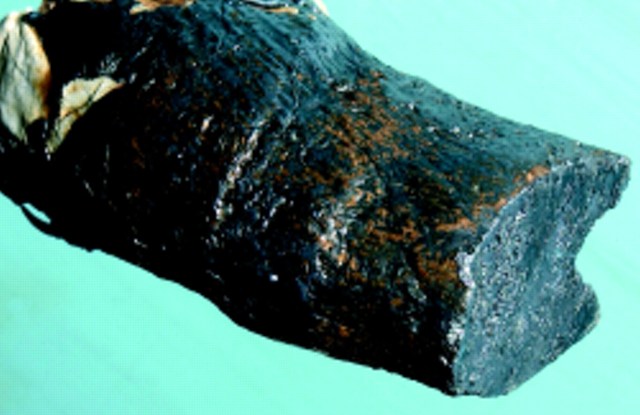
Several sources mention the bursting of internal organs. The question remains whether this is actually the case and, also, what the cause of death would be. To investigate this, we obtained a bovine larynx from a local slaughter house (no animal was harmed or killed specifically for this purpose). After fixing the larynx in a horizontal position to a piece of wood and closing the distal end using tissue paper, 750 g of pure lead (around 450°C) was heated until melting and then poured into the larynx. Immediately, large amounts of steam appeared at both ends of the specimen, and the clot of tissue paper was expelled with force by the steam. Within 10 seconds, the lead had congealed again, completely filling the larynx.

After cooling, cross sections of the larynx were made, and formalin fixed, paraffin wax embedded slides of the laryngeal wall were observed under the light microscope. The laryngeal mucosa was found to be totally absent, and coagulation necrosis of the underlying chondroid and striated muscle was seen at a maximum depth of 1 cm.

Based on these findings, we suggest that the development of steam with increasing pressure might result in both heat induced and mechanical damage to distal organs, possibly leading to over inflation and rupture of these organs. Direct thermal injury to the lungs may lead to instantaneous death, as a result of acute pulmonary dysfunction and shock. Even if this is not the case, the development of a “cast” (once the metal congeals again) would completely block the airways, thus suffocating the victim.

In conclusion, we have shown that in the execution method of pouring hot liquefied metals into the throat of a victim, death is probably mediated by the development of steam and consequent thermal injury to the airways.

http://jcp.bmj.com/content/56/2/157.full

Richard A. Friedman: Why can’t doctors identify killers?

MASS killers like Elliot Rodger teach society all the wrong lessons about the connection between violence, mental illness and guns — and what we should do about it. One of the biggest misconceptions, pushed by our commentators and politicians, is that we can prevent these tragedies if we improve our mental health care system. It is a comforting notion, but nothing could be further from the truth.

And although the intense media attention might suggest otherwise, mass killings — when four or more people are killed at once — are very rare events. In 2012, they accounted for only about 0.15 percent of all homicides in the United States. Because of their horrific nature, however, they receive lurid media attention that distorts the public’s perception about the real risk posed by the mentally ill.

Anyone who watched Elliot Rodger’s chilling YouTube video, detailing his plan for murderous vengeance before he killed six people last week near Santa Barbara, Calif., would understandably conflate madness with violence. While it is true that most mass killers have a psychiatric illness, the vast majority of violent people are not mentally ill and most mentally ill people are not violent. Indeed, only about 4 percent of overall violence in the United States can be attributed to those with mental illness. Most homicides in the United States are committed by people without mental illness who use guns.

Mass killers are almost always young men who tend to be angry loners. They are often psychotic, seething with resentment and planning revenge for perceived slights and injuries. As a group, they tend to avoid contact with the mental health care system, so it’s tough to identify and help them. Even when they have received psychiatric evaluation and treatment, as in the case of Mr. Rodger and Adam Lanza, who killed 20 children and seven adults, including his mother, in Connecticut in 2012, we have to acknowledge that our current ability to predict who is likely to be violent is no better than chance.

Large epidemiologic studies show that psychiatric illness is a risk factor for violent behavior, but the risk is small and linked only to a few serious mental disorders. People with schizophrenia, major depression or bipolar disorder were two to three times as likely as those without these disorders to be violent. The actual lifetime prevalence of violence among people with serious mental illness is about 16 percent compared with 7 percent among people who are not mentally ill.

What most people don’t know is that drug and alcohol abuse are far more powerful risk factors for violence than other psychiatric illnesses. Individuals who abuse drugs or alcohol but have no other psychiatric disorder are almost seven times more likely than those without substance abuse to act violently.

As a psychiatrist, I welcome calls from our politicians to improve our mental health care system. But even the best mental health care is unlikely to prevent these tragedies.

If we can’t reliably identify people who are at risk of committing violent acts, then how can we possibly prevent guns from falling into the hands of those who are likely to kill? Mr. Rodger had no problem legally buying guns because he had neither been institutionalized nor involuntarily hospitalized, both of which are generally factors that would have prevented him from purchasing firearms.

Would lowering the threshold for involuntary psychiatric treatment, as some argue, be effective in preventing mass killings or homicide in general?

It’s doubtful.

The current guideline for psychiatric treatment over the objection of the patient is, in most states, imminent risk of harm to self or others. Short of issuing a direct threat of violence or appearing grossly disturbed, you will not receive involuntary treatment. When Mr. Rodger was interviewed by the police after his mother expressed alarm about videos he had posted, several weeks ago, he appeared calm and in control and was thus not apprehended. In other words, a normal-appearing killer who is quietly planning a massacre can easily evade detection.

In the wake of these horrific killings, it would be understandable if the public wanted to make it easier to force treatment on patients before a threat is issued. But that might simply discourage other mentally ill people from being candid and drive some of the sickest patients away from the mental health care system.

We have always had — and always will have — Adam Lanzas and Elliot Rodgers. The sobering fact is that there is little we can do to predict or change human behavior, particularly violence; it is a lot easier to control its expression, and to limit deadly means of self-expression. In every state, we should prevent individuals with a known history of serious psychiatric illness or substance abuse, both of which predict increased risk of violence, from owning or purchasing guns.

But until we make changes like that, the tragedy of mass killings will remain a part of American life.

Richard A. Friedman is a professor of clinical psychiatry and the director of the psychopharmacology clinic at the Weill Cornell Medical College.

Parenting Rewires the Male Brain

By Elizabeth Norton

Cultures around the world have long assumed that women are hardwired to be mothers. But a new study suggests that caring for children awakens a parenting network in the brain—even turning on some of the same circuits in men as it does in women. The research implies that the neural underpinnings of the so-called maternal instinct aren’t unique to women, or activated solely by hormones, but can be developed by anyone who chooses to be a parent.

“This is the first study to look at the way dads’ brains change with child care experience,” says Kevin Pelphrey, a neuroscientist at Yale University who was not involved with the study. “What we thought of as a purely maternal circuit can also be turned on just by being a parent—which is neat, given the way our culture is changing with respect to shared responsibility and marriage equality.”

The findings come from an investigation of two types of households in Israel: traditional families consisting of a biological mother and father, in which the mother assumed most of the caregiving duties, though the fathers were very involved; and homosexual male couples, one of whom was the biological father, who’d had the child with the help of surrogate mothers. The two-father couples had taken the babies home shortly after birth and shared caregiving responsibilities equally. All participants in the study were first-time parents.

Researchers led by Ruth Feldman, a psychologist and neuroscientist at Bar-Ilan University in Ramat Gan, Israel, visited with the families in their homes, videotaping each parent with the child and then the parents and children alone. The team, which included collaborators at the Tel Aviv Sourasky Medical Center in Israel, also took saliva samples from all parents before and after the videotaped sessions to measure oxytocin—a hormone that’s released at times of intimacy and affection and is widely considered the “trust hormone.” Within a week of the home visit, the participants underwent functional magnetic resonance imaging scanning to determine how their brains reacted to the videotapes of themselves with their infants.

The mothers, their husbands, and the homosexual father-father couples all showed the activation of what the researchers term a “parenting network” that incorporated two linked but separate pathways in the brain. One circuit encompasses evolutionarily ancient structures such as the amygdala, insula, and nucleus accumbens, which handle strong emotions, attention, vigilance, and reward. The other pathway turns up in response to learning and experience and includes parts of the prefrontal cortex and an area called the superior temporal sulcus.

In the mothers, activation was stronger in the amygdala-centered network, whereas the heterosexual fathers showed more activity in the network that’s more experience-dependent. At first glance, Feldman says, the finding would seem to suggest that mothers are more wired up to nurture, protect, and possibly worry about their children. The fathers, in contrast, might have to develop these traits through tending, communicating, and learning from their babies what various sounds mean and what the child needs.

“It’s as if the father’s amygdala can shut off when there’s a woman around,” Feldman observes. It could be assumed, she says, that this circuitry is activated only by the rush of hormones during conception, pregnancy, and childbirth.

But the brains of the homosexual couples, in which each partner was a primary caregiver, told a different story. All of these men showed activity that mirrored that of the mothers, with much higher activation in the amygdala-based network, the team reports online today in the Proceedings of the National Academy of Sciences.

This finding argues strongly that the experience of hands-on parenting, with no female mother anywhere in the picture, can configure a caregiver’s brain in the same way that pregnancy and childbirth do, Feldman says.

She adds that in the heterosexual fathers, the activation of the amygdala-based network was proportional to the amount of time they spent with the baby, though the activity wasn’t as high as in the mothers or in the two-father couples.

Feldman does not believe that the brain activity of the primary-caregiving fathers differed because they were gay. Previous imaging studies, she notes, show no difference in brain activation when homosexual and heterosexual participants viewed pictures of their loved ones.

Future studies, Pelphrey says, might focus more closely on this question. “But it’s clear that we’re all born with the circuitry to help us be sensitive caregivers, and the network can be turned up through parenting.”

http://news.sciencemag.org/brain-behavior/2014/05/parenting-rewires-male-brain

Study Finds Pedophiles’ Brains Wired to Find Children Attractive

Pedophiles’ brains are “abnormally tuned” to find young children attractive, according to a new study published this week. The research, led by Jorge Ponseti at Germany’s University of Kiel, means that it may be possible to diagnose pedophiles in the future before they are able to offend.

The findings, published in scientific journal Biology Letters, discovered that pedophiles have the same neurological reaction to images of those they find attractive as those of people with ordinary sexual predilections, but that all the relevant cerebral areas become engaged when they see children, as opposed to fellow adults. The occipital areas, prefrontal cortex, putamen, and nucleus caudatus become engaged whenever a person finds another attractive, but the subject of this desire is inverted for pedophiles.

While studies into the cognitive wiring of sex offenders have long been a source of debate, this latest research offers some fairly conclusive proof that there is a neural pattern behind their behavior.

The paper explains: “The human brain contains networks that are tuned to face processing, and these networks appear to activate different processing streams of the reproductive domain selectively: nurturing processing in the case of child faces and sexual processing in the case of sexually preferred adult faces. This implies that the brain extracts age-related face cues of the preferred sex that inform appropriate response selection in the reproductive domains: nurturing in the case of child faces and mating in the case of adult faces.”

Usually children’s faces elicit feelings of caregiving from both sexes, whereas those of adults provide stimuli in choosing a mate. But among pedophiles, this trend is skewed, with sexual, as opposed to nurturing, emotions burgeoning.

The study analyzed the MRI scans of 56 male participants, a group that included 13 homosexual pedophiles and 11 heterosexual pedophiles, exposing them to “high arousing” images of men, women, boys, and girls. Participants then ranked each photo for attractiveness, leading researchers to their conclusion that the brain network of pedophiles is activated by sexual immaturity.

The critical new finding is that face processing is also tuned to face cues revealing the developmental stage that is sexually preferred,” the paper reads.

Dr. James Cantor, associate professor at the University of Toronto’s Faculty of Medicine, said he was “delighted” by the study’s results. “I have previously described pedophilia as a ‘cross-wiring’ of sexual and nurturing instincts, and this data neatly verifies that interpretation.”

Cantor has undertaken extensive research into the area, previously finding that pedophiles are more likely to be left-handed, 2.3 cm shorter than the average male, and 10 to 15 IQ points lower than the norm.

He continued: “This [new] study is definitely a step in the right direction, and I hope other researchers repeat this kind of work. There still exist many contradictions among scientists’ observations, especially in identifying exactly which areas of the brain are the most central to pedophilia. Because financial support for these kinds of studies is quite small, these studies have been quite small, permitting them to achieve only incremental progress. Truly definitive studies about what in the brain causes pedophilia, what might detect it, and what might prevent it require much more significant support.”

Ponseti said that he hoped to investigate this area further by examining whether findings could be emulated when images of children’s faces are the sole ones used. This could lead to gauging a person’s predisposition to pedophilia far more simply than any means currently in place. “We could start to look at the onset of pedophilia, which is probably in puberty at about 12 or 14 years [old],” he told The Independent.

While Cantor is correct in citing the less than abundant size of the study, the research is certainly significant in providing scope for future practicable testing that could reduce the number of pedophilic crimes committed. By being able to run these tests and examine a person’s tendency toward being sexually attracted to underage children, rehabilitative care and necessary precautions could be taken to safeguard children and ensure that those at risk of committing a crime of this ilk would not be able to do so.

http://www.thedailybeast.com/articles/2014/05/23/study-finds-pedophiles-brains-wired-to-find-children-attractive.html#

LA Sheriff Secretly Recorded All of Compton From Above

In 2012, a private company working with the LA County Sheriff’s Department flew a civilian plane rigged with multiple high-powered video cameras over the city of Compton, recording “video of everything that happened inside that 10-square-mile municipality,” all without telling residents, according to The Atlantic. Expanding on a previous piece by the Center for Investigative Reporting, The Atlantic says that the project was a test-run of sorts by the company, Persistent Surveillance Systems, eager to show off its tech to the country’s largest sheriff’s department. (Neither article says how long the plane was in the air or exactly how many times it flew and recorded, but the head of the company himself brags that “We literally watched all of Compton during the time that we were flying, so we could zoom in anywhere within the city of Compton and follow cars and see people.”)

They didn’t tell Compton because Compton might not have liked it.

Ohio-based PSS sells surveillance equipment (known as wide area surveillance) that uses cameras mounted on the underside of planes to record video, allowing police to pause, rewind, and zoom in on footage that’s been recorded in real-time, like a much creepier DVR. The Sheriffs were “persuaded” by Ross McNutt (the Air Force veteran who owns PSS) to let him fly a plane outfitted with cameras over Compton in response to a chain of horrible crimes terrorizing the city’s residents: a string of necklace-jackings. The plan was to have McNutt’s aircraft hover over areas where reported thefts had taken place, and to look for anything that might help investigators.

“Our whole system costs less than the price of a single police helicopter and costs less for an hour to operate than a police helicopter. But at the same time, it watches 10,000 times the area that a police helicopter could watch,” McNutt told CIR. While the tech sounds futuristic (in a dystopian way), it is thankfully still limited: the cameras are not powerful enough yet to recognize faces. (Nowhere near as fancy/invasive as the license-plate recognition software that the LAPD uses.) McNutt himself predicts that technology will advance within the next few years, so don’t even sweat it.

At no point was any of this revealed to the residents of Compton because the cops knew they wouldn’t much care for having their entire city recorded. “A lot of people do have a problem with the eye in the sky, the Big Brother, so in order to mitigate any of those kinds of complaints, we basically kept it pretty hush-hush,” says LA County Sheriff Sgt. Doug Iketani, the project’s supervisor.

http://la.curbed.com/archives/2014/04/la_sheriff_secretly_recorded_all_of_compton_from_above.php

Thanks to Kebmodee for bringing this to the attention of the It’s Interesting community.

End The War On Drugs, Say Nobel Prize-Winning Economists

war_on_drugs_thumb

The decades-long global war on drugs has failed and it’s time to shift the focus from mass incarceration to public health and human rights, according to a new report endorsed by five Nobel Prize-winning economists.

The report, titled “Ending the Drug Wars” and put together by the London School of Economics’ IDEAS center, looks at the high costs and unintended consequences of drug prohibitions on public health and safety, national security and law enforcement.

“The pursuit of a militarized and enforcement-led global ‘war on drugs’ strategy has produced enormous negative outcomes and collateral damage,” says the 82-page report. “These include mass incarceration in the US, highly repressive policies in Asia, vast corruption and political destabilization in Afghanistan and West Africa, immense violence in Latin America, an HIV epidemic in Russia, an acute global shortage of pain medication and the propagation of systematic human rights abuses around the world.”

The report urges the world’s governments to reframe their drug policies around treatment and harm reduction rather than prosecution and prison.

It is also aimed at the United Nations General Assembly, which is preparing to convene a special session on drug policy in 2016. The hope is to push the U.N. to encourage countries to develop their own policies, because the report declares the current one-size-fits-all approach has not proved to be effective.

“The UN must recognize its role is to assist states as they pursue best-practice policies based on scientific evidence, not undermine or counteract them,” said Danny Quah, a professor of economics at LSE and a contributor to the report. “If this alignment occurs, a new and effective international regime can emerge that effectively tackles the global drug problem.”

In addition to contributions from Quah and a dozen other foreign and drug policy experts, the report has been endorsed by five past winners of the Nobel Prize in Economics: Kenneth Arrow (1972), Sir Christopher Pissarides (2010), Thomas Schelling (2005), Vernon Smith (2002) and Oliver Williamson (2009). Also signing on to the report’s foreword are a number of current and former international leaders, including George Shultz, secretary of state under President Ronald Reagan; Nick Clegg, British deputy prime minister; and Javier Solana, the former EU high representative for common foreign and security policy.

Guatemalan President Otto Perez Molina, who has announced that his government may present a plan to legalize production of marijuana and opium poppies by the end of 2014, has also publicly backed the report. Molina plans to discuss the report at the U.N.

A recent Pew survey suggests that Americans may be ready to refocus the U.S. end of the drug war, with 67 percent favoring policies that would provide drug treatment.

“The drug war’s failure has been recognized by public health professionals, security experts, human rights authorities and now some of the world’s most respected economists,” said John Collins, the International Drug Policy Project coordinator at LSE IDEAS. “Leaders need to recognize that toeing the line on current drug control strategies comes with extraordinary human and financial costs to their citizens and economies.”

http://www.huffingtonpost.com/2014/05/06/end-drug-war_n_5275078.html?utm_hp_ref=politics

Thanks to Dr. Lutter for bringing this to the attention of the It’s Interesting community.

Hawaii police stripped of legal right to have sex with prostitutes

Hawaii legislators in both chambers agreed that police should no longer have legal permission to have sex with prostitutes in the course of their duties.

Hawaii was the only US state that permitted officers to engage in such activity with sex workers during investigations.

House and Senate members are still thrashing out the details of House Bill 1926, which they will subsequently send to the governor. But they agree that the crime bill should revoke an unusual exemption that permits police in Hawaii to have sex with prostitutes in the course of their duties.

Originally, the bill cracking down on prostitution would have deleted the exemption, but last month, after lobbying efforts by Hawaii police officers, the exemption was made.

Honolulu police said vice officers needed the legal protection for their undercover work to prevent pimps and prostitutes from knowing the limits of police methods. They also added that the provision is needed to protect the integrity of investigations.

The bill was amended as it passed out of the chamber’s Judicial Committee. Rep. Karl Rhoads, the Democratic chairman of the Judicial Committee, clarified that he corrected the bill to allow the exclusion because of the police testimony. However, experts and sex worker advocates say that this permission is no help and, in fact, even makes things worse.

“It doesn’t help your case, and at worst you further traumatize someone. And do you think he or she is going to trust a cop again?” Derek Marsh, an expert on human trafficking who trains police officers how to handle extraordinary cases, earlier told AP.

Rhoads said now he wants to remove the prostitution exemption for police, and limit police from engaging in sex or sadomasochistic acts with prostitutes.

The House and Senate members are settling on a final version, but once they vote on it, Gov. Neil Abercrombie must sign it into official law.

http://rt.com/usa/hawaii-police-prostitutes-sex-412/

Thanks to Dr. Lutter for bringing this to the attention of the It’s Interesting community.

Psychopaths: how can you spot one?

There are a few things we take for granted in social interactions with people. We presume that we see the world in roughly the same way, that we all know certain basic facts, that words mean the same things to you as they do to me. And we assume that we have pretty similar ideas of right and wrong.

But for a small – but not that small – subset of the population, things are very different. These people lack remorse and empathy and feel emotion only shallowly. In extreme cases, they might not care whether you live or die. These people are called psychopaths. Some of them are violent criminals, murderers. But by no means all.

Professor Robert Hare is a criminal psychologist, and the creator of the PCL-R, a psychological assessment used to determine whether someone is a psychopath. For decades, he has studied people with psychopathy, and worked with them, in prisons and elsewhere. “It stuns me, as much as it did when I started 40 years ago, that it is possible to have people who are so emotionally disconnected that they can function as if other people are objects to be manipulated and destroyed without any concern,” he says.

Our understanding of the brain is still in its infancy, and it’s not so many decades since psychological disorders were seen as character failings. Slowly we are learning to think of mental illnesses as illnesses, like kidney disease or liver failure, and developmental disorders, such as autism, in a similar way. Psychopathy challenges this view. “A high-scoring psychopath views the world in a very different way,” says Hare. “It’s like colour-blind people trying to understand the colour red, but in this case ‘red’ is other people’s emotions.”

At heart, Hare’s test is simple: a list of 20 criteria, each given a score of 0 (if it doesn’t apply to the person), 1 (if it partially applies) or 2 (if it fully applies). The list in full is: glibness and superficial charm, grandiose sense of self-worth, pathological lying, cunning/manipulative, lack of remorse, emotional shallowness, callousness and lack of empathy, unwillingness to accept responsibility for actions, a tendency to boredom, a parasitic lifestyle, a lack of realistic long-term goals, impulsivity, irresponsibility, lack of behavioural control, behavioural problems in early life, juvenile delinquency, criminal versatility, a history of “revocation of conditional release” (ie broken parole), multiple marriages, and promiscuous sexual behaviour. A pure, prototypical psychopath would score 40. A score of 30 or more qualifies for a diagnosis of psychopathy. Hare says: “A friend of mine, a psychiatrist, once said: ‘Bob, when I meet someone who scores 35 or 36, I know these people really are different.’ The ones we consider to be alien are the ones at the upper end.”

But is psychopathy a disorder – or a different way of being? Anyone reading the list above will spot a few criteria familiar from people they know. On average, someone with no criminal convictions scores 5. “It’s dimensional,” says Hare. “There are people who are part-way up the scale, high enough to warrant an assessment for psychopathy, but not high enough up to cause problems. Often they’re our friends, they’re fun to be around. They might take advantage of us now and then, but usually it’s subtle and they’re able to talk their way around it.” Like autism, a condition which we think of as a spectrum, “psycho­pathy”, the diagnosis, bleeds into normalcy.

We think of psychopaths as killers, criminals, outside society. People such as Joanna Dennehy, a 31-year-old British woman who killed three men in 2013 and who the year before had been diagnosed with a psychopathic personality disorder, or Ted Bundy, the American serial killer who is believed to have murdered at least 30 people and who said of himself: “I’m the most cold-blooded son of a bitch you’ll ever meet. I just liked to kill.” But many psychopathic traits aren’t necessarily disadvantages – and might, in certain circumstances, be an advantage. For their co-authored book, “Snakes in suits: When Psychopaths go to work”, Hare and another researcher, Paul Babiak, looked at 203 corporate professionals and found about four per cent scored sufficiently highly on the PCL-R to be evaluated for psychopathy. Hare says that this wasn’t a proper random sample (claims that “10 per cent of financial executives” are psychopaths are certainly false) but it’s easy to see how a lack of moral scruples and indifference to other people’s suffering could be beneficial if you want to get ahead in business.

“There are two kinds of empathy,” says James Fallon, a neuroscientist at the University of California and author of The Psychopath Inside: A Neuroscientist’s Personal Journey into the Dark Side of the Brain. “Cognitive empathy is the ability to know what other people are feeling, and emotional empathy is the kind where you feel what they’re feeling.” Autistic people can be very empathetic – they feel other people’s pain – but are less able to recognise the cues we read easily, the smiles and frowns that tell us what someone is thinking. Psychopaths are often the opposite: they know what you’re feeling, but don’t feel it themselves. “This all gives certain psychopaths a great advantage, because they can understand what you’re thinking, it’s just that they don’t care, so they can use you against yourself.” (Chillingly, psychopaths are particularly adept at detecting vulnerability. A 2008 study that asked participants to remember virtual characters found that those who scored highly for psychopathy had a near perfect recognition for sad, unsuccessful females, but impaired memory for other characters.)

Fallon himself is a case in point. In 2005, he was looking at brain scans of psychopathic murderers, while on another study, of Alzheimer’s, he was using scans of his own family’s brains as controls. In the latter pile, he found something strange. “You can’t tell just from a brain scan whether someone’s a psychopath,” he says, “but you can make a good guess at the personality traits they’ll have.” He describes a great loop that starts in the front of the brain including the parahippocampal gyrus and the amygdala and other regions tied to emotion and impulse control and empathy. Under certain circumstances they would light up dramatically on a normal person’s MRI scan, but would be darker on a psychopath’s.

“I saw one that was extremely abnormal, and I thought this is someone who’s way off. It looked like the murderers I’d been looking at,” he says. He broke the anonymisation code in case it had been put into the wrong pile. When he did, he discovered it was his own brain. “I kind of blew it off,” he says. “But later, some psychiatrist friends of mine went through my behaviours, and they said, actually, you’re probably a borderline psychopath.”

Speaking to him is a strange experience; he barely draws breath in an hour, in which I ask perhaps three questions. He explains how he has frequently put his family in danger, exposing his brother to the deadly Marburg virus and taking his son trout-fishing in the African countryside knowing there were lions around. And in his youth, “if I was confronted by authority – if I stole a car, made pipe bombs, started fires – when we got caught by the police I showed no emotion, no anxiety”. Yet he is highly successful, driven to win. He tells me things most people would be uncomfortable saying: that his wife says she’s married to a “fun-loving, happy-go-lucky nice guy” on the one hand, and a “very dark character who she does not like” on the other. He’s pleasant, and funny, if self-absorbed, but I can’t help but think about the criteria in Hare’s PCL-R: superficial charm, lack of emotional depth, grandiose sense of self-worth. “I look like hell now, Tom,” he says – he’s 66 – “but growing up I was good-looking, six foot, 180lb, athletic, smart, funny, popular.” (Hare warns against non-professionals trying to diagnose people using his test, by the way.)

“Psychopaths do think they’re more rational than other people, that this isn’t a deficit,” says Hare. “I met one offender who was certainly a psychopath who said ‘My problem is that according to psychiatrists I think more with my head than my heart. What am I supposed to do about that? Am I supposed to get all teary-eyed?’ ” Another, asked if he had any regrets about stabbing a robbery victim, replied: “Get real! He spends a few months in hospital and I rot here. If I wanted to kill him I would have slit his throat. That’s the kind of guy I am; I gave him a break.”

And yet, as Hare points out, when you’re talking about people who aren’t criminals, who might be successful in life, it’s difficult to categorise it as a disorder. “It’d be pretty hard for me to go into high-level political or economic or academic context and pick out all the most successful people and say, ‘Look, I think you’ve got some brain deficit.’ One of my inmates said that his problem was that he’s a cat in a world of mice. If you compare the brainwave activity of a cat and a mouse, you’d find they were quite different.”

It would, says Hare, probably have been an evolutionarily successful strategy for many of our ancestors, and can be successful today; adept at manipulating people, a psychopath can enter a community, “like a church or a cultural organisation, saying, ‘I believe the same things you do’, but of course what we have is really a cat pretending to be a mouse, and suddenly all the money’s gone”. At this point he floats the name Bernie Madoff.

This brings up the issue of treatment. “Psychopathy is probably the most pleasant-feeling of all the mental disorders,” says the journalist Jon Ronson, whose book, The Psychopath Test, explored the concept of psychopathy and the mental health industry in general. “All of the things that keep you good, morally good, are painful things: guilt, remorse, empathy.” Fallon agrees: “Psychopaths can work very quickly, and can have an apparent IQ higher than it really is, because they’re not inhibited by moral concerns.”

So psychopaths often welcome their condition, and “treating” them becomes complicated. “How many psychopaths go to a psychiatrist for mental distress, unless they’re in prison? It doesn’t happen,” says Hare. The ones in prison, of course, are often required to go to “talk therapy, empathy training, or talk to the family of the victims” – but since psychopaths don’t have any empathy, it doesn’t work. “What you want to do is say, ‘Look, it’s in your own self-interest to change your behaviour, otherwise you’ll stay in prison for quite a while.’ ”

It seems Hare’s message has got through to the UK Department of Justice: in its guidelines for working with personality-disordered inmates, it advises that while “highly psychopathic individuals” are likely to be “highly treatment resistant”, the “interventions most likely to be effective are those which focus on ‘self-interest’ – what the offender wants out of life – and work with them to develop the skills to get those things in a pro-social rather than anti-social way.”

If someone’s brain lacks the moral niceties the rest of us take for granted, they obviously can’t do anything about that, any more than a colour-blind person can start seeing colour. So where does this leave the concept of moral responsibility? “The legal system traditionally asserts that all people standing in front of the judge’s bench are equal. That’s demonstrably false,” says the neuroscientist David Eagleman, author of Incognito: The Secret Lives of the Brain. He suggests that instead of thinking in terms of blameworthiness, the law should deal with the likelihood that someone will reoffend, and issue sentences accordingly, with rehabilitation for those likely to benefit and long sentences for those likely to be long-term dangers. The PCL-R is already used as part of algorithms which categorise people in terms of their recidivism risk. “Life insurance companies do exactly this sort of thing, in actuarial tables, where they ask: ‘What age do we think he’s going to die?’ No one’s pretending they know exactly when we’re going to die. But they can make rough guesses which make for an enormously more efficient system.”

What this doesn’t mean, he says, is a situation like the sci-fi film Minority Report, in which people who are likely to commit crimes are locked up before they actually do. “Here’s why,” he says. “It’s because many people in the population have high levels of psychopathy – about 1 per cent. But not all of them become criminals. In fact many of them, because of their glibness and charm and willingness to ride roughshod over the people in their way, become quite successful. They become CEOs, professional athletes, soldiers. These people are revered for their courage and their straight talk and their willingness to crush obstacles in their way. Merely having psychopathy doesn’t tell us that a person will go off and commit a crime.” It is central to the justice system, both in Britain and America, that you can’t pre-emptively punish someone. And that won’t ever change, says Eagleman, not just for moral, philosophical reasons, but for practical ones. The Minority Report scenario is a fantasy, because “it’s impossible to predict what somebody will do, even given their personality type and everything, because life is complicated and crime is conceptual. Once someone has committed a crime, once someone has stepped over a societal boundary, then there’s a lot more statistical power about what they’re likely to do in future. But until that’s happened, you can’t ever know.”

Speaking to all these experts, I notice they all talk about psychopaths as “them”, almost as a different species, although they make conscious efforts not to. There’s something uniquely troubling about a person who lacks emotion and empathy; it’s the stuff of changeling stories, the Midwich Cuckoos, Hannibal Lecter. “You know kids who use a magnifying glass to burn ants, thinking, this is interesting,” says Hare. “Translate that to an adult psychopath who treats a person that way. It is chilling.” At one stage Ronson suggests I speak to another well-known self-described psychopath, a woman, but I can’t bring myself to. I find the idea unsettling, as if he’d suggested I commune with the dead.

http://www.telegraph.co.uk/culture/books/10737827/Psychopaths-how-can-you-spot-one.html

Thanks to Steven Weihing for bringing this to the attention of the It’s Interesting community.

DNA mugshot: Computer sketch program can reconstruct faces from DNA


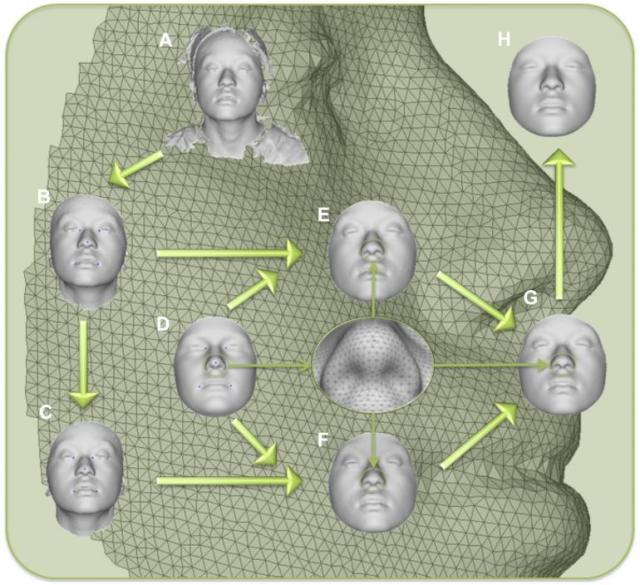
Workflow for 3D face scan processing, including the A) original surface, B) trimmed to exclude non-face parts, C) reflected to make mirror image, D) anthropometric mask of quasi-landmarks, E) remapped, F) reflected remapped, G) symmetrized and H) reconstructed.

By Philip Ross

Could a single hair be used to make an accurate 3D model of a criminal suspect’s face? Researchers from the U.S. and Belgium have developed a computer program that renders a crude genetic “mugshot” from a small sample of DNA.

Forensics can already predict eye and hair color relatively easily. Io9 notes that criminal investigators can even use maggots to extract a victim’s DNA from their unidentifiable body or find hidden faces by zooming into hi-res photos of eyes. But the face is a complex structure that’s more difficult to map from just one DNA sample.

According to New Scientist, researchers used a stereoscopic camera to make 3D images of roughly 600 volunteers with mixed European and West African ancestry. They identified more than 7,000 distinct points on the face to see how sex and racial ancestry affect the position of these points. The variations were used to develop a statistical model that reconstructs the overall shape of a person’s face.

The team also isolated 24 genetic variants, called single nucleotide polymorphisms, which play a role in shaping a face, such as those that shape the head during embryonic development. Lastly, researchers had volunteers rate the 600 faces on perceived ethnicity as well as on a scale of masculinity and femininity.

The new study, published in the journal PLOS Genetics, says this process could allow investigators to make computer-generated mugshots from genetic material left at a crime scene.

“We show that facial variation with regard to sex, ancestry, and genes can be systematically studied with our methods, allowing us to lay the foundation for predictive modeling of faces,” the authors note. “Such predictive modeling could be forensically useful; for example, DNA left at crime scenes could be tested and faces predicted in order to help to narrow the pool of potential suspects. Further, our methods could be used to predict the facial features of descendants, deceased ancestors, and even extinct human species. In addition, these methods could prove to be useful diagnostic tools.”

Any 3D renderings created using the new technology wouldn’t be used in a court of law – any person identified via the DNA mugshots would still have his DNA compared to the crime scene sample – but it could at least narrow the search for a suspected criminal. And there are still a few kinks to work out in the process before the technology is ever used in the field.

“I believe that in five to 10 years’ time, we will be able to computationally predict a face,” Peter Claes of the Catholic University of Leuven in Belgium told New Scientist.

http://www.ibtimes.com/dna-mugshot-how-crime-fighting-computer-sketch-program-can-predict-face-your-genes-1563049

Thanks to Da Brayn for bringing this to the attention of the It’s Interesting community.
This drone can steal what’s on your phone

The next threat to your privacy could be hovering over head while you walk down the street.

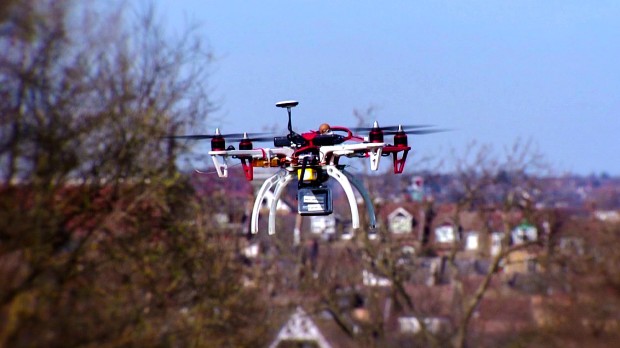
Hackers have developed a drone that can steal the contents of your smartphone — from your location data to your Amazon password — and they’ve been testing it out in the skies of London. The research will be presented next week at the Black Hat Asia cybersecurity conference in Singapore.

The technology equipped on the drone, known as Snoopy, looks for mobile devices with Wi-Fi settings turned on.

Snoopy takes advantage of a feature built into all smartphones and tablets: When mobile devices try to connect to the Internet, they look for networks they’ve accessed in the past.

“Their phone will very noisily be shouting out the name of every network its ever connected to,” Sensepost security researcher Glenn Wilkinson said. “They’ll be shouting out, ‘Starbucks, are you there?…McDonald’s Free Wi-Fi, are you there?”

That’s when Snoopy can swoop into action (and be its most devious, even more than the cartoon dog): the drone can send back a signal pretending to be networks you’ve connected to in the past. Devices two feet apart could both make connections with the quadcopter, each thinking it is a different, trusted Wi-Fi network. When the phones connect to the drone, Snoopy will intercept everything they send and receive.

“Your phone connects to me and then I can see all of your traffic,” Wilkinson said.

That includes the sites you visit, credit card information entered or saved on different sites, location data, usernames and passwords. Each phone has a unique identification number, or MAC address, which the drone uses to tie the traffic to the device.

The names of the networks the phones visit can also be telling.

“I’ve seen somebody looking for ‘Bank X’ corporate Wi-Fi,” Wilkinson said. “Now we know that that person works at that bank.”

CNNMoney took Snoopy out for a spin in London on a Saturday afternoon in March and Wilkinson was able to show us what he believed to be the homes of several people who had walked underneath the drone. In less than an hour of flying, he obtained network names and GPS coordinates for about 150 mobile devices.

He was also able to obtain usernames and passwords for Amazon, PayPal and Yahoo accounts created for the purposes of our reporting so that we could verify the claims without stealing from passersby.

Collecting metadata, or the device IDs and network names, is probably not illegal, according to the Electronic Frontier Foundation. Intercepting usernames, passwords and credit card information with the intent of using them would likely violate wiretapping and identity theft laws.

Wilkinson, who developed the technology with Daniel Cuthbert at Sensepost Research Labs, says he is an ethical hacker. The purpose of this research is to raise awareness of the vulnerabilities of smart devices.

Installing the technology on drones creates a powerful threat because drones are mobile and often out of sight for pedestrians, enabling them to follow people undetected.

While most of the applications of this hack are creepy, it could also be used for law enforcement and public safety. During a riot, a drone could fly overhead and identify looters, for example.

Users can protect themselves by shutting off Wi-Fi connections and forcing their devices to ask before they join networks.

http://money.cnn.com/2014/03/20/technology/security/drone-phone/?google_editors_picks=true

Thanks to Da Brayn for bringing this to the attention of the It’s Interesting community.