New SARS-like virus can infect both humans and animals

sn-coronavirus


A SARS-like virus discovered this summer in the Middle East may infect more than just humans. The pathogen, a close cousin to the one that caused the 2002 to 2003 SARS outbreak, may also be able to infect cells from pigs and a wide range of bat species, researchers report today. The findings may help public health officials track the source of the outbreak and identify the role of wild animals and livestock in spreading the virus, researchers say.

Scientists first detected the virus in a 60-year-old man from Jeddah, Saudi Arabia, who developed severe pneumonia this past spring. Unable to identify the microbe causing the illness, doctors sent samples to Erasmus MC in Rotterdam, the Netherlands. There, scientists identified the infectious agent as a coronavirus, a group known to cause many ailments, such as the common cold and a variety of gastrointestinal infections. Cases have popped up in Qatar and Jordan as well; in total, researchers have so far confirmed nine infections, including five deaths. Several other cases are suspected but haven’t been confirmed.

Researchers have fully sequenced the virus, which they dubbed hCoV-EMC (short for human coronavirus-Erasmus Medical Center). The genome revealed that it is closely related to the SARS coronavirus.

The new study, published online in mBio, is an attempt to answer other basic questions, such as where the virus originated, how it enters cells, and what other animals it might infect, says Christian Drosten, a virologist at the University of Bonn Medical Center in Germany and one of the lead authors.

Scientists knew that the SARS virus uses a receptor called ACE2 to pry open cells. Because these receptors are mainly found deep inside the human lung, patients developed very severe illness that frequently left them too sick to spread SARS to many others; the people most at risk were health care workers who take care of patients. If hCoV-EMC used the same receptor, researchers would have a head start in understanding how it spreads and how to stop it—primarily by protecting health care workers. It might also help them in the development of drugs and vaccines.

To find out, the team engineered baby hamster kidney cells to express the human ACE2 receptor. These cells could be infected with the SARS coronavirus, as expected, but not hCoV-EMC. That finding, supported by additional experiments, led them to conclude that the new coronavirus does not use ACE2 to get in. Which receptor it uses instead is still unclear, which is a “downside” of the new study, says Larry Anderson, an infectious disease specialist at Emory University in Atlanta.

Epidemiologists also want to know which species of animals it is capable of infecting to keep the new coronavirus from spreading further. To determine what types of animals hCoV-EMC can infect, Drosten and colleagues infected cells from humans, pigs, and a wide variety of bats, the key natural reservoirs of coronaviruses. The new virus could infect all of these types of cells. “It’s unusual for a coronavirus to easily go back to bats,” Drosten says. “Most coronaviruses come from bats, but once they jump to other species, you could never get them to reinfect bat cells.” The SARS virus, for instance, originated in Chinese horseshoe bats, but once it ended up in humans, it had changed so much that scientists were unable to infect bat cells with it.

“The fact that [hCoV-EMC] can infect bat cells is consistent with the hypothesis that bats might be the origin of this virus, but this finding doesn’t prove it,” Anderson says. “This virus had to come from an animal source—there’s no other explanation for what’s going on. But we still don’t know what that source is.”

Based on the findings, however, it seems likely that the new coronavirus can infect a wide range of species, Drosten says. That means public health officials may have to start looking for infections and deaths in local wild animal and livestock populations to keep the virus in check, he says.

http://news.sciencemag.org/sciencenow/2012/12/new-sars-like-virus-infects-both.html?ref=hp

Gardening On The Moon


Gardening in space! Chinese astronauts may grow fresh vegetables in extraterrestrial bases on Moon or Mars in the future to provide food and oxygen supplies to astronauts, an official said after a successful lab experiment.

Deng Yibing, deputy director of the Beijing-based Chinese Astronaut Research and Training Center, said that the recent experiment focused on a dynamic balanced mechanism of oxygen, carbon dioxide, and water between people and plants in a closed system.

According to Deng, a cabin of 300 cubic metres was established to provide sustainable supplies of air, water and food for two participants during the experiment, the official Xinhua news agency reported.

Four kinds of vegetables were grown, taking in carbon dioxide and providing oxygen for the two people living in the cabin. They could also harvest fresh vegetables for meals, Deng said.

The experiment, the first of its kind in China, is extremely important for the long-term development of the country’s manned space programme, Deng added.

The cabin, a controlled ecological life support system (CELSS) built in 2011, is a model of China’s third generation of astronauts’ life support systems, which is expected to be used in extraterrestrial bases on the Moon or Mars.

The introduction of a CELSS seeks to provide sustainable supplies of air, water and food for astronauts with the help of plants and algae, instead of relying on stocks of such basics deposited on board at the outset of the mission.

Advance forms of CELSS also involve the breeding of animals for meat and using microbes to recycle wastes.

Scientists from Germany also participated in the experiments.

http://www.phenomenica.com/2012/12/chinese-astronauts-plan-to-grow-vegetables-on-moon.html

Drive-in Sex Booths to Open in Zurich

zurichsex booth


Zurich city officials hope to have new sex booths, similar to those pictured above that are currently used in Germany, by August

There will be enough booths constructed on the outskirts of the city to accommodate around 30 prostitutes.

City officials hope the booths, which will come with inbuilt panic alarms, will be ready for launch in August.

An on-site counsellor will also be provided in the taxpayer funded scheme.

It is hoped the move will help make the sex industry much safer and more regulated, ABC News reported.

Prostitution will be banned in certain parts of the city and confined to the booths and two other zones after they open in August.

Michael Herzig, spokesperson for Zurich Social Welfare Department, said: ‘The big difference is that until now prostitution is in a public space.

‘Now we are going to change this, transfer it from the street, from a public to a private space to an old industrial area which belongs to the city that give us the possibility to define the rules of prostitution in this space.

‘The women will be better protected from attack, and it will also mean better business for them.

‘With the women right by the sex boxes there is no “travel time” so they can deal with more customers. It’s a better business model than standing on the street.’

Prostitutes will also have to apply for a £26 licence, register with a health insurer and buy a ticket each night for about £3 before they begin soliciting customers from January onwards.

Social Welfare Department officials said the plan is ‘progressing’ and is ready to enter into full-force in the New Year.
http://www.dailymail.co.uk/news/article-2240233/Drive-sex-booths-built-Zurich-help-make-prostitution-safer.html?ito=feeds-newsxml

Musicians’ Brains Synchronize During Duets

brain-generic-101221-02

The brain waves of two musicians synchronize when they are performing duet, a new study found, suggesting that there’s a neural blueprint for coordinating actions with others.

A team of scientists at the Max Planck Institute for Human Development in Berlin used electrodes to record the brain waves of 16 pairs of guitarists while they played a sequence from “Sonata in G Major” by Christian Gottlieb Scheidler. In each pair, the two musicians played different voices of the piece. One guitarist was responsible for beginning the song and setting the tempo while the other was instructed to follow.

In 60 trials each, the pairs of musicians showed coordinated brain oscillations — or matching rhythms of neural activity — in regions of the brain associated with social cognition and music production, the researchers said.

“When people coordinate their own actions, small networks between brain regions are formed,” study researcher Johanna Sänger said in a statement. “But we also observed similar network properties between the brains of the individual players, especially when mutual coordination is very important; for example at the joint onset of a piece of music.”

Sänger added that the internal synchronization of the lead guitarists’ brain waves was present, and actually stronger, before the duet began.

“This could be a reflection of the leading player’s decision to begin playing at a certain moment in time,” she explained.

Another Max Planck researcher involved in the study, Ulman Lindenberger, led a similar set of experiments in 2009. But in that study, which was published in the journal BMC Neuroscience, the pairs of guitarists played a song in unison, rather than a duet. Lindenberger and his team at the time observed the same type of coordinated brain oscillations, but noted that the synchronization could have been the result of the similarities of the actions performed by the pairs of musicians.

As the new study involved guitarists who were performing different parts of a song, the researchers say their results provide stronger evidence that there is a neural basis for interpersonal coordination. The team believes people’s brain waves might also synchronize during other types of actions, such as during sports games.

The study was published online Nov. 29 in the journal Frontiers in Human Neuroscience.

http://www.livescience.com/25117-musicians-brains-sync-up-during-duet.html

German woman charged with attempted murder for trying to smother boyfriend with her breasts


A busty woman is accused of trying to kill her boyfriend by suffocating him with her double-D breasts.

Franziska Hansen, 33, is reportedly charged with “attempted murder with a weapon” after her lawyer boyfriend claimed she tried to smother him while pretending it was a sex game.

Nine-stone Franziska, from Germany, denies the allegations, saying it was a sex game and he knew what it was about, according to the Daily Mail.

But boyfriend Tim Schmidt claims she admitted trying to kill him on the phone, saying she smothered him because she “wanted to make your death as pleasurable as possible”.

He told a court in Germany that the couple had been having sex in May this year when Ms Hansen suddenly grabbed his head and pushed it between her breasts with all her force.

He is quoted as saying: “I couldn’t breathe any more, I must have turned blue. I couldn’t tear myself free and I thought I was going to die.”

Mr Schmidt, who weighs 13 stone, claims he managed to wriggle free and fled naked to a neighbour, who raised the alarm.

He told the court that the couple’s four-year relationship had been strained after they moved to the town of Unna, where his career as a lawyer took off and she struggled to hold a job.

Mr Schmidt said his girlfriend tried to kill him after she discovered he was planning to leave her.

He reportedly told the court: “It is clear she wanted to kill me. She even admitted it to me on the telephone.

“I asked her why she wanted to smother me to death with her breasts and she told me: ‘Treasure – I wanted your death to be as pleasurable as possible.’”

http://www.mirror.co.uk/news/weird-news/woman-tried-to-kill-boyfriend-with-dd-1450638

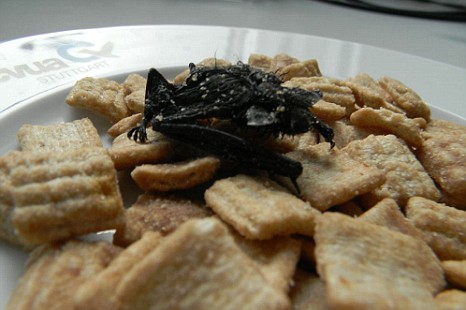
Man finds mummified bat in his breakfast cereal


The hungry German man’s start to the day was completely ruined when he discovered the dead bat in his bowl of cereal at his home in Stuttgart.

He was left feeling more horrified than hungry when he realised the mummified mammal was not a Halloween themed toy.

The incident was reported to health officials who are attempting to establish how the errant bat managed to fly into the box of corn flakes.

They believe the bat may have flown into the plastic packaging by mistake and suffocated to death.

Scientists are investigating whether the bat had flown into the box of Mini-Zimties cereal at the factory or after they had been opened.

Food safety official Jorg Sturmer said: ‘I have never seen anything like it. This really is an unusual case.’

Last month, a live frog was found jumping around a Waitrose salad bag bought by a family in Hampshire.

Read more: http://www.metro.co.uk/weird/917782-man-finds-mummified-bat-in-his-morning-bowl-of-cereal#ixzz2CDalVctB

German town designates men-only parking spaces


The mayor of the Black Forest town of Triberg says women would find it difficult to park there because drivers need to back in diagonally without hitting a pillar and a wall.

Gallus Strobel noted that 12 places in the 220-capacity car park are reserved for women. Many German cities designate a small number of parking spaces, usually near exits, for women concerned about their personal safety in poorly-lit garages.

Strobel told The Associated Press that he had received overwhelmingly positive reactions from men who feel discriminated against by “women only” parking.

But the Triberg mayor says some “humorless people” had criticized the move.


Forest Boy


Berlin police on Wednesday released a photograph of the so-called “forest boy,” an English-speaking youth who wandered into the German capital nine months ago saying he had lived in the woods for five years with his father.

Investigators have failed to identify him and police are now hoping the image will prompt leads from the public.

The boy has told authorities his father called him “Ray” and that he was born June 20, 1994. However, he claims not to know his last name or where he’s from. 

“We have checked his DNA against all missing person reports, sent the data to Interpol so that they could check it internationally, but unfortunately without any success,” police spokesman Thomas Neuendorf said.

Investigators told NBC News that DNA evidence suggests Ray is most likely from a neighboring country, as opposed to the United States. Authorities also believe that English might not be his native language.

The boy was unable or refused to give his family name or any other biographical information when he showed up at the German capital’s City Hall on September 5.

English-speaking teen: I lived five years in woods

He said his mother, Doreen, died in a car accident when he was 12 and after that he and his father, Ryan, took to the forest. He said they wandered using maps and a compass, staying in tents or caves overnight. 

‘Many question marks’
He told authorities that after his father died in August, 2011, he buried him in the forest and then walked five days north before ending up in Berlin. Police told NBC News that they have not been able to find a corresponding dead body.

“There are many question marks,” Neuendorf added.

Ray has also quickly adapted to city life and technology, using a laptop and his cell phone with no problems.  

Everything gives the impression that he was not far away from civilization for years,” Neuendorf told The Associated Press.

The boy is being taken care of by youth services and has been assigned a legal guardian.

Ray is described as being somewhere between 16-20 years old and about 5-foot 11-inches tall. He has dark blonde hair and blue eyes, and three small scars on his forehead, three small scars on his chin and a small scar on his right arm. 

http://worldnews.msnbc.msn.com/_news/2012/06/13/12200265-forest-boy-mystery-stumped-german-police-release-photo?lite

City of Pied Piper fame again faces rat problem

The German city of Hamelin may be in need of another Pied Piper – it seems the rats are back.

City officials say a popular fountain has been put out of service after the rodents gnawed through a power cable, according to the Sueddeutsche Zeitung newspaper.

The Lower Saxony city is where, legend has it, the Pied Piper led all the rats out in 1284 with his magic pipe into the Weser River, where they drowned.

But more than 700 years later, city officials say such drastic measures may not be necessary. The fountain was due to be permanently closed anyway because of the high upkeep costs.

And the solution in the fictitious Piper story isn’t practical anyway: rats are actually pretty good swimmers.

http://hosted.ap.org/dynamic/stories/E/EU_ODD_GERMANY_PIED_PIPER?SITE=AP&SECTION=HOME&TEMPLATE=DEFAULT