Malik Obama, Barack Obama’s half-brother, running for governor in Kenya

Malik Obama

A politician named Obama who is running for governor in Kenya can boast of one big claim to fame on the campaign trail: blood relations with the president of the United States.

Malik Obama — a half-brother of Barack Obama — is running for a governor’s position in the country’s nationwide elections on Monday, though he said he’s not sure what impact his relationship to the American president has on his campaign.

“I’m going into it as Malik Obama,” he said in a phone interview with The Associated Press from western Kenya. “I can’t run away from my name and association with my brother, but I have the feeling that people somewhat want to see who the brother of Obama is.”

The president’s relative even invokes the message that Barack Obama leaned on during his groundbreaking 2008 political campaign: Change. Malik Obama says his platform is poverty eradication, infrastructure development and industrialization.

“I hope that you all out there will support me and vote for me for this important position so that we can bring change to the county of Siaya,” Obama said at a recent campaign stop.

Kenyans on Monday will cast ballots for a wide range of regional offices, but the most crucial vote is for president. Monday is Kenya’s first nationwide election since the 2007 vote devolved into massive tribal violence that killed more than 1,000 people and displaced 600,000 from their homes.

The 54-year-old Malik Obama hopes to become the first governor of Kenya’s western county of Siaya. He is running as an independent candidate. Kenya’s new 2010 constitution created 47 new political divisions known as counties, to be headed by governors.

Obama is competing against candidates who are from well-funded parties, and the political newcomer may be in need of campaign cash. He asked an AP Television News freelance cameraman to contribute to his campaign. No contribution was given. Obama said he was asking for the individual to contribute, not for AP to contribute.

This is Malik Obama’s first run for office.

Barack Obama’s father was from Kenya and the U.S. president has several relatives in the country. Malik and Barack Obama have the same father but different mothers.

Read more: http://world.time.com/2013/03/01/president-obamas-half-brother-runs-for-office-in-kenya/#ixzz2MUZtgYfo

Retreating rebels burn Timbuktu’s science manuscripts

t1

t2

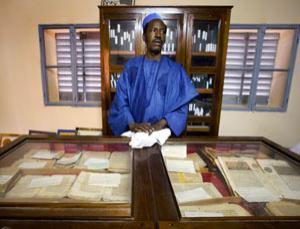
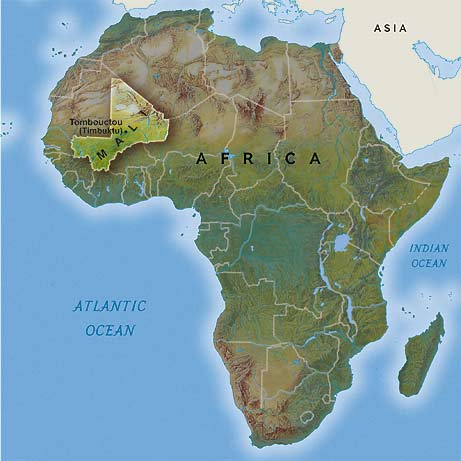
It is what conservators, archivists and researchers have feared. As Malian troops, supported by the French military, advanced on the fabled city of Timbuktu in northern Mali, retreating Islamist rebels have set fire to the Ahmed Baba Institute and a warehouse containing valuable scientific manuscripts dating back to medieval times.

The Ahmed Baba Institute housed an estimated 30,000 manuscripts. The texts include documents on astronomy, medicine, botany, mathematics and biology, evidence that science was under way in Africa before European settlers arrived. They were not only from scholars working in Timbuktu, once a centre for learning, but also from all over Mali and as far as the borders of Mauritania, Burkina Faso, Senegal, Guinea, Niger, Algeria and the Ivory Coast.

It is unclear at this stage how many of the texts have been destroyed.

The rebel group Ansar al Dine wrestled control of Timbuktu from Tuareg separatists in April last year, and since have been using the Institute as their base. The rebels had earlier looted the building of its vehicles, computers and other equipment.

Rich academic history“There is no way these people can claim to be Africans when they destroy the very foundation of our contribution to world knowledge and academia,” says George Abungu, vice president of the executive council of the International Council of Museums. The texts “are the very evidence that Africa had a rich academic history before the coming of the Europeans, as opposed to the earlier notion that we had none”, he says. He describes the burning as “an incredible loss to Africa’s heritage, a backward move to the dark ages”.

Following the rebels’ destruction of Timbuktu’s shrines and tombs in recent weeks, there had been talk of a behind-the-scenes plan to remove for safekeeping some of the estimated 700,000 manuscripts housed in public and private libraries throughout the city.

But even if the plan had been carried out in time, not all the ancient texts would have been rescued given their number and their scattered locations. In any case, some manuscripts are too fragile to be moved.

http://www.newscientist.com/article/dn23113-retreating-rebels-burn-timbuktus-science-manuscripts.html?cmpid=RSS|NSNS|2012-GLOBAL|online-news

Ugandan teenager Phiona Mutesi: Chess Prodigy

Phiona-Mutesi-Uganda-ches-007

She grew up in one of the poorest spots on earth. She couldn’t read or write. As a child, she scrounged for food each day for herself, her mother, and her brother.

But a chance encounter with a chess coach turned her into a rising international chess star, the subject of a book — and the protagonist in a future Disney movie.

Ugandan teenager Phiona Mutesi is “the ultimate underdog,” her biographer says.

Those who work with her believe she’s 16. But since her birthday is unclear, she might still only be 15, they say.

Her father died from AIDS when Mutesi was around 3.

“I thought the life I was living, that everyone was living that life,” the teenager told CNN, describing her childhood in Katwe, a slum in the Ugandan capital of Kampala.

“I was living a hard life, where I was sleeping on the streets, and you couldn’t have anything to eat at the streets. So that’s when I decided for my brother to get a cup of porridge.”

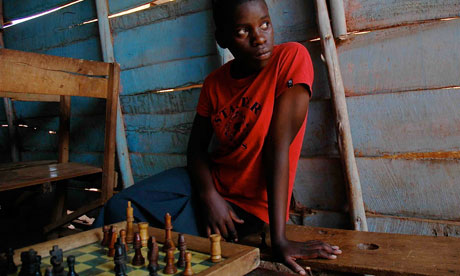
Robert Katende, a missionary and refugee of Uganda’s civil war, had started a chess program in Katwe. He offered a bowl of porridge to any child who would show up and learn.

“It teaches you how to assess, how to make decisions, obstructive thinking, forecasts, endurance, problem solving, and looking at challenges as an opportunity in all cases — and possibly not giving up,” he told CNN. “The discipline, the patience … anything to do with life, you can get it in that game.”

Mutesi did not become a top player overnight. But from the time she first showed up in 2005, her aptitude was clear.

Her talent is “extraordinary,” said Katende.

Mutesi liked chess, and started training and practicing regularly. “It took me like a year” to get very good, she said.

She walked about four miles a day to practice — and to get that precious food.

Soon she found herself beating the older girls and boys in the program.

Mutesi and her family faced pressure from some people in Uganda who insisted chess was a white man’s game, or at least not something girls should be playing, according to her biographer, Tim Crothers.

But in her slum, so few people even knew what chess was that they didn’t give her a hard time, Mutesi told CNN.

Eventually, she became her country’s champion — and represented Uganda at international tournaments. In 2009, she traveled to Sudan. Then, in 2010, she boarded an airplane to Siberia.

When the flight took off, “I thought that I was maybe in heaven,” she wrote in a letter to her mother quoted in Crothers’ book. “I asked God to protect me because who am I to fly to the europlane.”

Mutesi had also never seen ice before.

This year, she played in Istanbul.

Mutesi is not one of the world’s top chess players. But she is the first titled female Ugandan player. She has a fighter’s instinct to reach the top level — and to achieve much more.

“Chess gave me hope, whereby now I’m having a hope of becoming a doctor and … a grand master,” she said.

A grant from a program called Sports Outreach has allowed her to go back to school. She’s learning to read and write.

Meanwhile, Mutesi is becoming an inspiration to people all over the world.

Some learned about her through Crothers’ article for ESPN, which went viral. Others have seen a brief documentary about her on YouTube.

Crothers’ book about her, “The Queen of Katwe,” was published this fall.

“That she’s from Africa makes her an underdog in the world. The fact that she’s from Uganda makes her sort of an underdog in Africa, because it’s one of the poorer countries in Africa. The fact that she’s in Katwe makes her an underdog in Uganda because it’s the most impoverished slum in the entire country. And then to be a girl in Katwe — girls are not treated as equals to the boys,” said Crothers.

“Every hurdle that the world can place in front of her it has placed in front of her.”

The extreme poverty and deprivation in Katwe is hard for many around the world to imagine. Crothers wrote that “human waste from downtown Kampala is dumped directly into the slum. There is no sanitation.”

Mutesi wakes at 5 a.m. every morning to “begin a two-hour trek through Katwe to fill a jug with drinkable water, walking through lowland that is often so severely flooded by Uganda’s torrential rains that many residents sleep in hammocks near their ceilings to avoid drowning,” he wrote.

In the country of 34 million people, about one-fourth live below the poverty line, according to the CIA World Factbook. About three-quarters of the men in Uganda are literate; only 58% of women are.

Mutesi told CNN she’s never heard of Idi Amin, the so-called butcher of Uganda, who helped plunge his country into economic chaos throughout the 1970s.

She does know the name Joseph Kony, a brutal Ugandan warlord who was the subject of a viral video earlier this year. Kids talk about him, Mutesi said.

“He was in northern Uganda torturing people and could kidnap children. That’s what I know.”

Chess could prove to be Mutesi’s ticket out of a hard life — particularly through a project that lies ahead.

Disney has optioned the rights to “The Queen of Katwe,” and is starting work on a movie, Crothers said.

It’s all too much for Mutesi to fathom.

“I feel happy,” she said when asked about the growing attention. “I’m excited. I didn’t have hope that one time, one day, I would be like someone who can encourage people, and they start playing chess,” she told CNN.

As her world travels take off, she’s in for more and more culture shock.

“I don’t like New York because there’s too much noise in it,” the teenager said with a big smile.

But while it may be somewhat overwhelming for her, Mutesi’s success at the game she loves is bringing joy to her family.

“Some of them cried. Years back we didn’t have hope that … one day it can happen,” she said. “So they are very excited.”

http://www.cnn.com/2012/12/10/world/africa/uganda-chess-teen/index.html?hpt=hp_c1

Black Mamba venom discovered to be a better painkiller than morphine


A painkiller as powerful as morphine, but without most of the side-effects, has been found in the deadly venom of the black mamba, say French scientists.

The predator, which uses neurotoxins to paralyse and kill small animals, is one of the fastest and most dangerous snakes in Africa.

However, tests on mice, reported in the journal Nature, showed its venom also contained a potent painkiller.

They admit to being completely baffled about why the mamba would produce it.

The researchers looked at venom from 50 species before they found the black mamba’s pain-killing proteins – called mambalgins.

Dr Eric Lingueglia, from the Institute of Molecular and Cellular Pharmacology near Nice, told the BBC: “When it was tested in mice, the analgesia was as strong as morphine, but you don’t have most of the side-effects.”

Morphine acts on the opioid pathway in the brain. It can cut pain, but it is also addictive and causes headaches, difficulty thinking, vomiting and muscle twitching. The researchers say mambalgins tackle pain through a completely different route, which should produce few side-effects.

He said the way pain worked was very similar in mice and people, so he hoped to develop painkillers that could be used in the clinic. Tests on human cells in the laboratory have also showed the mambalgins have similar chemical effects in people.

But he added: “It is the very first stage, of course, and it is difficult to tell if it will be a painkiller in humans or not. A lot more work still needs to be done in animals.”

Dr Nicholas Casewell, an expert in snake venom at the Liverpool School of Tropical Medicine, has recently highlighted the potential of venom as a drug source.

Commenting on this study he said: “It’s very exciting, it’s a really great example of drugs from venom, we’re talking about an entirely new class of analgesics.”

Dr Lingueglia said it was “really surprising” that black mamba venom would contain such a powerful painkiller.

Dr Casewell agreed that it was “really, really odd”. He suggested the analgesic effect may work in combination “with other toxins that prevent the prey from getting away” or may just affect different animals, such as birds, differently to mice.

The Royal Pharmaceutical Society’s Dr Roger Knaggs said: “We are witnessing the discovery of a novel mechanism of action which is not a feature of any existing painkillers.”

He cautioned that the mambalgins worked by injections into the spine so would need “significant development” before they could be used in people.

http://www.bbc.co.uk/news/health-19812064

Thanks to Kebmodee for bringing this to the It’s Interesting community.

New monkey species discovered: Cercopithecus Lomamiensis

Scientists are claiming they have discovered a new species of monkey living  in the remote forests of the Democratic Republic of Congo — an animal  well-known to local hunters but until now, unknown to the outside world.

In a paper published Wednesday in the open-access journal Plos One, the  scientists describe the new species that they call Cercopithecus Lomamiensis,  known locally as the Lesula, whose home is deep in central DR Congo’s Lomami  forest basin. The scientists say it is only the second discovery of a monkey  species in 28 years.

In an age where so much of the earth’s surface has been photographed,  digitized, and placed on a searchable map on the web discoveries like this one  by a group of American scientists this seem a throwback to another time.

“We never expected to find a new species there,” says John Hart, the lead  scientist of the project, “but the Lomami basin is a very large block that has  had very little exploration by biologists.”

Hart says that the rigorous scientific process to determine the new species  started with a piece of luck, strong field teams, and an unlikely field sighting  in a small forest town.

“Our Congolese field teams were on a routine stop in Opala. It is the closest  settlement of any kind to the area of forest we were working in,” says Hart.

The team came across a strange looking monkey tethered to a post. It was the  pet of Georgette, the daughter of the local school director.

She adopted the young monkey when its mother was killed by a hunter in the  forest. Her father said it was a Lesula, well-known to hunters in that part of  the forest. The field team took pictures and showed them to Hart.

“Right away I saw that this was something different. It looked a bit like a  monkey from much further east, but the coloring was so different and the range  was so different,” said Hart.

The monkey to the east is the semi-terrestrial owl-faced monkey. Based on the  photos, Hart believed that their shape and size could be similar, but their  morphology or outward appearance was very distinct.

The Lesula had strikingly large, almost human like, eyes, a pink face and  golden mane. Far to the east, across several large river systems, the Owl Face  is aptly named. Its sunken eyes are set deep in a dark face, a white stripe  running down from its brow to its mouth, like a line of chalk on a  blackboard.

To a layman it looks like an open and shut case. But animals are often widely  divergent within a species — humans are an obvious example — so Hart and his  team needed science to prove their gut feeling.

“I got in touch with geneticists and anthropologists to get their advice. I  knew it was important to have a collaborative team of experts,” says Hart.

The exhaustive study took three years.

Hart’s teams set up digital sound recorders in the forests to record the  morning calls of the Owl Face and Lesula monkeys. They analyzed the ecology of  the forest and behavior of the shy and difficult to observe monkey.

Field teams collected Lesula specimens from hunters and monkeys freshly  killed by leopards and once, a crowned eagle (the field worker had to wait for  the eagle to leave its perch, says Hart). The specimens were shipped to two  research centers in the U.S and the data shared with labs across the  country.

Christopher Gilbert, an anthropologist based at Hunter College in Manhattan,  says the difference in appearance between the Lesula and Owl Face was  striking.

“After comparing the skins, we immediately concluded that this was probably  something different that we had seen before,” says Gilbert, an expert in primate  and monkey evolution.

Skulls of the Lesula and Owl Face monkey were measured with calipers and  digitally drawn in 3D. “We looked at the difference in shape and a number of  landmarks in the skulls,” says Gilbert.

While the Owl Face and Lesula had similar sized skulls, he says, the Lesula  had significantly larger orbits and several other small, but statistically  significant, differences in the hard anatomy of the skull.

The anatomical studies are backed up by genetics. Scientists at New York  University and Florida Atlantic University were able trace an ancient common  ancestor. Scientists believe the monkeys evolved separately after a series of  rivers separated their habitats.

“The clincher was that lab and field teams were able to document significant  difference in conjunction with the genetics. The monkeys were different and have  been different for a couple of million years. It demonstrates that there are  places in the world that we do not know much about,” says Gilbert.

The Lesula’s range covers an area of about 6,500 square miles (17,000 square  kilometers) between the Lomani and Tshuapa Rivers. Until recently, it was one of  the Congo’s least biologically explored forest blocks.

Hart hopes that the announcement will bring a renewed effort to save central  Africa’s pristine forests. Under threat by loggers, bush meat hunters, and weak  national governments, the forests are a potential well of important scientific discoveries, and a key linchpin of the earth’s  biodiversity.

Teresa and John Hart’s Lukuru Foundation is working with the Congolese  authorities to establish a national park in the Lomani basin before it loses its  unique biodiversity.

“The challenge now is to make the Lesula an iconic species that carries the  message for conservation of all of DR Congo’s endangered fauna,” says Hart.

And what of the first Lesula they found — Georgette’s pet. After he saw the  pictures, Hart regularly sent a team to keep track of the young Lesula’s  progress. At some point Georgette let the monkey roam free.

“It seems someone captured it,” says Hart, “it probably ended up in the  cooking pot.”

He hopes that with proper protection, the Lesula, and the rest of Lomani’s  incredible animal biodiversity, won’t suffer a similar fate.

Read more: http://www.abc15.com/dpp/news/national/scientists-discover-new-monkey#ixzz26JLXnMcp


Couple stoned to death in Mali for adultery


An al-Qaida-linked Islamist militant group in control of northern Mali stoned to death a couple accused of engaging in extramarital affairs, the group’s spokesman said.

The couple were publicly executed in the remote town of Aguelhok, near the vast West African nation’s northern border with Algeria, on Sunday, a spokesman for the Ansar Dine group told Reuters.

“These two people were married and had extra-conjugal relations. Our men on the ground in Aguelhok applied shariah (Islamic law),” said Sanda Ould Bounama, reached by telephone on Monday.

“They both died right away and even asked for this application. We don’t have to answer to anyone over the application of shariah,” he said.

A local government official told the AFP news agency that he was on the scene. “The Islamists took the unmarried couple to the center of Aguelhok. The couple was placed in two holes and the Islamists stoned them to death,” he said.

“The woman fainted after the first few blows,” he said. The man shouted out once and then was silent, he added.

Mali have long practiced Islam, but frustrations with the strict form of shariah being imposed by Islamists have sparked several protests in recent months.

Ansar Dine and well-armed allies, including al-Qaida splinter group MUJWA, have hijacked a separatist uprising by local Tuareg rebels and now control two-thirds of Mali’s desert north, territory that includes the regions of Gao, Kidal and Timbuktu.

Western and African governments are struggling to muster a response to the crisis as politicians in the capital Bamako continue to squabble over how the country should be governed after a March coup removed the country’s president.

http://worldnews.nbcnews.com/_news/2012/07/31/13045617-mali-al-qaida-linked-group-stones-couple-to-death-over-alleged-adultery?lite