New evidence that p gingivalis may be a main culprit in Alzheimer’s disease

by Debora MacKenzie

We may finally have found a long-elusive cause of Alzheimer’s disease: Porphyromonas gingivalis, the key bacteria in chronic gum disease. That’s bad, as gum disease affects around a third of all people. But the good news is that a drug that blocks the main toxins of P. gingivalis is entering major clinical trials this year, and research published this week shows it might stop and even reverse Alzheimer’s. There could even be a vaccine.

Alzheimer’s is one of the biggest mysteries in medicine. As populations have aged, dementia has skyrocketed to become the fifth biggest cause of death worldwide. Alzheimer’s constitutes some 70 per cent of these cases and yet, we don’t know what causes it. The disease often involves the accumulation of proteins called amyloid and tau in the brain, and the leading hypothesis has been that the disease arises from defective control of these two proteins. But research in recent years has revealed that people can have amyloid plaques without having dementia. So many efforts to treat Alzheimer’s by moderating these proteins have failed, and the hypothesis has now been seriously questioned.

Indeed, evidence has been growing that the function of amyloid proteins may be as a defence against bacteria, leading to a spate of recent studies looking at bacteria in Alzheimer’s, particularly those that cause gum disease, which is known to be a major risk factor for the condition.

Bacteria involved in gum disease and other illnesses have been found after death in the brains of people who had Alzheimer’s, but until now, it hasn’t been clear whether these bacteria caused the disease or simply got in via brain damage caused by the condition.

Gum disease link

Multiple research teams have been investigating P. gingivalis, and have so far found that it invades and inflames brain regions affected by Alzheimer’s; that gum infections can worsen symptoms in mice genetically engineered to have Alzheimer’s; and that it can cause Alzheimer’s-like brain inflammation, neural damage, and amyloid plaques in healthy mice.

“When science converges from multiple independent laboratories like this, it is very compelling,” says Casey Lynch of Cortexyme, a pharmaceutical firm in San Francisco, California.

In the new study, Cortexyme have now reported finding the toxic enzymes – called gingipains – that P. gingivalis uses to feed on human tissue in 96 per cent of the 54 Alzheimer’s brain samples they looked at, and found the bacteria themselves in all three Alzheimer’s brains whose DNA they examined.

“This is the first report showing P. gingivalis DNA in human brains, and the associated gingipains, co-lococalising with plaques,” says Sim Singhrao, of the University of Central Lancashire, UK. Her team previously found that P. gingivalis actively invades the brains of mice with gum infections. She adds that the new study is also the first to show that gingipains slice up tau protein in ways that could allow it to kill neurons, causing dementia.

The bacteria and its enzymes were found at higher levels in those who had experienced worse cognitive decline, and had more amyloid and tau accumulations. The team also found the bacteria in the spinal fluid of living people with Alzheimer’s, suggesting that this technique may provide a long-sought after method of diagnosing the disease.

When the team gave P. gingivalis gum disease to mice, it led to brain infection, amyloid production, tangles of tau protein, and neural damage in the regions and nerves normally affected by Alzheimer’s.

Cortexyme had previously developed molecules that block gingipains. Giving some of these to mice reduced their infections, halted amyloid production, lowered brain inflammation and even rescued damaged neurons.

The team found that an antibiotic that killed P. gingivalis did this too, but less effectively, and the bacteria rapidly developed resistance. They did not resist the gingipain blockers. “This provides hope of treating or preventing Alzheimer’s disease one day,” says Singhrao.

New treatment hope

Some brain samples from people without Alzheimer’s also had P. gingivalis and protein accumulations, but at lower levels. We already know that amyloid and tau can accumulate in the brain for 10 to 20 years before Alzheimer’s symptoms begin. This, say the researchers, shows P. gingivalis could be a cause of Alzheimer’s, but it is not a result.

Gum disease is far more common than Alzheimer’s. But “Alzheimer’s strikes people who accumulate gingipains and damage in the brain fast enough to develop symptoms during their lifetimes,” says Lynch. “We believe this is a universal hypothesis of pathogenesis.”

Cortexyme reported in October that the best of their gingipain blockers had passed initial safety tests in people, and entered the brain. It also seemed to improve participants with Alzheimer’s. Later this year the firm will launch a larger trial of the drug, looking for P. gingivalis in spinal fluid, and cognitive improvements, before and after.

They also plan to test it against gum disease itself. Efforts to fight that have led a team in Melbourne to develop a vaccine for P. gingivalis that started tests in 2018. A vaccine for gum disease would be welcome – but if it also stops Alzheimer’s the impact could be enormous.

Journal reference: Science Advances

https://www.newscientist.com/article/2191814-we-may-finally-know-what-causes-alzheimers-and-how-to-stop-it/

Study Offers Hint of Hope for Staving Off Dementia in Some People by Controlling Blood Pressure


Coloured positron emission tomography (PET, centre) and computed tomography (CT, left) scans of the brain of a 62-year-old woman with Alzheimer’s disease.

By Pam Belluck

In dementia research, so many paths have led nowhere that any glimmer of optimism is noteworthy.

So some experts are heralding the results of a large new study, which found that people with hypertension who received intensive treatment to lower their blood pressure were less likely than those receiving standard blood pressure treatment to develop minor memory and thinking problems that often progress to dementia.

The study, published Monday in JAMA, is the first large, randomized clinical trial to find something that can help many older people reduce their risk of mild cognitive impairment — an early stage of faltering function and memory that is a frequent precursor to Alzheimer’s disease and other dementias.

The results apply only to those age 50 or older who have elevated blood pressure and who do not have diabetes or a history of stroke. But that’s a condition affecting a lot of people — more than 75 percent of people over 65 have hypertension, the study said. So millions might eventually benefit by reducing not only their risk of heart problems but of cognitive decline, too.

“It’s kind of remarkable that they found something,” said Dr. Kristine Yaffe, a professor of psychiatry and neurology at University of California San Francisco, who was not involved in the research. “I think it actually is very exciting because it tells us that by improving vascular health in a comprehensive way, we could actually have an effect on brain health.”

The research was part of a large cardiovascular study called Sprint, begun in 2010 and involving more than 9,000 racially and ethnically diverse people at 102 sites in the United States. The participants had hypertension, defined as a systolic blood pressure (the top number) from 130 to 180, without diabetes or a history of stroke.

These were people who could care for themselves, were able to walk and get themselves to doctors’ appointments, said the principal investigator, Dr. Jeff D. Williamson, chief of geriatric medicine and gerontology at Wake Forest School of Medicine.

The primary goal of the Sprint study was to see if people treated intensively enough that their blood pressure dropped below 120 would do better than people receiving standard treatment which brought their blood pressure just under 140. They did — so much so that in 2015, the trial was stopped because the intensively treated participants had significantly lower risk of cardiovascular events and death that it would have been unethical not to inform the standard group of the benefit of further lowering their blood pressure.

But the cognitive arm of the study, called Sprint Mind, continued to follow the participants for three more years even though they were no longer monitored for whether they continued with intensive blood pressure treatment. About 8,500 participants received at least one cognitive assessment.

The primary outcome researchers measured was whether patients developed “probable dementia.” Fewer patients did so in the group whose blood pressure was lowered to 120. But the difference — 149 people in the intensive-treatment group versus 176 people in the standard-treatment group — was not enough to be statistically significant.

But in the secondary outcome — developing mild cognitive impairment or MCI — results did show a statistically significant difference. In the intensive group, 287 people developed it, compared to 353 people in the standard group, giving the intensive treatment group a 19 percent lower risk of mild cognitive impairment, Dr. Williamson said.

Because dementia often develops over many years, Dr. Williamson said he believes that following the patients for longer would yield enough cases to definitively show whether intensive blood pressure treatment helps prevent dementia too. To find out, the Alzheimer’s Association said Monday it would fund two more years of the study.

“Sprint Mind 2.0 and the work leading up to it offers genuine, concrete hope,” Maria C. Carrillo, the association’s chief science officer, said in a statement. “MCI is a known risk factor for dementia, and everyone who experiences dementia passes through MCI. When you prevent new cases of MCI, you are preventing new cases of dementia.”

Dr. Yaffe said the study had several limitations and left many questions unanswered. It’s unclear how it applies to people with diabetes or other conditions that often accompany high blood pressure. And she said she would like to see data on the participants older than 80, since some studies have suggested that in people that age, hypertension might protect against dementia.

The researchers did not specify which type of medication people took, although Dr. Williamson said they plan to analyze by type to see if any of the drugs produced a stronger cognitive benefit. Side effects of the intensive treatment stopped being monitored after the main trial ended, but Dr. Williamson said the biggest negative effect was dehydration.

Dr. Williamson said the trial has changed how he treats patients, offering those with blood pressure over 130 the intensive treatment. “I’ll tell them it will give you a 19 percent lower chance of developing early memory loss,” he said.

Dr. Yaffe is more cautious about changing her approach. “I don’t think we’re ready to roll it out,” she said. “It’s not like I’m going to see a patient and say ‘Oh my gosh your blood pressure is 140; we need to go to 120.’ We really need to understand much more about how this might differ by your age, by the side effects, by maybe what else you have.”

Still, she said, “I do think the take-home message is that blood pressure and other measures of vascular health have a role in cognitive health,” she said. “And nothing else has worked.”

Protein Changes Detected in Blood Years Before Alzheimer’s Onset

Levels of a protein called neurofilament light chain increase in the blood and spinal fluid of some Alzheimer’s patients 16 years before they develop symptoms, according to a study published January 21 in Nature Medicine.

The results suggest that neurofilament light chain (NfL), which is part of the cytoskeleton of neurons and has previously been tied to brain damage in mice, could serve as a biomarker to noninvasively track the progression of the disease. “This is something that would be easy to incorporate into a screening test in a neurology clinic,” coauthor Brian Gordon, an assistant professor of radiology at Washington University, says in a press release.

Gordon and his colleagues measured NfL in nearly 250 people carrying an Alzheimer’s-risk allele and more than 160 of their relatives who did not carry the variant. They found that those at risk of developing the disease had higher levels of the protein early on, and that NfL levels in both the blood and spinal fluid were on the rise well before the patients began to show signs of neurodegeneration, more than 16 years before disease onset.

Examining a subset of the patients more closely, the team saw that the rate of increase in NfL correlated with the shrinkage of a brain region called the precuneus, and patients whose NfL levels were rising rapidly tested worse on cognitive tests. “It is not necessarily the absolute levels which tell you your neurodegeneration is ongoing, it is the rate of change,” coauthor Mathias Jucker, a professor of cellular neurology at the German Center for Neurodegenerative Diseases in Tübingen, tells The Guardian.

The Alzheimer’s-linked mutation carried by patients examined in this study only affects about 1 percent of people who get the neurodegenerative disease, so the approach must be validated in a broader patient population, James Pickett, the head of research at the Alzheimer’s Society, tells The Guardian.

“We validated it in people with Alzheimer’s disease because we know their brains undergo lots of neurodegeneration, but this marker isn’t specific for Alzheimer’s,” Gordon says in the release. “I could see this being used in the clinic in a few years to identify signs of brain damage in individual patients.”

Meanwhile, a research team at Seoul National University in South Korea described another potential blood test for Alzheimer’s, focusing on the tau and amyloid proteins known to be associated with the disease. According to their study published today in Brain, blood levels of tau and amyloid correlate with how much tau has accumulated in the brain, as well as other markers of neurodegeneration such as hippocampal volume. “These results indicate that combination of plasma tau and amyloid-β1–42 levels might be potential biomarkers for predicting brain tau pathology and neurodegeneration,” the researchers write in their report.

https://www.the-scientist.com/news-opinion/protein-changes-detected-in-blood-years-before-alzheimers-onset-65347

A new 3-D printed ‘sponge’ sops up excess chemo drugs

Bringing the filtering abilities of a fuel cell into the blood vessels of living organisms, a new device could cut down on toxic effects of cancer treatment.

At the heart of this approach — recently tested in pigs — is a tiny, cylindrical “sponge” created by 3-D printing. Wedged inside a vein near a tumor being treated with chemotherapy, the sponge could absorb excess drug before it spreads through the body — thus lessening chemotherapy’s harmful side effects, including vomiting, immune suppression or even heart failure.

A human study could launch “in a couple of years, if all the stars are aligned,” says Steve Hetts, a neuroradiologist at the University of California, San Francisco who came up with the drug-capture concept. He worked with engineers at UC Berkeley and elsewhere to create and test prototypes.

A test of the most recent prototype showed that the absorber captured nearly two-thirds of a common chemotherapy drug infused into a nearby vein, without triggering blood clots or other obvious problems in the pig, Hetts and his colleagues report January 9 in ACS Central Science.

The study addresses a major need, says Eleni Liapi, a radiologist at Johns Hopkins University School of Medicine not involved with the new work. Existing methods for controlling chemotherapy delivery do not fully block drug escape, she notes. “A technological advancement to reduce unwanted circulating drug is always welcome.”


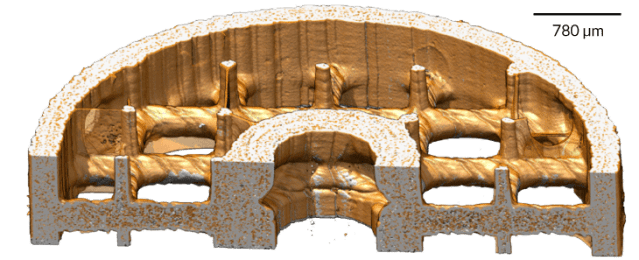
This image shows a cross-sectional view of a new 3-D printed cylindrical device that could cut down on toxic side effects from cancer treatment. Resin coatings (gold) bind to a chemo drug used to treat liver cancer, experiments show.

Chemo is often delivered intravenously in the hope that some treatment reaches the cancer site. In a more localized form of chemotherapy used to treat hard-to-remove tumors, the drug travels through catheter wires snaked into arteries going straight to the tumor. Although this technique, known as transarterial chemo embolization, or TACE, is given to tens of thousands of people each year, typically some of the injected drug bypasses the tumor site and slips into general circulation where it can wreak havoc elsewhere.

Hetts uses the transarterial method to treat babies with a rare eye tumor called retinoblastoma – and it was those experiences that birthed the “sponge” idea in the first place. After the chemotherapy ran its course through transarterial catheters, the infants’ eye tumors shrank. However, several weeks later, their blood cell counts tanked, suggesting to Hetts that some of the chemo drugs were escaping the eye and affecting other cells. Those observations eight years ago led Hetts to think that “if only I had a device I could put into the vein to bind up the excess drug, then maybe these little babies wouldn’t get the side effect” of immune suppression.

Heart surgeons use a similar “filter” to remove bits of cholesterol plaque from arteries of people with atherosclerosis, a disease characterized by the clogging and hardening of arteries. Hetts envisioned a similar device for chemotherapy treatment — “but not just a dumb, inert membrane to capture debris,” he says. “I wanted a ‘smart’ membrane that chemically binds to a drug.”

Instead of trying to develop a drug-trap device for a super rare tumor — retinoblastoma has just 300 new cases per year in the United States — Hetts’ team focused on a chemo drug for liver cancer, which is estimated to strike more than 40,000 Americans this year and kill three-quarters of them.

Anand Patel, a trainee in the Hetts’ lab with a bioengineering background, tested a batch of resins and found several that could bind to this drug, known as doxorubicin. To optimize the resins and get them onto the tips of guide wires, Patel sought help with “cold call” e-mails to local professors. Nitash Balsara — a UC Berkeley chemical engineer with expertise in polymer chemistry and membranes — “was actually crazy enough to return my e-mail with interest,” says Patel, who now works as an interventional radiologist in the Los Angeles area.

Balsara’s lab develops materials to regulate ion flow in batteries and fuel cells. As it turns out, these filtration processes are “very similar to those that we needed to capture excess chemotherapy drugs from the blood,” Patel says. The team worked with Carbon, Inc., a 3-D printing company in the San Francisco Bay area, to get the drug-binding material onto a 30-millimeter-long, cylinder-shaped “sponge” about as wide as a drinking straw. Hee Jeung Oh of UC Berkeley spent more than a year working out how to attach the drug-binding material to the 3-D printed cylinder with crisscrossing struts.

In experiments, the team injected the liver cancer drug through the pigs’ leg and pelvic veins — which are similar in width to human liver veins, Hetts says. Before infusing the chemotherapy drug, the researchers inserted the 3-D printed sponge a few centimeters from the infusion site — as well as catheters above and below the sponge for collecting blood samples to measure drug absorption over time. Within a half hour, the device absorbed, on average, 64 percent of the liver cancer drug.

The next round of studies will monitor the capture of doxorubicin by drug sponges inserted directly into the pigs’ liver veins.

A new 3-D printed ‘sponge’ sops up excess chemo drugs

In 1960, about a half-million teens took a test. Now it could predict the risk of Alzheimer’s disease.

FIGMMJV2X4I6RLNYAEJFIFWBAI
High school students in 1960 take the Project Talent test, the largest survey of American teenagers ever done; it is now being used for research into dementia. (American Institutes for Research)

By Tara Bahrampour

In 1960, Joan Levin, 15, took a test that turned out to be the largest survey of American teenagers ever conducted. It took two-and-a-half days to administer and included 440,000 students from 1,353 public, private and parochial high schools across the country — including Parkville Senior High School in Parkville, Md., where she was a student.

“We knew at the time that they were going to follow up for a long time,” Levin said — but she thought that meant about 20 years.

Fifty-eight years later, the answers she and her peers gave are still being used by researchers — most recently in the fight against Alzheimer’s disease. A study released this month found that subjects who did well on test questions as teenagers had a lower incidence of Alzheimer’s and related dementias in their 60s and 70s than those who scored poorly.

Known as Project Talent, the test was funded by the U.S. government, which had been concerned, given the Soviet Union’s then-recent successful Sputnik launch, that Americans were falling behind in the space race.

Students answered questions about academics and general knowledge, as well as their home lives, health, aspirations and personality traits. The test was intended to identify students with aptitudes for science and engineering. Test-takers included future rock stars Janis Joplin, then a senior at Thomas Jefferson High School in Port Arthur, Tex., and Jim Morrison, then a junior at George Washington High School in Alexandria, Va.

In recent years, researchers have used Project Talent data for follow-up studies, including one published Sept. 7 in the Journal of the American Medical Association. Conducted by researchers at the Washington-based American Institutes for Research (AIR), the organization that originally administered the test, it compared results for more than 85,000 test-takers with their 2012-2013 Medicare claims and expenditures data, and found that warning signs for dementia may be discernible as early as adolescence.

The study looked at how students scored on 17 areas of cognitive ability such as language, abstract reasoning, math, clerical skills, and visual and spatial prowess, and found that people with lower scores as teenagers were more prone to getting Alzheimer’s and related dementias in their 60s and early 70s.

Specifically, those with lower mechanical reasoning and memory for words as teens had a higher likelihood of developing dementia in later life: Men in the lower-scoring half were 17 percent more likely, while women with lower scores were 16 percent more likely. Worse performance on other components of the test also increased the risk for later-life dementia.

An estimated 5.7 million Americans have Alzheimer’s disease, and in the absence of scientific breakthroughs to curb the disease, the Alzheimer’s Association projects that number could reach 14 million by 2050, with the cost of care topping $1 trillion per year.

The 1960 test could have the potential to be like the groundbreaking Framingham study, a decades-long study of men in Massachusetts that led to reductions in heart disease in the 1970s, ’80s and ’90s, said Susan Lapham, director of Project Talent and a co-author of the JAMA study.

“If Project Talent can be for dementia what the Framingham study was for heart disease, it will make a difference in public health,” she said. “It indicates that we should be designing interventions for kids in high school and maybe even earlier to maybe keep their brains active from a young age.”

This might include testing children, identifying those with lower scores and “getting them into a program to make sure they’re not missing out and maybe putting themselves at risk,” she said.

For years, little was done with the Project Talent data because the participants could not be found. A proposal in the 1980s to try to find them failed because, in that pre-Internet age, the task seemed too daunting.

In 2009, as the students’ 50th high school reunions were coming up, researchers decided to use the gatherings as an occasion to contact many of them. (About a quarter have died.) They were then able to use the test data to study things such as the effects of diabetes and personality type on later-life health.

But when contacted, the participants were most interested in dementia, Lapham said. “They wanted that to be studied more than any other topic,” she said. “They said, ‘The thing I fear most is dementia.’ ”

While students were supposed to have received their results soon after taking the test, some students said they did not remember getting them.

Receiving her results recently was interesting in hindsight, said Levin, a retired human-resources director who is now 73 and living in Cockeysville, Md. Most of her scores were over 75 percent, with very high marks in vocabulary, abstract reasoning and verbal memory, and lower marks in table reading and clerical tasks.

Low scores do not mean a person will get dementia; the correlation is merely associated with a higher risk. But even if her scores had been lower, Levin said she would want to know. “I’m kind of a planner, and I look ahead,” she said. “I’d want my daughter and her family to maybe have an idea of what to expect.”

Karen Altpeter, 75, of Prescott, Wis., said she would also probably want to know about her risk, because her mother and grandmother had Alzheimer’s. She liked the idea that the answers she had given as a teen could help science.

“If there’s any opportunity I can have to make a difference just by taking a test and answering some questions, I’ll do it,” she said. “I want the opportunity to make things better for people.”

Earlier studies had suggested a relationship between cognitive abilities in youth and dementia in later life, including one that followed 800 nuns earlier in the 20th century and found that the complexity of sentences they used in writing personal essays at 21 correlated with their dementia risk in old age.

But that study included only women and no minorities. Project Talent’s subjects reflected the nation’s demographic mix in 1960.

Today, however, the country is more diverse. The number of minorities 65 and older is projected to grow faster than the general population, and by 2060 there will be about 3.2 million Hispanics and 2.2 million African Americans with Alzheimer’s disease and related dementias, according to a study by the Centers for Disease Control and Prevention published this week. African Americans and Hispanics have a higher prevalence of Alzheimer’s and related diseases than non-Hispanic whites.

A follow-up study underway of a smaller sample of the Project Talent pool — 22,500 people — will be weighted to reflect today’s population mix and will dig more deeply into age-related brain and cognitive changes over time.

It will examine the long-term impact of school quality and school segregation on brain health, and the impact of adolescent socioeconomic disadvantage on cognitive and psychosocial resilience, with a special focus on the experiences of participants of color.

That study includes an on-paper survey of demographics, family and marriage history, residential history, educational attainment and health status; an online survey of health, mental health and quality of life; and a detailed cognitive assessment by phone of things such as memory for words and counting backward.

Researchers will also evaluate school quality to determine whether there are racial or ethnic differences in the benefits of attending higher quality schools, and explore more deeply why some people develop dementia and some do not.

The follow-up, slated to be completed next year, is funded by the National Institute on Aging, part of the National Institutes of Health, and conducted by AIR in conjunction with researchers from Columbia University Medical Center and the University of Southern California.

Cliff Jacobs, 75, of Arlington, Va., who took the Project Talent test as a high school junior in Tenafly, N.J., doesn’t remember hearing about any results. Then, a few months ago, researchers conducting the follow-up study contacted him, tested his cognitive abilities and asked about his life history.

“They delved into my issues growing up — did my parents smoke, and was I exposed to any secondhand smoke? Yeah, my parents both smoked, and I didn’t even think it was something to consider,” he said.

A retired geoscientist for the National Science Foundation, Jacobs said he would be interested in learning if he is at risk for dementia.

“The statistical correlation is not one that will necessarily apply to you, but they can give you some probabilities,” he said. “I guess basic human nature would be, ‘Yeah, you’d probably want to know.’ ”

Try these 12 sample questions from the test.


Can’t see the Quiz? Click Here.

1

In the Bible story, Samson knew he would lose his strength if

his hair were cut.

he fell in love.

he left Jerusalem.

he spoke with a Philistine.

he went to war.

2

Chartreuse is a mixture of

green and blue.

yellow and orange.

yellow and green.

orange and brown.

red and orange.

3

The above is usually called a

fly.

spoon.

spinner.

plug.

streamer.

4

High pointed arches are used chiefly in

Roman architecture.

Greek architecture.

Gothic architecture.

Renaissance architecture.

modern architecture.

5

If a camper sees a garter snake, he should

leave it alone.

pin its head down with a forked stick.

hit it with a rock.

climb the nearest tree.

stand still until it leaves.

6

Tartar sauce is most often served with

tossed salad.

ice cream.

fish.

barbecued beef.

chow mein.

7

Suppose that after the post office is closed, someone finds he urgently needs stamps. He should probably try getting them

in a drug store.

from a stamp collector.

by phoning the postmaster’s home.

in a department store.

in a gas station.

8

In a suspension bridge, the road bed is supported by

pontoons.

pilings.

arches.

cables.

cantilevers.

9

Which of these guns has the largest bore?

12 ga.

.22 cal.

.44 cal.

16 ga.

20 ga.

10

A boy takes a girl to a movie and they find a pair of seats on a side aisle. Usually the girl should take the seat

on the left.

on the right.

nearest the aisle.

furthest from the aisle.

nearest the center of the theater.

11

About when did Leonardo de Vinci live?

1st century

5th century

10th century

15th century

20th century

12

Locks were built into the Panama Canal because

the Atlantic Ocean is higher than the Pacific.

the Pacific Ocean is higher than the Atlantic.

Panama is above sea level.

the canal is narrow.

the canal is wide.

The Gut of Mice Communicates with the Brain Through the Vagus Nerve, forming a possible basis for a 6th Sense

webp-net-resizeimage-14--x

by SUKANYA CHARUCHANDRA

Previous research has shown that the gut-brain connection, which refers to signaling between the digestive and the central nervous systems, is based on the transport of hormones, but a study published today (September 21) in Science suggests there may be a more direct link—the vagus nerve.

This research presents “a new set of pathways that use gut cells to rapidly communicate with . . . the brain stem,” Daniel Drucker, who studies gut disorders at the Lunenfeld-Tanenbaum Research Institute in Toronto, Canada, and was not involved with the project, tells Science.

Building on an earlier study in which the team found that gut cells had synapses, the researchers injected a rabies virus, expressing green fluorescence, into the stomachs of mice and watched it travel speedily from the intestines to the rodents’ brainstems.

When they grew sensory gut cells together with neurons from the vagus nerve, the neurons moved across the dish to form synapses with the gut cells and began electrically coupling with them. Adding sugar to the dish sped up the rate of signaling between the gut and brain cells, a finding that suggests glutamate, a neurotransmitter involved in sensing taste, may be key to the process. Blocking glutamate secretion in gut cells brought these signals to a grinding halt.

“We think these findings are going to be the biological basis of a new sense,” coauthor Diego Bohórquez, an assistant professor of medicine at Duke University School of Medicine, says in a statement. “One that serves as the entry point for how the brain knows when the stomach is full of food and calories. It brings legitimacy to idea of the ‘gut feeling’ as a sixth sense.”

https://www.the-scientist.com/news-opinion/the-gut-of-mice-communicates-with-the-brain-through-the-vagus-nerve-64846?utm_campaign=TS_DAILY%20NEWSLETTER_2018&utm_source=hs_email&utm_medium=email&utm_content=66141129&_hsenc=p2ANqtz–EaFM3BB6i_l04LL2zbvjlEHCWVwrSrks2D9Aksml-wGa9f88gfOwPhtiPCXEMJRqzu6WG53_vzEvHht0oAGylLgMANQ&_hsmi=66141129

A protein in skeletal muscles helps mice recover from sleep deprivation.

mice-x

by SUKANYA CHARUCHANDRA

The protein Bmal1, which helps regulate the body’s internal clock, is found in especially high levels in the brain and in skeletal muscles. Mice completely deficient in Bmal1 were known to suffer from sleep impairments, but the specifics at play weren’t clear. At the University of California, Los Angeles, Ketema Paul and colleagues looked to these mice for clues about the role Bmal1 plays in sleep regulation.

MUSCLE PLAY
When Paul’s team restored levels of the Bmal1 protein in the mice’s brains, their ability to rebound from a night of bad sleep remained poor. However, turning on production in skeletal muscles alone enabled mice to sleep longer and more deeply to recover after sleep loss.

SWEET DREAMS
For decades, scientists have thought sleep was controlled purely by the brain. But the new study indicates the ability to catch up on one’s sleep after a bout of sleeplessness is locked away in skeletal muscles, not the brain—at least for mice. “I think it’s a real paradigm shift for how we think about sleep,” says John Hogenesch, a chronobiologist at Cincinnati Children’s Hospital Medical Center who discovered the Bmal1 gene but was not involved in this study.

TARGET LOCKED
Paul’s group also found that having too much of the Bmal1 protein in their muscles not only made mice vigilant but also invulnerable to the effects of sleep loss, so that they remained alert even when sleep-deprived and slept fewer hours to regain lost sleep. “To me, that presents a potential target where you could treat sleep disorders,” says Paul, noting that an inability to recover from sleep loss can make us more susceptible to diseases.

The paper
J.C. Ehlen et al., “Bmal1 function in skeletal muscle regulates sleep,” eLife, 6:e26557, 2017.

https://www.the-scientist.com/the-literature/muscles-hold-a-key-to-sleep-recovery-64685?utm_campaign=TS_DAILY%20NEWSLETTER_2018&utm_source=hs_email&utm_medium=email&utm_content=66141129&_hsenc=p2ANqtz–EaFM3BB6i_l04LL2zbvjlEHCWVwrSrks2D9Aksml-wGa9f88gfOwPhtiPCXEMJRqzu6WG53_vzEvHht0oAGylLgMANQ&_hsmi=66141129

Kill Zombie Neurons to Prevent Alzheimer’s Disease

zombie-neurons-identified-in-alzheimers-brains-309765
Senescent cells (represented here in green) no longer function but can broadcast inflammatory signals to the cells around them. These cells are implicated in a number of age-related diseases. Credit: The Mayo Clinic

0Q9B6965
Darren Baker, Ph.D., a Mayo Clinic molecular biologist and senior author of the paper, and first author Tyler Bussian, a Mayo Clinic Graduate School of Biomedical Sciences student.

Zombie cells are the ones that can’t die but are equally unable to perform the functions of a normal cell. These zombie, or senescent, cells are implicated in a number of age-related diseases. And with a new letter in Nature, Mayo Clinic researchers have expanded that list.

In a mouse model of brain disease, scientists report that senescent cells accumulate in certain brain cells prior to cognitive loss. By preventing the accumulation of these cells, they were able to diminish tau protein aggregation, neuronal death and memory loss.

“Senescent cells are known to accumulate with advancing natural age and at sites related to diseases of aging, including osteoarthritis; atherosclerosis; and neurodegenerative diseases, such as Alzheimer’s and Parkinson’s,” says Darren Baker, Ph.D., a Mayo Clinic molecular biologist and senior author of the paper. “In prior studies, we have found that elimination of senescent cells from naturally aged mice extends their healthy life span.”

In the current study, the team used a model that imitates aspects of Alzheimer’s disease.

“We used a mouse model that produces sticky, cobweb like tangles of tau protein in neurons and has genetic modifications to allow for senescent cell elimination,” explains first author Tyler Bussian, a Mayo Clinic Graduate School of Biomedical Sciences student who is part of Dr. Baker’s lab. “When senescent cells were removed, we found that the diseased animals retained the ability to form memories, eliminated signs of inflammation, did not develop neurofibrillary tangles, and had maintained normal brain mass.” They also report that pharmacological intervention to remove senescent cells modulated the clumping of tau proteins.

Also, the team was able to identify the specific type of cell that became senescent, says Dr. Baker.

“Two different brain cell types called ‘microglia’ and ‘astrocytes’ were found to be senescent when we looked at brain tissue under the microscope,” says Bussian. “These cells are important supporters of neuronal health and signaling, so it makes sense that senescence in either would negatively impact neuron health.”

The finding was somewhat surprising, explains Dr. Baker, because at the time their research started, a causal link between senescent cells and neurodegenerative disease had not been established.

“We had no idea whether senescent cells actively contributed to disease pathology in the brain, and to find that it’s the astrocytes and microglia that are prone to senescence is somewhat of a surprise, as well,” says Dr. Baker.

In terms of future work, Dr. Baker explains that this research lays out the best-case scenario, where prevention of damage to the brain avoided the disease state. “Clearly, this same approach cannot be applied clinically, so we are starting to treat animals after disease establishment and working on new models to examine the specific molecular alterations that occur in the affected cells,” says Dr. Baker.

In addition to Dr. Baker and Bussian, the other authors are Asef Aziz, a medical student formerly at Mayo Clinic; Charlton Meyer, Mayo Clinic; Barbara Swenson, Ph.D., Mayo Clinic; and Jan van Deursen, Ph.D., Mayo Clinic. Dr. van Deursen is the Vita Valley Professor of Cellular Senescence. Drs. Baker and van Deursen are inventors on patents licensed to Unity Biotechnology by Mayo Clinic, and Dr. van Deursen is a co-founder of Unity Biotechnology.

Funding for this research was provided by the Ellison Medical Foundation, the Glenn Foundation for Medical Research, the National Institutes of Health, the Mayo Clinic Children’s Research Center, and the Alzheimer’s Disease Research Center of Mayo Clinic.

https://newsnetwork.mayoclinic.org/discussion/senescent-cells-found-in-brains-of-mice-prior-to-cognitive-loss/

Scientists Determine Four Personality Types Based on New Data

Researchers led by Northwestern Engineering’s Luis Amaral sifted through data from more than 1.5 million questionnaire respondents to find at least four distinct clusters of personality types exist — average, reserved, self-centered, and role model — challenging existing paradigms in psychology.

“People have tried to classify personality types since Hippocrates’s time, but previous scientific literature has found that to be nonsense,”said co-author William Revelle, professor of psychology at Northwestern University’s Weinberg College of Arts and Sciences.

“Now, these data show there are higher densities of certain personality types,” said Revelle, who specializes in personality measurement, theory, and research.

The new study appears in Nature Human Behaviour. The findings potentially could be of interest to hiring managers and mental healthcare providers.

Initially, Revelle was skeptical of the study’s premise. The concept of personality types remains controversial in psychology, with hard scientific proof difficult to find. Previous attempts based on small research groups created results that often were not replicable.

“Personality types only existed in self-help literature and did not have a place in scientific journals,” said Amaral, Erastus Otis Haven Professor of Chemical and Biological Engineering at the McCormick School of Engineering. “Now, we think this will change because of this study.”

The new research combined an alternative computational approach with data from four questionnaires, attracting more than 1.5 million respondents from around the world. The questionnaires, developed by the research community over the decades, have between 44 and 300 questions. People voluntarily take the online quizzes, attracted by the opportunity to receive feedback about their own personality.

These data are now being made available to other researchers for independent analyses.

“A study with a dataset this large would not have been possible before the web,” Amaral said. “Previously, researchers would recruit undergrads on campus and maybe get a few hundred people. Now, we have all these online resources available, and data is being shared.”

Average

Average people are high in neuroticism and extraversion, while low in openness. “I would expect that the typical person would be in this cluster,” said Martin Gerlach, a postdoctoral fellow in Amaral’s lab and the paper’s first author. Females are more likely than males to fall into the Average type.

Reserved

The Reserved type is emotionally stable, but not open or neurotic. They are not particularly extraverted but are somewhat agreeable and conscientious.

Role Models

Role Models score low in neuroticism and high in all the other traits. The likelihood that someone is a role model increases dramatically with age. “These are people who are dependable and open to new ideas,” Amaral said. “These are good people to be in charge of things. In fact, life is easier if you have more dealings with role models.” More women than men are likely to be role models.

Self-Centered

Self-Centered people score very high in extraversion and below average in openness, agreeableness and conscientiousness. “These are people you don’t want to hang out with,” Revelle said. There is a very dramatic decrease in the number of self-centered types as people age, both with women and men.

The group’s first attempt to sort the data used traditional clustering algorithms, but that yielded inaccurate results, Amaral said.

“At first, they came to me with 16 personality types, and there’s enough literature that I’m aware of that says that’s ridiculous,” Revelle said. “I believed there were no types at all.”

He challenged Amaral and Gerlach to refine their data.

“Machine learning and data science are promising but can be seen as a little bit of a religion,” Amaral said. “You still need to test your results. We developed a new method to guide people to solve the clustering problem to test the findings.”

Their algorithm first searched for many clusters using traditional clustering methods, but then winnowed them down by imposing additional constraints. This procedure revealed the four groups they reported.

“The data came back, and they kept coming up with the same four clusters of higher density and at higher densities than you’d expect by chance, and you can show by replication that this is statistically unlikely,” Revelle said.

“I like data, and I believe these results,” he added. “The methodology is the main part of the paper’s contribution to science.”

To be sure the new clusters of types were accurate, the researchers used a notoriously self-centered group—teenaged boys—to validate their information.

“We know teen boys behave in self-centered ways,” Amaral said. “If the data were correct and sifted for demographics, they would they turn out to be the biggest cluster of people.”

Indeed, young males are overrepresented in the Self-Centered group, while females over 15 years old are vastly underrepresented.

Along with serving as a tool that can help mental health service providers assess for personality types with extreme traits, Amaral said the study’s results could be helpful for hiring managers looking to insure a potential candidate is a good fit or for people who are dating and looking for an appropriate partner.

And good news for parents of teenagers everywhere: As people mature, their personality types often shift. For instance, older people tend to be less neurotic yet more conscientious and agreeable than those under 20 years old.

“When we look at large groups of people, it’s clear there are trends, that some people may be changing some of these characteristics over time,” Amaral said. “This could be a subject of future research.”

This article has been republished from materials provided by Northwestern University. Note: material may have been edited for length and content. For further information, please contact the cited source.

Reference:

Martin Gerlach, Beatrice Farb, William Revelle, Luís A. Nunes Amaral. A robust data-driven approach identifies four personality types across four large data sets. Nature Human Behaviour, 2018; DOI: 10.1038/s41562-018-0419-z

Scientists have found a previously unknown mechanism in which the protein tau, which is implicated in Alzheimer’s disease, damages brain cells by interfering with their internal communications.

The discovery sheds new light on the origins of this most common cause of dementia, a hallmark of which is the buildup of tangled tau protein filaments in the brain.

The finding could also lead to new treatments for Alzheimer’s and other diseases that progressively destroy brain tissue, conclude the researchers in a paper about their work that now features in the journal Neuron.

Scientists from Massachusetts General Hospital (MGH) in Charlestown and the Johns Hopkins School of Medicine in Baltimore, MD, led the study, which set out to investigate how tau protein might contribute to brain cell damage.

Alzheimer’s disease does not go away and gets worse over time. It is the sixth most common cause of death in adults in the United States, where an estimated 5.7 million people have the disease.

Exact causes of Alzheimer’s still unknown

Exactly what causes Alzheimer’s and other forms of dementia is still a mystery to science. Evidence suggests that a combination of environment, genes, and lifestyle is involved, with different factors having different amounts of influence in different people.

Most cases of Alzheimer’s do not show symptoms until people are in their 60s and older. The risk of getting the disease rises rapidly with age after this.

Brain studies of people with the disease — together with postmortem analyses of brain tissue — have revealed much about how Alzheimer’s changes and harms the brain.

“Age-related changes” include: inflammation; shrinkage in some brain regions; creation of unstable, short-lived molecules known as free radicals; and disruption of cellular energy production.

The brain of a person with Alzheimer’s disease also has two distinguishing features: plaques of amyloid protein that form between cells, and tangles of tau protein that form inside cells. The recent study concerns the latter.

Changes to tau behavior

Brain cells, or neurons, have internal structures known as microtubules that support the cell and its function. They are highly active cell components that help carry substances from the body of the cell out to the parts that connect it to other cells.

In healthy brain cells, tau protein normally “binds to and stabilizes” the microtubules. Tau behaves differently, however, in Alzheimer’s disease.

Changes in brain chemistry make tau protein molecules come away from the microtubules and stick to each other instead.

Eventually, the detached tau molecules form long filaments, or neurofibrillary tangles, that disrupt the brain cell’s ability to communicate with other cells.

The new study introduces the possibility that, in Alzheimer’s disease, tau disrupts yet another mechanism that involves communication between the nucleus of the brain cell and its body.

Communication with cell nucleus

The cell nucleus communicates with the rest of the cell using structures called nuclear pores, which comprise more than 400 different proteins and control the movement of molecules.

Studies on the causes of amyotrophic lateral sclerosis, frontotemporal, and other types of dementia have suggested that flaws in these nuclear pores are involved somehow.

The recent study reveals that animal and human cells with Alzheimer’s disease have faulty nuclear pores, and that the fault is linked to tau accumulation in the brain cell.

“Under disease conditions,” explains co-senior study author Bradley T. Hyman, the director of the Alzheimer’s Unit at MGH, “it appears that tau interacts with the nuclear pore and changes its properties.”

He and his colleagues discovered that the presence of tau disrupts the orderly structure of nuclear pores containing the major structural protein Nup98. In Alzheimer’s disease cells, there were fewer of these pores and those that were there tended to be stuck to each other.

‘Mislocalized’ Nup98
They also observed another curious change involving Nup98 inside Alzheimer’s disease brain cells. In cells with aggregated tau, the Nup98 was “mislocalized” instead of staying in the nuclear pore.

They revealed that this feature was more exaggerated in brain tissue of people who had died with more extreme forms of Alzheimer’s disease.

Finally, when they added human tau to living cultures of rodent brain cells, the researchers found that it caused mislocalization of Nup98 in the cell body and disrupted the transport of molecules into the nucleus.

This was evidence of a “functional link” between the presence of tau protein and damage to the nuclear transport mechanism.

The authors note, however, that it is not clear whether the Nup98-tau interaction uncovered in the study just occurs because of disease or whether it is a normal mechanism that behaves in an extreme fashion under disease conditions.

They conclude:

“Taken together, our data provide an unconventional mechanism for tau-induced neurodegeneration.”

https://www.medicalnewstoday.com/articles/322991.php