FDA grants fast-track status to promising new drug for treating the cognitive symptoms of schizophrenia

Forum Pharmaceuticals announced that the FDA has granted Fast Track designation to encenicline for the treatment of cognitive impairment in schizophrenia.

Forum recently completed patient enrollment for the COGNITIV SZ phase 3 clinical trial program which includes two randomized, double-blind, placebo-controlled studies. The program is evaluating the safety and efficacy of two oral doses of once-daily treatment with encenicline as a pro-cognitive treatment compared to placebo when added to chronic, stable, atypical antipsychotic therapy in people with schizophrenia.

Primary endpoints of the trials include effect on cognitive function and effect on clinical function. The two global 26-week trials enrolled a total of more than 1,500 patients at approximately 200 clinical sites.

Encenicline is an orally administered, selective, and potent agonist of the alpha 7 receptor found in hippocampal and cortical neurons involved in cognition.

In a phase 2 trial, which was sponsored by Forum and results of which were released in March, 319 schizophrenia patients were randomized to receive either encenicline in one of two doses daily, or a placebo, for 12 weeks.

Patients in both encenicline dose groups showed significant cognitive improvement based on various measures, according to a presentation made at the 15th International Congress on Schizophrenia Research. In a subset of 154 patients, the improvement was greater in the higher-dose group (0.9 mg) than the lower-dose cohort (0.27 mg).

“Beautiful Mind” John Nash’s Schizophrenia “Disappeared” as he aged


The Princeton mathematician, who along with his wife died in a car crash last month, claimed that aging as opposed to medicine helped improve his condition

Mathematician John Nash, who died May 23 in a car accident, was known for his decades-long battle with schizophrenia—a struggle famously depicted in the 2001 Oscar-winning film “A Beautiful Mind.” Nash had apparently recovered from the disease later in life, which he said was done without medication.

But how often do people recover from schizophrenia, and how does such a destructive disease disappear?

Nash developed symptoms of schizophrenia in the late 1950s, when he was around age 30, after he made groundbreaking contributions to the field of mathematics, including the extension of game theory, or the math of decision making. He began to exhibit bizarre behavior and experience paranoia and delusions. Over the next several decades, he was hospitalized several times, and was on and off anti-psychotic medications.

But in the 1980s, when Nash was in his 50s, his condition began to improve. In an email to a colleague in the mid-1990s, Nash said, “I emerged from irrational thinking, ultimately, without medicine other than the natural hormonal changes of aging,” according to The New York Times. Nash and his wife Alicia died, at ages 86 and 82, respectively, in a crash on the New Jersey Turnpike while en route home from a trip on which Nash had received a prestigious award for his work.

Studies done in the 1930s, before medications for schizophrenia were available, found that about 20 percent of patients recovered on their own, while 80 percent did not, said Dr. Gilda Moreno, a clinical psychologist at Nicklaus Children’s Hospital in Miami. More recent studies have found that, with treatment, up to 60 percent of schizophrenia patients can achieve remission, which researchers define as having minimal symptoms for at least six months, according to a 2010 review study in the journal Advances in Psychiatric Treatment.

It’s not clear why only some schizophrenia patients get better, but researchers do know that a number of factors are linked with better outcomes. Nash appeared to have had many of these factors in his favor, Moreno said.

People who have a later onset of the disease tend to do better than those who experience their first episode of psychosis in their teens, Moreno said. (“Psychosis” refers to losing touch with reality, exhibited by symptoms like delusions.) Nash was 30 years old when he started to experience symptoms of schizophrenia, which include hallucinations and delusions.

In addition, social factors—such as having a job, a supportive community and a family that is able to help with everyday tasks—are also linked with better outcomes for schizophrenia patients, Moreno said.

Nash had supportive colleagues who helped him find jobs where people were protective of him, and a wife who cared for him and took him into her house even after the couple divorced, which may have prevented him from becoming homeless, according to an episode of the PBS show “American Experience” that focused on Nash. “He had all those protective factors,” Moreno said.

Some researchers have noted that patients with schizophrenia tend to get better as they age.

“We know, as a general rule, with exceptions, that as people with schizophrenia age, they have fewer symptoms, such as delusions and hallucinations,” Dr. E. Fuller Torrey, a psychiatrist who specializes in schizophrenia, said in an interview with “American Experience.”

However, Moreno said that many patients will get worse over time if they don’t have access to proper medical care and are not in a supportive environment.

“When you have a schizophrenic who has had the multiple psychotic breaks, there is a downward path,” Moreno said. Patients suffer financially because they can’t work, physically because they can’t take care of themselves, and socially because their bizarre behaviors distance them from others, Moreno said.

It may be that the people who have supportive environments are the ones who are able to live to an older age, and have a better outcome, Moreno said.

Still, there is no guarantee that someone will recover from schizophrenia—a patient may have all the protective factors but not recover, Moreno said. Most patients cope with their symptoms for their entire lives, but many are also able to live rewarding lives, according to the National Institute of Mental Health.

http://www.scientificamerican.com/article/beautiful-mind-john-nash-s-schizophrenia-disappeared-as-he-aged/

New genetic evidence for the link between creativity and bipolar disorder / schizophrenia


Results imply creative people are 25% more likely to carry genes that raise risk of bipolar disorder and schizophrenia. But others argue the evidence is flimsy.

The ancient Greeks were first to make the point. Shakespeare raised the prospect too. But Lord Byron was, perhaps, the most direct of them all: “We of the craft are all crazy,” he told the Countess of Blessington, casting a wary eye over his fellow poets.

The notion of the tortured artist is a stubborn meme. Creativity, it states, is fuelled by the demons that artists wrestle in their darkest hours. The idea is fanciful to many scientists. But a new study claims the link may be well-founded after all, and written into the twisted molecules of our DNA.

In a large study published on Monday, scientists in Iceland report that genetic factors that raise the risk of bipolar disorder and schizophrenia are found more often in people in creative professions. Painters, musicians, writers and dancers were, on average, 25% more likely to carry the gene variants than professions the scientists judged to be less creative, among which were farmers, manual labourers and salespeople.

Kari Stefansson, founder and CEO of deCODE, a genetics company based in Reykjavik, said the findings, described in the journal Nature Neuroscience, point to a common biology for some mental disorders and creativity. “To be creative, you have to think differently,” he told the Guardian. “And when we are different, we have a tendency to be labelled strange, crazy and even insane.”

The scientists drew on genetic and medical information from 86,000 Icelanders to find genetic variants that doubled the average risk of schizophrenia, and raised the risk of bipolar disorder by more than a third. When they looked at how common these variants were in members of national arts societies, they found a 17% increase compared with non-members.

The researchers went on to check their findings in large medical databases held in the Netherlands and Sweden. Among these 35,000 people, those deemed to be creative (by profession or through answers to a questionnaire) were nearly 25% more likely to carry the mental disorder variants.

Stefansson believes that scores of genes increase the risk of schizophrenia and bipolar disorder. These may alter the ways in which many people think, but in most people do nothing very harmful. But for 1% of the population, genetic factors, life experiences and other influences can culminate in problems, and a diagnosis of mental illness.

“Often, when people are creating something new, they end up straddling between sanity and insanity,” said Stefansson. “I think these results support the old concept of the mad genius. Creativity is a quality that has given us Mozart, Bach, Van Gogh. It’s a quality that is very important for our society. But it comes at a risk to the individual, and 1% of the population pays the price for it.”

Stefansson concedes that his study found only a weak link between the genetic variants for mental illness and creativity. And it is this that other scientists pick up on. The genetic factors that raise the risk of mental problems explained only about 0.25% of the variation in peoples’ artistic ability, the study found. David Cutler, a geneticist at Emory University in Atlanta, puts that number in perspective: “If the distance between me, the least artistic person you are going to meet, and an actual artist is one mile, these variants appear to collectively explain 13 feet of the distance,” he said.

Most of the artist’s creative flair, then, is down to different genetic factors, or to other influences altogether, such as life experiences, that set them on their creative journey.

For Stefansson, even a small overlap between the biology of mental illness and creativity is fascinating. “It means that a lot of the good things we get in life, through creativity, come at a price. It tells me that when it comes to our biology, we have to understand that everything is in some way good and in some way bad,” he said.

But Albert Rothenberg, professor of psychiatry at Harvard University is not convinced. He believes that there is no good evidence for a link between mental illness and creativity. “It’s the romantic notion of the 19th century, that the artist is the struggler, aberrant from society, and wrestling with inner demons,” he said. “But take Van Gogh. He just happened to be mentally ill as well as creative. For me, the reverse is more interesting: creative people are generally not mentally ill, but they use thought processes that are of course creative and different.”

If Van Gogh’s illness was a blessing, the artist certainly failed to see it that way. In one of his last letters, he voiced his dismay at the disorder he fought for so much of his life: “Oh, if I could have worked without this accursed disease – what things I might have done.”

In 2014, Rothernberg published a book, “Flight of Wonder: an investigation of scientific creativity”, in which he interviewed 45 science Nobel laureates about their creative strategies. He found no evidence of mental illness in any of them. He suspects that studies which find links between creativity and mental illness might be picking up on something rather different.

“The problem is that the criteria for being creative is never anything very creative. Belonging to an artistic society, or working in art or literature, does not prove a person is creative. But the fact is that many people who have mental illness do try to work in jobs that have to do with art and literature, not because they are good at it, but because they’re attracted to it. And that can skew the data,” he said. “Nearly all mental hospitals use art therapy, and so when patients come out, many are attracted to artistic positions and artistic pursuits.”

http://www.theguardian.com/science/2015/jun/08/new-study-claims-to-find-genetic-link-between-creativity-and-mental-illness

Scientists manage to give mice ‘eating disorders’ by knocking out one gene

By Rachel Feltman

If you give a mouse an eating disorder, you might just figure out how to treat the disease in humans. In a new study published Thursday in Cell Press, researchers created mice who lacked a gene associated with disordered eating in humans. Without it, the mice showed behaviors not unlike those seen in humans with eating disorders: They tended to be obsessive compulsive and have trouble socializing, and they were less interested in eating high-fat food than the control mice. The findings could lead to novel drug treatments for some of the 24 million Americans estimated to suffer from eating disorders.

In a 2013 study, the same researchers went looking for genes that might contribute to the risk of an eating disorder. Anorexia nervosa and bulimia nervosa aren’t straightforwardly inherited — there’s definitely more to an eating disorder than your genes — but it does seem like some families might have higher risks than others. Sure enough, the study of two large families, each with several members who had eating disorders, yielded mutations in two interacting genes. In one family, the estrogen-related receptor α (ESRRA) gene was mutated. The other family had a mutation on another gene that seemed to affect how well ESRRA could do its job.

So in the latest study, they created mice that didn’t have ESRRA in the parts of the brain associated with eating disorders.

“You can’t go testing this kind of gene expression in a human,” lead author and University of Iowa neuroscientist Michael Lutter said. “But in mice, you can manipulate the expression of the gene and then look at how it changes their behavior.”

It’s not a perfect analogy to what the gene mutation might do in a human, but the similarities can allow researchers to figure out the mechanism that causes the connection between your DNA and your eating habits.

The mice without ESRRA were tested for several eating-disorder-like behaviors: The researchers tested how hard they were willing to work for high fat food when they were hungry (less, it seemed, so much so that they weighed 15 percent less than their unaltered littermates), how compulsive they were, and how they behaved socially.

In general, the ESRRA-lacking mice were twitchier: They tended to overgroom, a common sign of anxiety in mice, and they were more wary of novelty, growing anxious when researchers put marbles into their cages. They also showed an inability to adapt: When researchers taught the mice how to exit a maze and then changed where the exit was, the mice without ESRRA spent way more time checking out the area where the exit should have been before looking for where it had gone.

The social changes were even more striking: Mice will usually show more interest in a new mouse than one they’ve met before, but in tests the modified mice showed the opposite preference, socializing with a familiar mouse when a new one was also presented.

They were also universally submissive to other mice, something the researchers detected with a sort of scientific game of chicken. Two mice are placed at either end of a tube, and one always plows past the other to get to the opposite side. It’s just the way mice size each other up — someone has to be on top. But every single one of the modified mice let themselves get pushed around.

“100% of the mice lacking this gene were subordinate,” Lutter said. “I’ve never seen an experiment before that produced a 0% verses 100% result.”

The avoidance of fats has an obvious connection to human disorders. But the social anxiety and rigidity are also close analogies to disordered eating in humans.

Now that Lutter and his colleagues know that the gene does something similar in mice, they can start looking for the actual mechanism that’s tripping these switches in the brain. They know that the gene’s pathway is very important for energy metabolism, especially in the breakdown of glucose. It’s possible that mutations in the gene cause some kind of impairment in neurons’ ability to get and process energy, but they can’t be sure yet.

They’ll see if they can pinpoint affected neurons and fix them. They’re also going to test some drugs that are known to affect this gene and its pathways. It’s possible that they’ll land on a treatment that helps calm these negative behaviors in affected mice, leading to treatments for humans with the mutation.

http://www.washingtonpost.com/news/speaking-of-science/wp/2015/04/09/scientists-manage-to-give-mice-eating-disorders-by-knocking-out-one-gene/

Open Access Article here: http://www.cell.com/cell-reports/abstract/S2211-1247(15)00301-0

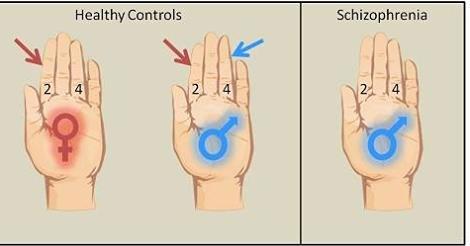
Finger lengths may indicate risk of schizophrenia in males

Research suggests that the ratio of the lengths of the index finger and the ring finger in males may be predictive of a variety of disorders related to disturbed hormonal balance. When the index finger is shorter than the ring finger, this results in a small 2D:4D ratio, pointing to a high exposure to testosterone in the uterus.

In a new study of 103 male patients diagnosed with schizophrenia and 100 matched healthy male individuals, investigators found that the 2D:4D ratio may be an effective predictor of schizophrenia — there were significant differences between schizophrenia and control groups concerning the ratio of the lengths of the second digit to the fourth digit, as well as its asymmetry, in both hands.

“Asymmetry index showed moderate discriminatory power and, therefore asymmetry index has a potential utility as a diagnostic test in determining the presence of schizophrenia,” said Dr. Taner Oznur, co-author of the Clinical Anatomy study.

Abdullah Bolu, Taner Oznur, Sedat Develi, Murat Gulsun, Emre Aydemir, Mustafa Alper, Mehmet Toygar. The ratios of 2nd to 4th digit may be a predictor of schizophrenia in male patients. Clinical Anatomy, 2015; DOI: 10.1002/ca.22527

http://www.sciencedaily.com/releases/2015/03/150316134920.htm

Blueberries may be effective in the treatment for post-traumatic stress disorder (PTSD)

Researchers from Louisiana State University have found that blueberries may be effective in the treatment for post-traumatic stress disorder (PTSD). Findings from the study have been presented at the Experimental Biology Meeting in Boston, MA.

Presently, the only therapy approved by the Food and Drug Administration (FDA) for PTSD is selective serotonin reuptake inhibitors (SSRIs) such as sertraline and paroxetine. Study authors have previously shown that SSRIs increase the level of serotonin (5-HT) and norepinephrine, and that the increased norepinephrine be a possible reason for the reduced efficacy of SSRI therapy.

For this study, the team studied the ability of blueberries to modulate neurotransmitter levels in a rat model of PTSD. Some of the rats received a 2% blueberry-enriched supplement diet and others received a control diet. A third control group consisted of rats without PTSD and received a standard diet without blueberries. Scientists used high-performance liquid chromatography to to measure monoamines and related metabolite levels.

Rats with PTSD who did not receive blueberries showed a predictable increase in 5-HT and norepinephrine level compared with the control group. But rats with PTSD that received blueberries showed a beneficial increase in 5-HT levels with no impact on norepinephrine levels, which suggest that blueberries can alter neurotransmitter levels in PTSD. More studies are needed to understand the protective effects of blueberries and its potential target as a treatment for PTSD.

http://www.empr.com/benefits-of-blueberries-for-post-traumatic-stress-disorder-explored-in-study/article/405810/

World’s oldest psychiatric hospital opens new museum

The world’s oldest psychiatric institution, the Bethlem Royal Hospital outside London, this week opened a new museum and art gallery charting the evolution in the treatment of mental disorders.

The original hospital was founded in 1247 in what is now central London and the name spawned the English word “bedlam” meaning chaos and madness.

In the 18th century visitors could pay to gawk at the hospital’s patients and, three centuries later, stereotypes about mental illness still abound.

“The museum is to do with challenging the stigma around mental health and one of the main ways you can do that is actually get people to walk onto the site and realise that this is not a frightening, threatening and dark place,” Victoria Northwood, head of the Archives and Museum, told AFP.

The bleak period in the history of mental treatment is addressed but not dwelled upon in the museum.

Iron and leather shackles used until the mid-19th century to restrain patients are displayed behind a wall of mirrors so they cannot be seen directly.

A padded cell is deconstructed and supplemented with audio of a patient describing what is was like to be locked inside.

The exhibition is full of interactive exhibits, including a video where the visitor is challenged to decide whether to commit a young woman, in denial about the dangers of her anorexia, to hospital against her will.

The decision is surprisingly difficult and it shows the complexity in diagnosing ailments linked to the brain, which we still know comparatively little.

“We are just getting across that this is not a black and white issue. It is not very easy. Human beings aren’t very easy,” Northwood said.

Art features strongly throughout the space, starting with the imposing 17th century statues “Raving Madness” and “Melancholy Madness” by Caius Gabriel Cibber, which used to stand at the entrance to the Bethlem hospital when it was in central London.

Also included are paintings by current or former patients, like Dan Duggan’s haunting charcoal “Cipher” series of a man’s elongated face—a testament to the 41-year-old’s inner turmoil.

Duggan, who made several suicide attempts and was detained three times under the mental health act including at Bethlem, said art was an instrumental tool in his recovery.

“A lot of the time you spend in hospital, particularly a psychiatric hospital, is very prescribed.

“When you’re engaged in a creative process, you’re able to be free of all of that for a while and the power is back in your hands to do whatever you want to do,” he said.

Visual artist and dancer Liz Atkin grew up in an alcoholic household. She developed dermatillomania or Compulsive Skin Picking from the age of eight as a way to manage the stress.

“I could have ended things in a very different way,” said Atkin, now aged 38.

Atkin received treatment and works with patients at the anxiety unit of Bethlem, which is now located in spacious grounds about one hour south of London.

She said the new museum and gallery is a unique space to encourage healing.

“Making artwork isn’t a complete cure and I personally don’t think that I’m cured, but I think it provides a very powerful outlet for some of those things that are hard to talk about.”

http://medicalxpress.com/news/2015-02-world-oldest-psychiatric-hospital-museum.html

New study shows that use of psychedelic drugs does not increase risk of mental illness

An analysis of data provided by 135,000 randomly selected participants – including 19,000 people who had used drugs such as LSD and magic mushrooms – finds that use of psychedelics does not increase risk of developing mental health problems. The results are published in the Journal of Psychopharmacology.

Previously, the researchers behind the study – from the Norwegian University of Science and Technology in Trondheim – had conducted a population study investigating associations between mental health and psychedelic use. However, that study, which looked at data from 2001-04, was unable to find a link between use of these drugs and mental health problems.

“Over 30 million US adults have tried psychedelics and there just is not much evidence of health problems,” says author and clinical psychologist Pål-Ørjan Johansen.

“Drug experts consistently rank LSD and psilocybin mushrooms as much less harmful to the individual user and to society compared to alcohol and other controlled substances,” concurs co-author and neuroscientist Teri Krebs.

For their study, they analyzed a data set from the US National Health Survey (2008-2011) consisting of 135,095 randomly selected adults from the US, including 19,299 users of psychedelic drugs.

Krebs and Johansen report that they found no evidence for a link between use of psychedelic drugs and psychological distress, depression, anxiety or suicidal thoughts, plans and attempts.

In fact, on a number of factors, the study found a correlation between use of psychedelic drugs and decreased risk for mental health problems.

“Many people report deeply meaningful experiences and lasting beneficial effects from using psychedelics,” says Krebs.

However, Johansen acknowledges that – given the design of the study – the researchers cannot “exclude the possibility that use of psychedelics might have a negative effect on mental health for some individuals or groups, perhaps counterbalanced at a population level by a positive effect on mental health in others.”

Despite this, Johansen believes that the findings of the study are robust enough to draw the conclusion that prohibition of psychedelic drugs cannot be justified as a public health measure.

Krebs says:

“Concerns have been raised that the ban on use of psychedelics is a violation of the human rights to belief and spiritual practice, full development of the personality, and free-time and play.”

Commenting on the research in a piece for the journal Nature, Charles Grob, a paediatric psychiatrist at the University of California-Los Angeles, says the study “assures us that there were not widespread ‘acid casualties’ in the 1960s.” However, he urges caution when interpreting the results, as individual cases of adverse effects can and do occur as a consequence of psychedelic use.

For instance, Grob describes hallucinogen persisting perception disorder, sometimes referred to as “a never-ending trip.” Patients with this disorder experience “incessant distortions” in their vision, such as shimmering lights and colored dots. “I’ve seen a number of people with these symptoms following a psychedelic experience, and it can be a very serious condition,” says Grob.

http://www.medicalnewstoday.com/articles/290461.php

Depression, Behaviour Changes May Start in Alzheimer’s Even Before Memory Changes

Depression and other behaviour changes may show up in people who will later develop Alzheimer’s disease even before they start having memory problems, according to a study published in the January 14, 2015, online issue of the journal Neurology.

“While earlier studies have shown that an estimated 90% of people with Alzheimer’s experience behavioural or psychological symptoms such as depression, anxiety, and agitation, this study suggests that these changes begin before people even have diagnosable dementia,” said Catherine M. Roe, PhD, Washington University School of Medicine, St. Louis, Missouri.

The study looked at 2,416 people aged 50 years and older who had no cognitive problems at their first visit to one of 34 Alzheimer’s disease centres across the country. The participants were followed for up to 7 years. Of the participants, 1,198 people stayed cognitively normal, with no memory or thinking problems, during the study. They were compared with 1,218 people who were followed for about the same length of time, but who developed dementia.

The people who developed dementia during the study also developed behaviour and mood symptoms such as apathy, appetite changes, irritability, and depression sooner than the people who did not develop dementia. For example, 30% of people who would develop dementia had depression after 4 years in the study, compared with 15% of those who did not develop dementia. Those who developed dementia were more than twice as likely to develop depression sooner than those without dementia and more than 12 times more likely to develop delusions than those without dementia.

Dr. Roe said the study adds to the conflicting evidence on depression and dementia.

“We still don’t know whether depression is a response to the psychological process of Alzheimer’s disease or a result of the same underlying changes in the brain,” she said. “More research is needed to identify the relationship between these two conditions.”

http://dgnews.docguide.com/depression-behaviour-changes-may-start-alzheimer-s-even-memory-changes?overlay=2&nl_ref=newsletter&pk_campaign=newsletter

Selfies Linked to Narcissism, Psychopathy

Men who post selfies on social media such as Instagram and Facebook have higher than average traits of narcissism and psychopathy, according to a new study from academics at Ohio State University.

Furthermore, people who use filters to edit shots score even higher for anti-social behaviour such as narcissism, an obsession with one’s own appearance.

Psychologists from the University of Ohio sampled 800 men aged 18 to 40 about their photo-posting habits on social media.

As well as questionnaires to test their levels of vanity, they were also asked if they edited their photos by cropping them or adding a filter.

Assistant Professor Jesse Fox, lead author of the study at The Ohio State University, said: ‘It’s not surprising that men who post a lot of selfies and spend more time editing them are more narcissistic, but this is the first time it has actually been confirmed in a study.

‘The more interesting finding is that they also score higher on this other anti-social personality trait, psychopathy, and are more prone to self-objectification” she said.

http://www.timeslive.co.za/lifestyle/2015/01/08/men-who-post-selfies-have-narcissistic-and-psychopathic-tendencies-study