Rare Form of MS May Be Caused by a Single Gene Mutation

A single genetic mutation may increase a person’s risk of developing a rare, severe form of multiple sclerosis (MS) by roughly 60 percent, according to a study published recently in the journal Neuron.

That’s an unusually straightforward result for a complex disease like MS, which has previously been traced to hundreds of mutations that each increases the risk of developing the disease only slightly.

“That’s why our finding is unprecedented,” Carles Vilariño-Güell, Ph.D., an assistant professor of medical genetics at The University of British Columbia and one of the paper’s senior authors, told Healthline.

His team found the mutation by combing through a database of Canadians with MS who had donated blood samples as part of the Canadian Collaborative Project on Genetic Susceptibility to MS.

Some of these samples belonged to a family that was disproportionately diagnosed with the disease. Four first cousins and two parents developed MS.

The team isolated a common mutation from their DNA, and looked for that mutation in other individuals in the database.

That’s how they found a second family similarly afflicted. Three first cousins and two parents were diagnosed with MS.

Having so many cases of MS within a family is rare. The disease is not considered truly heritable, although a person’s risk does increase if a parent or sibling has the disease.

The families shared another rare trait. Most had the more severe version of the disease known as primary progressive MS, which makes up 10 to 15 percent of all MS cases.

Treatments for primary progressive MS have so far eluded scientists, although there are promising clinical trials underway of a drug called Ocrelizumab.


Future Research

The study found the mutation only in a handful of people, all of whom were diagnosed with a rare form of the disease.

Therefore, the researchers don’t suggest they have found the genetic basis of MS.

But they do think they’ve discovered a way to study how the disease progresses in the body and what drugs could be developed to slow or even stop it

Bruce Bebo, Ph.D., vice president of research at the National Multiple Sclerosis Society, agrees.

“Studying the genetics of a very rare form that is inherited can give us clues about pathways involved in MS in the general population,” he told Healthline.

The mutation appears to disable a regulatory gene called NR1H3, which codes for a protein that helps regulate the inflammation and the metabolism of lipids.

The researchers now plan to engineer a similar mutation in mice so they can study the outcome of a disabled NR1H3 gene and test potential new drugs in an animal model.

And because the NR1H3 pathway has already been implicated in diseases like atherosclerosis and heart disease, there are already drugs in clinical trials for safety that could be repurposed for treating MS, Vilariño-Güell said.

“Understanding the genetics of MS could help us get closer to individualizing therapy to people for better outcomes,” Bebo said.

Getting Personal with Treatment

People with a disease like MS, which appears in so many different ways and can be linked to so many different genetic components, could benefit by personalized medicine.

If the mechanism of each disease causing mutation or group of mutations is pinpointed, scientists could potentially design more effective, targeted treatments rather than the standard one-size-fits-all therapies.

That means tracking down the many different genetic hotspots that are linked to MS.

Overall, genetic predisposition accounts for only about a third of a person’s risk of developing the disease, Bebo said. Within that category only about half the genes responsible can be identified.

Researchers don’t know where the other half of that genetic risk comes from, Bebo said, but it makes sense that it would include rare mutations like this one that help explain risk in a small fraction of MS patients.

And there could be many different versions of these mutations.

“Odds are if you look at a different family the genetic risk would probably be something different than this,” Bebo said.

Speeding Through the Genome

The Canadian database has been available since the late 1990s, but only recently has the team had access to exome sequencing, a powerful, efficient tool that makes searching for tiny genetic changes easier.

This technique sequences only the DNA that codes for proteins — leaving the other 98 percent behind. It’s like speed reading the genome.

Exome sequencing has been particularly helpful for finding so-called “Mendelian” diseases — diseases that can be traced to a single, heritable mutation just like Gregor Mendel’s purple and white pea flowers. Cystic fibrosis and sickle cell anemia are two examples of these diseases.

With this discovery, the researchers say that have found a Mendelian form of MS.

That doesn’t mean the discovery won’t be beneficial for the 85 percent of people diagnosed with relapsing remitting MS. In many of those patients, the disease eventually changes course and becomes progressive.

Whatever is learned about primary progressive MS — a condition that doesn’t respond to treatments for other types of MS — could also potentially help those with secondary progressive MS, the researchers say.

http://www.healthline.com/health-news/form-of-ms-could-be-caused-by-single-genetic-mutation#5

“Joke Addiction” As A Neurological Symptom

In a new paper, neurologists Elias D. Granadillo and Mario F. Mendez describe two patients in whom brain disorders led to an unusual symptom: “intractable joking.”

Patient #1 was

A 69-year-old right-handed man presented for a neuropsychiatric evaluation because of a 5-year history of compulsive joking… On interview, the patient reported feeling generally joyful, but his compulsive need to make jokes and create humor had become an issue of contention with his wife. He would wake her up in the middle of the night bursting out in laughter, just to tell her about the jokes he had come up with. At the request of his wife, he started writing down these jokes as a way to avoid waking her. As a result, he brought to our office approximately 50 pages filled with his jokes.

Granadillo and Mendez quote some of the patient’s gags:

Q: What is a pill-popping sexual molester guilty of? A: Rape and pillage.
Q: What did the proctologist say to his therapist? A: All day long I am dealing with assholes.

Went to the Department of Motor Vehicles to get my driver’s license. They gave me an eye exam and here is what they said:
ABCDEFG, HIJKMNLOP, QRS, TUV, WXY and Z; now I know my ABC’s, can I have my license please?

The man’s comedic compulsion was attributed to a stroke, which had damaged part of his left caudate nucleus, although an earlier lesion to the right frontal cortex, caused by a subarachnoid hemorrhage, may have contributed to the pathological punning. Granadillo and Mendez say that a series of medications, including antidepressants, had little impact on his “compulsive need to constantly make and tell jokes.”

Patient #2 was a 57-year old man, who had become “a jokester”, a transformation that had occurred gradually, over a three period. At the same time, the man became excessively forward and disinhibited, making inappropriate actions and remarks. He eventually lost his job after asking “Who the hell chose this God-awful place?”

The patient constantly told jokes and couldn’t stop laughing at them. However, he did not seem to find other people’s jokes funny at all.

The man’s case, however, came to a sad end. His behavior continued to deteriorate and he developed symptoms of Parkinson’s. He died several years later. The diagnosis was Pick’s disease, a rare form of dementia. A post mortem revealed widespread neurodegeneration: “frontotemporal atrophy, severe in the frontal lobes and moderate in the temporal lobes, affecting the right side more than the left” was noted.

Neuroskeptic
« The Myth of “Mind-Altering Parasite” Toxoplasma Gondii?
“Joke Addiction” As A Neurological Symptom
By Neuroskeptic | February 28, 2016 5:51 am
26
In a new paper, neurologists Elias D. Granadillo and Mario F. Mendez describe two patients in whom brain disorders led to an unusual symptom: “intractable joking.”

Patient #1 was

A 69-year-old right-handed man presented for a neuropsychiatric evaluation because of a 5-year history of compulsive joking… On interview, the patient reported feeling generally joyful, but his compulsive need to make jokes and create humor had become an issue of contention with his wife. He would wake her up in the middle of the night bursting out in laughter, just to tell her about the jokes he had come up with. At the request of his wife, he started writing down these jokes as a way to avoid waking her. As a result, he brought to our office approximately 50 pages filled with his jokes.

Granadillo and Mendez quote some of the patient’s gags:

Q: What is a pill-popping sexual molester guilty of? A: Rape and pillage.
Q: What did the proctologist say to his therapist? A: All day long I am dealing with assholes.

Went to the Department of Motor Vehicles to get my driver’s license. They gave me an eye exam and here is what they said:
ABCDEFG, HIJKMNLOP, QRS, TUV, WXY and Z; now I know my ABC’s, can I have my license please?

The man’s comedic compulsion was attributed to a stroke, which had damaged part of his left caudate nucleus, although an earlier lesion to the right frontal cortex, caused by a subarachnoid hemorrhage, may have contributed to the pathological punning. Granadillo and Mendez say that a series of medications, including antidepressants, had little impact on his “compulsive need to constantly make and tell jokes.”

granadillo_mendez

Patient #2 was a 57-year old man, who had become “a jokester”, a transformation that had occurred gradually, over a three period. At the same time, the man became excessively forward and disinhibited, making inappropriate actions and remarks. He eventually lost his job after asking “Who the hell chose this God-awful place?”

The patient constantly told jokes and couldn’t stop laughing at them. However, he did not seem to find other people’s jokes funny at all.

The man’s case, however, came to a sad end. His behavior continued to deteriorate and he developed symptoms of Parkinson’s. He died several years later. The diagnosis was Pick’s disease, a rare form of dementia. A post mortem revealed widespread neurodegeneration: “frontotemporal atrophy, severe in the frontal lobes and moderate in the temporal lobes, affecting the right side more than the left” was noted.

The authors say that both of these patients displayed Witzelsucht, a German term literally meaning ‘joke addiction’. Several cases have been reported in the neurological literature, often associated with damage to the right hemisphere of the brain. Witzelsucht should be distinguished from ‘pathological laughter‘, in which patients start laughing ‘out of the blue’ and the laughter is incongruent with their “mood and emotional experience.” In Witzelsucht, the laughter is genuine: patients really do find their own jokes funny, although they often fail to appreciate those of others.

Granadillo ED, & Mendez MF (2016). Pathological Joking or Witzelsucht Revisited. The Journal of Neuropsychiatry and Clinical Neurosciences PMID: 26900737

Phantom Eye Patients See and Feel with Missing Eyeballs

by Elizabeth Preston

Amputees often feel eerie sensations from their missing limbs. These “phantom limb” feelings can include pain, itching, tingling, or even a sense of trying to pick something up. Patients who lose an eye may have similar symptoms—with the addition of actual phantoms.

Phantom eye syndrome (PES) had been studied in the past, but University of Liverpool psychologist Laura Hope-Stone and her colleagues recently conducted the largest study of PES specifically in patients who’d lost an eye to cancer.

The researchers sent surveys to 239 patients who’d been treated for uveal melanoma at the Liverpool Ocular Oncology Centre. All of these patients had had one eye surgically removed. Some of their surgeries were only 4 months in the past; others had taken place almost 4 and a half years earlier. Three-quarters of the patients returned the surveys, sharing details about how they were doing in their new monocular lives.

Sixty percent of respondents said they had symptoms of phantom eye syndrome. These symptoms included pain, visual sensations, or the impression of actually seeing with the missing eye.

Patients with visual symptoms most often saw simple shapes and colors. But some people reported more distinct images, “for example, resembling wallpaper, a kaleidoscope, or fireworks, or even specific scenes and people,” the authors write.

Then there were the ghosts.

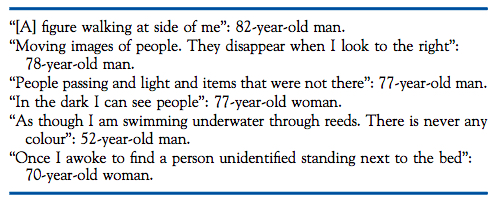
Some people said they had seen strangers haunting their fields of vision, as in these survey responses:

A survey isn’t a perfect way to measure how common PES is overall. But Hope-Stone says there were enough survey responses to produce helpful data for doctors who treat patients with eye cancer.

“We can now tell whether certain kinds of patients are more likely to have phantom symptoms,” she says. For example, “PES is more common in younger patients, and having pain in the non-existent eye is more likely in patients who are anxious and depressed, although we don’t know why.”

About a fifth of PES patients, understandably, said they were disturbed by their symptoms. A similar number found them “pleasurable,” Hope-Stone says.

Doctors aren’t sure exactly why phantom eye syndrome occurs. Since different patients have different symptoms, Hope-Stone says, “I suspect that…there may be a range of causes.”

For that matter, phantom limbs are still mysterious to doctors too. “Human perception is a complex process,” Hope-Stone explains. Even when our sensory organs are gone—the vision receptors in our eyes, the pain and touch receptors in our hands—the nerves and brain areas that used to talk to those organs keep working just fine. “Interactions between [these systems] may contribute to phantom sensations,” she says, although “the exact mechanisms are unclear.”

Even if they don’t know why it happens, doctors can warn their patients about the kinds of symptoms they’re likely to experience—and the ghosts they might see.

http://blogs.discovermagazine.com/inkfish/2015/06/05/phantom-eye-patients-see-and-feel-with-missing-eyeballs/#.VtM-OfkrIgv

Wheelchair-bound multiple sclerosis patients able to walk again after new stem-cell therapy


Holly Drewry, 25, of Sheffield, was wheelchair bound after the birth of her daughter Isla, now two.

A pioneering new stem cell treatment is reversing and then halting the potentially crippling effects of multiple sclerosis.

Patients embarking on a ground-breaking trial of the new treatment have found they can walk again and that the disease even appears to be stopped in its tracks.

Holly Drewry, 25, from Sheffield, was wheelchair bound after the birth of her daughter Isla, now two. But Miss Drewry claims the new treatment has transformed her life.

She told the BBC’s Panorama programme: “I couldn’t walk steadily. I couldn’t trust myself holding her (Isla) in case I fell. Being a new mum I wanted to do it all properly but my MS was stopping me from doing it.

“It is scary because you think, when is it going to end?”

The treatment is being carried out at Royal Hallamshire Hospital in Sheffield and Kings College Hospital, London and involves use a high dose of chemotherapy to knock out the immune system before rebuilding it with stem cells taken from the patient’s own blood.

Miss Drewry had the treatment in Sheffield. She said: “I started seeing changes within days of the stem cells being put in.

“I walked out of the hospital. I walked into my house and hugged Isla. I cried and cried. It was a bit overwhelming. It was a miracle.”

Her treatment has now been reviewed and her condition found to have been dramatically halted. She will need to be monitored for years but the hope is that her transplant will be a permanent fix.

She is now planning to get married.

For other patients, the results have been equally dramatic. Steven Storey was a marathon runner and triathlete before he was struck down with the disease and left completely paralysed: “I couldn’t flicker a muscle,” he said.

But within nine days of the treatment he could move his toe and after 10 months managed a mile-long swim in the Lake District. He has also managed to ride a bike and walk again.

“It was great. I felt I was back,” he said.

Mr Storey celebrated his first transplant birthday with his daughters. His treatment has been reviewed and, like Miss Drewry, there was no evidence of active disease.

The treatment – which effectively ‘reboots’ the immune systems – is the first to reverse the symptoms of MS, which has no cure, and affects around 100,000 people in Britain.

Stem cells are so effective because they can become any cell in the body based on their environment.

Although it is unclear what causes MS, some doctors believe that it is the immune system itself which attacks the brain and spinal cord, leading to inflammation and pain, disability and in severe cases, death.

Professor Basil Sharrack, a consultant neurologist at Sheffield Teaching Hospitals NHS Foundation Trust, said: “Since we started treating patients three years ago, some of the results we have seen have been miraculous.

“This is not a word I would use lightly, but we have seen profound neurological improvements.”

During the treatment, the patient’s stem cells are harvested and stored. Then doctors use aggressive drugs which are usually given to cancer patients to completely destroy the immune system.

The harvested stem cells are then infused back into the body where they start to grow new red and white blood cells within just two weeks.

Within a month the immune system is back up and running fully and that is when patients begin to notice that they are recovering.

However specialists warn that patients need to be fit to benefit from the new treatment.

The research has been published in the Journal of the American Medical Association.

http://www.telegraph.co.uk/news/health/news/12104774/Miraculous-results-from-new-MS-treatment.html

Thanks to Steve Weihing for bringing this to the It’s Interesting community.

Migraine headaches in the NFL


Jets linebacker Lorenzo Mauldin (55) wears special contact lenses and a helmet shade to prevent migraines.

By ZACH SCHONBRUN

FWhen he woke last Sunday morning, Jeremy Kerley sensed trouble already coming on. Fitful sleep is often his trigger, he said. The migraine eventually hit him like an anvil late in last week’s game against the Giants.

His eyes grew blurry and he felt what he described as a “sharp, shooting, throbbing pain.” He wanted to sit down. He wanted to lie down. He knew he needed to leave the field.

Kerley, the Jets’ punt returner, departed to the locker room and did not return. As the Jets came from behind to beat the Giants in overtime, he was receiving intravenous fluids and oxygen to help relieve the anguish from a struggle that has afflicted him since high school.

For Kerley, migraines are the silent menace that constantly lurks. They ambush him almost once a month, even though he rarely talks about it. He knew his grandfather got them; only recently, he discovered that his dad did, too. He just never knows when they will affect him.

Though Kerley is one of approximately 38 million Americans who suffer from them, migraines are not something that is openly discussed in N.F.L. locker rooms. They are far more common in women, and often minimized as simply a headache, a stigma that Kerley acknowledged could make it difficult to pull himself out of a game.

But those who do struggle with migraines — which the Migraine Research Foundation considers a neurological disease, like epilepsy — understand the plight. When Kerley felt a severe headache coming on last season after a game at Minnesota, his teammate Percy Harvin patted him on the back.

“I know how you feel,” Harvin said quietly. He has struggled with migraines throughout his career.

Kerley did the same thing earlier this season, after linebacker Lorenzo Mauldin revealed that he had had migraines since adolescence. Kerley gave him recommendations about nutritional supplements that he found helpful, like fish oil and magnesium. Mauldin also now takes prescription medication to both relieve and prevent severe headaches.

He said that light could often trigger his migraine episodes, so Mauldin wears special contact lenses and a protective shade on his helmet.

“It hurts because it’s pulsating and you can’t really stop it,” Mauldin said. “With a bruise or something, you can put alcohol or peroxide over it and it’ll be fine. Or if you’ve hurt a muscle, you can ice it. But you can’t put ice over a migraine.”

In September, a migraine forced Ohio State quarterback Cardale Jones to the emergency room, something that is not uncommon, said Dr. Melissa Leber, the director of emergency department sports medicine at the Icahn School of Medicine at Mount Sinai. She typically treats patients intravenously. But that often cannot relieve the crippling symptoms right away.

“Some people can’t even get out of bed,” Leber said. “Others can function just while not feeling well. It really runs the gamut for how debilitating it can be.”

Migraines are thought to be related to the brain’s trigeminal nerve, which can grow hypersensitive and cause pain signals to fire throughout the brain, typically concentrated around the eyes or temples. Though migraines are strongly hereditary, showing up in people who have had no sports history, they are often clinically similar to post-traumatic headaches, like the headaches that arise after a concussion, according to Dr. Tad Seifert, a neurologist at Norton Healthcare in Louisville, Ky.

During the summer, Seifert led a study of 74 high school football players in the Louisville area and found that 33.8 percent of them suffered from migraines, a rate twice that of the normal population. The rate rose to 37.5 percent in players who reported having sustained a concussion once in their lives, and 40.7 percent in those who reported multiple concussions.

“The elephant in the room is whether there is some influence of contact sports and the development of frequent or chronic headache later in life,” Seifert said. “And if so, how much?”

Seifert, who also chairs an N.C.A.A. task force on headaches, said that he expected to publish a similar report involving 834 Division I athletes in the spring. Though he would not go into detail about the results, he said that it looked to be “very similar to what we’ve found in this sample of high school players.” Mauldin, it should be noted, sustained a concussion earlier this season.

There is no cure for migraines, and sufferers often go the rest of their lives “controlling” the issue, Seifert said, comparing it to those dealing with high blood pressure or diabetes. What concerns him, though, are the studies that have shown that people with migraines are more susceptible to concussions, and when they do sustain one, it takes them longer to recover.

“We know that the migraine brain is just wired differently,” Seifert said. “And we know that it’s a brain that is hypersensitive to external injury. And those pain receptors that are in overdrive — it takes that much longer to calm down and return to baseline.”

In the time it takes for the receptors to settle, though, the pain can bring a linebacker to his knees.

“When they pop up out of nowhere, you start to feel a sensation like in between the middle of your forehead,” Mauldin said. “But it’s in the back of your head as well. It’s like somebody’s punching you in the side of the head.”

Kerley said he had yet to receive a migraine disease diagnosis, but he thinks it could be related to difficulties he regularly has with sleeping, being someone who has sleep apnea. When he feels a headache coming on, he has a nasal spray that he said often cured his symptoms within a half-hour. But last Sunday, it was too late.

“If you don’t catch it while it’s early, it could get pretty bad,” Kerley said. “Mine got there.”

Cancer drug nilotinib may reverse Parkinson’s disease

by Jon Hamilton

A drug that’s already approved for treating leukemia appears to dramatically reduce symptoms in people who have Parkinson’s disease with dementia, or a related condition called Lewy body dementia.

A pilot study of 12 patients given small doses of nilotinib found that movement and mental function improved in all of the 11 people who completed the six-month trial, researchers reported Saturday at the Society for Neuroscience meeting in Chicago.

And for several patients the improvements were dramatic, says Fernando Pagan, an author of the study and director of the Movement Disorders Program at Georgetown University Medical Center. One woman regained the ability to feed herself, one man was able to stop using a walker, and three previously nonverbal patients began speaking again, Pagan says.

“After 25 years in Parkinson’s disease research, this is the most excited I’ve ever been,” Pagan says.

If the drug’s effectiveness is confirmed in larger, placebo-controlled studies, nilotinib could become the first treatment to interrupt a process that kills brain cells in Parkinson’s and other neurodegenerative diseases, including Alzheimer’s.

One of the patients in the pilot study was Alan Hoffman, 74, who lives with his wife, Nancy, in Northern Virginia.

Hoffman was diagnosed with Parkinson’s in 1997. At first, he had trouble moving his arms. Over time, walking became more difficult and his speech became slurred. And by 2007, the disease had begun to affect his thinking.

“I knew I’d dropped off in my ability to read,” Hoffman says. “People would keep giving me books and I’d have read the first chapter of about 10 of them. I had no ability to focus on it.”

“He had more and more difficulty making sense,” Nancy Hoffman says. He also became less active, less able to have conversations, and eventually stopped doing even household chores, she says.

But after a few weeks on nilotinib, Hoffman “improved in every way,” his wife says. “He began loading the dishwasher, loading the clothes in the dryer, things he had not done in a long time.”

Even more surprising, Hoffman’s scores on cognitive tests began to improve. At home, Nancy Hoffman says her husband was making sense again and regained his ability to focus. “He actually read the David McCullough book on the Wright Brothers and started reading the paper from beginning to end,” she says.

The idea of using nilotinib to treat people like Alan Hoffman came from Charbel Moussa, an assistant professor of neurology at Georgetown University and an author of the study.

Moussa knew that in people who have Parkinson’s disease with dementia or a related condition called Lewy body dementia, toxic proteins build up in certain brain cells, eventually killing them. Moussa thought nilotinib might be able to reverse this process.

His reasoning was that nilotinib activates a system in cells that works like a garbage disposal — it clears out unwanted proteins. Also, Moussa had shown that while cancer cells tend to die when exposed to nilotinib, brain cells actually become healthier.

So Moussa had his lab try the drug on brain cells in a Petri dish. “And we found that, surprisingly, with a very little amount of the drug we can clear all these proteins that are supposed to be neurotoxic,” he says.

Next, Moussa had his team give the drug to transgenic mice that were almost completely paralyzed from Parkinson’s disease. The treatment “rescued” the animals, he says, allowing them to move almost as well as healthy mice.

Moussa’s mice got the attention of Pagan from Georgetown’s Movement Disorders Program. “When Dr. Moussa showed them to me,” Pagan says, “it looked like, hey, this is type of drug that we’ve been looking for because it goes to the root of the problem.”

The pilot study was designed to determine whether nilotinib was safe for Parkinson’s patients and to determine how much drug from the capsules they were taking was reaching their brains. “But we also saw efficacy, which is really unheard of in a safety study,” Pagan says.

The study found that levels of toxic proteins in blood and spinal fluid decreased once patients began taking nilotinib. Also, tests showed that the symptoms of Parkinson’s including tremor and “freezing” decreased. And during the study patients were able to use lower doses of Parkinson’s drugs, suggesting that the brain cells that produce dopamine were working better.

But there are some caveats, Pagan says. For one thing, the study was small, not designed to measure effectiveness, and included no patients taking a placebo.

Also, nilotinib is very expensive. The cost of providing it to leukemia patients is thousands of dollars a month.

And finally, Parkinson’s and dementia patients would have to keep taking nilotinib indefinitely or their symptoms would continue to get worse.

Alan Hoffman was okay for about three weeks after the study ended and he stopped taking the drug. Since then, “There’s (been) a pretty big change,” his wife says. “He does have more problems with his speech, and he has more problems with cognition and more problems with mobility.”

The Hoffmans hope to get more nilotinib from the drug’s maker, Novartis, through a special program for people who improve during experiments like this one.

Meanwhile, the Georgetown team plans to try nilotinib in patients with another brain disease that involves toxic proteins: Alzheimer’s.

http://www.npr.org/sections/health-shots/2015/10/17/448323916/can-a-cancer-drug-reverse-parkinsons-disease-and-dementia

The human brain is particularly vulnerable to trauma at two distinct ages

Our brain’s ability to process information and adapt effectively is dependent on a number of factors, including genes, nutrition, and life experiences. These life experiences wield particular influence over the brain during a few sensitive periods when our most important muscle is most likely to undergo physical, chemical, and functional remodeling.

According to Tara Swart, a neuroscientist and senior lecturer at MIT, your “terrible twos” and those turbulent teen years are when the brain’s wiring is most malleable. As a result, traumatic experiences that occur during these time periods can alter brain activity and ultimately change gene expressions—sometimes for good.

Throughout the first two years of life, the brain develops at a rapid pace. However, around the second year, something important happens—babies begin to speak.

“We start to understand speech first, then we start to articulate speech ourselves and that’s a really complex thing that goes on in the brain,” Swart, who conducts ongoing research on the brain and how it affects how we become leaders, told Quartz. “Additionally, children start to walk—so from a physical point of view, that’s also a huge achievement for the brain.

Learning and understanding a new language forces your brain to work in new ways, connecting neurons and forming new pathways. This is a mentally taxing process, which is why learning a new language or musical instrument often feels exhausting.

With so many important changes happening to the brain in such a short period of time, physical or emotional trauma can cause potentially momentous interruptions to neurological development. Even though you won’t have any memories of the interruptions (most people can’t remember much before age five), any kind of traumatic event—whether it’s abuse, neglect, ill health, or separation from your loved ones—can lead to lasting behavioral and cognitive deficits later in life, warns Swart.

To make her point, Swart points to numerous studies on orphans in Romania during the 1980s and 1990s. After the nation’s communist regime collapsed, an economic decline swept throughout the region and 100,000 children found themselves in harsh, overcrowded government institutions.

“[The children] were perfectly well fed, clothed, washed, but for several reasons—one being that people didn’t want to spread germs—they were never cuddled or played with,” explains Swart. “There was a lot of evidence that these children grew up with some mental health problems and difficulty holding down jobs and staying in relationships.”

Swart continues: “When brain scanning became possible, they scanned the brains of these children who had grown up into adults and showed that they had issues in the limbic system, the part of the brain [that controls basic emotions].”

In short, your ability to maintain proper social skills and develop a sense of empathy is largely dependent on the physical affection, eye contact, and playtime of those early years. Even something as simple as observing facial expressions and understanding what those expressions mean is tied to your wellbeing as a toddler.

The research also found that the brains of the Romanian orphans had lower observable brain activity and were physically smaller than average. As a result, researchers concluded that children adopted into loving homes by age two have a much better chance of recovering from severe emotional trauma or disturbances.

The teenage years

By the time you hit your teenage years, the brain has typically reached its adult weight of about three pounds. Around this same time, the brain is starting to eliminate, or “prune” fragile connections and unused neural pathways. The process is similar to how one would prune a garden—cutting back the deadwood allows other plants to thrive.

During this period, the brain’s frontal lobes, especially the prefrontal cortex, experience increased activity and, for the first time, the brain is capable of comparing and analyzing several complex concepts at once. Similar to a baby learning how to speak, this period in an adolescent’s life is marked by a need for increasingly advanced communication skills and emotional maturity.

“At that age, they’re starting to become more understanding of social relationships and politics. It’s really sophisticated,” Swart noted. All of this brain activity is also a major reason why teenagers need so much sleep.

Swart’s research dovetails with the efforts of many other scientists who have spent decades attempting to understand how the brain develops, and when. The advent of MRIs and other brain-scanning technology has helped speed along this research, but scientists are still working to figure out what exactly the different parts of the brain do.

What is becoming more certain, however, is the importance of stability and safety in human development, and that such stability is tied to cognitive function. At any point in time, a single major interruption has the ability to throw off the intricate workings of our brain. We may not really understand how these events affect our lives until much later.

http://qz.com/470751/your-brain-is-particularly-vulnerable-to-trauma-at-two-distinct-ages/

A more expensive placebo works better than a cheaper one.

Results of a small study suggest that Parkinson’s patients seem to improve if they think they’re taking a costly medication. The findings have been published online Jan. 28 in Neurology.

In the study, 12 patients had their movement symptoms evaluated hourly, for about four hours after receiving each of the placebos. On average, patients had bigger short-term improvements in symptoms like tremor and muscle stiffness when they were told they were getting the costlier of two drugs. In reality, both “drugs” were nothing more than saline, given by injection. But the study patients were told that one drug was a new medication priced at $1,500 a dose, while the other cost just $100 — though, the researchers assured them, the medications were expected to have similar effects.

Yet, the researchers found that when patients’ movement symptoms were evaluated in the hours after receiving the fake drugs, they showed greater improvements with the pricey placebo. What’s more, magnetic resonance imaging scans showed differences in the patients’ brain activity, depending on which placebo they’d received. The patients in the study didn’t get as much relief from the two placebos as they did from their regular medication, levodopa. But the magnitude of the expensive placebo’s benefit was about halfway between that of the cheap placebo and levodopa. What’s more, patients’ brain activity on the pricey placebo was similar to what was seen with levodopa.

And this effect is “not exclusive to Parkinson’s,” according to Peter LeWitt, M.D., a neurologist at the Henry Ford West Bloomfield Hospital in Michigan, who wrote an editorial published with the study. Research has documented the placebo effect in various medical conditions, he told HealthDay. “The main message here is that medication effects can be modulated by factors that consumers are not aware of — including perceptions of price.”

http://www.empr.com/pricey-placebo-works-better-than-cheaper-one-in-parkinsons-study/article/395255/?DCMP=EMC-MPR_DailyDose_rd&CPN=edgemont14,emp_lathcp&hmSubId=&hmEmail=5JIkN8Id_eWz7RlW__D9F5p_RUD7HzdI0&dl=0&spMailingID=10518237&spUserID=MTQ4MTYyNjcyNzk2S0&spJobID=462545599&spReportId=NDYyNTQ1NTk5S0

Depression, Behaviour Changes May Start in Alzheimer’s Even Before Memory Changes

Depression and other behaviour changes may show up in people who will later develop Alzheimer’s disease even before they start having memory problems, according to a study published in the January 14, 2015, online issue of the journal Neurology.

“While earlier studies have shown that an estimated 90% of people with Alzheimer’s experience behavioural or psychological symptoms such as depression, anxiety, and agitation, this study suggests that these changes begin before people even have diagnosable dementia,” said Catherine M. Roe, PhD, Washington University School of Medicine, St. Louis, Missouri.

The study looked at 2,416 people aged 50 years and older who had no cognitive problems at their first visit to one of 34 Alzheimer’s disease centres across the country. The participants were followed for up to 7 years. Of the participants, 1,198 people stayed cognitively normal, with no memory or thinking problems, during the study. They were compared with 1,218 people who were followed for about the same length of time, but who developed dementia.

The people who developed dementia during the study also developed behaviour and mood symptoms such as apathy, appetite changes, irritability, and depression sooner than the people who did not develop dementia. For example, 30% of people who would develop dementia had depression after 4 years in the study, compared with 15% of those who did not develop dementia. Those who developed dementia were more than twice as likely to develop depression sooner than those without dementia and more than 12 times more likely to develop delusions than those without dementia.

Dr. Roe said the study adds to the conflicting evidence on depression and dementia.

“We still don’t know whether depression is a response to the psychological process of Alzheimer’s disease or a result of the same underlying changes in the brain,” she said. “More research is needed to identify the relationship between these two conditions.”

http://dgnews.docguide.com/depression-behaviour-changes-may-start-alzheimer-s-even-memory-changes?overlay=2&nl_ref=newsletter&pk_campaign=newsletter

Man experiencing headaches, seizures, memory flashbacks and strange smells discovered to have had tapeworm living in his brain for 4 years


Parasitic worm normally found in amphibians and crustaceans in China may have scavenged nutrients from patient’s brain

A man who went to see his doctor after suffering headaches and experiencing strange smells was found to have been living for more than four years with a rare parasitic worm in his brain.

In the first case of its kind in Britain, the ribbon-shaped tapeworm was found to have burrowed from one side of the 50-year-old man’s brain to the other.

Doctors were left baffled after spotting strange ring-like patterns moving 5cm through his brain tissue in a series of scans taken over four years.

Surgeons only discovered the 1cm worm while carrying out a biopsy at Addenbrooke’s hospital in Cambridge and took it to parasite experts to be identified.

Geneticists at the Wellcome Trust Sanger Institute in Cambridge found the creature was a rare species of tapeworm known as Spirometra erinaceieuropaei.

Only 300 cases of infection by this parasite in humans have been reported since 1953, with only two previous cases identified in Europe.

The worm is normally found in amphibians and crustaceans in China and as it goes through its life cycle it later infects the guts of cats and dogs, where it can grow into 1.5-metre adult worms. Even in China, where the parasite is normally found, there have only been 1,000 cases reported in humans since 1882.

The unfortunate patient, who was of Chinese descent but lived in East Anglia, is thought to have picked up the parasite while on a visit to China, where he visited regularly. However, exactly how he came to be infected is not known, but he could have picked it up from infected meat or water and the worm then burrowed through his body to his brain.

Now scientists believe they have been able to learn new information about this rare parasite after studying its DNA.

Rather than living on the brain tissue of its unknowing victim, the parasite is thought to have simply absorbed nutrients from the man’s brain through its body as the worm has no mouth.

Dr Hayley Bennett said they hoped to use the result of the study to help diagnose infections in humans more quickly in the future and even find ways of treating it.

She said: “This worm is quite mysterious and we don’t know everything about what species it can infect or how. Humans are a rare and accidental host. for this particular worm. It remains as a larva throughout the infection. We know from the genome that the worm has fatty acid binding proteins that might help it scavenge fatty acids and energy from its environment, which may be one the mechanisms for how it gets its food.

“This genome will act as a reference, so that when new treatments are developed for the more common tapeworms, scientists can cross-check whether they are also likely to be effective against this very rare infection.” The research is published in the journal Genome Biology.

The patient first noticed something was wrong in 2008 when he began suffering headaches, seizures, memory flashbacks and strange smells.

After visiting his doctor, an MRI scan revealed a cluster of rings in the right medial temporal lobe.

He was given tests for a wide range of other diseases including syphilis, HIV and tuberculosis but tested negative for them all. Later scans showed the rings moving through his brain.

After undergoing two biopsies, surgeons found the worm moving around in his brain and removed it in 2012. The man was then given drugs to help treat the infection but he continues to suffer from problems associated with having had the worm living in his brain.

It is not known how he first became infected, but one source of infection is the use of frog poultice, a traditional Chinese remedy where raw frog meat is used to calm sore eyes.

“We did not expect to see an infection of this kind in the UK, but global travel means that unfamiliar parasites do sometimes appear,” said Dr Effrossyni Gkrania-Klotsas, one of the clinicians involved in the man’s treatment at Addenbrooke’s NHS Trust.

“We can now diagnose sparganosis using MRI scans, but this does not give us the information we need to identify the exact tapeworm species and its vulnerabilities.

“Our work shows that, even with only tiny amounts of DNA from clinical samples, we can find out all we need to identify and characterise the parasite.”

http://www.theguardian.com/science/2014/nov/21/tapeworm-parasite-mans-brain-four-years-china