These Birds of Prey Are Deliberately Setting Forests on Fire

by PETER DOCKRILL

It’s pretty hot in Australia right now. A brutal heatwave that’s incinerated temperature records threatens devastating bushfires – and to make matters worse, authorities have to contend with an ancient breed of flying arsonists that may as well be miniature dragons.

A new study incorporating traditional Indigenous Australian ecological knowledge describes the largely unknown behaviour of so-called ‘firehawk raptors’ – birds that intentionally spread fire by wielding burning sticks in their talons and beaks.

These flying firestarters are spread across at least three known species – the Black Kite (Milvus migrans), Whistling Kite (Haliastur sphenurus), and Brown Falcon (Falco berigora) – but while their hell-raising may be observed in Indigenous knowledge, that’s not so elsewhere.

“Though Aboriginal rangers and others who deal with bushfires take into account the risks posed by raptors that cause controlled burns to jump across firebreaks, official skepticism about the reality of avian fire-spreading hampers effective planning for landscape management and restoration,” the international team explains in their paper.

While news of aerial arsonists fire-bombing the landscape may seem surprising or even shocking, the researchers are eager to emphasise that this destructive phenomenon has actually been witnessed for untold millennia.

“We’re not discovering anything,” one of the team, geographer Mark Bonta from Penn State Altoona, told National Geographic.

“Most of the data that we’ve worked with is collaborative with Aboriginal peoples… They’ve known this for probably 40,000 years or more.”

According to the team, firehawk raptors congregate in hundreds along burning fire fronts, where they will fly into active fires to pick up smouldering sticks, transporting them up to a kilometre (0.6 miles) away to regions the flames have not yet scorched.

“The imputed intent of raptors is to spread fire to unburned locations – for example, the far side of a watercourse, road, or artificial break created by firefighters – to flush out prey via flames or smoke,” the researchers write.

This behaviour, documented in interviews with the team and observed first-hand by some of the researchers, sees prey driven toward the raptors by a wall of flame, enabling them to engage in a feeding frenzy upon fleeing or scorched land animals.

The inspiration for the study came from a passage in the 1964 autobiography of Indigenous doctor and activist, Phillip Waipuldanya Roberts.

“I have seen a hawk pick up a smouldering stick in its claws and drop it in a fresh patch of dry grass half a mile away,” he said, “then wait with its mates for the mad exodus of scorched and frightened rodents and reptiles.”

Of course, as any law student knows, crimes not only entail a physical component, but a mental one.

In this case, do the birds really know what they’re doing, or are they only accidentally clutching at (burning) straws?

The researchers think the former is the case, saying accounts of multiple witnesses suggest this behaviour is not a fluke – and even more scary, it looks to be coordinated like a pack hunt.

“It’s not gratuitous,” one of the team, Australian ethnobiologist and ornithologist Bob Gosford, told The Washington Post in 2016.

“There’s a purpose. There’s an intent to say, okay, there are several hundred of us there, we can all get a meal.”

If the hypothesis is correct, it means we finally have confirmation of a new force in nature that can spread devastating wildfires – and local Indigenous people knew it all along.

“The birds aren’t starting fires from scratch, but it’s the next best thing,” Bonta told The Washington Post.

“Fire is supposedly so uniquely human.”

The findings are reported in the Journal of Ethnobiology.

https://www.sciencealert.com/birds-intentionally-set-prey-ablaze-rewriting-history-fire-use-firehawk-raptors

Thanks to Mike Lutter for bringing this to the It’s Interesting community.

Why poison dart frogs don’t poison themselves

Poison frogs produce toxins that plow down a nervous system. Get a tiny amount of the poison in your system, and you’re in for trouble. They manage this by storing up toxins ingested from their prey. And yet the frogs themselves are totally immune. How does a frog that stores and dispenses poison manage to avoid negative effects from its own lethal toxins? It’s actually a complex evolution of amino acid replacements, according to a recent study in the journal Science.

The frog neurotoxin epibatidine binds to acetylcholine receptors, which makes it difficult for frogs to gain a resistance to epibatidine. But one amino acid replacement that has evolved in three clades of poison frogs allows the amphibians a lower sensitivity to epibatidine, while still maintaining receptor functionality.

The study’s authors “found that the single amino acid change common to all the poison frogs made the receptor less sensitive to the toxin, yet also rendered it less responsive to acetylcholine, its endogenous ligand,” the Scientist magazine notes. “But the different combinations of additional amino acid substitutions observed in two of the groups of poison frogs recovered the receptor’s function, suggesting that these mutations compensate for the cost associated with avoiding self-poisoning.”

In other words, poison frogs are immune to the toxins because they have been able to reorganize how their nervous system works using amino acid replacements.

https://www.mnn.com/earth-matters/animals/blogs/why-dont-poison-dart-frogs-poison-themselves

Rare two-headed rattlesnake found in Arkansas

A very rare two-headed rattlesnake has been caught in the US, and is being donated to a nature centre.

The venomous snake was found this week according to American TV station KLRT and is believed to have been captured near Forrest City in Arkansas.

A Facebook post from a friend of the man who caught the snake read “It is is absolutely real! But I don’t think it’s a sign from God that the end times are near…”.

The Arkansas Game and Fish Commission (AGFC) confirmed the snake is, indeed, real.

The author of the Facebook post, Mark Young, explained that Rodney Kelso, District Two Manager at Woodruff Electric, was the one who caught the snake.

Game and Fish are trying to nurse it back to health.

“It’s not doing too well right now. Obviously two heads, two minds might have been thinking different things. With predators it’s easy to get to want to do two different things,” Keith Stephens with the Arkansas Game and Fish said.

In 2016, a two-headed snake was found in Indiana.

https://au.news.yahoo.com/a/37024043/two-headed-snake-found-in-the-us/

Finches place cigarette butts in their nests to ward off ticks

By Natasha Khaleeq

A species of urban bird seems to harness the toxic chemicals in cigarette butts in its fight against nest parasites – although there is a downside to the practice.

Constantino Macías Garcia at the National Autonomous University of Mexico, and his colleagues, have spent several years studying the curious cigarette habit in urban house finches (Carpodacus mexicanus). Initial evidence hinted that nicotine and other chemicals in the butts might help deter insect pests from moving into the nests – nicotine does have anti-parasite properties – but it wasn’t conclusive.

To firm up the conclusion, Macías Garcia and his team experimented with 32 house finch nests. One day after the eggs in the nest had hatched, the researchers removed the natural nest lining and replaced it with artificial felt, to remove any parasites that might have moved in during brooding. They then added live ticks to 10 of the nests, dead ticks to another 10 and left 12 free of ticks.

They found that the adult finches were significantly more likely to add cigarette butt fibres to the nest if it contained ticks. What’s more, the weight of cigarette butt material added to nests containing live ticks was, on average, 40 percent greater than the weight of cigarette butt material added to nests containing dead ticks.

The results suggest that the finches are using the cigarette butts to “medicate” their nests against the ticks, says Macías Garcia. ‘‘Ectoparasites such as ticks and mites cause damage to finches – for example, eating their feathers and sucking their blood,” he says.

“It’s fascinating, and an exciting example of animals being innovative and making use of the materials available to them,” says Steve Portugal at Royal Holloway, University of London.

However, Macías Garcia’s earlier studies suggest the habit is harmful too. “The butts cause [genetic] damage to finches by interfering with cell division, which we assessed by looking at their red blood cells,” he says.

“I think the anti-parasite effects the cigarette butts provide must outweigh any negative problems they cause,” says Portugal. “Alternatively, the genotoxic effects take longer to manifest, and the adult birds aren’t aware of any problem.”

Journal reference: Journal of Avian Biology, DOI: 10.1111/jav.01324

https://www.newscientist.com/article/2138655-birds-use-cigarette-butts-for-chemical-warfare-against-ticks/

.

For this New Zealand parrot, ‘laughter’ is contagious


When people are feeling playful, they giggle and laugh, making others around them want to laugh and play too. Now, researchers have found that the particularly playful kea parrot from New Zealand has a ‘play call’ with a similarly powerful influence. When other kea hear that call, it puts them into a playful mood.

The findings make kea the first known non-mammal to have such an “emotionally contagious” vocalization, the researchers say. Earlier studies had made similar findings for chimpanzees and rats.

“We were able to use a playback of these calls to show that it animates kea that were not playing to do so,” says Raoul Schwing of the Messerli Research Institute in Austria. “The fact that at least some of these birds started playing spontaneously when no other birds had been playing suggests that, similar to human laughter, it had an emotional effect on the birds that heard it, putting them in a playful state.”

Schwing and his colleagues got interested in this particular call after carefully analyzing the kea’s full vocal repertoire. It was clear to them that the play call was used in connection with the birds’ play behavior. That made them curious to know how kea in the wild would respond to the recorded calls.

To find out, the researchers played recordings of play calls to groups of wild kea for a period of five minutes. The researchers also played other kea calls and the calls of a South Island robin as controls. When the birds heard the play calls, it led them to play more and play longer in comparison to the other sounds.

“Upon hearing the play call, many birds did not join in play that was already underway, but instead started playing with other non-playing birds, or in the case of solitary play, with an object or by performing aerial acrobatics,” the researchers write. “These instances suggest that kea weren’t ‘invited’ to play, but this specific call induced playfulness, supporting the hypothesis that play vocalizations can act as a positive emotional contagion.”

While it might be a bit anthropomorphic, they continue, the kea play calls can be compared to a form of infectious laughter. The researchers say that they now plan to explore the effects of play and play calls on kea social groups more generally.

For the rest of us, the findings come as an intriguing reminder: “If animals can laugh,” Schwing says, “we are not so different from them.”

Journal Reference:
1.Raoul Schwing, Ximena J. Nelson, Amelia Wein, Stuart Parsons. Positive emotional contagion in a New Zealand parrot. Current Biology, 2017; 27 (6): R213 DOI: 10.1016/j.cub.2017.02.020

https://www.sciencedaily.com/releases/2017/03/170320122838.htm

Zebra Shark Attains Ability of Asexual Reproduction and Has Babies Without a Male After Years of Isolation

bxeknm2xegkrde4mnrdu

by Rhett Jones

A female zebra shark in Australia has shocked scientists by producing three offspring after spending years away from her male partner. Subsequent analysis found that she had simply developed the ability to do it all on her own.

Leonie the zebra shark spent about 12 years living with a male at an aquarium in Townsville, Australia. In that time, the two sharks had 24 pups and life was good. Then, someone ripped Leonie from her home and family, placing her in a separate tank in 2012. After spending years away from any male sharks, Leonie suddenly gave birth to three healthy babies in 2016.

This caught the attention of Christine Dudgeon, a professor at the University of Queensland in Brisbane, Australia. Her first avenue of investigation was to make sure that Leonie had not somehow stored her former partner’s sperm and used it to fertilize her own eggs. When tests showed that the pups were only carrying their mother’s DNA, it became clear that the shark had likely achieved asexual reproduction.

According to New Scientist, “Some vertebrate species have the ability to reproduce asexually even though they normally reproduce sexually,” such as “certain sharks, turkeys, Komodo dragons, snakes and rays.”

But what makes Leonie’s circumstances especially rare is that asexual reproduction tends to manifest in females that have never had a sexual history. Reportedly, there have only been two other documented cases of this occurring—once with an eagle ray and another with a boa constrictor.

Russell Bonduriansky a professor at the University of New South Wales tells New Scientist, “In species that are capable of both reproductive modes, there are quite a few observations of switches from asexual to sexual reproduction.” But it’s extremely uncommon for the opposite to occur.

In the case of sharks, this is possible through a form of inbreeding that is far from ideal in the grand scheme of evolution. An adjacent cell, called a polar body, actually fertilizes the egg with the females own genetic material. “It’s not a strategy for surviving many generations because it reduces genetic diversity and adaptability,” Dudgeon says.

Scientists believe that this ability functions as a temporary mechanism to continue the species until a male partner can be found.

http://www.stumbleupon.com/su/1TcnDP/:1EWy9@euP:bm5m1PzY/gizmodo.com/zebra-shark-has-babies-without-a-male-after-years-of-is-1791261509

Fijian ants grow their own plant cities and farm tropical fruits

By Alice Klein

Ants beat us to it. A Fijian ant first started planting fruit crops 3 million years ago, long before human agriculture evolved.

The ant – Philidris nagasau – grows and harvests Squamellaria fruit plants that grow on the branches of various trees.

First, the ants insert seeds of the fruit plant in the cracks in tree bark. Workers constantly patrol the planting sites and fertilise the seedlings, probably with their faeces.

As the plants grow, they form large, round hollow structures at their base called domatia that the ants live in instead of building nests. When the fruit appears, the ants eat the flesh and collect the seeds for future farming.

Guillaume Chomicki at the University of Munich, Germany, and his colleagues discovered that each ant colony farmed dozens of Squamellaria plants at the same time, with trails linking each thriving hub. The connected plant cities often spanned several adjacent trees.

The researchers found that Squamellaria plants are completely dependent on the ants to plant and fertilise their seeds. At the same time, Philidris nagasau ants cannot survive without the food and shelter provided by the plants. The Fijian phenomenon is the first documented example of ants farming plants in a mutually dependent relationship.

Trees in nearby Australia have been observed with similar-looking ant-filled plants growing along their branches, but no one has known why, says Simon Robson at James Cook University in Australia. The plants are from the same family as Squamellaria, suggesting they have the same symbiotic farming relationship with ants.

Chomicki’s team also conducted a genetic analysis to study the history of the Fijian ant-plant interactions. The results showed that the ants lost their ability to build nests around 3 million years ago, at the same time as the plants developed roots that could grow in bark. This signals the beginning of the mutual relationship, which emerged when Fiji and Australia were still connected.

Brainy ants
Only a handful of other species have been found to farm their food. For example, Yeti crabs cultivate bacteria on their claws and sloths grow algae gardens on their fur. Ants have been known to cultivate fungi, but this is the first time they have been found to plant crops in such a mutualistic manner.

The fact that ants have developed such sophisticated food production skills confirms the impressive teamwork of ants, says Kirsti Abbott at the University of New England, Australia.

“Ants are a lot smarter than we think they are – we call them superorganisms because they form networks that are much like our brains,” she says. “The information flow among ant colonies is just insane compared to human social systems, so this finding does not surprise me in the slightest.”

Journal reference: Nature Plants, DOI: 10.1038/nplants.2016.181

https://www.newscientist.com/article/2113410-fijian-ants-grow-their-own-plant-cities-and-farm-tropical-fruits/

Coyotes and badgers hunt together

by Russell McLendon

Competition and cooperation aren’t mutually exclusive. Just ask a coyote or a badger.

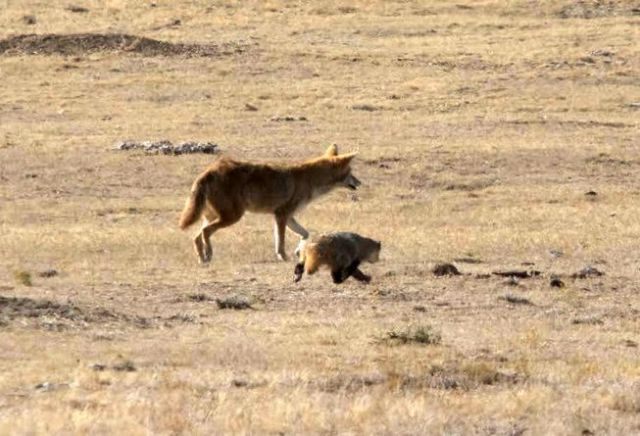
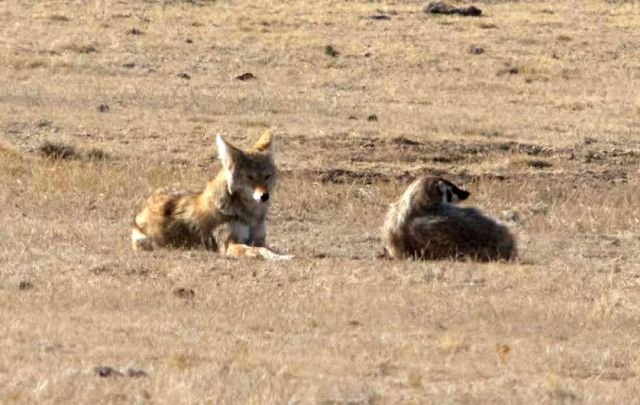
Both are crafty carnivores, and since they often hunt the same prey in the same prairies, it would make sense for them to be enemies, or at least to avoid each other. But while they don’t always get along, coyotes and badgers also have an ancient arrangement that illustrates why it can be smart for rivals to work together.

An example of that partnership recently unfolded on a prairie in northern Colorado, near the National Black-footed Ferret Conservation Center. And it was captured in photos, both by a wildlife camera trap and by sharp-eyed photographers:

While it’s relatively rare to capture such good photos of a hunt like this, the phenomenon is well-documented. It was familiar to many Native Americans long before Europeans reached the continent, and scientists have studied it for decades. It has been reported across much of Canada, the United States and Mexico, according to Ecology Online, typically with one badger hunting alongside one coyote.

(In one study at the National Elk Refuge in Wyoming, 90 percent of all coyote-badger hunts featured one of each animal, while about 9 percent involved one badger with two coyotes. Just 1 percent saw a lone badger join a coyote trio.)

But why would these predators work together at all? When one of them finally catches something, they aren’t known to share the spoils. So what’s the point?

The point, apparently, is to improve the likelihood that at least one of the hunters will snag some prey. Even if that means the other one ends up empty-handed, the partnership seems to pay off for both species in the long run.

Each member of the hunting party has a distinct set of skills. Coyotes are nimble and quick, so they excel at chasing prey across an open prairie. Badgers are slow and awkward runners by comparison, but they’re better diggers than coyotes are, having evolved to pursue small animals in underground burrow systems. So when they hunt prairie dogs or ground squirrels on their own, badgers usually dig them up, while coyotes chase and pounce. The rodents therefore use different strategies depending which predator is after them: They often escape a digging badger by leaving their burrows to flee aboveground, and evade coyotes by running to their burrows.

When badgers and coyotes work together, however, they combine these skills to hunt more effectively than either could alone. Coyotes chase prey on the surface, while badgers take the baton for subterranean pursuits. Only one may end up with a meal, but overall, research suggests the collaboration makes both predators better at their jobs. If you’re a prairie dog trying to escape this dynamic duo, good luck.

“Coyotes with badgers consumed prey at higher rates and had an expanded habitat base and lower locomotion costs,” according to the authors of the National Elk Refuge study. “Badgers with coyotes spent more time below ground and active, and probably had decreased locomotion and excavation costs. Overall, prey vulnerability appeared to increase when both carnivores hunted in partnership.”

Badgers and coyotes aren’t always friendly, though. While the majority of their interactions “appear to be mutually beneficial or neutral,” Ecology Online notes they do sometimes prey on each other. The two species have developed “a sort of open relationship,” according to the U.S. Fish and Wildlife Service (FWS), since they tend to collaborate in warmer months, then often drift apart as winter sets in.

“In the winter, the badger can dig up hibernating prey as it sleeps in its burrow,” the FWS explains. “It has no need for the fleet-footed coyote.”

Not at the time, anyway. But winter eventually turns to spring, and these two hunters may start to need each other again. And just as they have for thousands of years, they’ll make peace, embrace their differences and get back to work.

http://www.mnn.com/earth-matters/animals/blogs/coyote-and-badger-hunt-together

Sharks Have Distinct Personalities, New Study Finds

Sharks of the same species can have different personalities, indicates a new study published in the Journal of Fish Biology.

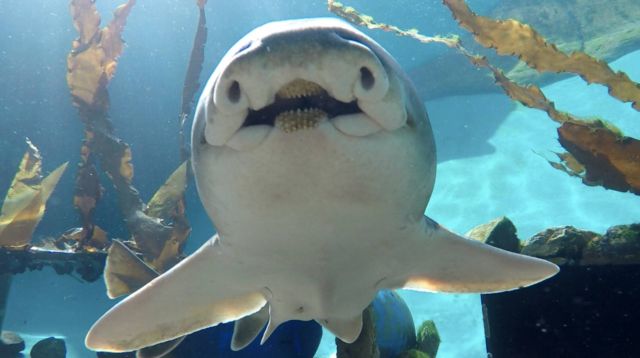
The study, led by Dr. Evan Byrnes of Macquarie University in North Ryde, Australia, examined interindividual personality differences between Port Jackson sharks (Heterodontus portusjacksoni).

Trials were designed to test the sharks’ boldness, which is a measure of their propensity to take risks, but also an influencer of individual health through its correlation with stress hormones and associated physiological profiles.

Port Jackson sharks were first introduced to a tank where they were provided with shelter, and timed to see how long it took for each shark to emerge from their refuge box into a new environment.

The second behavior test exposed each shark to handling stress, similar to handling by a fisherman, before releasing them again and observing how quickly they recovered.

The results demonstrated that each shark’s behavior was consistent over repeated trials, indicating ingrained behaviors rather than chance reactions.

That is, some sharks were consistently bolder than others, and the sharks that were the most reactive to handling stress in the first trial were also the most reactive in a second trial.

“This work shows that we cannot think of all sharks as the same,” Dr. Byrnes said.

“Each has its own preferences and behaviors, and it is likely that these differences influence how individuals interact with their habitat and other species.”

“We are excited about these results because they demonstrate that sharks are not just mindless machines. Just like humans, each shark is an individual with its unique preferences and behaviors,” said co-author Dr. Culum Brown, also from Macquarie University.

“Our results raise a number of questions about individual variation in the behavior of top predators and the ecological and management implications this may have. If each shark is an individual and doing its own thing, then clearly managing shark populations is much more complicated than we previously thought.”

“Understanding how personality influences variation in shark behavior – such as prey choice, habitat use and activity levels – is critical to better managing these top predators that play important ecological roles in marine ecosystems.”

_____

E.E. Byrnes & C. Brown. Individual personality differences in Port Jackson sharks Heterodontus portusjacksoni. Journal of Fish Biology, published online May 26, 2016; doi: 10.1111/jfb.12993

Bumblebees Use Vibrating Hairs to Detect Floral Electric Fields

Bumblebees use information from surrounding electric fields to make foraging decisions.

However, how they detect these fields has been a mystery – until now.

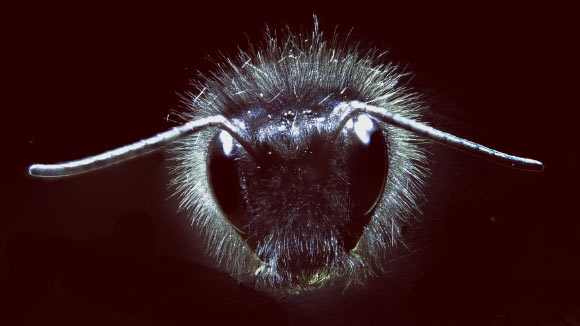
Mechanosensory hairs may explain how bumblebees sense electric signals transmitted by flowers, says a team of scientists at the University of Bristol, UK.

Focusing on the buff-tailed bumblebee (Bombus terrestris), Bristol scientists tested two potential mechanisms that would allow the insects to detect electric fields through the insulating medium of dry air: deflections of either the antenna or hairs.

Using a laser to measure vibrations, they found that both the antenna and mechanosensory hairs deflect in response to an electric field, but the hairs move more rapidly and with overall greater displacements.

They then looked at the bumblebees’ nervous system, finding that only the hairs alerted their nervous system to this signal.

“This ability may arise from the low mass and high stiffness of bumblebee hairs, the rigid, lever-like motion of which resembles acoustically sensitive spider hairs and mosquito antennae,” the researchers said.

Noting that mechanosensory hairs are common in arthropods, they suggest that electroreception could be a widespread phenomenon that provides insects with a variety of currently unrecognized abilities.

“We were excited to discover that bumblebees’ tiny hairs dance in response to electric fields, like when humans hold a balloon to their hair,” said lead author Dr. Gregory Sutton from the University of Bristol’s School of Biological Sciences.

“A lot of insects have similar body hairs, which leads to the possibility that many members the insect world may be equally sensitive to small electric fields.”

“Scientists are particularly interested in understanding how floral signals are perceived, received and acted upon by bees as they are critical pollinators of our crops,” he added.

“Research into these relationships has revealed the co-evolution of flowers and their pollinators, and has led to the unraveling of this important network which keeps our planet green.”

The team’s findings have been accepted for publication in the Proceedings of the National Academy of Sciences.

http://www.sci-news.com/biology/bumblebees-hairs-detect-floral-electric-fields-03909.html?utm_source=feedburner&utm_medium=feed&utm_campaign=Feed%3A+BreakingScienceNews+%28Breaking+Science+News%29