Plastic-eating bacteria discovered in recycling plant

By Eva Botkin-Kowacki

Plastic is everywhere around us. We drink out of plastic cups, buy disposable water bottles, unwrap new electronics from plastic packaging, take home plastic shopping bags, and even wear plastic in polyester fabrics.

Some 311 million tons of plastic is produced across the globe annually, and just 10 percent makes it back to a recycling plant. The rest ends up in landfills, or as litter on land or in the ocean, where it remains for decades and longer.

As for the plastic that has been recycled, it has given rise to an unintended side effect: A team of scientists searching through sediments at a plastic bottle recycling plant in Osaka, Japan have found a strain of bacteria that has evolved to consume the most common type of plastic.

Ideonella sakaiensis 201-F6 can degrade poly (ethylene terephthalate), commonly called PET or PETE, in as little as six weeks, they report in a new paper published Thursday in the journal Science.

Common uses of PET include polyester fibers, disposable bottles, and food containers. The last two are typically labelled with a No. 1 inside a recycling symbol.

But this new paper doesn’t mean you should ditch your reusable water bottles in favor of a tray of disposable ones, or that we’re going to inject this bacteria into landfills tomorrow. This study simply evaluated if the bacteria in question could degrade PET and was conducted under laboratory conditions.

“We hope this bacterium could be applied to solve the severe problems by the wasted PET materials in nature,” Kohei Oda, one of the study authors, tells The Christian Science Monitor in an email. But “this is just the initiation for application.” More research has to be done in order to make this a practical solution to plastic pollution.

But could this sort of fix work in theory?

“[Plastics] have been engineered for cost and for durability, or longevity,” says Giora Proskurowski, an oceanographer at the University of Washington who studies plastic debris in the ocean but was not part of this study, in a phone interview with the Monitor. But he’s hopeful that this research could yield further studies and technologies to mitigate the problem.

The durability of plastic isn’t the only challenge this potential fix faces. Microbes are like teenagers, Christopher Reddy, a senior scientist at Woods Hole Oceanographic Institution who studies environmental pollution and was not part of this study, explains in an interview with the Monitor.

“You can tell them to clean the garage over the weekend but they’re going to do it on their own timescale, they’re going to do it when they want, they’re going to pick the easiest thing to do and they’re likely going to leave you more frustrated than you think,” he explains the metaphor. Similarly, you can’t rely on microbes to break down compounds. “Don’t rely on microbes to clean the environment.”

Dr. Reddy says that has a lot to do with the environment outside the lab. In the experiment, he says, the researchers controlled the situation so the bacteria ate the plastic, but in nature, they would have many options for food.

Also, if I. sakaiensis 201-F6 were to be applied, it would likely only help plastic pollution on land. PET particles are denser than water, so they tend to sink down into the sediment. The trillions of tons of plastic particles amassing in the oceans are other types of plastics, types for which this bacteria probably lacks an appetite. Also, Dr. Proskurowski says, marine organisms have evolved to withstand the saltwater and sunlight that sediment-dwelling organisms might not.

Still, perhaps this bacteria could be harnessed to accelerate degradation of plastics that make it to a landfill, he says.

But this study does show that “the environment is evolving and you get the microbes evolving along with that as well,” Proskurowski says. “These are evolving systems.”

Neither Proskurowski nor Reddy were surprised that the researchers found an organism that can consume PET.

“I’m surprised it’s taken this long. I’ve been waiting for results like this,” Proskurowski says.

“Nature is incredibly wily, microbes are incredibly wily,” Reddy says. “Microbes are very good eaters.”

This is not the first time researchers have found an organism that will eat trashed plastic. Last year engineers at Stanford University found a mealworm that can eat styrofoam. And in that case, it was not the animal’s digestion that broke down the styrofoam, but bacteria it its gut.

http://www.csmonitor.com/Science/2016/0310/Researchers-discover-plastic-eating-bacteria-in-recycling-plant

Woman torches her son’s room when he refuses to clean

Police in Toda, Saitama Prefecture, have arrested a 71-year-old woman on suspicion of setting her son’s room on fire.

Eiko Sasaki is suspected of setting fire to her son’s room at around 9 a.m. Sunday, Sankei Shimbun reported. The fire spread and destroyed the 50-square-meter apartment.

According to police, Sasaki has admitted to the charge and was quoted as saying that she was upset with her ​​50-year-old son for letting magazines pile up in his room, so she decided to burn them.

Sasaki said she lit a newspaper and threw it into the room while her son was out.

http://www.japantoday.com/category/crime/view/71-year-old-torches-her-sons-room-for-not-cleaning-up-mess

The world’s first robot-run farm will harvest 30,000 heads of lettuce daily

robot farm

The Japanese lettuce production company Spread believes the farmers of the future will be robots.

So much so that Spread is creating the world’s first farm manned entirely by robots. Instead of relying on human farmers, the indoor Vegetable Factory will employ robots that can harvest 30,000 heads of lettuce every day.

Don’t expect a bunch of humanoid robots to roam the halls, however; the robots look more like conveyor belts with arms. They’ll plant seeds, water plants, and trim lettuce heads after harvest in the Kyoto, Japan farm.

“The use of machines and technology has been improving agriculture in this way throughout human history,” J.J. Price, a spokesperson at Spread, tells Tech Insider. “With the introduction of plant factories and their controlled environment, we are now able to provide the ideal environment for the crops.”

The Vegetable Factory follows the growing agricultural trend of vertical farming, where farmers grow crops indoors without natural sunlight. Instead, they rely on LED light and grow crops on racks that stack on top of each other.

In addition to increasing production and reducing waste, indoor vertical farming also eliminates runoff from pesticides and herbicides — chemicals used in traditional outdoor farming that can be harmful to the environment.

The new farm, set to open in 2017, will be an upgrade to Spread’s existing indoor farm, the Kameoka Plant. That farm currently produces about 21,000 heads of lettuce per day with help from a small staff of humans. Spread’s new automation technology will not only produce more lettuce, it will also reduce labor costs by 50%, cut energy use by 30%, and recycle 98% of water needed to grow the crops.

The resulting increase in revenue and resources could cut costs for consumers, Price says.

“Our mission is to help create a sustainable society where future generations will not have to worry about food security and food safety,” Price says. “This means that we will have to make it affordable for everyone and begin to grow staple crops and plant protein to make a real difference.”

http://www.techinsider.io/spreads-robot-farm-will-open-soon-2016-1

Thanks to Kebmodee for bringing this to the It’s Interesting community.

What’s the Secret to Longevity? Lessons from “Blue Zones” Worldwide

Five places in the world are now considered so-called “Blue Zones” – geographic areas where people are living much longer and more active lives. The first Blue Zone identified was Sardinia’s Nuoro province, which researchers Gianni Pes and Michel Poulain found to have the greatest number of male centenarians. Four other Blue Zones have since been identified by National Geographic explorer Dan Buettner and his team of longevity researchers. In these Blue Zones people are reaching the age of 100 at a much greater rate than anywhere else in the world. So what exactly sets these places apart from the rest? In his book The Blue Zones: Lessons for Living Longer From the People Who’ve Lived the Longest, Dan Buettner discusses the lessons he learned from the people inhabiting the Blue Zones and what specific lifestyle characteristics allow these people to live longer and better lives.

Ikaria, Greece

The tiny Mediterranean island boasts nearly non-existent rates of dementia and chronic disease and an isolated culture with a focus on socialization. Residents often drink goat’s milk and herbal teas and eat a Mediterranean diet full of fruits and vegetables, whole grains, beans, potatoes, and olive oil. Because this population is comprised traditionally of Greek Orthodox Christians, many fast for nearly half the year (caloric restriction has been linked to a slowing of the aging process in mammals). They also exercise by gardening, walking, or completing yard work but also nap regularly.

Loma Linda, CA

It may be surprising that one of the Blue Zones is located in the U.S., but Loma Linda is home to about 9,000 Seventh-day Adventists who form an extremely close community. Many Seventh-day Adventists adhere to a vegetarian diet rich in fruits and vegetables and consume water and nuts in lieu of soda and unhealthy snacks. They also spend time with family and friends, particularly during the weekly 24-hour Sabbath, and give back by volunteering.

Nicoya, Costa Rica

Besides their diet, the secret to a longer life for Nicoyans may be in their sense of purpose and strong social connections. They eat a traditional diet of fortified maize and beans, drink water with the country’s highest calcium levels, and eat a light dinner early in the early evening. Nicoyan residents often live with family members for support and strongly wish to contribute to a greater good. Their physical work keeps them fit and is embraced in everyday life.

Okinawa, Japan

Although this area is experiencing a decline in life expectancies from the influence of factors like fast food, older residents have consumed a plant-based, soy-rich diet most of their lives and eat pork only for infrequent ceremonial occasions in small amounts. Okinawans spend time outside every day and nearly all grow or have grown gardens (a source of vitamin D and fresh vegetables). It is also traditional to form a moai, or social network, for emotional and financial support.

Shuri Castle in Okinawa, Japan

Sardinia, Italy

Sardinia has nearly 10 times more centenarians per capita than the U.S., which could be attributed to a combination of genetics and a traditional lifestyle. The rare genetic M26 marker is common in this population and has been associated with longevity; due to the geographic isolation of the island, this gene is not prevalent in other areas worldwide. Sardinians eat a plant-based diet with pecorino cheese made from grass-fed sheep that is high in omega-3 fatty acids and drink wine in moderation. Laughter may be good medicine on this island – men in particular here are known for their afternoon laughing sessions in the street.

View of Cala Domestica beach, Sardinia, Italy

New trend in Japan of photographing dads jumping next to their daughters

A series of photos sees Japanese dads jumping next to their daughters
They are part of a new book by Japanese photographer Yûki Aoyama
The book’s title roughly translates as Daughter and Salary Man

Sick of awkward father-daughter portraits? Well one photographer has found an effective – if a little odd – way of making them more interesting.

Japanese photographer Yûki Aoyama’s latest series of images capture po-faced teenagers pictured next to their fathers leaping into the air.

In each picture the daughter looks directly into the camera smiling while her father pulls a dramatic pose.

The images are from the 37-year-old’s latest book which roughly translates into Daughter and Salary Man.

According to the photographer’s website the images allow the father who usually has to act serious to express his fun side by being ‘a hero jumping the sky, enfold(ing) strong excitement and hope.’

http://translate.google.com/translate?depth=1&hl=en&prev=search&rurl=translate.google.co.uk&sl=ja&u=http://yukiao.jp/

Salary man may refer to the choice of clothing in the shoot which sees each dad in a sharply dressed suit.

The images see the fathers pull energetic poses despite their age with some of the expressions of the older fathers looking slightly pained.

Very little else is known about the pictures or why they have come into existence but they are already drumming up plenty of interest online for their curious nature.

<img sr

c=”https://its-interesting.com/wp-content/uploads/2015/04/dads1.jpg&#8221; alt=”” width=”460″ height=”613″ class=”aligncenter size-full wp-image-8855″ />

Read more: http://www.dailymail.co.uk/femail/article-3021238/Bizarre-Japanese-trend-fathers-photographed-JUMPING-daughters.html#ixzz3WovRtiSv

World’s First Robot-Staffed Hotel to Open in Japan

by Tanya Lewis

What if you could check into a hotel, have your luggage carried to your room and order a coffee — all with help from a team of robots?

A new hotel at a theme park in Nagasaki, Japan, hopes to make that dream a reality. The Henn-na Hotel (whose name means “strange hotel”) will be partially staffed by androids that work as reception attendants, robot waiters, cleaning staff and a cloakroom attendant.

Developed by Japan’s Osaka University and manufactured by the Japanese robotics company Kokoro, many of the “Actroid” robots resemble a young Japanese woman. The bots will be able to speak Japanese, Chinese, Korean and English, make hand gestures, and pull off the somewhat creepy feat of mimicking eye movements.

The android-staffed hotel will be part of a theme park called Huis Ten Bosch, which is modeled after a typical Dutch town. Hotel guests will be able to access their rooms using facial recognition software instead of keys, if they choose.

“We’d like to draw visitors to this setting surrounded by nature by establishing a smart hotel, which could be something we could spread through Japan and the world, a spokeswoman for Huis Ten Bosch said.

If the robot hotel is a success, another one may be opened in 2016, the spokeswoman added.

Room rates at the Henn-na Hotel will start at about $60 U.S. (7,000 yen), but will likely remain well below the rates for the park’s other hotels, which start at around $170 to $255 (20,000 to 30,000 yen). The use of robots and renewable energy will help the hotel keep its operating costs down.

http://www.livescience.com/49711-japanese-robot-hotel.html

Japan man arrested for dumping a quarter-ton of porn

A 70 year old man who dumped almost a quarter of a tonne of pornography in a Japanese park is unlikely to be charged, police said Tuesday, because the stash belonged to an ill friend. Hideaki Adachi was spotted unloading 17 sacks of films and magazines, which included around 500 VHS video tapes, from the back of a truck at a small park in the western Japanese city of Osaka.

Adachi was arrested on suspicion of illegally dumping the 200 kilograms (440 pounds) of porn, but was released the next day after telling police he had found the trove in a storehouse belonging to a bedridden friend, police told AFP.

“He wanted to get rid of them out of goodwill for his friend,” a spokesman said.

Asked if he had left the library in the park with the intention of giving the material away, the spokesman said officers thought not, because “the videos were not laid out to be seen”. Adachi, who worked as a volunteer in the park helping homeless people, had hoped that the huge collection of adult materials would be picked up and taken to a proper disposal site.

http://www.afp.com/en/node/2965441/

New research projects that climate change may increase female:male ratio

Climate change could affect the ratio of human males to human females that are born in some countries, a new study from Japan suggests. The researchers found that male fetuses may be particularly vulnerable to the effects of climate change.

Since the 1970s, temperature fluctuations from the norm have become more common in Japan, and at the same time there has been an increase in the deaths of male fetuses, relative to the number of deaths of female fetuses in that country, according to the study.

Over this period, the ratio of male to female babies born in the country has been decreasing, meaning there have been fewer and fewer male babies born relative to the number of female babies born.

http://www.livescience.com/48070-male-fetus-climate-change.html

Japanese jeans designed by caged lions and tigers

A Japanese jeans maker has found a new way of capitalising on zoo animals. Zoo Jeans are producing jeans “designed by dangerous animals”. Denim is wrapped around tyres, which are then thrown to the lions who enjoy ripping and biting at the material. This produces that all-important designer, distressed look.

Rather than simply being a marketing gimic, there is actually value in this from an animal welfare perspective. Involving lions and the zoo’s other large carnivores in the activity is part of what’s called environmental enrichment. This is the provision of stimuli to help improve well-being. It’s a win-win activity for many zoos, who can make alternative profits from their animals, which tend to be used to provide extra facilities for them.

Wrapping denim around a tyre to make enrichment devices for toothy carnivores is just one way that zoos have profited from their animals’ hobbies over the years. Since their inception, zoos have looked for different ways to fund their activities. London Zoo when it first opened would let in penniless visitors for a cat or dog to be fed to the carnivores. Visitors with money were offered other things to keep themselves amused as they looked at the animals.

read more: http://theconversation.com/jeans-designed-by-lions-and-tigers-are-a-win-win-for-zoos-28988

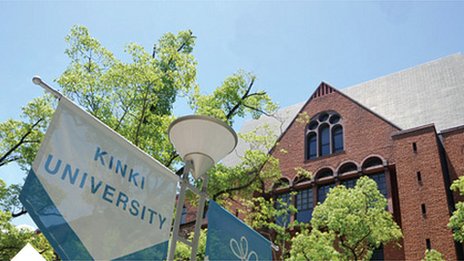
Kinki University in Japan is changing its joke-inducing name in order to appeal to English-speaking overseas students.

From 2016 it is going to adopt the name of Kindai University.

Kinki is one of the biggest universities in western Japan with more than 32,000 students, but only 329 of them are from overseas.

The university is to change its name to avoid any misunderstanding.

The Kinki name is drawn from its surrounding local region – but the university has had to counter other interpretations.

The new name of Kindai University is a combination of “Kinki” and “Daigaku” for university.

The shift in name is part of its plans for a more international identity.

“The word ‘kinky’ also means perverted. We have no other choice than changing the English name because we are serious about pursuing a more international school culture,” the university’s dean, Hitoshi Shiozaki, told the AFP news agency.

“We aim to get more foreign students coming here, so we’ve decided to change our English name to ensure there is no misunderstanding,” the university told English language newspaper the Japan Times.

It is not clear whether the change in name will affect the university’s English language newspaper, the Kinki Times.

http://www.bbc.com/news/education-27519000