Neuroscientists at Indiana University have reported the first evidence that non-human animals can mentally replay past events from memory. The discovery could help advance the development of new drugs to treat Alzheimer’s disease.
The study, led by IU professor Jonathon Crystal, appears today in the journal Current Biology.
“The reason we’re interested in animal memory isn’t only to understand animals, but rather to develop new models of memory that match up with the types of memory impaired in human diseases such as Alzheimer’s disease,” said Crystal, a professor in the IU Bloomington College of Arts and Sciences’ Department of Psychological and Brain Sciences and director of the IU Bloomington Program in Neuroscience.
Under the current paradigm, Crystal said most preclinical studies on potential new Alzheimer’s drugs examine how these compounds affect spatial memory, one of the easiest types of memory to assess in animals. But spatial memory is not the type of memory whose loss causes the most debilitating effects of Alzheimer’s disease.
“If your grandmother is suffering from Alzheimer’s, one of the most heartbreaking aspects of the disease is that she can’t remember what you told her about what’s happening in your life the last time you saw her,” said Danielle Panoz-Brown, an IU Ph.D. student who is the first author on the study. “We’re interested in episodic memory — and episodic memory replay — because it declines in Alzheimer’s disease, and in aging in general.”
Episodic memory is the ability to remember specific events. For example, if a person loses their car keys, they might try to recall every single step — or “episode” — in their trip from the car to their current location. The ability to replay these events in order is known as “episodic memory replay.” People wouldn’t be able to make sense of most scenarios if they couldn’t remember the order in which they occurred, Crystal said.
To assess animals’ ability to replay past events from memory, Crystal’s lab spent nearly a year working with 13 rats, which they trained to memorize a list of up to 12 different odors. The rats were placed inside an “arena” with different odors and rewarded when they identified the second-to-last odor or fourth-to-last odor in the list.
The team changed the number of odors in the list before each test to confirm the odors were identified based upon their position in the list, not by scent alone, proving the animals were relying on their ability to recall the whole list in order. Arenas with different patterns were used to communicate to the rats which of the two options was sought.
After their training, Crystal said, the animals successfully completed their task about 87 percent of the time across all trials. The results are strong evidence the animals were employing episodic memory replay.
Additional experiments confirmed the rats’ memories were long-lasting and resistant to “interference” from other memories, both hallmarks of episodic memory. They also ran tests that temporarily suppressed activity in the hippocampus — the site of episodic memory — to confirm the rats were using this part of their brain to perform their tasks.
Crystal said the need to find reliable ways to test episodic memory replay in rats is urgent since new genetic tools are enabling scientists to create rats with neurological conditions similar to Alzheimer’s disease. Until recently, only mice were available with the genetic modifications needed to study the effect of new drugs on these symptoms.
“We’re really trying push the boundaries of animal models of memory to something that’s increasingly similar to how these memories work in people,” he said. “If we want to eliminate Alzheimer’s disease, we really need to make sure we’re trying to protect the right type of memory.”
A computer program can learn to navigate through space and spontaneously mimics the electrical activity of grid cells, neurons that help animals navigate their environments, according to a study published May 9 in Nature.
“This paper came out of the blue, like a shot, and it’s very exciting,” Edvard Moser, a neuroscientist at the Kavli Institute for Systems Neuroscience in Norway who was not involved in the work, tells Nature in an accompanying news story. “It is striking that the computer model, coming from a totally different perspective, ended up with the grid pattern we know from biology.” Moser shared a Nobel Prize for the discovery of grid cells with neuroscientists May-Britt Moser and John O’Keefe in 2014.
When scientists trained an artificial neural network to navigate in the form of virtual rats through a simulated environment, they found that the algorithm produced patterns of activity similar to that found in the grid cells of the human brain. “We wanted to see whether we could set up an artificial network with an appropriate task so that it would actually develop grid cells,” study coauthor Caswell Barry of University College London, tells Quanta. “What was surprising was how well it worked.”
The team then tested the program in a more-complex, maze-like environment, and found that not only did the virtual rats make their way to the end, they were also able to outperform a human expert at the task.
“It is doing the kinds of things that animals do and that is to take direct routes wherever possible and shortcuts when they are available,” coauthor Dharshan Kumaran, a senior researcher at Google’s AI company DeepMind, tells The Guardian.
DeepMind researchers hope to use these types of artificial neural networks to study other parts of the brain, such as those involved in understanding sound and controlling limbs, according to Wired. “This has proven to be extremely hard with traditional neuroscience so, in the future, if we could improve these artificial models, we could potentially use them to understand other brain functionalities,” study coauthor Andrea Banino, a research scientist at DeepMind, tells Wired. “This would be a giant step toward the future of brain understanding.”
Synesthetes can taste sounds, smell colors or see scents, and research proves these people experience reality differently.
By Laura Moss
I know that the number four is yellow, but I have a friend who insists four is red.
She also says four has a motherly personality, but my four has no personality — none of my numbers do. But all of my numbers have colors, and so do my letters, days and months.
My friend and I both have synesthesia, a perceptual condition in which the stimulation of one sense triggers an automatic, involuntary experience in another sense.
Synesthesia can occur between just about any combination of senses or cognitive pathways.
Synesthetes — or people who have synesthesia — may see sounds, taste words or feel a sensation on their skin when they smell certain scents. They may also see abstract concepts like time projected in the space around them, like the image on the right.
Many synesthetes experience more than one form of the condition. For example, my friend and I both have grapheme-color synesthesia — numbers and letters trigger a color experience, even though my experience differs from hers.
Because her numbers have personalities, she also has a form of synesthesia known as ordinal-linguistic personification.
Scientists used to think synesthesia was quite rare, but they now think up to 4 percent of the population has some form of the condition.
What’s it like?
David Eagleman, a neuroscientist and director of the Laboratory for Perception and Action at the Baylor College of Medicine, isn’t a synesthete, but he often uses this analogy to explain the phenomenon.
When you see this photo, you likely think “President Barack Obama” even though those words aren’t written anywhere on the picture. Your brain automatically and involuntarily makes that connection, much like my brain makes a connection between the number four and the color yellow.
“It’s not the same as a hallucination,” Eagleman explains in the documentary “Red Mondays and Gemstone Jalapenos.” “It’s not actually interfering with their ability to see, so in that same way, you could picture a giant orange pumpkin sitting in front of you, but that doesn’t prevent you from seeing through that and past that.”
Synesthesia is a sensory phenomenon that’s unrelated to memory, so if you’re not a synesthete, you could teach yourself to associate a color with a certain number for example, but your brain wouldn’t respond the same way a synesthete’s would.
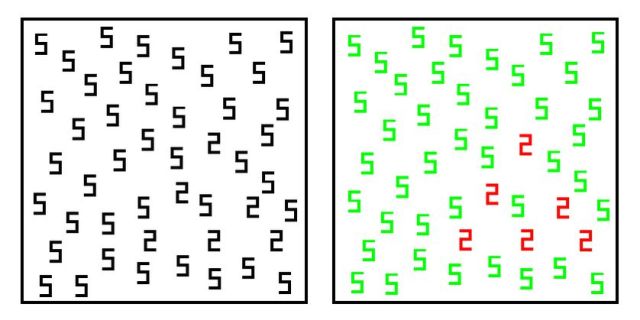
For instance, someone without grapheme-color synesthesia would have a more difficult time picking out the black twos from the black fives in the image on the left.
However, if your numbers have colors, you’ll see the triangle of twos almost instantly.
But this task may be even easier for some grapheme-color synesthetes.
Daniel Smilek, a psychology professor at the University of Waterloo, has identified two groups of synesthetes among those who associate colors with letters and numbers. There are projectors, those whose colors fill the printed letter in front of them, and associators who see the colors in their mind’s eye, like I do.
What about people who can hear silent videos?
Synesthesia doesn’t just apply to people who associate certain colors with images. Some people have the ability to hear sounds in videos when there is actually no sound being played.
Psychologist Chris Fassnidge calls this phenomenon “visually evoked auditory response” (vEAR). While it’s technically not synesthesia, Fassnidge believes it’s a new form that warrants further study. “Some people describe it as a buzzing sound in their head,” Fassnidge told Vox. “For other people, it’s kind of like a white noise. And then other people say it varies depending on what it is they are looking at.”
A 2008 study suggests that vEAR is fairly common — affecting 20 to 30 percent of people — and many people may not realize they are associating faint sounds with imagery.
“A lot of people don’t realize they have this thing until you start testing for it in the laboratory,” Fassnidge said. “Maybe because they co-occur so frequently you either aren’t aware of the mental sound until you strip away everything else.”
What causes it?
About 40 percent of synesthetes have a first-degree relative with synesthesia, and many synesthetes recall having synesthesia as long as they can remember.
“I was definitely playing with it when I was 5 or 6 years old because I remember raiding my parents’ record cabinet, searching for records that I liked to listen to for colors,” said Sean Day, a synesthete who associates colors with both sounds and tastes.
A 2018 study conducted by scientists from the Max Planck Institute for Psycholinguistics and the University of Cambridge analyzed DNA samples from several families who have multiple generations of synesthetes. They concluded that while the families differed in DNA variations, there was one commonality. There was an enhancement of genes involved in cell migration and axonogenesis – a process that enables brain cells to wire up to their correct partners.
“This research is revealing how genetic variation can modify our sensory experiences, potentially via altered connectivity in the brain,” Professor Simon Baron-Cohen stated in the study. “Synesthesia is a clear example of neurodiversity which we should respect and celebrate.”
Other experts believe that everyone may be born with the ability to experience synesthesia.
Daphne Maurer, a psychologist at McMaster University, has speculated that all of us may be born with the neural connections that allow synesthesia, but that most of us lose those connections as we grow.
Eagleman acknowledges there may be synesthetic correspondences in the brains of non-synesthetes, but that people are unaware of them until they’re teased out.
He points to something called the bouba/kiki effect as an example. When asked to choose which of two shapes on the right is named “bouba” and which is “kiki,” most people choose kiki for the angular shape and bouba for the rounded one.
Research also shows that people are likely to say that louder tones are brighter than soft ones and that darker liquids smell stronger than lighter ones.
In his book, “Wednesday Is Indigo Blue,” Eagleman says these examples prove that these analogies are actually “pre-existing relationships.”
“In this way, synesthetic associations our ancestors established long ago grew into the more abstract expressions we know today — and this is why metaphors make sense,” he writes.
However, synesthesia differs from these examples in that the sensory experience triggered is automatic and unlearned, making it different from metaphorical thinking.
“It’s a genuine phenomenon, and people who have it are actually experiencing the world differently,” Eagleman said.
How is it tested?
Consistency is one of the best ways to test for synesthesia.
“If you tell me that your letter ‘J’ is a very particular shade of powder blue … I can test you on that and have you identify exactly the shade that best matches,” Eagleman said. “If you’re just being poetic or metaphorical or making something up, then you can’t capture those colors again. But if you’re really synesthetic, then you’ll be able to pick exactly those colors out years later.”
Researchers also look at synesthetes’ brains. Using positron-emission tomography and functional magnetic resonance imaging, they’ve found that people who report seeing colors in music, for example, have increased activation in the visual areas of the brain in response to sound.
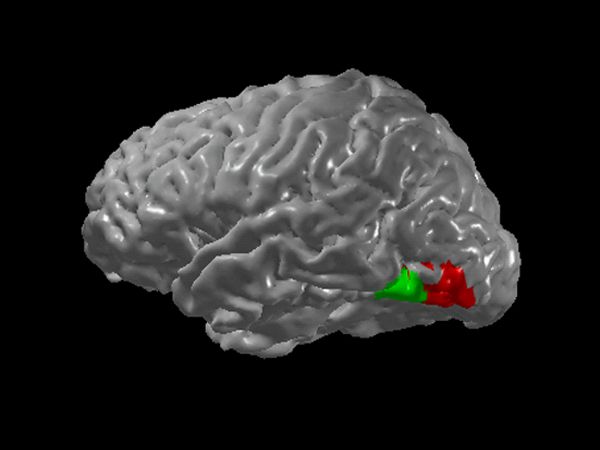
Pictured right are the regions of the brain that are thought to be cross-activated in grapheme-color synesthesia.
The pros and cons
Some synesthetes say their condition can be uncomfortable at times. For example, seeing words printed in the wrong color can be strange, or certain names may taste bad to a synesthete. Others report suffering sensory overload or feeling embarrassed at a young age when they describe experiences they didn’t know were atypical.
However, most synesthetes think of their abilities as a gift and wouldn’t want to lose them.
“You’ve experienced extremely unpleasant odors,” Day points out. “Do you want to permanently lose your sense of smell?”
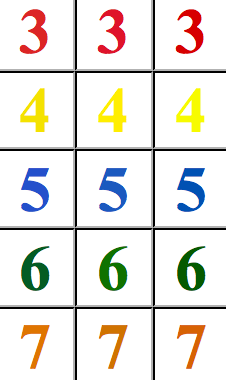
There may also be some benefits to being a synesthete, such as an ability to discern similar colors and easily memorize information. For example, I might not remember a digit in a phone number, but I’ll have an impression of green and therefore know the mystery number is six. (Some of my numbers are pictured above, as depicted by the Synesthesia Battery.)
In 2005, Daniel Tammet set the European record for pi memorization by memorizing 22,514 digits in five hours. He attributed the feat to his ability to see numbers with color, texture and sound.
There’s also evidence that synesthesia may enhance creativity. A 2004 study at the University of California had a group of students take the Torrance Tests of Creative Thinking. The synesthetes who took the test scored more than twice as high in every category.
In some instances, the neurological condition has even led to unique job opportunities. Some car manufacturers, for example, are hiring synesthetes to help designers create cars that are more pleasing to potential drivers.
And synesthetes keep good company. The list of known synesthetes is long and includes Vladimir Nabokov, Vincent Van Gogh, Marilyn Monroe, Billy Joel and Mary J. Blige.
Musician Pharrell Williams associates music with colors and says he can’t imagine life without this “gift.”
“If it was taken from me suddenly I’m not sure that I could make music,” he told Psychology Today. “I wouldn’t be able to keep up with it. I wouldn’t have a measure to understand.”
The comedian John Oliver, who made a name for himself as host of an HBO talk show, will now have his name in a slightly more embarrassing locale: outside a koala chlamydia clinic in Australia.
While he is known for clever stunts — Oliver recently published a children’s book about a gay bunny and started a church — his latest prank may have backfired.
After Oliver revealed that he had bought several items from actor Russell Crowe’s divorce auction, Crowe found “a cool way” to honor him. That “cool way” turned out to be a ward at a zoo, now called “The John Oliver Koala Chlamydia Ward.”
We’ll explain: Here’s what you — and John Oliver — need to know about koala chlamydia.
Do koalas really have chlamydia?
Sadly, yes. Some surveys of koala populations in Queensland have suggested at least half of wild koalas are infected with the disease — possibly more.
Chlamydia, a sexually transmitted disease, causes conjunctivitis, which can lead to blindness, urinary-tract infections and infections of the reproductive organs that can lead to female infertility.
Researchers at the University of the Sunshine Coast discovered in April that a retrovirus was further weakening koalas, making them even more susceptible to chlamydia.
It’s not just chlamydia; dogs, loss of habitat, rapid urbanization and deaths from vehicles are also killing koalas. In some parts of Queensland, between 1994 and 2016, the koala population declined 80 percent.
In 2012, the federal government classified koalas as “vulnerable” in the states of New South Wales and Queensland and in the Australian Capital Territory. The Australia Zoo says that 40,000 to 100,000 koalas — a symbol of Australia’s unique wildlife — remain in the wild.
How is the disease transmitted?
Though transmitted through sex, koalas have little time for randy rooting, as the Australians call it, because they sleep about 20 hours a day. There are two main strains of bacteria that lead to chlamydia in the marsupials. The more common strain, Chlamydia pecorum, is responsible for most of the outbreak in Queensland and cannot be transmitted to humans. The second strain, C. pneumoniae, can infect humans if, say, an infected koala were to urinate on someone, though it’s unlikely.
Baby koalas, known as joeys, can also catch the disease from their mothers while nursing if they come into contact with infected feces.
Is there a cure?
For humans, treatment of the disease involves an embarrassing trip to the doctor for antibiotics (and maybe a few angry texts).
Antibiotics are also used to treat koalas, although they do not prevent re-infection and come with a host of unpleasant side effects. Research has shown that the treatment messes with the gut microbes that help them digest their leafy diet — meaning they can starve.
There have been successful trials of a vaccine to prevent infection in both healthy koalas and those in early stages of infection. Some of those experiments have taken place at the wildlife hospital where Oliver’s name now adorns the wall.
And don’t worry, the Australian government isn’t letting Oliver have all the credit: Monday, the New South Wales government announced a 45 million Australian dollar plan to save the state’s koalas. (That’s almost $34 million.)
What did John Oliver actually get?
Apart from his name forever memorialized with the words “koala chlamydia,” a ward in Oliver’s honor was donated at the Australia Zoo Wildlife Hospital in Queensland. The ward will focus on treating and vaccinating koalas in that state.
“Thanks to your auction, you are now saving literally thousands of koala lives,” Bindi Irwin, daughter of conservationist Steve Irwin, who died in 2006, said in a video tweeted out by Crowe.
The reward was all too much for Oliver, who joked Sunday on his show, “Last Week Tonight With John Oliver,” that he was so overcome by the accomplishment that he was done hosting it.
“Don’t think of this as a sad occasion, because I leave you in total triumph …,” he said. “If you’ll excuse me, I’ve got a date with some very contagious koalas.”
Activating something called the behavioral immune system puts a damper on dating, new research shows.
About a decade ago, evolutionary psychologists suggested that humans have evolved a first line of defense against disease: this behavioral immune system or BIS.
The theory is that perceiving, rightly or wrongly, the threat of disease unconsciously activates this system. Although we cannot see microorganisms with the naked eye, we are nevertheless able to identify cues—such as coughs, unpleasant smells, or skin lesions—that hint at the possible presence of pathogens, whether or not these are actually present or represent real health threats.
Scientists have suggested that the activation of the BIS leads to prejudiced and avoidant attitudes and behavior towards those who display superficial cues connoting disease.
But how does this affect our dating lives, where two competing needs are pitted against one another—i.e., the potential benefits of connecting and finding a mate versus the need to protect oneself from disease? McGill University scientists set out to find out, by looking at the activation of the BIS in young, single, heterosexual Montrealers in both real speed-dating events and in experimental online dating.
The results were convincing. And not very happy.
“We found that when the behavioral immune system was activated it seemed to put the brakes on our drive to connect with our peers socially,” says first author of the study Natsumi Sawada, who holds a PhD in psychology from McGill University.
“We hadn’t expected this to be the case in real life situations like dating where people are generally so motivated to connect. The results suggest that beyond how we consciously or unconsciously think and feel about each other there are additional factors that we may not be consciously aware of, such as a fear of disease that may influence how we connect with others.”
This video explains how the experiments worked:
The findings appear in the Personality and Social Psychology Bulletin. The Social Sciences and Humanities Research Council (SSHRC) and the Fonds de Recherche sur la Société et la Culture (FRQSC) supported the work.
An array of semitransparent organic pixels on top of a ultrathin sheet of gold. The thickness of both the organic islands and the underlying gold is more than one-hundred times thinner than a single neuron.
SUMMARY: A simple retinal prosthesis is under development. Fabricated using cheap and widely-available organic pigments used in printing inks and cosmetics, it consists of tiny pixels like a digital camera sensor on a nanometric scale. Researchers hope that it can restore sight to blind people.
Researchers led by Eric Glowacki, principal investigator of the organic nanocrystals subgroup in the Laboratory of Organic Electronics, Linköping University, have developed a tiny, simple photoactive film that converts light impulses into electrical signals. These signals in turn stimulate neurons (nerve cells). The research group has chosen to focus on a particularly pressing application, artificial retinas that may in the future restore sight to blind people. The Swedish team, specializing in nanomaterials and electronic devices, worked together with researchers in Israel, Italy and Austria to optimise the technology. Experiments in vision restoration were carried out by the group of Yael Hanein at Tel Aviv University in Israel. Yael Hanein’s group is a world-leader in the interface between electronics and the nervous system.
The results have recently been published in the scientific journal Advanced Materials.
The retina consists of several thin layers of cells. Light-sensitive neurons in the back of the eye convert incident light to electric signals, while other cells process the nerve impulses and transmit them onwards along the optic nerve to an area of the brain known as the “visual cortex.” An artificial retina may be surgically implanted into the eye if a person’s sight has been lost as a consequence of the light-sensitive cells becoming degraded, thus failing to convert light into electric pulses.
The artificial retina consists of a thin circular film of photoactive material, and is similar to an individual pixel in a digital camera sensor. Each pixel is truly microscopic — it is about 100 times thinner than a single cell and has a diameter smaller than the diameter of a human hair. It consists of a pigment of semi-conducting nanocrystals. Such pigments are cheap and non-toxic, and are commonly used in commercial cosmetics and tattooing ink.
“We have optimised the photoactive film for near-infrared light, since biological tissues, such as bone, blood and skin, are most transparent at these wavelengths. This raises the possibility of other applications in humans in the future,” says Eric Glowacki.
He describes the artificial retina as a microscopic doughnut, with the crystal-containing pigment in the middle and a tiny metal ring around it. It acts without any external connectors, and the nerve cells are activated without a delay.
“The response time must be short if we are to gain control of the stimulation of nerve cells,” says David Rand, postdoctoral researcher at Tel Aviv University. “Here, the nerve cells are activated directly. We have shown that our device can be used to stimulate not only neurons in the brain but also neurons in non-functioning retinas.”
High school football player in for the touchdown.; Shutterstock ID 408266332; Purchase Order: –
Researchers reported on Monday in the journal JAMA Neurology that dementia was a possible complication following concussion even if the patient did not lose consciousness.
Scientists from the University of California, San Francisco (UCSF) tracked more than one-third of a million American veterans, and found that the likelihood of dementia more than doubled following concussion.
After adjusting for age, sex, race, education and other health conditions, they found that concussion without loss of consciousness led to 2.36 times the risk for dementia.
According to the study, these risks were slightly elevated for those in the loss-of-consciousness bracket (2.51 times) and were nearly four times higher (3.77 times) for those with the more serious moderate-to-severe traumatic brain injury.
In the total of 357,558 participants, whose average age was 49, half had been diagnosed with traumatic brain injury, of which 54 percent had concussion. The study followed participants for an average of 4.2 years, and 91 percent were male and 72 percent were white.
“There are several mechanisms that may explain the association between traumatic brain injury and dementia,” said the study’s senior author Kristine Yaffe, professor with the UCSF departments of neurology, psychiatry, and epidemiology and biostatistics.
“There’s something about trauma that may hasten the development of neurodegenerative conditions. One theory is that brain injury induces or accelerates the accumulation of abnormal proteins that lead to neuronal death associated with conditions like Alzheimer’s disease,” said Yaffe.
“It’s also possible that trauma leaves the brain more vulnerable to other injuries or aging processes,” said Yaffe, “but we need more work in this area.”
A study by scientists of the German Center for Neurodegenerative Diseases (DZNE) points to a novel potential approach against Alzheimer’s disease. In studies in mice, the researchers were able to show that blocking a particular receptor located on astrocytes normalized brain function and improved memory performance. Astrocytes are star-shaped, non-neuronal cells involved in the regulation of brain activity and blood flow. The findings are published in the Journal of Experimental Medicine (JEM).
Alzheimer’s disease is a common and currently incurable brain disorder leading to dementia, whose mechanisms remain incompletely understood. The disease appears to be sustained by a combination of factors that include pathological changes in blood flow, neuroinflammation and detrimental changes in brain cell activity.
“The brain contains different types of cells including neurons and astrocytes”, explains Dr. Nicole Reichenbach, a postdoc researcher at the DZNE and first author of the paper published in JEM. “Astrocytes support brain function and shape the communication between neurons, called synaptic transmission, by releasing a variety of messenger proteins. They also provide metabolic and structural support and contribute to the regulation of blood flow in the brain.”
Glitches in network activity
Similar to neurons, astrocytes are organized into functional networks that may involve thousands of cells. “For normal brain function, it is crucial that networks of brain cells coordinate their firing rates. It’s like in a symphony orchestra where the instruments have to be correctly tuned and the musicians have to stay in synchrony in order to play the right melody”, says Professor Gabor Petzold, a research group leader at the DZNE and supervisor of the current study. “Interestingly, one of the main jobs of astrocytes is very similar to this: to keep neurons healthy and to help maintain neuronal network function. However, in Alzheimer’s disease, there is aberrant activity of these networks. Many cells are hyperactive, including neurons and astrocytes. Hence, understanding the role of astrocytes, and targeting such network dysfunctions, holds a strong potential for treating Alzheimer’s.”
Petzold and colleagues tested this approach in an experimental study involving mice. Due to a genetic disposition, these rodents exhibited certain symptoms of Alzheimer’s similar to those that manifest in humans with the disease. In the brain, this included pathological deposits of proteins known as “Amyloid-beta plaques” and aberrant network activity. In addition, the mice showed impaired learning ability and memory.
In their study, the DZNE scientists targeted a cell membrane receptor called P2Y1R, which is predominately expressed by astrocytes. Previous experiments by Petzold and colleagues had revealed that activation of this receptor triggers cellular hyperactivity in mouse models of Alzheimer’s. Therefore, the researchers treated groups of mice with different P2Y1R antagonists. These chemical compounds can bind to the receptor, thus switching it off. The treatment lasted for several weeks.
“We found that long-term treatment with these drugs normalized the brain’s network activity. Furthermore, the mice’s learning ability and memory greatly improved”, Petzold says. On the other hand, in a control group of wild type mice this treatment had no significant effect on astrocyte activity. “This indicates that P2Y1R inhibition acts quite specifically. It does not dampen network activity when pathological hyperactivity is absent.”
New approaches for research and therapies?
Petzold summarizes: “This is an experimental study that is currently not directly applicable to human patients. However, our results suggest that astrocytes, as important safeguards of neuronal health and normal network function, may hold the potential for novel treatment options in Alzheimer’s disease.” In future studies, the scientists intend to identify additional novel pathways in astrocytes and other cells as potential drug targets.
Reference:
Reichenbach, N., Delekate, A., Breithausen, B., Keppler, K., Poll, S., Schulte, T., . . . Petzold, G. C. (2018). P2Y1 receptor blockade normalizes network dysfunction and cognition in an Alzheimer’s disease model. The Journal of Experimental Medicine. doi:10.1084/jem.20171487
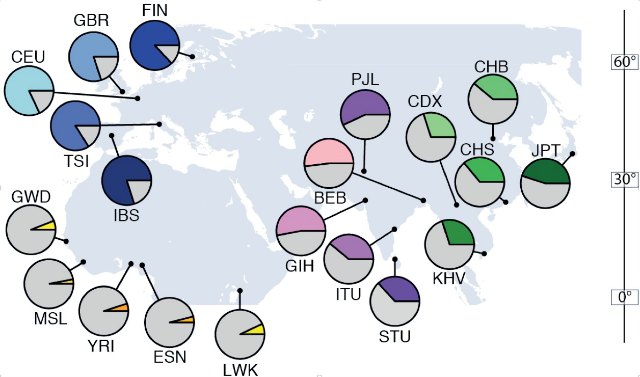
Frequency of the adaptive allele in several human populations (from the 1000 Genomes dataset). Colors and letters represent different populations in the dataset, and the pie charts reflect the proportion of individuals in those populations who have the variant TRPM8 allele.
By Viviane Callier
A human genetic variant in a gene involved in sensing cold temperatures became more common when early humans migrated out of Africa into colder climates between 20,000 and 30,000 years ago, a study published May 3 in PLOS Genetics shows. The advantage conferred by this variant isn’t definitively known, but the researchers suspect that it influences the gene’s expression levels, which in turn affect the degree of cold sensation. The observed pattern of positive selection strongly indicates that the allele was beneficial, but that benefit had a tradeoff—bringing with it a higher risk of getting migraines.
“This paper is the latest in a series of papers showing that humans really have adapted to different environments after some of our ancestors migrated out of Africa,” explains evolutionary geneticist Rasmus Nieslen of the University of California, Berkeley, who was not involved in the study. “There are a number of adaptations associated with moving into an artic climate, but none with as clear a connection to cold as this one,” he adds.
Although studies have demonstrated some striking examples of recent human adaptation, for instance, warding off infectious diseases such as malaria or having the ability to digest milk, relatively little was known about the evolutionary responses to fundamental features of the environment, namely, temperature and climate.
“Obviously, humans lived in Africa for a long time, and one of the main environmental factors that changed as humans migrated north was temperature,” explains population geneticist Aida Andres. So she and Felix Key the Max Planck Institute in Leipzig homed in on a gene, TRPM8, that encodes a cation channel in the neurons that innervate the skin. It is activated by cold temperatures and necessary for sensing cold and for thermoregulation. If there was a place to look for human adaptation, this gene looked like a good candidate.
Using the 1000 Genomes dataset and the Simons Genome Diversity Panel, the researchers investigated variants of this gene in populations throughout Africa, Europe, and Asia. They found that a single nucleotide polymorphism (SNP) in a regulatory region of the TRPM8 gene was “highly differentiated between different populations in the world,” Andres, now at University College London, says. And genotype correlated with latitude: 5 percent of people with Nigerian ancestry, versus 88 percent of people with Finnish ancestry, carry the cold-adapted variant.
Using models of population genetics, the researchers inferred that the cold-adapted allele had already existed in the ancestral African population, and that it became more common as people migrated northward. The geographic pattern was consistent with positive selection for the SNP at higher latitudes, Andres says.
“One of the interesting things about [this variant] is that it is relatively more common in Europe than in Asian people who live at the same latitude,” notes Hawks. “We don’t know why that should be. Maybe there’s a historical factor here that isn’t yet understood.”
To find out when selection on this variant occurred, the researchers looked for the SNP in the genomes from ancient remains of hunter gatherers or farmers that lived 3,000–8,000 years ago in Eurasia. It turned out that the allele was already common among these groups at least 3,000 years ago.
The connection between TRPM8 and migraine isn’t clear, other than the association. “Selection is optimizing fitness,” says anthropologist John Hawks of the University of Wisconsin-Madison who was not associated with the study. “It doesn’t optimize health, it doesn’t optimize happiness, so sometimes things are pushed by selection and they have negative side effects. This seems to be a case where a gene is pushed higher in frequency by selection for adaptation to cold, and it maybe has a bad side effect on increased susceptibility to migraines.” It’s also possible that the downside to having the cold-adaptive TRPM8 allele is a modern phenomenon, and that the migraine risk didn’t appear until more recently as environments have changed, says Nielsen.
F.M. Key et al., “Human local adaptation of the TRPM8 cold receptor along a latitudinal cline. PLOS Genet, 14:e1007298, 2018.
In 1989, Morandi set sail with his friends and decided to go to Polynesia “to look for an island and start a new life.” His journey would take him to the nearby island of Budelli. “I was very angry with a society that does not take into consideration the individual, but only runs for power and money,” Morandi said.
Morandi said there was one “caretaker” who was leaving the island, and he asked if he could move into his home. That was on July 1, 1989, and the rest is history. Morandi fell in love with the island and decided to make it his permanent residence.
“This island was what I was looking for … The whole island is my place.”
Budelli is located in the northern Sardinia region of Italy in the Mediterranean Sea and is part of La Maddalena National Park. The area is known for its pink sand beaches, which Morandi said is composed of calcium carbonate from seashells and a “pink micro-organism that gives color to the beach.”
Morandi lives alone on the island, but tourists visit during the summer — but only for a day and there are no overnight stays. The visitors are always fascinated by his lifestyle.
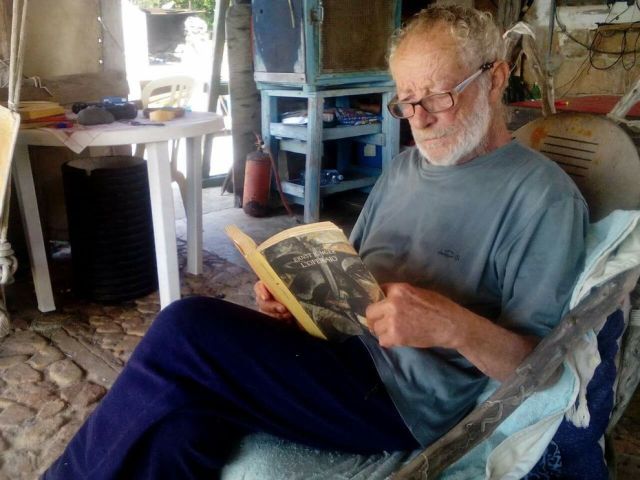
“No one comes from November to April, and then I enjoy the solitude,” he says. “I love, reading, taking pictures and sharing them with the whole world to communicate beauty.”
However, Morandi’s friends visit him and bring him fresh fish. (He lost his boat three years ago and can no longer go fishing.)
He relies on solar panels to supply power to his home and has a system for collecting and purifying rainwater to drink. He even builds his own furniture, using driftwood and other materials he finds around the island.
Several years ago, Morandi began posting his photos on Facebook and Instagram — allowing the rest of the world to appreciate the island’s beauty as much as he does. He hopes that by bringing attention to the island’s beauty, more people will fight to protect it.
“I am realizing that there’s beginning to be an awareness that it is essential to protect nature.”
In 1999, Italy closed Budelli’s pink sand beaches to tourists, who now — in an effort to protect the island from further erosion — may only walk along a pathway behind the beach.
“We must try to see the beauty to the end, and then we will respect nature and perhaps this world will be saved.”
His message to the world: “Looking at the surface is not enough. You must see beyond, feel the beauty, the scents, the whistling of the wind, the noise of the backwash, the gleam of the sun on the sea…”
















 It's Interesting