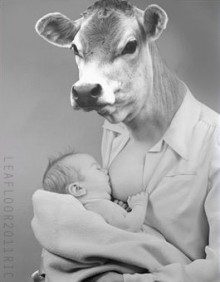
Professor Ning Li of China Agriculture University has successfully led a team that introduced the human gene for breast milk into cows.
Human genes were inserted in the DNA of Holstein dairy cows, and modified embryos were implanted into surrogate cows.
The offspring contained lysozyme, an anti-bacterial protein found in human breast milk that protects infants from infection during their first days of life.
They also created cattle containing lactoferrin, an immune system booster for babies that is found in human milk.
Fat content was raised by about 20% as well, and the level of milk solids was altered to make the final product as close to human milk as possible.
300 of these cattle have been produced.
Professor Li Ning, the director of the project, stated: “There are 1.5 billion people in the world who don’t get enough to eat. It’s our duty to develop science and technology, not to hold it back. We need to feed people first, before we consider ideals and convictions.”
The ultimate goal is to sell the milk as an alternative to cow milk, which is less nutritious than human milk. The modified milk is currently undergoing safety tests, but those who have tasted the milk say it is stronger tasting and sweeter than cow’s milk.
This isn’t the first genetically engineered food China has created. Known for having a more liberal approach toward genetically modified food, China has already created modified fruits and vegetables such as papayas and tomatoes, as well as insect-resistant rice and corn.
This tiny, near-microscopic water flea, daphnia-pulex, has more genes than humans.
This freshwater zooplankton is the first crustacean to have its genome sequenced, and its 31,000 genes crowns it the animal with the most genes so far. Humans have about 20,000 to 25,000 genes.
As well as having a massive number of genes, more than a third of them have never been seen before in other animals.
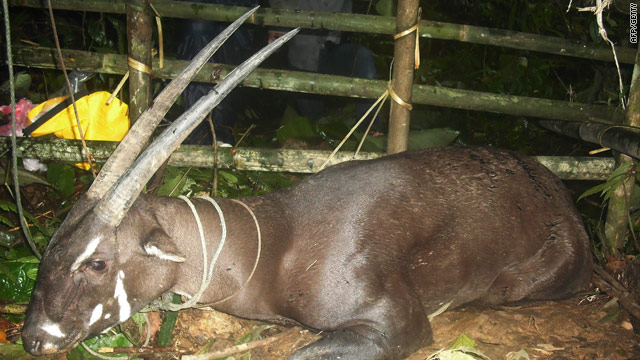
Scientists have confirmed the first sighting in more than a decade of one of the world’s rarest animals — a horned forest-dwelling bovine – the saola, sometimes called the Asian “unicorn.”
The animal was captured by villagers in Laos in August, according to the International Union for the Conservation of Nature.
The villagers took the saola back to their village in Bolikhamxay province and Laotian conservation authorities sent a team to check on the animal. The creature, likely weakened from its time in captivity, died shortly after that team arrived.
In Vietnam, 40,000 acres has been placed in reserve in order to protect the country’s saola population. The new reserve is located in the Annamite Mountains, along the Laotian border.
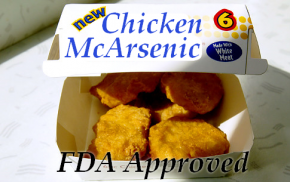
In 1944, 3-Nitro (Roxaserone, marketed by Pfizer) became the first arsenic-containing new animal drug product approved by the FDA. It is used primarily in broiler chickens.
Combined with other animal drugs, 3-Nitro has been used by some in the poultry industry to help control coccidiosis, a parasitic disease that affects the intestinal tracts of animals. It has also been used for weight gain, feed efficiency and improved pigmentation.
Published scientific reports have indicated that organic arsenic, a less toxic form of arsenic and the form present in 3-Nitro could transform into inorganic arsenic.
“FDA detected increased levels of inorganic arsenic in the livers of chickens treated with 3-Nitro, raising concerns of a very low, but completely avoidable, exposure to a carcinogen,” said Michael R. Taylor, FDA deputy commissioner for foods.
Summing up the results from the experiment, Professor Simon Crowe concluded:
There is a link between high levels of stress and psychosis, and caffeine was found to correlate with hallucination proneness. The combination of caffeine and stress affect the likelihood of an individual experiencing a psychosis-like symptom.
It would be prudent to note that correlation isn’t the same as causation, and this study merely suggests the former.
This isn’t the first instance of scientists finding a link between caffeine intake and hallucinations. An even more alarming study was published in 2009, claiming that individuals who drink the equivalent of 315 milligrams of caffeine — that’s three cups of brewed coffee, or seven of the instant variety — are three times more likely to hear and see things that aren’t actually there.
The Journal of Applied Psychology found that women who are 25 lbs. below average weight take home an additional $15,572 each year.
On the other hand, men who are 25 lbs. below average weight take home $8,437 less each year.
“Perhaps the most startling finding of this investigation is that men and women experience opposite incentives regarding weight in the very thin to average weight range. Whereas women are punished for any weight gain, very thin women receive the most severe punishment for their first few pounds of weight gain. This finding is consistent with research showing that the media’s consistent depiction of an unrealistically thin female ideal leads people to see this ideal as normative, expected, and central to female attractiveness.“
“Studies have demonstrated that people assign positive personality traits to drawings or photographs of mesomorphic (muscular) men and mostly negative traits to nonmesomorphic men. For example traits ascribed to mesomorphic men were very positive (i.e., best friend, has lots of friends, polite, happy, helps others, brave, healthy, smart, and neat). By contrast … ectomorphic (slender) men were described with a different set of negative traits (i.e., nervous, sneaky, afraid, sad, weak, and sick).”
35 year old competitive weight-lifter Kulsoom Abdullah of Atlanta is getting international attention as she challenges the USA Weightlifting rules that won’t allow her to compete wearing a hijab.
And just a couple weeks ago, Iran’s women’s soccer team was disqualified during an Olympic qualifying competition against Jordan after athletes wore a full-body outfit with a head scarf.