
13 year old Aidan Dwyer makes breakthrough in solar power
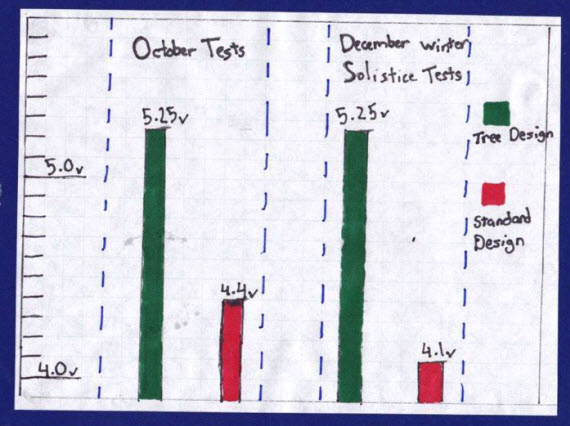
Aidan Dwyer did a much better job on his 7th grade science project than any of us. While on a wintertime hike in the Catskills, he noticed the branches of trees held a spiral pattern as they ascended. He wondered if that could possibly serve some purpose, looked into it, and learned about the Fibonacci sequence, which is a mathematical way of describing a spiral. Then he studied tree branches more closely and found their leaves adhered to the sequence. Then he figured out that if he arranged solar panels the way an oak tree arranged its leaves, they were 20 to 50 percent more efficient than the standard straight-line solar arrays. That is why the American Museum of Natural History gave him a Young Naturalist award, and published his findings on its website.
http://www.amnh.org/nationalcenter/youngnaturalistawards/2011/aidan.html
His write-up concludes:
The tree design takes up less room than flat-panel arrays and works in spots that don’t have a full southern view. It collects more sunlight in winter. Shade and bad weather like snow don’t hurt it because the panels are not flat. It even looks nicer because it looks like a tree. A design like this may work better in urban areas where space and direct sunlight can be hard to find.
Not bad for a kid who hasn’t started high school yet.
Researchers Find Where Musical Memory is Located in the Brain
Neuroscientists have pinpointed the area of our brain where we store memories of music.
The findings are part of a study, published in the journal Brain, on memory loss in dementia, in particular looking at the ability to remember and recognize sounds, which is unusually preserved in Alzheimer’s disease.
In the study, participants with dementia, as well as healthy controls, were asked to distinguish between well-known tunes and made-up tunes that had the same key and tempo but a different combination of notes.
The 27 participants with dementia had a diagnosis of either Alzheimer’s disease or a type of dementia called semantic dementia, where patients lose their understanding of words, objects and concepts.
The researchers found that participants with semantic dementia were unable to recognise the famous melodies.
MRI scans of these participants showed that the right anterior lobe of the brain, located behind the right ear, was significantly shrunken.
Participants with Alzheimer’s did not show significant damage in this area of the brain.
http://alzheimersweekly.com/content/researchers-find-location-music-brain
Monster Crocodile
Wildlife authorities in the Philippines have captured a 21-foot-long, 2,370-pound saltwater crocodile, thought to be the largest creature of its kind now in captivity.
The croc was captured in Agusan del Sur marsh on the southern Philippine island of Mindinao. Hunters had been trying to capture it for 21 days, using meat as bait and an 8 mm cable to snare it.
Edwin Cox Elorde, mayor of the remote town of Bunawan near where the croc was caught, said the reptile will become the star of a nature park there.
They believe that an even bigger crocodile is still at large in the same area.
The previous largest crocodile in captivity is an 18-footer in Australia, according to Guinness World Records.
http://www.abs-cbnnews.com/nation/regions/09/06/11/bigger-monster-croc-still-large-agusan
Woman Vows One Year Without Mirrors
R.I.P. Mourice M. Rapport, Father of Serotonin
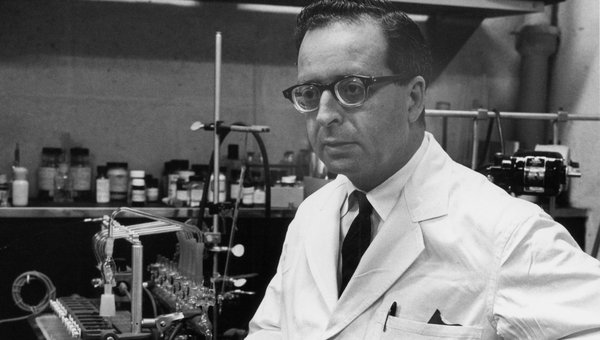
Maurice M. Rapport, a biochemist who helped isolate and name the neurotransmitter serotonin, which plays a role in regulating mood and mental states, and who first described its molecular structure, a development that led to the creation of a wide variety of psychiatric and other drugs, died on Aug. 18 in Durham, N.C. He was 91.
http://www.nytimes.com/2011/09/03/health/03rapport.html
Thanks to Dr. R for bringing this to the attention of the It’s Interesting community.
A New Form of MDMA (Ecstasy) May Help Fight Cancer
New research suggests that a modified form of MDMA — more commonly known as the illegal drug ecstasy — could kill some types of blood cancer cells. Prozac and similar antidepressants may also possess similar anti-cancer potential.
It has been known that ecstasy and other psychoactive drugs can attack cancer cells, but the problem with using a drug like MDMA to fight cancer is that the dose would have to be so large, it would kill the patient.
“That’s obviously not a very good treatment,” says John Gordon, a professor of cellular immunology at the University of Birmingham in the U.K., explaining that knowing the toxic dose gave his team a place to start when “redesigning the designer drug.”
Gordon and colleagues have developed analogues of MDMA — one that’s 100 times more powerful against lymphoma cells than MDMA and another that’s 1,000 times stronger. The experimental compounds are designed to reduce toxicity to brain cells — and possibly, therefore, the high — while increasing effectiveness against cancer cells.
The researchers say that in lab tests, the chemically engineered compounds were attracted to the fats in the cell walls of blood-cancer cells, including leukemia, lymphoma and myeloma. That made it easier for the compounds to get into cancer cells and kill them.
Read more: http://healthland.time.com/2011/08/23/could-a-form-of-ecstasy-fight-cancer/#ixzz1WeSq404w
“Cathepsin S” – a General Blood Test May Predict Your Chance of Death
Reporting in an early online publication of the Journal of the American Medical Association and at the European Society of Cardiology Congress, Johan Arnlov and his colleagues say that a certain enzyme that is measured in the blood may be linked to both heart disease and cancer, and therefore could serve as an early predictor of who is mostly likely to die from these diseases.
In the study, which involved nearly 2,000 people enrolled in two separate long-term trials, Arnlov’s team measured the levels of cathepsin S, an enzyme involved in breaking up proteins. They then tracked these volunteers for up to 12.5 years, and found that those with the highest levels of cathepsin S were more likely to die than those with lower, or about half those levels.
Physical training can substitute effectively in place of a second medication for people diagnosed with depression
Exercise can be as effective as a second medication for as many as half of depressed patients whose condition has not been cured by a single antidepressant medication.
“Many people who start on an antidepressant medication feel better after they begin treatment, but they still don’t feel completely well or as good as they did before they became depressed,” said Dr. Madhukar Trivedi, professor of psychiatry at UT Southwestern Medical Center in Dallas, and the study’s lead author. “This study shows that exercise can be as effective as adding another medication. Many people would rather use exercise than add another drug, particularly as exercise has a proven positive effect on a person’s overall health and well-being.”
http://www8.utsouthwestern.edu/utsw/cda/dept353744/files/651304.html
$12 Million a Day Wasted in Our Wars
A nonpartisan panel reporting to Congress says the United States is wasting $12 million a day among contracts issued in support of American efforts in Iraq and Afghanistan.
The Commission on Wartime Contracting spent the past three years documenting whether American funding went where it was supposed to. The findings show misdirected money has totaled between $31 billion and $60 billion, and that both the government and the contractors are to blame for fraud and waste.
Commissioner Katherine Schinasi told reporters at a news conference Wednesday that the numbers don’t seem to have an impact on people concerned about spending.
To make it easier to grasp the magnitude of the problem, Schinasi said, “we’ve broken it down to $12 million a day.”
http://www.cnn.com/2011/POLITICS/08/31/wartime.contracting/index.html?hpt=hp_c1