
Toe-Sucking Assailant on the Loose in Arkansas

Police in Conway, Arkansas have received two complaints in the past week about a man who seems desperate to suck women’s toes — whether they want him to or not.
“This is on the police department’s radar, and they are concerned,” said LaTresha Woodruff, police spokeswoman in Conway, about 30 miles from Little Rock. “They are taking information and trying to figure out who is doing it … we want him off the streets.”
Last Saturday, Ruth Harris, an 83-year-old Conway woman, told police that she was sitting in a chair in front of her apartment.
A man approached her and said he liked her feet. According to a police report, the man took off one of her shoes and began sucking on her toe.
“The man then asked if he could kiss her and she had told him no and told him he was crazy,” the report stated.
The man left quickly after people walked into the apartment complex’s courtyard.
On Tuesday, police received another call from a woman who said that on Saturday she was shopping at a local department store when she noticed a man staring at her.
He approached her and “told her he loved her toes, and they were so long and beautiful,” the report said.
The man then told the woman that he had a foot fetish and that “her toes are so long and succulent” and he wanted to suck them. When the woman’s cell phone rang, the man retreated.
He then returned and chatted with her for a brief moment. She told police that the man was wearing flip flops, a T-shirt, and blue jeans.
She said the man had “messed up toes.”
http://www.reuters.com/article/2011/09/16/us-toe-sucking-idUSTRE78F42P20110916
Woman Dies After Exposure to Odor in Georgia McDonald’s Bathroom

One woman died and at least eight other people were hospitalized after being exposed to an odor at a McDonald’s restaurant in eastern Georgia, a police chief said Thursday.
Police and fire personnel were called to one of the chain’s restaurants in Pooler, just west of Savannah, about 11:50 a.m. Wednesday, Pooler Police Chief Mark Revenew said.
Upon arrival, first responders found two people unconscious in the women’s restroom and also “became stricken (by) an odor,” according to Revenew.
Pooler Fire Chief Wade Simmons said crews “immediately backed out and put on their breathing apparatus,” at which point they re-entered the bathroom.
The stench notwithstanding, Revenew said, authorities were able to bring the women outside and begin providing medical attention, including CPR.
Nine people, including three firefighters, were transported to a local hospital. The nine included Anne Felton, 80, of Ponte Vedra, Florida, who died.
The police chief said that although an investigation is under way, authorities do not anticipate filing criminal charges.
“It appears to be an accident,” Revenew said.
The chief did not offer any other details, including the cause or nature of the toxic fumes. And in a statement released through McDonald’s corporate offices, franchise owners John and Monique Palmaccio said “authorities have been unable to determine the cause of the incident.”
The owners noted that the restaurant reopened Wednesday afternoon after authorities, following a “thorough investigation,” “deemed (the location) to be safe.”
http://www.cnn.com/2011/US/09/08/georgia.mcdonalds.death/index.html?iref=obinsite
Thousands of bees attack man and shut down California street
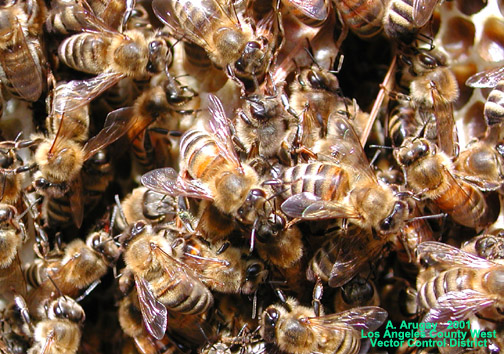
Thousands of angry bees swarmed a man in a wheelchair, sending him and three others who came to his aid to the hospital in the Southern California city of Santa Ana.
The attack also shut down a street and forced the evacuation of several businesses while beekeepers removed the hive, which was estimated to contain 60,000 bees.
The trouble started at a storage yard when a man in a wheelchair apparently disturbed the hive, causing the bees to bombard him, Santa Ana fire Capt. Steven Snyder said.
“He was attacked and stung over 60 times and had fallen out of the wheelchair and was yelling for help,” Snyder said.
The man’s cries attracted the attention of three bystanders who ran to his aid.
The bees were so aggressive that the three men had to retreat initially, but they dove back in and managed to pull the man to safety, Snyder said.
The men were stung dozens of times during the “very impressive” rescue, he said.
All four men had difficulty breathing and suffered rashes, nausea and vomiting.
http://www.msnbc.msn.com/id/44546297/ns/us_news-life/?gt1=43001
Thanks to Mr. C for bringing this to the attention of the It’s Interesting community.
Zombie Caterpillars Rain Death From the Treetops
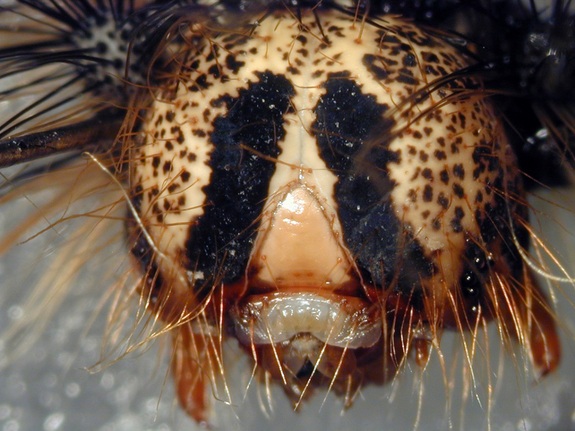
A single gene in a caterpillar virus sends its victims running for the treetops, where they die and their bodies liquefy, sending an ooze of virus particles on their brothers and sisters below.
This species of baculovirus infects only gypsy moth caterpillars, essentially turning them into zombies. It stops the caterpillars from molting and sends them up into the tree leaves during the day (a behavior they normally save for the cover of darkness), where they die among the leaves as they wait to molt.
“They die there, and then they melt within hours after they die, and they are dripping virus down onto the leaves below,” said study researcher Kelli Hoover, of Pennsylvania State University. “We knew before that this behavior benefits the virus, but we didn’t know how it was causing the behavior.”
The viral gene, named egt, interferes with the caterpillar’s molting hormone and sends the caterpillars crawling upward. The virus multiplies fiercely in almost every cell of the caterpillar’s body. When the caterpillar dies among the leaves, it undergoes a natural liquefaction process in which its exoskeleton disintegrates. Each drop of caterpillar goo contains millions of viruses.
Birds even help disperse the virus; when they scarf a caterpillar snack from the leaves, they bash it on branches to remove some of its hair. Slow-motion video shows this action not only dispenses of hair, but also expels droplets of liquefied caterpillar. The virus can even survive in the gut of the birds, to be rained down like viral bombs from above in their feces.
http://www.livescience.com/15962-zombie-caterpillar-virus.html
Thanks to Mr. C for bringing this to the attention of the It’s Interesting community.
Snorting Insulin May Treat Alzheimer’s Disease

A study in the journal Archives of Neurology suggests that intranasal insulin may help with cognition and functioning in patients who have both mild and more severe dementia.
Recent research has suggested that insulin plays an important role in a number of brain functions, in addition to regulating blood sugar. Insulin promotes cell repair and cell genesis, so the thinking is that it could actually modify the course of Alzheimer’s disease.
It also appears to protect against the toxic effects of beta-amyloid, the protein involved in the brain plaques associated with dementia. Insulin also prevents the formation of the toxic form of tau, a biomarker found in the cerebrospinal fluid.
The goal of this study was to supplement and normalize the insulin levels in the brain without affecting levels in the rest of the body. This was done with a device that was designed to deliver insulin through the nose to the brain without getting too much into the blood.
Patients treated with insulin were able to remember information over a period of time better than those who got placebo; in fact, performance improved 20%. They also showed an enhancement in brain glucose metabolism in some areas; those who received placebo tended to show a decline.
The treatment had the mild side effects of occasional mild headache and runny nose.
http://thechart.blogs.cnn.com/2011/09/12/insulin-may-help-treat-alzheimers/?hpt=hp_t2
One Donor = 150 Half-Siblings

Cynthia Daily and her partner used a sperm donor to conceive a baby seven years ago, and they hoped that one day their son would get to know some of his half siblings — an extended family of sorts for modern times.
So Ms. Daily searched a Web-based registry for other children fathered by the same donor and helped to create an online group to track them. Over the years, she watched the number of children in her son’s group grow.
And grow.
Today there are 150 children, all conceived with sperm from one donor, in this group of half siblings, and more are on the way. “It’s wild when we see them all together — they all look alike,” said Ms. Daily, 48, a social worker in the Washington area who sometimes vacations with other families in her son’s group.
http://www.nytimes.com/2011/09/06/health/06donor.html?_r=1&src=me&ref=general
Thanks to Kedmobee for bringing this to the attention of the It’s Interesting community.
Big Bunny in Sweden


As part of this summer’s openART biennale in Orebro, Sweden, Dutch artist Florentijn Hofman built this giant, 13-meter-high yellow bunny using local materials and craftsmen. Located near St. Nicolai church in the city center, Stor Gul Kanin (Big Yellow Bunny) questions the purpose of the public space and changes the perspective of the monuments within.

