Student’s sex-tape plays at graduation


A student in Denmark shared much more about his high school experience with his family and friends than he anticipated last week, when a videotape of him having sex was played during his school’s graduation festivities.

The X-rated clip of the student having sex with a woman began to play in a video presentation celebrating the graduates of the Gammel Hellerup Gymnasium school near Copenhagen, shocking the 400 to 500 people in the crowd.

“It started with some pictures of them and you thought it was fun. But it then turned into a sex video,” a student told Danish website Politiken. “Everyone was shocked – but no-one turned it off. It was clearly too much and the 30 seconds the film lasted, felt a very long time.”

http://articles.nydailynews.com/2012-05-30/news/31903504_1_student-graduation-video-presentation

Thanks to Kebmodee for bringing this to the attention of the It’s Interesting community.

Traveller caught in India with monkey in his underwear

Customs authorities in India have arrested a man who was attempting to board a flight at New Delhi’s international airport with a monkey in his underwear, a report said on Monday.

The man, who was detained along with two other travellers, had arrived from Bangkok and was about to take a connecting flight to Dubai on Jet Airways, the Press Trust of India reported.

Personnel at the airport found the seven-inch (17-centimetre) loris, a type of monkey native to India and southeast Asia, “in one of the passengers’ underwear during the security check,” PTI said.

Another loris was discovered in a dustbin at the Indira Gandhi International airport.

“They had abandoned him as they were unable to carry him,” a senior security official told the news agency.

The passengers, named as Hamad Al-Dhaheri, Mohammed Al-Shamsi and Rashid Al-Shamsi, were handed over to Wildlife and Customs Department for further questioning and were later arrested by customs police.

Authorities were trying to determine the exact origin of the monkeys.

Customs officials recently caught an Indian man at Mumbai’s main airport with 10 turtles in his underwear, which he was trying to smuggle into the city from Bangkok, the Hindustan Times reported last week.

They also seized six Persian cats, three poisonous tarantula spiders and 11 birds eggs from the man and his two accomplices, the report said.

The newspaper quoted a customs official saying the men were fined and sent back to Bangkok with the protected species and eggs they were trying to smuggle.

http://www.france24.com/en/20120910-traveller-caught-india-with-monkey-pants-report

Jonah Falcon: World’s Largest Penis


Jonah Falcon is something of a celebrity in his home city of New York for one very big reason: he is the owner of the world’s largest penis.

Measuring eight inches when flaccid and an impressive 13.5 inches when erect, the 41-year-old’s XL asset hit the headlines recently when the huge bulge in his trousers caused a security alert at San Francisco airport.

Today the well-endowed American told This Morning that the experience was nothing new for him and that he doesn’t see his over-sized appendage as anything special anymore.

He said: ‘I was amused. What was the worst that was going to happen? Would I have to pull it out for them?

‘I have been doing that all my life. It was more annoying that I had a two hour delay.’

Jonah, who is 5ft 9 and has size ten feet, realised from a young age that he was different from the other boys.

The average length of a flaccid male organ measures in at 3-4 inches; Jonah’s is double that at a staggering 8 inches in length.

Depending on temperature, his penis can grow up to 13.5 inches when erect, something that has often taken his friends by surprise.

He said: ‘I went to a mostly Jewish school, and I was the only one who was uncircumsised so I always thought that was what my classmates were fascinated by.’

It wasn’t under the age of nineteen that Jonah began putting his proud parts to the test.

‘I was pretty promiscuous. I am an actor and an only child so very much a show-off.

‘At baseball camp, people made a big deal out of it so then I just went hog wild,’ he said.

Up until the age of 25, Jonah was ruled by his surprisingly large penis, sleeping with lots of men and women: ‘I was trying to boost my own self-esteem and when I learnt that then I crashed and got burnt out, gaining weight I stopped caring.’

When it comes to relationships, Jonah, who has been single since 1996, finds that the women who stick around the longest are the older, more experienced one’s.

‘They have been on that road before, they have evolved beyond sex and are looking for something beyond that.’ he said.

And as for his sex life, he insists there are no complications.

‘I am extremely into foreplay.

‘I am a performer, when the other person gets excited and enjoys then I am happy.

‘I do have to be turned on, patience is the key, don’t expect me to get up immediately,’ he said.

And his hidden ‘talent’ has sparked worldwide curiosity: celebrities often call to ask him about it and Jonah has received lots of offers to join the porn industry which he continues to decline: ‘I can’t perform in public, I wear tight jeans but I won’t do anything in front of other people.’

He often has people stopping him in the street, but admits that’s because he enjoys wrapping his penis around his leg and wearing tight cycling shorts to make it all the more prominent.

And whilst Jonah has received a lot of attention, he is worried that it may actually have a negative effect.

‘I worry that it might cost me work. As an actor, do you think I’d ever work for Disney?

‘I do these shows because I enjoy talking and I fancy myself as very intelligent but in back of my head I think what am I doing this for?

‘There’s a very fine line between exploitation and prostitution and I concern myself with that; I think I have been on the right side.’

‘Having things come easy has made me lazy. I have just started putting effort in.

‘I am moving forward and may be older, but it’s better late than never, I feel like a teenager that is suddenly becoming adult.’

And asked would he change anything about himself and his headline grabbing trouser department he insists absolutely not.

‘This is me. When I look down on myself I don’t see anything special but I still enjoy having something special, everyone does.’

http://www.dailymail.co.uk/femail/article-2199227/Jonah-Falcon-13-5-inches-living-worlds-biggest-penis.html

Scientists to sink a dead whale to study zombie worms that eat their bones

Scientists are planning to conduct what would be the first study in UK deep waters of creatures known as “zombie worms” that eat bones of dead whales.

The research would involve sinking a whale carcass, potentially at a location off the coast of Scotland.

Similar work has been done in Sweden, Japan and off California in the US.

Dr Nick Higgs, a researcher at the Natural History Museum, and Dr Kim Last, of the Scottish Association for Marine Science, hope to do the study.

The worms from the Osedax genus were only discovered in 2004.

New discoveries of the creatures are still being made. Scientists are also trying to better understand how the worms find dead whales.

The worms do not have a mouth or gut and use root-like tissue to bore into and eat bones.

Large marine mammals that die and sink to sea floors in deep water become a food source for various forms of wildlife.

Called whale-fall, the layers of blubber, internal organs and bones can provide sustenance for many years.

Studies of what happens to dead whales, dolphins and porpoises have been done in the UK, but only in shallow water where the worms have not yet been found.

Dr Higgs, a researcher in the deep sea who works from London, and Oban-based marine chronobiology investigator Dr Last, have hopes of carrying out the UK’s first deep water investigation.

It would involve sinking a whale that has died in a stranding.

Dr Higgs said it was possible this could be done off Scotland, and with cameras to monitor what happens to the animal.

Deliberately sinking a dead whale is done for scientific studies because it is so rare to find the carcasses at sea.

Dr Higgs said: “We have a good idea of how to do it. It’s pretty straight-forward really.

“You just have to make sure the carcass doesn’t bloat up too much and then attach a large amount of weight to the back of it and let it sink.”

The scientist said sinking stranded whales could be an alternative to cutting them up and incinerating the animals.

Scottish local authorities have spent between £10,000 and £50,000 dealing with dead sperm and pilot whales in this way.

Dr Higgs said: “From what I can gather, sinking would be in order of £10,000 to £15,000.

“I am not saying we should sink every whale that washes up on UK shores, but in some cases it could be cheaper than a disposal costing £50,000 and would also help science.”

http://www.bbc.co.uk/news/uk-scotland-highlands-islands-19517079


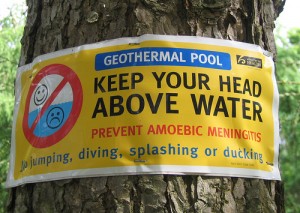
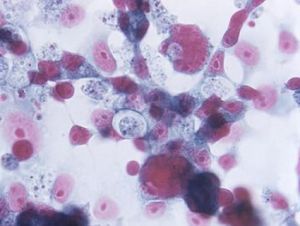
Primary amebic meningoencephalitis: brain-eating parasite in southwestern Indiana


If hantavirus wasn’t enough to freak you out, the Associated Press reported on Tuesday that the autopsy report for a 30-year-old man in southwestern Indiana indicates that a brain-eating amoeba was responsible for his death. If confirmed by the Centers for Disease Control and Prevention, this would be the fourth death this year from primary amebic meningoencephalitis, which is caused by a parasite known as Naegleria fowleri

Naegleria fowleri is a single-celled living organism that lives in warm, fresh water, according to the CDC. (It’s not actually an amoeba, despite the colloquial term for it.) It can travel up your nose while swimming in a lake or stream, multiply, and proceed to eat your brain. It has a 99 percent fatality rate, since only one person in the United States has ever been documented surviving the infection. (There have also been several incidents in the US in recent years of people getting the parasite from using a neti pot.) 

Still, it’s a rare occurrence—between 2002 and 2011, there were only 32 infections in the US. Four deaths in a year is well within the recent average.

But as the CDC points out, the organism “grows best at higher temperatures.” That might be a good reason to worry about whether higher temperatures caused by climate change will make it worse, as a CDC scientist warned a few years ago:

“This is definitely something we need to track,” said Michael Beach, a specialist in recreational waterborne illnesses for the Centers for Disease Control and Prevention.

“This is a heat-loving amoeba. As water temperatures go up, it does better,” Beach said. “In future decades, as temperatures rise, we’d expect to see more cases.”

The CDC notes that “assessing the potential for climate-related changes to the geographical range of the organism and associated infections” is one of the areas the agency is working on.

http://www.motherjones.com/blue-marble/2012/09/brain-eating-amoebas-climate-change

Lord Martin Rees: alien life could be discovered within the next 40 years


Alien life beyond our solar system could be discovered within the next 40 years, a top British astronomer has said.

According to Lord Martin Rees, the president of the Royal Society of London, developments in astronomy mean that astrophysicists could be able to view images of distant planets outside of our solar system as soon as 2025, and potentially discover whether there is some form of life on them, the Daily Mail reported.

The question of whether earth is alone in supporting living organisms has puzzled scientists, philosophers for centuries.

“We know now that stars are orbited by retinues of planets just as our sun is. We have learned this in just the last decade, essentially,” Rees said.

“Within 10 or 20 years we will be able to image other planets like the earth, orbiting other stars. That will be a really exciting subject to see if there is evidence for [extra-terrestrial] life or not,” Rees was quoted as saying by the paper.

Speaking at a debate on the meaning of life for the launch of Professor Stephen Hawking’s new show Grand Design, he added that finding out more about the “origin of life, the place where it exists, and whether aliens exist, is going to be crucial over the next four decades”.

“There may be some questions that our brains will never understand, in the same way that chimpanzees couldn’t understand quantum theory, that are just beyond human brains,” Rees added.

Last year Lord Rees said it was possible that aliens were “staring us in the face” in a form humans are unable to recognise.

“I suspect there could be life and intelligence out there in forms we can’t conceive,” he added.

http://www.phenomenica.com/2012/09/aliens-could-be-discovered-within-40-years.html

Record High Ice-Thaw In Arctic and Greenland this year


The Northern Hemisphere’s largest expanses of ice have thawed faster and more extensively this year than scientists have previously recorded. And the summer isn’t over.

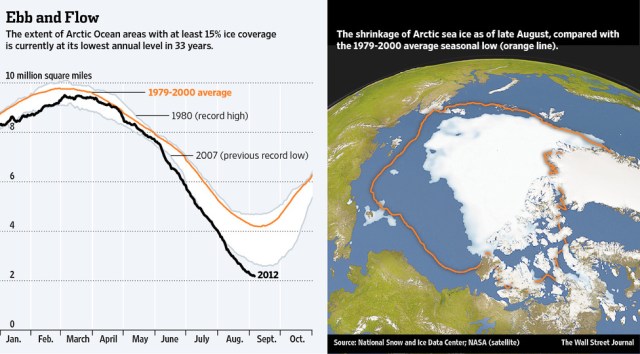
Studies suggest that more of the massive Greenland ice cap has melted than at any time since satellite monitoring began 33 years ago, while the Arctic sea’s ice is shrinking to its smallest size in modern times.

“This year’s melting season is a Goliath,” said geophysicist Marco Tedesco, director of the Cryospheric Processes Laboratory at City University of New York. “The ice is being lost at a very strong pace.”

Scientists monitor the annual thaw closely because changes in the ice of the far North can raise sea levels and affect weather throughout the hemisphere by altering wind currents, heat distribution and precipitation.

Shrinkage of the Arctic sea ice since 2006, for instance, helped lead to seasons of severe snow across Europe, China and North America, researchers at Columbia University, the Georgia Institute of Technology and the Chinese Academy of Sciences reported earlier this year.

As the seasonal ice abates more each year, new polar shipping lanes also open up, as do opportunities for mineral exploration. By some estimates, as much as 25% of the world’s oil and natural-gas reserves are under the Arctic seafloor. Russia, Denmark, Norway and Canada are vying to control these assets.

The giant ice cap at the top of the world partly melts every summer and refreezes every winter. In recent years, the thaw has become progressively more extensive, NASA and European satellite observations suggest. At the same, the refreeze has been smaller—adding up to long-term shrinkage in the ice cover.

This year’s unusual summer thaw was spurred partly by natural variations in weather, but also reflected rising levels of heat-trapping carbon dioxide and methane in the air, amplified by carbon soot from widespread wildfires and the burning of fuels, said scientists at Stanford University and the National Snow and Ice Data Center.

Carried north across the Arctic by winds, soot not only darkens snow and ice, making it absorb more heat from sunlight, but also interferes with the formation of clouds that might otherwise providing cooling shade.

“They all cause enhanced warming in the Arctic,” said Stanford University atmospheric scientist Mark Jacobson, who advocates for renewable energy. “Soot can double the warming.”

In many ways, the Arctic ice pack and Greenland ice cap are mirror opposites. The ice pack is a vast layer of frozen salt water, a few yards thick at most, floating atop an open sea, like ice cubes in a highball. Changes in the size of the Arctic ice can alter weather patterns globally, though the melting doesn’t raise sea levels since the ice displaces the same amount of ocean water when frozen as when liquid.

The Greenland ice sheet is a land-based formation of frozen fresh water up to two miles thick. The water runoff from Greenland ice dilutes the salinity of ocean water, changing its density and altering currents. The runoff that doesn’t refreeze adds to rising ocean levels.

Despite their differences, their fates are linked. “There is little doubt that in terms of warming, things are coming together in the Arctic,” said glaciologist Paul Mayewski, director of the Climate Change Institute at the University of Maine. “Without a doubt, warming in the Arctic is very, very strong,”

In fact, more melting occurred across the Greenland ice cap—the world’s second-largest ice sheet after Antarctica—in June and July than in any year since at least 1979, when satellite monitoring of the island’s ice began, Dr. Tedesco and his colleagues reported earlier this month. The Greenland thaw began in May, a month earlier than usual.

On average, about half of the surface of Greenland’s ice sheet naturally melts during the summer, and then mostly refreezes with the approach of winter. This year, nearly the entire ice cover, from its thin, low-lying coastal edges to its two-mile-thick center, experienced some melting at its surface, according to measurements from three independent satellites analyzed by NASA and university scientists.

“This summer, we have seen melting at the very highest elevations of the Greenland ice sheet, which we have not seen before in the satellite record,” said climatologist Thomas Mote of the University of Georgia, who studies snow cover. Researchers expect much of it to refreeze.

By Wednesday, the Arctic sea ice had shrunk to 1.54 million square miles, about 70,000 square miles smaller than the previous modern low set in September 2007, according to the satellite readings compiled by NASA and the National Snow and Ice Data Center in Boulder, Colo. By that measure, the six lowest Arctic sea ice levels on record all occurred in the past six years.

Even when the Arctic ice refreezes, the new ice is often thinner, making it more vulnerable to storms and seasonal temperature variations, said climate scientist Julienne Stroeve at the Snow and Ice Data Center.

About a week remains in the melt season. Researchers won’t know the full extent of this year’s melting until the end of September.

http://online.wsj.com/article/SB10000872396390444772804577621470127844642.html?mod=googlenews_wsj#articleTabs%3Darticle

16 whales dies in mass beaching in Scotland


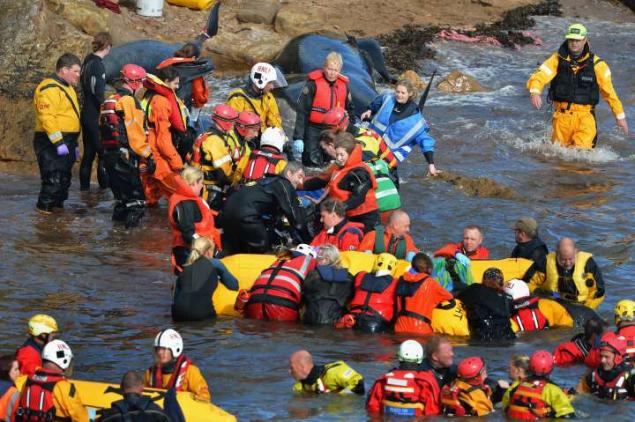
Sixteen whales were killed and ten others saved in a mass beaching on Scotland’s east coast on Sunday, authorities said.

The 20-foot pilot whales became stranded in a small cove in the county of Fife – home to the famed Old Course at St. Andrew’s golf course — at around 7 a.m. local time, The Scotsman newspaper reported.

Volunteers, coast guardsmen, firefighters and local vets scrambled to rescue the poor beasts from the shallow North Sea waters.

“I went down to the beach at about 12 p.m. and I could see all the whales. It was horrible. I have never seen anything like it in my life,” David Galloway, a local fish cutter, told The Scotsman.

“We were told we couldn’t go down on to the beach, but we could see rescuers beside the whales, they were trying to take care of them, trying to keep them moist, he said.

“They were waiting for the tide to come in. It was just horrible.”

The rescue operation drew a large crowd to the windswept beach, prompting the coast guard to urge would-be volunteers to stay away.

The whales may have become stranded after the lead whale got sick or lost its way, officials told the newspaper.

Three of the whales that died were calves.

The ones that were saved were being monitored for 24 hours to make sure they didn’t wash ashore again, BBC reported.

“It is a very rare occurrence in Scotland and very sad,” a coast guard spokeswoman told The Scotsman.

Read more: http://www.nydailynews.com/news/world/16-whales-die-mass-beaching-scotland-article-1.1150716#ixzz25o3LI3u2