Dallas Parkland Memorial Hospital caregivers accused of sexually abusing patients

Parkland Memorial Hospital is the nation’s largest healthcare facility ever forced into federal oversight to remedy patient-safety dangers. How did the landmark Dallas County public hospital reach this precipice? The problems have been years in the making.

By BROOKS EGERTON
Staff Writer
begerton@dallasnews.com

The nurse aide was accused of raping a grandmother who could barely walk. Doctors moved her from Parkland Memorial Hospital to another facility, where caregivers caught the man trying to track her down. Parkland fired him for “unsatisfactory work performance” and moved on.

Hospital police overlooked or ignored potential evidence and never filed charges. Hospital administrators failed to alert state regulators, as required by law. And Manuel Rodriguez went to work for a hospice company, caring for dying people in their homes. He denies wrongdoing, and Parkland said its police force found no evidence to support the rape allegation.

Parkland Memorial Hospital faces an April 2013 federal deadline to prove it is safe. How did Dallas’s landmark public hospital reach this precipice? Read First, do no harm, a compilation of The Dallas Morning News’ coverage of Parkland’s patient-safety crisis. The case is one of at least 25 in recent years in which patients accused Parkland caregivers of sexual abuse. Parkland’s in-house police force — which controls all criminal investigations of hospital staff — made no arrests. One caregiver was ticketed and fined.

Parkland has made it difficult to see how the cases were handled. The public hospital has sued the Texas attorney general in an effort to shield records. For a year, hospital officials refused to release any police investigative reports to The Dallas Morning News and would not answer most questions. Last month, they again declined interview requests, but did release a four-page statement and a selection of police records.

But the newspaper, using other sources, had already pieced together extensive details about several cases. All showed signs of poor police work, with one going officially uninvestigated for a year. Some patients and front-line workers involved in the cases alleged cover-ups.

Parkland adamantly disagrees. “To suggest that there has been a systemic or even inadvertent effort to suppress or overlook incidents of alleged assault at Parkland is to suggest a falsehood,” hospital leaders said in their Jan. 22 statement to The News.

Parkland Feb. 1, 2013 email statement to “opinion leaders and media” Parkland stressed that the Rodriguez case was “discussed with the Dallas County district attorney’s office.” It did not mention that the discussion occurred in December, nearly two years after the rape report. Parkland police officials met with prosecutors only after The News asked the district attorney’s office whether it had been consulted about any of the accused caregivers. It had not, and the DA’s office did not do any official investigations, its spokeswoman Debbie Denmon said.

Parkland’s statement also said the hospital now asks the district attorney’s office to review every sexual assault allegation, “regardless of whether the police believe it is substantiated.”

The investigative records that Parkland released last month show that detectives took logical steps in several cases and amply documented reasons for dropping them. For example, some accusers made vague, shifting allegations, and some seemed delirious.

But other cases were closed with little or no investigation, deemed to be medical procedures or bathing assistance that patients misunderstood. In the four cases about which The News had already pieced together the most information, the newly released investigative records raised further questions about police conduct.

PARKLAND AND CMS

Mike Malaise, senior vice president/external affairs, Parkland Memorial Hospital, in a Feb. 1 statement:

“In the normal course of regulatory oversight, the U.S. Centers for Medicare and Medicaid Services and the Texas State Department of Health Services investigate incidents such as those under review by the Morning News. In reviewing some of these cases, those agencies did find deficiencies in reporting, documentation or procedures surrounding the incidents. At no time did those agencies suggest that police handling of the incidents was insufficient or inappropriate.”

David Wright, deputy regional administrator, U.S. Centers for Medicare and Medicaid Services, in an email response to The News later that day:

“We have neither the authority nor expertise to review the adequacy of law enforcement investigations from any jurisdiction. Our investigations focus solely on the hospital’s compliance with the Medicare Conditions of Participation.” The Parkland statement did not address questions asked of hospital leaders: How many sexual abuse cases have come to light recently, since the newspaper last sought police records under the Public Information Act? What were the allegations? How did Parkland respond?

There has been at least one new case, the newspaper learned. Government regulators found in December that a psychiatric aide had been inappropriately touching a patient. Hospital police filed no charges.

These are the first accounts to emerge alleging deliberate mistreatment at Parkland, which collects about $425 million annually from Dallas County taxpayers. The News’ three-year investigation of the hospital previously documented harm stemming from error, under-staffing, lax supervision or, occasionally, psychiatric aides’ violent reaction to combative patients.

U.S. health officials intervened in 2011, putting Parkland under a rare form of probation that could force it to close unless systemic change is documented in the next three months. Federal monitors have reported significant progress by the hospital in some areas as well as ongoing patient-safety breakdowns. They have said nothing publicly about possible crimes committed by caregivers.

In late 2011, when the newspaper began researching sexual abuse allegations, Parkland said there had been 15 such complaints against employees in the previous four years. Abuse, as defined by Parkland, ranges from verbal or visual sexual harassment to rape — it’s “anything that forces a person into unwanted sexual contact or attention.”

Police substantiated no wrongdoing in 13 of the 15 cases, said Dr. Thomas Royer, who was Parkland’s interim chief executive at the time. The other two “were found to be assaults but not sexual,” he added. “Those people have been dealt with through the HR process.”

Records show that in one of those cases, the suspect was not a caregiver but a patient. In the other case, Parkland police accused a nurse aide of improperly touching a patient near her genitals and ticketed the man in 2011 for Class C misdemeanor assault. He was fined the maximum $500 penalty by a justice of the peace.

It’s a Class A misdemeanor to intentionally or knowingly make offensive physical contact with people who are “substantially unable” to protect themselves because of disease or injury, Austin criminal justice expert Eric Nichols said. It’s a first-degree felony if such contact causes serious mental or physical injury to a disabled person.

Three women recall their suffering at the hands of Manuel Rodriguez, a nurse aide accused of raping a patient at Parkland Memorial Hospital. In general, such misconduct “is judged very harshly by jurors and members of the community,” said Nichols, a former federal prosecutor and former Texas deputy attorney general. The maximum penalty for a Class A misdemeanor is a year in jail. The maximum for a first-degree felony is life in prison.

The aide resigned from Parkland — which failed, as it did in the Rodriguez case, to make a required report to regulators.

There’s no good way to compare the number of abuse cases at Parkland to those at other hospitals, most of which are private. In Dallas County, the DA’s office says it does not keep statistics on the types of cases filed by different police departments.

But sexual abuse of patients has been documented around the country since at least the 1970s. And predators in health-care settings, experts say, are the same as predators everywhere: They choose victims who are particularly vulnerable — physically or mentally or because their credibility can be questioned. They take advantage of institutions with a culture “of not paying attention,” said Boston College nursing professor Ann Wolbert Burgess, who co-edited a textbook on patient exploitation.

Patients are doubly vulnerable, she said. Predators have extraordinary access to their bodies. Hospital managers may assume that accusers — because of illness or medication — imagined or misunderstood a caregiver’s actions.

Burgess, a consultant on patient-abuse issues, said criminal prosecutions can be difficult or impossible because of limited evidence and victims’ disabilities. Another reason “is the hospital does not want negative publicity.”

Courtney Underwood Newsome, the Dallas area’s most prominent advocate for sex-crime victims, reviewed Parkland records obtained by The News and said she could not believe all the cases were unfounded. She cited research showing that most sexual abuse allegations are never reported to police and, of those that are, fewer than 10 percent are false.

“They [Parkland] are fighting to survive,” Underwood Newsome said, “and no one wants to see them fail.” But “there appears to be an egregious lack of action,” one that will “lead people to question what, in addition to criminal behavior, is being swept under the rug.”

Underwood Newsome co-founded the Dallas Area Rape Crisis Center and has led efforts to expand the number of hospitals offering victims full forensic examinations, which seek evidence such as an attacker’s bodily fluids. Until 2010, Parkland was the only place in Dallas County providing this service.

She questioned whether Parkland police should handle serious criminal allegations against their fellow employees. “There is always going to be a question regarding the conflict of interest,” she said.

In-house police forces like Parkland’s also face questions about whether they have the time and expertise for specialized investigations, former Dallas Police Chief Ben Click said. There are times when they should ask for outside help but don’t, he said, because “egos come into play.”

State records say Parkland has 59 licensed officers — more than some Dallas suburbs, such as Highland Park and University Park. The hospital’s force includes one veteran officer with his own history of sexual misconduct: Duane Stubbe, who served deferred-adjudication probation for exposing himself to a Collin County girl.
Parkland officials acknowledged knowing about Stubbe’s misdemeanor criminal case. Separately, they have praised their police department for preventing sex crime. In 2009, a magazine for Parkland employees said officers monitor “potentially dangerous individuals” who have medical appointments.

“Whether you’re running errands or going to your grocery store, predators can be anywhere,” the magazine quoted Lt. Rick Roebuck as saying. “I’m glad that at least while they’re here, we can make sure Parkland remains safe.”

Fred Price, who retired as a Parkland detective in 2005, said his fellow officers were generally “sincere.” But “you just knew you walked on eggshells” when investigating insiders.

Co-workers “would definitely try to cover up” for each other, said Price, who’s now a Dallas County courtroom bailiff. And management “would always believe any employee, especially a doctor, over any policeman.”

Here’s how Manuel Rodriguez got a nurse aide job in 2010 on Parkland’s eighth-floor neurology unit, according to hospital records:

He made the lowest possible passing score on a basic math test. No one else was considered for the position. Another male aide was in the process of being terminated — after being accused, for the third time in three years, of sexually abusing female patients.

Rodriguez’s personnel file shows no sign that he underwent a background check or provided any work history. He was 53 at the time and, after a career as a printer, had just spent a few weeks training at Parkland to become a certified aide.

His boss tried to fire him within 90 days, citing emails in which he complained about understaffing and accused nurses of not helping patients who’d lost control of their bowels. “Our unit’s patients and staff do not need an employee such as this,” the boss wrote to a personnel official. “I made a poor decision in hiring him.”

For reasons not explained in the personnel file, Rodriguez kept his job. And, in March 2011, the disabled grandmother was delivered to his care after fainting at a workers’ compensation hearing. A conveyor belt injury had left her in chronic pain and largely unable to use the right side of her body, including her dominant right hand. She lost her job, car, home and ability to live independently.

Rodriguez was her most helpful caregiver at first. “He brought me blankets,” said the woman, who is in her mid-50s. “He gave me a lot of attention.”

But the aide soon began to seem too familiar with his hands, “using lots of talcum powder.” And late one night, after she’d been in Parkland about a week, “he said he was going to give me a bath, and I told him, no, I didn’t want to.”

“He dragged me to the bathroom,” the woman told The News. Then, through sobs, she described how she refused when he “tried to put his thing in my mouth,” and how he went on to pin her down in bed and vaginally rape her.

Afterward, she said, he cleaned their genitals and put her bed sheets in the linen drop.

Police records say the woman tried to cry out during the attack but couldn’t make much noise, both because of her medical condition and because Rodriguez put his hand over her mouth. She remembered being restrained by terror, too: Rodriguez, she said, showed her that he had access to her medical records, so he knew where she lived with relatives. A Parkland detective verified that Rodriguez had looked up her address in the computer, a police report says.

“He threatened to kill not just me but them,” she said. “I didn’t know what to do.”

So at first, she told no one. Doctors sent her for therapy related to her workplace injury at UT Southwestern Medical Center’s Zale Lipshy hospital, next door to Parkland. There, she said, she finally felt safe enough to tell an employee what Rodriguez had done.

A Parkland police officer was summoned to her Zale room. It was the afternoon of March 29, 2011 — six days after the alleged rape, according to a Parkland police report.

KYE R. LEE/The Dallas Morning News

A disabled Dallas woman says she was raped last year by Manuel Rodriguez, a nurse aide at Parkland Memorial Hospital. Parkland fired the man, but its police force filed no charges. The woman’s daughter was present when a hospital police officer first responded to the rape complaint and described him as ‘really rude.’ She tried to get help from Dallas police instead, to no avail.“The policeman was really rude,” recalled one of the woman’s daughters, who was present for the interview. He raised his voice repeatedly, she said, demanding to know “why didn’t she say anything before.”

The daughter told him she was going to contact the Dallas Police Department, “and he said there’s no point in calling them because they have no jurisdiction over us.” She later called anyway and found out that Parkland was, indeed, a law force unto itself. DPD says it gets involved only if it responds first to a major crime in progress or if Parkland seeks help.

Hospital police did not immediately arrange for a physical examination of the woman, ask her to undergo a rape exam or refer her to a counselor. At the daughter’s insistence, Parkland agreed to see the woman two days after she reported being raped.

Two Parkland officers escorted her from Zale back to their hospital to have a rape exam done, police records say. But a Parkland nurse told them that “because of the extended time that had elapsed, the test could not be performed.” The hospital did test her for possible exposure to sexual diseases.

In its statement to The News, Parkland said a rape exam “only has clinical or evidentiary value within 96 hours after an alleged assault.” Underwood Newsome, the Rape Crisis Center’s co-founder, called that claim “completely unfounded.”

Texas law says police must request a rape exam when an accuser comes forward within 96 hours; after that, “the law enforcement agency may request” one. Experts say it often makes sense to perform rape exams beyond 96 hours, especially if the accuser, like the one in this case, has had limited physical activity.

“It is important to remember that evidence collection beyond the cutoff point is conceivable and may be warranted in particular cases,” says an evidence protocol published by the U.S. Justice Department.

A basic physical examination “should be performed in all cases of sexual assault, regardless of the length of time which may have elapsed,” says a Texas attorney general’s protocol. One reason is to check for internal injuries. Also, “evidence may still be gathered” — for example, by taking photographs of bruises.

While waiting for the two officers at Zale, the grandmother’s room phone rang. It was Rodriguez, taunting that he had been to court before and “nothing happened to him that time either,” a UTSW police report quoted the woman as saying. In the same call, she told The News, he also made the sound of a gun.

Nurses moved her to a different room and put her on the “no info” list, preventing anyone from knowing where she was unless she told them. She spoke with a Parkland counselor, whose notes describe her as tearful, fearful and intensely depressed.

Bruises on a Parkland patient’s arm, photographed in 2011 at a Parkland counseling center two weeks after the victim was allegedly raped by Parkland nurse aide Manuel Rodriguez. The photo comes from her medical records.“Don’t leave me,” she begged the counselor. “I feel like I’m dying.”

Parkland suspended Rodriguez the following day, April 1. On April 2, according to UTSW police records, he showed up at Zale, apparently unaware she had already been discharged. Dressed in street clothes and a white ball cap, he asked to see the woman and gave nurses his name. They refused to help him and alerted police, but Rodriguez left before officers arrived.

Marsha Newberry, who is a friend of Rodriguez’s and one of his ex-wives, said he called her about the suspension. He denied wrongdoing, described the patient as “crazy” and said “she claimed that he was trying to track her down in another building. He was like, ‘I’ve never even been in that building.’”

One example Rodriguez gave of the patient’s behavior: “She would just, like, not have any clothes on and open up the sheets and try to pull him down on her, and he was like, ‘I can’t do this. I’m here to take care of you.’” According to Newberry, Rodriguez said he also received a love letter from the patient but didn’t show it to anyone before destroying it.

Rodriguez, who has never been convicted of a crime, declined an interview request. He referred The News to his longtime lawyer, Dennis Croman, who said the patient had “mental problems” and might not be “altogether competent.” He did not elaborate.

For months before her hospitalization, the woman was treated by a psychiatrist at Parkland’s outpatient Victim Intervention Program. He diagnosed her with major depression and post-traumatic stress disorder, including nightmares and flashbacks, which he said stemmed from her work injury, disability and pain. He saw her again on April 7 and noted that she was “distraught” because of a sexual assault at Parkland that had “significantly exacerbated symptoms.”

Other therapists who later saw the woman briefly offered varying diagnoses, according to her medical records, which she let The News review. One said she talked about a childhood belief in “aliens.” Another said she described elaborate visions, but he thought she was faking mental and physical symptoms for financial gain. The woman told The News that doctors, generally working through translators, had asked her to visualize as part of stress-reduction therapy. She said she knew the difference between the imaginary and the reality of rape.

During the April 7 visit, Victim Intervention Program staff took photographs of the woman in a wheelchair — the only photos that appear in medical records she’s been able to obtain. Two weeks had passed since the alleged rape, but bruises were still visible on her calves and upper arms. Parkland also gave her a brochure from the Texas Association Against Sexual Assault that explains how vulnerable the disabled are to sexual abuse. The association offers a similar pamphlet for police that urges patience with the disabled, who are often reluctant to report abuse for fear of losing health care and may be “considered less credible.”

On April 8, intervention program staff contacted the detective assigned to the woman’s case. The detective wrote a report saying that she learned two things from the call: “The patient was being treated for a work-related shoulder injury that was traumatic,” and had previously been sexually assaulted without reporting it to police. There is no mention of her bruises in this report or any other police records released by Parkland.

The detective, Darlene Griffin, closed the case that day. “We have no physical evidence to support a sexual assault against the victim,” she wrote.

“Investigation believes that there are inconsistencies with the statement of the patient,” she added. “However, investigation cannot conclude that an offense did not occur.”

Griffin’s report gave no examples of inconsistencies and made no reference to the patient’s mental status. The News, in hours of interviews with the patient over several months, detected no inconsistencies. It found no sign in her medical records that caregivers doubted the truthfulness of her rape report.

The newspaper did find, deep in a box of her personal papers, hospital menus from the day after the alleged rape. “I am dirty,” says a note she scrawled near references to peach halves and grilled chicken breast. The note curses Rodriguez by name and adds, “He raped me.”

Griffin’s report noted that Rodriguez, during the week of the alleged rape, had accessed personal contact information for another of his female patients. He called her after she was discharged and said he was sorry “he couldn’t help her with her bath,” the report says.

An unsigned memo dated April 12 told Rodriguez to return to duty. “Although the allegations were determined to be unfounded, you are strongly cautioned to exercise prudent judgment so similar situations are avoided,” his boss wrote. “However, should we substantiate any of these allegations in the future or continue to receive additional complaints, further corrective action may be taken not to exclude termination.”

That week, the neurology boss also drafted a memo for all of her staff. It decreed that aides could no longer care for patients of the opposite sex unless another caregiver was present.

A nursing administrator responded by noting that problems could also arise when caregivers worked alone with patients of the same gender. Parkland’s patient relations department, the administrator wrote, “is currently investigating a complaint by a male patient against a male provider regarding inappropriate touching.”

Rodriguez was fired in late April, ending an 11-month tenure at Parkland. Records released by the hospital do not detail reasons for the firing beyond his “unsatisfactory” job performance.

“He said something about how they fired him because he wouldn’t write down a statement” admitting he violated a procedure, Newberry said. He told her he refused because “I did everything I was supposed to do.”

She said he was “heartbroken.” “He was just like, ‘I cannot believe I’ve lost my job because of some stupid woman.’”

Croman, Rodriguez’s lawyer, said he talked with two Parkland detectives during the criminal investigation.

“We tried to cooperate with them and give them what information we knew,” Croman said. “They just determined that it wasn’t worth pursuing.”

The detective’s report contradicts this. “The suspect has been non-cooperative,” Griffin wrote. “Investigation did not receive communication from the suspect attorney.”

The International Association of Chiefs of Police says sexual assault investigations should be treated not as “he said, she said” cases, but as “he said, they said” matters. Detectives should look for a pattern of unreported crimes “by interviewing the suspect’s social circles, current and former partners,” says the association’s list of recommended best practices.

OTHER PARKLAND ACCUSATIONS Here are other examples of sexual abuse allegations against Parkland Memorial Hospital caregivers. Parkland’s police force filed charges only in the first case.

KHASRO HASAN

Position: Nurse aide
Background: He told Parkland that he worked as a nurse in Iraq and as a translator for U.S. military officials.
Tenure at Parkland: Seven months in 2010-11
Accusations: In January 2011, a patient accused him of groping her breast and pubic areas “more than once.”
His response: He denied wrongdoing to Parkland police and The Dallas Morning News. He told the newspaper that a vindictive co-worker manufactured the accusations. According to police records, he admitted touching the patient’s abdomen and head without consent. He said he was trying to help her with pain. An aide’s duties don’t include treatment.
Outcome: Hasan quit his job. Parkland police later charged him with Class C misdemeanor assault. He was convicted in a justice of the peace court and assessed the maximum penalty: a $500 fine.
Today: Parkland did not make a required report to regulators. Hasan avoided being put on the state’s list of aides who are unemployable because of abuse. He said he is no longer working in health care.
PETER SARMIE

Position: Neurology unit nurse aide
Background: He told Parkland that he studied to be a mechanic in the West African nation of Liberia before becoming a certified aide in Texas.
Tenure at Parkland: 2007-10
Accusations: He put his hand in a patient’s vagina while bathing her in 2010. “This is the third complaint received for the same type of behavior,” Parkland told him.
His response: “All of it was investigated and employee was found not guilty,” he wrote to his superiors. Sarmie reiterated these denials in an interview with The Dallas Morning News. Male aides, he said, are vulnerable to false accusations when assigned to female patients who need assistance with bathing and dressing.
Outcome: He was fired for “repetitive at risk behavior/reckless conduct that jeopardizes the life and/or welfare of another individual.”
Today: He lives in Rhode Island and said he is working as a nurse aide.

ARLO TABADA

Position: Intensive care unit nurse
Background: His resume says he worked as a physician in his native Philippines before getting a U.S. nursing degree in 2008.
Tenure at Parkland: 2008-12
Accusations: In January 2012, a patient said, Tabada woke her in the middle of the night, while she was intubated, for bathing. “I felt a pinch on my nipple,” she told the nurse’s supervisor. Then he “started to rub my back” with a hot towel and “had his hand on my pubic area.” The patient added that she’d never been bathed by a male nurse before.
His response: Tabada and an aide, who helped with the bathing, denied wrongdoing to Parkland. He reiterated that denial to The News. Having female caregivers bathe female patients “might be the best scenario,” he added. But “sometimes it’s just not practical” given Parkland’s “heavy load” of patients.
Outcome: Both caregivers returned to work after a one-day investigation by Parkland police. A psychiatrist said the patient’s allegations were “likely due to delirium given that she was on propofol,” a sedative and hypnotic agent. Tabada told The News he agreed to take a polygraph test, but police “didn’t pursue it.”
Today:Parkland fired Tabada in July 2012 for seizing an emergency-call button from another ICU patient. He said the patient was repeatedly demanding painkillers ahead of schedule, disrupting care of others in the short-staffed unit. “I made a mistake,” Tabada told Parkland. He still has his Texas nursing license and would not say whether he is currently working as a caregiver elsewhere.

MORE INCIDENTS

Because Parkland withheld or blacked out large portions of many records, it’s impossible to identify most of the other accused caregivers and their jobs. Here are examples of patients’ accusations and how hospital police responded:
December 2010, second floor: A caregiver performed an invasive exam without consent. The patient grabbed the caregiver’s hand “and pulled it out.” Records released by Parkland show no sign that any police investigation resulted. Ten months later, the supervisor of criminal investigations created a report that declared, without elaboration: “This was a medical procedure not an assault.”
February 2012, emergency room: A clothed caregiver pressed his erect penis into the patient’s genital area during an exam. The patient was upset and terminated the exam. Here’s why a Parkland detective said he closed the case as unfounded: The caregiver “would have to slouch or get on his knees” to do what he was accused of, and the patient said he was standing.
March 2012, emergency room: A caregiver “fondled the nipple on her left breast three different times” while attaching testing equipment to her chest. The caregiver denied touching any part of the breast. Both parties agreed to take a polygraph. “After interviewing both parties and polygraphing one, we came to the conclusion that there was no assault,” a detective wrote. “The polygraph showed there was no deception.”

SOURCE: Parkland police and personnel records; Dallas Morning News research. Records released by Parkland don’t show whether its police followed this advice. But The News found a pattern of abuse allegations in Rodriguez’s past and support for what he allegedly told the disabled grandmother — that he’d been to court before.

Oralia “Lala” Boatright, a divorced mother of two, lived with Rodriguez in the early 1990s, in his hometown of Irving. Police there arrested him twice after she accused him of assault.

In 1991, according to a police report, he grabbed her by the throat when she tried to leave him. An officer took him to jail after she said she “was afraid if the police left, the assault would continue.” Municipal court records show the case was dismissed but don’t say why.

A 1992 police report said he pinned her down on a bed with his knees to keep her from leaving home, then pushed her into a glass table. Hospital records say she received treatment for a gash near her right eye, in the company of an unidentified man.

That man was Rodriguez, Boatright told The News. She recalled a nurse asking whether she’d been assaulted and being so afraid that she claimed it was just an accident. Three days later, after moving out of his house for good, she gave police a written statement. It said he had previously held her at gunpoint.

“He kept an old antique shotgun that his dad gave him behind the bedroom door,” Boatright said in an interview. “He pointed it at me and says, ‘You’re not going anywhere. Do you understand?’” Her response: “OK, OK, I promise. Don’t do anything — my son’s in the next room.”

She said he put the gun down and taunted her: “I broke you, didn’t I?”

Police deemed the 1992 case serious enough to send to the district attorney’s office for prosecution. A judge found Rodriguez innocent, for reasons that county records don’t explain. Boatright said she didn’t know the case went to trial, because she went into hiding and didn’t leave a forwarding address.

Rodriguez called Boatright a “maniac” who deliberately injured herself, according to his friend Newberry. “She told him she was going to get him put away” and “jumped into the glass coffee table,” Newberry said, recounting his story. “He said, ‘I didn’t touch the girl.’”

Newberry was married to Rodriguez for about eight years. When filing for divorce in 2004, she accused him of cruelty and adultery. The cruelty, she told The News, was strictly verbal. “He was never physical with me.”

Rodriguez was briefly married in the mid-1990s to Sandy Jackson, who accused him of harassment while their divorce was pending. When she contacted Irving police, she said he had called her about 25 times that day and knocked on her door, trying to get her to move back in with him.

An officer told him to leave Jackson alone, according to police records, prompting Rodriguez to reply: “But I want to talk to her.” He agreed to stop bothering her but did not, records say. Police then referred the matter to the city attorney, but Irving officials recently said there was no record of prosecution.

Jackson told officers that Rodriguez “was violent towards her during their marriage,” but she did not call police then. She told The News that she feared complaining would lead to more violence and that she spoke up only after securing a place of her own.

“One time I thought I was going to end up in the bottom of Grapevine Lake because he hit me so hard,” Jackson said in an interview. They were in his sailboat, she explained, and he was barking orders while doing no work. When she protested, “he hit me right on the pelvic bone,” and “half my body went over the railing.”

Jackson said Rodriguez sometimes bragged that his common names and lack of a middle name made him hard to track. “He was very bold about that,” she said. “He would just tell me, ‘How the hell is anybody ever going to catch up to me?’”

The News learned of the Parkland rape allegation in late 2011, about eight months after it was made. The newspaper sought information from the Texas Department of State Health Services, which licenses hospitals and which Parkland should have notified within 48 hours.

DSHS said it had never been notified and began investigating. It isn’t clear what steps the state agency took, but it did not interview Rodriguez and found no fault with Parkland.

Agency spokeswoman Carrie Williams said she could not discuss investigative details. But in general, she said, Parkland’s past failures to report abuse allegations made it difficult for DSHS to determine what happened and contributed to the agency’s decision to fine the hospital a record $1 million last year.

“They really protect the workers there,” Rodriguez’s accuser said of Parkland. “And the patients, where does that leave us? In their hands, where they can do what they want.”

Rodriguez went to work in early 2012 for a home-health firm based in Arlington. Officials there said he wanted more work than was available and quit after a few months. He gave no notice, they said, and simply failed to show up at a home where a patient was waiting for help.

Since then, he has been working for Hospice Plus, a Dallas-based company that cares for the terminally ill. Its chief executive, Dr. Bryan White, said he knew of no problems with Rodriguez. He declined to comment on whether the company received information from Parkland about the aide. “We followed our policies and procedures,” White added.

The Parkland patient who accused Rodriguez began to cry when told of his hospice work. She said she suspects the hospital views her as someone who just wants money.

“I don’t want money. I don’t want any of that. I want justice,” she said, sobbing. “I want justice so this doesn’t keep happening to so many other women.”

Police officer remains on Parkland’s force after sexual misconduct findings
He served probation for indecent exposure and was later fired, but the hospital hired him back.
By BROOKS EGERTON
Staff Writer
begerton@dallasnews.com

Parkland Memorial Hospital police officials promoted Officer Duane Stubbe after his first incident of sexual misconduct. They warned him after the second. They fired him after the third.

And two months later, they gave him back his gun, badge and previous salary. He remains on Parkland’s police force today, enforcing the law at primary-care clinics.

The troubles date to 1996, when Stubbe was arrested for being naked in front of three middle-school girls during a slumber party at his home. In 1998, he was found not guilty on two misdemeanor charges of indecent exposure and agreed to plead no contest to a third. A Collin County judge put him on six months of deferred-adjudication probation.

Parkland Memorial Hospital
Duane Mark Stubbe, a longtime Parkland Hospital police officer, is shown in a 1998 booking photo from Collin County. He was arrested in 1996 for indecent exposure, and again in 1998 for a probation violation.Stubbe was required to leave home, undergo sex-offender treatment and submit to polygraph testing. When tested, he “failed when asked his sexual intent during the commission of the offense,” court records say.

Prosecutors sought to revoke his probation. Stubbe sought to withdraw his plea, claiming he hadn’t understood its consequences or the evidence against him. He had always “maintained his innocence,” his lawyer argued.

A judge rejected both efforts in early 1999. Stubbe completed probation with no conviction record.

The Texas Commission on Law Enforcement Officer Standards and Education then moved to suspend Stubbe’s license. It got a late start because Stubbe had failed to make a required report of his arrest; he didn’t disclose the criminal case until after his probation began.

Parkland intervened on the officer’s behalf. Kenneth Cheatle — then his lieutenant and now Parkland’s police chief — wrote a letter praising Stubbe. So did CaSandra Williams, who was assistant chief at the time and now heads the police department at Texas Health Presbyterian Hospital Dallas.

Smith Lawrence, then Parkland’s chief and now retired, went to Austin and testified before an administrative law judge. He said he’d recently promoted Stubbe to a supervisory job “entirely based on merit.” The officer “enjoys the support of both his superiors and peers.”

The three supervisors did not respond to requests for comment.

Stubbe, who declined to comment for this story, also testified in Austin and gave this version of what happened at the slumber party: He was sleeping naked and unaware of the sleepover when a noise from his stepdaughter’s room woke him. He went to investigate, opened her door and saw the girls. “He immediately closed the door,” he said, and two of the three girls did not see him nude.

But two of the girls, who are now young women, told The Dallas Morning News that they did see full frontal nudity. They said Stubbe entered the room naked, told the girls to quiet down and then briefly lingered there. The two did not testify in Austin.

Parkland Memorial Hospital
Image from the Parkland Hospital newsletter, released in Sept. 2012, showing Officer Duane Stubbe, a member of Parkland Memorial Hospital’s police force, who has his own history of sex crime: He was sentenced to six months of probation in 1998 for indecent exposure, and state regulators later suspended his officer’s license. Stubbe has worked as an officer for the hospital since 1994.In his testimony, Stubbe said “he has learned his lesson and is truly remorseful,” the administrative judge wrote. The police officer said suspension would cost him his job and hurt his family.

It would also hurt Parkland, Stubbe asserted, because he was the hospital police force’s only member specially trained to deal with mentally ill people.

The law enforcement commission agreed to a six-month probated suspension, which began in early 2000 and allowed Stubbe to keep working.

By late 2000, he was in trouble again. Parkland supervisors cited Stubbe for refusing to help a patient who’d lost her purse. And in early 2001, he was written up for failures including an “unsatisfactory” report on the use of force and not telling the Secret Service when a psychiatric patient threatened President-elect George W. Bush.

Stubbe received a “final warning” in April 2001, for sexually harassing another officer. He grabbed the man, according to personnel records, and made comments such as “You need to quit looking at me like you want me to … [expletive] you.”

The records show that Stubbe was fired the following month for similar sexual comments. He told a fellow supervisor, for example, “I’ll do it if you [perform oral sex on me].”

Termination paperwork also cited “inappropriate incidents” with his Parkland-issued gun, such as taking it out during a meeting, sliding it across a table and telling a subordinate, “You shoot him.”

There is no sign in records Parkland released that Stubbe denied doing any of these things. Nor is there any explanation for why, two months after his firing, he was rehired. He appealed his firing, the hospital said in a statement to The News, and Lawrence “agreed to allow him back onto the police force.”

Stubbe, 48, has received excellent evaluations in recent years.

That is little consolation to the two young women who attended the slumber party. Both said they were upset to learn that Stubbe was still working as a police officer. One said she worked in health care and had considered getting additional training at Parkland.

Now, she said, she’s afraid to go there. “You don’t know you’re safe.”

http://res.dallasnews.com/graphics/2013_02/parkland/#day1main

Russian family was isolated from all human contact for 40 years, unaware that WWII existed

russia1

russia2

russia3

russia4

russia5

Siberian summers do not last long. The snows linger into May, and the cold weather returns again during September, freezing the taiga into a still life awesome in its desolation: endless miles of straggly pine and birch forests scattered with sleeping bears and hungry wolves; steep-sided mountains; white-water rivers that pour in torrents through the valleys; a hundred thousand icy bogs. This forest is the last and greatest of Earth’s wildernesses. It stretches from the furthest tip of Russia’s arctic regions as far south as Mongolia, and east from the Urals to the Pacific: five million square miles of nothingness, with a population, outside a handful of towns, that amounts to only a few thousand people.

When the warm days do arrive, though, the taiga blooms, and for a few short months it can seem almost welcoming. It is then that man can see most clearly into this hidden world—not on land, for the taiga can swallow whole armies of explorers, but from the air. Siberia is the source of most of Russia’s oil and mineral resources, and, over the years, even its most distant parts have been overflown by oil prospectors and surveyors on their way to backwoods camps where the work of extracting wealth is carried on.

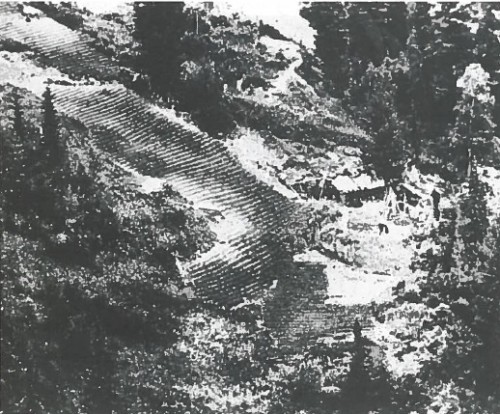
Thus it was in the remote south of the forest in the summer of 1978. A helicopter sent to find a safe spot to land a party of geologists was skimming the treeline a hundred or so miles from the Mongolian border when it dropped into the thickly wooded valley of an unnamed tributary of the Abakan, a seething ribbon of water rushing through dangerous terrain. The valley walls were narrow, with sides that were close to vertical in places, and the skinny pine and birch trees swaying in the rotors’ downdraft were so thickly clustered that there was no chance of finding a spot to set the aircraft down. But, peering intently through his windscreen in search of a landing place, the pilot saw something that should not have been there. It was a clearing, 6,000 feet up a mountainside, wedged between the pine and larch and scored with what looked like long, dark furrows. The baffled helicopter crew made several passes before reluctantly concluding that this was evidence of human habitation—a garden that, from the size and shape of the clearing, must have been there for a long time.

It was an astounding discovery. The mountain was more than 150 miles from the nearest settlement, in a spot that had never been explored. The Soviet authorities had no records of anyone living in the district.

The four scientists sent into the district to prospect for iron ore were told about the pilots’ sighting, and it perplexed and worried them. “It’s less dangerous,” the writer Vasily Peskov notes of this part of the taiga, “to run across a wild animal than a stranger,” and rather than wait at their own temporary base, 10 miles away, the scientists decided to investigate. Led by a geologist named Galina Pismenskaya, they “chose a fine day and put gifts in our packs for our prospective friends”—though, just to be sure, she recalled, “I did check the pistol that hung at my side.”

As the intruders scrambled up the mountain, heading for the spot pinpointed by their pilots, they began to come across signs of human activity: a rough path, a staff, a log laid across a stream, and finally a small shed filled with birch-bark containers of cut-up dried potatoes. Then, Pismenskaya said,

“beside a stream there was a dwelling. Blackened by time and rain, the hut was piled up on all sides with taiga rubbish—bark, poles, planks. If it hadn’t been for a window the size of my backpack pocket, it would have been hard to believe that people lived there. But they did, no doubt about it…. Our arrival had been noticed, as we could see.”

The low door creaked, and the figure of a very old man emerged into the light of day, straight out of a fairy tale. Barefoot. Wearing a patched and repatched shirt made of sacking. He wore trousers of the same material, also in patches, and had an uncombed beard. His hair was disheveled. He looked frightened and was very attentive…. We had to say something, so I began: ‘Greetings, grandfather! We’ve come to visit!’

The old man did not reply immediately…. Finally, we heard a soft, uncertain voice: ‘Well, since you have traveled this far, you might as well come in.’

The sight that greeted the geologists as they entered the cabin was like something from the middle ages. Jerry-built from whatever materials came to hand, the dwelling was not much more than a burrow—”a low, soot-blackened log kennel that was as cold as a cellar,” with a floor consisting of potato peel and pine-nut shells. Looking around in the dim light, the visitors saw that it consisted of a single room. It was cramped, musty and indescribably filthy, propped up by sagging joists—and, astonishingly, home to a family of five:

The silence was suddenly broken by sobs and lamentations. Only then did we see the silhouettes of two women. One was in hysterics, praying: ‘This is for our sins, our sins.’ The other, keeping behind a post… sank slowly to the floor. The light from the little window fell on her wide, terrified eyes, and we realized we had to get out of there as quickly as possible.

Led by Pismenskaya, the scientists backed hurriedly out of the hut and retreated to a spot a few yards away, where they took out some provisions and began to eat. After about half an hour, the door of the cabin creaked open, and the old man and his two daughters emerged—no longer hysterical and, though still obviously frightened, “frankly curious.” Warily, the three strange figures approached and sat down with their visitors, rejecting everything that they were offered—jam, tea, bread—with a muttered, “We are not allowed that!” When Pismenskaya asked, “Have you ever eaten bread?” the old man answered: “I have. But they have not. They have never seen it.” At least he was intelligible. The daughters spoke a language distorted by a lifetime of isolation. “When the sisters talked to each other, it sounded like a slow, blurred cooing.”

Slowly, over several visits, the full story of the family emerged. The old man’s name was Karp Lykov, and he was an Old Believer—a member of a fundamentalist Russian Orthodox sect, worshiping in a style unchanged since the 17th century. Old Believers had been persecuted since the days of Peter the Great, and Lykov talked about it as though it had happened only yesterday; for him, Peter was a personal enemy and “the anti-Christ in human form”—a point he insisted had been amply proved by Tsar’s campaign to modernize Russia by forcibly “chopping off the beards of Christians.” But these centuries-old hatreds were conflated with more recent grievances; Karp was prone to complain in the same breath about a merchant who had refused to make a gift of 26 poods [940 pounds] of potatoes to the Old Believers sometime around 1900.

Things had only got worse for the Lykov family when the atheist Bolsheviks took power. Under the Soviets, isolated Old Believer communities that had fled to Siberia to escape persecution began to retreat ever further from civilization. During the purges of the 1930s, with Christianity itself under assault, a Communist patrol had shot Lykov’s brother on the outskirts of their village while Lykov knelt working beside him. He had responded by scooping up his family and bolting into forest.

That was in 1936, and there were only four Lykovs then—Karp; his wife, Akulina; a son named Savin, 9 years old, and Natalia, a daughter who was only 2. Taking their possessions and some seeds, they had retreated ever deeper into the taiga, building themselves a succession of crude dwelling places, until at last they had fetched up in this desolate spot. Two more children had been born in the wild—Dmitry in 1940 and Agafia in 1943—and neither of the youngest Lykov children had ever seen a human being who was not a member of their family. All that Agafia and Dmitry knew of the outside world they learned entirely from their parents’ stories. The family’s principal entertainment, the Russian journalist Vasily Peskov noted, “was for everyone to recount their dreams.”

The Lykov children knew there were places called cities where humans lived crammed together in tall buildings. They had heard there were countries other than Russia. But such concepts were no more than abstractions to them. Their only reading matter was prayer books and an ancient family Bible. Akulina had used the gospels to teach her children to read and write, using sharpened birch sticks dipped into honeysuckle juice as pen and ink. When Agafia was shown a picture of a horse, she recognized it from her mother’s Bible stories. “Look, papa,” she exclaimed. “A steed!”

But if the family’s isolation was hard to grasp, the unmitigated harshness of their lives was not. Traveling to the Lykov homestead on foot was astonishingly arduous, even with the help of a boat along the Abakan. On his first visit to the Lykovs, Peskov—who would appoint himself the family’s chief chronicler—noted that “we traversed 250 kilometres [155 miles] without seeing a single human dwelling!”

Isolation made survival in the wilderness close to impossible. Dependent solely on their own resources, the Lykovs struggled to replace the few things they had brought into the taiga with them. They fashioned birch-bark galoshes in place of shoes. Clothes were patched and repatched until they fell apart, then replaced with hemp cloth grown from seed.

The Lykovs had carried a crude spinning wheel and, incredibly, the components of a loom into the taiga with them—moving these from place to place as they gradually went further into the wilderness must have required many long and arduous journeys—but they had no technology for replacing metal. A couple of kettles served them well for many years, but when rust finally overcame them, the only replacements they could fashion came from birch bark. Since these could not be placed in a fire, it became far harder to cook. By the time the Lykovs were discovered, their staple diet was potato patties mixed with ground rye and hemp seeds.

In some respects, Peskov makes clear, the taiga did offer some abundance: “Beside the dwelling ran a clear, cold stream. Stands of larch, spruce, pine and birch yielded all that anyone could take…. Bilberries and raspberries were close to hand, firewood as well, and pine nuts fell right on the roof.”

Yet the Lykovs lived permanently on the edge of famine. It was not until the late 1950s, when Dmitry reached manhood, that they first trapped animals for their meat and skins. Lacking guns and even bows, they could hunt only by digging traps or pursuing prey across the mountains until the animals collapsed from exhaustion. Dmitry built up astonishing endurance, and could hunt barefoot in winter, sometimes returning to the hut after several days, having slept in the open in 40 degrees of frost, a young elk across his shoulders. More often than not, though, there was no meat, and their diet gradually became more monotonous. Wild animals destroyed their crop of carrots, and Agafia recalled the late 1950s as “the hungry years.” “We ate the rowanberry leaf,” she said,

“roots, grass, mushrooms, potato tops, and bark, We were hungry all the time. Every year we held a council to decide whether to eat everything up or leave some for seed.”

Famine was an ever-present danger in these circumstances, and in 1961 it snowed in June. The hard frost killed everything growing in their garden, and by spring the family had been reduced to eating shoes and bark. Akulina chose to see her children fed, and that year she died of starvation. The rest of the family were saved by what they regarded as a miracle: a single grain of rye sprouted in their pea patch. The Lykovs put up a fence around the shoot and guarded it zealously night and day to keep off mice and squirrels. At harvest time, the solitary spike yielded 18 grains, and from this they painstakingly rebuilt their rye crop.

As the Soviet geologists got to know the Lykov family, they realized that they had underestimated their abilities and intelligence. Each family member had a distinct personality; Old Karp was usually delighted by the latest innovations that the scientists brought up from their camp, and though he steadfastly refused to believe that man had set foot on the moon, he adapted swiftly to the idea of satellites. The Lykovs had noticed them as early as the 1950s, when “the stars began to go quickly across the sky,” and Karp himself conceived a theory to explain this: “People have thought something up and are sending out fires that are very like stars.”

“What amazed him most of all,” Peskov recorded, “was a transparent cellophane package. ‘Lord, what have they thought up—it is glass, but it crumples!'” And Karp held grimly to his status as head of the family, though he was well into his 80s. His eldest child, Savin, dealt with this by casting himself as the family’s unbending arbiter in matters of religion. “He was strong of faith, but a harsh man,” his own father said of him, and Karp seems to have worried about what would happen to his family after he died if Savin took control. Certainly the eldest son would have encountered little resistance from Natalia, who always struggled to replace her mother as cook, seamstress and nurse.

The two younger children, on the other hand, were more approachable and more open to change and innovation. “Fanaticism was not terribly marked in Agafia,” Peskov said, and in time he came to realize that the youngest of the Lykovs had a sense of irony and could poke fun at herself. Agafia’s unusual speech—she had a singsong voice and stretched simple words into polysyllables—convinced some of her visitors she was slow-witted; in fact she was markedly intelligent, and took charge of the difficult task, in a family that possessed no calendars, of keeping track of time. She thought nothing of hard work, either, excavating a new cellar by hand late in the fall and working on by moonlight when the sun had set. Asked by an astonished Peskov whether she was not frightened to be out alone in the wilderness after dark, she replied: “What would there be out here to hurt me?”

Of all the Lykovs, though, the geologists’ favorite was Dmitry, a consummate outdoorsman who knew all of the taiga’s moods. He was the most curious and perhaps the most forward-looking member of the family. It was he who had built the family stove, and all the birch-bark buckets that they used to store food. It was also Dmitry who spent days hand-cutting and hand-planing each log that the Lykovs felled. Perhaps it was no surprise that he was also the most enraptured by the scientists’ technology. Once relations had improved to the point that the Lykovs could be persuaded to visit the Soviets’ camp, downstream, he spent many happy hours in its little sawmill, marveling at how easily a circular saw and lathes could finish wood. “It’s not hard to figure,” Peskov wrote. “The log that took Dmitry a day or two to plane was transformed into handsome, even boards before his eyes. Dmitry felt the boards with his palm and said: ‘Fine!'”

Karp Lykov fought a long and losing battle with himself to keep all this modernity at bay. When they first got to know the geologists, the family would accept only a single gift—salt. (Living without it for four decades, Karp said, had been “true torture.”) Over time, however, they began to take more. They welcomed the assistance of their special friend among the geologists—a driller named Yerofei Sedov, who spent much of his spare time helping them to plant and harvest crops. They took knives, forks, handles, grain and eventually even pen and paper and an electric torch. Most of these innovations were only grudgingly acknowledged, but the sin of television, which they encountered at the geologists’ camp,

“proved irresistible for them…. On their rare appearances, they would invariably sit down and watch. Karp sat directly in front of the screen. Agafia watched poking her head from behind a door. She tried to pray away her transgression immediately—whispering, crossing herself…. The old man prayed afterward, diligently and in one fell swoop.”

Perhaps the saddest aspect of the Lykovs’ strange story was the rapidity with which the family went into decline after they re-established contact with the outside world. In the fall of 1981, three of the four children followed their mother to the grave within a few days of one another. According to Peskov, their deaths were not, as might have been expected, the result of exposure to diseases to which they had no immunity. Both Savin and Natalia suffered from kidney failure, most likely a result of their harsh diet. But Dmitry died of pneumonia, which might have begun as an infection he acquired from his new friends.

His death shook the geologists, who tried desperately to save him. They offered to call in a helicopter and have him evacuated to a hospital. But Dmitry, in extremis, would abandon neither his family nor the religion he had practiced all his life. “We are not allowed that,” he whispered just before he died. “A man lives for howsoever God grants.”

When all three Lykovs had been buried, the geologists attempted to talk Karp and Agafia into leaving the forest and returning to be with relatives who had survived the persecutions of the purge years, and who still lived on in the same old villages. But neither of the survivors would hear of it. They rebuilt their old cabin, but stayed close to their old home.

Karp Lykov died in his sleep on February 16, 1988, 27 years to the day after his wife, Akulina. Agafia buried him on the mountain slopes with the help of the geologists, then turned and headed back to her home. The Lord would provide, and she would stay, she said—as indeed she has. A quarter of a century later, now in her seventies herself, this child of the taiga lives on alone, high above the Abakan.

“She will not leave. But we must leave her, seen through the eyes of Yerofei on the day of her father’s funeral:

I looked back to wave at Agafia. She was standing by the river break like a statue. She wasn’t crying. She nodded: ‘Go on, go on.’ We went another kilometer and I looked back. She was still standing there.”

Read more: http://www.smithsonianmag.com/history-archaeology/For-40-Years-This-Russian-Family-Was-Cut-Off-From-Human-Contact-Unaware-of-World-War-II-188843001.html#ixzz2JgLr6Xgw
Follow us: @SmithsonianMag on Twitter

Thanks to Kebmodee for bringing this to the attention of the It’s Interesting community.

First Evidence of Life in Antarctic Subglacial Lake

subglacial lake 4
subglacial lake 3
subglacial lake 2
subglacial lake 1

The search continues for life in subglacial Lake Whillans, 2,600 feet below the surface of the West Antarctic Ice Sheet—but a thrilling preliminary result has detected signs of life.

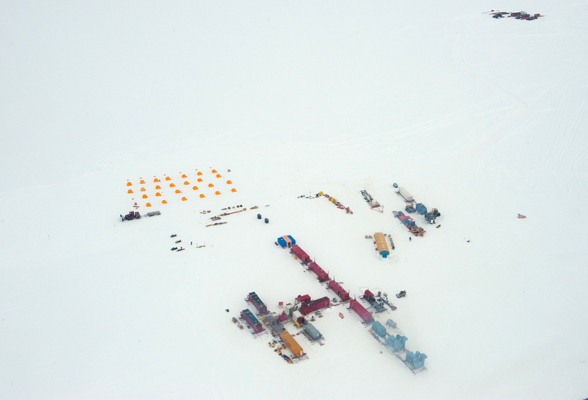
At 6:20am on January 28, four people in sterile white Tyvek suits tended to a wench winding cable onto the drill platform. One person knocked frost off the cable as it emerged from the ice borehole a few feet below. The object of their attention finally rose into sight: a gray plastic vessel, as long as a baseball bat, filled with water from Lake Whillans, half a mile below.

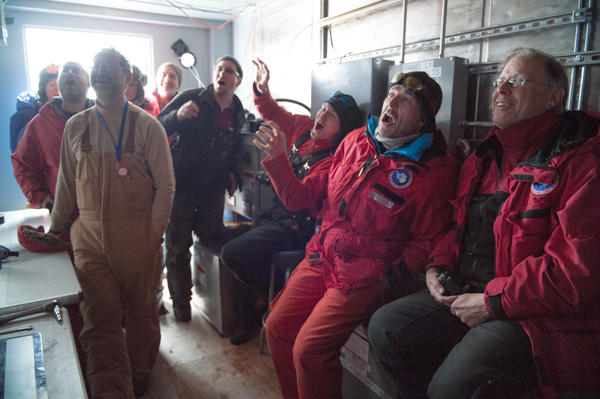
The bottle was hurried into a 40-foot cargo container outfitted as a laboratory on skis. Some of the lake water was squirted into bottles of media in order to grow whatever microbes might inhabit the lake. Those cultures could require weeks to produce results. But one test has already produced an interesting preliminary finding. When lake water was viewed under a microscope, cells were seen: their tiny bodies glowed green in response to DNA-sensitive dye. It was the first evidence of life in an Antarctic subglacial lake.

(A Russian team has reported that two types of bacteria were found in water from subglacial Lake Vostok, but DNA sequences matched those of bacteria that are known to live inside kerosene—causing the scientists to conclude that those bacteria came from kerosene drilling fluid used to bore the hole, and not from Lake Vostok itself.)

In order to conclusively demonstrate that Lake Whillans harbors life, the researchers will need to complete more time-consuming experiments showing that the cells actually grow—since dead cells can sometimes show up under a microscope with DNA-sensitive staining. And weeks or months will pass before it is known whether these cells represent known types of microbes, or something never seen before. But a couple of things seem likely. Most of those microbes probably subsist by chewing on rocks. And despite being sealed beneath 2,600 feet of ice, they probably have a steady supply of oxygen.

The oxygen comes from water melting off the base of the ice sheet—maybe a few penny thicknesses of ice per year. “When you melt ice, you’re liberating the air bubbles [trapped in that ice],” says Mark Skidmore, a geomicrobiologist at Montana State University who is part of the Whillans drilling, or WISSARD, project. “That’s 20 percent oxygen,” he says. “It’s being supplied to the bed of the glacier.”

In one possible scenario, lake bacteria could live on commonly occurring pyrite minerals that contain iron and sulfur. The bacteria would obtain energy by using oxygen to essentially “burn” that iron and sulfur (analogous to the way that animals use oxygen to slowly burn sugars and fats). Small amounts of sulfuric acid would seep out as a byproduct; that acid would attack other minerals in the sands and sediments of the lake—leaching out sodium, potassium, calcium, and other materials that would accumulate in the water.

This process, called weathering, breaks down billions of tons of minerals across the Earth’s surface each year. Researchers working on the National Science Foundation-funded WISSARD project hope to learn whether something like this also happens under the massive ice sheets covering Antarctica and Greenland. They’ve already seen one tantalizing sign.

The half mile of glacial ice sitting atop Lake Whillans is quite pure—derived from snow that fell onto Antarctica thousands of years ago. It contains only one-hundredth the level of dissolved minerals that are seen in a clear mountain creek, or in tap water from a typical city. But a sensor lowered down the borehole this week showed that dissolved minerals were far more abundant in the lake itself. “The fact that we see high concentrations is suggestive that there’s some interesting water-rock-microbe interaction that’s going on,” says Andrew Mitchell, a microbial geochemist from Aberystwyth University in the UK who is working this month at Lake Whillans.

Microbes, in other words, might well be munching on minerals under the ice sheet. The Whillans team will take months or years to unravel this picture. They will perform experiments to see whether microbes taken from the lake metabolize iron, sulfur, or other components of minerals. And they will analyze the DNA of those microbes to see whether they’re related to rock-chewing bacteria that are already known to science.

Antarctica isn’t the only place in the solar system where water sits concealed in the dark beneath thick ice. Europa and Enceladus (moons of Jupiter and Saturn, respectively) are also thought to harbor oceans of liquid water. What is learned at Lake Whillans could shed light on how best to look for life in these other places.

http://blogs.discovermagazine.com/crux/2013/01/29/first-evidence-of-life-in-antarctic-subglacial-lake/

Thanks to Kebmodee for bringing this to the attention of the It’s Interesting community.

DNA pioneer James Watson takes aim at “cancer establishments”

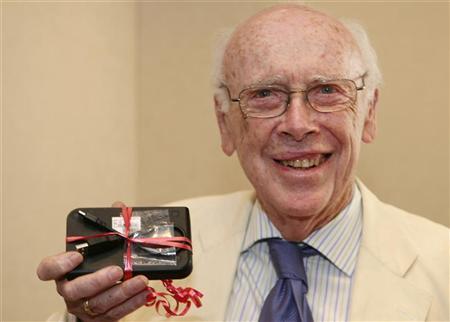
File photo of Watson receiving data encompassing his personal genome sequence in Houston

James Watson, co-discoverer of the double helix structure of DNA, lit into targets large and small. On government officials who oversee cancer research, he wrote in a paper published on Tuesday in the journal Open Biology, “We now have no general of influence, much less power … leading our country’s War on Cancer.”

On the $100 million U.S. project to determine the DNA changes that drive nine forms of cancer: It is “not likely to produce the truly breakthrough drugs that we now so desperately need,” Watson argued. On the idea that antioxidants such as those in colorful berries fight cancer: “The time has come to seriously ask whether antioxidant use much more likely causes than prevents cancer.”

That Watson’s impassioned plea came on the heels of the annual cancer report was coincidental. He worked on the paper for months, and it represents the culmination of decades of thinking about the subject. Watson, 84, taught a course on cancer at Harvard University in 1959, three years before he shared the Nobel Prize in medicine for his role in discovering the double helix, which opened the door to understanding the role of genetics in disease.

Other cancer luminaries gave Watson’s paper mixed reviews.

“There are a lot of interesting ideas in it, some of them sustainable by existing evidence, others that simply conflict with well-documented findings,” said one eminent cancer biologist who asked not to be identified so as not to offend Watson. “As is often the case, he’s stirring the pot, most likely in a very productive way.”

There is wide agreement, however, that current approaches are not yielding the progress they promised. Much of the decline in cancer mortality in the United States, for instance, reflects the fact that fewer people are smoking, not the benefits of clever new therapies.

“The great hope of the modern targeted approach was that with DNA sequencing we would be able to find what specific genes, when mutated, caused each cancer,” said molecular biologist Mark Ptashne of Memorial Sloan-Kettering Cancer Center in New York. The next step was to design a drug to block the runaway proliferation the mutation caused.

But almost none of the resulting treatments cures cancer. “These new therapies work for just a few months,” Watson told Reuters in a rare interview. “And we have nothing for major cancers such as the lung, colon and breast that have become metastatic.”

The main reason drugs that target genetic glitches are not cures is that cancer cells have a work-around. If one biochemical pathway to growth and proliferation is blocked by a drug such as AstraZeneca’s Iressa or Genentech’s Tarceva for non-small-cell lung cancer, said cancer biologist Robert Weinberg of MIT, the cancer cells activate a different, equally effective pathway.

That is why Watson advocates a different approach: targeting features that all cancer cells, especially those in metastatic cancers, have in common.

One such commonality is oxygen radicals. Those forms of oxygen rip apart other components of cells, such as DNA. That is why antioxidants, which have become near-ubiquitous additives in grocery foods from snack bars to soda, are thought to be healthful: they mop up damaging oxygen radicals.

That simple picture becomes more complicated, however, once cancer is present. Radiation therapy and many chemotherapies kill cancer cells by generating oxygen radicals, which trigger cell suicide. If a cancer patient is binging on berries and other antioxidants, it can actually keep therapies from working, Watson proposed.

“Everyone thought antioxidants were great,” he said. “But I’m saying they can prevent us from killing cancer cells.”

Research backs him up. A number of studies have shown that taking antioxidants such as vitamin E do not reduce the risk of cancer but can actually increase it, and can even shorten life. But drugs that block antioxidants – “anti-antioxidants” – might make even existing cancer drugs more effective.

Anything that keeps cancer cells full of oxygen radicals “is likely an important component of any effective treatment,” said cancer biologist Robert Benezra of Sloan-Kettering.

Watson’s anti-antioxidant stance includes one historical irony. The first high-profile proponent of eating lots of antioxidants (specifically, vitamin C) was biochemist Linus Pauling, who died in 1994 at age 93. Watson and his lab mate, Francis Crick, famously beat Pauling to the discovery of the double helix in 1953.

One elusive but promising target, Watson said, is a protein in cells called Myc. It controls more than 1,000 other molecules inside cells, including many involved in cancer. Studies suggest that turning off Myc causes cancer cells to self-destruct in a process called apoptosis.

“The notion that targeting Myc will cure cancer has been around for a long time,” said cancer biologist Hans-Guido Wendel of Sloan-Kettering. “Blocking production of Myc is an interesting line of investigation. I think there’s promise in that.”

Targeting Myc, however, has been a backwater of drug development. “Personalized medicine” that targets a patient’s specific cancer-causing mutation attracts the lion’s share of research dollars.

“The biggest obstacle” to a true war against cancer, Watson wrote, may be “the inherently conservative nature of today’s cancer research establishments.” As long as that’s so, “curing cancer will always be 10 or 20 years away.”

http://www.reuters.com/article/2013/01/09/us-usa-cancer-watson-idUSBRE90805N20130109

Dutch 737 pilot locked out of cockpit while co-pilot sleeps

plane

Dutch airline Transavia said it has launched an investigation after a Boeing 737 pilot was locked out of the cockpit and his first officer was later found asleep at the controls.

The incident took place in September, when the airliner was en route from Greece to the Netherlands, a top Dutch safety investigation agency said. The 737 landed safely in Amsterdam as scheduled, the airline said Wednesday.

According to a Dutch Safety Board report released Wednesday, the pilot stepped out of the cockpit to take a bathroom break about 2½ hours into the flight.

When he returned a short time later, the pilot used an intercom to ask his first officer to open the door. There was no answer, the report said.

Eventually, the pilot alerted the crew and was able to open the door himself. That’s when he found the first officer asleep, according to the report.

“It’s a serious incident,” said Wim van der Weegen of the Dutch Safety Board, “What makes it serious is the combination of the pilot being unable to access the cockpit and the first officer being asleep.

“By ‘serious incident,’ I mean the flight was in danger,” he said.

The Dutch Safety Board will decide whether to open its own inquiry when the airline’s investigation is finished, van der Weegen said.

Laws regarding pilot breaks during flights vary from country to country. For U.S. carriers, sleeping while at the controls is a violation of FAA regulations. Flights longer than eight hours require a relief pilot on board to take over when pilots sleep.

U.S. airlines also require a flight attendant to be in the cockpit when the pilot or first officer take bathroom breaks, in case the person flying the aircraft becomes incapacitated.

Oldest known portrait in the world discovered from the Ice Age

Ice Age art: The oldest known portrait of a woman

The oldest known portrait of a woman, sculpted from mammoth ivory during the last ice age around 26,000 years ago. Photograph: Graeme Robertson for the Guardian

It’s smaller than your thumb: a little piece of mammoth ivory delicately carved into the shape of a woman’s head. But this miniature sculpture, with one wonky eye and rather elongated, slightly Modigliani-esque proportions, is the oldest known portrait in the world, and is about to go on show to the public for the first time in Britain in a new exhibition at the British Museum, Ice Age Art: Arrival of the Modern Mind.

Some 26,000 years ago, in a valley teeming with game in what is now Moravia, a man or woman carved this little head with skill and not a little persistence, using stone tools to smooth away the recalcitrant, hard ivory.

According to the British Museum’s curator Jill Cook, “The reason we say it is a portrait is because she has absolutely individual characteristics. She has one beautifully engraved eye; on the other, the lid comes over and there’s just a slit. Perhaps she had a stroke, or a palsy, or was injured in some way. In any case, she had a dodgy eye. And she has a little dimple in her chin: this is an image of a real, living woman.”

The exhibition will show that the first figurative art was created in Europe in the shadow of the Ice Age – and that the people making it were capable not only of highly naturalistic images but also of abstract representation. Everything, argues Cook, that we think of as art was already present in the culture of these early people.

“Most people looking at art are looking at the five minutes to midnight – the art of the last 500 years,” she says. “We have been used to separating work like this off by that horrible word ‘prehistory’. It’s a word that tends to bring the shutters down, but this is the deep history of us.”

The works even suggest a nascent art world, she argues – professionals occupying a particular place in society, entrusted with the work of creating art. “Some of the things we have from digs are a bit rubbish; some of them almost look like apprentice pieces. But the best things are masterpieces and would have taken hundreds of hours to produce.”

In one Pyrenean cave, where a number of delicate carvings of horses’ heads were found – boldly likened by Cook to the equine sculptures on the Parthenon frieze – was an area where carvings had clearly been produced over a period of time, like an “atelier”, said Cook. The skill and time required to make the works suggest that “this was a society that valued their producers”.

In fact, Cook is convinced that the urge to make art – including the earlier abstract work made by Homo sapiens in Africa, before the species made its way to Europe – is as old as the frontal cortex itself. “This work is where the executive brain comes from: the ability to think ahead, to collaborate, to compromise, to regulate ourselves,” said Cook.

The profound need for objects that had no practical function, but seem to have been created purely to delight, to entrance, or to inspire awe or reverence, is aptly demonstrated by a small clay sculpture of a woman. She has drooping breasts, a paunchy stomach and, endearingly, carefully incised fat folds, or love handles, on her back. “Gravity is taking over,” said Cook. “I have some sympathy.” This object, between 31,000 and 27,000 years old, is the oldest known object made from clay – not a pot or a vessel, but a sculpture.

The woman’s portrait head from Moravia was excavated in the 1920s in Dolní Věstonice, a valley frequented in the Ice Age by mammoth and reindeer and other huntable beasts travelling between the Polish plains and the Danube valley. A headline in the Illustrated London News called the excavation the “The Stone-age Pompeii” because of the wealth of objects discovered there. But, according to Cook, “in the wake of the second world war and the Iron Curtain people in western Europe almost forgot about the finds.”

The head and other artefacts are a rare loan from the Moravian Museum in Brno – their arrival on British shores having been delayed, as it happens, by the ice and snow at the weekend.

Other artefacts – such as a 32,000-year-old lion-headed man from Hohlenstein-Stadel in Germany, carved with consummate skill from a mammoth tusk – suggest that Ice Age artists were capable of imaginative works. Such fantasies may hint at the existence of myth or story.

At the opposite extreme is what Cook calls a “hyper-real” landscape picture of deer pausing at a stream, scratched into bone about 14,000 years ago. “The artist has carefully chosen the right piece of bone, and prepared the surface, which suggests a preconceived plan,” said Cook. “The figures of the deer occupy just the right amount of space to give you a sense of perspective. The texture and colour of the deer’s coat have been carefully depicted, even its white bottom. These are exactly the considerations that a modern artist would make. The key concepts of drawing are all there.”

http://www.guardian.co.uk/science/2013/jan/24/ice-age-art-british-museum?utm_source=feedburner&utm_medium=feed&utm_campaign=Feed%3A+C2C-InTheNews+%28Feed+-+Coast+to+Coast+-+In+the+News%29

Men Undergo Simulated Labor Pains For Dutch TV Show


Not content with merely sympathising with women in labour, two male Dutch TV hosts have experienced the agony for themselves.

Dennis Storm and Valerio Zeno allowed nurses to strap electrode emitting machines to their abdomens for their show Guinea Pigs, aired earlier this week.

The shocks cause stomach cramps which simulate the excruciating contractions felt during childbirth.

“Do you think the pain will make us scream,” Zeno asked one of the nurses before the shocks began.

“Yes, it definitely will,” the nurse replied.

Sure enough, the pair were soon groaning and screaming and curling up into the fetal position from the pain.

Storm and Zeno endured two hours of the shocks before calling it a day and comparing the experience to torture.

This isn’t the first time a man has “gone into labour’ for the sake of a TV show.

In 2009, Dr Andrew Rochford put himself through a similarly agonising process for the Nine Network’s What’s Good For You.

http://news.ninemsn.com.au/entertainment/2013/01/19/15/02/male-tv-hosts-experience-agony-of-labour

British scientist claims to have disovered alien life inside meteorite that crash-landed in Sri Lanka

Chandra-Wickramasinghe

A top British scientist has claimed that he has found proof of extraterrestrial life after he discovered tiny fossils of algae, similar to the kind found in seaweed, in a meteorite fragment that crash landed in central Sri Lanka in December.

Professor Chandra Wickramasinghe believes it proves we are not alone in the universe.

The finding provides strong evidence that human life started outside Earth, he stated.

The two-inch wide rock was one of several fragments of a meteorite that fell to earth in a spectacular fireball. They were still smoking when villagers living near the city of Polonnaruwa picked them up.

The fossils were discovered when the rocks were examined under a powerful scanning electron microscope in a British laboratory.

They are similar to micro-organisms found in fossils from the dinosaur age 55 million years ago.

Though critics argued that the rock had probably become contaminated with algae fossils from Earth, Prof Wickramasinghe insisted that they are the remnants of extra-terrestrial life.

He noted that the algae organisms are similar to ones found in Earth fossils and that the rock also has other organisms they have not yet identified.

http://www.phenomenica.com/2013/01/alien-life-found-in-meteorite-that-crash-landed-in-sri-lanka.html

Economic crisis in Greece has lowered their air pollution

greece

EVEN the darkest cloud may have a silver lining. The sharp drop in air pollution that accompanied Greece’s economic crisis could be a boon to the nation’s health.

Mihalis Vrekoussis of the Cyprus Institute in Nicosia and colleagues used three satellites and a network of ground-based instruments to measure air pollution over Greece between 2007 and 2011. Levels of nitrogen dioxide fell over the whole country, with a particularly steep drop of 30 to 40 per cent over Athens. Nitrogen monoxide, carbon monoxide and sulphur dioxide also fell (Geophysical Research Letters, DOI: 10.1002/grl.50118).

Pollution levels have been falling since 2002, but the rate accelerated after 2008 by a factor of 3.5, says Vrekoussis. He found that the drop in pollution correlated with a decline in oil consumption, industrial activity and the size of the economy. “This suggests that the additional reported reduction in gas pollutant levels is due to the economic recession,” he says.

In Athens, a combination of heavy car use and lots of sunshine have created serious health problems, so city dwellers should see real benefits. Sunlight triggers chemical reactions that make the car exhaust pollution more harmful, for instance by forming small particulates that cause respiratory diseases. “Hospital admissions for asthma should decline,” says Dwayne Heard of the University of Leeds in the UK.

It’s not all good news: despite the drop in pollutants, levels of ground-level ozone – another cause of respiratory disease – have risen. Ozone would normally be suppressed by nitrogen oxides, but those have declined. That will take the edge off the benefit, says Heard.

Greece isn’t the only country where air pollution has dropped. Nitrogen oxide levels fell across Europe after the 2008 financial crisis (Scientific Reports, doi.org/j74). In the US, nitrogen dioxide levels fell between 2005 and 2011, with the sharpest fall at the height of the recession (Atmospheric Chemistry and Physics, doi.org/j75).

Such declines can be one-offs, or governments can help make them permanent, says Ronald Cohen of the University of California, Berkeley, who led the US study. “A time of crisis is a real opportunity to initiate change.” After the 2008 financial downturn, for instance, the US and Europe committed to pollution cuts. “In 10 years, there will be an end to air pollution in the US and Europe,” says Cohen. “It’s an incredible success story.”

Greece, however, is not seizing the current opportunity, says Vrekoussis. “Investments in clean technologies and low-carbon green strategies have been abandoned,” he says. “I’m afraid that in the long run the negative effects will override the positives.”

Global greenhouse gas emissions initially fell in the wake of the financial crisis, but not by much. Emerging economies like China and India continued their economic growth, so a small emissions drop in 2009 was followed by a huge rise in 2010 which continued in 2011.

http://www.newscientist.com/article/mg21729014.300-greek-economic-crisis-has-cleared-the-air.html?cmpid=RSS|NSNS|2012-GLOBAL|online-news