Two billion planets in our galaxy may be suitable for life

Artist's impression of planets discovered by Kepler spacecraft

Our galaxy probably contains at least two billion planets that, like Earth, have liquid water on their surfaces and orbit around their parent stars in the “habitable zone” for life. The nearest, according to astronomers, could be a mere 12 light years away.

A new study, published on Monday in the Proceedings of the National Academy of Sciences, suggests that Earth-like planets capable of supporting life are far more common than previously thought. Using measurements from Nasa’s Kepler space observatory, scientists led by Erik Petigura at the University of California, Berkeley, estimated that 22% of our galaxy’s sun-like stars have rocky planets circling them in the zone where they get roughly the same amount of light energy as Earth receives from the sun. There are around 100bn stars in our galaxy, of which 10% are like the sun.

So far Kepler has studied more than 150,000 stars and identified more than 3,000 candidate planets, but many of these are “gas giants”, similar to Jupiter, that orbit close to their parent stars. If there is life out there, it is far more likely to have evolved on rocky planets with liquid water on their surfaces, similar to Earth.

To get their results, Petigura’s team looked for planets in Kepler data that had a radius up to double that of Earth. They searched for planets that orbited far enough from their star that liquid water would not evaporate, but not so far that the water would all freeze.

Subhanjoy Mohanty, an astrophysicist at Imperial College London who was not involved with the study, said: “This is the first estimate of the frequency of Earth-like planets around sun-like stars, in orbits large enough to lie in the habitable zone of their stars. The finding that roughly one in five sun-like stars may host such planets is an incredibly important one, probably exceeding the expectations of most cautious astronomers.”

He added that the latest analysis increased the chances that there might be life somewhere among the stars. “Previous analyses of Kepler data had shown that red dwarfs – the most common type of star in the galaxy, making up about 80% of the stellar population – very frequently harbour Earth-size planets, including in their habitable zones. This new study shows that the same is true around stars more like our own sun. This is certainly an added impetus for planned future missions which will study the atmospheres of these potentially habitable planets, enabling us to investigate whether they are in fact habitable or not, and also whether their atmospheres show actual biosignatures of existing life.”

Nasa also announced on Monday that the Kepler probe would be given a new lease of life, following fears that it would have to end its mission after only four years in space. In May 2013, scientists discovered that one of the gyroscopic wheels – known as “reaction wheels” – that kept the probe pointing in the right direction had stopped working and, try as they might, Nasa engineers could not restart it. Unable to point itself at the stars with any accuracy, the probe could no longer be used to collect data about the position of new exoplanets.

But it looks as though there could be a solution that involves reorienting the probe to look along the plane of the galaxy, which will allow it to remain stable with only two of its reaction wheels working. “The old saying ‘necessity is the mother of invention’ has rung true here, with engineers and scientists from Nasa and the spacecraft manufacturers having figured out this way to – we hope – recover much of the performance we thought we had lost. We are very excited,” said Bill Chaplin, an astrophysicist at the University of Birmingham in the UK.

If all goes well, the new Kepler mission – dubbed “K2” – will look for planets around smaller stars than the sun, and will also study the stars themselves. “There are a wealth of fantastically interesting targets for astrophysics that can be observed in the ecliptic plane, which were not accessible in the original Kepler field, notably brighter clusters of stars – where the common origins and distances to these stars make the clusters excellent laboratories for testing our understanding of stars – and young, star-forming regions,” said Chaplin.

http://www.theguardian.com/science/2013/nov/04/planets-galaxy-life-kepler

Thanks to Kebmodee for bringing this to the attention of the It’s Interesting community.

Japanese inventions signal the future changes in human relationships

art-coat-200x0

A Guardian article about Japanese young people no longer being interested in sex and relationships has generated a lot of blogosphere criticism recently, primarily about Western media exoticising “weird” Japanese culture. Those criticisms duly noted, there have also been some recent Japanese innovations that seem to not only support the premise of the article – that technology is taking over the space once occupied by sex and dating – but take it further. Several recent inventions in Japan seem not only likely to disrupt traditional relationships in the way that social media or text messaging has, but to physically replace companionship and affection. A report this week of the physiological benefits of using the Hugvie, a soft doll that simulates a human heartbeat so that the user can “cuddle” with the person on the other end of their phone, is one such case.

Here are some Japanese inventions, like the Hugvie, that may be the most solid proof that Japan is indeed throwing out the idea of relationships and becoming a dystopian future of human loneliness.

The Hugvie is a soft body-fitting pillow with a slot in the head for a smart phone. Users can cuddle with the pillow while talking on the phone, and the pillow’s internal vibrators generate a simulated heartbeat of the caller based on the voice’s tone and volume. In other words, the soft, “blobular” doll transforms a standard phone conversation into a “cuddling” experience with your phone companion. The gizmo was invented by an Osaka University professor who built off of an earlier remote-controlled doll.

A video from the product’s launch last year shows users talking into the phone end and cradling their pillows, and new evidence suggests that the pillow might be as satisfying and soul-warming as the video portrays: a joint study from the University of Sussex and Osaka University that levels of the stress hormone cortisol were reduced in people after using the pillow.

Wine for cats
Earlier this month, a Japanese company took the age-old stereotype of the lonely cat woman and made it a little less lonely with the invention of Nyan Nyan Nouveau, a non-alcoholic feline wine. Masahito Tsurimi, the chief executive of the company behind the wine, told the Wall Street Journal that it was invented in response to requests from cat-owners – despite the fact that only one in 10 cats were willing to taste it.

Tsurimi said he saw a bright future in the “specialty pet-drink business” six years ago when he was worried about where future beverage sales would come from with a shrinking, ageing Japanese population. It was probably just a nice bonus when he read about the country’s sexual aversion and social awkwardness on top of that.

The girlfriend coat
In April of this year, RocketNews 24 reported that a group of engineering students at Tsukuba University created a coat that could hug its wearer and whisper phrases into its ear. Meant to simulate a girlfriend, motors in the coat operate the “arms” that squeeze the wearer when he puts it on. In a pair of headphones he slips on with the coat, he also hears one of a number of programmed phrases: “I’m sorry, were you waiting?” and “Guess who?”

The university students named it the Riajyuu Coat. According to gaming site Kotaku, riajyuu is a mash-up Japanese word that means someone who is pleased with his non-virtual life. Unlike some of the other replacements for human contact, this one appears to have just been a joke between friends, and the inventors have no real plans to release it commercially.

Video game relationships
Japan has cultivated a global reputation for their romantic simulation video games, and for good reason: while some of the games are just bizarre, like a game in which both the player and his mate are pigeons, others mimic relationships down to eerily small details. LovePlus, for instance, a dating simulation game released in Japan in 2009, invites players to choose one girl that they prefer out of three types – a “goodie-goodie”, “sassy”, or “big-sister” type – and then earn “boyfriend power” points by going to the gym or doing homework to become smarter. The girl can get mad at their boyfriends, too: in a 2010 article, LovePlus gamer Shunsuke Kato told the Wall Street Journal he was on the outs with his LovePlus “girlfriend” for being busy at work and only playing the game for 10 minutes a day.

The game has blurred the line between real and virtual to such an extent that a Japanese resort town once known for honeymooning, Atami, launched a promotional campaign in 2010 that relied on recreating the virtual trip to Atami from the game. At Atami’s (real) Hotel Ohnoya, the staff was trained to check in single men as couples, and restaurants created Love Plus-inspired menus for the gaming guests.

If there’s some silver lining to be found in all of this, it’s that a business opportunity will be there to pad the landing when humans do something self-destructive. As Japan has demonstrated, the risk of a plummeting birth rate and the social instability inherent in becoming a society where unmarried people exist in large numbers at least opens up the possibility for bizarre romance-gamer tourism, wine for cats and pillows you can cuddle with.

http://m.smh.com.au/digital-life/digital-life-news/bizarre-japanese-inventions-signal-the-future-of-human-loneliness-20131104-2ww7d.html

Thanks to Kebmodee for bringing this to the attention of the It’s Interesting community.

Mom Lets Son Wear KKK Halloween Costume, Says It’s A Family Tradition

o-KKK-COSTUME-570

A Virginia mother let her 7-year-old son wear a Ku Klux Klan costume this Halloween because, she insisted, it’s a family tradition.

Jessica Black of Craigsville, Va., let her son, Jackson, dress as a Klansman with a floor-length white robe and full-faced white hood, according to local ABC affiliate WHSV. The outfit garnered media attention after a photo of the boy dressed in the KKK regalia was posted to the WHSV Facebook page. When Black was confronted by the news network, she defended her decision.

“My brother has [worn it] when he was in Kindergarten and when he was 13,” Black said. She went on to claim there is nothing wrong with the costume or with the White Supremacist group, which she says still exists in their Virginia town. “It’s supposed to be white with white, black with black, man with woman and all of that. That’s what the KKK stands for.”

Facebook users were not happy about the attire.

“A mini kkk costume??? In our area??? Sounds like something we should ALL be concerned about. #noroomforacistsonthisplanet,” one respondent wrote on the WHSV Facebook page. Another defended the child on the station’s “Daybreak” Facebook page, saying he probably thought it was a ghost costume.

Some users were angry that the town was being criticized for the act of one individual, but others criticized these people for missing the larger point.

“The fact of the matter is that this event could have happened anywhere in the US and you all being more outraged that your town has a bad name than the actual issue at hand is extremely disappointing,” wrote one woman. “A few of you have missed the point completely. Just because we are in a new century does not mean that racism is a thing of the past. Racism is alive and well and if you opened your eyes, you’d see it clearly.”

It’s been quite the Halloween season for offensive costumes. First there was actress Julianne’s Hough’s major mistake of going out in blackface to portray “Orange Is the New Black” character Crazy Eyes. Then, two men thought it would be funny to go out as Trayvon Martin (in blackface) and George Zimmerman. And the latest adult to face backlash on Twitter is the young woman who decided to dress up as a Boston bombing victim.

http://www.huffingtonpost.com/2013/11/04/mom-son-kkk-halloween-costume_n_4212461.html

Top climate scientists ask environmentalists to support nuclear power in climate battle

Some of the world’s top climate scientists say wind and solar energy won’t be enough to head off extreme global warming, and they’re asking environmentalists to support the development of safer nuclear power as one way to cut fossil fuel pollution.

Four scientists who have played a key role in alerting the public to the dangers of climate change sent letters Sunday to leading environmental groups and politicians around the world. The letter, an advance copy of which was given to The Associated Press, urges a crucial discussion on the role of nuclear power in fighting climate change.

Environmentalists agree that global warming is a threat to ecosystems and humans, but many oppose nuclear power and believe that new forms of renewable energy will be able to power the world within the next few decades.

That isn’t realistic, the letter said.

“Those energy sources cannot scale up fast enough” to deliver the amount of cheap and reliable power the world needs, and “with the planet warming and carbon dioxide emissions rising faster than ever, we cannot afford to turn away from any technology” that has the potential to reduce greenhouse gases.

The letter signers are James Hansen, a former top NASA scientist; Ken Caldeira, of the Carnegie Institution; Kerry Emanuel, of the Massachusetts Institute of Technology; and Tom Wigley, of the University of Adelaide in Australia.

Hansen began publishing research on the threat of global warming more than 30 years ago, and his testimony before Congress in 1988 helped launch a mainstream discussion. Last February he was arrested in front of the White House at a climate protest that included the head of the Sierra Club and other activists. Caldeira was a contributor to reports from the Intergovernmental Panel on Climate Change, Emanuel is known for his research on possible links between climate change and hurricanes, and Wigley has also been doing climate research for more than 30 years.

Emanuel said the signers aren’t opposed to renewable energy sources but want environmentalists to understand that “realistically, they cannot on their own solve the world’s energy problems.”

The vast majority of climate scientists say they’re now virtually certain that pollution from fossil fuels has increased global temperatures over the last 60 years. They say emissions need to be sharply reduced to prevent more extreme damage in the future.

In 2011 worldwide carbon dioxide emissions jumped 3 per cent, because of a large increase by China, the No. 1 carbon polluting country. The U.S. is No. 2 in carbon emissions.

Hansen, who’s now at Columbia University, said it’s not enough for environmentalists to simply oppose fossil fuels and promote renewable energy.

“They’re cheating themselves if they keep believing this fiction that all we need” is renewable energy such as wind and solar, Hansen told the AP.

The joint letter says, “The time has come for those who take the threat of global warming seriously to embrace the development and deployment of safer nuclear power systems” as part of efforts to build a new global energy supply.

Stephen Ansolabehere, a Harvard professor who studies energy issues, said nuclear power is “very divisive” within the environmental movement. But he added that the letter could help educate the public about the difficult choices that climate change presents.

One major environmental advocacy organization, the Natural Resources Defence Council, warned that “nuclear power is no panacea for our climate woes.”

Risk of catastrophe is only one drawback of nuclear power, NRDC President Frances Beinecke said in a statement. Waste storage and security of nuclear material are also important issues, he said.

“The better path is to clean up our power plants and invest in efficiency and renewable energy.”

The scientists acknowledge that there are risks to using nuclear power, but say those are far smaller than the risk posed by extreme climate change.

“We understand that today’s nuclear plants are far from perfect.”

http://www.ottawacitizen.com/technology/climate+scientists+environmentalists+support+nuclear+power/9118639/story.html

Atlanta man shatters coast-to-coast ‘Cannonball Run’ speed record

cannonball run

Before the transcontinental race in “Cannonball Run,” the starter tells the gathered racers, “You all are certainly the most distinguished group of highway scofflaws and degenerates ever gathered together in one place.”

Ed Bolian prefers the term “fraternity of lunatics.”

Where the 1981 Burt Reynolds classic was a comedic twist on a race inspired by real-life rebellion over the mandated 55-mph speed limits of the 1970s, Bolian set out on a serious mission to beat the record for driving from New York to Los Angeles.

The mark? Alex Roy and David Maher’s cross-country record of 31 hours and 4 minutes, which they set in a modified BMW M5 in 2006.

Bolian, a 28-year-old Atlanta native, had long dreamed of racing from East Coast to West. A decade ago, for a high school assignment, Bolian interviewed Brock Yates, who conceived the Cannonball Baker Sea-To-Shining-Sea Memorial Trophy Dash, aka the Cannonball Run.

Yates, who played the previously quoted organizer in the film he wrote himself, won the first Cannonball in the early 1970s with a time of 35 hours and 53 minutes.

“I told him, ‘One day I’d like to beat your record,’ ” Bolian recalled.

It sounds like great outlaw fun — and certainly, Hollywood added its embellishments, like the supremely confident, infidel-cursing sheik with a Rolls Royce and Sammy Davis Jr. in a priest getup — but Bolian said it took considerable research and groundwork.

Beginning in 2009, about the time he started working for Lamborghini Atlanta, Bolian researched cars, routes, moon phases, traffic patterns, equipment, gas mileage and modifications.

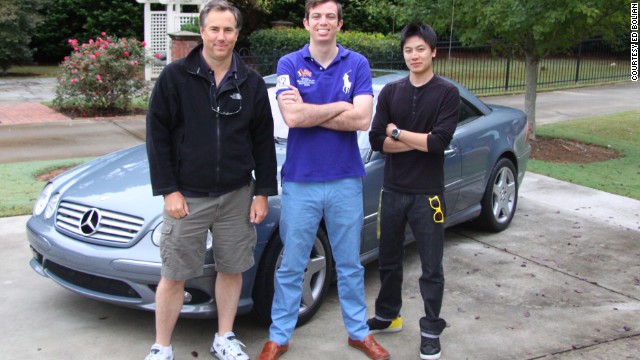
He went into preparation mode about 18 months ago and chose a Mercedes CL55 AMG with 115,000 miles for the journey. The Benz’s gas tank was only 23 gallons, so he added two 22-gallon tanks in the trunk, upping his range to about 800 miles. The spare tire had to go in the backseat with his spotter, Dan Huang, a student at Georgia Tech, Bolian’s alma mater.

To foil the police, he installed a switch to kill the rear lights and bought two laser jammers and three radar detectors. He commissioned a radar jammer, but it wasn’t finished in time for the trek. There was also a police scanner, two GPS units and various chargers for smartphones and tablets — not to mention snacks, iced coffee and a bedpan.

By the time he tricked out the Benz, which included a $9,000 tuneup, “it was a real space station of a thing,” he said, describing the lights and screens strewn through the car’s cockpit.

Yet he still wasn’t done.

“The hardest thing, quite honestly, was finding people crazy enough to do it with me,” he said.

Co-driver Dave Black, one of the Atlanta Lamborghini dealership’s customers, didn’t sign on until three days before they left, and “support passenger” Huang didn’t get involved until about 18 hours before the team left Atlanta for Manhattan.

If his difficulty finding a copilot wasn’t an omen, Manhattan would deliver one. While scouting routes out of the city, a GPS unit told Bolian to take a right on red, in the wrong direction down a one-way road. He was quickly pulled over.

Bolian got a warning — and a healthy dose of relief that the officer didn’t question the thick odor of fuel as he stood over the vents pumping fumes from the trunk.

The trio ignored what some might have considered a harbinger and the left the Red Ball Garage on East 31st Street, the starting point for Yates’ Cannonball, a few hours later. To be exact, they left October 19 at 9:55 p.m., according to a tracking company whose officials asked not be identified because they were unaware that Bolian would be driving so illegally when he hired them.

They hit a patch of traffic in New York that held them up for 15 minutes but soon had an average speed of about 90 mph. In Pennsylvania, they tapped the first of many scouts, one of Bolian’s acquaintances who drove the speed limit 150 to 200 miles ahead of the CL55 and warned them of any police, construction or other problems.

They blew through Ohio, Indiana and Illinois, hitting St. Louis before dawn.

“Everything possible went perfect,” Bolian said, explaining they never got lost and rarely encountered traffic or construction delays.

By the time they hit southern Missouri, near the Oklahoma border, they learned they were “on track to break the existing record if they averaged the speed limit for the rest of the trip,” he said.

Yeah, right. This wasn’t about doing speed limits.

They kept humming west, and as they neared the Texas-New Mexico border, they calculated they might beat the 30-hour mark, a sort of Holy Grail in transcontinental racing that Bolian likened to the 4-minute mile.

Not one to settle, “we decided to break 29,” Bolian said.

The unnamed tracking company says the Benz pulled into the Portofino Hotel and Marina in Redondo Beach, California, at 11:46 p.m. on October 20 after driving 2,803 miles. The total time: 28 hours, 50 minutes and about 30 seconds.

“Most of the time, we weren’t going insanely fast,” Bolian said, not realizing his definition of “insanely” is a little different from most folks’.

When they were moving, which, impressively, was all but 46 minutes of the trip, they were averaging around 100 mph. Their total average was 98 mph, and their top speed was 158 mph, according to an onboard tracking device.

“Apart from a FedEx truck not checking his mirrors before he tried to merge on top of me, we didn’t really have any issues,” Bolian said.

He concedes his endeavor was a dangerous one, especially when you consider Bolian slept only 40 minutes of the trip, and co-driver Black slept an hour. But Bolian went out of his way to make it as safe as possible, choosing a weekend day with clear weather and a full moon — and routes, when possible, with little traffic or construction.

“I had plenty of people at home praying I’d make it safely, and, more importantly, had my wife praying that I wouldn’t have to do it again,” he said, adding he has no children, which was also a factor. “That was one of the spurs to go ahead and get this over with. That’s probably the next adventure.”

Asked if the technological advances since the previous record holders made their run gave him an advantage, Bolian replied, “Absolutely.” Because two teams broke the 32-hour mark in 2006 and 2007, he had a detailed “guide book” on how to do it, where they had to rely on word-of-mouth tales from the 1980s.

“I thank Alex for that. We’re all adding chapters to the same story of American car culture,” Bolian said. Alex Roy did not respond to an e-mail seeking comment.

Bolian had hoped to revisit that high school interview and tell Yates he’d followed through on that promise to break his record, but Yates now suffers from Alzheimer’s.

“I’ll pay him a visit just for the sake of it,” Bolian said, “but I can’t tell him.”

Where the Cannonball scofflaws aimed to make a statement about personal freedom, Bolian said he has the utmost respect for law enforcement. His goal was merely to “add myself and pay tribute to this chapter of automotive history,” he said.

Bolian also hopes that he shattered Roy’s record by such a stark margin that it discourages would-be Cannonballers from attempting to break his record, and it’s not just a matter of his own legacy, he said.

“It really isn’t something we need a whole band of lunatics doing,” he said.

http://www.cnn.com/2013/10/31/us/new-york-los-angeles-cannonball-speed-record/index.html?hpt=hp_c2

Texas college turns its football field into an organic farm

texas1

Six years ago, Michael Sorrell made a decision that threatened his reputation and maybe his job. His tenure as president of Paul Quinn College started in 2007 and, shortly thereafter, he opted to cut football in an effort to save money. The response on campus was not pleasant.

“Predictably, we had folks who were, I guess, the reaction was loud,” Sorrell says.

This was in football-nuts Dallas, only seven miles from the heart of the city. Sorrell was not anti-sports, either. He played basketball and loved football. He just felt the sport was “something economically we could not justify.”

Sorrell made an offer to the angry defenders of the sport: Raise $2 million to save football, and he would match it. “To date,” Sorrell says, “no one has raised a dollar.”

College football is dealing with an emerging financial crisis. It’s plaguing programs as large as the University of Tennessee, which was a reported $200 million in debt over the summer, and as small as Grambling, which is begging alums for donations after poor facilities led to a player mutiny earlier this month. Escalating coaches’ salaries and declining attendance have led to real concern that the entire college football complex will become insolvent, leaving only a few schools with thriving programs.

“We are standing on the precipice of an economic day of reckoning in higher education,” Sorrell says. “I think there will be more schools to do this. I think we’re just early.”

Football was eating $600,000 of Sorrell’s budget, and Paul Quinn is a tiny school of only 250 students. How could he continue to educate when so much funding was going to something that wasn’t building an academic reputation? He simply couldn’t. So the field sat vacant.

Sorrell moved on to a much bigger issue: his school is located in a food desert with neither a restaurant nor a grocery store nearby, and many of the students at the oldest historically black college west of the Mississippi are poor. Eighty percent of the students at Paul Quinn are Pell Grant-eligible. There’s a “clothes closet” on campus where students can get business casualwear for free, and money had to be raised so students could afford eyeglasses to read.

A year after the end of football, Sorrell was meeting with a real estate investor named Trammell Crow. They bandied about the idea of devoting a tract of land to producing food for the community. But where?

Sorrell joked that they should just build a farm on the football field. The jest quickly turned into a reality, and the school’s future was changed for the better. Some of the produce grown in full view of the scoreboard would go to local food banks and the surrounding community. Some of it, eventually, could be sold. Crow helped fund the farm, and slowly crops began to yield produce: kale, sweet potatoes, herbs, cilantro. In 2009, two years removed from the end of Paul Quinn College’s football life, a rather famous client struck a deal with the school for its food: Cowboy’s Stadium.

Legends Hospitality is now Paul Quinn College’s largest buyer for the “WE over Me Farm,” and the school has run a surplus of six or seven figures in four of the past five years. The money budgeted for football now goes to academic scholarships. This is a school that had one month’s worth of cash when Sorrell took over in 2007.

A potential disaster has turned into one of the most inspired decisions made at the college level. It’s not like Paul Quinn is SMU – the NAIA school is smaller than a lot of Dallas high schools – but it shows life after football isn’t necessarily bleak.

“We turned our football field into an organic farm,” Sorrell says. “It’s made us a national leader on this issue. There are no regrets. We didn’t have the resources necessary to change and really build a football program in the way we wanted to do it. This is what was right for us.”

Students who work on the farm are paid $10 an hour for overseeing the project, which will produce 17,500 lbs. of food for Cowboys fans this season.

“I’m in love with what we’re doing with the field,” says Shon Griggs, Jr., a legal-studies major who played football at his Atlanta high school. “It’s exciting and I’ve learned so much. I’ve personally gotten more out of the farm than the football field.”

Griggs spends 12 hours a week on the farm, and he considers it “a workout” that has benefits beyond sports.

“When I played football, I was able to strengthen my body,” he says. “Here, we’re impacting community, changing lives, teaching kids, and learning about nature.”
Griggs says the only downside is the coyotes that come around at night and try to break into the chicken coop.

The goalposts are still up at Paul Quinn College, and so are the scoreboard and the ticket booth, but nobody misses the sport much anymore. The treasure everyone guards most is that farm. Asked what would happen if those two acres were razed again, Griggs doesn’t hesitate.

“We would have a problem,” he says. “There would be a revolt. This is big.”

It is big. Those who work on the farm not only have experience and some take-home pay, but a built-in connection to one of the most famous buildings in America. The director of food and beverage at Legends Hospitality at Cowboys Stadium is George Wasai, who went to Paul Quinn College. He played football there.

http://sports.yahoo.com/news/ncaaf–how-one-small-texas-college-made-money-by-saying-no-to-football-065751785.html

Thanks to Kebmodee for bringing this to the attention of the It’s Interesting community.
Vets: Dogs overdose on drug-user poop

dog

Vets in Berlin are warning about an increase in the number of pets falling ill and being unable to walk properly after eating the drug-users’ faeces in the city’s parks.

Parks in the Treptow and Kreuzburg areas of the capital see groups of drug users gathering – some of whom go to the toilet in the bushes. The results of which, the Tagesspiegel newspaper reported on Monday, are proving dangerous for dogs.

Vets told the newspaper that they had seen a rise in the number of dogs being brought in that had eaten human waste. Tests revealed that they had been poisoned by illegal drugs, like heroin, still present in the excrement.

Vet Reinhold Sassnau told the paper that symptoms include dehydration, shaking, an inability to walk properly and a rapid heartbeat. He sees a lot of these cases during his night shifts, he said.

If owners take their dog to a vet in time, the animal can be given an emetic which forces them to vomit up the faeces. If not, treatment can require staying in a clinic for some time to stabilize. Sassnau said fatal cases were rare.

One student, identified only as Malte, told the newspaper that he had to take his 10-year-old dog, Bob, to an emergency vet after walking him through Görlitzer Park, an area well-known for drug-dealing. “We thought he was going to die,” he said.

Jörn Bischof, the vet at the Charlottenburg clinic who treated Bob earlier in October, told the paper: “This is becoming more frequent.”

He added that although dogs are often tempted to eat waste they come across outdoors, owners should try to train them not to.

http://www.thelocal.de/society/20131021-52497.html

New research suggests that other universes may be pulling ours

universe

Is our universe merely one of billions? Evidence of the existence of ‘multiverse’ revealed for the first time by a cosmic map of background radiation data gathered by Planck telescope. The first ‘hard evidence’ that other universes exist has been claimed to have been found by cosmologists studying new Planck data released this past June. They have concluded that it shows anomalies that can only have been caused by the gravitational pull of other universes.

“Such ideas may sound wacky now, just like the Big Bang theory did three generations ago,” says George Efstathiou, professor of astrophysics at Cambridge University.”But then we got evidence and now it has changed the whole way we think about the universe.”

Scientists had predicted that it should be evenly distributed, but the map shows a stronger concentration in the south half of the sky and a ‘cold spot’ that cannot be explained by current understanding of physics. Laura Mersini-Houghton, theoretical physicist at the University of North Carolina at Chapel Hill, and Richard Holman, professor at Carnegie Mellon University, predicted that anomalies in radiation existed and were caused by the pull from other universes in 2005. Mersini-Houghton will be in Britain soon promoting this theory and, we expect, the hard evidence at the Hay Festival on May 31 and at Oxford on June 11.

Dr Mersini-Houghton believes her hypothesis has been proven from the Planck data that data has been used to create a map of light from when the universe was just 380,000 years old. “These anomalies were caused by other universes pulling on our universe as it formed during the Big Bang,” she says. “They are the first hard evidence for the existence of other universes that we have seen.”

Columbia University mathematician Peter Woit writes in his blog, Not Even Wrong, that in recent years there have been many claims made for “evidence” of a multiverse, supposedly found in the CMB data. “Such claims often came with the remark that the Planck CMB data would convincingly decide the matter. When the Planck data was released two months ago, I looked through the press coverage and through the Planck papers for any sign of news about what the new data said about these multiverse evidence claims. There was very little there; possibly the Planck scientists found these claims to be so outlandish that it wasn’t worth the time to look into what the new data had to say about them.

“One exception,” Woit adds, “was this paper, where Planck looked for evidence of ‘dark flow’. They found nothing, and a New Scientist article summarized the situation: ‘The Planck team’s paper appears to rule out the claims of Kashlinsky and collaborators,’ says David Spergel of Princeton University, who was not involved in the work. If there is no dark flow, there is no need for exotic explanations for it, such as other universes, says Planck team member Elena Pierpaoli at the University of Southern California, Los Angeles. “You don’t have to think of alternatives.'”

“Dark Flow” sounds like a new SciFi Channel series. It’s not! The dark flow is controversial because the distribution of matter in the observed universe cannot account for it. Its existence suggests that some structure beyond the visible universe — outside our “horizon” — is pulling on matter in our vicinity.

Back in the Middle Ages, maps showed terrifying images of sea dragons at the boundaries of the known world. Today, scientists have observed strange new motion at the very limits of the known universe – kind of where you’d expect to find new things, but they still didn’t expect this. A huge swath of galactic clusters seem to be heading to a cosmic hotspot and nobody knows why.

Cosmologists regard the microwave background — a flash of light emitted 380,000 years after the universe formed — as the ultimate cosmic reference frame. Relative to it, all large-scale motion should show no preferred direction. A 2010 study tracked the mysterious cosmic ‘dark flow’ to twice the distance originally reported. The study was led by Alexander Kashlinsky at NASA’s Goddard Space Flight Center in Greenbelt, Maryland.

“This is not something we set out to find, but we cannot make it go away,” Kashlinsky said. “Now we see that it persists to much greater distances – as far as 2.5 billion light-years away,” he added.

Dark flow describes a possible non-random component of the peculiar velocity of galaxy clusters. The actual measured velocity is the sum of the velocity predicted by Hubble’s Law plus a small and unexplained (or dark) velocity flowing in a common direction. According to standard cosmological models, the motion of galaxy clusters with respect to the cosmic microwave background should be randomly distributed in all directions. However, analyzing the three-year WMAP data using the kinematic Sunyaev-Zel’dovich effect, the authors of the study found evidence of a “surprisingly coherent” 600–1000 km/s flow of clusters toward a 20-degree patch of sky between the constellations of Centaurus and Vela.

The clusters appear to be moving along a line extending from our solar system toward Centaurus/Hydra, but the direction of this motion is less certain. Evidence indicates that the clusters are headed outward along this path, away from Earth, but the team cannot yet rule out the opposite flow.

“We detect motion along this axis, but right now our data cannot state as strongly as we’d like whether the clusters are coming or going,” Kashlinsky said.

The unexplained motion has hundreds of millions of stars dashing towards a certain part of the sky at over eight hundred kilometers per second. Not much speed in cosmic terms, but the preferred direction certainly is: most cosmological models have things moving in all directions equally at the extreme edges of the universe. Something that could make things aim for a specific spot on such a massive scale hasn’t been imagined before. The scientists are keeping to the proven astrophysical strategy of calling anything they don’t understand “dark”, terming the odd motion a “dark flow”.

A black hole can’t explain the observations – objects would accelerate into the hole, while the NASA scientists see constant motion over a vast expanse of a billion light-years. You have no idea how big that is. This is giant on a scale where it’s not just that we can’t see what’s doing it; it’s that the entire makeup of the universe as we understand it can’t be right if this is happening.

The hot X-ray-emitting gas within a galaxy cluster scatters photons from the cosmic microwave background (CMB). Because galaxy clusters don’t precisely follow the expansion of space, the wavelengths of scattered photons change in a way that reflects each cluster’s individual motion.

This results in a minute shift of the microwave background’s temperature in the cluster’s direction. The change, which astronomers call the kinematic Sunyaev-Zel’dovich (KSZ) effect, is so small that it has never been observed in a single galaxy cluster.

But in 2000, Kashlinsky, working with Fernando Atrio-Barandela at the University of Salamanca, Spain, demonstrated that it was possible to tease the subtle signal out of the measurement noise by studying large numbers of clusters.

In 2008, armed with a catalog of 700 clusters assembled by Harald Ebeling at the University of Hawaii and Dale Kocevski, now at the University of California, Santa Cruz, the researchers applied the technique to the three-year WMAP data release. That’s when the mystery motion first came to light.

The new study builds on the previous one by using the five-year results from WMAP and by doubling the number of galaxy clusters.

“It takes, on average, about an hour of telescope time to measure the distance to each cluster we work with, not to mention the years required to find these systems in the first place,” Ebeling said. “This is a project requiring considerable followthrough.”

According to Atrio-Barandela, who has focused on understanding the possible errors in the team’s analysis, the new study provides much stronger evidence that the dark flow is real. For example, the brightest clusters at X-ray wavelengths hold the greatest amount of hot gas to distort CMB photons. “When processed, these same clusters also display the strongest KSZ signature — unlikely if the dark flow were merely a statistical fluke,” he said.

In addition, the team, which now also includes Alastair Edge at the University of Durham, England, sorted the cluster catalog into four “slices” representing different distance ranges. They then examined the preferred flow direction for the clusters within each slice. While the size and exact position of this direction display some variation, the overall trends among the slices exhibit remarkable agreement.

The researchers are currently working to expand their cluster catalog in order to track the dark flow to about twice the current distance. Improved modeling of hot gas within the galaxy clusters will help refine the speed, axis, and direction of motion.

Future plans call for testing the findings against newer data released from the WMAP project and the European Space Agency’s Planck mission, which is also currently mapping the microwave background.

Which is fantastic! Such discoveries force a whole new set of ideas onto the table which, even if they turn out to be wrong, are the greatest ways to advance science and our understanding of everything. One explanation that’s already been offered is that our universe underwent a period of hyper-inflation early in its existence, and everything we think of as the vast and infinite universe is actually a small corner under the sofa of the real expanse of reality. Which would be an amazing, if humbling, discovery.

The image at the top of the page shows the most distant object we have ever observed with high confidence, according to Wei Zheng, the leading astronomer of the team at Johns Hopkins University who that noticed the galaxy on multiple images from both the Hubble and Spitzer space telescopes. At 13.2-billion years old, we are technically seeing this galaxy when it was very young, but its light is only reaching Earth now.

http://www.dailygalaxy.com/my_weblog/2013/10/is-our-universe-one-of-billions-new-planck-data-has-anomalies-caused-by-unknown-gravitational-pull-t.html

9 lousy places for a vacation

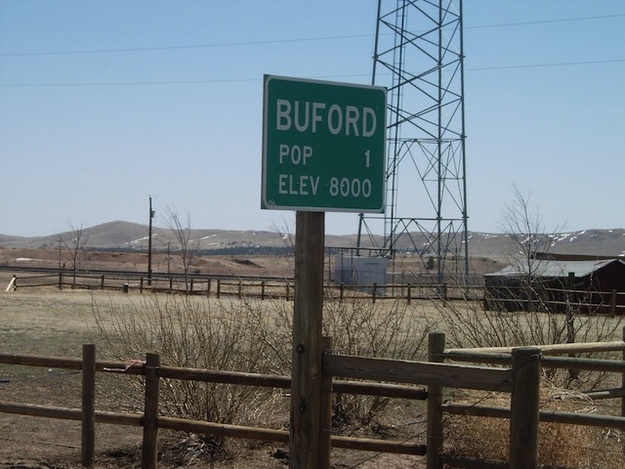
1. Buford, Wyoming
1 -  Buford
Formerly sporting a bustling population of two, Buford now only has a single resident.

2. The Great Pacific Garbage Patch
2 - garbage
The Patch is a basically immobile, gigantic mass of trash out in the middle of the Pacific. Most estimates put its size—composed entirely of plastic bottles, chemical sludge, and basically any other kind of debris you can imagine—larger than the state of Texas. You’d probably rather go to Texas.

3. Alnwick Poison Garden, England
3 - posion gardcen
The Alnwick Poison Garden is pretty much what you’d think it is: a garden full of plants that can kill you (among many other things). Some of the plants are so dangerous that they have to be kept behind bars. It’s not exactly your typical stroll through a botanical garden.

4. Ramree Island, Burma
4 - bur,a
Ramree Island may be in the beautiful Burma, but nothing about this place is beautiful. It’s actually just a giant swamp full of thousands of saltwater crocodiles—which are the deadliest in the world—plus mosquitos loaded with malaria, oh, and venomous scorpions. Also, there was a six-week long battle here during WWII, in which only twenty Japanese soliders survived… out of 1000. And most were killed by the wildlife.

5. The Zone of Alienation, Ukraine
5 - ukraine
Although you probably wouldn’t want to vacation in Pripyat either, the Zone of Alienation is the 19-mile decommissioned perimeter surrounding the grounds of the Chernobyl incident. It’s administered by a branch of government specifically so that no-one is allowed into it, but there are a few hundred residents who refused to move. What’s wrong with those people? You probably don’t want to know

6. Ilha de Queimada Grande, Brazil
6 - brazil
Sorry to tell you this, but Ilha de Queimada Grande isn’t a fantastical island getaway. It’s actually an island full of thousands of snakes. Its name literally means, “Snake Island.” It has the highest concentration of snakes in the world, with 1-5 golden lanceheads per square meter—oh, and they’re very poisonous: when designs were drawn up to build a plantation on the island, all the scouts were killed.

7. St. Helena
7 - st helena
If you somehow end up in the same place where Napoleon was imprisoned and spent his final days, things are probably going wrong. Oh yeah, and there’s no functioning airport, either. The only way you can get on or off the island is via container ships from South Africa. Which only come every few months.

8. Izu Island, Japan
8 - japan
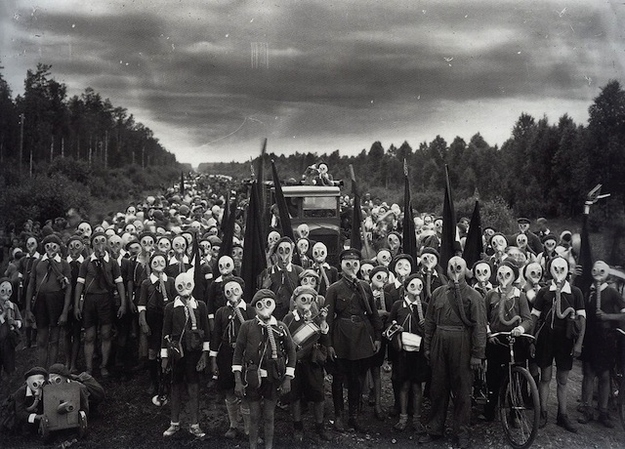
The Izus are a group of volcanic islands located off the southern coast of Japan’s Honshu island. They’re technically part of Tokyo, except because they’re extremely volcanic, the air constantly smells of sulfur and residents have been evacuated twice—in 1953 and 2000—because of “dangerously high levels of gas.” Although allowed back in 2005, inhabitants are now required to carry gas masks on their person at all times.

9. Mud Volcanoes of Azerbaijan
9 - mud volcano
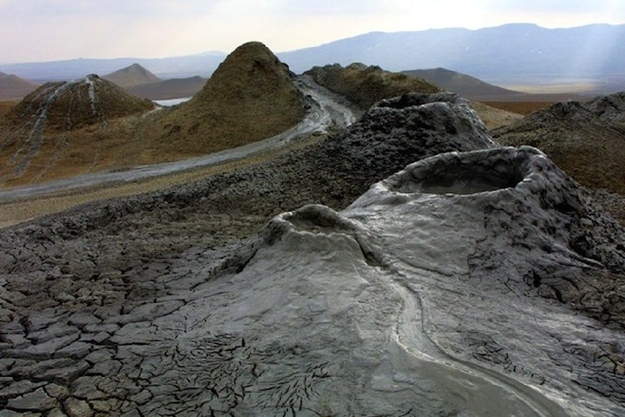
Sure, mud volcanoes aren’t nearly as dangerous as their cousins of the magmatic variety, but when they do actually erupt, it’s not exactly a pretty sight. In 2001, a new island grew out of the Caspian Sea, due to an increase in volcanic activity—right nearby where hundreds of these bad boys are. Generally, they go off every twenty years, and when they do, they shoot flames “hundreds of meters into the sky” and deposit tons of mud into the immediate area.

http://www.stumbleupon.com/su/AVvBxP

Nasty note left on quadriplegic man’s BMW

matt-milstead

mean-note

I would love to see your wheelchair!”

That’s one line of a mean-spirited note left on the car of 36-year-old Matt Milstead — a Michigan man who parked his BMW in a handicapped spot at a Grand Rapids YMCA.

Milstead, a quadriplegic, was there to play wheelchair rugby — and did display a handicapped tag on his rear-view mirror.

His wife Leslie told WWJ Newsradio 950′s Zahra Huber she wants to set the record straight.

“He’s not just some jerk parking in this spot; he has a right to park there. He deals with a lot of stuff on a daily basis that parking in a handicap spot does not compensate for,” she said.

Leslie posted the following response to the note-writer on her Facebook page:

“To the author of the note left on my husband’s car at the David D Hunting YMCA:

I wanted to tell you a little bit about my husband since you took the time to write him in the parking lot last night.

You were so close on the age, he’s actually 36, and he is a professional with a full-time job. He is also a quadriplegic, which for him means that he can no longer move his legs or his fingers in either hand. He has no grip.

So, if you are willing to give him your functioning hands and legs for the rest of your life in exchange for his 6-year old BMW and handicapped parking pass, I’m sure he’d make that trade.

As for ‘having the world by the ass’ …you think he’s some arrogant jerk who wants to park his fancy car in a handicapped spot and strut into the YMCA in Grand Rapids, MI because he thinks he’s a bad ass? Why are you so confident that a handicapped person couldn’t be a hard worker who is successful and owns a nice vehicle?

I would say he’s a good guy dealing with some tough circumstances that he refuses to be knocked down by. Thankfully, he just shakes his head at people like you who leave notes on his car. Trust me, you aren’t the first. Ignorance is everywhere.

P.S. Look Matt Milstead up on Facebook. You’ll get to see lots of pictures of that wheelchair you had questions about.”

Leslie Milstead said there’s a lesson to be learned from this.

“I think that the message for everybody is that we have to really think before we make rash judgments,” she said. “We’ve all done it; I’ve done it, Matt’s done it — we’re not perfect.

“But it was just really upsetting to get just an unkind note for no reason.”

http://detroit.cbslocal.com/2013/10/21/quadriplegic-finds-nasty-note-on-car-in-handicapped-spot/