People tell more convincing lies when their bladder is full

David Cameron’s full-bladder technique really does work – but perhaps not in a way that the UK prime minister intends. Before important speeches or negotiations, Cameron keeps his mind focused by refraining from micturating. The technique may be effective – but it also appears to help people to lie more convincingly.

Iris Blandón-Gitlin of California State University in Fullerton and her colleagues asked 22 students to complete a questionnaire on controversial social or moral issues. They were then interviewed by a panel, but instructed to lie about their opinions on two issues they felt strongly about. After completing the questionnaire, and 45 minutes before the interview, in what they were told was an unrelated task, half drank 700 ml of water and the other half 50 ml.

The interviewers detected lies less accurately among those with a full bladder. Subjects who needed to urinate showed fewer signs that they were lying and gave longer, more detailed answers than those who drank less.

The findings build on work by Mirjam Tuk of Imperial College London, whose study in 2011 found that people with full bladders were better able to resist short-term impulses and make decisions that led to bigger rewards in the long run. These findings hinted that different activities requiring self-control share common mechanisms in the brain, and engaging in one type of control could enhance another.

Other research has suggested that we have a natural instinct to tell the truth which must be inhibited when we lie. Blandón-Gitlin was therefore interested to see whether the “inhibitory spillover effect” identified by Tuk would apply to deception.

Although we think of bladder control and other forms of impulse control as different, they involve common neural resources, says Blandón-Gitlin. “They’re subjectively different but in the brain they’re not. They’re not domain-specific. When you activate the inhibitory control network in one domain, the benefits spill over to other tasks.”

Blandón-Gitlin stresses that her study does not suggest that David Cameron would be more deceitful as a consequence of his full bladder technique. But she says that deception might be made easier using the approach – as long as the desire to urinate isn’t overwhelming. “If it’s just enough to keep you on edge, you might be able to focus and be a better liar,” she says.

https://www.newscientist.com/article/dn28199-the-lies-we-tell-are-more-convincing-when-we-need-to-pee/

Giraffes spend their nights constantly humming.

For years, experts believed that giraffes didn’t really communicate vocally. After all, many zookeepers thought, it would be pretty difficult to force enough air past their voice boxes to make any sort of sound aside from a snort, considering the length of their necks. But as it turns out, giraffes spend their nights humming to each other.

Since it would take a lot of airflow to make a loud sound from a giraffe’s 13-foot-long trachea, researchers believed that giraffes had no form of vocal communication and instead relied on their keen sense of sight. But according to a new study by researchers from the University of Vienna, giraffes do communicate vocally after all – it’s just that the sounds they make are so low that it’s hard for humans to hear them.

Initially, the researchers wanted to test a long-standing theory that giraffes could “talk” using infrasonic frequencies too low for the human ear, much like elephants and some other large mammals do. To answer the question, they spent almost 1,000 hours recording giraffes at three different European zoos and painstaking analyzed the waveforms by sight, looking for patterns. While they didn’t find any evidence of the giraffes using infrasound, the scientists realized that the giraffes would spend their nights humming.

Because giraffes seem to only hum at night, scientists have yet to figure out whether it correlates with any behavior or if it’s just snoring. However, it’s possible that the humming might be used to communicate all sorts of information from age, gender, social dominance and sexual arousal.

Read more: http://www.smithsonianmag.com/smart-news/giraffes-spend-their-nights-quietly-constantly-humming-180956683/#T0MUP6ruXlsYDl81.99

No votes cast in small-town Iowa school board race

An Iowa farmer who was running unopposed for his local school board failed to earn any votes — not even his own — but he’ll probably still get the job.

Randy Richardson, 42, didn’t find time to vote for himself between his full-time maintenance job at a bean processing plant in Riceville and his chores on his farm near McIntire, The Des Moines Register reported (http://dmreg.co/1KuptW7 ).

Richardson was recruited to run by school staff, and though he said he’s “run paper thin the way it is,” he agreed because he has two kids in the district.

Neighbor Jessie Miller said there wasn’t any key issue to drive her to vote in the school board race.

“I would’ve voted for him!” she said. “He’s an awesome guy.”

Riceville is a farming community of around 500 residents near the Minnesota border. The school board district Richardson was running for is also home to a number of Amish and Mennonite farmers who typically don’t vote.

There are only 122 registered voters who could have voted for Richardson. Across the entire school district, only 36 people voted in the Sept. 8 election.

School board president Karl Fox, who also farms, said the timing of last week’s vote was unfortunate because it’s a busy time of year for fieldwork.

Fox said farmers have a hard time sacrificing a day of nice weather at this time of year, and many people in the area have to drive 50 miles or more to get to work each day.

“It’s hard to get the general public to remember when to vote for president,” Fox said.

But Richardson will likely still get the job on the Riceville School Board because the board probably will appoint him to fill the seat he was running for, Fox said.

Breakthrough in cloaking / invisibility technology

A cloak of invisibility may be common in science fiction but it is not so easy in the real world. New research suggests such a device may be moving closer to reality.

Scientists said on Thursday they have successfully tested an ultra-thin invisibility cloak made of microscopic rectangular gold blocks that, like skin, conform to the shape of an object and can render it undetectable with visible light.

The researchers said while their experiments involved cloaking a miniscule object they believe the technology could be made to conceal larger objects, with military and other possible applications.

The cloak, 80 nanometers in thickness, was wrapped around a three-dimensional object shaped with bumps and dents. The cloak’s surface rerouted light waves scattered from the object to make it invisible to optical detection.

It may take five to 10 years to make the technology practical to use, according to Xiang Zhang, director of the Materials Sciences Division of the U.S. Department of Energy’s Lawrence Berkeley National Laboratory and a professor at the University of California, Berkeley.

“We do not see fundamental roadblocks. But much more work needs to be done,” said Zhang, whose research was published in the journal Science.

The technology involves so-called metamaterials, which possess properties not present in nature. Their surfaces bear features much smaller than the size of a wavelength of light. They redirect incoming light waves, shifting them away from the object being cloaked.

The cloaking “skin” boasts microscopic light-scattering antennae that make light bouncing off an object look as if it were reflected by a flat mirror, rendering the object invisible.

“The fact that we can make a curved surface appear flat also means that we can make it look like anything else. We also can make a flat surface appear curved,” said Penn State University electrical engineering professor Xingjie Ni, the study’s lead author.

The researchers said they overcame two drawbacks of previous experimental microscopic cloaks that were bulkier and harder to “scale up,” or become usable for larger objects.

Ni said the technology eventually could be used for military applications like making large objects like vehicles or aircraft or even individual soldiers “invisible.”

Ni also mentioned some unconventional applications.

How about a cloaking mask for the face? “All the pimples and wrinkles will no longer be visible,” Ni said. How about fashion design? Ni suggested a cloak that “can be made to hide one’s belly.”

http://www.huffingtonpost.com/entry/invisibility-cloak-may-be-moving-closer-to-reality_55febe51e4b0fde8b0ce9afd

Dog stands guard for week protecting trapped friend

A Washington state animal shelter says a dog dutifully stood guard for a nearly a week on Vashon Island to protect another dog that had fallen in a cistern.

Tillie, a setter mix, only left Phoebe’s side to try to alert people of her trapped friend.

Amy Carey of Vashon Island Pet Protectors says the two were found Tuesday after they were reported missing by their owners last week. Vashon Island Pet Protectors says volunteers looking for the pair received a call about a reddish dog being seen on someone’s property a few times before promptly heading back into the ravine.

Carey says the Pet Protectors followed the tip and found Tillie lying beside an old cistern. Inside rescuers found Phoebe, a basset hound, on a pile of stones above the water.

The dogs were cold and hungry but otherwise unharmed.

“It’s really quite remarkable,” Carey said.

http://bigstory.ap.org/urn:publicid:ap.org:9c331f3640d040c5ba3be1c8ebd32e2e

In 72 hours deep learning machine teaches itself to play chess at International Grand Master level by evaluating the board rather than using brute force to work out every possible move – a computer first.

t’s been almost 20 years since IBM’s Deep Blue supercomputer beat the reigning world chess champion, Gary Kasparov, for the first time under standard tournament rules. Since then, chess-playing computers have become significantly stronger, leaving the best humans little chance even against a modern chess engine running on a smartphone.

But while computers have become faster, the way chess engines work has not changed. Their power relies on brute force, the process of searching through all possible future moves to find the best next one.

Of course, no human can match that or come anywhere close. While Deep Blue was searching some 200 million positions per second, Kasparov was probably searching no more than five a second. And yet he played at essentially the same level. Clearly, humans have a trick up their sleeve that computers have yet to master.

This trick is in evaluating chess positions and narrowing down the most profitable avenues of search. That dramatically simplifies the computational task because it prunes the tree of all possible moves to just a few branches.

Computers have never been good at this, but today that changes thanks to the work of Matthew Lai at Imperial College London. Lai has created an artificial intelligence machine called Giraffe that has taught itself to play chess by evaluating positions much more like humans and in an entirely different way to conventional chess engines.

Straight out of the box, the new machine plays at the same level as the best conventional chess engines, many of which have been fine-tuned over many years. On a human level, it is equivalent to FIDE International Master status, placing it within the top 2.2 percent of tournament chess players.

The technology behind Lai’s new machine is a neural network. This is a way of processing information inspired by the human brain. It consists of several layers of nodes that are connected in a way that change as the system is trained. This training process uses lots of examples to fine-tune the connections so that the network produces a specific output given a certain input, to recognize the presence of face in a picture, for example.

In the last few years, neural networks have become hugely powerful thanks to two advances. The first is a better understanding of how to fine-tune these networks as they learn, thanks in part to much faster computers. The second is the availability of massive annotated datasets to train the networks.

That has allowed computer scientists to train much bigger networks organized into many layers. These so-called deep neural networks have become hugely powerful and now routinely outperform humans in pattern recognition tasks such as face recognition and handwriting recognition.

So it’s no surprise that deep neural networks ought to be able to spot patterns in chess and that’s exactly the approach Lai has taken. His network consists of four layers that together examine each position on the board in three different ways.

The first looks at the global state of the game, such as the number and type of pieces on each side, which side is to move, castling rights and so on. The second looks at piece-centric features such as the location of each piece on each side, while the final aspect is to map the squares that each piece attacks and defends.

Lai trains his network with a carefully generated set of data taken from real chess games. This data set must have the correct distribution of positions. “For example, it doesn’t make sense to train the system on positions with three queens per side, because those positions virtually never come up in actual games,” he says.

It must also have plenty of variety of unequal positions beyond those that usually occur in top level chess games. That’s because although unequal positions rarely arise in real chess games, they crop up all the time in the searches that the computer performs internally.

And this data set must be huge. The massive number of connections inside a neural network have to be fine-tuned during training and this can only be done with a vast dataset. Use a dataset that is too small and the network can settle into a state that fails to recognize the wide variety of patterns that occur in the real world.

Lai generated his dataset by randomly choosing five million positions from a database of computer chess games. He then created greater variety by adding a random legal move to each position before using it for training. In total he generated 175 million positions in this way.

The usual way of training these machines is to manually evaluate every position and use this information to teach the machine to recognize those that are strong and those that are weak.

But this is a huge task for 175 million positions. It could be done by another chess engine but Lai’s goal was more ambitious. He wanted the machine to learn itself.

Instead, he used a bootstrapping technique in which Giraffe played against itself with the goal of improving its prediction of its own evaluation of a future position. That works because there are fixed reference points that ultimately determine the value of a position—whether the game is later won, lost or drawn.

In this way, the computer learns which positions are strong and which are weak.

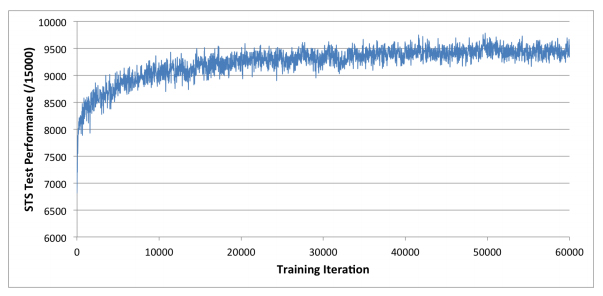
Having trained Giraffe, the final step is to test it and here the results make for interesting reading. Lai tested his machine on a standard database called the Strategic Test Suite, which consists of 1,500 positions that are chosen to test an engine’s ability to recognize different strategic ideas. “For example, one theme tests the understanding of control of open files, another tests the understanding of how bishop and knight’s values change relative to each other in different situations, and yet another tests the understanding of center control,” he says.

The results of this test are scored out of 15,000.

Lai uses this to test the machine at various stages during its training. As the bootstrapping process begins, Giraffe quickly reaches a score of 6,000 and eventually peaks at 9,700 after only 72 hours. Lai says that matches the best chess engines in the world.

“[That] is remarkable because their evaluation functions are all carefully hand-designed behemoths with hundreds of parameters that have been tuned both manually and automatically over several years, and many of them have been worked on by human grandmasters,” he adds.

Lai goes on to use the same kind of machine learning approach to determine the probability that a given move is likely to be worth pursuing. That’s important because it prevents unnecessary searches down unprofitable branches of the tree and dramatically improves computational efficiency.

Lai says this probabilistic approach predicts the best move 46 percent of the time and places the best move in its top three ranking, 70 percent of the time. So the computer doesn’t have to bother with the other moves.

That’s interesting work that represents a major change in the way chess engines work. It is not perfect, of course. One disadvantage of Giraffe is that neural networks are much slower than other types of data processing. Lai says Giraffe takes about 10 times longer than a conventional chess engine to search the same number of positions.

But even with this disadvantage, it is competitive. “Giraffe is able to play at the level of an FIDE International Master on a modern mainstream PC,” says Lai. By comparison, the top engines play at super-Grandmaster level.

That’s still impressive. “Unlike most chess engines in existence today, Giraffe derives its playing strength not from being able to see very far ahead, but from being able to evaluate tricky positions accurately, and understanding complicated positional concepts that are intuitive to humans, but have been elusive to chess engines for a long time,” says Lai. “This is especially important in the opening and end game phases, where it plays exceptionally well.”

And this is only the start. Lai says it should be straightforward to apply the same approach to other games. One that stands out is the traditional Chinese game of Go, where humans still hold an impressive advantage over their silicon competitors. Perhaps Lai could have a crack at that next.

http://www.technologyreview.com/view/541276/deep-learning-machine-teaches-itself-chess-in-72-hours-plays-at-international-master/

Thanks to Kebmodee for bringing this to the It’s Interesting community.

Captive snake with no male companion gives birth – again

For the second time in two years, a captive snake in southeast Missouri has given birth without any interaction with a member of the opposite sex.

Officials at the Missouri Department of Conservation’s Cape Girardeau Conservation Nature Center say a female yellow-bellied water snake reproduced on her own in 2014 and again this summer. The snake has been living in captivity, without a male companion, for nearly eight years. An intern who cares for the snake found the freshly laid membranes in July.

This year’s offspring didn’t survive, but the two born last summer are on display at the nature center, about 100 miles south of St. Louis.

Conservation Department herpetologist Jeff Briggler said virgin births are rare but can occur in some species through a process called parthenogenesis. It occurs in some insects, fish, amphibians, birds and reptiles, including some snakes, but not mammals.

Parthenogenesis is a type of asexual reproduction in which offspring develop from unfertilized eggs, meaning there is no genetic contribution by a male. It’s caused when cells known as polar bodies, which are produced with an animal’s egg and usually die, behave like sperm and fuse with the egg, triggering cell division.

The conservation department said there are no other documented cases of parthenogenesis by a yellow-bellied water snake. Like other water snakes, this species gives birth to live young rather than eggs that hatch.

Robert Powell, a biology professor and snake expert at Avila University in Kansas City, said the Brahminy blind snake — a small burrowing animal native to southeast Asia commonly known as the flowerpot snake — has long been the only known snake that routinely reproduces without a male’s contribution.

In the Missouri case, it’s possible — but unlikely — that momma snake simply stored sperm from her time in the wild. But Michelle Randecker, a naturalist at the center, said eight years is too long. Powell agreed, saying a female snake usually can’t store sperm for longer than a year, although there are accounts of successful storage as long as three years.

“Long-term storage is unusual. When you run into situations like this, you always wonder, ‘Is that a possibility?'” he said. “If nothing else, it’s an interesting phenomena. Whether this is long-term storage or parthenogenesis, it’s cool. Just another sign that nature works in mysterious ways.”

A.J. Hendershott, outreach and education regional supervisor for the conservation department, said there was some pride in having the first snake of its species reproduce through parthenogenesis.

“This is the way you make discoveries when you keep things in captivity,” Hendershott said. “You learn things about what they’re capable of.”

http://bigstory.ap.org/urn:publicid:ap.org:e854d0d586f746f68f6cb19c0ace6ab8

Humpback whale nearly crushes kayakers

A massive humpback whale nearly flattened a pair of kayakers on California’s Central Coast when it launched out of the sea and landed on their boat.

Nearby whale watchers looked on in fright as the creature flipped the couple into the water Saturday near Monterey Bay’s Moss Landing Harbor. A video (posted above)filmed by a Sanctuary Cruises passenger and shared by the company on Facebook shows the whale’s “full 180 degree breach.”

One passenger can be heard asking anxiously, “The kayak! The kayak! Where’s the kayak?” followed by applause when the couple appeared unharmed.

The kayaking company that took the paddlers out that day has halted its whale-watching tours, citing the safety of both its kayakers and the whales.

A full-size humpback whale can weigh more than 40 tons. Sanctuary Cruises captain and co-owner Michael Sack, writing about the encounter on the company’s blog, said it was “one of the more dangerous situations that I’ve seen out here.”

There has been a high number of reported sightings of humpback whales and other marine mammals in the Monterey Bay area in the past couple of years. Saturday’s kayakers, who are tourists from the United Kingdom, were paddling through a large pod of humpback whales when they were knocked underwater. They were less than a mile from shore. Both were wearing life vests, and some other paddlers helped right their boat.

Sean Furey, a guide with Monterey Bay Kayaks who was with the group when it happened, told CNN the couple handled the whole thing “incredibly well.” The company immediately made the decision to suspend its whale-watching tours.

“We’ve talked to some biologists and we feel it’s probably affecting the health of the whales, affecting their ability to feed so we just want to make sure that the whales are safe out there and keep everybody safe here,” Furey told CNN affiliate KSBW-TV.

http://www.cnn.com/2015/09/16/travel/kayakers-nearly-crushed-by-whale-irpt/index.html

Zimbabwe’s President Robert Mugabe reads old speech at the opening of Parliament

He gave the same one during his state-of-the-nation address on 25 August, when he was heckled by opposition. His spokesman told the state-run Herald paper the error was because of a mix-up in the president’s secretarial office.

The BBC’s Brian Hungwe in Harare says tensions were high ahead of the speech and the state broadcaster cancelled its live feed fearing further disruptions.

At least six MPs from the opposition Movement for Democratic Change (MDC) received a text message from a sender called “Death” warning them to behave.

“Warning: Immunity ends in parliament… act wisely by not disturbing the proceedings
of parliament,” the message on opposition MP Nelson Chamisa’s phone said.

Before the 91-year-old president spoke, the parliamentary speaker also warned against disrupting proceedings.

After Mr Mugabe began speaking, it was not long before it dawned on those present that they had heard it all before, our reporter says.

But during the speech, the MDC members sat quietly, while ruling Zanu-PF party supporters clapped at regular intervals, Reuters news agency reports.

The president made reference to the country amending labour laws to protect workers from arbitrary termination of employment, efforts being made to stimulate investment and the country registering modest growth in tourism and agriculture, our correspondent says.

The first time Mr Mugabe read the speech opposition MPs sang protest songs against his 10-point plan to solve the country’s economic crisis.

Presidential spokesman George Charamba said the error in delivering the wrong speech was “sincerely regretted”.

He added that the president would read the correct speech later at a hotel in the capital Harare, Reuters reports.

http://www.bbc.com/news/world-africa-34256898

Head transplant team selected for operation in 2017

The likely date and location for the first-ever human head transplant have been set, after the controversial Italian doctor that will lead the surgery said that he has selected his team of surgeons.

Radical Italian surgeon Sergio Canavero has drawn fascination and criticism after he announced plans to cut off a man’s head and put it onto another body. Many had expected that the planned operation would probably never happen – but a team has now been appointed to lead the operation.

Canavero is hoping to complete the procedure – which will take 36-hours, and cost $11 million – by December 2017, according to Russia Today.

The transplant is likely to happen in China, with a team made up largely of doctors from the country, according to AFP. That is likely to raise worries about the already highly-controversial operation, since China has been criticised for using the organs of executed prisoners without their consent.

The procedure has already drawn widespread condemnation, from doctors who say that it is likely to kill the person undergoing it, and that if he does survive he will undergo something a “lot worse than death”.

Russian Valery Spiridonov has already been selected as the recipient of the new body. He suffers from the rare, genetic Werdnig-Hoffmann disease, which gradually wastes away his muscles.

During the procedure, the donor and patient will each have their head sliced off their body in a super-fast procedure. The transplanted parts will then be stuck together with glue and stitches.

Spiridinov will then be placed in a month-long coma and injected with drugs intended to stop the body and head from rejecting each other.

Since the procedure is unprecedented, apart from mixed results in dogs and monkeys, doctors are not sure what could happen during the surgery – or how Spiridinov is likely to be if and when he wakes up.

Ren Xiaoping, who will work with Canavero to try and attempt the procedure in the next two years, said that the team will only attempt it if research and tests show that it is likely to be successful.

The operation will probably happen in China, at the Harbin Medical University, according to reports.

Since Ren refused to say where the donated body might be found, some have worried that the donated body might be taken from an executed prisoner.

In China – where the huge population and a low number of donations have led to a high demand for organs – an industry of forced donations and a black market for the sale of organs have flourished.

Canavero has said that China is keen to be involved in the procedure as a way of demonstrating its keenness for scientific research to the world, likening the race to complete the transplant to the space race. The Italian doctor has recognised that he could go to jail for performing the procedure in an unfriendly country and said that he has “been studying Chinese for a few years”.

The doctor has said that the procedure is just a first step towards his ultimate aim of immortality.

http://www.independent.co.uk/life-style/gadgets-and-tech/news/head-transplant-team-selected-for-controversial-operation-that-will-go-ahead-in-2017-10498627.html

Thanks to Kebmodee for bringing this to the It’s Interesting community.