Uber’s First Self-Driving Fleet Arrives in Pittsburgh This Month

by Max Chafkin

Near the end of 2014, Uber co-founder and Chief Executive Officer Travis Kalanick flew to Pittsburgh on a mission: to hire dozens of the world’s experts in autonomous vehicles. The city is home to Carnegie Mellon University’s robotics department, which has produced many of the biggest names in the newly hot field. Sebastian Thrun, the creator of Google’s self-driving car project, spent seven years researching autonomous robots at CMU, and the project’s former director, Chris Urmson, was a CMU grad student.

“Travis had an idea that he wanted to do self-driving,” says John Bares, who had run CMU’s National Robotics Engineering Center for 13 years before founding Carnegie Robotics, a Pittsburgh-based company that makes components for self-driving industrial robots used in mining, farming, and the military. “I turned him down three times. But the case was pretty compelling.” Bares joined Uber in January 2015 and by early 2016 had recruited hundreds of engineers, robotics experts, and even a few car mechanics to join the venture. The goal: to replace Uber’s more than 1 million human drivers with robot drivers—as quickly as possible.

The plan seemed audacious, even reckless. And according to most analysts, true self-driving cars are years or decades away. Kalanick begs to differ. “We are going commercial,” he says in an interview with Bloomberg Businessweek. “This can’t just be about science.”

Starting later this month, Uber will allow customers in downtown Pittsburgh to summon self-driving cars from their phones, crossing an important milestone that no automotive or technology company has yet achieved. Google, widely regarded as the leader in the field, has been testing its fleet for several years, and Tesla Motors offers Autopilot, essentially a souped-up cruise control that drives the car on the highway. Earlier this week, Ford announced plans for an autonomous ride-sharing service. But none of these companies has yet brought a self-driving car-sharing service to market.

Uber’s Pittsburgh fleet, which will be supervised by humans in the driver’s seat for the time being, consists of specially modified Volvo XC90 sport-utility vehicles outfitted with dozens of sensors that use cameras, lasers, radar, and GPS receivers. Volvo Cars has so far delivered a handful of vehicles out of a total of 100 due by the end of the year. The two companies signed a pact earlier this year to spend $300 million to develop a fully autonomous car that will be ready for the road by 2021.

The Volvo deal isn’t exclusive; Uber plans to partner with other automakers as it races to recruit more engineers. In July the company reached an agreement to buy Otto, a 91-employee driverless truck startup that was founded earlier this year and includes engineers from a number of high-profile tech companies attempting to bring driverless cars to market, including Google, Apple, and Tesla. Uber declined to disclose the terms of the arrangement, but a person familiar with the deal says that if targets are met, it would be worth 1 percent of Uber’s most recent valuation. That would imply a price of about $680 million. Otto’s current employees will also collectively receive 20 percent of any profits Uber earns from building an autonomous trucking business.

Otto has developed a kit that allows big-rig trucks to steer themselves on highways, in theory freeing up the driver to nap in the back of the cabin. The system is being tested on highways around San Francisco. Aspects of the technology will be incorporated into Uber’s robot livery cabs and will be used to start an Uber-like service for long-haul trucking in the U.S., building on the intracity delivery services, like Uber Eats, that the company already offers.

The Otto deal is a coup for Uber in its simmering battle with Google, which has been plotting its own ride-sharing service using self-driving cars. Otto’s founders were key members of Google’s operation who decamped in January, because, according to Otto co-founder Anthony Levandowski, “We were really excited about building something that could be launched early.”

Levandowski, one of the original engineers on the self-driving team at Google, started Otto with Lior Ron, who served as the head of product for Google Maps for five years; Claire Delaunay, a Google robotics lead; and Don Burnette, another veteran Google engineer. Google suffered another departure earlier this month when Urmson announced that he, too, was leaving.

“The minute it was clear to us that our friends in Mountain View were going to be getting in the ride-sharing space, we needed to make sure there is an alternative [self-driving car],” says Kalanick. “Because if there is not, we’re not going to have any business.” Developing an autonomous vehicle, he adds, “is basically existential for us.” (Google also invests in Uber through Alphabet’s venture capital division, GV.)

Unlike Google and Tesla, Uber has no intention of manufacturing its own cars, Kalanick says. Instead, the company will strike deals with auto manufacturers, starting with Volvo Cars, and will develop kits for other models. The Otto deal will help; the company makes its own laser detection, or lidar, system, used in many self-driving cars. Kalanick believes that Uber can use the data collected from its app, where human drivers and riders are logging roughly 100 million miles per day, to quickly improve its self-driving mapping and navigation systems. “Nobody has set up software that can reliably drive a car safely without a human,” Kalanick says. “We are focusing on that.”

In Pittsburgh, customers will request cars the normal way, via Uber’s app, and will be paired with a driverless car at random. Trips will be free for the time being, rather than the standard local rate of $1.05 per mile. In the long run, Kalanick says, prices will fall so low that the per-mile cost of travel, even for long trips in rural areas, will be cheaper in a driverless Uber than in a private car. “That could be seen as a threat,” says Volvo Cars CEO Hakan Samuelsson. “We see it as an opportunity.”

Although Kalanick and other self-driving car advocates say the vehicles will ultimately save lives, they face harsh scrutiny for now. In July a driver using Tesla’s Autopilot service died after colliding with a tractor-trailer, apparently because both the driver and the car’s computers didn’t see it. (The crash is currently being investigated by the National Highway Traffic Safety Administration.) Google has seen a handful of accidents, but they’ve been less severe, in part because it limits its prototype cars to 25 miles per hour. Uber’s cars haven’t had any fender benders since they began road-testing in Pittsburgh in May, but at some point something will go wrong, according to Raffi Krikorian, the company’s engineering director. “We’re interacting with reality every day,” he says. “It’s coming.”

For now, Uber’s test cars travel with safety drivers, as common sense and the law dictate. These professionally trained engineers sit with their fingertips on the wheel, ready to take control if the car encounters an unexpected obstacle. A co-pilot, in the front passenger seat, takes notes on a laptop, and everything that happens is recorded by cameras inside and outside the car so that any glitches can be ironed out. Each car is also equipped with a tablet computer in the back seat, designed to tell riders that they’re in an autonomous car and to explain what’s happening. “The goal is to wean us off of having drivers in the car, so we don’t want the public talking to our safety drivers,” Krikorian says.

On a recent weekday test drive, the safety drivers were still an essential part of the experience, as Uber’s autonomous car briefly turned un-autonomous, while crossing the Allegheny River. A chime sounded, a signal to the driver to take the wheel. A second ding a few seconds later indicated that the car was back under computer control. “Bridges are really hard,” Krikorian says. “And there are like 500 bridges in Pittsburgh.”
http://www.bloomberg.com/news/features/2016-08-18/uber-s-first-self-driving-fleet-arrives-in-pittsburgh-this-month-is06r7on

Venus could have been habitable while life evolved on Earth

By Aviva Rutkin

Nicknamed Earth’s evil twin, Venus seems like everything our planet is not: scorching hot, dried out and covered in toxic clouds.

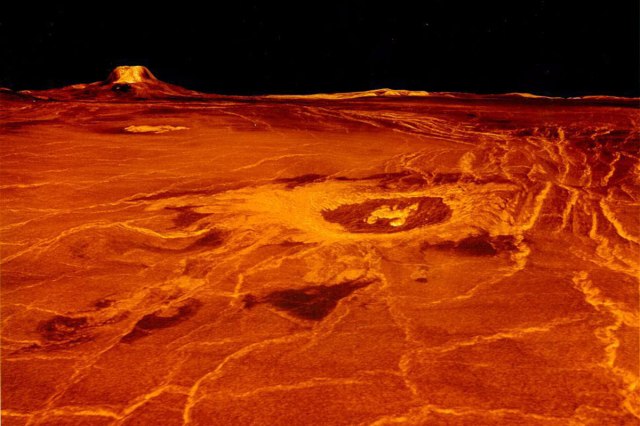
But a mere one or two billion years ago, these two wayward siblings might have been more alike. New computer simulations suggest that early Venus might have looked a lot like our home planet – and it might even have been habitable.

“It’s one of the big mysteries about Venus. How did it get so different from Earth when it seems likely to have started so similarly?” says David Grinspoon at the Planetary Science Institute in Tucson, Arizona. “The question becomes richer when you consider astrobiology, the possibility that Venus and Earth were very similar during the time of the origin of life on Earth.”

Grinspoon and his colleagues aren’t the first to imagine that Venus was once hospitable. It’s similar to Earth in size and density, and the fact that the two planets formed so close together suggests that they’re made of the same bulk materials. Venus also has an unusually high ratio of deuterium to hydrogen atoms, a sign that it once housed a substantial amount of water, mysteriously lost over time.

Venus, but snowy
To simulate early Venus, the researchers turned to a model of environmental conditions often used to study climate change here on Earth. They created four versions for Venus, each varying slightly in details such as the amount of energy the planet received from the sun, or the length of a Venusian day. Where information was scant about Venus’s climate, the team filled in educated guesses. They also added a shallow ocean, 10 per cent the volume of Earth’s ocean, covering about 60 per cent of the planet’s surface.

Looking at how each version might have evolved over time, the researchers say they were encouraged to believe that the planet might have looked much like an early Earth, and remained habitable for a substantial portion of its lifetime. The most promising of the four Venuses enjoyed moderate temperatures, thick cloud cover and even the occasional light snowfall.

Could life have emerged on this early Venus? If it did, it’s certainly no more, thanks to the oceans later boiling away and volcanoes drastically reshaping the landscape around 715 million years ago. But the team is not ruling it out.

“There’s great uncertainties in understanding Earth, not only its climate history but the history of how life began,” says Michael Way at the NASA Goddard Institute for Space Studies in New York City. If it began in oceans on Earth – a theory we’ve yet to confirm – the same could be true on a waterlogged Venus. “There’s no reason that life on this world would not have existed in these oceans. But that’s about all you can say.”

Alternative histories
“Both planets probably enjoyed warm liquid water oceans in contact with rock and with organic molecules undergoing chemical evolution in those oceans,” says Grinspoon. “As far as we understand at present, those are the requirements for the origin of life.”

To bolster their findings, the team suggests a future mission to Venus should look out for signs of water-related erosion near the equator, which would provide evidence for the oceans detailed in their simulation. Such signs have already been detected by missions at Mars. NASA is currently weighing up two potential Venus projects, although neither has been confirmed. One mission would drop a probe through the clouds down to the surface, while another would orbit around the planet and image its surface.

The researchers would also like to run simulations of further alternative pasts for Venus – perhaps one where it was a desert world, or submerged in as much water as Earth, to find out which scenario is most likely to lead to the Venus we see today.

The study could also aid astronomers in their search for exoplanets, says James Kasting at Pennsylvania State University. If Venus might have once been habitable, then it suggests that other planets close to their stars might be, too. “If you make the habitable zone really wide, that raises the probability of finding an Earth.”

Reference: arxiv.org/abs/1608.00706

https://www.newscientist.com/article/2100191-venus-could-have-been-habitable-while-life-evolved-on-earth/

Science Keeps Not Debunking the Alien Dyson Sphere Idea

by Robby Berman

All the scientific studies in the world of this one mysterious star have so far ruled out every theory except one, and it’s the wildest one. The whole thing started when Yale astronomer Tabetha Boyajian located star KIC 8462852, unofficially known as “Tabby’s star,” after Boyajian. Tabby’s star is doing something very strange.

In 2009, NASA launched its Kepler probe to keep a close watch on a small section of the sky — the idea was to learn more about a smaller area than less about a larger one. The probe tracks how light reflected from stars dims and grows brighter. Generally, when a star dims, a planet has passed in front of it, and will again and again as it travels its orbital path.

Kepler’s found some 2,000+ planets orbiting stars and published its data to allow citizen scientists to confirm their findings. A group of people affiliated with Yale called Planet Finders started going over the data, and Boyajian found her star.

To start with, it’s unexpectedly dim for a star of its its size and age. But what really got her attention was this chart.

Each vertical dip represents a holy-cow reduction in the star’s brightness, more than 10 times the dimming that astronomers would expect from a planet even as big as Jupiter crossing in front of the star. So it appears it’s not a planet causing Tabby’s star to dim, which is why it’s also called the “WTF star,” after the paper they published about it titled “Where’s the Flux?”

The data suggests something huge is orbiting the star, but what?

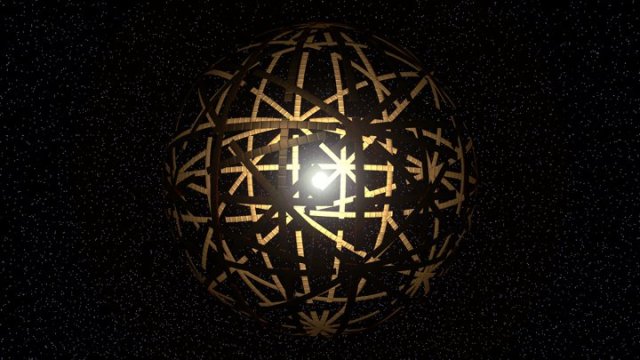
The reason the WTF star is famous is the hypothesis put forward to explain the dimming by Penn State astronomer Jason Wright: That what’s orbiting the star could be a “swarm of megastructures,” alien-built energy collectors, much like terrestrial solar panels. Wright told The Atlantic, “When Boyajian showed me the data, I was fascinated by how crazy it looked. Aliens should always be the very last hypothesis you consider, but this looked like something you would expect an alien civilization to build.” He was imagining something like a Dyson sphere.

Crazy, right? Well, since then scientists have been frantically pushing out other hypotheses to explain the anomaly.

Here are some of the more normal theories, and why they’re probably wrong:
•Kepler was malfunctioning — Nope.
•It’s a cloud of dust from star formation — But the star isn’t young. It shows no sign of the infrared light that indicates a new star.
•It’s a swarm of comets — But the dimming is too extreme to be caused by comets.
•It’s debris from colliding planets — But that matter would get sucked into the star so quickly it would be unlikely to linger long enough for us to see it.

http://bigthink.com/robby-berman/science-keeps-not-debunking-the-alien-dyson-sphere-idea?utm_source=Big+Think+Weekly+Newsletter+Subscribers&utm_campaign=344e51650c-Newsletter_081716&utm_medium=email&utm_term=0_6d098f42ff-344e51650c-41106061

Melting ice could expose Cold War toxic waste

PM2Anuclearpowerplant-2.jpg.653x0_q80_crop-smart
The army base at Camp Century in Greenland was abandoned in the ’60s, leaving behind buried toxic waste that may become exposed by the end of the century. (Photo: U.S. Army/Wikimedia Commons)

by Sami Grover

When the Cold War ended, much of the world breathed a huge sigh of relief. And while the immediate threat of nuclear armageddon may have faded, there are countless sites around the world that are still burdened with the toxic legacy of military superpowers.

As global climate change reshapes our world, at least one such site is in danger of becoming a more immediate problem.

As reported over at Scientific American, Camp Century in northwest Greenland was a U.S. military base abandoned in the mid-1960s. When American forces shipped out, they left behind literally thousands of tons of waste buried deep inside tunnels that were dug out of the thick, year-round ice. Not unreasonably — given that the tunnels were 120 feet below the surface, and that fresh snow fell every year to bury the tunnels ever deeper — an assumption was made that the waste would remain buried for tens of thousands of years. But we all know what they say about assumptions…

With the rapid rate of Greenland’s ice melt (which CNN reports is off to a record start this year), concerns are surfacing that the buried waste — which includes everything from radioactive coolant to toxic PCBs — will be exposed much sooner than previously thought. A new study led by glaciologist William Colgan of York University in Toronto suggests that while cleaning up the site will have to wait until melting brings it closer to the surface, now would be a good time for world powers to start thrashing out who is responsible for such long abandoned waste materials.

http://www.mnn.com/earth-matters/climate-weather/stories/melting-ice-could-expose-cold-war-toxic-waste

Tiny golden scrolls found on 2,000-year-old skeleton contain ancient magic spells


The spells are written in a mysterious language, but a few names of demons could be deciphered.

By Bryan Nelson

Archaeologists excavating a site associated with the ancient Roman city of Viminacium in modern day Serbia have stumbled upon something very unusual: tiny sheets of gold and silver, rolled up like scrolls and placed inside diminutive lead amulets, with mysterious writing etched on them. Scholars now believe the etchings are ancient magic spells, reports The Guardian.

The amulets were discovered inside the graves of skeletons that were buried 2,000 years ago. The scrolls, made of incredibly thin precious metals, likely would have taken expert craftsmanship to be so elegantly etched upon.

“The alphabet is Greek, that much we know. The language is Aramaic – it’s a Middle Eastern mystery to us,” said Miomir Korać, chief archaeologist at the site.

So far the only thing that can be deciphered from the writing is the names of a few demons that are connected to the territory of modern-day Syria, adding to the interest of the find. Archaeologists guess that the inscriptions must be magic spells… but for what purpose?

Since the amulets are similar to those found at sites in other countries, which have been known to contain “binding magic” and which were also buried in graves, researchers assume these gold and silver scrolls have a similar purpose.

“They were often love charms, ordering someone to fall in love, but there were also dark, malignant curses, to the tune of ‘May your body turn dead, as cold and heavy as this lead,’” explained archaeologist Ilija Danković.

If a similar spell was inscribed on these scrolls, it certainly adds some ominous intrigue to the cause of death of these ancient humans!

Actually, magic charms were especially common in the graves of individuals who had suffered a violent death, because of a belief that “souls of such people took longer to find rest and had a better chance of finding demons and deities and pass the wishes to them so they could do their magic,” added Danković.

The fact that these skeletons received their charms on precious sheets of gold and silver might indicate that they had an elevated social status.

As for the prospects of ever fully deciphering the scrolls, researchers are doubtful; the language they were written in has been lost.

http://www.mnn.com/lifestyle/arts-culture/stories/tiny-golden-scrolls-found-2000-year-old-skeleton-contain-ancient-magic-spells

Scientists find ‘closest ever’ second Earth outside our solar system – but won’t talk about it until the end of the month.


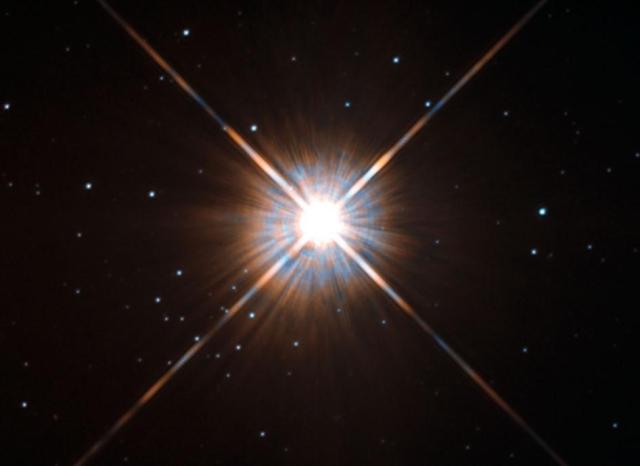
An image from Hubble of Proxima Centauri, which is our nearest neighbour and could be the home of another Earth ESA/Hubble & NASA

Scientists might have found the closest ever candidate for another Earth that could support life, according to reports. But nobody will say whether it’s true.

The new-found planet orbits around a now well-investigated star in Proxima Centauri, near us, according to reports. It is similar to Earth and could support life, it is claimed.

The researchers that found the planet are expected to show it off at the end of this month. But until then they are saying nothing.

One report said the planet will be the closest ‘second Earth’ ever found. The Proxima Centauri star is part of the Alpha Centauri system, which includes our solar system.

“The still nameless planet is believed to be Earth-like and orbits at a distance to Proxima Centauri that could allow it to have liquid water on its surface — an important requirement for the emergence of life,” German newspaper Der Spiegel reported.

The report didn’t give any more details on the planet itself.

A spokesperson for the European Southern Observatory has refused to comment on the report, but said that he was aware of it.

Nasa revealed a second Earth to much fanfare last year. That planet was called Kepler 452b, and is just 60 per cent larger than Earth and in many other ways is almost identical to our planet.

But since it is so far away – 1,400 light years – the chance of ever getting there or learning much more about it is limited. The new discovery is far, far nearer, at just 4.24 light years from us.

http://www.independent.co.uk/news/science/second-earth-discovery-nasa-esa-space-solar-system-scientists-a7192341.html

Mystery object found in weird orbit beyond Neptune

By Shannon Hall

“I hope everyone has buckled their seatbelts because the outer solar system just got a lot weirder.” That’s what Michele Bannister, an astronomer at Queens University, Belfast tweeted on Monday.

She was referring to the discovery of a TNO or trans-Neptunian object, something which sits beyond Neptune in the outer solar system. This one is 160,000 times fainter than Neptune, which means the icy world could be less than 200 kilometres in diameter. It’s currently above the plane of the solar system and with every passing day, it’s moving upwards – a fact that makes it an oddity.

The TNO orbits in a plane that’s tilted 110 degrees to the plane of the solar system. What’s more, it swings around the sun backwards unlike most of the other objects in the solar system. With this in mind, the team that discovered the TNO nicknamed it “Niku” after the Chinese adjective for rebellious.

To grasp how truly rebellious it is, remember that a flat plane is the signature of a planetary system, as a star-forming gas cloud creates a flat disk of dust and gas around it. “Angular momentum forces everything to have that one spin direction all the same way,” says Bannister. “It’s the same thing with a spinning top, every particle is spinning the same direction.”

That means anything that doesn’t orbit within the plane of the solar system or spins in the opposite direction must have been knocked off course by something else. “It suggests that there’s more going on in the outer solar system than we’re fully aware of,” says Matthew Holman at the Harvard-Smithsonian Center for Astrophysics, part of the team that discovered Niku using the Panoramic Survey Telescope and Rapid Response System 1 Survey (Pan-STARRS 1) on Haleakala, Maui.

Planet Nine

He should know – Batygin was one of two astronomers who earlier this year announced that the presence of another highly inclined group of objects could be pointing toward a large undiscovered world, perhaps 10 times as massive as Earth, lurking even further away – the so-called Planet Nine.

Upon further analysis, the new TNO appears to be part of another group orbiting in a highly inclined plane, so Holman’s team tested to see if their objects could also be attributed to the gravitational pull of Planet Nine.

It turns out Niku is too close to the solar system to be within the suggested world’s sphere of influence, so there must be another explanation. The team also tried to see if an undiscovered dwarf planet, perhaps similar to Pluto, could supply an explanation, but didn’t have any luck. “We don’t know the answer,” says Holman.

Bannister couldn’t be more thrilled. “It’s wonderful that it’s so confusing,” she says. “I’m looking forward to seeing what the theoretical analysists do once they get their hands on this one.”

But Batygin isn’t jumping up and down just yet. “As they say in the paper, what they have right now is a hint,” he says. “If this hint develops into a complete story that would be fantastic.”

https://www.newscientist.com/article/2100700-mystery-object-in-weird-orbit-beyond-neptune-cannot-be-explained/

Off-grid living on a floating home

Wayne Adams and Catherine King live on a massive float home made of 12 platforms in Cypress Bay, just northeast of Tofino, B.C. The couple appropriately named their vibrant creation “Freedom Cove.”

The abode is completely off-grid, off-land, and off-the-chain as far as float homes go. Built in 1992, the property includes five greenhouses, a dance floor, an art gallery, a lighthouse tower for guests, a generator shed, and a studio where King and Adams live.

Oh, and they’ve painted most of the buildings turquoise and magenta.

The couple don’t own a fridge or freezer, eating what King grows in her half-acre garden and what Adams catches fresh from the ocean. Their drinking water comes from a nearby waterfall in the summer, and from rainwater in the winter.

The structure used to be powered by 14 solar panels, but Adams and King recently had to convert to a small Honda generator when the panels broke down. Adams says the generator gives them about 3,000 watts of power, which is enough to keep the lights on for 12 hours.

“We have both done so many things in our lives and we’ve had hard times, so we were well prepared for how different the lifestyle would be out here,” Adams, 66, says. “It fits us.”

Both artists, King and Adams used to live in the the heart of tiny Tofino. They finally chose to build their dream float home when opportunity literally fell at their feet.

“One winter, a storm blew a whole bunch of trees down,” Adams explains to The Huffington Post B.C. in a Skype interview. “We gathered all the wood up, took it to the fellow who owned it, but he said keep it. So we thought, time to start on the home.”

Using that lumber, they began building in the summer of 1991. The following February, they towed the million-pound masterpiece into the cove using old fish-farm technology to keep it afloat.

Adams and King, who have two children, have lived there year-round ever since.

“Living in the wilderness is constant inspiration,” King, 59, adds. “It’s so incredible to wake up every morning and see all of this.”

The pair say they pass the time indulging in their artistic passions — he as a carver, she as a painter, dancer, writer and musician. From June to September, they also welcome Freedom Cove tours with the hope that visitors learn about a way of life that doesn’t exist anywhere else.

“This whole home is for the kids in our family to come and see what you can’t learn in school anymore,” Adams explains. “When I was young, this is what you learned in school: skills. To share this with the community and young minds, that is the teaching here on the west coast.”

As for the city life, Adams and King say they’re content to just keep floating on.

“This is how I will live for the rest of my life,” King says.

http://www.huffingtonpost.ca/2015/04/14/freedom-cove-tofino-float-home_n_7066358.html

Self-Driving Car Takes Man To Hospital After He Suffers Pulmonary Embolism


Joshua Neally had only been driving his Tesla Model X for a week when he found himself suffering a medical emergency.

Joshua Neally says he suffered a pulmonary embolism late last month while behind the wheel of the Tesla Model X, which features auto-driving technology, that he had purchased a week earlier.

“It was kinda getting scary. I called my wife and just said, ‘something’s wrong,’ and I couldn’t breathe, I was gasping, kind of hyperventilating,” the attorney from Springfield, Missouri, told KY3 News. “I just knew I had to get there, to the ER.”

Instead of pulling over to call 911 and wait for an ambulance, the 37-year-old father said he was able to direct his car to the nearest hospital.

Neally told Slate he doesn’t remember much after that. He said he’s fully aware, however, that the blockage in his lungs could have killed him or caused him to pass out behind the wheel.

Roughly one-third of people with an untreated or undiagnosed pulmonary embolism don’t survive, according to the Mayo Clinic.

Neally’s health scare occurred about three months after a Tesla driver in Florida was killed when his self-driving car crashed into a semi truck. The incident inspired a federal investigation into the company’s auto-piloting technology.

Neally knows about that accident, but is still grateful for his experience with the vehicle.

“It’s not going to be perfect, there’s no technology that’s perfect, but I think the measure is that it’s better and safer,” he said.

http://www.huffingtonpost.com/entry/tesla-drives-man-to-hospital_us_57a8aee8e4b0b770b1a38886

Thanks to Michael Lutter for bringing this to the It’s Interesting community.