Pretending to be a badger wins Charles Foster 10 trillion dollar Ig Nobel Prize

by Simon Sharwood

The annual Ig Nobel Prizes were handed out on Thursday night, as always “honoring achievements that make people laugh, then think”.

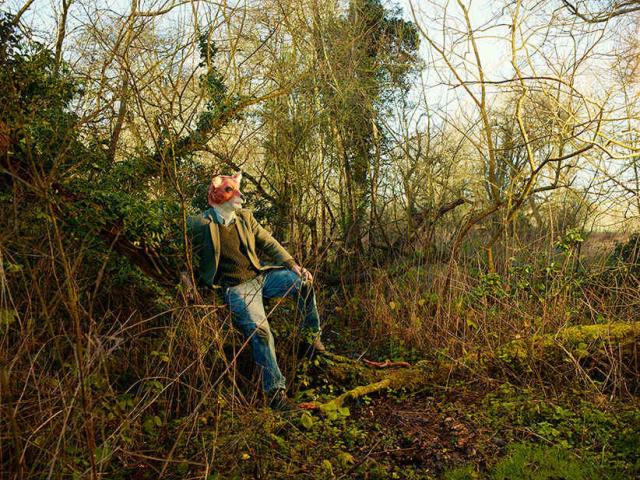
Among this year’s winners were “Charles Foster, for living in the wild as, at different times, a badger, an otter, a deer, a fox, and a bird.” Foster turned that research into a book, Being a Beast, in which he “set out to know the ultimate other: the non-humans, the beasts.” That effort saw him live “… alongside badgers for weeks, sleeping in a sett in a Welsh hillside and eating earthworms, learning to sense the landscape through his nose rather than his eyes.”

Foster’s Oxford University bio says he’s “a Fellow of Green Templeton College, a Senior Research Associate at the Uehiro Centre for Practical Ethics, a Research Associate at the the Ethox and HeLEX Centres, (at at the University of Oxford), and a practising barrister.” Foster shared the Biology Prize with Thomas Thwaites, who created “prosthetic extensions of his limbs that allowed him to move in the manner of, and spend time roaming hills in the company of, goats.”

Volkswagen won the Chemistry prize “for solving the problem of excessive automobile pollution emissions by automatically, electromechanically producing fewer emissions whenever the cars are being tested.”

The Psychology Prize went to the authors of a paper titled “From Junior to Senior Pinocchio: A Cross-Sectional Lifespan Investigation of Deception” that the Ig Nobel committee summarised as “asking a thousand liars how often they lie, and for deciding whether to believe those answers.”

Japanese researchers won the Perception Prize for research titled “Perceived size and Perceived Distance of Targets Viewed From Between the Legs: Evidence for Proprioceptive Theory”, while a paper titled “On the Reception and Detection of Pseudo-Profound Bullshit” took out the Peace Prize.

The Ig Nobels are misunderstood as deriding rubbish science, but are actually about celebrating how even seemingly-obscure science gets us thinking. As the awards’ backer, Improbable Research, point out:

Good achievements can also be odd, funny, and even absurd; So can bad achievements. A lot of good science gets attacked because of its absurdity. A lot of bad science gets revered despite its absurdity.

The full list of winners is here: http://www.improbable.com/ig/winners/

Winners reportedly took home Ten Trillion Dollars, sadly Zimbabwe dollars, or about US$0.40.

http://www.theregister.co.uk/2016/09/23/pretending_to_be_a_badger_wins_oxford_don_10_trillion_dollars/

Teen Makes ‘Sit With Us’ App That Helps Students Find Lunch Buddies to Avoid Bullying

A new app makes finding friends in the school cafeteria a piece of cake.

“Sit With Us” helps students who have difficulty finding a place to sit locate a welcoming group in the lunchroom.

The app allows students to designate themselves as “ambassadors,” thereby inviting others to join them. Ambassadors can then post “open lunch” events, which signal to anyone seeking company that they’re invited to join the ambassadors’ table.

Natalie Hampton, a 16-year-old from Sherman Oaks, California, is the designer of Sit With Us, which launched on September 9. She was inspired to create it after she ate alone her entire seventh grade year, she told LA Daily News. The situation left Hampton feeling vulnerable and made her a target for bullying.

Hampton, now a junior, is attending a different school and is thriving socially. Yet, the memory of sitting alone and being bullied still haunts her, especially since she knows her experience isn’t an isolated one.

Hampton told Audie Cornish on NPR’s “All Things Considered” that the reason why she felt an app like this was necessary is because it prevents kids from being publicly rejected and being considered social outcasts by their peers.

“This way it’s very private. It’s through the phone. No one else has to know,” she explained to Cornish. “And you know that you’re not going to be rejected once you get to the table.”

Hampton might be on to something even more, especially since she’s asking fellow students to take the stand against bullying.

When students ― especially the “cool kids” ― stand up to bullying, it has a significant impact, according to a study conducted by Princeton, Rutgers and Yale University. During a 2012-2013 school year, over 50 New Jersey middle schools provided their most socially competent students with social media tools and encouragement to combat bullying, and saw a reduction in student conflict reports by 30 percent.

Hampton told All Things Considered that since she launched the app last week, she’s already getting positive feedback from her peers.

“People are already posting open lunches at my school,” she told the program. “So I’m very excited that things are already kicking off with a great start.”

http://www.huffingtonpost.com/entry/teen-creates-app-sit-with-us-open-welcoming-tables-lunch-bullying_us_57c5802ee4b09cd22d926463

Dolphins may have a spoken language, new research suggests

By Ben Westcott

A conversation between dolphins may have been recorded by scientists for the first time, a Russian researcher claims.

Two adult Black Sea bottlenose dolphins, named Yasha and Yana, didn’t interrupt each other during an interaction taped by scientists and may have formed words and sentences with a series of pulses, Vyacheslav Ryabov says in a new paper.

“Essentially, this exchange resembles a conversation between two people,” Ryabov said.

Joshua Smith, a research fellow at Murdoch University Cetacean Research Unit, says there will need to be more research before scientists can be sure whether dolphins are chatting.

“I think it’s very early days to be drawing conclusions that the dolphins are using signals in a kind of language context, similar to humans,” he told CNN.

There are two different types of noises dolphins use for communication, whistles and clicks, also known as pulses.

Using new recording techniques, Ryabov separated the individual “non coherent pulses” the two dolphins made and theorized each pulse was a word in the dolphins’ language, while a collection of pulses is a sentence.

“As this language exhibits all the design features present in the human spoken language, this indicates a high level of intelligence and consciousness in dolphins,” he said in the paper, which was published in the St. Petersburg Polytechnical University Journal: Physics and Mathematics last month.

“Their language can be ostensibly considered a high developed spoken language.”

In his paper, Ryabov calls for humans to create a device by which human beings can communicate with dolphins.

“Humans must take the first step to establish relationships with the first intelligent inhabitants of the planet Earth by creating devices capable of overcoming the barriers that stand in the way of … communications between dolphins and people,” he said.

Smith said while the results were an exciting advance in the under-researched field of dolphin communication, the results first needed to be replicated in open water environments.

“If we boil it down we pretty much have two animals in an artificial environment where reverberations are a problem … It wouldn’t make much sense for animals (in a small area) to make sounds over each other because they wouldn’t get much (sonar) information,” he said.

“It would be nice to see a variety of alternate explanations to this rather than the one they’re settling on.”

http://www.cnn.com/2016/09/13/europe/dolphin-language-conversation-research/index.html

D.C. will hide once-banned books throughout the city this month

bors_bannedbooks

By Perry Stein

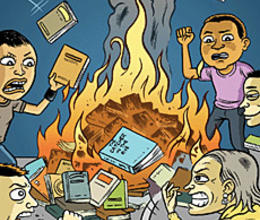
If you enter just the right business or library this month, you may stumble upon a hidden book that was censored or challenged at one point. And if you find it, it’s yours for the keeping.

The D.C. public library system is hiding several hundred copies of books — which were once banned or challenged — in private businesses throughout all eight wards to celebrate Banned Books Week. The “UNCENSORED banned books” scavenger hunt kicked off Sept. 6 and will run through the month.

Each book is wrapped in a cover that explains why that book was banned or challenged. For example, J.D. Salinger’s “Catcher in the Rye” will say “Anti-White” because in 1963, parents of high school students in Columbus, Ohio, asked the school board to ban the novel for being “anti-white.”

Other challenged or banned books included in the scavenger hunt: “The Color Purple,” “Slaughterhouse Five,” “A Separate Peace,” “One Flew Over the Cuckoo’s Nest” and “Native Son.”

D.C. public libraries will dole out clues about the books’ whereabouts on its social media accounts throughout the month with the hashtag #UncensoredDC. People who find a book are encouraged to post a picture of it on social media with that hashtag.

Winners at least 21 years old have a chance to win free tickets to “UNCENSORED: The Cocktail Party” as part of a fundraiser for the D.C. Public Library Foundation.

The city’s library system will host banned-book-related events at 25 neighborhood libraries throughout the month.

“This year’s theme is ‘Diversity,’ which will celebrate literature written by diverse writers that has been banned or challenged, as well as explore why diverse books are being disproportionately singled out,” the library system wrote in a release explaining the festivities. “It’s estimated that more than half of all banned books are by authors of color, or contain events and issues concerning diverse communities, according to the American Library Association’s Office for Intellectual Freedom.”

Ants trapped in nuclear bunker are developing a new form of ant society

122864_web

By Richa Malhotra

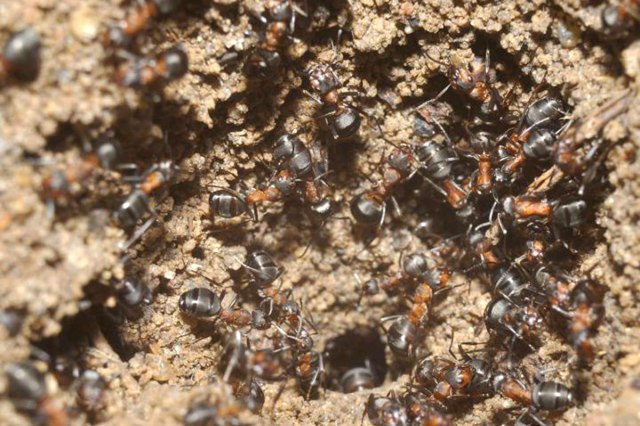
Keep calm and carry on building. That’s the motto of 100,000 or so wood ants stranded without food in a nuclear bunker until they starve.

Wood ants (Formica polyctena) typically build a cosy mound nest on the forest floor. They seek out the sugary secretions of aphids living on trees and supplement their diet with insects. Now, scientists have uncovered a population of wood ants that has sustained for years without food and light inside a bunker where temperatures are constantly low.

The ant population was discovered in 2013 by a group of volunteers counting bats overwintering in the bunker, which is part of an abandoned Soviet nuclear base near Templewo in western Poland.

Later, Wojciech Czechowski at the Museum and Institute of Zoology in Warsaw, Poland, and his colleagues, entered the bunker to study the ants more closely. They noticed that the wood ants had built a nest on the terracotta floor of the bunker – right below a ventilation pipe. Looking up through the five-metre-long pipe, they realised where the bunker ants come from.

A 60-centimetre-high wood ant nest sits on the forest floor directly on top of the ventilation pipe outlet. But because the metal cap over the ventilation pipe has rusted, ants can fall through from time to time.

It’s a one-way journey for any ant that falls into the bunker. They can scale its 2.3-metre-high walls but Czechowski and his colleagues realised that – for some reason – the ants never walk across the bunker ceiling and so are unable to reach the ventilation pipe to make it back home.

So, how did they respond? “These ants gathered together and did what ants do,” says Terry McGlynn, an entomologist at the California State University Dominguez Hills, who was not involved in the study. “They built a nest and eked out an existence.”

Today that nest covers most of the floor of a chamber that measures three metres by one metre.

Czechowski and his colleagues have looked for evidence of a food source that the bunker ants could use, but haven’t found one yet. Rather, the ants seemed to be doomed to starve to death in pitch-blackness. They found ant corpses carpeting the bunker floor in layers a few centimetres thick and estimated the number of dead ants to be about two million.

Without any food, the individual bunker ants are probably dying at a rate faster than at the surface, the researchers think. But because there is a steady stream of new arrivals falling into the bunker, the colony has grown to a reasonable size.

This explains one of the unusual features of this nest. When the researchers dug into it to look for an ant brood they found none – no larvae, pupae or empty cocoons. The “colony” was queenless and lacked any males. This fits with the idea that it is no ordinary nest, but a strange nest-like structure that the worker population has instinctively built.

“This is kind of fascinating that such a huge non-productive nest could exist on its own, built solely from the ants that got trapped in the bunker,” McGlynn says.

Journal reference: Journal of Hymenoptera Research, DOI: 10.3897/jhr.51.9096

https://www.newscientist.com/article/2104632-ants-trapped-in-nuclear-bunker-are-developing-their-own-society/

Librarian surprises school with $4 million gift


Robert Morin graduated from the University of New Hampshire in 1961, and he had a passion for books and movies.

by Mary Jo DiLonardo

Robert Morin spent nearly 50 years working as a librarian on the campus of his alma mater, the University of New Hampshire. Because he was known to live simply, few at the Durham university knew that the long-time employee had amassed a $4 million estate. Morin died in March 2015, but this week the school announced he had left his fortune to the university.

“Bob’s demonstrated commitment to UNH through his philanthropy is tremendously inspiring,” university President Mark Huddleston said in a statement. “His generous gift allows us to address a number of university priorities.”

Morin loved movies, and from 1979 to 1997 he watched more than 22,000 videos. After he satisfied his passion for movies, he turned his attention to books, deciding to read — in chronological order — every book published in the United States from 1930 to 1940 except for children’s books, textbooks and books about cooking and technology. When he died at the age of 77, he had gotten as far as 1938, the year he was born.

According to his obituary, his job at the library was to write short descriptions of DVDs, enter ISBN, or International Standard Book Numbers, for CDs, and to catalog books of sheet music.

Morin’s financial advisor, Edward Mullen, told the New Hampshire Union Leader that his client was able to accumulate so much wealth because he rarely spent money. He drove an older vehicle and ate frozen dinners.

“He never went out,” Mullen said.

In the last year or so of his life, Morin lived in an assisted living facility where he developed a new passion: football. He became an avid fan, watching games on TV, learning the rules of the game along with the names of the players and the teams.

Mullen said Morin chose to give all his savings to his alma mater because he didn’t have any relatives he wanted to leave it to. Morin trusted the university would spend the money wisely for its students.

The only specific request in the donation was $100,000 dedicated to the Dimond Library where Morin worked. The money will “provide scholarships for work-study students, support staff members who continue their studies in library science, and renovate and upgrade one of the library’s multimedia rooms.”

Of the remaining funds, Huddleston said $2.5 million will help launch an expanded and centrally located career center for students and alumni, and $1 million will go toward a video scoreboard at the school’s new football stadium.

http://www.mnn.com/money/personal-finance/stories/librarian-surprises-school-4-million-gift

Teen dies after girlfriend gives fatal hickey

By Cimaron Neugebauer

A 17-year-old has died after a hickey reportedly took his life, according to a local news outlet in Mexico City, Mexico.

Doctors say the teen began having convulsions while at the dinner table eating with his family in Mexico City. Before dinner, Julio Macias Gonzalez had spent the evening with his 24-year-old girlfriend, who is now in hiding.

Medical professionals believe the suction of the hickey resulted in a blood clot for the teen. Doctors believe the blood clot traveled to his brain and caused the fatal stroke.

This isn’t the first time for a passionate kiss on the neck to land someone in the hospital.

In a 2010 case, was reported in a New Zealand Medical Journal where a 44-year-old woman was rushed to the hospital after losing movement in her arm due to a hickey on her neck, Doctors weren’t sure why the woman was having a stroke, but then noticed a bruise on her neck and realized the suction on a major artery created a blood clot, which traveled to her heart, causing a minor stroke.

http://wlos.com/news/offbeat/teen-dies-after-girlfriend-gives-fatal-hickey-lover-now-on-the-run

Thanks to Kebmodee for bringing this to the It’s Interesting community.

‘Strong signal’ from sun-like star sparks alien speculation

By James Griffiths

Astronomers engaged in the search for extraterrestrial intelligence (SETI) are training their instruments on a star around 94 light years from Earth after a very strong signal was detected by a Russian telescope.

An international team of researchers is now examining the radio signal and its star, HD 164595 — described in a paper by Italian astronomer Claudio Maccone and others as a “strong candidate for SETI” — in the hopes of determining its origin.

“The signal from HD 164595 is intriguing, because it comes from the vicinity of a sun-like star, and if it’s artificial, its strength is great enough that it was clearly made by a civilization with capabilities beyond those of humankind,” astronomer Douglas Vakoch, president of METI International, which searches for life beyond Earth, tells CNN.

Whenever a strong signal is detected, “it’s a good possibility for some nearby civilization to be detected,” Maccone tells CNN.

Paul Gilster of the Tau Zero Foundation, which conducts interstellar research, said that if the signal was artificial, its strength suggested it would have to come from a civilization more advanced than our own.

Such a civilization would likely be Type II on the Kardashev scale, an attempt by the Soviet astronomer of the same name to categorize various technological stages of civilizations.

“The Kardashev scale is based basically on the energy that that civilization might be able to funnel for its own use,” says Maccone.

At present, our own species is somewhere near Type I on the scale, whereby a civilization is able to harness all the energy available to it on its own planet, including solar, wind, earthquakes, and other fuels.

A Type II civilization would be able to harness the entirety of the energy emitted by its star, billions of billions of watts.

Doing so would require a colossal undertaking, likely the construction of some kind of superstructure, such as a giant sphere or swarm of super-advanced solar panels popularized by astronomer Freeman Dyson that could catch and store all radiation put out by the sun.

Scientists believe superstructures are probably our best chance of detecting alien life unless they are actively trying to communicate with us.

A Dyson sphere was one of the solutions suggested to the peculiar light fluctuations detected around Tabby’s Star, which caused great excitement when they were detected last year.

Maccone is working on developing an alternative mathematical measure of how advanced civilizations are, based on the amount of knowledge and information available to them, that “might help us in the future classify alien civilizations” that we detect.

What’s happening at HD 164595?

In a statement, Seth Shostak, a senior astronomer with the SETI Institute, said that “it’s hard to understand why anyone would want to target our solar system with a strong signal.”

“This star system is so far away they won’t have yet picked up on any TV or radar that would tell them that we’re here,” he added.

METI International will be observing the star from the Boquete Optical SETI Observatory in Panama, Vakoch says, “searching for any brief laser pulses that might be sent as a beacon from advanced extraterrestrials.”

He stressed the importance of all of the SETI community following up on a signal detected by any single member.

“Without corroboration from an independent observatory, a putative signal from extraterrestrials doesn’t have a lot of credibility.”

The SETI Institute is also examining HD 164595, using the Allen Telescope Array in California.

So far, the team has not found any signals to match those originally detected by the Russian telescope, but Shostak notes that “we have not yet covered the full range of frequencies in which the signal could be located.”

“A detection, of course, would immediately spur the SETI and radio astronomy communities to do more follow-up observations.”

According to Vakoch, “if this were really a signal from extraterrestrials, we’d want to survey the target star across as much of the electromagnetic spectrum as we could.”

So is it aliens?

Probably not, says Vakoch, pointing to potential technological interference or amplification through gravitational lensing, where a signal behind a planet or other large object appears to be far stronger than it actually is, as potential causes.

Maccone says gravitational lensing is “an important possibility that should be taken into account for future SETI research.”

“We should learn how to discriminate that against real extraterrestrial signals,” he added.

Vakoch says “the greatest limitation of the May 2015 signal is that it hasn’t been replicated. Before we can give any credence to a signal as coming from extraterrestrials, we need to see it repeatedly to make sure it wasn’t just a transient phenomenon.”

“It deserves at least a few hours of observing time by SETI researchers at other locations to make sure we don’t miss an opportunity to make first contact, however remote.”

If it does prove to be transient and unexplained, HD 164595 could become another “Wow! signal,” frustratingly tantalizing and mysterious in equal measures.

Shostak writes that “of course (it’s) possible” the signal could be from an extraterrestrial civilization, but without confirmation, “we can only say that it’s ‘interesting’.”

http://www.cnn.com/2016/08/30/health/seti-signal-hd-164595-alien-civilization/index.html

A team of doctors across the world is helping the only two medical professionals left in one besieged town in Syria—via cell phone.

by AVI ASHER-SCHAPIRO

Earlier this year, a Syrian American orthopedic surgeon was shopping with his two toddlers at a Walmart in Grand Rapids, Michigan, when he heard the familiar ping of a notification from WhatsApp, the encrypted messaging service: A teenager had been shot in the leg and the bullet had passed straight through his tibia. The fractured bone punctured his skin like a spear. Although it was the surgeon’s day off, he took the call—as an expert in complex bone operations, this was his specialty.

But this was no ordinary case. His patient was over 6,000 miles away, awaiting care in a makeshift medical clinic in Madaya, a town in Syria some 28 miles from Damascus. The clinic is only a 45-minute drive from Damascus Hospital, but it might as well be on the other side of the world. Madaya, a rebel-held town controlled by the Islamist group Ahrar al-Sham, has been held under siege by Hezbollah, which is fighting on behalf of the Syrian government, since last July. Hezbollah won’t let anything in or out of the town; it was a Hezbollah fighter, locals say, who shot the teenager in the leg.

At the Madaya clinic that day, two men were on duty: a 25-year-old who had been a first-year dental student when the Syrian civil war broke out in 2011, and a veterinarian in his mid-40s. Gangrene had begun to spread down the patient’s leg, and the dental student, in a series of frantic texts, was asking the surgeon in Michigan what to do. As he walked through the parking lot of the Walmart, the surgeon picked up the phone and called the dental student, guiding him through the steps: Immediately load the patient up with antibiotics. Scrub the wound. Clear away as much dead tissues as possible without agitating the patient. Splint the leg.

“Any other call I would have ignored,” the surgeon admitted to me when we spoke in early August. But he knew that the dental student had nowhere else to turn. He is the only orthopedic surgeon in the “Madaya Medical Consultants,” a group composed of over two dozen, mostly Syrian American doctors, whose specialties include pediatrics, obstetrics, and pulmonology. They meet, digitally, in a WhatsApp chat room that supports the Madaya clinic around the clock. Most of the doctors in the group quoted in this story asked not to be identified, for fear of endangering their families in Syria. Rajaai Bourhan, a resident of Madaya, introduced me to the Madaya clinicians, whose identities I’ve also left anonymous for similar reasons.

Throughout Syria, more than 500,000 people are now under siege. The vast majority are penned in by pro-government fighters, their survival hinging on the medical know-how of the doctors, nurses, or medical students who happen to be trapped with them. In clinics like the one in Madaya, medical expertise is increasingly hard to come by, and remote medicine is often the only way patients with complex ailments can receive a semblance of care.

In Madaya, a year-long blockade enforced by a series of Hezbollah checkpoints, backed up by deadly minefields, has separated its 40,000 civilians from the rest of the country. The town hasn’t received a humanitarian-aid convoy since May, and only the most gravely injured or sick are allowed safe passage out. These evacuations require complex negotiations with rebels in other parts of Syria, in a high-stakes human trade.

This places a tremendous burden on the Madaya clinicians, the town’s two remaining full-time medical workers. Neither man has ever set foot in a medical school. The town’s most-skilled medical practitioner, a nurse with a background in anesthesiology, managed to escape last spring after receiving death threats.

But even the stifling siege can’t keep out wi-fi, which permeates the town thanks to a cluster of nearby cell-phone towers operated by Syriatel, the Syrian cellphone giant owned by Rami Makhlouf, President Bashar al-Assad’s cousin. In February 2016, a pulmonologist in Indiana who grew up outside Madaya realized he could use that wi-fi to smuggle medical advice past the blockade. During the winter of 2016, Madaya’s food stores emptied out. Dozens starved to death, and the health clinic swelled with malnourished patients. As the body count rose, the pulmonologist—a board member of the Syrian American Medical Society (SAMs), a humanitarian organization staffed by Syrian American doctors—grew increasingly desperate to boost the capacity of the town’s small clinic.

“It was the only way I could think of to help,” the pulmonologist told me recently. SAMs runs similar telemedicine programs in other parts of Syria, but Madaya is one of the only besieged areas without any trained doctors. After the anesthesiologist nurse fled, he knew the clinic would need more help than he alone could provide.

In February, the pulmonologist wrote an SOS on his Facebook page (he’s shared the posting, but asked me not to make it public since it includes names of doctors who want to remain anonymous) asking Arabic-speaking doctors to join a WhatsApp chat room that would become Madaya Medical Consultants. Within 24 hours of posting the message, over two dozen doctors joined, he recalled. Not wanting to overcrowd the group, he eventually started turning people down.

The dental student remembered the first time the doctors in the WhatsApp group helped him make a diagnosis. The day after the pulmonologist introduced him to the group, a child, whose body was body swollen and misshapen, was brought into the clinic. One of the group’s pediatricians helped identify the patient’s ailment as kwashiorkor, a disease brought on by extreme protein deficiency. First identified during a famine in West Africa in 1935, its name comes from a Ghanaian term for a child whose mother does not have enough breast milk to feed it. To treat the condition, a pediatrician in Chicago helped devise a formula using vegetable proteins that accustoms children to a high-protein diet. “We were so thankful that these doctors from so far away would volunteer their time to help us,” the dental student said.

The five-year civil war has plunged the Madaya clinicians into the deep end, forcing them to perform medical procedures that push them far beyond their training. They have treated countless gunshot victims, performed seven amputations, over a dozen C-sections, and diagnosed everything from meningitis to cancer, they told me during multiple conversations over WhatsApp and Facebook. “I’ve learned as I go,” the dental student said when we chatted over Facebook in August. “God willing, I am able to help as many people as possible.”

But there are limits to what they can do. Every day, one member of the group, a Virginia-based internist, obsessively checks the WhatsApp group for new messages: at 4 a.m. when she wakes up to breastfeed her newborn daughter, or on her lunch break at her clinic. In recent weeks, she has been trying to help the Madaya clinicians diagnose a woman who suddenly lost her vision, without warning, and is experiencing hallucinations. If a patient walked into her clinic with those symptoms, the internist said, she would immediately order an MRI. But since there’s no MRI machine in Madaya, she and three other doctors have been working to diagnose the woman “empirically,” trying out different medications the clinic happens to have and seeing if they work.

In July, as the internist recovered from the birth of her second child, she helped the Madaya clinicians perform a C-section on a woman pregnant with twins. The veterinarian, fortunately, was comfortable making the incision. But he was unprepared for all the blood the mother would lose after giving birth to two babies. So the internist explained that the woman needed a transfusion. She advised the dental student to transfer two units of blood every 30 minutes—the gap between transfusions was critical, she explained, to allow time to observe whether the mother was having an allergic reaction to the blood.

The whole exchange took place in a series of rapid-fire text messages. Though the Madaya clinicians sometimes send photos or videos of their procedures, the town’s patchy cell-phone-enabled internet service can’t reliably stream videos, and only sometimes supports phone calls. In the end, the C-section was a success; the newborns and mother are healthy and back at home. Still, no amount of hands on experience—even crash courses in surgery and complex diagnostics—can substitute for formal training. “Sometimes, talking to those two is like speaking with a first-year medical student,” the internist said. “You never know what they will know or what will be new to them.”

Doctor Silvia Dallatomasina, the medical-operations manager for Doctors Without Borders’s Syria office, explained that almost everywhere across the country “the medical staff is young or inexperienced, out of their comfort zone.” That dynamic is supercharged in Madaya. “There’s no second clinic to fall back on. You can’t bring in a doctor from a neighboring community,” explained Valerie Szybala, the executive director of the Syrian Institute, a nonprofit that helps run Siege Watch, a project monitoring Syria’s besieged communities. “For patients, there is nowhere to go. It’s that clinic, or nothing.”

At times, the group does indeed resemble a classroom. For hours every day in the chat group, doctors and the Madaya clinicians discuss the merits of different antibiotics, or analyze the urine of a patient, or try to devise a workaround for a surgery. The orthopedic surgeon in Michigan recently taught the dental student how to perform minor hand surgery without general anesthetic by suppressing a nerve in the hand to temporarily numb a wounded finger. “We became more professional, more precise,” the dental student said. “In some ways, its been an academic experience, learning things I had no way of knowing before.”

“We thank God for the group,” the veterinarian told me at the end of a full-day shift at the clinic, via a WhatsApp audio message. “Without them, we would have more questions than answers.”

For many of the doctors in the WhatsApp group, the digital thread tethering them to Madaya has become an obsession. The pulmonologist described constantly looking at his phone, even while driving in traffic, to make sure the group is answering all the questions that come up. “I can’t let it go,” he said. “My soul is attached there.” The orthopedic surgeon said he checks the chat room “multiple times every day.” Before the WhatsApp group, he had to switch off the television whenever it showed images of the Syrian civil war, overwhelmed by a feeling of helplessness. “I just shut my brain up. I didn’t want people even talking to me about it,” he said.

For the past five years, he has been in touch with his family in Aleppo, the northern province that’s become the center of the Syrian conflict in recent months. When his cousins talk about the horrors of life in a war zone, all he can say is “I’m sorry, I’m sorry,” leaving him feeling “like a jackass,” he said. Though he has no personal connection to Madaya, the WhatsApp group has given him a feeling of concrete solidarity with those suffering in Syria.

Born and raised in Damascus, the internist hasn’t been able to return to her native Syria or see her parents in five years. The WhatsApp group, she said, offers her a “portal” back into her homeland, a rare opportunity to alleviate suffering. She still has fond childhood memories of Madaya: She and her sister used to drive there from Damascus to buy rare fruits smuggled into Syria from across the Lebanese border.

Remote medicine, of course, is not enough to keep Madaya healthy. Many of the conversations in the WhatsApp group fizzle out as the doctors realize the clinic doesn’t have the right medicine or equipment—or that the Madaya clinicians can’t perform the needed procedures, like brain surgery or a lumpectomy. At that point, the doctors will promise to pray for the patient, and the chat room goes silent. When asked if these dead ends discourage him, the pulmonologist paraphrased a verse from the Koran: “If we save one life, it is as if we are saving the whole of humanity.”

http://www.theatlantic.com/international/archive/2016/08/syria-madaya-doctors-whatsapp-facebook-surgery-assad/496958/

Stranded mariners saved by Guam-based Navy after writing ‘SOS’ in the sand

Two stranded mariners were rescued after a US Navy aircraft crew spotted three vital letters etched into the sand while flying over a deserted beach in Micronesia: “SOS.”

The US Navy alerted a Guam search and rescue team identifying the uninhabited location, the Coast Guard in Guam said in a statement Friday.

The survivors, who were marooned for eight days with “limited supplies and no emergency equipment on board,” were picked up Friday and transferred to Nomwin atoll, according to the Coast Guard.
The Coast Guard received a report about an 18-foot vessel with two people aboard missing since August 19. The ship left Weno Island two days earlier en route to Tamatam Island — but the castaway pair never made it.

In seven days, the aircraft and boat patrol teams searched a total of 16,571 square miles before rescuing the boaters, who have yet to be identified, the Coast Guard said.

http://www.cnn.com/2016/08/27/us/sos-rescue-from-island/index.html