
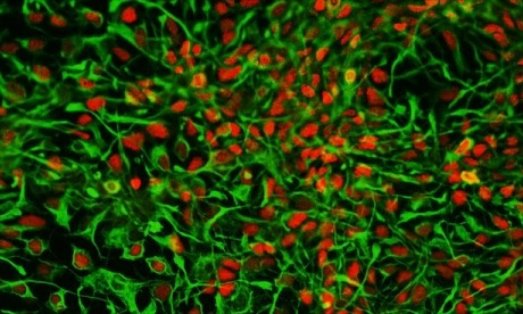
Chinese scientists turn human urine into brain cells

NPGs_from_urine


Chinese researchers have developed a new technique for isolating kidney cells from urine and turning them into neural progenitors — –immature brain cells that can develop into various types of glial cells and neurons. Reprogramming cells has been done before, of course, but not with cells gleaned from urine and not via a method this direct. The technique could prove extremely helpful to those pursuing treatments for neurodegenerative disorders like Parkinson’s and Alzheimer’s.

The innovation here is in the source and the method. We know that embryonic stem cells offer potential treatments for neurodegenerative disorders. And we know that we can turn adult human cells–that is, non-embryonic cells gathered from adult humans–into pluripotent cells (those that can become a different type of cell) by reprogramming them, usually with genetically engineered viruses that tamper with the cells’ genetic codes.

But embryonic stem cell treatments are fraught with ethical issues and non-embryonic methods are complicated–and complexity introduces a greater chance of something going wrong (in this case that means mutations and genetic defects). The new method, which taps skin-like cells from the linings of the kidney tubes that are present in urine, converts its source cells into neurons and glia cells via a more direct route, making the process more efficient while narrowing the margin of error.

In their study, the researchers harvested kidney cells from the urine samples of three human donors and converted the cells directly to neural progenitors. Rather than using a genetically engineered virus to reprogram the cells, they used a small piece of bacterial DNA that can replicate in the cellular cytoplasm, a technique that eliminates the need to tamper directly with the chromosome (in theory, at least, this should reduce mutations) while also speeding up the entire process. After growing their progenitors into mature neurons and glial cells, the researchers transplanted the progenitors into the brains of newborn rats. A month later, the cells were still alive in the rats’ brains, though it is not yet clear that they can survive for extended periods or mesh with the brain’s wiring to become functioning parts of the neural machine.

There’s still a lot of research to be done on this method of course, but the researchers think it may provide a way to take cells gathered non-invasively and quickly and efficiently convert them into neural cells while reducing the likelihood of genetic mutations.

http://www.guardian.co.uk/science/neurophilosophy/2012/dec/09/turning-urine-into-brain-cells

 

Left Party in Sweden wants men to sit down to urinate


Left Party members of a Swedish county council  said they want to encourage men using the council’s toilets to sit during  urination.

The Left Party in Sormland said it wants the Sormland County Council to pass  a motion requiring toilets reserved for stand-up urination to be labeled,  Swedish news agency TT reported Monday.

The party said sit-down urination is more hygienic and reduces the risk of  bathroom users having to negotiate their way around puddles en route to the  toilet.

The supporters of the motion said sitting during urination also has medical  benefits, including reducing the risk of prostate problems and leading to a  healthier and longer sex life.

Viggo Hansen, a substitute member of the council and author of the motion,  said he wants it to eventually lead to sitting-only bathrooms.

Read more: http://www.upi.com/Odd_News/2012/06/11/Swedish-party-wants-sit-down-urination/UPI-70041339439528/#ixzz1y9CccWfG

Swimmer’s Urine Caused Mass-Death of Fish in German Lake


The mass death of fish in a lake near Hamburg has been blamed on swimmers’ urine causing an algal bloom that has poisoned the water.

Around 500 dead fish have been found in the picturesque Eichbaum lake near the northern port city, which attracts bathers in the summery weather. But now it seems those pleasure-seekers have blood on their hands.

“Swimmers who urinate in the lake are introducing a lot of phosphate,” Manfred Siedler, spokesman for the Hamburger Angling Association (ASV), told Bild newspaper. “We’re calculating half a litre of urine per swimmer per day.”

Phosphate contributes to a build-up of blue-green algae in the water, playing havoc with the lake’s eco-system and apparently poisoning the fish. According to Bild, authorities have already tipped some 148 tonnes of anti-phosphate agent Bentophos into the water, at a cost of €516,000, but to little effect.

The Local understands that there has also been a longstanding feud between the anglers and the bathers over the lake.

Bathers are currently banned from the lake due to the high levels of algae, but the city’s Urban Development and Environment Authority (BSU) is working to fight it and re-open the lake.

The BSU believes that the fish deaths are not particularly unusual, and have been caused by a combination of natural causes and ice-skaters, rather than pee.

“The ice-skaters make a noise that wakes the fish out of hibernation,” BSU spokeswoman Kerstin Graupner told the Local.

“Then they can’t breathe and freeze. That’s a very common phenomenon.”

She underlined that though the fish have only been found in the past two weeks, they must have been dead for some time, judging by the decomposition.

BSU has since called in Hamburg University to test the pee-death theory, and says that apart from the high level of algae, the water is clean. “It is very rich in fish,” Graupner added.

But according to Bild, the first water tests are not encouraging – with a pH level of 8.7 (as opposed to the neutral 7), the lake is very alkaline.

Scientists have reportedly also found anabaena algae blooms, unusual at this time of year, which produce anatoxin-a. This causes the lake’s ammonium to change into the poisonous ammonia, which restricts the fish’s breathing.