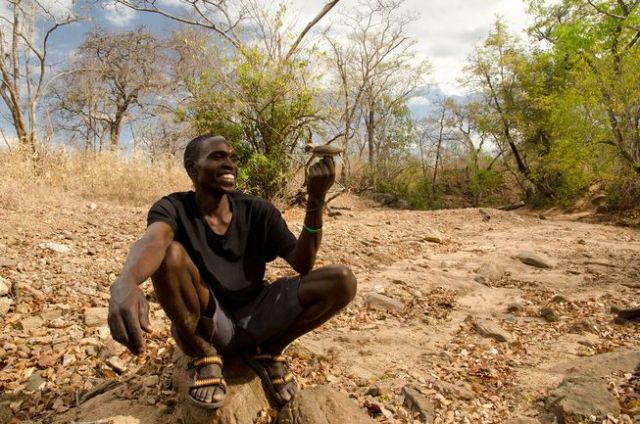
Wild birds communicate and collaborate with humans, study confirms


Humans use a unique call to request help from honeyguide birds, and the birds also ‘actively recruit’ human partners. This is two-way teamwork, scientists say, a rarity between people and wildlife.

By Russell McLendon

“Brrr-hm!”

When a human makes that sound in Mozambique’s Niassa National Reserve, a wild bird species instinctively knows what to do. The greater honeyguide responds by leading the human to a wild beehive, where both can feast on honey and wax. The bird does this without any training from people, or even from its own parents.

This unique relationship pre-dates any recorded history, and likely evolved over hundreds of thousands of years. It’s a win-win, since the birds help humans find honey, and the humans (who can subdue a beehive more easily than the 1.7-ounce birds can) leave behind beeswax as payment for their avian informants.

While this ancient partnership is well-known to science, a new study, published July 22 in the journal Science, reveals incredible details about how deep the connection has become. Honeyguides “actively recruit appropriate human partners,” the study’s authors explain, using a special call to attract people’s attention. Once that works, they fly from tree to tree to indicate the direction of a beehive.

Not only do honeyguides use calls to seek human partners, but humans also use specialized calls to summon the birds. Honeyguides attach specific meaning to “brrr-hm,” the authors say, a rare case of communication and teamwork between humans and wild animals. We’ve trained lots of domesticated animals to work with us, but for wildlife to do so voluntarily — and instinctively — is pretty wild.

Here’s an example of what the “brrr-hm” call sounds like:

“What’s remarkable about the honeyguide-human relationship is that it involves free-living wild animals whose interactions with humans have probably evolved through natural selection, probably over the course of hundreds of thousands of years,” says lead author Claire Spottiswoode, a zoologist at the University of Cambridge.

“[W]e’ve long known that people can increase their rate of finding bees’ nests by collaborating with honeyguides, sometimes following them for over a kilometer,” Spottiswoode explains in a statement. “Keith and Colleen Begg, who do wonderful conservation work in northern Mozambique, alerted me to the Yao people’s traditional practice of using a distinctive call which they believe helps them to recruit honeyguides. This was instantly intriguing — could these calls really be a mode of communication between humans and a wild animal?”

To answer that question, Spottiswoode went to Niassa National Reserve, a vast wildlife refuge larger than Switzerland. With the help of honey hunters from the local Yao community, she tested whether the birds can distinguish “brrr-hm” — a sound passed down from generation to generation of Yao hunters — from other human vocalizations, and if they know to respond accordingly.

She made audio recordings of the call, along with two “control” sounds — arbitrary words spoken by the Yao hunters, and the calls of another bird species. When she played all three recordings in the wild, the difference was clear: Honeyguides proved much more likely to answer the “brrr-hm” call than either of the other sounds.

“The traditional ‘brrr-hm’ call increased the probability of being guided by a honeyguide from 33 percent to 66 percent, and the overall probability of being shown a bees’ nest from 16 percent to 54 percent compared to the control sounds,” Spottiswoode says. “In other words, the ‘brrr-hm’ call more than tripled the chances of a successful interaction, yielding honey for the humans and wax for the bird.”

The researchers released this video, which includes footage from their experiments

This is known as mutualism, and while lots of animals have evolved mutualistic relationships, it’s very rare between humans and wildlife. People also recruit honeyguides in other parts of Africa, the study’s authors note, using different sounds like the melodious whistle of Hadza honey hunters in Tanzania. But aside from that, the researchers say the only comparable example involves wild dolphins who chase schools of mullet into anglers’ nets, catching more fish for themselves in the process.

“It would be fascinating to know whether dolphins respond to special calls made by fishermen,” Spottiswoode says.

The researchers also say they’d like to study if honeyguides learned “language-like variation in human signals” across Africa, helping the birds identify good partners among the local human population. But however it began, we know the skill is now instinct, requiring no training from people. And since honeyguides reproduce like cuckoos — laying eggs in other species’ nests, thus tricking them into raising honeyguide chicks — we know they don’t learn it from their parents, either.

This human-honeyguide relationship isn’t just fascinating; it’s also threatened, fading away in many places along with other ancient cultural practices. By shedding new light on it, Spottiswoode hopes her research can also help preserve it.

“Sadly, the mutualism has already vanished from many parts of Africa,” she says. “The world is a richer place for wildernesses like Niassa where this astonishing example of human-animal cooperation still thrives.”
http://www.mnn.com/earth-matters/animals/blogs/wild-birds-communicate-and-collaborate-humans-study-confirms

Maine EBT phone number sends callers to sex line

Calling the phone number on the back of his electronic benefit transfer card to check his balance before taking his son to the grocery store this week, a Lewiston dad heard a perky, come-hither voice answer and figured he’d dialed the wrong number.

Only he hadn’t.

In a misprint on some cards, the number to report a lost or stolen card to the Maine Department of Health and Human Services is actually the number of a phone sex line for women.

It’s one digit off from the DHHS Customer Service number.

When called, the incorrect line immediately picks up and a recorded voice says: “Welcome to America’s hottest talk line. Ladies, to talk with interesting and exciting guys free, press 1 now. Press 1 now.” Then hangs up.

“It played over my (car) speaker. I was like, ‘Wow, I must have messed that number up somehow really bad,'” said Lj Langelier, 25. “I look at the card. I dial it the exact same way again and it keeps happening. I thought it was just hilarious.”

He ended up posting a video of the card and of himself making another call on Facebook.

DHHS spokesman John Martins said Friday afternoon that the department was aware the number “is off by one digit and therefore incorrect.”

“The defect has been corrected on all new EBT cards being issued,” he said. “We have a plan in place to replace all existing defective cards and have taken additional steps to strengthen our review process so this type of inadvertent error does not occur again.”

Martins said the department had been aware of the mistake “for some time.” It wasn’t clear how many cards contain the misprint.

“I do know that cards that have been produced for the last several months have been accurate,” he said.

Martins also added: “While we recognize that we are responsible for this inadvertent error, what we have learned is that it appears the company that operates this chat line searches for phone numbers that are very similar to widely published government phone numbers and buys them to take advantage of either consumers who misdial or an inadvertent error in publishing the number.”

Langelier said that after he discovered the wrong number on his card, he asked neighbors, “‘Let’s compare cards. Maybe it’s just mine.’ Theirs were the same.”

He believes he’s had the blue Pine Tree EBT card for six to 12 months. The back of the card has three spots for phone numbers that should be identical: one for retailer assistance, one for “if lost, call” in small print and one for customer service in large print.

Callers to the misprinted number who “press 1” are told they have to be 18 or over and directed to call a different number for the actual chats.

Langelier was initially hesitant to make the error public due to the stigma of people receiving welfare — pointing out that he works 40 hours a week despite a medical condition, his fianceé is in college and they have two children — but he ultimately decided it was too funny to ignore.

“I just wanted people to have a good laugh,” he said.

http://www.sunjournal.com/news/lewiston-auburn-maine/2016/07/15/maine-ebt-phone-number-sends-callers-sex-line/1959958

Suspected Female-to-Male Sexual Transmission of Zika Virus — New York City, 2016

A routine investigation by the New York City (NYC) Department of Health and Mental Hygiene (DOHMH) identified a nonpregnant woman in her twenties who reported she had engaged in a single event of condomless vaginal intercourse with a male partner the day she returned to NYC (day 0) from travel to an area with ongoing Zika virus transmission. She had headache and abdominal cramping while in the airport awaiting return to NYC. The following day (day 1) she developed fever, fatigue, a maculopapular rash, myalgia, arthralgia, back pain, swelling of the extremities, and numbness and tingling in her hands and feet. In addition, on day 1, the woman began menses that she described as heavier than usual. On day 3 she visited her primary care provider who obtained blood and urine specimens. Zika virus RNA was detected in both serum and urine by real-time reverse transcription–polymerase chain reaction (rRT-PCR) performed at the DOHMH Public Health Laboratory using a test based on an assay developed at CDC (1). The results of serum testing for anti-Zika virus immunoglobulin M (IgM) antibody performed by the New York State Department of Health Wadsworth Center laboratory was negative using the CDC Zika IgM antibody capture enzyme-linked immunosorbent assay (Zika MAC-ELISA) (2).

Seven days after sexual intercourse (day 6), the woman’s male partner, also in his twenties, developed fever, a maculopapular rash, joint pain, and conjunctivitis. On day 9, three days after the onset of his symptoms, the man sought care from the same primary care provider who had diagnosed Zika virus infection in his female partner. The provider suspected sexual transmission of Zika virus and contacted DOHMH to seek testing for the male partner. That same day, day 9, urine and serum specimens were collected from the man. Zika virus RNA was detected in urine but not serum by rRT-PCR testing at the DOHMH Public Health Laboratory. Zika virus IgM antibodies were not detectable by the CDC Zika MAC-ELISA assay performed at the New York State Department of Health Wadsworth Center. The CDC Arbovirus Disease Branch confirmed all rRT-PCR results for urine and serum specimens from both partners.

During an interview with DOHMH on day 17, the man confirmed that he had not traveled outside the United States during the year before his illness. He also confirmed a single encounter of condomless vaginal intercourse with his female partner (the patient) after her return to NYC and reported that he did not engage in oral or anal intercourse with her. The man reported that he noticed no blood on his uncircumcised penis immediately after intercourse that could have been associated either with vaginal bleeding or with any open lesions on his genitals. He also reported that he did not have any other recent sexual partners or receive a mosquito bite within the week preceding his illness.

Independent follow-up interviews with the woman and man corroborated the exposure and illness history. The patients were consistent in describing illness onset, symptoms, sexual history, and the woman’s travel. This information also was consistent with the initial report from the primary care provider.

The timing and sequence of events support female-to-male Zika virus transmission through condomless vaginal intercourse. The woman likely was viremic at the time of sexual intercourse because her serum, collected 3 days later, had evidence of Zika virus RNA by rRT-PCR. Virus present in either vaginal fluids or menstrual blood might have been transmitted during exposure to her male partner’s urethral mucosa or undetected abrasions on his penis. Recent reports document detection of Zika virus in the female genital tract, including vaginal fluid. A study on nonhuman primates found Zika virus RNA detected in the vaginal fluid of three nonpregnant females up to 7 days after subcutaneous inoculation (3), and Zika virus RNA was detected in specimens from a woman’s cervical mucous, genital swab, and endocervical swab collected 3 days after illness onset, using an unspecified RT-PCR test (4). Further studies are needed to determine the characteristics of Zika virus shedding in the genital tract and vaginal fluid of humans.

This case represents the first reported occurrence of female-to-male sexual transmission of Zika virus. Current guidance to prevent sexual transmission of Zika virus is based on the assumption that transmission occurs from a male partner to a receptive partner (5,6). Ongoing surveillance is needed to determine the risk for transmission of Zika virus infection from a female to her sexual partners. Providers should report to their local or state health department any patients with illnesses compatible with Zika virus disease who do not have a history of travel to an area with ongoing Zika virus transmission, but who had a sexual exposure to a partner who did travel.

Persons who want to reduce the risk for sexual transmission of Zika virus should abstain from sex or correctly and consistently use condoms for vaginal, anal, and oral sex, as recommended in the current CDC guidance (5). Guidance on prevention of sexual transmission of Zika virus, including other methods of barrier protection, will be updated as additional information becomes available (http://www.cdc.gov/zika).

Corresponding author: Sally Slavinski, sslavins@health.nyc.gov, 347-396-2672.

References
1.Lanciotti RS, Kosoy OL, Laven JJ, et al. Genetic and serologic properties of Zika virus associated with an epidemic, Yap State, Micronesia, 2007. Emerg Infect Dis 2008;14:1232–9. CrossRef PubMed
2.CDC. Zika MAC-ELISA: instructions for use. Atlanta, GA: US Department of Health and Human Services, CDC; 2016. http://www.fda.gov/downloads/MedicalDevices/Safety/EmergencySituations/UCM488044.pdf
3.Dudley DM, Aliota MT, Mohr EL, et al. A rhesus macaque model of Asian-lineage Zika virus infection. Nat Commun 2016;7:12204. CrossRef PubMed
4.Prisant N, Bujan L, Benichou H, et al. Zika virus in the female genital tract [Letter]. Lancet Infect Dis 2016. E-pub July 11, 20162016. CrossRef
5.Oster AM, Russell K, Stryker JE, et al. Update: interim guidance for prevention of sexual transmission of Zika virus—United States, 2016. MMWR Morb Mortal Wkly Rep 2016;65:323–5. CrossRef PubMed
6.Hills SL, Russell K, Hennessey M, et al. Transmission of Zika virus through sexual contact with travelers to areas of ongoing transmission—continental United States, 2016. MMWR Morb Mortal Wkly Rep 2016;65:215–6. CrossRef PubMed

Davidson A, Slavinski S, Komoto K, Rakeman J, Weiss D. Suspected Female-to-Male Sexual Transmission of Zika Virus — New York City, 2016. MMWR Morb Mortal Wkly Rep. ePub: 15 July 2016. DOI: http://dx.doi.org/10.15585/mmwr.mm6528e2

Thieves at large, with 20,000 pounds of cheese, in Wisconsin

Police in southeastern Wisconsin say 20,000 pounds of cheese have vanished. The cheese, produced by U.S. Foods, was in a semitrailer parked at a business in the Milwaukee suburb of Oak Creek when it went missing Thursday.

Police say the semi driver was transporting the load from Green Bay to the New York City area and unhitched the trailer to run an errand. When he returned, the trailer and $46,000 worth of cheese was gone.

It’s not the first such heist of the legacy commodity in a state where sports fans like to wear foam wedges on their heads. A semitrailer carrying $70,000 worth of cheese was stolen from Germantown, another Milwaukee suburb, in January.

http://bigstory.ap.org/f17f21e16dcc44eb9374057028e0ce33

Smartphone Blindness

A short-lived optical sensation can lead some smartphone users to mistakenly believe they’ve lost sight in one eye, according to a research letter published in the June 23 issue of the New England Journal of Medicine.

The letter cites two case studies: a 22-year-old woman who’d suffered recurring bouts of nighttime vision loss in her right eye for several months, and a 40-year-old woman who would wake up with a loss of vision in one eye that lasted as long as 15 minutes.

Both women underwent several tests, including magnetic resonance imaging and echocardiograms, before doctors realized that the transient “blindness” was due to an optical adaptation of the eyes caused by reading a smartphone in the dark while lying on their side in bed. When one eye was occluded by the pillow and they were viewing the phone with the other eye, the occluded eye adapted to the dark and the viewing eye adapted to the light. When both eyes were uncovered in the dark, the light-adapted eye was perceived to be “blind,” an effect lasting several minutes.

“I have seen a dozen or so similar cases,” study author Gordon Plant, M.D. an ophthalmologist with Moorfields Eye Hospital in London, told HealthDay. “The reason I wish to make this known is because it leads to anxiety and unnecessary investigation because the patients — and their doctors — think they have had a transient ischemic attack.”

http://www.empr.com/news/cases-of-smartphone-blindness-reported/article/505173/?DCMP=EMC-MPR_DailyDose_cp&cpn=psych_all&hmSubId=2yAHMYaJqF41&hmEmail=vPigp3w1pSfglyX1nN7WTB7-wZu_ebv40&NID=&c_id=&dl=0&spMailingID=14837517&spUserID=MjY3NzIzMzI1OTg1S0&spJobID=802028667&spReportId=ODAyMDI4NjY3S0

Mother-assisted C-section birth

Moments before her planned cesarean delivery last year Gerri Wolfe scrubbed up and donned surgical gloves.

She took her place on the surgical table and her doctors delivered an anesthetic into her spine.

When her surgeon gave her the signal, she reached down and helped deliver her own twin babies. Seconds after they entered the world, she was holding them close to her chest.

In a maternal-assisted cesarean, Mom doesn’t have to miss out on a thing.

Wolfe’s experience wasn’t an isolated case.

Other mothers in Australia have also participated in their cesarean deliveries.

In fact, the Western Australia Department of Health provides guidelines for mother-assisted elective cesarean.

Dr. David Garfinkel, OB-GYN, is an attending physician at Morristown Medical Center in Morristown, New Jersey, and senior partner at One to One FemaleCare. Healthline asked if he has had requests for mother-assisted cesarean delivery.

“I have not been asked to do that, but I would be open to it so long as I could ensure a safe and sterile environment,” he said. “There is a special system (drapes and sterile gloves for the mother) that can help facilitate that request. Safety is number one in providing care for the mother and the newborn.”

In the first half of the 20th century, control over how women gave birth went from mothers and midwives to doctors and hospitals.

By the 1960s, there was a growing movement to turn that around again. Moms wanted to be awake and alert. They also wanted fathers and partners to be able to share the experience.

Today, mothers-to-be work with their doctors, midwives, and support systems to create a personalized childbirth experience.

When you’re planning for a cesarean delivery, it’s an entirely different story.

While some cesarean deliveries are emergencies, many are planned ahead of time. Among the reasons for this are multiple births, large babies, or maternal health conditions that complicate labor and delivery.

In the United States, the cesarean delivery rate is slightly more than 32 percent of all births, according to the Centers for Disease Control and Prevention (CDC).

It’s a common procedure, but that doesn’t make it a minor one. A planned cesarean delivery is generally performed using an epidural so the mother can stay awake but not feel the pain of surgery.

A small curtain prevents the mother from seeing her own abdomen get cut open. It also prevents her from seeing her newborn enter the world.

Some mothers and doctors want to change that.

Mother-assisted cesarean delivery may not be all the rage in the United States, but there is a movement toward friendlier cesarean birth.

“A gentle C-section is a change in the attitudes toward C-sections,” said Garfinkel. “It’s where the care team (the OB, anesthesiologists, and nurse) aims to make the C-section experience in the operating room as similar as possible to the labor and delivery room.”

Garfinkel explained that with a gentle C-section, there are no drapes to block the woman’s view.

“While the patient may not be pushing, a patient can see the baby entering into the world for the first time. Unlike a traditional C-section, where the baby and partner are taken out of the room, a gentle C-section allows the family to stay together in one room, with the baby being cared for in the same room as the mother,” he said.

How women give birth has been evolving for decades. Now some are assisting in their own cesarean deliveries.

women watching c-sections
Moments before her planned cesarean delivery last year Gerri Wolfe scrubbed up and donned surgical gloves.

She took her place on the surgical table and her doctors delivered an anesthetic into her spine.

When her surgeon gave her the signal, she reached down and helped deliver her own twin babies. Seconds after they entered the world, she was holding them close to her chest.

In a maternal-assisted cesarean, Mom doesn’t have to miss out on a thing.

I have not been asked to do that, but I would be open to it so long as I could ensure a safe and sterile environment.
Dr. David Garfinkel, Morristown Medical Center
Wolfe’s experience wasn’t an isolated case.

Other mothers in Australia have also participated in their cesarean deliveries.

In fact, the Western Australia Department of Health provides guidelines for mother-assisted elective cesarean.

Dr. David Garfinkel, OB-GYN, is an attending physician at Morristown Medical Center in Morristown, New Jersey, and senior partner at One to One FemaleCare. Healthline asked if he has had requests for mother-assisted cesarean delivery.

“I have not been asked to do that, but I would be open to it so long as I could ensure a safe and sterile environment,” he said. “There is a special system (drapes and sterile gloves for the mother) that can help facilitate that request. Safety is number one in providing care for the mother and the newborn.”

Read More: Cesarean Rates Starting to Drop in the United States »

Changing Attitudes About Childbirth
In the first half of the 20th century, control over how women gave birth went from mothers and midwives to doctors and hospitals.

By the 1960s, there was a growing movement to turn that around again. Moms wanted to be awake and alert. They also wanted fathers and partners to be able to share the experience.

Today, mothers-to-be work with their doctors, midwives, and support systems to create a personalized childbirth experience.

When you’re planning for a cesarean delivery, it’s an entirely different story.

women watching c-sections
While some cesarean deliveries are emergencies, many are planned ahead of time. Among the reasons for this are multiple births, large babies, or maternal health conditions that complicate labor and delivery.

In the United States, the cesarean delivery rate is slightly more than 32 percent of all births, according to the Centers for Disease Control and Prevention (CDC).

It’s a common procedure, but that doesn’t make it a minor one. A planned cesarean delivery is generally performed using an epidural so the mother can stay awake but not feel the pain of surgery.

A small curtain prevents the mother from seeing her own abdomen get cut open. It also prevents her from seeing her newborn enter the world.

Some mothers and doctors want to change that.

Read More: A Mother’s Journey Through Chemotherapy and Pregnancy »

The ‘Gentle C-Section’
Mother-assisted cesarean delivery may not be all the rage in the United States, but there is a movement toward friendlier cesarean birth.

“A gentle C-section is a change in the attitudes toward C-sections,” said Garfinkel. “It’s where the care team (the OB, anesthesiologists, and nurse) aims to make the C-section experience in the operating room as similar as possible to the labor and delivery room.”

Garfinkel explained that with a gentle C-section, there are no drapes to block the woman’s view.

“While the patient may not be pushing, a patient can see the baby entering into the world for the first time. Unlike a traditional C-section, where the baby and partner are taken out of the room, a gentle C-section allows the family to stay together in one room, with the baby being cared for in the same room as the mother,” he said.

The gentle C-section allows immediate skin-to-skin contact or breastfeeding.

More patients at his facility are asking about them, said Garfinkel. He believes gentle C-sections are the future.

Besides the mother, this type of cesarean delivery benefits the father or partner and allows family bonding time.

The experience may feel gentler, but Garfinkel makes it clear that it’s still major surgery.

“As a physician, I am not being more gentle as I do the surgery,” he said.

He performs gentle C-sections, but Garfinkel has no interest in increasing the rate of cesarean births unnecessarily. He and his practice promote vaginal births whenever possible.

But if a cesarean delivery is called for, he wants his patients to have the option of a gentler, more emotional experience.

“A gentle C-section allows a woman to be almost as involved as if her birth was happening vaginally,” he said. “I believe all women should be given the opportunity to be as much a part of their births as they want.”

For those who are interested in pursuing a gentle C-section, Garfinkel recommends interviewing providers and asking about their attitudes toward these types of deliveries well in advance of the due date.

http://www.healthline.com/health-news/women-who-want-to-watch-their-c-sections#5

7 Signs Your Partner Is Too Selfish For A Relationship

by Brittany Wong

Not everyone you find yourself attracted to is necessarily the right person for a relationship.

Below, therapists and other relationship experts share seven signs the person you’re seeing is too self-centered for a long-term relationship.

1. They care more about your career than your character.

If you never feel quite good enough for your partner — and she’s much more interested in what you do than who you are — consider it a big, glaring red flag, said Karyl McBride, a therapist and author of Will I Ever Be Free of You? How to Navigate a High-Conflict Divorce from a Narcissist and Heal Your Family.

“The ‘what you do’ may be status-oriented qualities, like looks or career accomplishments, but often it is about what you ‘do’ for her,” she said. “You will find that your partner is not as interested in who you really are as a person because she lacks the capacity to emotionally tune in and provide empathy. In this situation, you don’t feel seen or heard and often feel invisible.”

2. You feel controlled by their many rules.

People with narcissistic personalities put high expectations on others — and when you fail to meet those expectations, judgement almost always follows, said Jan Hill, a Toronto-based counselor and author of Happy Sex: Putting Passion and Play Back into Your Relationship.

“To help you meet those expectations, people with big egos establish rules,” she said. “For example, one narcissist I know wanted his girlfriend to give him 24-hour notice if she was going out with her friends and he wanted to know where she was going. Meanwhile, he maintained spontaneity in his own social life.”

Relationship rules that aren’t applied equally “create resentment, anger and shut down any possibilities for real, respectful and honest love,” Hill said.

3. Your partner prioritizes “me” over “we.”
Your partner should value your opinion, embrace a team mentality and consider the collective couple when making decisions, said Samantha Burns, a Boston-based relationship counselor and dating coach. When you’re with a quality partner, your happiness matters just as much as hers.

“If she doesn’t stop to think about your preferences, she likely won’t be able to prioritize your happiness at any point,” Burns said. “This can lead to dissatisfaction, disconnection and a potential breakup.”

4. They sabotage your success.

A narcissistic personality will share the spotlight, but only up to a point. The second your success starts to overshadows his there’s bound to be trouble, Hill said.

“If you have your own career aspirations and your success could take the spotlight off him, he will sabotage you,” she said. “One classic sabotage technique is this: just before your big interview, your partner will make a demand of your time or have an emotional fit that will distract you from your goal and you will fail to achieve to the best of your potential because you were too busy helping out.”

5. They never ask, “How was your day?”

Getting home and ranting to your partner about subway outages and your crappy workday is one of the great joys of life. You deserve someone who not only asks, “how was your day, honey?” but actually listens to what you have to say, even if your response is 90 percent complaining, Burns said.

“It’s hard to feel like you really matter to someone who always dominates the conversation — it’s as if you’re only there to stroke his ego,” she said “To be with someone who never stops to ask about how your day was is a red flag. The one-sided dynamic can leave you in the shadows and unhappy.”

6. They talk over you.

Good luck getting a word in edgewise; a self-centered partner seems to enjoy the sound of her voice a lot more than yours, said Debra Campbell, a psychologist and couple’s therapist in Melbourne, Australia.

“And when you disagree, your partner is more concerned with defending her position than acknowledging your point of view,” she said. “Feeling heard is a vital part of feeling loved, so the result is usually to feel emotionally sidelined when a partner consistently doesn’t listen well.”


7. You have to beg your partner to do things you want to do.

Compromise is essential in any healthy relationship. It should worry you if your partner doesn’t care about your opinion, isn’t willing to take “no” for an answer or guilt trips you into making decisions, Burns said.

“You shouldn’t have to beg, nag or pull teeth to get your partner to participate in your activities, whether it’s the vacation spot you’ve been dying to get to, or the restaurant you want to try for dinner,” she said. “Your needs and wants are just as important as hers and you will likely grow resentful if your mate can’t create a healthy balance of compromise.”

Logical Fallacies

Logical Fallacies

STRAWMAN: Misrepresenting someone’s argument to make it easier to attack.

SLIPPERY SLOPE: You said that if we allow A to happen, then Z will eventually happen too, therefore A should not happen.

SPECIAL PLEADING: You moved the goalposts or made up an exception when your claim was shown to be false.

THE GAMBLER’S FALLACY: You said that ‘runs’ occur (like getting 7 red numbers in a row at a roulette table), not realizing that each spin (event) is completely independent.

BLACK-OR-WHITE (AKA FALSE DICHOTOMY): You presented two alternative states as the only possibilities, when in fact more possibilities exist (the “grey area”)

FALSE CAUSE (AKA Post Hoc, Ergo Propter Hoc (Literally: “After this, therefore because of this”): You presumed that a real or perceived relationship between things means that one is the cause of the other.

AD HOMINEM: You attacked your opponent’s character or personal traits in an attempt to undermine their argument. Politicians do this frequently.

LOADED QUESTION: You asked a question that had a presumption built into it so that it couldn’t be answered without appearing guilty.

BANDWAGON: You appealed to popularity or the fact that many people do something as an attempted form of validation.

BEGGING THE QUESTION: You presented a circular argument in which the conclusion was included in the premise. (Example: The Bible is true because God exists, and God exists because the Bible says so, therefore the Bible is true since God exists…)

APPEAL TO AUTHORITY: You said that because an authority thinks something, therefore it must be true.

APPEAL TO NATURE: You argued that because something isn’t ‘natural’ it is therefore valid, justified, inevitable, good, or ideal.

COMPOSITION/DIVISION: You assumed that one part of something has to be applied to all, or other, parts of it; or that the whole must apply to its parts.

ANECDOTAL: You used a personal experience or an isolated example instead of a sound argument or compelling evidence.

APPEAL TO EMOTION: You attempted to manipulate an emotional response in place of valid or compelling argument.

TU QUOQUE: You avoided having to engage with criticism by turning it back on the accuser. You answered criticism with criticism.

BURDEN OF PROOF: You said that the burden of proof lies not with the person making the claim, but with someone else to disprove. Extraordinary claims require extraordinary evidence.

NO TRUE SCOTSMAN: You made what could be called an appeal to purity as a way to dismiss relevant criticisms or flows of your argument.

TEXAS SHARPSHOOTER: You cherry-picked a data cluster to suit your argument, or found a pattern to fit a presumption. (Example: Climate change deniers zooming in on a small part of the graph and ignoring the trend in the entire data set.)

FALLACY FALLACY: You presumed that because a claim has been poorly argued, or a fallacy has been made, that the claim itself must be wrong.

PERSONAL INCREDULITY: Because you found something difficult to understand, or are unaware how it works, you made out like it’s probably not true. (Example: Bill O’Reilly doesn’t understand how the tides work… therefore God did it.)

AMBIGUITY: You used a double meaning or ambiguity of language to mislead or misrepresent the truth.

GENETIC: You judged something as either good or bad on the basis of where it comes from, or from whom it came.

MIDDLE GROUND: You claimed that a compromise, or middle point, between two extremes must be the truth.

Computers can now accurately predict future development of schizophrenia based on how a person talks


A new study finds an algorithmic word analysis is flawless at determining whether a person will have a psychotic episode.

by ADRIENNE LAFRANCE

Although the language of thinking is deliberate—let me think, I have to do some thinking—the actual experience of having thoughts is often passive. Ideas pop up like dandelions; thoughts occur suddenly and escape without warning. People swim in and out of pools of thought in a way that can feel, paradoxically, mindless.

Most of the time, people don’t actively track the way one thought flows into the next. But in psychiatry, much attention is paid to such intricacies of thinking. For instance, disorganized thought, evidenced by disjointed patterns in speech, is considered a hallmark characteristic of schizophrenia. Several studies of at-risk youths have found that doctors are able to guess with impressive accuracy—the best predictive models hover around 79 percent—whether a person will develop psychosis based on tracking that person’s speech patterns in interviews.

A computer, it seems, can do better.

That’s according to a researchers at Columbia University, the New York State Psychiatric Institute, and the IBM T. J. Watson Research Center. They used an automated speech-analysis program to correctly differentiate—with 100-percent accuracy—between at-risk young people who developed psychosis over a two-and-a-half year period and those who did not. The computer model also outperformed other advanced screening technologies, like biomarkers from neuroimaging and EEG recordings of brain activity.

“In our study, we found that minimal semantic coherence—the flow of meaning from one sentence to the next—was characteristic of those young people at risk who later developed psychosis,” said Guillermo Cecchi, a biometaphorical-computing researcher for IBM Research, in an email. “It was not the average. What this means is that over 45 minutes of interviewing, these young people had at least one occasion of a jarring disruption in meaning from one sentence to the next. As an interviewer, if my mind wandered briefly, I might miss it. But a computer would pick it up.”

Researchers used an algorithm to root out such “jarring disruptions” in otherwise ordinary speech. Their semantic analysis measured coherence and two syntactic markers of speech complexity—including the length of a sentence and how many clauses it entailed. “When people speak, they can speak in short, simple sentences. Or they can speak in longer, more complex sentences, that have clauses added that further elaborate and describe the main idea,” Cecchi said. “The measures of complexity and coherence are separate and are not correlated with one another. However, simple syntax and semantic incoherence do tend to aggregate together in schizophrenia.”

Here’s an example of a sentence, provided by Cecchi and revised for patient confidentiality, from one of the study’s participants who later developed psychosis:

I was always into video games. I mean, I don’t feel the urge to do that with this, but it would be fun. You know, so the one block thing is okay. I kind of lied though and I’m nervous about going back.

While the researchers conclude that language processing appears to reveal “subtle, clinically relevant mental-state changes in emergent psychosis,” their work poses several outstanding questions. For one thing, their sample size of 34 patients was tiny. Researchers are planning to attempt to replicate their findings using transcripts from a larger cohort of at-risk youths.

They’re also working to contextualize what their findings might mean more broadly. “We know that thought disorder is an early core feature of schizophrenia evident before psychosis onset,” said Cheryl Corcoran, an assistant professor of clinical psychiatry at Columbia University. “The main question then is: What are the brain mechanisms underlying this abnormality in language? And how might we intervene to address it and possibly improve prognosis? Could we improve the concurrent language problems and function of children and teenagers at risk, and either prevent psychosis or at least modify its course?”

Intervention has long been the goal. And so far it has been an elusive one. Clinicians are already quite good at identifying people who are at increased risk of developing schizophrenia, but taking that one step farther and determining which of those people will actually end up having the illness remains a huge challenge.

“Better characterizing a behavioral component of schizophrenia may lead to a clearer understanding of the alterations to neural circuitry underlying the development of these symptoms,” said Gillinder Bedi, an assistant professor of clinical psychology at Columbia University. “If speech analyses could identify those people most likely to develop schizophrenia, this could allow for more targeted preventive treatment before the onset of psychosis, potentially delaying onset or reducing the severity of the symptoms which do develop.”

All this raises another question about the nature of human language. If the way a person speaks can be a window into how that person is thinking, and further, a means of assessing how they’re doing, which mechanisms of language are really most meaningful? It isn’t what you say, the aphorism goes, it’s how you say it. Actually, though, it’s both.

As Cecchi points out, the computer analysis at the center of the study didn’t include any acoustic features like intonation, cadence, volume—all characteristics which could be meaningful in interpreting a person’s pattern of speaking and, by extension, thinking. “There is a deeper limitation, related to our current understanding of language and how to measure the full extent of what is being expressed and communicated when people speak to each other, or write,” Cecchi said. “The discriminative features that we identified are still a very simplified description of language. Finally, while language provides a unique window into the mind, it is still just one aspect of human behavior and cannot fully substitute for a close observation and interaction with the patient.”

http://www.theatlantic.com/technology/archive/2015/08/speech-analysis-schizophrenia-algorithm/402265/