Meditation and Music Boost Memory and Cognition

Two simple mind-body practices improved cognition and helped reverse perceived memory loss in older adults with subjective cognitive decline, in a pilot study published in the Journal of Alzheimer’s Disease.

Researchers randomly assigned 60 older adults with subjective cognitive decline—a strong predictor of Alzheimer’s disease—to a program of either beginner meditation (Kirtan Kriya) or music listening over 6 months. For the first 3 months, participants were directed to practice their intervention 12 minutes daily. For the remaining 3 months, participants were told to engage in their intervention at their discretion.

At 3 months, both the meditation and music listening groups showed marked and significant improvements in subjective memory function and objective cognitive performance, researchers found. What’s more, the substantial gains were maintained or improved at 6 months.

Brain Games Linked to Delayed Cognitive Decline in Elderly

“Findings of this preliminary randomized controlled trial suggest practice of meditation or music listening can significantly enhance both subjective memory function and objective cognitive performance in adults with subjective cognitive decline,” researchers concluded, “and may offer promise for improving outcomes in this population.”

Researchers had previously found that both interventions also improved sleep, mood, stress, well-being, and quality of life—with gains particularly pronounced in participants who practiced meditation. In that study, too, improvements were maintained or improved 3 months after baseline.

—Jolynn Tumolo

References

Innes KE, Selfe TK, Khalsa DS, Kandati S. Meditation and music improve memory and cognitive function in adults with subjective cognitive decline: a pilot randomized controlled trial. Journal of Alzheimer’s Disease. 2017;56:899-916.

Meditation and music may help reverse early memory loss in adults at risk for Alzheimer’s disease [press release]. Lansdale, PA: IOS Press; January 23, 2017.

Why you need to walk at lunchtime

by Mary Jo DiLonardo

A new study finds that lunchtime strolls can immediately improve your mood, increase relaxation, and make you more enthusiastic about your work.

This doesn’t seem like news. After all, we’ve known forever that walking — and exercise — is good for you. But as the New York Times points out, those fitness studies typically looked at the long-term effects of exercise plans. This new study, published in the Scandinavian Journal of Medicine and Science in Sports, looks at changes that happen more quickly, from one day to the next or even hour to hour.

For the study, researchers gathered a group of mostly sedentary office workers in the U.K. and asked them to take 30-minute lunchtime walks, three days a week for 10 weeks. Most of the volunteers were middle-aged women, although a handful of men also agreed to take part. All were out of shape, but otherwise emotionally and physically healthy.

The volunteers installed apps on their phones that allowed them to answer questions on the mornings and afternoons that they walked. The researchers used those answers to assess how the volunteers were feeling at the time about life and work, and to measure their feelings about everything from stress and tension to motivation and fatigue.

When the researchers compared the volunteers’ responses on the afternoons when they walked to the afternoons they didn’t walk, there was quite a difference. On the days after a lunchtime amble, the volunteers said they felt less tense, more enthusiastic, more relaxed and able to cope versus on the days when they didn’t walk and even compared to the mornings before they walked.

Those positive feelings may even translate into better worker productivity.

“There is now quite strong research evidence that feeling more positive and enthusiastic at work is very important to productivity,” lead author Cecile Thogersen-Ntoumani, professor of exercise science at Curtin University in Perth, Australia, told the New York Times. “So we would expect that people who walked at lunchtime would be more productive.”

Not surprisingly, the walkers also reaped some positive health benefits from the experiment, making gains in aerobic fitness, for example.

Unfortunately, the researchers told the Times, many of the volunteers didn’t believe they’d be able to continue walking once the study ended, primarily because they were expected to work through their lunch breaks.

http://www.mnn.com/health/fitness-well-being/stories/why-you-need-walk-lunchtime

Paper invented that can be printed with light instead of ink, and reprinted up to 80 times


No ink required to print on this paper — yet look how readable the type is. (Photo: University of California, Riverside/YouTube)

by BRYAN NELSON

As much as 40 percent of our landfills consist of paper and cardboard, and a major source of that material comes from office supplies. Just think of all the paper that gets used and discarded on a daily basis through the printer in your office alone. Even if that paper gets recycled, it still presents a different sort of problem due to pollution associated with the ink removal process.

Then there’s the concern about deforestation. In the United States, about one-third of all harvested trees are used for paper and cardboard production.

Paper and printing is a problem, to be sure. But now, thanks to a breakthrough from a team of scientists at Shandong University in China, the University of California, Riverside, and Lawrence Berkeley National Laboratory, it might be a problem with a solution.

The researchers have invented a new type of rewritable paper that can be printed with light — no ink required. The paper feels like normal paper to the touch, but it’s coated in color-changing nanoparticles that react to UV light. The technology works simply enough: a UV light printer zaps the paper everywhere except where the text is meant to be. The text then boldly stands out against the clear, light-zapped background.

“The greatest significance of our work is the development of a new class of solid-state photoreversible color-switching system to produce an ink-free light-printable rewritable paper that has the same feel and appearance as conventional paper, but can be printed and erased repeatedly without the need for additional ink,” explained Yadong Yin, chemistry professor at the University of California, Riverside. “Our work is believed to have enormous economic and environmental merits to modern society.”

The researchers published a paper on their work in the journal Nano Letters.

The nanoparticles return to their original background state if left untreated for five days, so the text will disappear naturally. (It certainly beats a paper shredder.) But if you wanted to erase and rewrite onto the same paper sooner than that, it will also revert back if heated for only about 10 minutes at 250 degrees Fahrenheit. It’s kind of like a hardcopy version of Snapchat, assuming you’ve got the proper equipment on hand to erase a message after it’s been read.

“We believe the rewritable paper has many practical applications involving temporary information recording and reading, such as newspapers, magazines, posters, notepads, writing easels, product life indicators, oxygen sensors, and rewritable labels for various applications,” said Yin.

Aside from producing little waste, the technology is also inexpensive. The coating materials are so cheap that they add almost nothing to the cost of a sheet of paper. Meanwhile, the printing technology ought to be cheaper than traditional inkjet printers simply because no ink is required. (Imagine never having to change out your ink cartridge again!)

And of course, because the paper can be re-used more than 80 times before the effect is dulled, the technology saves on the cost of paper as well.

“Our immediate next step is to construct a laser printer to work with this rewritable paper to enable fast printing,” said Yin. “We will also look into effective methods for realizing full-color printing.”

http://www.mnn.com/green-tech/research-innovations/stories/scientists-invent-paper-can-be-printed-light-instead-ink

The Alnwick Poison Gardens

Lauren McMah

AT FIRST glance it seems like a typical English country garden: lush trees billowing over manicured topiaries, pretty blooms dotted along gravel paths, and everything neatly enclosed in an antique-style, wrought-iron fence.

But on closer inspection, nothing here is really that innocent.

On the gate leading to this green oasis is a grim message, a genuine warning of what lurks inside: “These plants can kill”.

That is the sign that greets intrepid visitors to the Alnwick Poison Garden in Northumberland, UK, a sinister botanical wonderland that is home to 100 of the world’s most lethal plants.

Tourists have fallen ill and fainted here, having flouted stern advice to not smell or touch anything that grows inside.

The garden is in the grounds surrounding Alnwick Castle, the traditional seat of the Duke of Northumberland, and is arguably northern England’s darkest tourist attraction.

The castle itself is steeped in history and was featured as Hogwarts School of Witchcraft and Wizardry in the first two Harry Potter films, as well as a filming location for Downton Abbey.

For generations, the grounds surrounding the castle were little more than abandoned forestry.
But then Jane Percy, the poison garden’s visionary patron, became Duchess of Northumberland in 1995.

She wanted to transform the neglected wilderness into a garden, but not the kind usually seen in the English countryside — she wanted something that would inspire awe, fascination, and perhaps a little dread.

“If you’re building something, especially a visitor attraction, it needs to be something really unique,” she told the Smithsonian.

“One of the things I hate in this day and age is the standardisation of everything. I thought, ‘Let’s try and do something really different’.”

She considered an apothecary-like garden, filled with healing herbs and other natural goodness, until a trip to Italy provided more macabre inspiration.

She visited the Medici family’s infamous poison garden in Padua, where she became introduced to a dangerous kind of flora: the kind that could kill, rather than heal.

“What’s really interesting is to know how a plant kills you, and how the patient dies, and what you feel like before you die,” the duchess said.

“Most plants that kill are quite interesting.”

The duchess set about curating terrifying botanicals for her garden of horrors, which opened in 2004 and currently draws about 800,000 tourists a year.

Visitors can see up close — but not too close — more than 100 different species of deadly and intoxicating plants and discover the science and history behind them, as well as the myth and legendry that gave them their infamy.

So genuinely dangerous are these species, groundskeepers have to wear gloves and take extra precautions when tending to the gardens.

Some plants are permanently kept in cages, while the entire garden is secured and under 24-hour guard.
Among the deadly flora at Alnwick are foxgloves, atropa belladonna — also known as the deadly nightshade — and hemlock, the plant that killed the philosopher Socrates.

There is also ricinus communis, which can annihilate internal organs with a single seed, and nux vomica, which is the source of the pesticide strychnine.

Even some common plants are seriously dangerous: a daffodil bulb can kill a person, and leaves from the seemingly innocuous laurel hedge are not much safer.

The duchess said some tourists had taken laurel leaves as a souvenir from the garden only to fall asleep at the wheel while driving away, having succumbed to the toxic fumes from the leaves.

All visitors to Alnwick are told not to touch or smell, much less taste, the plants.

“People think we’re being overdramatic when we talk about (not smelling the plants), but I’ve seen the health and safety reports,” the duchess told the UK’s TheTelegraph.

“Datura is an incredible poison, but an amazing aphrodisiac, too, and you see it everywhere.

“In Argentina, even nowadays, some people put a bell of datura … on a baby’s pillow at night, then take it away after five minutes and the baby has gone to sleep. If it were left all night the baby would be dead in the morning.

“Victorian ladies used to sit around a table with a datura plant in the middle and play cards or have tea. They’d pop their cup under a bell, tap it, and pollen would fall into the cup. They would experience similar effects to that of LSD.”

Even more interestingly, the duchess also grows narcotics in her poison garden.

She has a licence to grow marijuana, cocaine and magic mushrooms, and also nurtures opium poppies and tobacco plants.

But she does so in the name of education — the garden has in more recent times also served as a place in which to warn youngsters about the perils of drug use.

“I thought: if you can engage a child through stories of gruesome and very painful deaths, which is how most of these plants kill, you can then teach them about other things by stealth without them realising they are being taught a valuable lesson,” the duchess told the Smithsonian.

“If they knew that, it would also fail.

“It was all about storytelling and there are so many great true stories out there which have been forgotten, really.”

pop

http://www.news.com.au/travel/travel-ideas/weird-and-wacky/welcome-to-the-alnwick-poison-garden-where-everything-wants-to-kill-you/news-story/ccc8673fe95c00b2f5a693640354d560

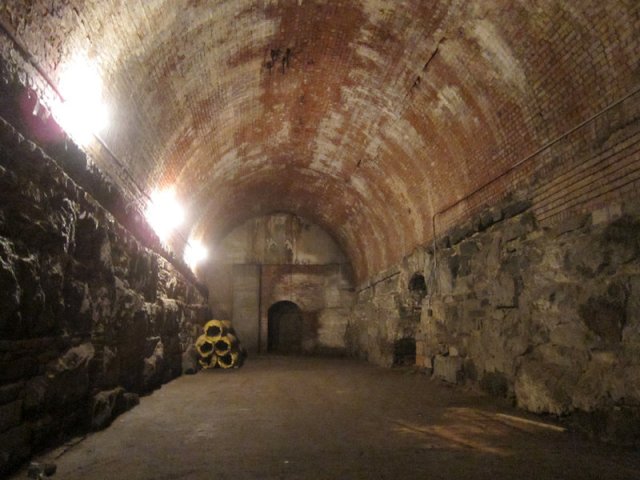
Hidden Wine Cellars Under The Brooklyn Bridge


In 1915, the year this photo was taken, liquor vendors were still allowed to use the cool, dark chambers under the bridge.
The Library of Congress

by Nicole Jankowski

A muted statue of the Virgin Mary received the revelers, a few hundred of New York City’s fortunate elite, as they navigated the recesses of the dark, cool caverns underneath the Brooklyn Bridge on the Manhattan side. An orchestra struck up the first chords of the “Blue Danube.” The ladies were careful not to lean against the slanted, peeling walls and the men minded their coattails. Amidst the stacks of wine crates stamped ANTHONY OECHS & CO., couples began to waltz. A bottle of fine champagne was passed around as a waiter produced a tray of crystal glasses. Overhead, Depression-era Packards and Hudsons motored along at a roaring 20 mph. It was July 11, 1934, and as The Pittsburgh Gazette eagerly explained, “the dry era” was finally over.

It was a celebration of new beginnings. When the Anthony Oechs wine distributors moved to the Brooklyn Bridge’s wine cellar, dormant for almost two decades — the vaults would once again do what they had been built to do when they were established in 1876, seven years before the bridge was even opened for travel.

The wine cellars had originally been constructed as a sort of compromise. As chief bridge engineer, Washington Roebling (and his father John A. Roebling before him), developed plans for a roadway connecting Brooklyn and Manhattan, the question loomed over what to do with two establishments that were in the path of construction. On the Brooklyn shore of the East River, Rackey’s Wine Company was doing steady business, and on the Manhattan side, Luyties & Co., sold its liquor to thirsty New Yorkers.

Roebling saw an opportunity to offset some of the bridge’s massive $15 million construction costs. It was an ingeniously perfect fit. The design of the bridge would allow for two wine cellars, one on each shore, along with several other vaulted chambers, to be incorporated into construction. The chambers would be rented out to local businesses, which used them mostly for storage, to help pay off the city’s debt.

The design of the Brooklyn Bridge allowed for two wine cellars, one on each shore.
Hulton Archive/Getty Images

Roebling’s plan worked, both architecturally and financially. According to The New York Times, as the bridge was erected in the 1870s, the wine vaults were built “beneath the ramps that lead up to the anchorages, within the arched granite and limestone approaches that span the intervening streets.”

Over the course of the next 40 years, several different liquor vendors would utilize the cellars below the bridge. City records indicate, for example, that in 1901, the “Luyties Brothers paid $5,000 for a vault on the Manhattan side of the bridge,” located at 204 Williams St., while in Brooklyn, “A. Smith & Company” forked over $500 a year to rent a wine cellar from 1901 until 1909.

Storing wine under the bridge made perfect sense. The caverns below the 60,000-ton granite entrances were dark and consistently cool, ideal places to house even the most delicate vintage Bordeaux, Burgundy or Champagne. And as the vaults became home to wines from across the globe, the dingy walls of the cellars were enhanced to reflect that heritage. The winding maze of caverns was transformed into a painted “labyrinth”, with the names of French streets—-Avenue Les Deux Oefs, Avenue Des Chateux Haut Brion— stenciled overhead. Over time, the cellar walls were festooned with illustrations of provincial Europe; designs of sinewy leaves and purple grapes trailed along the stucco in subdued hues.


The caverns below the 60,000-ton granite entrances were dark and consistently cool, ideal places to house even the most delicate vintage Bordeaux, Burgundy or Champagne.
Paul Fitzpatrick for NPR

Later, the waltzing guests of 1934 would take a turn surrounded by cellar walls which displayed long-faded quotations, such as this one, attributed to either Martin Luther, father of the Protestant Reformation, or Johann Heinrich Voss, a German poet:

Who loveth not wine, women and song,

He remaineth a fool his whole life long.

No one remembers exactly when the statue of the Virgin Mary made its way to the small alcove in the Manhattan cellars. Legend has it that a vendor may have transported the stone figure, plucked straight from the Champagne cellars of Pol Rogers in Epernay, France. Those who saw the Madonna statue watching over the bridge’s caverns likened the ethereal scene to Italy’s Grotto Azzurra, or the Blue Grotto of Capri. The statue mysteriously disappeared sometime around 1942, but the sobriquet lingered.

By the late 1910s, as America debated the vices of liquor, the wine was moved out and the cellars were converted into newspaper storage. But the end of Prohibition in 1933 enticed new wine distributors. The storied celebration on July 11, 1934 was held in honor of Anthony Oechs & Co.’s move into the bridge’s blue-black caverns. Champagne once again flowed through the Manhattan vaults. For just a few years, the era of the Blue Grotto would be reborn. After World War II, for logistical reasons, the city of New York would take over permanent management of the cellars.

But the rare few who have been allowed to visit the historic cellars in the past half century say they can still sense the spirits that once occupied the extraordinary space. If you squint hard enough, they claim you can make out a final homage to the cellars’ past imprinted in the 1930s on the crumbling wall: “Legend of Oechs Cellars: These cellars were built in 1876, about seven years prior to the official opening of the Brooklyn Bridge in 1883. From their inception, they housed the choicest wines in New York City.”

http://www.npr.org/sections/thesalt/2017/01/30/511204977/a-sip-of-history-the-hidden-wine-cellars-under-the-brooklyn-bridge

Science confirms link between slow walking and cognitive decline

Older people with a slow walking pace are at increased risk of cognitive decline and dementia, according to a new meta-analysis.

“In light of its characteristics of safety, cost-effectiveness, and ease to test and interpret, walking pace may be an effective indicator of the development of cognitive decline and dementia in older people,” Dr. Minghui Quan of Shanghai University of Sport in China and colleagues write in their report, published online December 6 in the Journal of Gerontology: Medical Sciences.

Past research has linked walking pace to cognitive dysfunction, but the size of the association and whether there is a dose-response relationship has not been studied systematically, the researchers state. To investigate, they reviewed 17 prospective studies of walking pace. Seven looked at cognitive decline, seven at dementia, and three studies included both outcomes.

The 10 studies of cognitive decline included nearly 10,000 participants, while the 10 studies with dementia as an outcome included more than 14,000. The slowest walkers had an 89% higher risk of cognitive decline (95% confidence interval, 1.54 – 2.31), but there was no linear relationship between walking pace and cognitive decline risk.

Dementia risk was 66% higher in individuals with the slowest walking pace versus those with the fastest pace (95% CI, 1.43 – 1.92). Three studies included data on dose-response relationship, and found a relative risk of cognitive decline of 1.13 for each decimeter/second drop in walking pace (95% CI, 1.08 – 1.18).

Walking pace may be an indicator of cognitive function for many reasons, Dr. Quan and colleagues note. For example, walking pace is associated with muscle strength, and muscle loss has been tied to inflammation, oxidative stress and other factors related to cognitive function.

Walking is not an automatic activity, they add, but “requires a seamless coordination of several neurologic systems including motor, sensory, and cerebellar activities.” Slow walking pace could also contribute to physical inactivity, they add, which in turn is associated with cognitive decline and dementia.

“Since a randomized clinical trial on walking pace and cognitive function may not be feasible due to practical considerations, future well-designed, large-scale, prospective cohort studies are needed to determine the age-, sex-, and population-specified cutoff values for walking pace, in order to enhance the effectiveness and efficiency of this early indicator of cognitive decline and dementia,” Dr. Quan and colleagues conclude.

Nicotine May Compensate for Brain Deficits in Schizophrenia

Regular use of nicotine may normalize brain activity impairments linked with schizophrenia, according to a study using a mouse model, published online in Nature Medicine. The finding may explain why up to 90% of people with schizophrenia smoke—most of them heavily.

“Basically the nicotine is compensating for a genetically determined impairment,” said researcher Jerry Stitzel, PhD, of the University of Colorado Boulder. “No one has ever shown that before.”

Dr. Stitzel is part of an international research team that investigated whether a variant in the CHRNA5 gene, which is believed to increase schizophrenia risk, is associated with a reduction of neural firing in the brain’s prefrontal cortex, or hypofrontality. Researchers also examined whether nicotine could interrupt the effect.

In mice with the CHRNA5 gene variant, brain images confirmed hypofrontality, researchers reported. Behavioral tests further revealed that the mice shared key characteristics of people with schizophrenia, such as an inability to suppress a startle response and aversion to social interaction. The findings, they explained, suggest the CHRNA5 gene variant plays a role in schizophrenia by causing hypofrontality.

Nicotine, however, seemed to reverse hypofrontality. When researchers gave the mice daily nicotine, their sluggish brain activity improved within 2 days. Within a week, it was normal.

Researchers believe the nicotine corrected the impaired brain activity by acting on nicotinic receptors in regions important for healthy cognitive function.

Noting that hypofrontality is also linked with addiction, attention deficit hyperactivity disorder, bipolar disorder, and other psychiatric conditions, researchers believe the discovery could lead to new nonaddictive, nicotine-based medications.

“This defines a completely novel strategy for medication development,” said lead author Uwe Maskos, PhD, of Institut Pasteur, Paris, France.

—Jolynn Tumolo

References:

Koukouli F, Rooy M, Tziotis D, et al. Nicotine reverses hypofrontality in animal models of addiction and schizophrenia. Nature Medicine. 2017 January 23;[Epub ahead of print].

Nicotine normalizes brain deficits key to schizophrenia [press release]. Boulder, CO: University of Colorado Boulder; January 23, 2017.

Zebra Shark Attains Ability of Asexual Reproduction and Has Babies Without a Male After Years of Isolation

bxeknm2xegkrde4mnrdu

by Rhett Jones

A female zebra shark in Australia has shocked scientists by producing three offspring after spending years away from her male partner. Subsequent analysis found that she had simply developed the ability to do it all on her own.

Leonie the zebra shark spent about 12 years living with a male at an aquarium in Townsville, Australia. In that time, the two sharks had 24 pups and life was good. Then, someone ripped Leonie from her home and family, placing her in a separate tank in 2012. After spending years away from any male sharks, Leonie suddenly gave birth to three healthy babies in 2016.

This caught the attention of Christine Dudgeon, a professor at the University of Queensland in Brisbane, Australia. Her first avenue of investigation was to make sure that Leonie had not somehow stored her former partner’s sperm and used it to fertilize her own eggs. When tests showed that the pups were only carrying their mother’s DNA, it became clear that the shark had likely achieved asexual reproduction.

According to New Scientist, “Some vertebrate species have the ability to reproduce asexually even though they normally reproduce sexually,” such as “certain sharks, turkeys, Komodo dragons, snakes and rays.”

But what makes Leonie’s circumstances especially rare is that asexual reproduction tends to manifest in females that have never had a sexual history. Reportedly, there have only been two other documented cases of this occurring—once with an eagle ray and another with a boa constrictor.

Russell Bonduriansky a professor at the University of New South Wales tells New Scientist, “In species that are capable of both reproductive modes, there are quite a few observations of switches from asexual to sexual reproduction.” But it’s extremely uncommon for the opposite to occur.

In the case of sharks, this is possible through a form of inbreeding that is far from ideal in the grand scheme of evolution. An adjacent cell, called a polar body, actually fertilizes the egg with the females own genetic material. “It’s not a strategy for surviving many generations because it reduces genetic diversity and adaptability,” Dudgeon says.

Scientists believe that this ability functions as a temporary mechanism to continue the species until a male partner can be found.

http://www.stumbleupon.com/su/1TcnDP/:1EWy9@euP:bm5m1PzY/gizmodo.com/zebra-shark-has-babies-without-a-male-after-years-of-is-1791261509

Listen with your eyes: one in five of us may ‘hear’ flashes of light

synaesthesia

A surprising number of people experience a form of sensory cross wiring in which light flashes and visual movements are ‘heard’, research finds.

One in five people is affected by a synaesthesia-like phenomenon in which visual movements or flashes of light are “heard” as faint sounds, according to scientists.

The findings suggest that far more people than initially thought experience some form of sensory cross-wiring – which could explain the appeal of flashing musical baby toys and strobed lighting at raves.

Elliot Freeman, a cognitive neuroscientist at City University and the study’s lead author, said: “A lot of us go around having senses that we do not even recognise.”

More florid forms of synaesthesia, in which disparate sensory experiences are blended, are found in only about 2–4% of the population. To a synaesthete, the number seven might appear red, or the name Wesley might “taste” like boiled cabbage, for instance.

The latest work – only the second published on the phenomenon – suggests that many more of us experience a less intrusive version of the condition in which visual movements or flashes are accompanied by an internal soundtrack of hums, buzzes or swooshes. Since movements are very frequently accompanied by sounds in everyday life, the effect is likely to be barely discernible.

When tested under laboratory conditions, the “hearing motion” effect appeared to enhance a person’s ability to interpret fine visual movements, but also interfered with the ability to hear real sounds when visual and audio signals were mis-matched.

“These internal sounds seem to be perceptually real enough to interfere with the detection of externally-generated sounds,” said Freeman. “The finding that this ‘hearing-motion’ phenomenon seems to be much more prevalent compared to other synaesthesias might occur due to the strength of the natural connection between sound and vision.”

In the study, published in the journal Consciousness and Cognition, 40 participants were presented with pairs of either visual or auditory Morse-code like patterns, and had to decide whether each pair contained the same or different sequences. Participants were then asked whether they were aware of hearing faint sounds accompanying the flashes.

Of the 40 participants, 22% reported hearing sounds accompanying the visual flashes in the ‘Morse-code’ task – and also tended to do better on this task.

“My data suggests there are two kinds of people,” said Freeman. “Those who generate sounds deliberately and those who get the internal sounds without trying.”

In a second task, participants had to detect faint sounds, similar to those given in audiology tests, presented with or without irrelevant visual flashes.

Those who scored better on the Morse-code task also appeared to find irrelevant light flashes more of a distraction to listening tasks, suggesting that the visual stimuli was effectively acting as an internal background noise.

In a separate study, the team tested for the phenomenon in trained musicians and found that it was much more common in the group. It is not clear if this is due to a natural disposition to link sounds and visual cues or whether thousands of hours of training might have strengthened the neural circuitry behind the effect.

https://www.theguardian.com/science/2017/jan/17/listen-with-your-eyes-one-in-five-of-us-may-hear-flashes-of-light-synaesthesia

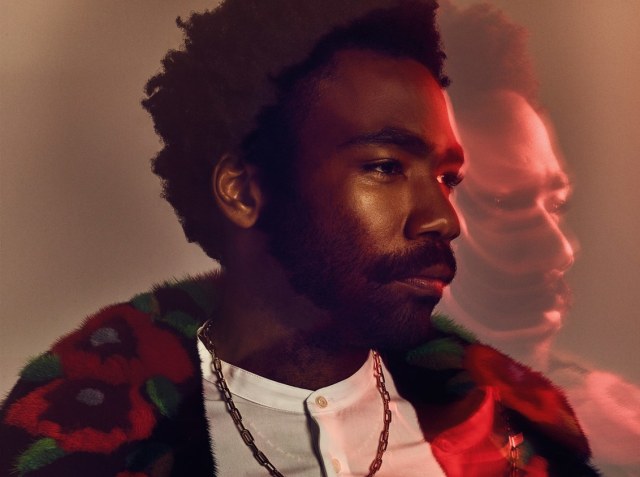
Inside the Weird, Industry-Shaking World of Donald Glover

DONALD GLOVER WISHES people would clap more. Not that they should applaud—he gets enough applause when he performs stand-up or when he gets recognized from Atlanta, the TV show he both writes and stars in. No, Glover’s talking about clapping to a beat. “I was listening to Donny Hathaway’s album Live at the Troubadour,” he says. “You hear the crowd harmonizing with every song and clapping to the beat on time. You don’t hear that at concerts anymore.”

It’s an odd thing to notice, maybe, but Glover has been listening to a lot of Hathaway lately, and to Bill Withers too—another soulful ballad singer. This may be part of the reason his onstage persona, Childish Gambino, has drifted from hip hop to something else. His latest album, Awaken, My Love!, sounds more like James Brown or Sly and the Family Stone. Possibly with a little Pink Floyd.

But more than that, Glover has been thinking a lot about performance and the different ways a performer can interact with an audience. Maybe it’s like church, he says, like gospel music. In many African American churches, clapping hands and tapping feet were requirements for attendance.“I don’t think black people go to church like that anymore,” Glover says.

Glover’s giving audiences someplace new where they can clap along. Lots of new places, actually. There’s the Burning Man–ish three-day concert in the desert that teed up his new album. Or, if you didn’t make it there, you can grab the virtual reality experience that goes along with it. Or just stream the album itself.

He has, in other words, a lot going on. There’s his TV show Atlanta, the stand-up comedy, and the weird supporting roles in giant movies (Glover was a rocket scientist who came up with the plan to save Matt Damon in The Martian). Oh, and he’s going to play Lando Calrissian in the Han Solo prequel Star Wars movie, set to begin filming in early 2017.

How does a young hyphenate put together a career like that in a time of entertainment-industry turmoil? A team of creative advisers and managers helps, but Glover was early to the multiplatform artist party. All of his projects intersect in strange, intertextual ways. So amid all the different platforms, there’s also world-building going on (both metaphorically and, with his new project, virtually). Glover may not be as mass-culture as some of the other artists experimenting in this territory—Beyoncé, Drake—but his ambition is to create something entirely new.

GLOVER GREW UP in Stone Mountain, Georgia, about 20 miles east of Atlanta; his mother ran a day care center and didn’t much care for music, but his father, a Postal Service worker, played everything from Hall & Oates to Funka­delic to the Police. “I remember listening to some of my dad’s music as a kid, like Parliament. I’d hear a woman moaning and groaning, and it was so scary because she sounded terrified,” Glover says. “That music was filled with so many different real emotions and feelings that you could listen to it again and again.”

By day, Glover lived in his imagination. His Jehovah’s Witness upbringing meant no television. He’d listen to bootleg audio of Simpsons episodes in bed at night, though he did manage to sneak into a viewing of Star Wars: Episode I and catch the occasional Muppet movie. It was a little weird, and he translated that weirdness into his own puppet shows, performing for the foster kids his parents took care of. “Being a Jehovah’s Witness amplified my own alienness,” he says. “Jehovah’s Witnesses don’t celebrate Christmas. You don’t pledge allegiance to the flag. People don’t understand that.”

But Glover understands people. He has an almost preternatural emotional intelligence; when we meet for the second time I give him a hug, and he calls me out on it: “What’s up with that hug? That didn’t have any feeling! Where’s my hug?” I try again. Glover is happily missing much of the stifling bravado that weighed down far too many male African American performers in, say, the 1990s. He’s in touch with all his feelings, and he seems to think everyone else should be too.

Combine youth, empathy, alienation, and love of performance and you get a drama major. Glover went to college at New York’s Tisch School of the Arts, where he joined an improv comedy group. When Tina Fey saw some of the short videos Glover made there, she hired him to write for her popular TV show 30 Rock. He had never written for television; he was 23 years old.“I decided I wanted to write for television because of Tina,” Glover says. “She was always so happy, and I was like, I want to be happy like that too.”

It worked. He was happy. He did stand-up, made funny sketch comedy videos on YouTube, wrote for 30 Rock for three seasons, and eventually joined the cast of the cult-hit sitcom Community, playing the young, earnest, deeply nerdy Troy—the only mostly normal person (a plumber messiah, but still). It was starting to seem like Glover could make a career out of that kind of code switch, an African American cast before a mostly white audience.

In 2011 Glover donned the Childish Gambino identity he’d worn in a few comedy videos and mixtapes and released a rap album. It was more hipster than hip hop, to be honest, and earned mixed reviews, but it got him a whole new audience—and his second album got two Grammy nominations. Small but significant parts in The Martian and Magic Mike XXL did even more. Whatever Glover did, more and more people were starting to clap along to the beat. A team of managers, artists, and technologists—Glover calls them Royalty—has had a say in almost every move in his career since 2012. At the core are Glover’s younger brother Steve and Glover’s manager, Chad Taylor. Fam Udeorji joined when Taylor met him on the road with Childish Gambino. They formed a management company, Wolf and Rothstein—Wolf is Taylor’s nickname, and Udeorji named himself after Ace Rothstein, Robert De Niro’s character in Casino.

Taylor and Udeorji manage a few other musicians who often hang out with Royalty and offer input. Ibra Ake, a photographer and art director, is the visual and creative expert. Glover’s artist buddy Swank rounds out the group. Hiro Murai, who directed a bunch of Childish Gambino videos, and producer Ludwig Göransson often hang out too. Gathered together for drinks in a Beverly Hills café, the subset of Glover’s team who join us look a little like fraternity brothers—not the jerk kind, the cute, smart, and nerdy kind. They used to meet every day, before the responsibilities of fatherhood started to rule Glover’s time, in a house he rented from Chris Bosh of the Miami Heat. “We’d just roll out ideas while making a sandwich or talking about life,” Udeorji says.

That’s how the idea for Atlanta began to come together. It was Glover’s hometown region, of course, but he had more in mind than just depicting a city that has become a cultural center for African Americans—Glover also wanted to explore what it’s like to be young, talented, and black in the South. He had in mind two other African American–led TV programs, from the comedians Bernie Mac and Dave Chappelle. “Those shows were so honest and so true,” Glover says. “Bernie Mac had a sister who was a crack addict on the show. It wasn’t funny, but it was real.”

To the FX network, Glover pitched the idea of a black Ivy League dropout who returns to Atlanta and begins managing his drug-­dealing cousin’s fledging rap career. It’d have drama, comedy, and music but also deal with issues like mass incarceration, poverty, drug use, and fatherhood in the black community. “We like to sit down with artists a few times and listen to what they say about their project,” says John Landgraf, president and general manager of FX. “With Donald, he didn’t always articulate his vision in a way that we could see it, but his passions and ambition were clear. So we felt confident in the story he wanted to tell and how he wanted to tell it.”
The challenge would be in getting the language and tone of the show right. Mess that up and Atlanta would be considered irrelevant or—worse—totally wack. Glover solved the problem in a way that is, in retrospect, obvious but practically unheard of in Hollywood: an all-black writing team, which included a few names that had never written a script for television before. “It wasn’t a conscious decision, really,” Glover says. “I knew I wanted people with similar experiences who understood the language and the mindset of the characters and their environment.”

Still, television is an industry that has only recently begun to acknowledge the need for diversity in front of the camera,much less behind it. “Listen, even BET wouldn’t have given him that much freedom,” says one television and film executive.“An all-black writers’ room is one thing, but for me it’s the number of writers who hadn’t written on a show before at all. Most networks aren’t going to take that chance.”

And it’s true, says Udeorji—one of the writers—that other networks didn’t really get the concept. But even though there were times when FX wasn’t exactly sure where Glover’s team was headed, the network let them go there. “Donald’s a rapper who has unique experience, because he worked with Tina Fey and that crew early on. That gave him a lot of clout with the network,” Udeorji says. “He showed us the ropes of character development and story structure and took the leadership role in the room, and then we just let the ideas out.”

That dynamic has led to some genre-breaking storytelling. Atlanta is a half-hour comedy about black people that makes no extra effort to explain black people to its viewers. You either get it or you don’t. One episode, “Value,” spends an entire scene at a dinner with Van (ex-girlfriend of Earn, Glover’s character) and her best friend. It’s 10 minutes of the most nuanced dialog seen on television between two women of color as they land brutally honest viewpoints on each other’s complicated lives. “That scene blew me away,” said Cheo Hodari Coker, a longtime TV writer who runs the Netflix show Luke Cage. “You never see that amount of time given to straight dialog. It was so real, like you were eavesdropping on someone’s conversation. That’s good television.”

The crew even contributed visual flair. “I like it when black people are hit with a certain light, like purple,” Glover says. So he and Murai started experimenting.“It just felt good to play around with the look of the show.”

IN EARLY 2016, with Atlanta in production, Glover was also thinking about his next album.

Roughly, he already knew what he wanted. “He came into our offices with a five-year vision of his music and the visuals that were to go with it,” says Daniel Glass, president of Glassnote Records, Glover’s label. “There aren’t a lot of artists that have that kind of clarity about where their career is headed.”

But fatherhood had altered his course. Glover doesn’t live particularly publicly—he didn’t announce his son’s birth on social media, for example—but he acknowledges that being a dad changed his ideas about some things. He spent months returning to the sounds of his own childhood, listening to the music his father played, and the first single from the new album, “Me and Your Mama” is a highly charged, funked-out lullaby of sorts for his new little one.

More than that, he wanted to find yet another way to connect with fans—not a traditional concert but what Glover describes as a “shared vibration.” He called Udeorji and Taylor with the concept: a three-day camping trip/performance installation in the desert to debut new songs and show off wild new visuals. Glover called it Pharos, named for the lighthouse at Alexandria, one of the seven wonders of the ancient world. “We were inspired by Kanye and other artists, but the vision for most things comes from Donald,” Taylor says. “For us it became figuring out how to make it all happen.”

They watched concert films and talked about imagery they liked—for example, the digital mountain from Kanye’s Yeezus tour in 2013. But bringing fans in became Miles Konstantin’s job. The 22-year-old had started a fan site for Childish Gambino in high school that so impressed Glover, he hired the kid. Konstantin studied physics in college by day, and he and his two roommates worked on Glover’s website at night.

For Pharos, Konstantin designed an app with a countdown anda slowly approaching planet Earth—and the option to buy a ticket to something for $99, locked to the owner of the phone and therefore unscalpable. (Glover wanted to keep ticket prices down.)

Once you bought a ticket, you got a guidebook and an app-based mani­festo about the human condition during the digital age. The first shows sold out in six minutes; Glover added two more. But the concert came with a draconian rule: Members of the audience would have to surrender their phones on entry. “Today, kids’ idea of going to a concert is proving that they are there on Snapchat or Instagram,” Glover says. “We wanted to give them a complete show and have their attention.”

Even that didn’t dissuade anyone. “We weren’t completely sure how fans would handle that part, but Donald’s fans are very open-minded,” Konstantin says.

Step two: Build the set. The concerts would happen in a giant white dome in Joshua Tree, California. Dancing zombies and ghostlike creatures would sway to the tunes on screens and interact with sounds in their environments. Glover performed in a yellow grass skirt, long cornrows, and glow-in-the-dark tribal war paint. It was like a cross between Captain EO and Fantasia,complete with a grand finale flight through space, featuring planets moving to the beat.

To get it all right, Glover went to Microsoft. “He came in with his music and a story and asked how we could accommodate his ideas,” says Fred Warren, creative director for the company. When the computer-­generated characters planned for massive screens inside the performance dome weren’t moving the way Glover’s group envisioned, Warren’s team figured they had only one choice: Go to the source. “We decided the best way to showcase the moves on the screen was to have Donald create them and use Kinect sensors to capture his every dance move.” Glover spent a day at Microsoft’s New York office performing the movements of the zombies and ghosts, much like in those puppet shows he used to put on as a kid.

Beyond the high tech animation, the new Childish Gambino album is pretty great. Awaken, My Love! is a chaotic mix of funk, punk, and R&B infused with a new age vibe. On more than a few tracks, Glover uses falsetto like Luther Vandross—and Withers and Hathaway.

And once Microsoft had all that mo-capped performance and computer-­generated set design, the next step was almost self-­evident. You can buy Awaken, My Love! on old-school vinyl, but you can also watch the video in way-new-school virtual reality using your mobile device. 1 It’s not quite like seeing Pharos in Joshua Tree, but it’s close.

DAVE CHAPPELLE WALKED away from his wildly popular eponymous show on Comedy Central (and the $50 million that came with it) in 2005. He was arguably at the peak of his success, but the mercurial comedian had begun to feel that white audiences were laughing at his sketches and jokes about black people without absorbing them, without picking up the social message.

Glover has made himself a student of Chappelle’s, including trying to understand that specific kind of disconnect with the audience. “On some level, the situation Dave faced is probably already happening,” Glover says. “But that’s why it’s so good to have a room filled with people who understand what you’re trying to do. You’ve got to have someone willing to say ‘I don’t enjoy that.’ That makes you step back and rethink when someone says that shit doesn’t work.”

The parallel to Chappelle isn’t a perfect one. Both are influential African American comedians, but their MOs aren’t equivalent. Glover is much younger and fundamentally a well-adjusted, middle-class kid. When he performs, he’s not drawing from anger or a tough childhood. He’s connecting to a wider emotional spectrum, and that seems to give him a broader performance palette. Even Chappelle—a fan of Glover’s—acknowledges the differences. “I can’t keep up with all the shit he’s doing, but it’s all damn good. That he can do it all blows me away,” Chappelle says. “But my show was a sketch show, and Donald’s is more of a regular sitcom. And then we’re in a different time. Race is more nuanced today, and that helps the message. It’s been 10 years.”

A lot changes in a decade. If Chappelle and the late Bernie Mac opened up possibilities for a performer like Glover, now it’s Glover’s turn to rough out a frame for the next generation. Leveraging personal work to reach unpredictable audiences who stay loyal through unpredictable projects won’t be unusual—it’ll be the norm. And that’ll encourage more weird media, beyond live shows and VR, and even more unpredictability. Chappelle’s Show wore its politics on its sleeve—the things Chappelle wanted you to understand were text. Atlanta and the music and video work of Childish Gambino are about feelings and subtext, opening new worlds for creators to explore and audiences to experience. The worlds may be odd and their rhythms idiosyncratic—but you’re going to want to clap along.

https://www.wired.com/2017/01/childish-gambino-donald-glover/