CO2 causing oceans to acidify at ‘unprecedented’ rate, scientists warn

<> on June 9, 2010 in Houma, Louisiana.

By Susannah Cullinane, CNN

The world’s oceans have become 26% more acidic since the start of the Industrial Revolution and continue to acidify at an “unprecedented rate,” threatening marine ecosystems, aquaculture and the societies that rely on them, scientists say.

In a report released Thursday, researchers say that carbon dioxide emissions from human activities such as fossil fuel burning are the primary cause of ocean acidification.

They say the rate of change may be faster than at any time in the last 300 million years, predicting that by 2100 there will have been a 170% increase in ocean acidity, compared to pre-industrial times.

The report is based on the findings from a September 2012 Symposium on the Ocean, at which 540 experts from 37 countries discussed research on ocean acidification, and has been updated with more recent research.

Unless carbon dioxide emissions are reduced, marine ecosystems will be damaged and the impact of climate change will be worsened, the scientists warn. “The only known realistic mitigation option on a global scale is to limit future atmospheric CO2 levels.”

The report says oceans currently act as a CO2 “sinkhole” absorbing approximately a quarter of emissions.

“As ocean acidity increases, its capacity to absorb CO2 from the atmosphere decreases. This decreases the ocean’s role in moderating climate change,” they write.

The increased acidity will also change the ocean environment, with evidence suggesting that some organisms will be less able to survive, while others, such as seagrass, may thrive.

Acidification is faster in Arctic waters because cold water is richer in CO2, while melting sea ice worsens the problem, they say.

“Within decades, large parts of the polar oceans will become corrosive to the unprotected shells of calcareous marine organisms,” the report says, while in the tropics the growth of coral reefs may be hampered.

“People who rely on the ocean’s ecosystem services are especially vulnerable and may need to adapt or cope with ocean acidification impacts within decades,” it says. “Tropical coral reef loss will affect tourism, food security and shoreline protection for many of the world’s poorest people.”

“Very aggressive reductions in CO2 emissions are required to maintain a majority of tropical coral reefs in waters favorable for growth,” the report says.

One of the report’s authors is Daniela Schmidt, from the University of Bristol, in the UK.

Schmidt said the research highlighted the impact acidification would have on biodiversity and aquaculture and the societies that rely on them for their food and economic well-being.

“We’re talking about countries that strongly depend on this, in warmer countries where there are complex problems with climate change as it is,” Schmidt said.

“What I’m hoping is that people realize that CO2 is not just a question of global warming. That we are acidifying the ocean at a rate that has been unprecedented — for millions and millions of years,” she said.

“The more CO2 emissions, the more acidification,” Schmidt said. “The ocean is in direct interchange with the atmosphere.”

If acidification continued to increase at its current rate, “you will definitely see damage,” she said. “The first signs we can already see today, in oyster farms off the West Coast of the United States.”

Schmidt said while 90% of the world’s ocean was in equilibrium with the atmosphere, some oyster hatcheries in this area were located in the 10% that wasn’t.

Oysters in the larval stage were much more vulnerable to damage, she said. “When (more acidic) water comes up and hits the hatchery, they close the whole thing.”

While tanks could be closed off to more acidic seawater, Schmidt said that by 2100 the issue would be there every day. “So we can’t just switch off that tap anymore.”

She said the report would be presented in Warsaw, Poland, on November 18, during the U.N. Conference of the Parties climate change meeting.

Schmidt said while she hoped the research would lead to stricter emissions limits, “the realist in me thinks that we’ve been discussing this for decades. This isn’t a problem that is just going to go away. It’s simple. The consequences are frightening.”

The 2012 symposium that led to the report was sponsored by the Scientific Committee on Oceanic Research, the Intergovernmental Oceanographic Commission of UNESCO, and the International Geosphere-Biosphere Programme.

http://www.cnn.com/2013/11/14/world/ocean-acidification-report/index.html?hpt=hp_t3

Japanese inventions signal the future changes in human relationships

art-coat-200x0

A Guardian article about Japanese young people no longer being interested in sex and relationships has generated a lot of blogosphere criticism recently, primarily about Western media exoticising “weird” Japanese culture. Those criticisms duly noted, there have also been some recent Japanese innovations that seem to not only support the premise of the article – that technology is taking over the space once occupied by sex and dating – but take it further. Several recent inventions in Japan seem not only likely to disrupt traditional relationships in the way that social media or text messaging has, but to physically replace companionship and affection. A report this week of the physiological benefits of using the Hugvie, a soft doll that simulates a human heartbeat so that the user can “cuddle” with the person on the other end of their phone, is one such case.

Here are some Japanese inventions, like the Hugvie, that may be the most solid proof that Japan is indeed throwing out the idea of relationships and becoming a dystopian future of human loneliness.

The Hugvie is a soft body-fitting pillow with a slot in the head for a smart phone. Users can cuddle with the pillow while talking on the phone, and the pillow’s internal vibrators generate a simulated heartbeat of the caller based on the voice’s tone and volume. In other words, the soft, “blobular” doll transforms a standard phone conversation into a “cuddling” experience with your phone companion. The gizmo was invented by an Osaka University professor who built off of an earlier remote-controlled doll.

A video from the product’s launch last year shows users talking into the phone end and cradling their pillows, and new evidence suggests that the pillow might be as satisfying and soul-warming as the video portrays: a joint study from the University of Sussex and Osaka University that levels of the stress hormone cortisol were reduced in people after using the pillow.

Wine for cats
Earlier this month, a Japanese company took the age-old stereotype of the lonely cat woman and made it a little less lonely with the invention of Nyan Nyan Nouveau, a non-alcoholic feline wine. Masahito Tsurimi, the chief executive of the company behind the wine, told the Wall Street Journal that it was invented in response to requests from cat-owners – despite the fact that only one in 10 cats were willing to taste it.

Tsurimi said he saw a bright future in the “specialty pet-drink business” six years ago when he was worried about where future beverage sales would come from with a shrinking, ageing Japanese population. It was probably just a nice bonus when he read about the country’s sexual aversion and social awkwardness on top of that.

The girlfriend coat
In April of this year, RocketNews 24 reported that a group of engineering students at Tsukuba University created a coat that could hug its wearer and whisper phrases into its ear. Meant to simulate a girlfriend, motors in the coat operate the “arms” that squeeze the wearer when he puts it on. In a pair of headphones he slips on with the coat, he also hears one of a number of programmed phrases: “I’m sorry, were you waiting?” and “Guess who?”

The university students named it the Riajyuu Coat. According to gaming site Kotaku, riajyuu is a mash-up Japanese word that means someone who is pleased with his non-virtual life. Unlike some of the other replacements for human contact, this one appears to have just been a joke between friends, and the inventors have no real plans to release it commercially.

Video game relationships
Japan has cultivated a global reputation for their romantic simulation video games, and for good reason: while some of the games are just bizarre, like a game in which both the player and his mate are pigeons, others mimic relationships down to eerily small details. LovePlus, for instance, a dating simulation game released in Japan in 2009, invites players to choose one girl that they prefer out of three types – a “goodie-goodie”, “sassy”, or “big-sister” type – and then earn “boyfriend power” points by going to the gym or doing homework to become smarter. The girl can get mad at their boyfriends, too: in a 2010 article, LovePlus gamer Shunsuke Kato told the Wall Street Journal he was on the outs with his LovePlus “girlfriend” for being busy at work and only playing the game for 10 minutes a day.

The game has blurred the line between real and virtual to such an extent that a Japanese resort town once known for honeymooning, Atami, launched a promotional campaign in 2010 that relied on recreating the virtual trip to Atami from the game. At Atami’s (real) Hotel Ohnoya, the staff was trained to check in single men as couples, and restaurants created Love Plus-inspired menus for the gaming guests.

If there’s some silver lining to be found in all of this, it’s that a business opportunity will be there to pad the landing when humans do something self-destructive. As Japan has demonstrated, the risk of a plummeting birth rate and the social instability inherent in becoming a society where unmarried people exist in large numbers at least opens up the possibility for bizarre romance-gamer tourism, wine for cats and pillows you can cuddle with.

http://m.smh.com.au/digital-life/digital-life-news/bizarre-japanese-inventions-signal-the-future-of-human-loneliness-20131104-2ww7d.html

Thanks to Kebmodee for bringing this to the attention of the It’s Interesting community.

Li-Fi – A plan to turn every lightbulb into an ultra-fast alternative to Wi-Fi

lifi-thing2

Current wireless networks have a problem: The more popular they become, the slower they are. Researchers at Fudan University in Shanghai have just become the latest to demonstrate a technology that transmits data as light instead of radio waves, which gets around the congestion issue and could be ten times faster than traditional Wi-Fi.

In dense urban areas, the range within which Wi-Fi signals are transmitted is increasingly crowded with noise—mostly, other Wi-Fi signals. What’s more, the physics of electromagnetic waves sets an upper limit to the bandwidth of traditional Wi-Fi. The short version: you can only transmit so much data at a given frequency. The lower the frequency of the wave, the less it can transmit.

But what if you could transmit data using waves of much higher frequencies, and without needing a spectrum license from your country’s telecoms regulator? Light, like radio, is an electromagnetic wave, but it has about 100,000 times the frequency of a Wi-Fi signal, and nobody needs a license to make a light bulb. All you need is a way to make its brightness flicker very rapidly and accurately so it can carry a signal.

The idea sounds daft: Who would want to sit under a flickering bulb? But Li-Fi, a standard proposed just two years ago, is seeing rapid technological progress.
First, data are transmitted to an LED light bulb—it could be the one illuminating the room in which you’re sitting now. Then the lightbulb is flicked on and off very quickly, up to billions of times per second. That flicker is so fast that the human eye cannot perceive it. (For comparison, the average energy-saving compact fluorescent bulb already flickers between 10,000 and 40,000 times per second.) Then a receiver on a computer or mobile device—basically, a little camera that can see visible light—decodes that flickering into data. LED bulbs can be flicked on and off quickly enough to transmit data around ten times as fast the fastest Wi-Fi networks. (If they could be manipulated faster, the bandwidth would be even higher.)

Li-Fi has one big drawback compared to Wi-Fi: you, or rather your device, need to be within sight of the bulb. It wouldn’t necessarily need to be a special bulb; in principle, overhead lights at work or at home could be wired to the internet. But it would mean that, unlike with Wi-Fi, you couldn’t go into the next room unless there were wired bulbs there too.

However, a new generation of ultrafast Wi-Fi devices that we’re likely to start using soon face a similar limitation. They use a higher range of radio frequencies, which aren’t as crowded with other signals (at least for now), and have a higher bandwidth, but, like visible light, cannot penetrate walls.

Engineers and a handful of startups, like Oledcomm, have been experimenting with Li-Fi technology. The Fudan University team unveiled an experimental Li-Fi network in which four PCs were all connected to the same light bulb. Other researchers are working on transmitting data via different colors of LED lights—imagine, for example, transmitting different signals through each of the the red, green and blue LEDs inside a multi-colored LED light bulb.

Because of its limitations, Li-Fi won’t do away with other wireless networks. But it could supplement them in congested areas, and replace them in places where radio signals need to be kept to a minimum, like hospitals, or where they don’t work, such as underwater.

http://qz.com/137221/a-plan-to-turn-every-lightbulb-into-an-ultra-fast-alternative-to-wi-fi/#

An army of robot baristas could mean the end of Starbucks as we know it

briggo_temple

By Christopher Mims — October 17, 2013

Starbucks’ 95,000 baristas have a competitor. It doesn’t need sleep. It’s precise in a way that a human could never be. It requires no training. It can’t quit. It has memorized every one of its customers’ orders. There’s never a line for its perfectly turned-out drinks.

It doesn’t require health insurance.

Don’t think of it as the enemy of baristas, insists Kevin Nater, CEO of the company that has produced this technological marvel. Think of it as an instrument people can use to create their ideal coffee experience. Think of it as a cure for “out-of-home coffee drinkers”—Nater’s phrase—sick of an “inconsistent experience.”

Think of it as the future. Think of it as empowerment. Your coffee, your way, flawlessly, every time, no judgments. Four pumps of sugar-free vanilla syrup in a 16 oz. half-caff soy latte? Here it is, delivered to you precisely when your smartphone app said it would arrive, hot and fresh and indistinguishable from the last one you ordered.

In a common area at the University of Texas at Austin, the Briggo coffee kiosk, covered in fake wood paneling and a touch screen and not much else, takes up about as much space as a pair of phone booths. Its external appearance was designed by award-winning industrial designer Yves Behar, with the intention that it radiate authenticity and what Briggo says is its commitment to making coffee that is the equal of what comes out of any high-end coffee shop.

The kiosk at the university is the second version, the one that will be rolling out across the country in locations that are still secret. It needs just 50 square feet (4.6 sq m) of floor space, and it can be dropped anywhere—an airport, a hospital, a company campus, a cafe with tables and chairs and WiFi just like Starbucks. It’s manufactured in Austin.

Inside, protected by stainless steel walls and a thicket of patents, there is a secret, proprietary viscera of pipes, storage vessels, heating instruments, robot arms and 250 or so sensors that together do everything a human barista would do if only she had something like perfect self-knowledge. “How is my milk steamer performing? Am I a half-degree off in my brewing temperature? Is my water pressure consistent? Is there any residue buildup on my brewing chamber that might require me to switch to a backup system?”

The Briggo coffee kiosk knows how to make a perfect coffee because it was “trained” by an award-winning barista, Patrick Pierce. He’s since left the company, but no matter: as in the techno-utopian Singularity, whose adherents believe that some day we will all upload our brains to computers, once a barista’s essence has been captured by Briggo, his human form is just a legacy system.

Besides, baristas, especially the ones at America’s favorite “high end” coffee shop, don’t often stick around long enough to become as good as Pierce. Turnover at Starbucks, which is typical of all demanding retail environments, leads to what Nater calls “variation,” and not the kind that’s exciting—the kind that coffee connoisseurs frown upon, because it means coffee isn’t being extracted from beans in the optimal way.

“What we’ve created is in essence a small food factory that absolutely replicates what a champion barista does,” says Nater. Briggo roasts its own beans—sourced by a pair of coffee supply veterans who between them spent a combined 40 years at Starbucks. “We have calibrated this machine to pull espresso shots to the same specification as an Illy or a Stumptown or an Intelligentsia. We’ve just done it without the human element.”

Ever stood in line at a Starbucks or some other cafe and wondered why, in the year 2013, you can’t just send in your order 10 minutes early via an app on your phone, and pick it up as soon as you walk in? Briggo has such an app. It asks you to log in, so it can memorize your order and payment information, which enables one-click coffee ordering. Or you can order a coffee for a friend. And use the app to check out how long the wait is for a drink. Fifteen minutes? Just complete your order now, while you’re walking across campus—it will be ready by the time you arrive. Hit another button to announce on Facebook that you’ll be at the Briggo kiosk by 9:30, and hey, who wants to meet up?

“What we find at [the University of Texas] is that we have a younger generation of consumers who have no inhibition about ordering remotely and having self service,” says Nater. “Coffee shops are a great social interaction point, but so is social media.”

Had a great experience at Briggo? Why not tweet that? Invented a new combination of syrups and brew temperatures and other elements that yields the perfect drink? Tweet that, too. Briggo will make you an espresso, a latte, even an iced coffee made with a cold-brew process, something even many coffee shops don’t offer because it’s time consuming to produce. Not a coffee drinker? How about a chai latte, an ice chai latte, hot chocolate, or milk steamer?

In 2012, Julian Baggini, a British philosophy writer and coffee aficionado, wondered why dozens of Europe’s Michelin-starred restaurants were serving guests coffee that came out of vacuum-sealed plastic capsules manufactured by Nespresso. So he conducted a taste test on a small group of experts. A barista using the best, freshly-roasted beans went head to head with a Nespresso capsule coffee brewing machine. It’s the tale of John Henry all over again, only now it was a question of skill and grace rather than brute strength.

As the chefs at countless restaurants could have predicted, the Nespresso beat the barista.

Capsule coffee systems make consistent only two steps in the coffee-making process, but they’re the most important ones: Roasting and brewing. Beans roasted in a factory don’t change from the moment they’re vacuum-sealed into a capsule, because oxygen is the agent that causes food to go stale. (By contrast, beans roasted “fresh” are oxidizing continuously, until they’re brewed.) And the coffee-brewing process is complicated enough that achieving its most perfect expression requires a machine free from human interference.

“With a pre-dose capsule, it’s always the right grind,” says Mark Romano, a senior director at Illy coffee, which makes its own line of capsule coffee systems. “And with a self-contained extraction chamber, you can consistently get to 80-90 [out of a quality scale of 100].”

Capsule brewing systems can now control more variables in the brewing process—the relevant ones being temperature, pressure, and the way in which water reaches the ground beans—than even the best machine at an average Starbucks, says Romano.

“In any system you work with, the biggest risk you have to quality is the residual coffee oils that become oxidized, rancid and stale. They are conveying flavors into the next cup,” says Romano. Cleaning these machines properly is hard, and may just replace the problem of residual coffee oils with the problem of residual cleaning products. A capsule system, being disposable, is immune to these problems. It also, claims Illy in its promotional literature, “ensures a complete saturation of all the particles in the capsule,” something traditional brewing systems have trouble achieving.

I ask Romano whether Starbucks would be better off serving its customers coffee brewed from capsules. “I think in many cases they would. Perhaps a large percent of their locations should be using capsules.” Romano also notes that while Illy still employs “baristi” in many of its 240 cafes in Europe, there are only eight Illy cafes in North America, mostly because it’s impossible to find baristi who have been trained to the company’s exacting standards.

I also asked Starbucks if it would ever increase the amount of automation it already uses in its stores. Linda Mills, a spokesperson for the company, would say only that it wouldn’t move in this direction because an automated barista would “diminish what we offer every day.”

What she means, presumably, is the experience of being served by a human being. But is that enough?

Briggo’s leaders assert that they are “fanatical” about coffee, and that automation is primarily an enabler that will, as Nater puts it, “allow us to get large fast.” Their recent hire of Starbucks vets who have backgrounds in sourcing, blending and inventing new and seasonal drinks is, they say, about making something that is the equal of any other “third-wave” coffee shop like Starbucks or Stumptown.

Generally automation in food service has meant first standardizing the foods to be prepared, which means robbing them of their individual character. Currently, Briggo sells only a single blend of beans from three countries. But there’s nothing stopping the kiosk from dispensing single-origin coffees and adjusting its every parameter to accommodate a new crop of beans, says Nater.

The Briggo coffeebot “can measure humidity and shock time and can automatically adjust the grind of the bean to compensate,” he says. “We have visibility with that bean. We track every single shot of espresso. We know if it’s within our quality spec, and we fully control the whole supply chain. We can go well beyond what a high-attrition part-time employee can do.”

Briggo doesn’t have to be better than the best baristas in the world. It just has to be better than the nearest coffee shop. Think of this not as the epic chess showdown between Garry Kasparov and the IBM computer Deep Blue; think of Briggo, rather, as the Redbox video kiosk to Starbucks’ Blockbuster.

Still, there are limits to the Redbox/Blockbuster analogy. Blockbuster went into decline because it couldn’t offer anything that wasn’t offered by video kiosks or, more importantly, online-streaming services like Netflix. But as Romano of Illy points out, a coffee vending machine can’t reproduce the experience of a coffee shop. “Coffee is something social—do you really want to replace the social value of [your barista]?” he asks. And indeed, Nater told Melanie Kaplan of Smartplanet, ”We’re not asking people to stop going to coffee shops.”

But Briggo is hoping to at least displace Starbucks somewhat. Tim Kern, a 22-year veteran of Starbucks who joined Briggo in July, observes that some of the places where the company is scouting locations, like public areas in corporate campuses, are the sort where people might get both their social and their caffeine fix rather than trek to a nearby coffee shop. It’s not unlike the disruption of the PC industry by tablets and smartphones: these mobile devices haven’t replaced the PC, but they certainly reduce the number of occasions when you need one.

For now, a direct replacement for Starbucks—imagine a cafe with a host but no baristas—is not in Briggo’s business plan, though the company’s leaders have discussed it in the past, says Kern. (Romano is skeptical of such ideas: “We could go back to the 50′s, where you could go into the Automat, where you’d have those machines where you could get whatever you wanted, but what is the real value of that experience?” he asks.) The near-term plans are to move into places with bad coffee—think universities, hospitals, airports and corporate cafeterias—and improve the offerings. “With just 50 square feet we can create a barista-quality experience in a location where a coffee shop can’t have the economics to operate,” says Nater.

Barista robots are barely even a thing yet, and already the space is getting crowded. One company aiming for the lower end of the market is Marley Coffee, which in partnership with vending machine manufacturer AVT has developed “an Android-based coffee kiosk that comes with a full touchscreen automated checkout system,” says Joe Menichiello, vice president of sales and marketing at AVT.

One model sports a gigantic, 48-inch (122 cm) touchscreen. “You press the type of coffee you want, and specify how much sugar you want, and you swipe your card, and while it’s being ground and brewed for you, it’s playing Bob Marley music,” says Menichiello. Yes, Marley coffee is named for that Marley. ”Bob Marley is one of the top 10 most recognized names in the world,” says Menichiello. “From a branding standpoint it’s a no-brainer for us.”

AVT’s system isn’t nearly as sophisticated as Briggo’s—there is, for example, no expertly foamed, market-fresh milk here, just the powdered kind—but still, says Menichiello, “we’re grinding the beans individually for each and every customer. Ours will have that crema [the oils from coffee beans] on top that coffee won’t have unless it’s just been ground.” This, he says, “makes it almost better than at any brick-and-mortar coffee shop.”

The parts that go into a Marley Coffee kiosk are at this point standard enough that AVT expects to have plenty of competition. “Coffee is coffee and there are a lot of companies that follow the same model as us,” says Menichiello. “When we were at NAMA—the big vending convention in Las Vegas—I was looking around and there were a lot of machines where you could press a button and they’d do the bean to cup thing where it’s ground fresh for every customer.”

Indeed, one of AVT’s competitors is Starbucks itself. It already has a deal with Redbox to put coffee kiosks everywhere there’s currently a Redbox DVD rental kiosk, under the Seattle’s Best brand that Starbucks owns. These systems are actually built by Coinstar, which owns Redbox, and the machines go by the trade name Rubi.
But there are nonetheless different niches within the market. Starbucks’ kiosks tend to be aimed at convenience stores and supermarkets. Briggo is going after a higher-end customer. Marley Coffee sits somewhere in the middle, and is putting its systems into airports (where Briggo also has ambitions) and university bookstores.

There are two ways for an upstart to disrupt an incumbent like Starbucks: One is to deliver a better experience, which Briggo’s leaders believe they can do through a combination of convenience and technological whiz-bang, and the other is to compete on price. A cup of organic coffee from the Briggo kiosk is $1.40, while a cup of drip (non-organic) coffee at Starbucks is $1.85 in many locations. The difference in price reflects, in part, the difference in the expense structure of the two approaches: Briggo doesn’t have to deal with the overhead of all that human labor, and at present it also doesn’t have to think about the cost of renting all that retail space.

Briggo has raised “in excess of $11 million,” says Nater, and while it has only “about 20 employees,” it has managed to stack its executive suite with with people who have deep experience in building and running technology companies that scale. Briggo founder Charles Studor was formerly the head of the billion-dollar integrated circuit division at Motorola/Freescale. The CIO, John Craparo, was formerly the CIO of GE Capital and Dell Financial Services. Briggo’s VP of engineering spent 25 years leading manufacturing projects at Johnson & Johnson. The Briggo kiosk is designed in collaboration with Deaton Engineering, which has created everything from battle-hardened PCs for the Air Force to industrial waste-bailing systems.

“Our aspirations are to build a global business,” says Nater. “We’ve had interest from the Middle East, North America and Asia. We think this model works very well in Asia where a mobile platform and automated experience has been adopted heavily.”

Two big unknowns loom over Briggo and anyone else trying to follow its lead. The first is whether or not people will, at least some of the time, accept a coffee kiosk as a substitute for a coffee shop, even if the product is the same or better. And the second is whether Briggo’s high-end machines can deliver a cup of coffee so much better that cheaper competitors like Marley and Seattle’s Best can’t crowd them out.

But it’s still early days. Starbucks itself was an example of how an evolving company can take a winding path toward finding its perfect market fit, says Kern. When Kern started at Starbucks, the company was still trying to be a “retail experience” designed to sell coffeemakers and beans. But customers kept coming in demanding a cup of coffee, so eventually it decided to change direction. “What Starbucks turned into is something I could not have conceived when it was just six stores,” says Kern.

It’s also worth noting that in a key sense, Briggo isn’t a coffee company. It would be hard pressed to beat all the others on the quality of its beans. Rather, it’s an automation company, whose special skill is in creating computerized robot systems than can be endlessly refined and elaborated. Which means that if another company were to try to acquire Briggo, rather than a larger coffee conglomerate or a food retailer, why not one that is all about the perfection of automated processes—like Amazon?

http://qz.com/134661/briggo-coffee-army-of-robot-baristas-could-mean-the-end-of-starbucks-as-we-know-it/#

Thanks to Kebmodee for bringing this to the It’s Interesting community.

New Solar Plant in Arizona Powers 70,000 Homes Day Or Night

solar power

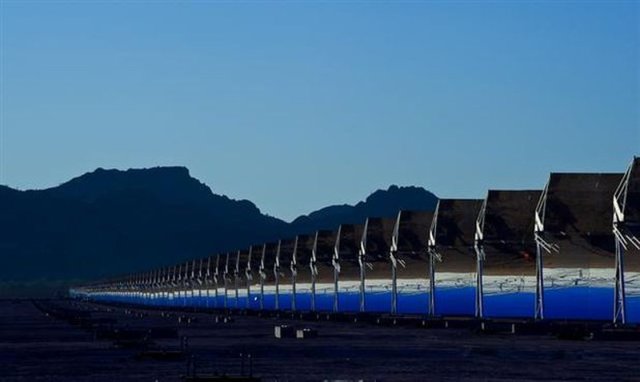
Outside Phoenix, Ariz., on Wednesday, a power company turned on one of the largest solar power plants of its kind in the world. But unlike other solar farms, this plant continues giving power to 70,000 Arizona households long after the sunset.

The Solana plant uses 3,200 mirrors that are tilted so they focus the sun’s rays to heat a specially-designed oil. That boils water, which drives turbines and generates electricity. Or, the oil can heat giant tanks of salt, which soak up the energy. When the sun goes down, or when households need more power, the hot salt tanks heat up the oil, which again boils water to drive the turbines.

Whereas conventional solar panels only give power when the sun is up, these giant salt batteries give renewable energy on demand. They can store six hours-worth of energy, which can meet the demands of Arizona customers, according to months of test data.

“That’s the sort of thing you can do with a conventional gas plant that no one had envisioned doing with renewables,” says Patrick Dinkel, vice president of resource management for Arizona Public Service, which is Arizona’s largest utility company.

The company has already bought the power from this plant for the next 30 years, to add to the state’s goal of generating 15 percent of its energy from renewable sources by 2025. The plant does mean higher energy bills for APS customers — an extra $1.28 per month for the first five years, $1.09 per month for the next five, and then 94 cents per month after that, according to the company. Dinkel says the state won’t see a lot more of these plants soon because that would cost too much.

“Right now natural gas wins that race (for cheap power,)” Dinkel says. “The challenge is no one knows what those economics look like in five years.”

The U.S. Department of Energy lent Abengoa Solar, the Spanish company that built that plant as well as Europe’s first solar thermal power plant, $1.4 billion, out of the $2 billion price tag. It’s the same program that financed Solyndra, a solar panel firm that went bankrupt in 2011. But this is a different kind of investment, says Armando Zuluaga, general manager of Abengoa Solar. He points out the company already has a public utility buying their output for the next 30 years, so the government will get its money back with interest.

“There’s no market risk here,” Zuluaga says. “It’s just about getting the plant built.”

This won’t be the last we hear of Abengoa Solar and this technology. The company is building a similar, though smaller plant in the Mojave desert in California, which will come online next year, as well as plants in South Africa.

http://www.npr.org/blogs/thetwo-way/2013/10/11/232348077/in-ariz-a-solar-plant-that-powers-70-000-homes-day-or-night

Thanks to Ray Gaudette for bringing this to the attention of the It’s Interesting community.

International Panel on Climate Change (IPCC) issues new stark warning over global warming

bnurning earth

Scientists will this week issue their starkest warning yet about the mounting dangers of global warming. In a report to be handed to political leaders in Stockholm on Monday, they will say that the burning of fossil fuels and deforestation have now led to a warming of the entire globe, including land surfaces, oceans and the atmosphere.

Extreme weather events, including heatwaves and storms, have increased in many regions while ice sheets are dwindling at an alarming rate. In addition, sea levels are rising while the oceans are being acidified – a development that could see the planet’s coral reefs disappearing before the end of the century.

Writing in the Observer ahead of the report’s release, the economist and climate change expert Lord Stern calls on governments to end their dithering about fossil fuels and start working to create a global low-carbon economy to curtail global warming. Governments, he states, must decide what “kind of world we want to present to our children and grandchildren”.

The fifth assessment report on the physical science of climate change by the Intergovernmental Panel on Climate Change (IPCC) warns that humanity is on course over the next few decades to raise global temperatures by more than 2C compared with pre-industrial levels. Such a rise could trigger the release of plumes of the greenhouse gas methane from the thawing Arctic tundra, while the polar ice caps, which reflect solar radiation back into space, could disappear.

Although the report does not say so, Earth would probably then be facing a runaway greenhouse effect.

The scientists’ warning – the most comprehensive and convincing yet produced by climate scientists – comes at a time when growing numbers of people are doubting the reality of global warming. Last week, the UK Energy Research Centre (UKERC) published a survey showing that the proportion of British people who do not think the world’s climate is changing has almost quadrupled since 2005.

Asked if they thought Earth’s climate was changing, 5% of respondents said “no” in 2005, a figure that rose to 11% last year and reached 19% this year.

But as the IPCC report underlines, scientists are becoming more and more certain that climate change poses a real danger to the planet.

Many believe the disconnection between popular belief and scientific analysis has been engineered by “deniers” explicitly opposed to the lifestyle changes – including restrictions on fossil fuel burning – that might be introduced in the near future.

“There are attempts by some politicians and lobbyists to confuse and mislead the public about the scientific evidence that human activities are driving climate change and creating huge risks,” said Stern.

“But the public should be wary of those who claim they know for certain that unmanaged climate change would not be dangerous. For they are not only denying 200 years of strong scientific evidence – the overwhelming view of the world’s scientific academies and over 95% of scientific papers on the subject – but they are often harbouring vested interests or rigid ideologies as well.”

The report will be discussed this week by political leaders meeting in Stockholm. The study – the work of more than 200 scientists – outlines the physical changes that are likely to affect Earth’s climate this century.

Future reports will cover the social impact of these changes and the efforts required to offset the damage caused by global warming. A United Nations meeting in Paris in 2015 will then debate what actions are needed to mitigate climate change.

According to the new report, humanity has emitted about half a trillion tonnes of carbon by burning fossil fuels over the past 250 years, a process that has caused atmospheric carbon dioxide levels to rise by 40%. The world is now on target to release another half trillion tonnes in the next few decades which could trigger a major jump in global temperatures.

Most measures that have been proposed for tackling global warming rely on curtailing the burning of fossil fuels and these will form the focus of the 2015 UN meeting in Paris. Given the poor record of previous summits, many are pessimistic an agreement can be reached.

However, other measures have been suggested to curb global warming. In particular, many scientists have backed geo-engineering projects that would involve either spraying particles into the atmosphere to reflect solar radiation back into space or extracting carbon dioxide from the atmosphere in order to bury it in mines or depleted oil fields.

Both suggestions get short shrift in the new report: atmospheric aerosols could have widespread side-effects that could produce major disruptions to weather patterns, while not enough is known about the effectiveness of carbon dioxide extraction or burial. “We have to face up to the prospect of weaning ourselves off our addiction to oil and coal,” said one report author. “It is as simple as that.”

http://www.theguardian.com/environment/2013/sep/21/climate-change-ipcc-global-warming

Thanks to Mr. C for bringing this to the attention of the It’s Interesting community.

Life on Earth will be obliterated by the heat of the sun (1.75 to 3.25 billion years from now)

Solar Flare

The Earth will stay livable for another 1.75 to 3.25 billion years before ”a catastrophic and terminal extinction event for all life,” according to a new study.

After that, the planet will be in the Sun’s “hot zone” — meaning surface water would “evaporate.”

The study was published in the journal Astrobiology by astrobiologists at the University of East Anglia.

“We used stellar evolution models to estimate the end of a planet’s habitable lifetime by determining when it will no longer be in the habitable zone. We estimate that Earth will cease to be habitable somewhere between 1.75 and 3.25 billion years from now,” Andrew Rushby, from UEA’s school of Environmental Sciences and the leader of the research said on the UEA website. ”After this point, Earth will be in the ‘hot zone’ of the sun, with temperatures so high that the seas would evaporate. We would see a catastrophic and terminal extinction event for all life.

And life doesn’t necessarily mean humans — it can mean things as simple as micro-organisms.

“Of course conditions for humans and other complex life will become impossible much sooner — and this is being accelerated by anthropogenic climate change,” Rushby wrote. “Humans would be in trouble with even a small increase in temperature, and near the end only microbes in niche environments would be able to endure the heat.”

Rushby said that the most important part of figuring out the total habitable time for a planet is that it gives an idea of how long it takes for complex life to develop.

“Looking back a similar amount of time, we know that there was cellular life on earth. We had insects 400 million years ago, dinosaurs 300 million years ago and flowering plants 130 million years ago. Anatomically modern humans have only been around for the last 200,000 years — so you can see it takes a really long time for intelligent life to develop,” he wrote on his school site. “The amount of habitable time on a planet is very important because it tells us about the potential for the evolution of complex life — which is likely to require a longer period of habitable conditions.”

Trending Ottawa | Concordia | BlackBerry | Washington | NFL | Marois | Syria | Trudeau | Mulcair | Lotto 6/49 numbers | Ford | Harper
Life on Earth will be obliterated by the heat of the sun (1.75 to 3.25 billion years from now)
Republish ReprintReprintsRepublish OnlineRepublish OfflineNational Post Staff | 19/09/13 | Last Updated: 19/09/13 3:04 PM ET
More from National Post Staff

.
AP Photo/NASAThe Earth will stay livable for another 1.75 to 3.25 billion years before “a catastrophic and terminal extinction event for all life,” according to a new study.
TwitterGoogle+ LinkedIn Email CommentsMore
TumblrPinterestRedditDiggFarkItStumbleUpon
.The Earth will stay livable for another 1.75 to 3.25 billion years before ”a catastrophic and terminal extinction event for all life,” according to a new study.

After that, the planet will be in the Sun’s “hot zone” — meaning surface water would “evaporate.”

The study was published in the journal Astrobiology by astrobiologists at the University of East Anglia.

“We used stellar evolution models to estimate the end of a planet’s habitable lifetime by determining when it will no longer be in the habitable zone. We estimate that Earth will cease to be habitable somewhere between 1.75 and 3.25 billion years from now,” Andrew Rushby, from UEA’s school of Environmental Sciences and the leader of the research said on the UEA website. ”After this point, Earth will be in the ‘hot zone’ of the sun, with temperatures so high that the seas would evaporate. We would see a catastrophic and terminal extinction event for all life.

And life doesn’t necessarily mean humans — it can mean things as simple as micro-organisms.

Related
Two new planets are the closest NASA has come so far to finding another like Earth
More planets, more possible life: Discovery of planet around Alpha Centauri will accelerate search for E.T.
All humans may be ‘Martians’: Growing evidence that all life on Earth came ‘on a rock’ from Mars
Famed SETI astronomer retiring, says discovery of alien life ‘very close’
Memo on puported UFO discovery in New Mexico becomes most read file in FBI’s electronic reading room
.“Of course conditions for humans and other complex life will become impossible much sooner — and this is being accelerated by anthropogenic climate change,” Rushby wrote. “Humans would be in trouble with even a small increase in temperature, and near the end only microbes in niche environments would be able to endure the heat.”

Rushby said that the most important part of figuring out the total habitable time for a planet is that it gives an idea of how long it takes for complex life to develop.

“Looking back a similar amount of time, we know that there was cellular life on earth. We had insects 400 million years ago, dinosaurs 300 million years ago and flowering plants 130 million years ago. Anatomically modern humans have only been around for the last 200,000 years — so you can see it takes a really long time for intelligent life to develop,” he wrote on his school site. “The amount of habitable time on a planet is very important because it tells us about the potential for the evolution of complex life — which is likely to require a longer period of habitable conditions.”

.This, in turn, can help us search for how complex life would develop on other planets. Scientists are looking for an Earth-size planet that’s in the habitable zone or the so-called “Goldilocks” zone — that sweet spot that’s not too hot and not too cold where water, which is essential for life as know it, could exist on the surface.

“Looking at habitability metrics is useful because it allows us to investigate the potential for other planets to host life, and understand the stage that life may be at elsewhere in the galaxy.”

The Earth is actually near the outer edge of the habitable zone. Scientists say that it would be much more likely for complex life to exist on planets that are closer to the sun than us than further from it, though the strip of “Goldilocks” space, in intrastellar terms, is quite small.

“Interestingly, not many other predictions based on the habitable zone alone were available, which is why we decided to work on a method for this. Other scientists have used complex models to make estimates for the Earth alone, but these are not suitable for applying to other planets,” Rushby wrote.

In April, NASA unveiled new planetary results from its Kepler mission, showing two very Earth-like planets.

“Two of the newly discovered planets orbit a star smaller and cooler than the sun. Kepler-62f is only 40% larger than Earth, making it the exoplanet closest to the size of our planet known in the habitable zone of another star,” NASA explains in a release. “Kepler-62f is likely to have a rocky composition. Kepler-62e orbits on the inner edge of the habitable zone and is roughly 60% larger than Earth.”

The distant duo are the best candidates for habitable planets that astronomers have found so far, said William Borucki, the chief scientist for NASA’s Kepler telescope. Both are Earth-sized and in the habitable zone.

Another key planet, Kepler 22b, was unveiled on December 5, 2011. It’s 2.4 times the size of the Earth, orbiting a Sun-like star every 290 days. Another, Gliese 581d, was discovered around the same time.

“One of the planets that we applied our model to is Kepler 22b, which has a habitable lifetime of 4.3 to 6.1 billion years. Even more surprising is Gliese 581d which has a massive habitable lifetime of between 42.4 to 54.7 billion years. This planet may be warm and pleasant for 10 times the entire time that our solar system has existed!” Rushby wrote.

The planets were discovered by NASA’s Kepler space telescope, which measures fluctuations in the brightness of more than 150,000 stars in order to detect planets. Scientists then used ground-based telescopes to peer at the information the spacecraft has gathered in order to analyze and verify its discoveries.

However, none of the discovered planets are perfect Earth analogues, Rusby wrote.

“To date, no true Earth analogue planet has been detected. But it is possible that there will be a habitable, Earth-like planet within 10 light-years, which is very close in astronomical terms. However reaching it would take hundreds of thousands of years with our current technology.”

He says that the best bet to transplant the human race remains right next door. On Mars.

“If we ever needed to move to another planet, Mars is probably our best bet. It’s very close and will remain in the habitable zone until the end of the Sun’s lifetime — six billion years from now.”

http://news.nationalpost.com/2013/09/19/life-on-earth-will-be-obliterated-by-the-heat-of-the-sun-1-75-to-3-25-billion-years-from-now/

U.N. panel says it’s more certain that humans drive global warming

Global-warming1

Scientists are increasingly convinced that human activity is behind the increase in global temperatures since the 1950s, which has boosted sea levels and the odds of extreme storms, according to a leaked draft of an upcoming U.N. report.

“It is extremely likely that human influence on climate caused more than half of the observed increase in global average surface temperature from 1951 to 2010,” according to a summary of the draft obtained by CNN. “There is high confidence that this has warmed the ocean, melted snow and ice, raised global mean sea level and changed some climate extremes in the second half of the 20th century.”

That conclusion comes from the upcoming report of the U.N. Intergovernmental Panel on Climate Change, the fifth in a series of multiyear reports seen as a benchmark on the subject. The panel’s last report, in 2007, concluded that it was 90% certain that rising temperatures were due to human activity; the new draft raises that figure to 95%.

The science of global warming is politically controversial but generally accepted as fact by most researchers, who point to heat-trapping carbon emissions from the burning of fossil fuels as the major cause. A May study of research papers published between 1991 and 2011 found that more than 97% of those that expressed an opinion on the cause of increasing temperatures supported that consensus.

The panel’s report is slated for release in sections, starting in September.

http://www.cnn.com/2013/08/20/world/un-climate/index.html?hpt=hp_t2

North Pole now a lake

n pole

Instead of snow and ice whirling on the wind, a foot-deep aquamarine lake now sloshes around a webcam stationed at the North Pole. The meltwater lake started forming July 13, following two weeks of warm weather in the high Arctic. In early July, temperatures were 2 to 5 degrees Fahrenheit (1 to 3 degrees Celsius) higher than average over much of the Arctic Ocean, according to the National Snow & Ice Data Center.

Meltwater ponds sprout more easily on young, thin ice, which now accounts for more than half of the Arctic’s sea ice. The ponds link up across the smooth surface of the ice, creating a network that traps heat from the sun. Thick and wrinkly multi-year ice, which has survived more than one freeze-thaw season, is less likely sport a polka-dot network of ponds because of its rough, uneven surface.

July is the melting month in the Arctic, when sea ice shrinks fastest. An Arctic cyclone, which can rival a hurricane in strength, is forecast for this week, which will further fracture the ice and churn up warm ocean water, hastening the summer melt. The Arctic hit a record low summer ice melt last year on Sept. 16, 2012, the smallest recorded since satellites began tracking the Arctic ice in the 1970s.

http://www.livescience.com/38347-north-pole-ice-melt-lake.html

Electricity-Generating, Transparent Solar Cell Windows

ucla-transparent-solar-windows-537x373

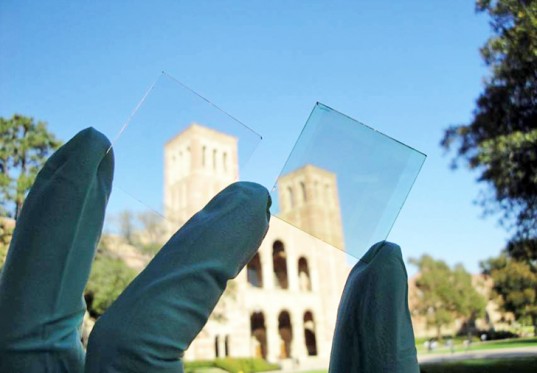
A team from UCLA has developed a new transparent solar cell that has the ability to generate electricity while still allowing people to see outside. In short, they’ve created a solar power-generating window! Described as “a new kind of polymer solar cell (PSC)” that produces energy by absorbing mainly infrared light instead of traditional visible light, the photoactive plastic cell is nearly 70% transparent to the human eye—so you can look through it like a traditional window.

“These results open the potential for visibly transparent polymer solar cells as add-on components of portable electronics, smart windows and building-integrated photovoltaics and in other applications,” said study leader Yang Yang, a UCLA professor of materials science and engineering and also director of the Nano Renewable Energy Center at California NanoSystems Institute (CNSI). “Our new PSCs are made from plastic-like materials and are lightweight and flexible. More importantly, they can be produced in high volume at low cost.”

There are also other advantages to polymer solar cells over more traditional solar cell technologies, such as building-integrated photovoltaics and integrated PV chargers for portable electronics. In the past, visibly transparent or semitransparent PSCs have suffered low visible light transparency and/or low device efficiency because suitable polymeric PV materials and efficient transparent conductors were not well deployed in device design and fabrication. However that was something the UCLA team wished to address.

By using high-performance, solution-processed, visibly transparent polymer solar cells and incorporating near-infrared light-sensitive polymer and silver nanowire composite films as the top transparent electrode, the UCLA team found that the near-infrared photoactive polymer absorbed more near-infrared light but was less sensitive to visible light. This, in essence, created a perfect balance between solar cell performance and transparency in the visible wavelength region.

UCLA Develops Electricity-Generating, Transparent Solar Cell Windows

Thanks to Jody Troupe for bringing this to the attention of the It’s Interesting community.