Mind-controlled drones promise a future of hands-free flying

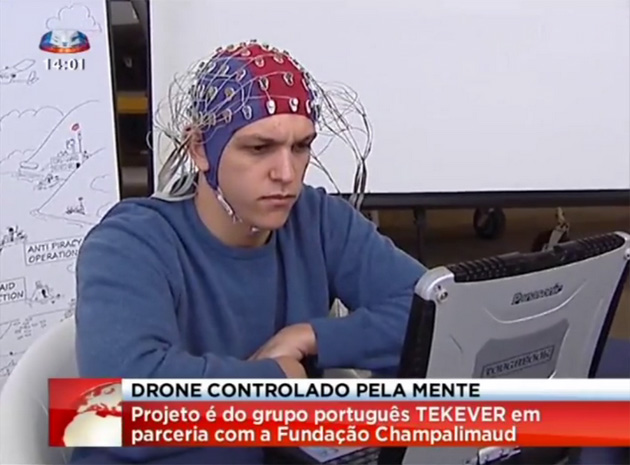
There have been tentative steps into thought-controlled drones in the past, but Tekever and a team of European researchers just kicked things up a notch. They’ve successfully tested Brainflight, a project that uses your mental activity (detected through a cap) to pilot an unmanned aircraft. You have to learn how to fly on your own, but it doesn’t take long before you’re merely thinking about where you want to go. And don’t worry about crashing because of distractions or mental trauma, like seizures — there are “algorithms” to prevent the worst from happening.

You probably won’t be using Brainflight to fly anything larger than a small drone, at least not in the near future. There’s no regulatory framework that would cover mind-controlled aircraft, after all. Tekever is hopeful that its technology will change how we approach transportation, though. It sees brain power reducing complex activities like flying or driving to something you can do instinctively, like walking — you’d have freedom to focus on higher-level tasks like navigation. The underlying technology would also let people with injuries and physical handicaps steer vehicles and their own prosthetic limbs. Don’t be surprised if you eventually need little more than some headgear to take to the skies.

http://www.engadget.com/2015/02/25/tekever-mind-controlled-drone/?ncid=rss_truncated

The eternity drive: Why DNA could be the future of data storage

By Peter Shadbolt, for CNN

How long will the data last in your hard-drive or USB stick? Five years? 10 years? Longer?

Already a storage company called Backblaze is running 25,000 hard drives simultaneously to get to the bottom of the question. As each hard drive coughs its last, the company replaces it and logs its lifespan.

While this census has only been running five years, the statistics show a 22% attrition rate over four years.

Some may last longer than a decade, the company says, others may last little more than a year; but the short answer is that storage devices don’t last forever.

Science is now looking to nature, however, to find the best way to store data in a way that will make it last for millions of years.

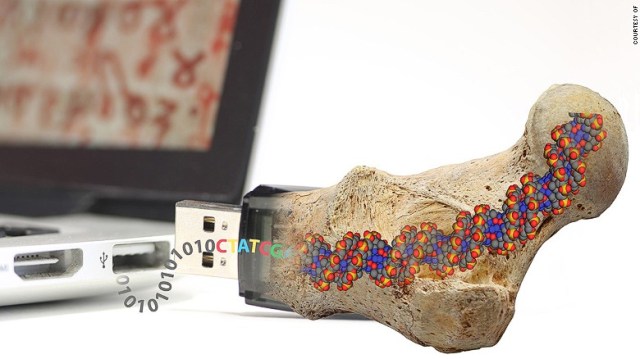
Researchers at ETH Zurich, in Switzerland, believe the answer may lie in the data storage system that exists in every living cell: DNA.

So compact and complex are its strands that just 1 gram of DNA is theoretically capable of containing all the data of internet giants such as Google and Facebook, with room to spare.

In data storage terms, that gram would be capable of holding 455 exabytes, where one exabyte is equivalent to a billion gigabytes.

Fossilization has been known to preserve DNA in strands long enough to gain an animal’s entire genome — the complete set of genes present in a cell or organism.

So far, scientists have extracted and sequenced the genome of a 110,000-year-old polar bear and more recently a 700,000-year-old horse.

Robert Grass, lecturer at the Department of Chemistry and Applied Biosciences, said the problem with DNA is that it degrades quickly. The project, he said, wanted to find ways of combining the possibility of the large storage density in DNA with the stability of the DNA found in fossils.

“We have found elegant ways of making DNA very stable,” he told CNN. “So we wanted to combine these two stories — to get the high storage density of DNA and combine it with the archaeological aspects of DNA.”

The synthetic process of preserving DNA actually mimics processes found in nature.

As with fossils, keeping the DNA cool, dry and encased — in this case, with microscopic spheres of glass – could keep the information contained in its strands intact for thousands of years.

“The time limit with DNA in fossils is about 700,000 years but people speculate about finding one-million-year storage of genomic material in fossil bones,” he said.

“We were able to show that decay of our DNA and store of information decays at the same rate as the fossil DNA so we get to similar time frames of close to a million years.”

Fresh fossil discoveries are throwing up new surprises about the preservation of DNA.

Human bones discovered in the Sima de los Huesos cave network in Spain show maternally inherited “mitochondrial” DNA that is 400,000 years old – a new record for human remains.

The fact that the DNA survived in the relatively cool climate of a cave — rather than in a frozen environment as with the DNA extracted from mammoth remains in Siberia – has added to the mystery about DNA longevity.

“A lot of it is not really known,” Grass says. “What we’re trying to understand is how DNA decays and what the mechanisms are to get more insight into that.”

What is known is that water and oxygen are the enemy of DNA survival. DNA in a test tube and exposed to air will last little more than two to three years. Encasing it in glass — an inert, neutral agent – and cooling it increases its chances of survival.

Grass says sol-gel technology, which produces solid materials from small molecules, has made it a relatively easy process to get the glass around the DNA molecules.

While the team’s work invites immediate comparison with Jurassic Park, where DNA was extracted from amber fossils, Grass says that prehistoric insects encased in amber are a poor source of prehistoric DNA.

“The best DNA comes from sources that are ceramic and dry — so teeth, bones and even eggshells,” he said.

So far the team has tested their storage method by preserving just 83 kilobytes of data.

“The first is the Swiss Federal Charter of 1291 — it’s like the Swiss Magna Carta — and the other was the Archimedes Palimpsest; a copy of an Ancient Greek mathematics treatise made by a monk in the 10th century but which had been overwritten by other monks in the 15th century.

“We wanted to preserve these documents to show not just that the method works, but that the method is important too,” he said.

He estimates that the information will be readable in 10,000 years’ time, and if frozen, as long as a million years.

The cost of encoding just 83Kb of data cost about $2,000, making it a relatively expensive process, but Grass is optimistic that price will come down over time. Advances in technology for medical analysis, he said, are likely to help with this.

“Already the prices for human genome sequences have dropped from several millions of dollars a few years ago to just hundreds of dollars now,” Grass said.

“It makes sense to integrate these advances in medical and genome analysis into the world of IT.”

http://www.cnn.com/2015/02/25/tech/make-create-innovate-fossil-dna-data-storage/index.html?utm_source=feedburner&utm_medium=feed&utm_campaign=Feed%3A+rss%2Fcnn_latest+%28RSS%3A+Most+Recent%29

World’s First Robot-Staffed Hotel to Open in Japan

by Tanya Lewis

What if you could check into a hotel, have your luggage carried to your room and order a coffee — all with help from a team of robots?

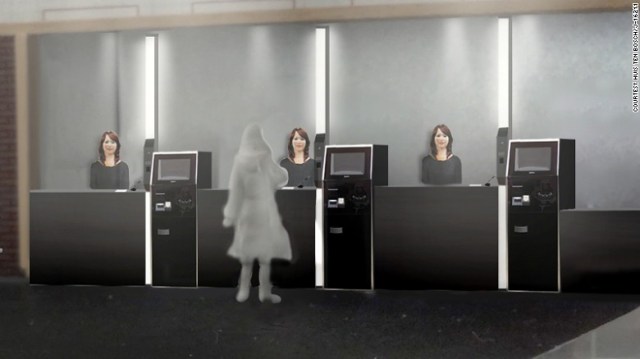
A new hotel at a theme park in Nagasaki, Japan, hopes to make that dream a reality. The Henn-na Hotel (whose name means “strange hotel”) will be partially staffed by androids that work as reception attendants, robot waiters, cleaning staff and a cloakroom attendant.

Developed by Japan’s Osaka University and manufactured by the Japanese robotics company Kokoro, many of the “Actroid” robots resemble a young Japanese woman. The bots will be able to speak Japanese, Chinese, Korean and English, make hand gestures, and pull off the somewhat creepy feat of mimicking eye movements.

The android-staffed hotel will be part of a theme park called Huis Ten Bosch, which is modeled after a typical Dutch town. Hotel guests will be able to access their rooms using facial recognition software instead of keys, if they choose.

“We’d like to draw visitors to this setting surrounded by nature by establishing a smart hotel, which could be something we could spread through Japan and the world, a spokeswoman for Huis Ten Bosch said.

If the robot hotel is a success, another one may be opened in 2016, the spokeswoman added.

Room rates at the Henn-na Hotel will start at about $60 U.S. (7,000 yen), but will likely remain well below the rates for the park’s other hotels, which start at around $170 to $255 (20,000 to 30,000 yen). The use of robots and renewable energy will help the hotel keep its operating costs down.

http://www.livescience.com/49711-japanese-robot-hotel.html

Ray Kurzweil’s Mind-Boggling Predictions for the Next 25 Years

Bill Gates calls Ray, “the best person I know at predicting the future of artificial intelligence.” Ray is also amazing at predicting a lot more beyond just AI.

This post looks at his very incredible predictions for the next 20+ years.

So who is Ray Kurzweil?

He has received 20 honorary doctorates, has been awarded honors from three U.S. presidents, and has authored 7 books (5 of which have been national bestsellers).

He is the principal inventor of many technologies ranging from the first CCD flatbed scanner to the first print-to-speech reading machine for the blind. He is also the chancellor and co-founder of Singularity University, and the guy tagged by Larry Page to direct artificial intelligence development at Google.

In short, Ray’s pretty smart… and his predictions are amazing, mind-boggling, and important reminders that we are living in the most exciting time in human history.

But, first let’s look back at some of the predictions Ray got right.

Predictions Ray has gotten right over the last 25 years

In 1990 (twenty-five years ago), he predicted…

…that a computer would defeat a world chess champion by 1998. Then in 1997, IBM’s Deep Blue defeated Garry Kasparov.

… that PCs would be capable of answering queries by accessing information wirelessly via the Internet by 2010. He was right, to say the least.

… that by the early 2000s, exoskeletal limbs would let the disabled walk. Companies like Ekso Bionics and others now have technology that does just this, and much more.

In 1999, he predicted…

… that people would be able talk to their computer to give commands by 2009. While still in the early days in 2009, natural language interfaces like Apple’s Siri and Google Now have come a long way. I rarely use my keyboard anymore; instead I dictate texts and emails.

… that computer displays would be built into eyeglasses for augmented reality by 2009. Labs and teams were building head mounted displays well before 2009, but Google started experimenting with Google Glass prototypes in 2011. Now, we are seeing an explosion of augmented and virtual reality solutions and HMDs. Microsoft just released the Hololens, and Magic Leap is working on some amazing technology, to name two.

In 2005, he predicted…

… that by the 2010s, virtual solutions would be able to do real-time language translation in which words spoken in a foreign language would be translated into text that would appear as subtitles to a user wearing the glasses. Well, Microsoft (via Skype Translate), Google (Translate), and others have done this and beyond. One app called Word Lens actually uses your camera to find and translate text imagery in real time.

Ray’s predictions for the next 25 years

The above represent only a few of the predictions Ray has made.

While he hasn’t been precisely right, to the exact year, his track record is stunningly good.

Here are some of Ray’s predictions for the next 25+ years.

By the late 2010s, glasses will beam images directly onto the retina. Ten terabytes of computing power (roughly the same as the human brain) will cost about $1,000.

By the 2020s, most diseases will go away as nanobots become smarter than current medical technology. Normal human eating can be replaced by nanosystems. The Turing test begins to be passable. Self-driving cars begin to take over the roads, and people won’t be allowed to drive on highways.

By the 2030s, virtual reality will begin to feel 100% real. We will be able to upload our mind/consciousness by the end of the decade.

By the 2040s, non-biological intelligence will be a billion times more capable than biological intelligence (a.k.a. us). Nanotech foglets will be able to make food out of thin air and create any object in physical world at a whim.

By 2045, we will multiply our intelligence a billionfold by linking wirelessly from our neocortex to a synthetic neocortex in the cloud.

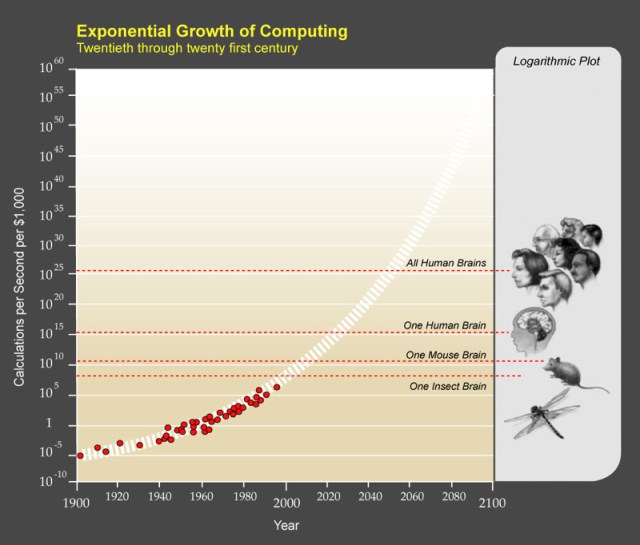
Ray’s predictions are a byproduct of his understanding of the power of Moore’s Law, more specifically Ray’s “Law of Accelerating Returns” and of exponential technologies.

These technologies follow an exponential growth curve based on the principle that the computing power that enables them doubles every two years.

Ray Kurzweil’s Mind-Boggling Predictions for the Next 25 Years

Thanks to Kebmodee for bringing this to the attention of the It’s Interesting community.

Pizza Hut’s Subconscious Menu Aims to Guess What You Want Before You Know You Do

Pizza Hut incorporating retina tracking into the ordering process, in what it is calling the first Subconscious Menu.

Powered by Tobii, a Swedish company that specializes in eye-tracking technology, Pizza Hut’s new system presents customers with images of ingredients on a screen. Based on how long a customer’s eyes remain on different items, the system generates an order meant to represent what he or she subconsciously wants.

The Subconscious Menu, which has been under development for about six months and is currently being piloted in the U.K., was selected by Pizza Hut as the method that best leverages technology to improve the experience for customers.

Thanks to Kebmodee for bringing this to the attention of the It’s Interesting community.

http://time.com/3613220/pizza-huts-subconscious-menu/#3613220/pizza-huts-subconscious-menu/

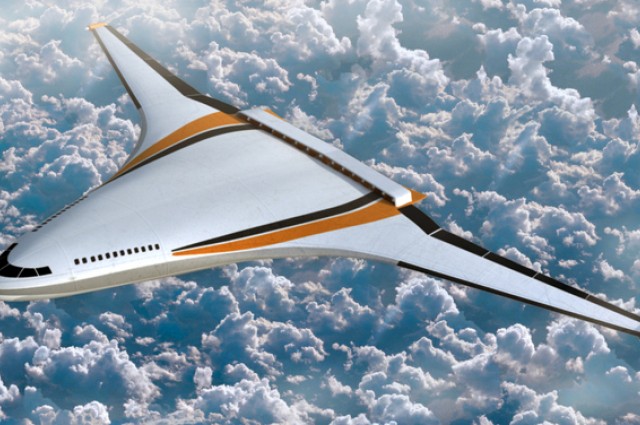
What commercial aircraft will look like in 2050

by Ashley Dove-Jay

The aircraft industry is expecting a seven-fold increase in air traffic by 2050, and a four-fold increase in greenhouse gas emissions unless fundamental changes are made. But just how “fundamental” will those changes need to be and what will be their effect on the aircraft we use?

The crucial next step towards ensuring the aircraft industry becomes greener is the full electrification of commercial aircraft. That’s zero CO2 and NOx emissions, with energy sourced from power stations that are themselves sustainably fuelled. The main technological barrier that must be overcome is the energy density of batteries, a measure of how much power can be generated from a battery of a certain weight.

Tesla CEO Elon Musk has said that once batteries are capable of producing 400 Watt-hours per kilogram, with a ratio of power cell to overall mass of between 0.7-0.8, an electrical transcontinental aircraft becomes “compelling”.

Given that practical lithium-ion batteries were capable of achieving energy-densities of 113Wh/kg in 1994, 202Wh/kg in 2004, and are now capable of approximately 300Wh/kg, it’s reasonable to assume that they will hit 400Wh/kg in the coming decade.

Another aspect is the exponential fall in the cost of solar panels, which have already become the cheapest form of power in most US states. The expected 70% reduction in cost of lithium-ion batteries by 2025, and the rapid rise seen in the cost of kerosene-based jet fuel means that there will be a large and growing disparity in the costs of running aircraft that will greatly favour electrification. As is often the case, the reasons that will slow transition are not technological, but are rooted in the economic and political inertia against overturning the status-quo.

Biofuels while we wait

Considering the average service-life of passenger and freight aircraft are around 21 and 33 years respectively, even if all new aircraft manufactured from tomorrow were fully electric, the transition away from fossil-fuelled aircraft would take two to three decades.

In the meantime, biofuel offers carbon emissions reductions of between 36-85%, with the variability depending on the type of land used to grow the fuel crops. As switching from one fuel to another is relatively straightforward, this is a low-hanging fruit worth pursuing before completely phasing out combustion engines.

Even though a biofuel-kerosene jet fuel blend was certified in 2009, the aircraft industry is in no hurry to implement change. There are minor technological hurdles and issues around scaling up biofuel production to industrial levels, but the main constraint is price – parity with fossil fuels is still ten years away.

The adoption of any new aircraft technology – from research, to design sketches, to testing and full integration – is typically a decade-long process. Given that the combustion engine will be phased out by mid-century, it would seem to make more economic and environmental sense to innovate in other areas: airframe design, materials research, electric propulsion design and air traffic control.

Bringing aircraft to life

In terms of the cost of computational power, computer technology is advancing more each hour today than it did in its entire first 90 years. With this in mind we can project that the equivalent of a US$1,000 computer today will by 2023 be more powerful than the potential brainpower of a human and, by 2045, will surpass the brainpower equivalent to all human brains combined.

The miniaturisation of digital electronics over the past half-century has followed a similar exponential trend, with the size of transistor gates reducing from approximately 1,000 nanometres in 1970 to 23 nanometres today. With the advent of transistors made of graphene showing great promise, this is expected to fall further to about 7 nanometres by 2025. By comparison, a human red blood cell is approximately 6,200-8,200 nanometres wide.

Putting together this increase in computational power and decrease in circuit size, and adding in the progress made with 3D-printing, at some point in the next decade we will be able to produce integrated computers powerful enough to control an aircraft at the equivalent of the cellular level in near real-time – wireless interlinking of nano-scale digital devices.

Using a biologically-inspired digital “nervous system” with receptors arranged over the aircraft sensing forces, temperatures, and airflow states could drastically improve the energy efficiency of aircraft, when coupled to software and hardware mechanisms to control or even change the shape of the aircraft in response.

Chopping the tail

Once electric aircraft are established, the next step will be to integrate a gimballed propulsion system, one that can provide thrust in any direction. This will remove the need for the elevators, rudders, and tailplane control surfaces that current designs require, but which add significant mass and drag.

The wings we are already designing are near their peak in terms of aerodynamic efficiency, but they still do no justice to what nature has achieved in birds. Aircraft design templates are a century old – constrained by the limitations of the day then, but technology has since moved on. We no longer need to build wings as rigid structures with discrete control surfaces, but can turn to the natural world for inspiration. As Richard Feynman said:

I think nature’s imagination is so much greater than man’s, she’s never going to let us relax.

http://www.iflscience.com/technology/what-commercial-aircraft-will-look-2050

The future of virtual-reality travel

Glynis Freeman stands on a tower balcony in nighttime London, peering down at the dizzying lights hundreds of feet below.

The distant rumble of city traffic rises up from the streets. A gust of wind brushes her hair. Freeman smiles while swiveling her head in all directions to take in the view.

“That was cool,” she said a few minutes later. “I want to go back to London.”

That’s because Freeman was never physically in London. The Marietta, Georgia, woman was 4,000 miles away in an Atlanta hotel lobby, wearing a headset and trying out a demonstration of new technology that can place people in exotic virtual settings almost anywhere on the planet.

It’s all part of a new experiment by Marriott, the global hotel chain, to let guests sample virtual destinations with the Oculus Rift, a headset whose high-definition, 3-D display immerses wearers in a lifelike interactive world.

“We really want to appeal to the next generation of travelers,” said Karen Olivares, director of global brand marketing for Marriott.

Virtual travel is in its infancy and a long way from being mainstream. But the travel industry is intrigued by its potential, which goes far beyond Google Street View or online “virtual tours” of hotels and resorts.

The idea is not that virtual travel will replace real-world travel, because nobody in the industry would go for that. Instead, the travel industry hopes that people who sample virtual snippets of alluring vacations — say, rafting the Grand Canyon or hiking the Great Wall of China — will be persuaded to splurge on the real thing.

Behind the Oculus Rift

Driving this trend are next-generation systems such as the Oculus Rift and Sony’s Project Morpheus, which promise a leap forward in virtual-reality technology.

The much-hyped Oculus Rift headset looks like something a skier or scuba diver might wear and fits snugly over the wearer’s face, paired with headphones. Its crisp 3D display immerses you in an interactive world — a medieval village or a tropical jungle — which you sometimes can navigate with the help of a game controller.

The goggles come packed with a 100-degree field of view, extending beyond viewers’ peripheral vision. They have an accelerometer, gyroscope and compass to track the position of your head and sync the visuals to the direction where you are looking — allowing Oculus to improve on the sometimes jerky visuals of other virtual-reality systems.

The Oculus Rift was designed to enhance video gaming. But Facebook paid $2 billion for its maker, Oculus VR, in March, seeing the device as a potential future communication platform.

One developer for the Oculus Rift is excited about the technology’s long-term potential to tranform travel.

“I could go for a run in the morning in some exotic beach and in the evening stroll the streets of some city … I could be a virtual storm chaser close to a tornado and even travel deep in the ocean,” the developer wrote in an online forum.

“In fact these experiences will be so real, without risk, and of course cheap that I might actually have second thoughts about traveling … Antarctica without the cold … Jungles without the heat and bugs … And people who will provide (this) content will make millions.”

Virtual journeying

Consumer versions of the Oculus Rift and Project Morpheus — which works in much the same way — aren’t expected on the market until 2015 at the earliest. But that hasn’t stopped the travel industry from tinkering with prototypes.

Thomas Cook, the international travel agency, announced a trial program in August that will allow customers at one of its stores in England to don Oculus Rifts and experience a flight on one of its airplanes or tour a Sentido resort.

And Marriott has been touring U.S. cities this fall with its “Teleporter,” a booth that invites visitors to climb inside, strap on an Oculus Rift and take a virtual tour of Wai’anapanapa Black Sand Beach in Maui and Tower 42 in London.

Viewers watch a 90-second video produced by Framestore, the British creative studio that has done visual effects for “Gravity” and other movies. To make the experiences feel more lifelike, fans in the booths blow soft breezes while misters recreate the feel of ocean spray.

Whether such virtual-reality glimpses inspire someone to take a real trip remains to be seen. But visitors to the booths on a recent weekday in Atlanta came away impressed.

“That was truly amazing. It reminded me of something from ‘Star Trek,’ ” said Lisa Lewis of Monroe, Louisiana. “London has always been a dream destination of mine. And just to get a feel for a place — it was much more than I imagined.”

http://www.cnn.com/2014/10/31/travel/virtual-reality-travel/index.html?c=&page=3

Comedy club uses facial recognition to charge by the laugh

comdey club

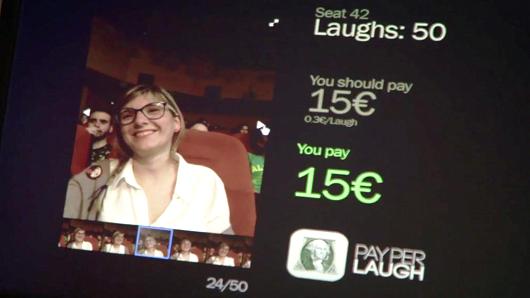
One Barcelona comedy club is experimenting with using facial recognition technology to charge patrons by the laugh.

The comedy club, Teatreneu, partnered with the advertising firm The Cyranos McCann to implement the new technology after the government hiked taxes on theater tickets, according to a BBC report. In 2012, the Spanish government raised taxes on theatrical shows from 8 to 21 percent.

Cyranos McCann installed tablets on the back of each seat that used facial recognition tech to measure how much a person enjoyed the show by tracking when each patron laughed or smiled.

Each giggle costs approximately 30 Euro cents ($0.38). However, if a patron hits the 24 Euros mark, which is about 80 laughs, the rest of their laughs are free of charge.

There’s also a social element. Get this, at the end of the show the patron can also check their laughter account and share their info on social networks. The comedy club in conjunction with their advertising partner even created a mobile app to be used as a system of payment.

While law enforcement has been developing and using facial recognition technology for quite sometime, more industries are beginning to experiment with it.

Some retailers, for example, are considering using the technology to gauge how people might feel while shopping in a certain section of a store.

The U.K. company NEC IT Solutions is even working on technology that would help retailers to identify V.I.P patrons, such as celebrities or preferred customers.

According to a recent report on EssentialRetail.com, the premium department store Harrod’s has been testing facial recognition during the last two years, albeit, the company has been primarily testing it for security reasons.

Facebook also uses facial recognition technology to suggest tags of people who are in images posted on its site.

http://www.cnbc.com/id/102078398

New research projects that climate change may increase female:male ratio

Climate change could affect the ratio of human males to human females that are born in some countries, a new study from Japan suggests. The researchers found that male fetuses may be particularly vulnerable to the effects of climate change.

Since the 1970s, temperature fluctuations from the norm have become more common in Japan, and at the same time there has been an increase in the deaths of male fetuses, relative to the number of deaths of female fetuses in that country, according to the study.

Over this period, the ratio of male to female babies born in the country has been decreasing, meaning there have been fewer and fewer male babies born relative to the number of female babies born.

http://www.livescience.com/48070-male-fetus-climate-change.html

Deep brain stimulation treatment for patients with obsessive-compulsive disorder (OCD)

It seems simple: Walk to the refrigerator and grab a drink.

But Brett Larsen, 37, opens the door gingerly — peeks in — closes it, opens it, closes it and opens it again. This goes on for several minutes.

When he finally gets out a bottle of soda, he places his thumb and index finger on the cap, just so. Twists it open. Twists it closed. Twists it open.

“Just think about any movement that you have during the course of a day — closing a door or flushing the toilet — over and over and over,” said Michele Larsen, Brett’s mother.

“I cannot tell you the number of things we’ve had to replace for being broken because they’ve been used so many times.”

At 12, Larsen was diagnosed with obsessive-compulsive disorder, or OCD. It causes anxiety, which grips him so tightly that his only relief is repetition. It manifests in the smallest of tasks: taking a shower, putting on his shoes, walking through a doorway.

There are days when Larsen cannot leave the house.

“I can only imagine how difficult that is to live with that every single living waking moment of your life,” said Dr. Gerald Maguire, Larsen’s psychiatrist.

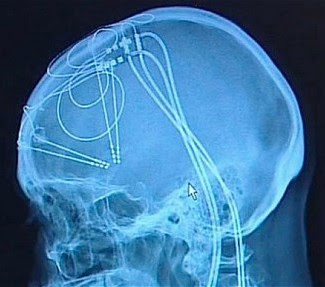
In a last-ditch effort to relieve his symptoms, Larsen decided to undergo deep brain stimulation. Electrodes were implanted in his brain, nestled near the striatum, an area thought to be responsible for deep, primitive emotions such as anxiety and fear.

Brett’s OCD trigger

Brett says his obsessions and compulsions began when he was 10, after his father died.

“I started worrying a lot about my family and loved ones dying or something bad happening to them,” he said. “I just got the thought in my head that if I switch the light off a certain amount of times, maybe I could control it somehow.

“Then I just kept doing it, and it got worse and worse.”

“Being OCD” has become a cultural catchphrase, but for people with the actual disorder, life can feel like a broken record. With OCD, the normal impulse to go back and check if you turned off the stove, or whether you left the lights on, becomes part of a crippling ritual.

The disease hijacked Larsen’s life (he cannot hold down a job and rarely sees friends); his personality (he can be stone-faced, with only glimpses of a slight smile); and his speech (a stuttering-like condition causes his speaking to be halting and labored.)

He spent the past two decades trying everything: multiple medication combinations, cognitive behavioral therapy, cross-country visits to specialists, even hospitalization.

Nothing could quell the anxiety churning inside him.

“This is not something that you consider first line for patients because this is invasive,” said Maguire, chair of psychiatry and neuroscience at the University of California Riverside medical school, and part of the team evaluating whether Larsen was a good candidate for deep brain stimulation. “It’s reserved for those patients when the standard therapies, the talk therapies, the medication therapies have failed.”

Deep brain stimulation is an experimental intervention, most commonly used among patients with nervous system disorders such as essential tremor, dystonia or Parkinson’s disease. In rare cases, it has been used for patients with intractable depression and OCD.

The electrodes alter the electrical field around regions of the brain thought to influence disease — in some cases amplifying it, in others dampening it — in hopes of relieving symptoms, said Dr. Frank Hsu, professor and chair of the department of neurosurgery at University of California, Irvine.

Hsu says stimulating the brain has worked with several OCD patients, but that the precise mechanism is not well understood.

The procedure is not innocuous: It involves a small risk of bleeding in the brain, stroke and infection. A battery pack embedded under the skin keeps the electrical current coursing to the brain, but each time the batteries run out, another surgical procedure is required.

‘I feel like laughing’

As doctors navigated Larsen’s brain tissue in the operating room — stimulating different areas to determine where to focus the electrical current — Larsen began to feel his fear fade.

At one point he began beaming, then giggling. It was an uncharacteristic light moment for someone usually gripped by anxiety.

In response to Larsen’s laughter, a staff member in the operating room asked him what he was feeling. Larsen said, “I don’t know why, but I feel happy. I feel like laughing.”

Doctors continued probing his brain for hours, figuring out what areas — and what level of stimulation — might work weeks later, when Larsen would have his device turned on for good.

In the weeks after surgery, the residual swelling in his brain kept those good feelings going. For the first time in years, Larsen and his mother had hope for normalcy.

“I know that Brett has a lot of normal in him, even though this disease eats him up at times,” said Michele Larsen. “There are moments when he’s free enough of anxiety that he can express that. But it’s only moments. It’s not days. It’s not hours. It’s not enough.”

Turning it on

In January, Larsen had his device activated. Almost immediately, he felt a swell of happiness reminiscent of what he had felt in the OR weeks earlier.

But that feeling would be fleeting — the process for getting him to an optimal level would take months. Every few weeks doctors increased the electrical current.

“Each time I go back it feels better,” Larsen said. “I’m more calm every time they turn it up.”

With time, some of his compulsive behaviors became less pronounced. In May, several weeks after his device was activated, he could put on his shoes with ease. He no longer spun them around in an incessant circle to allay his anxiety.

But other behaviors — such as turning on and shutting off the faucet — continued. Today, things are better, but not completely normal.

Normal, by society’s definition, is not the outcome Larsen should expect, experts say. Patients with an intractable disease who undergo deep brain stimulation should expect to have manageable OCD.

Lately, Larsen feels less trapped by his mind. He is able to make the once interminable trek outside his home within minutes, not hours. He has been to Disneyland with friends twice. He takes long rides along the beach to relax.

In his mind, the future looks bright.

“I feel like I’m getting better every day,” said Larsen, adding that things like going back to school or working now feel within his grasp. “I feel like I’m more able to achieve the things I want to do since I had the surgery.”

Thanks to Da Brayn for bringing this to the attention of the It’s Interesting community.

http://www.cnn.com/2014/06/24/health/brain-stimulation-ocd/?c=&page=0