Tupac Hologram Performance at Coachella


Snoop Dogg and Dr. Dre brought Tupac Shakur back from the dead for a showstopping finale to the first Coachella weekend on Sunday night.

Shakur appeared as a hologram on the festival stage after a tribute performance of his hit California Love and the late star ‘teamed up’ with Snoop on Ain’t Nothin’ Like A Gangsta Party after an eerie solo rendition of Hail Mary from beyond the grave.

The ghostly apparition drew mixed reactions from those watching the set online, with one fan calling it “wrong on so many levels” and others stunned by the Tupac trick, tweeting, “WTF!”

But most rap fans were thrilled, including the stars in attendance. Katy Perry tweeted, “I think I might have cried when I saw Tupac,” while her pal Rihanna boasted: “Tupac back unbelievable.”

It was somewhat of a who’s who of rap, with Eminem, 50 Cent, Wiz Khalifa and Kendrick Lamar joining them onstage, while Warren G teamed up with the hip-hop icons for a tribute to the late Nate Dogg and rap trio 213.


Villemard’s 1910 Artistic Predictions of the year 2000

In 1910, French artist Villemard produced a series of illustrations depicting what life might be like in the year 2000.


To see more, click here:  http://www.flickr.com/photos/amphalon/sets/72157615623434624/with/3367567475/

Project Glass


Google says, “We think technology should work for you—to be there when you need it and get out of your way when you don’t. A group of us from Google[x] started Project Glass to build this kind of technology, one that helps you explore and share your world, putting you back in the moment. We’re sharing this information now because we want to start a conversation and learn from your valuable input. So we took a few design photos to show what this technology could look like and created a video to demonstrate what it might enable you to do.”

https://plus.google.com/u/0/111626127367496192147/posts#111626127367496192147/posts


Dating Websites to Help You Find Your ‘Doomsday Partner’


Does your partner roll their eyes at your drums of water and cache of gas masks? Do you long for someone to share the last adrenaline-filled months before the apocalypse, as predicted by the ancient Mayan calendar? Look no further than Survivalist Singles, PrepperDats or Kwink, new dating sites specifically for those preparing for life after the world comes crashing down. You can look for fellow members of a post-apocalyptic tribal commune that scavenges the land in a marauding band, or that perfect partner who is savvy about water filtration, yet strong enough to protect your young from said scavenging hordes. And even if the Mayans were wrong about 2012, or your conspiracy theories don’t pan out, at least you’ll be dating someone who shares your interests. Your crazy, crazy interests.

http://now.msn.com/now/0408-dating-sites-apocalypse.aspx

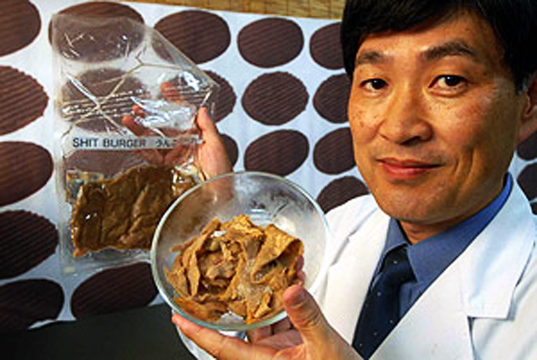
Japanese Scientist Invents Safe Edible Burger From Human Feces

Mitsuyuki Ikeda, a researcher from the Environmental Assessment Center in Okayama has developed a new artificial meat burger made of human feces.

Ikeda has gathered sewage mud (which contains human feces) and has developed the artificial meat by adding fecal extracts, soy protein and steak sauce essence. Artificial food coloring to added to it to give it the same look as red meat. It is composed of 63 percent protein, 25 percent carbohydrates, 3 percent lipids and 9 percent minerals.

Protein is extracted from the sewage mud first. After the protein is extracted, “reaction enhancer” is added to it and it is then put in a machine called the “exploder” which produces the artificial meat. During the entire process, the bacteria in the sewage mud is rendered harmless as it is killed by heating.

The scientist is hoping that the new type of meat will one day replace real meat, which is more expensive to produce. He claims that the new feces burger is actually healthier than real meat (fecal meat has less fat and hence less calories) and is more environment-friendly (cows supposedly contribute around 18 percent of our greenhouse gas emissions).

Currently, fecal meat costs 10-20 times more than normal meat because of the cost of research, but ultimately Ikeda plans to bring the price down so that people can switch to feacl meat one day.

Ikeda did not say whether his “poop meat” is as tasty as real meat and he has acknowledged that few people would be keen to eat it.

http://www.ibtimes.com/articles/164958/20110617/japanese-scientist-makes-poop-burger-mitsuyuki-ikeda.htm


Next Great Depression? MIT researchers predict ‘global economic collapse’ by 2030


A new study from researchers at Jay W. Forrester’s institute at MIT says that the world could suffer from “global economic collapse” and “precipitous population decline” if people continue to consume the world’s resources at the current pace.

Smithsonian Magazine writes that Australian physicist Graham Turner says “the world is on track for disaster” and that current evidence coincides with a famous, and in some quarters, infamous, academic report from 1972 entitled, “The Limits to Growth.

Produced for a group called The Club of Rome, the study’s researchers created a computing model to forecast different scenarios based on the current models of population growth and global resource consumption. The study also took into account different levels of agricultural productivity, birth control and environmental protection efforts. Twelve million copies of the report were produced and distributed in 37 different languages.

Most of the computer scenarios found population and economic growth continuing at a steady rate until about 2030. But without “drastic measures for environmental protection,” the scenarios predict the likelihood of a population and economic crash.

However, the study said “unlimited economic growth” is still possible if world governments enact policies and invest in green technologies that help limit the expansion of our ecological footprint.


The Smithsonian notes that several experts strongly objected to “The Limit of Growth’s” findings, including the late Yale economist Henry Wallich, who for 12 years served as a governor of the Federal Research Board and was its chief international economics expert. At the time, Wallich said attempting to regulate economic growth would be equal to “consigning billions to permanent poverty.”

Turner says that perhaps the most startling find from the study is that the results of the computer scenarios were nearly identical to those predicted in similar computer scenarios used as the basis for “The Limits to Growth.”

“There is a very clear warning bell being rung here,” Turner said. “We are not on a sustainable trajectory.”

http://news.yahoo.com/blogs/sideshow/next-great-depression-mit-researchers-predict-global-economic-190352944.html

Thanks to Ray Gaudette for bringing this to the attention of the It’s Interesting community.

U.S. Security Will Be Put at Risk With Future Water Shortages


Water shortages, polluted water and floods will increase the risk of instability in nations important to U.S. national security interests, according to a new U.S. intelligence community assessment released Thursday.

“During the next 10 years, many countries important to the United States will almost certainly experience water problems – shortages, poor water quality, or floods – that will contribute to the risk of instability and state failure and increase regional tensions,” the report from the office of the director of national intelligence states.


The assessment focused on seven key river basins located in the Middle East, Asia and Africa that are considered strategically important to the United States: the Indus, Jordan, Mekong, Nile, Tigris-Euphrates, Amu Darya and Brahmaputra basins.

The intelligence report indicates conflict between nations over water problems is unlikely in the next 10 years, but after that, water in shared basins will increasingly be used by some nations as leverage over their neighbors, the report says.

A senior U.S. intelligence official who briefed reporters on the report said, “It’s very difficult to be specific about where because it depends upon what individual states do and what actions are taken on water issues between states.”

The study also warns of the potential for water to be used as a weapon, “with more powerful upstream nations impeding or cutting off downstream flow.”

Water could also become a terrorist tool, according to the report. The U.S. official said that, “because terrorists are seeking more high visibility items to attack, in some cases we identified fragile water infrastructure that could potentially be a target for terrorism activity.” A likely target would be dams.

The official also said terrorist groups could take advantage of large movements of people displaced by water issues in vulnerable nations.

The report indicates water supplies will not keep up with the increasing demand posed by a growing world population.

Climate change will further aggravate the water problems in many areas, as will continued economic development, the report says.

“The lack of adequate water,” it says, “will be destabilizing factor in some countries because they do not have the financial resources or the technical ability to solve their internal water problems.”

Food markets are threatened by depletion of ground water in some agriculture areas of the world. Unless corrective steps are taken, food production will decline, increasing the stress on global markets, the report predicts.

The intelligence community assessed that by 2040, water shortages and pollution will harm the economic performance of important trading partners.

The study does not name specific countries, because it is based on a classified national intelligence estimate.

But the report indicates that increasing populations, industrial development and climate change in South Asia, the Middle East and North Africa will make it difficult for those regions to deal with water problems.

The report does say that improved water management and investment in water-related sectors, such as agriculture, hydroelectric power and water treatment, could compensate for increased demand over next 30 years.

Since agriculture uses nearly 70% of all ground water, the report states it has the most potential to provide relief if technological changes are implemented such as large-scale drip irrigation systems.

The intelligence study suggests developing countries are likely to turn to the United States to lead the effort to resolve water problems, because of its technological capabilities.

Secretary of State Hillary Clinton, who was concerned about how global water problems could affect U.S. security interests over the next 30 years, requested the study on global water security. The National Intelligence Council prepared the assessment with contributions from 10 intelligence organizations.  

At a World Water Day event at the State Department on Thursday,  Clinton labeled the report “sobering,” and called on everyone to read it to “see how imperative clean water and access to water is to future peace, security, and prosperity, globally.” 

The Secretary also used the occasion to announce a new effort called the U.S. Water Partnership which bring together experts in the private sector and government to find system wide solutions to water problems.

http://security.blogs.cnn.com/2012/03/22/u-s-security-at-risk-over-water/?hpt=hp_t3

Contingency Plans in Wyoming for the Complete Economic or Political Collapse of the Unites States


The Wyoming House of Representatives on Tuesday narrowly voted down legislation to launch a study into what the state should do in the event of a complete economic or political collapse in the United States.

House Bill 85 was rejected 30-27 in a final House vote, as opponents said the task force wasn’t needed and that the bill’s message had already been delivered thanks to significant national media coverage of the legislation in recent days.

The bill would have created a state-run government continuity task force, which would study and prepare Wyoming for potential catastrophes, from disruptions in food and energy supplies to a complete meltdown of the federal government.

The task force also would have looked at the feasibility of Wyoming issuing its own alternative currency, if needed. The original legislation asked for $32,000 to fund the task force; the Joint Appropriations Committee subsequently halved that.

The bill’s sponsor, state Rep. David Miller, R-Riverton, said he didn’t anticipate any major crises hitting America anytime soon. But with the national debt exceeding $15 trillion and protest movements growing around the country, Miller said Wyoming — which has a comparatively good economy and sound state finances — needs to make sure it’s protected should any unexpected emergency hit the U.S.

The bill received prominent media coverage around the state and the nation, especially after lawmakers tacked on a facetious amendment instructing the task force to examine conditions under which Wyoming would need to implement its own military draft, raise a standing army, and acquire strike aircraft and an aircraft carrier.

Many legislative supporters of HB85 said that they were caught off-guard by the amendment, and that several supporters didn’t realize what was going on until the amendment had passed. They stripped the amendment out of the bill on Monday.

Before Tuesday’s vote, Miller said he was optimistic the bill would pass the House. But after the legislation was rejected, Miller said the only things he was surprised about were that the bill made it as far as it did and the overwhelming show of support he’s seen for the proposal, both inside and outside Wyoming.

“I think the political class here in Cheyenne has a little myopic view of the world in relation of what government can do to people,” Miller said, when asked why he believed the bill failed. “I think people should wake up that there’s a lot more people out there concerned about this issue than they realize.”

State Rep. Jeb Steward, R-Encampment, said he voted against the bill Tuesday because he has an aversion to forming more government task forces — especially ones that he thinks aren’t needed.

“To me, they didn’t make a good case for the purpose or need of it,” he said. “It’s just not a priority for me at any price.”

House Speaker Ed Buchanan, R-Torrington, said he voted “no” on the final vote because he believed the proposal had achieved its goal: bringing attention to the serious issue of the mounting national debt.

“We sent the message, and it was received,” Buchanan said. “We had a little fun with it, tongue-in-cheek. But that’s what got the attention. That’s what that made sure the message was received.”

Miller said Tuesday he wasn’t yet sure whether he or another legislator would try again next session to get the task force passed.

Read more: http://trib.com/news/state-and-regional/govt-and-politics/end-time-for-wyoming-doomsday-bill/article_6c8f9ede-8c62-5025-a1c7-a9c37a8f0820.html#ixzz1nmuYUn1M

 
Thanks to Dr. Stricker for bringing this to the attention of the It’s Interesting community.

Genetically Engineered Stomach Microbe Converts Seaweed into Ethanol

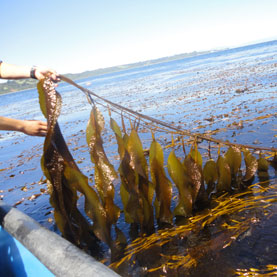
Seaweed may well be an ideal plant to turn into biofuel. It grows in much of the two thirds of the planet that is underwater, so it wouldn’t crowd out food crops the way corn for ethanol does. Because it draws its own nutrients and water from the sea, it requires no fertilizer or irrigation. Most importantly for would-be biofuel-makers, it contains no lignin—a strong strand of complex sugars that stiffens plant stalks and poses a big obstacle to turning land-based plants such as switchgrass into biofuel.

Researchers at Bio Architecture Lab, Inc., (BAL) and the University of Washington in Seattle have now taken the first step to exploit the natural advantages of seaweed. They have built a microbe capable of digesting it and converting it into ethanol or other fuels or chemicals. Synthetic biologist Yasuo Yoshikuni, a co-founder of BAL, and his colleagues took Escherichia coli, a gut bacterium most famous as a food contaminant, and made some genetic modifications that give it the ability to turn the sugars in an edible kelp called kombu into fuel. They report their findings in the January 20 issue of the journal Science.

To get his E. coli to digest kombu, Yoshikuni turned to nature—specifically, he looked into the genetics of natural microbes that can break down alginate, the predominant sugar molecule in the brown seaweed. “The form of the sugar inside the seaweed is very exotic,” Yoshikuni told Scientific American. “There is no industrial microbe to break down alginate and convert it into fuels and chemical compounds.”

Once he and his colleagues had isolated the genes that would confer the required traits, they used a fosmid—a carrier for a small chunk of genetic code—to place the DNA into the E. coli cells, where it took its place in the microbe’s own genetic instruction set. To test the new genetically engineered bacterium, the researchers ground up some kombu, mixed it with water and added the altered E. coli. Before two days had gone by the solution contained about 5 percent ethanol and water. It also did this at (relatively) low temperatures between 25 and 30 degrees Celsius, both of which mean that the engineered microbe can turn seaweed to fuel without requiring the use of additional energy for the process.

An analysis from the Pacific Northwest National Laboratory (pdf) suggests that the U.S. could supply 1 percent of its annual gasoline needs by growing such seaweed for harvest in slightly less than 1 percent of the nation’s territorial waters. Humans already grow and harvest some 15 million metric tons of kombu and other seaweeds to eat. And there’s no reason to fear the newly engineered E. coli escaping into the wild and consuming the seaweed already out there, Yoshikuni argues. “E. coli loves the human gut, it doesn’t like the ocean environment,” he says. “I can hardly imagine it would do something. It would just be dead.”

The microbe could turn out to be useful for making molecules other than ethanol, such as isobutanol or even the precursors of plastics, Yoshikuni says. “Consider the microbe as the chassis with engineered functional modules,” or pathways to produce a specific molecule, Yoshikuni says. “If we integrate other pathways instead of the ethanol pathway, this microbe can be a platform for converting sugar into a variety of molecules.”

The fact that such a one-stop industrial microbe can turn seaweed into a variety of molecules has attracted the attention of outfits such as the U.S. Department of Energy’s Advanced Research Projects Agency–Energy, or ARPA–e, which has funded BAL work with DuPont to produce other molecules from such engineered microbes. “Because seaweed grows naturally in the ocean, it uses the two thirds of the planet that we don’t use for agriculture,” ARPA–e program director Jonathan Burbaum wrote in an e-mail. “ARPA–e is directing a small portion of the remaining funding toward an aquafarm experiment to measure area productivity and harvest efficiency.”
http://www.scientificamerican.com/article.cfm?id=genetically-engineered-stomach-microbe-turns-seaweed-into-ethanol&WT.mc_id=MND_20120216