Retired Porn Star to Become First Adult Actress in Space

cocp2cocp

Coco Brown, who hasn’t made an adult film in a decade, has been training for her flight.

By Jason Koebler

Yuri Gagarin was the first man in space. Sally Ride was the first woman in space. Dennis Tito was the first tourist in space. And sometime next year, the human race will eclipse another benchmark, with Coco Brown possibly becoming the first porn star in space.

Brown made headlines earlier this year when Space Expedition Corporation, a German company, announced that the retired porn star had signed up to be on one of its first sub-orbital spaceflights in March 2014. Brown, who hasn’t starred in an adult film since 2003, says she’s quit the industry and is entirely focused on her mission.

“Performing in space isn’t something I ever thought about when I was deciding to do this. I just thought, ‘Oh my gosh, this is something really cool.’ I didn’t think ‘I’m going to try to have sex in space or perform in space,'” she says.

Brown says the opportunity arose when she was invited to a “space lunch” in Berlin, but she quickly discovered that the meeting was being held to discuss the possibility of space tourism.

“I thought they were going to be talking about the universe or something with astronomy or whatever, but then they started talking about flights to space,” she says. “I spent four months deciding whether or not I wanted to do this. The company called me a few times and finally I decided to do it.”

Brown has already completed a zero gravity flight and has begun training in Cape Canaveral. She has several more training missions coming up over the next few weeks. Since agreeing to take the trip, which costs $100,000, Brown says she may be in for more than she bargained for.

“I’m not worried about the fact of actually going to space, but when we come back, NASA wants to do a lot of observations and studies and things,” she says. “We’re some of the first people who are going to space without a specific job to do, so they were telling us all these [emergency contingency plans] and things like that, that made me wonder, ‘Why are they telling us this stuff?’ That kind of thing makes me worry.”

A spokesperson with NASA says they have not worked with Brown and have no plans to train her or conduct experiments on her when she returns.

“NASA does not fly space tourists and does not train them. Nor is NASA involved in postflight studies and observations,” the agency says.

Because she hasn’t performed in a decade, Brown says she wasn’t ready for the media blitz that has followed the announcement. Perhaps predictably, a lot of media focus has been put on whether she’ll make the world’s first porno movie filmed in space. That, she says, depends on what type of space suit she’s given. “They’re always giving us a new suit—I assume the one we use to go to space will be different. I haven’t asked about a special suit,” she says.

Despite the attention, she says she’s focused on being the best astronaut she can be.

“I haven’t done a movie since 2003, so when I decided to do this, the thought of performing in space didn’t even cross my mind. I have nothing against performing and would do it if the right offer comes along,” she says. “But now, my job is to train to be an astronaut.”

http://www.usnews.com/news/articles/2013/02/14/retired-porn-star-to-become-first-adult-actress-in-space

Thanks to Dr. Lutter for bringing this to the attention of the It’s Interesting community.

Pluto may have 10 more undiscovered moons

pluto

Pluto’s orbit may host a formation of 10 or more tiny undiscovered moons, which would each measure just 1 to 3 kilometres across, astronomers say.

This preliminary finding could make life even more difficult for the team planning NASA’s New Horizons mission, which is slated to take the first-ever up-close look at the Pluto system in July 2015.

After Pluto’s fifth known moon, a small satellite known as P5, was discovered last year, officials said they may need to redraw the spacecraft’s path to avoid such obstacles.

In the new study, astronomers led by Scott Kenyon of the Harvard-Smithsonian Center for Astrophysics used computer simulations that treat smaller particles statistically.

Once objects get above a certain size, roughly 1 km across, then the programme renders them individually – and this is when the satellites pop up.

It’s hard to say how many there are, the researchers said, as it’s difficult to simulate collisions among these tiny satellites. There could be anywhere from one to more than 10 objects lurking beyond Hydra’s orbit.

While the team can simulate these satellites, they said it’s unlikely they could be spotted, if they exist, from Earth.

The brightness of the potential objects dance with the edge of the Hubble Space Telescope’s capabilities, Kenyon said, and they are likely beyond the reach of even the most sensitive ground-based telescopes, such as the Keck Observatory in Hawaii.

New Horizons might be able to spot smaller satellites before it gets there, but Kenyon said he wasn’t sure when the objects would appear big enough for the spacecraft to detect.

The satellites would be “easily visible” during the spacecraft’s closest approach to Pluto in 2015, researchers said.

The study was submitted for publication in The Astronomical Journal.

http://www.phenomenica.com/2013/03/pluto-may-have-10-more-undiscovered-moons.html

Mars Rover Finds “All the Prerequisites For Life — a Habitable Environment”

mars

Curiosity has found discovered that Mars possesses conditions that could have supported ancient — and future — life, announced NASA scientists during a press conference today.

“A fundamental question for this mission is whether Mars could have supported a habitable environment,” said Michael Meyer, lead scientist for NASA’s Mars Exploration Program. “From what we know now, the answer is yes.”

Reportedly, the sample taken from the sedimentary rock targeted by Curiosity contains sulfur, nitrogen, hydrogen, oxygen, phosphorus, and carbon, all key ingredients for life. One NASA scientist referred to the findings as “really something special,” as well as containing up to 20% clay — which is formed by the reaction of relatively fresh water with igneous materials.

Additonally, scientists discovered a mixture of oxidized, less-oxidized, and even non-oxidized chemicals capable of supporting an energy gradient of the sort many microbes on Earth require for survival.

“The range of chemical ingredients we have identified in the sample is impressive, and it suggests pairings such as sulfates and sulfides that indicate a possible chemical energy source for micro-organisms,” said Paul Mahaffy, a NASA official.

http://www.policymic.com/mobile/articles/29536/mars-rover-finds-all-the-prerequisites-for-life-a-habitable-environment

Astrobiologists Find Ancient Fossils in Fireball Fragments

Polonnaruwa%20meteorite

On 29 December 2012, a fireball lit up the early evening skies over the Sri Lankan province of Polonnaruwa. Hot, sparkling fragments of the fireball rained down across the countryside and witnesses reported the strong odour of tar or asphalt.

Over the next few days, the local police gathered numerous examples of these stones and sent them to the Sri Lankan Medical Research Institute of the Ministry of Health in Colombo. After noticing curious features inside these stones, officials forwarded the samples to a team of astrobiologists at Cardiff University in the UK for further analysis.

The results of these tests, which the Cardiff team reveal today, are extraordinary. They say the stones contain fossilised biological structures fused into the rock matrix and that their tests clearly rule out the possibility of terrestrial contamination.

In total, Jamie Wallis at Cardiff University and a few buddies received 628 stone fragments collected from rice fields in the region. However, they were able to clearly identify only three as possible meteorites.

The general properties of these three stones immediately mark them out as unusual. One stone, for example, had a density of less than 1 gram per cubic centimetre, less than all known carbonaceous meteorites. It had a partially fused crust, good evidence of atmospheric heating, a carbon content of up to 4 per cent and contained an abundance of organic compounds with a high molecular weight, which is not unknown in meteorites. On this evidence, Wallis and co think the fireball was probably a small comet.

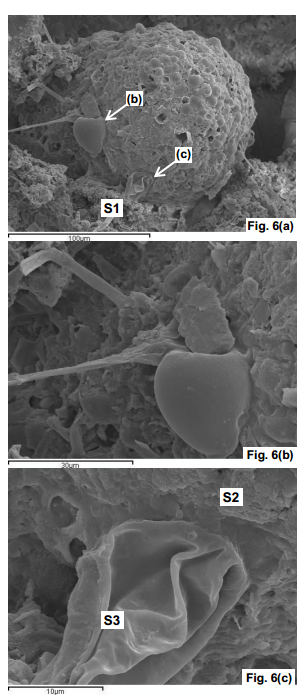
The most startling claims, however, are based on electron microscope images of structures within the stones (see above). Wallis and co say that one image shows a complex, thick-walled, carbon-rich microfossil about 100 micrometres across that bares similarities with a group of largely extinct marine dinoflagellate algae.

They say another image shows well-preserved flagella that are 2 micrometres in diameter and 100 micrometres long. By terrestrial standards, that’s extremely long and thin, which Wallis and co interpret as evidence of formation in a low-gravity, low-pressure environment.

Wallis and co also measured the abundance of various elements in the samples to determine their origin. They say that low levels of nitrogen in particular rule out the possibility of contamination by modern organisms which would have a much higher nitrogen content. The fact that these samples are also buried within the rock matrix is further evidence, they say.

Wallis and co are convinced that the lines of evidence they have gathered are powerful and persuasive. “This provides clear and convincing evidence that these obviously ancient remains of extinct marine algae found embedded in the Polonnaruwa meteorite are indigenous to the stones and not the result of post-arrival microbial contaminants,” they conclude.

There’s no question that a claim of this kind is likely to generate controversy. Critics have already pointed out that the stones could have been formed by lightning strikes on Earth although Wallis and co counter by saying there was no evidence of lightning at the time of the fireball and that in any case, the stones do not bear the usual characteristics of this kind of strike. What’s more, the temperatures generated by lightning would have destroyed any biological content.

Nevertheless, extraordinary claims require extraordinary evidence and Wallis and co will need to make their samples and evidence available to the scientific community for further study before the claims will be taken seriously.

If the paper is taken at face value, one obvious question that arises is where these samples came from. Wallis and co have their own ideas: “The presence of fossilized biological structures provides compelling evidence in support of the theory of cometary panspermia first proposed over thirty years ago,” they say.

This is an idea put forward by Fred Hoyle and Chandra Wickramasinghe, the latter being a member of the team who has carried out this analysis.

There are other explanations, of course. One is that the fireball was of terrestrial origin, a remnant of one of the many asteroid impacts in Earth’s history that that have ejected billions of tonnes of rock and water into space, presumably with biological material inside. Another is that the structures are not biological and have a different explanation.

Either way, considerably more work will have to be done before the claims from this team can be broadly accepted. Exciting times ahead!

http://www.technologyreview.com/view/512381/astrobiologists-find-ancient-fossils-in-fireball-fragments/

Thanks to Kebmodee for bringing this to the attention of the It’s Interesting community.
Supermassive black hole spins at nearly the speed of light

blackhole
This artist’s concept illustrates a supermassive black hole with millions to billions times the mass of our sun. It’s surrounded by matter flowing onto the black hole in what is termed an accretion disk. Also shown is an outflowing jet of energetic particles, believed to be powered by the black hole’s spin. High energy X-radiation lights up the disk, which reflects it, making the disk a source of X-rays. The reflected light enables astronomers to see how fast matter is swirling in the inner region of the disk, and ultimately to measure the black hole’s spin rate.

Nothing can escape a black hole, even light, because to wrench away from its titanic gravitational pull, you’d have to move faster than light is capable of traveling. And nothing can do that, as far as anyone knows. As matter falls into a black hole’s gaping maw, it superheats to millions of degrees, screaming a final cry of X-rays as it is torn apart. At a specific point called an event horizon, the matter disappears and is never heard from again.

A pair of X-ray telescopes recently watched some of these X-ray death gasps and were able to figure out how fast a black hole is spinning. This is “hugely important” for black hole science, according to researchers working with NASA’s Nuclear Spectroscopic Telescope Array, or NuSTAR space telescope. One particularly cool finding: The black hole is spinning almost as fast as Einstein’s theory of gravity says it possibly could. It’s spinning at almost the speed of light.

The galaxy in question is called NGC 1365, which is about twice the size of the Milky Way and located about 60 million light years away. The black hole is about 2 million times more massive than the sun. Scientists using NuSTAR and the European Space Agency’s XMM-Newton satellite wanted to measure how fast it is spinning. This is a key feature of black holes that is related to their size and the way they gobble up stars, gas and even other black holes.

The problem is that black holes are hard to study, because, you know, not even light can escape them. To measure them, you have to measure their effect on their surroundings–like the X-rays emitted by dying matter. This is hard to do because objects between us and them can get in the way, however, making the X-rays look distorted. There have been two competing models explaining why the X-rays look warped: Either gravitational distortion caused by black hole gravity, or distortion caused by intervening clouds of gas and dust.

In this new study, NuSTAR and XMM-Newton set out to determine which one is right. The telescopes carefully traced the X-rays emitted at the very, very edge of the black hole, right near the event horizon, or the point of no return. By combining their distinct viewing abilities, the two telescopes were able to see a wide range of X-ray energies, and figure out that the X-rays are not actually distorted by intervening gas clouds. They look distorted because the black hole is spinning, and its immense gravity warps spacetime as it swirls around. This information was used to tell just how fast the black hole is spinning: Just below the universal speed limit.

Along with new information about this particular black hole, this study suggests that black hole observations can remove a little bit of ambiguity. This will help astronomers continue to unravel the mysteries of these galactic monsters. A paper describing the findings is published last week in Nature.

http://www.popsci.com/science/article/2013-02/new-telescope-discovery-distant-gargantuan-black-hole-spins-near-light-speed

Mars One – proposed human settlement on Mars in 2023

Human Settlement on Mars in 2023
Mars One is a not-for-profit organization that will take humanity to Mars in 2023, to establish the foundation of a permanent settlement from which we will prosper, learn, and grow. Before the first crew lands, Mars One will have established a habitable, sustainable settlement designed to receive astronauts every two years. To accomplish this, Mars One has developed a precise, realistic plan based entirely upon existing technologies. It is both economically and logistically feasible, in motion through the integration of existing suppliers and experts in space exploration.
We invite you to participate in this journey, by sharing our vision with your friends, by supporting our effort and, perhaps, by becoming the next Mars astronaut yourself.

http://mars-one.com/en/

Thanks to Kebmodee for bringing this to the attention of the It’s Interesting community.
Evidence of water on the moon discovered in samples obtained from original Apollo missions

130218132355-large
Called the “Genesis Rock,” this lunar sample of unbrecciated anorthosite collected during the Apollo 15 mission was thought to be a piece of the moon’s primordial crust. In a paper published online Feb. 17 in Nature Geoscience, a University of Michigan researcher and his colleagues report that traces of water were found in the rock. (Credit: Photo courtesy of NASA/Johnson Space Center)

Traces of water have been detected within the crystalline structure of mineral samples from the lunar highland upper crust obtained during the Apollo missions, according to a University of Michigan researcher and his colleagues.

The lunar highlands are thought to represent the original crust, crystallized from a magma ocean on a mostly molten early moon. The new findings indicate that the early moon was wet and that water there was not substantially lost during the moon’s formation.

The results seem to contradict the predominant lunar formation theory — that the moon was formed from debris generated during a giant impact between Earth and another planetary body, approximately the size of Mars, according to U-M’s Youxue Zhang and his colleagues.

“Because these are some of the oldest rocks from the moon, the water is inferred to have been in the moon when it formed,” Zhang said. “That is somewhat difficult to explain with the current popular moon-formation model, in which the moon formed by collecting the hot ejecta as the result of a super-giant impact of a martian-size body with the proto-Earth.

“Under that model, the hot ejecta should have been degassed almost completely, eliminating all water.”

A paper titled “Water in lunar anorthosites and evidence for a wet early moon” was published online Feb. 17 in the journal Nature Geoscience. The first author is Hejiu Hui, postdoctoral research associate of civil and environmental engineering and earth sciences at the University of Notre Dame. Hui received a doctorate at U-M under Zhang, a professor in the Department of Earth and Environmental Sciences and one of three co-authors of the Nature Geoscience paper.

Over the last five years, spacecraft observations and new lab measurements of Apollo lunar samples have overturned the long-held belief that the moon is bone-dry.

In 2008, laboratory measurement of Apollo lunar samples by ion microprobe detected indigenous hydrogen, inferred to be the water-related chemical species hydroxyl, in lunar volcanic glasses. In 2009, NASA’s Lunar Crater Observation and Sensing satellite, known as LCROSS, slammed into a permanently shadowed lunar crater and ejected a plume of material that was surprisingly rich in water ice.

Hydroxyls have also been detected in other volcanic rocks and in the lunar regolith, the layer of fine powder and rock fragments that coats the lunar surface. Hydroxyls, which consist of one atom of hydrogen and one of oxygen, were also detected in the lunar anorthosite study reported in Nature Geoscience.

In the latest work, Fourier-transform infrared spectroscopy was used to analyze the water content in grains of plagioclase feldspar from lunar anorthosites, highland rocks composed of more than 90 percent plagioclase. The bright-colored highlands rocks are thought to have formed early in the moon’s history when plagioclase crystallized from a magma ocean and floated to the surface.

The infrared spectroscopy work, which was conducted at Zhang’s U-M lab and co-author Anne Peslier’s lab, detected about 6 parts per million of water in the lunar anorthosites.

“The surprise discovery of this work is that in lunar rocks, even in nominally water-free minerals such as plagioclase feldspar, the water content can be detected,” said Zhang, the James R. O’Neil Collegiate Professor of Geological Sciences.

“It’s not ‘liquid’ water that was measured during these studies but hydroxyl groups distributed within the mineral grain,” said Notre Dame’s Hui. “We are able to detect those hydroxyl groups in the crystalline structure of the Apollo samples.”

The hydroxyl groups the team detected are evidence that the lunar interior contained significant water during the moon’s early molten state, before the crust solidified, and may have played a key role in the development of lunar basalts.

“The presence of water,” said Hui, “could imply a more prolonged solidification of the lunar magma ocean than the once-popular anhydrous moon scenario suggests.”

The researchers analyzed grains from ferroan anorthosites 15415 and 60015, as well as troctolite 76535. Ferroan anorthosite 15415 is one the best known rocks of the Apollo collection and is popularly called the Genesis Rock because the astronauts thought they had a piece of the moon’s primordial crust. It was collected on the rim of Apur Crater during the Apollo 15 mission.

Rock 60015 is highly shocked ferroan anorthosite collected near the lunar module during the Apollo 16 mission. Troctolite 76535 is a coarse-grained plutonic rock collected during the Apollo 17 mission.

Co-author Peslier is at Jacobs Technology and NASA’s Johnson Space Center. The fourth author of the Nature Geoscience paper, Clive Neal, is a professor of civil and environmental engineering and earth sciences at the University of Notre Dame. The work was supported by NASA.

http://www.sciencedaily.com/releases/2013/02/130218132355.htm

Meteorite crashes in Russia today

The Ural Mountains were shaken by some pretty dramatic explosions on Friday, as a meteorite burst in midair and showered Russia with the remnants.

The Chelyabinsk region of Russia, in the Ural Mountains about 930 miles east of Moscow, was pelted by at least one meteorite on Friday, freaking out residents with bright streaks across the sky and loud, window-shaking explosions. No serious injuries have been reported from the blasts, and Russian authorities are providing slightly different explanations for what happened. The growing consensus is that a meteorite exploded about 32,000 feet in the air, scattering smaller chunks around the region. “Verified information indicates that this was one meteorite which burned up as it approached Earth and disintegrated into smaller pieces,” Russian Emergency Ministries official Elena Smirnykh tells Russia’s RIA Novosti.

Mind-meld brain power is best for steering spaceships

piggy

Two people have successfully steered a virtual spacecraft by combining the power of their thoughts – and their efforts were far more accurate than one person acting alone. One day groups of people hooked up to brain-computer interfaces (BCIs) might work together to control complex robotic and telepresence systems, maybe even in space.

A BCI system records the brain’s electrical activity using EEG signals, which are detected with electrodes attached to the scalp. Machine-learning software learns to recognise the patterns generated by each user as they think of a certain concept, such as “left” or “right”. BCIs have helped people with disabilities to steer a wheelchair, for example.

Researchers are discovering, however, that they get better results in some tasks by combining the signals from multiple BCI users. Until now, this “collaborative BCI” technique has been used in simple pattern-recognition tasks, but a team at the University of Essex in the UK wanted to test it more rigorously.

So they developed a simulator in which pairs of BCI users had to steer a craft towards the dead centre of a planet by thinking about one of eight directions that they could fly in, like using compass points. Brain signals representing the users’ chosen direction, as interpreted by the machine-learning system, were merged in real time and the spacecraft followed that path.

The results, to be presented at an Intelligent User Interfaces conference in California in March, strongly favoured two-brain navigation. Simulation flights were 67 per cent accurate for a single user, but 90 per cent on target for two users. And when coping with sudden changes in the simulated planet’s position, reaction times were halved, too. Combining signals eradicates the random noise that dogs EEG signals. “When you average signals from two people’s brains, the noise cancels out a bit,” says team member Riccardo Poli.

The technique can also compensate for a lapse in attention. “It is difficult to stay focused on the task at all times. So when a single user has momentary attention lapses, it matters. But when there are two users, a lapse by one will not have much effect, so you stay on target,” Poli says.

NASA’s Jet Propulsion Lab in Pasadena, California, has been observing the work while itself investigating BCI’s potential for controlling planetary rovers, for example. But don’t hold your breath, says JPL senior research scientist Adrian Stoica. “While potential uses for space applications exist, in terms of uses for planetary rover remote control, this is still a speculative idea,” he says.

http://www.newscientist.com/article/mg21729025.600-mindmeld-brain-power-is-best-for-steering-spaceships.html

First Evidence of Life in Antarctic Subglacial Lake

subglacial lake 4
subglacial lake 3
subglacial lake 2
subglacial lake 1

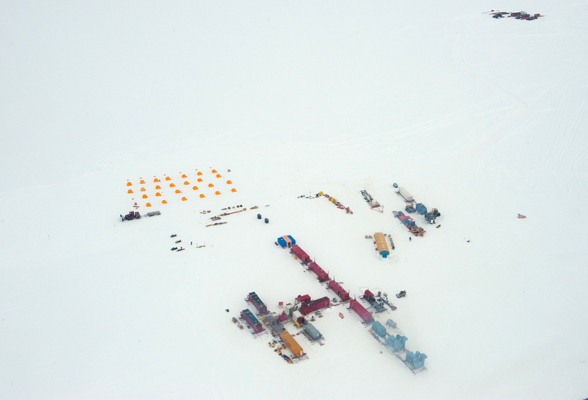
The search continues for life in subglacial Lake Whillans, 2,600 feet below the surface of the West Antarctic Ice Sheet—but a thrilling preliminary result has detected signs of life.

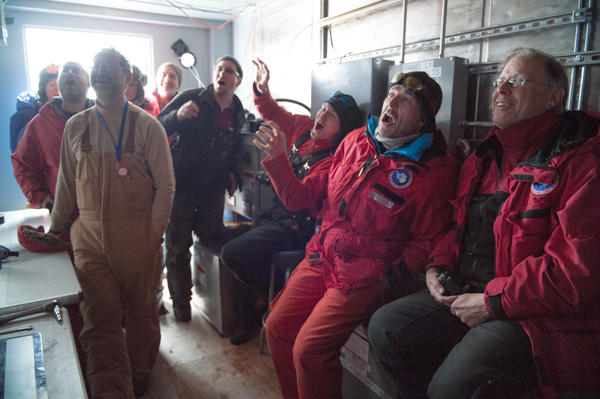
At 6:20am on January 28, four people in sterile white Tyvek suits tended to a wench winding cable onto the drill platform. One person knocked frost off the cable as it emerged from the ice borehole a few feet below. The object of their attention finally rose into sight: a gray plastic vessel, as long as a baseball bat, filled with water from Lake Whillans, half a mile below.

The bottle was hurried into a 40-foot cargo container outfitted as a laboratory on skis. Some of the lake water was squirted into bottles of media in order to grow whatever microbes might inhabit the lake. Those cultures could require weeks to produce results. But one test has already produced an interesting preliminary finding. When lake water was viewed under a microscope, cells were seen: their tiny bodies glowed green in response to DNA-sensitive dye. It was the first evidence of life in an Antarctic subglacial lake.

(A Russian team has reported that two types of bacteria were found in water from subglacial Lake Vostok, but DNA sequences matched those of bacteria that are known to live inside kerosene—causing the scientists to conclude that those bacteria came from kerosene drilling fluid used to bore the hole, and not from Lake Vostok itself.)

In order to conclusively demonstrate that Lake Whillans harbors life, the researchers will need to complete more time-consuming experiments showing that the cells actually grow—since dead cells can sometimes show up under a microscope with DNA-sensitive staining. And weeks or months will pass before it is known whether these cells represent known types of microbes, or something never seen before. But a couple of things seem likely. Most of those microbes probably subsist by chewing on rocks. And despite being sealed beneath 2,600 feet of ice, they probably have a steady supply of oxygen.

The oxygen comes from water melting off the base of the ice sheet—maybe a few penny thicknesses of ice per year. “When you melt ice, you’re liberating the air bubbles [trapped in that ice],” says Mark Skidmore, a geomicrobiologist at Montana State University who is part of the Whillans drilling, or WISSARD, project. “That’s 20 percent oxygen,” he says. “It’s being supplied to the bed of the glacier.”

In one possible scenario, lake bacteria could live on commonly occurring pyrite minerals that contain iron and sulfur. The bacteria would obtain energy by using oxygen to essentially “burn” that iron and sulfur (analogous to the way that animals use oxygen to slowly burn sugars and fats). Small amounts of sulfuric acid would seep out as a byproduct; that acid would attack other minerals in the sands and sediments of the lake—leaching out sodium, potassium, calcium, and other materials that would accumulate in the water.

This process, called weathering, breaks down billions of tons of minerals across the Earth’s surface each year. Researchers working on the National Science Foundation-funded WISSARD project hope to learn whether something like this also happens under the massive ice sheets covering Antarctica and Greenland. They’ve already seen one tantalizing sign.

The half mile of glacial ice sitting atop Lake Whillans is quite pure—derived from snow that fell onto Antarctica thousands of years ago. It contains only one-hundredth the level of dissolved minerals that are seen in a clear mountain creek, or in tap water from a typical city. But a sensor lowered down the borehole this week showed that dissolved minerals were far more abundant in the lake itself. “The fact that we see high concentrations is suggestive that there’s some interesting water-rock-microbe interaction that’s going on,” says Andrew Mitchell, a microbial geochemist from Aberystwyth University in the UK who is working this month at Lake Whillans.

Microbes, in other words, might well be munching on minerals under the ice sheet. The Whillans team will take months or years to unravel this picture. They will perform experiments to see whether microbes taken from the lake metabolize iron, sulfur, or other components of minerals. And they will analyze the DNA of those microbes to see whether they’re related to rock-chewing bacteria that are already known to science.

Antarctica isn’t the only place in the solar system where water sits concealed in the dark beneath thick ice. Europa and Enceladus (moons of Jupiter and Saturn, respectively) are also thought to harbor oceans of liquid water. What is learned at Lake Whillans could shed light on how best to look for life in these other places.

http://blogs.discovermagazine.com/crux/2013/01/29/first-evidence-of-life-in-antarctic-subglacial-lake/

Thanks to Kebmodee for bringing this to the attention of the It’s Interesting community.